Written by 
NUSRAT AZEEMA 
MCMS - 3 
VIRTUAL REALITY (VR) 
 What is Virtual Reality? 
Virtual Reality refers to a high-end user interface that involves real-time simulation and 
interactions through multiple sensorial channels. Virtual Reality is often used to describe a wide 
variety of applications, commonly associated with its immersive, highly visual, 3D 
environments. The development of CAD software, graphics hardware acceleration, head 
mounted displays; database gloves and miniaturization have helped popularize the concept. In 
1988, commercial development of VR began. In 1991, first commercial entertainment VR 
system "Virtuality" was released. In 1992 a method of the showing and testing of scientific 
visualizations called the CAVE was created.
 Applications 
Movies - Virtual reality is applied in 3-D movies to try and immerse the viewer into the 
movie and/or virtual setting and environments. 
Video Games - Virtual reality is evident in video games. Now you can physically interact 
with a game by using your body and motions to control characters and other elements of 
the game that years ago people would only imagine. 
 Types of VR Technology's 
1-Project Natal 
It’s a new piece of technology that is undergoing development now for the Xbox 
360. Project Natal proposes a new way of interacting with games, and indeed with 
computer systems in general. They propose that there system will not require any 
keyboards or controller. It will function by the use of the user's voice and motions as the 
method for interacting with the system.
2-Cave Automatic Virtual Environment 
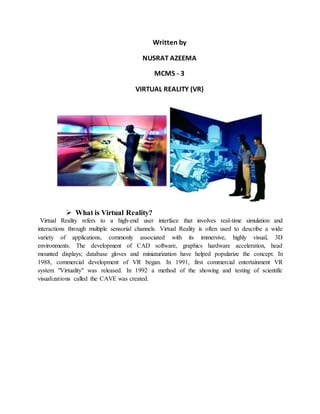
 The term “CAVE" refers to any virtual reality system that uses multiple walls with 
multiple projectors to immerse users in a virtual world. The CAVE is used for visualizing 
data, demonstrating 3D environments, and virtually testing component parts of newly 
developed engineering projects. 
3-The Nintendo Wii 
 The controller is basically a simplified version of the "virtual reality glove." Both the 
Wiimote and the Wii Fit offer users another way of interacting with their virtual 
environment without having to wear any bulky equipment. 
 Future of Virtual Reality Conclusion 
The future of virtual reality is hard to predict but one thing’s for sure the world of entertainment 
is going to see a lot more of it. Virtual reality is starting to evolve into video games and movies. 
The Nintendo Wii and Project Natal are great examples because the user is performing physical
movements to interact with the game. Also many more 3-D movies are being made and maybe in 
the near future they will all become more immersive than the “Experience in Rome” movie 
ADVANTAGES OF VIRTUAL REALITY 
1- User line 
2- User can see and even feel the shaped surface under his/her fingertips. 
3- Flight simulators and games. 
4- Biomedical Engineering the projects mentioned are use of virtual reality for viewing of 
X-RAY's and MRI‘s. 
5- Representation and 3-D lighting, modeling for resource management. 
 DISADVANTAGES OF VIRTUAL REALITY 
1- VR in medical treatment is going through some growing pains. 
2- There are limitations with VR devices as well in regards to usability. 
3- Lack of standardization of hardware and protocols. 
4- Most troublesome are the side effects it can induce, like confusion, faintness 
and nausea.

N

  • 1.
    Written by NUSRATAZEEMA MCMS - 3 VIRTUAL REALITY (VR)  What is Virtual Reality? Virtual Reality refers to a high-end user interface that involves real-time simulation and interactions through multiple sensorial channels. Virtual Reality is often used to describe a wide variety of applications, commonly associated with its immersive, highly visual, 3D environments. The development of CAD software, graphics hardware acceleration, head mounted displays; database gloves and miniaturization have helped popularize the concept. In 1988, commercial development of VR began. In 1991, first commercial entertainment VR system "Virtuality" was released. In 1992 a method of the showing and testing of scientific visualizations called the CAVE was created.
  • 2.
     Applications Movies- Virtual reality is applied in 3-D movies to try and immerse the viewer into the movie and/or virtual setting and environments. Video Games - Virtual reality is evident in video games. Now you can physically interact with a game by using your body and motions to control characters and other elements of the game that years ago people would only imagine.  Types of VR Technology's 1-Project Natal It’s a new piece of technology that is undergoing development now for the Xbox 360. Project Natal proposes a new way of interacting with games, and indeed with computer systems in general. They propose that there system will not require any keyboards or controller. It will function by the use of the user's voice and motions as the method for interacting with the system.
  • 3.
    2-Cave Automatic VirtualEnvironment  The term “CAVE" refers to any virtual reality system that uses multiple walls with multiple projectors to immerse users in a virtual world. The CAVE is used for visualizing data, demonstrating 3D environments, and virtually testing component parts of newly developed engineering projects. 3-The Nintendo Wii  The controller is basically a simplified version of the "virtual reality glove." Both the Wiimote and the Wii Fit offer users another way of interacting with their virtual environment without having to wear any bulky equipment.  Future of Virtual Reality Conclusion The future of virtual reality is hard to predict but one thing’s for sure the world of entertainment is going to see a lot more of it. Virtual reality is starting to evolve into video games and movies. The Nintendo Wii and Project Natal are great examples because the user is performing physical
  • 4.
    movements to interactwith the game. Also many more 3-D movies are being made and maybe in the near future they will all become more immersive than the “Experience in Rome” movie ADVANTAGES OF VIRTUAL REALITY 1- User line 2- User can see and even feel the shaped surface under his/her fingertips. 3- Flight simulators and games. 4- Biomedical Engineering the projects mentioned are use of virtual reality for viewing of X-RAY's and MRI‘s. 5- Representation and 3-D lighting, modeling for resource management.  DISADVANTAGES OF VIRTUAL REALITY 1- VR in medical treatment is going through some growing pains. 2- There are limitations with VR devices as well in regards to usability. 3- Lack of standardization of hardware and protocols. 4- Most troublesome are the side effects it can induce, like confusion, faintness and nausea.