4    ‡ÊÊœ, ‚◊ˡÊÊ •ÊÒ⁄U ◊ÍÀÿÊ¢∑§Ÿ (•ãÃ⁄U⁄UÊCÔ˛UËÿ ‡ÊÊœ ¬ÁòÊ∑§Ê)—ISSN-0974-2832,Vol. II, Issue-11-12 (Dec.2009—Jan.2010)


VIRTUAL REALITY SYSTEM


Research Paper—Information Technology                                                              *Anusha. G

1. WHAT DOES VIRTUAL REALITY MEAN?                          commercial system for controlling computer simulations
     Virtual reality (VR) is an artificial environment      through a dataglove and a stereoscopic Head-mounted
created with computer hardware and software and             Display (HMD). An artist himself, Lanier introduced
presented to the user in such a way that it appears like    Virtual Reality as a medium for shared self-expression.
a real environment. It is a synthetic technology            Over the past decades, two major streams of VR
combining three-dimensional video, audio, and other         emerged: the one stream based on the HMD and the
sensory components to achieve a sense of immersion          other stream based on the room-size projection of
in an interactive, computer-generated environment. To       graphics for unencumbered interaction.
enter a virtual reality, a user dons special gloves,             The helmet-based stream of VR emerged from
earphones, and goggles, all of which receive their input    military flight simulators. Frederick P. Brooks founded
from the computer system,and in this way, at least three    the virtual worlds laboratory at the University of North
of the five senses are controlled by the computer.          Carolina. Brooks began designing virtual worlds for
2. VIRTUAL REALITY HISTORY                                  solving problems in medicine, physics, and
     The term virtual reality first appeared in the late    engineering. The other stream of Virtual Reality (VR)
1980s in Jaron Lanier’s Virtual Programming Languages       development came from the art world. Another
Incorporated (VPL), which introduced the first              environment, Psychic Space, allows participants to


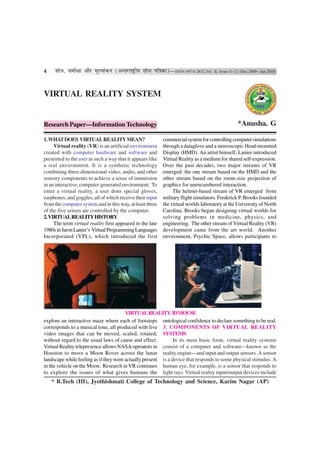
                                        VIRTUAL REALITY 3D MOUSE
explore an interactive maze where each of footsteps ontological confidence to declare something to be real.
corresponds to a musical tone, all produced with live 3. COMPONENTS OF VIRTUAL REALITY
video images that can be moved, scaled, rotated, SYSTEMS
without regard to the usual laws of cause and effect.          In its most basic form, virtual reality systems
Virtual Reality telepresence allows NASA operators in consist of a computer and software—known as the
Houston to move a Moon Rover across the lunar reality engine—and input and output sensors. A sensor
landscape while feeling as if they were actually present is a device that responds to some physical stimulus. A
in the vehicle on the Moon. Research in VR continues human eye, for example, is a sensor that responds to
to explore the issues of what gives humans the light rays. Virtual reality input/output devices include
    * B.Tech (III), Jyothishmati College of Technology and Science, Karim Nagar (AP)
Shodh, Samiksha aur Mulyankan (International Research Journal)—ISSN-0974-2832,Vol. II, Issue-11-12 (Dec.2009—Jan.2010)       5


head- and ear mounted equipment for hearing and                         AUDIO UNITS: The audio portion of virtual reality
seeing and gloves for controlling the virtual world.              is transmitted through small speakers placed over each
The fourth component is the user, who directs the                 ear. Audio cues may include voices, singing, thud like
chosen environment and reacts to it.                              noises of colliding objects—in short, any sound that
     REALITY ENGINE : Reality engines are based                   can be recorded. Sounds that seem to come from
largely on the same components that make up a                     above, below, or either side provide audio cues that
                         personal computer (PC),                  mimic how sounds are heard in the real world. Three-
                         although        much       more          dimensional (or omnidirectional) sound further
                         computing power is required              enhances the virtual reality experience.
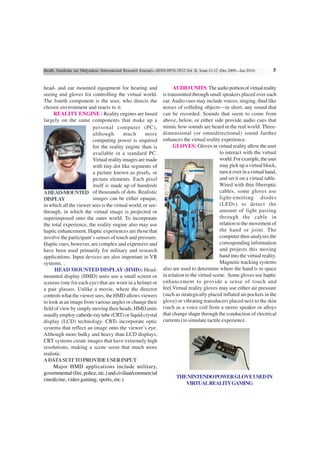
                         for the reality engine than is                 GLOVES: Gloves in virtual reality allow the user
                         available in a standard PC.                                            to interact with the virtual
                         Virtual reality images are made                                        world. For example, the user
                         with tiny dot like segments of                                         may pick up a virtual block,
                         a picture known as pixels, or                                          turn it over in a virtual hand,
                         picture elements. Each pixel                                           and set it on a virtual table.
                         itself is made up of hundreds                                          Wired with thin fiberoptic
A HEAD-MOUNTED of thousands of dots. Realistic                                                  cables, some gloves use
DISPLAY                  images can be either opaque,                                           light-emitting diodes
in which all the viewer sees is the virtual world, or see-                                      (LEDs) to detect the
through, in which the virtual image is projected or                                             amount of light passing
superimposed onto the outer world. To incorporate                                               through the cable in
the total experience, the reality engine also may use                                           relation to the movement of
haptic enhancement. Haptic experiences are those that                                           the hand or joint. The
involve the participant’s senses of touch and pressure.                                         computer then analyzes the
Haptic cues, however, are complex and expensive and                                             corresponding information
have been used primarily for military and research                                              and projects this moving
applications. Input devices are also important in VR                                            hand into the virtual reality.
systems. .                                                                                      Magnetic tracking systems
      HEAD MOUNTED DISPLAY (HMD): Head-                           also are used to determine where the hand is in space
mounted display (HMD) units use a small screen or                 in relation to the virtual scene. Some gloves use haptic
screens (one for each eye) that are worn in a helmet or           enhancement to provide a sense of touch and
a pair glasses. Unlike a movie, where the director                feel.Virtual reality gloves may use either air pressure
controls what the viewer sees, the HMD allows viewers             (such as strategically placed inflated air pockets in the
to look at an image from various angles or change their           glove) or vibrating transducers placed next to the skin
field of view by simply moving their heads. HMD units             (such as a voice coil from a stereo speaker or alloys
usually employ cathode-ray tube (CRT) or liquid crystal           that change shape through the conduction of electrical
display (LCD) technology. CRTs incorporate optic                  currents) to simulate tactile experience.
systems that reflect an image onto the viewer’s eye.
Although more bulky and heavy than LCD displays,
CRT systems create images that have extremely high
resolutions, making a scene seem that much more
realistic.
A DATA SUIT TO PROVIDE USER INPUT
     Major HMD applications include military,
governmental (fire, police, etc.) and civilian/commercial
                                                                          THE NINTENDO POWER GLOVE USED IN
(medicine, video gaming, sports, etc.).
                                                                             VIRTUAL REALITY GAMING
6      ‡ÊÊœ, ‚◊ˡÊÊ •ÊÒ⁄U ◊ÍÀÿÊ¢∑§Ÿ (•ãÃ⁄U⁄UÊCÔ˛UËÿ ‡ÊÊœ ¬ÁòÊ∑§Ê)—ISSN-0974-2832,Vol. II, Issue-11-12 (Dec.2009—Jan.2010)

4. TYPES OF VIRTUAL REALITY SYSTEMS                                Fully Immersive Head-Mounted Display Systems:
     Although it is difficult to categorise all VR systems,   All fully immersive systems will give a sense of
most configurations fall into three main categories and       presence that cannot be equaled by the other
each category can be ranked by the sense of immersion,        approaches discussed earlier, but the sense of
or degree of presence it provides.                            immersion depends on several parameters including
      Non-Immersive (Desktop) Systems: Non-                   the field of view of the HMD, the resolution, the update
immersive systems, as the name suggests, are the least        rate, and contrast and illumination of the display.
immersive implementation of VR techniques. Using the          5. VIRTUAL REALITY IMMERSION
desktop system, the virtual environment(VE) is viewed              Immersion is the state of consciousness where
through a portal or window by utilising a standard            an immersant’s awareness of physical self is diminished
high resolution monitor.                                      or lost by being surrounded in an engrossing total
     Semi-Immersive Projection Systems: Semi-                 environment; often artificial. The term is also cited as a
immersive systems are a relatively new implementation         frequently-used buzzword, in which case its meaning
of VR technology and borrow considerably from                 is intentionally vague, but carries the connotation of
technologies developed in the flight simulation field.        being particularly engrossing.
A semi-immersive system will comprise a relatively high
performance graphics computing system which can
be coupled with either a large screen projector system
, multiple television projection systems .


                .


                                                                      CLASSIC VIRTUAL REALITY HMD
    A SEMI-IMMERSIVE WIDE-SCREEN                                   According to Ernest Adams, immersion can be
PROJECTION SYSTEM IN USE WITH SHUTTER                         separated into three main categories:
              GLASSES                                              Tactical immersion: Tactical immersion is
                                                              experienced when performing tactile operations that
                                                              involve skill. Players feel “in the zone” while perfecting
                                                              actions that result in success.
                                                                   Strategic immersion: Strategic immersion is more
                                                              cerebral, and is associated with mental challenge.
                                                              Chess players experience strategic immersion when
                                                              choosing a correct solution among a broad array of
                                                              possibilities.
                                                                   Narrative immersion: Narrative immersion occurs
                                                              when players become invested in a story, and is similar
           The major components of an HMD. This               to what is experienced while reading a book or watching
      illustration shows the two screens capable of           a movie. Staffan Björk and Jussi Holopainen, in
    producing stereo images and speakers located to           Patterns In Game Design, divide immersion into similar
                   provide stereo sound.                      categories.They call them sensory-motoric immersion,
Shodh, Samiksha aur Mulyankan (International Research Journal)—ISSN-0974-2832,Vol. II, Issue-11-12 (Dec.2009—Jan.2010)    7


cognitive immersion and emotional immersion,                      6. ADV ANTAGES OF VIRTUAL REALITY SYSTEMS
respectively. In addition to these, they add three new                 Virtual reality has also been used extensively to
categories:                                                       treat phobias (such as a fear of heights, flying and
    Spatial immersion : Spatial immersion occurs                  spiders) and post-traumatic stress disorder. This type
when a player feels the simulated world is perceptually           of therapy has been shown to be effective in the
convincing. The player feels that he or she is really             academic setting, and several commercial entities now
“there” and that a simulated world looks and feels                offer it to patients.
“real”. Psychological immersion : Psychological                   7. DISADVANTAGES OF VIRTUAL REALITY
immersion occurs when a player confuses the game                  SYSTEMS
with real life.                                                        For use of digital and computer visualization
    Sensory immersion : The player experiences a                  techniques: Do not convey the true three-dimensional
unity of time and space as the player fuses with the              nature of objects; do not convey the non-visual and
image medium, which affects impression and                        aural feelings of touch, smell, etc.; less beneficial than
awareness.                                                        really being in the field; lack the serendipitous nature
                                                                  of discovery.
                                                                       Multiple styles of access e.g. CDROM and
                                                                  websites: CD-ROMs can only provide a finite limited
                                                                  amount of information; visiting a website can be
                                                                  difficult and depends on many factors, such as
                                                                  availability of computers, load on the network, number
                                                                  of connections, reliability of service provision, etc.
                                                                       For Designed to be interactive like computer
                                                                  games: It is easy for students to wallow, or obsess
                                                                  over particular sites, which raises the problem of time
                                                                  management.
                                                                  8. CONCLUSION
                       THECA   VE                                      Finally, it can be concluded that the Virtual Reality
     New technologies are currently under                         System makes man get immersed in a world of entities
development which claim to bring realistic                        that gives the feeling of reality when in fact they are
environmental effects to the players’ environment -               not actually present. Virtual Reality is often used to
effects like wind, seat vibration and ambient                     describe a wide variety of applications, commonly
lighting.Examples: There is a motion simulators of the            associated with its immersive, highly visual, 3D
Virunga Mountains in Rwanda to meet a tribe of                    environments. The development of CAD software,
Mountain Gorillas or a ride that takes a journey through          graphics hardware acceleration, head mounted
the arteries and heart to witness the build up of plaque          displays; database gloves and miniaturization have
and thus learn about cholesterol and health.                      helped popularize the notion.


R E F E R E N C E

   * www.webopedia.com/TERM/V/virtual_reality.html * www.webopedia.com/TERM/V/virtual_reality.html*
www.agocg.ac.uk/reports/virtual/37* www. scienceclarified.com/Ti-Vi/Virtual-Reality.html* www.artificialeyes.tv/reblog*
www.articlesbase.com/.../virtual-reality

4 7

  • 1.
    4 ‡ÊÊœ, ‚◊ˡÊÊ •ÊÒ⁄U ◊ÍÀÿÊ¢∑§Ÿ (•ãÃ⁄U⁄UÊCÔ˛UËÿ ‡ÊÊœ ¬ÁòÊ∑§Ê)—ISSN-0974-2832,Vol. II, Issue-11-12 (Dec.2009—Jan.2010) VIRTUAL REALITY SYSTEM Research Paper—Information Technology *Anusha. G 1. WHAT DOES VIRTUAL REALITY MEAN? commercial system for controlling computer simulations Virtual reality (VR) is an artificial environment through a dataglove and a stereoscopic Head-mounted created with computer hardware and software and Display (HMD). An artist himself, Lanier introduced presented to the user in such a way that it appears like Virtual Reality as a medium for shared self-expression. a real environment. It is a synthetic technology Over the past decades, two major streams of VR combining three-dimensional video, audio, and other emerged: the one stream based on the HMD and the sensory components to achieve a sense of immersion other stream based on the room-size projection of in an interactive, computer-generated environment. To graphics for unencumbered interaction. enter a virtual reality, a user dons special gloves, The helmet-based stream of VR emerged from earphones, and goggles, all of which receive their input military flight simulators. Frederick P. Brooks founded from the computer system,and in this way, at least three the virtual worlds laboratory at the University of North of the five senses are controlled by the computer. Carolina. Brooks began designing virtual worlds for 2. VIRTUAL REALITY HISTORY solving problems in medicine, physics, and The term virtual reality first appeared in the late engineering. The other stream of Virtual Reality (VR) 1980s in Jaron Lanier’s Virtual Programming Languages development came from the art world. Another Incorporated (VPL), which introduced the first environment, Psychic Space, allows participants to VIRTUAL REALITY 3D MOUSE explore an interactive maze where each of footsteps ontological confidence to declare something to be real. corresponds to a musical tone, all produced with live 3. COMPONENTS OF VIRTUAL REALITY video images that can be moved, scaled, rotated, SYSTEMS without regard to the usual laws of cause and effect. In its most basic form, virtual reality systems Virtual Reality telepresence allows NASA operators in consist of a computer and software—known as the Houston to move a Moon Rover across the lunar reality engine—and input and output sensors. A sensor landscape while feeling as if they were actually present is a device that responds to some physical stimulus. A in the vehicle on the Moon. Research in VR continues human eye, for example, is a sensor that responds to to explore the issues of what gives humans the light rays. Virtual reality input/output devices include * B.Tech (III), Jyothishmati College of Technology and Science, Karim Nagar (AP)
  • 2.
    Shodh, Samiksha aurMulyankan (International Research Journal)—ISSN-0974-2832,Vol. II, Issue-11-12 (Dec.2009—Jan.2010) 5 head- and ear mounted equipment for hearing and AUDIO UNITS: The audio portion of virtual reality seeing and gloves for controlling the virtual world. is transmitted through small speakers placed over each The fourth component is the user, who directs the ear. Audio cues may include voices, singing, thud like chosen environment and reacts to it. noises of colliding objects—in short, any sound that REALITY ENGINE : Reality engines are based can be recorded. Sounds that seem to come from largely on the same components that make up a above, below, or either side provide audio cues that personal computer (PC), mimic how sounds are heard in the real world. Three- although much more dimensional (or omnidirectional) sound further computing power is required enhances the virtual reality experience. for the reality engine than is GLOVES: Gloves in virtual reality allow the user available in a standard PC. to interact with the virtual Virtual reality images are made world. For example, the user with tiny dot like segments of may pick up a virtual block, a picture known as pixels, or turn it over in a virtual hand, picture elements. Each pixel and set it on a virtual table. itself is made up of hundreds Wired with thin fiberoptic A HEAD-MOUNTED of thousands of dots. Realistic cables, some gloves use DISPLAY images can be either opaque, light-emitting diodes in which all the viewer sees is the virtual world, or see- (LEDs) to detect the through, in which the virtual image is projected or amount of light passing superimposed onto the outer world. To incorporate through the cable in the total experience, the reality engine also may use relation to the movement of haptic enhancement. Haptic experiences are those that the hand or joint. The involve the participant’s senses of touch and pressure. computer then analyzes the Haptic cues, however, are complex and expensive and corresponding information have been used primarily for military and research and projects this moving applications. Input devices are also important in VR hand into the virtual reality. systems. . Magnetic tracking systems HEAD MOUNTED DISPLAY (HMD): Head- also are used to determine where the hand is in space mounted display (HMD) units use a small screen or in relation to the virtual scene. Some gloves use haptic screens (one for each eye) that are worn in a helmet or enhancement to provide a sense of touch and a pair glasses. Unlike a movie, where the director feel.Virtual reality gloves may use either air pressure controls what the viewer sees, the HMD allows viewers (such as strategically placed inflated air pockets in the to look at an image from various angles or change their glove) or vibrating transducers placed next to the skin field of view by simply moving their heads. HMD units (such as a voice coil from a stereo speaker or alloys usually employ cathode-ray tube (CRT) or liquid crystal that change shape through the conduction of electrical display (LCD) technology. CRTs incorporate optic currents) to simulate tactile experience. systems that reflect an image onto the viewer’s eye. Although more bulky and heavy than LCD displays, CRT systems create images that have extremely high resolutions, making a scene seem that much more realistic. A DATA SUIT TO PROVIDE USER INPUT Major HMD applications include military, governmental (fire, police, etc.) and civilian/commercial THE NINTENDO POWER GLOVE USED IN (medicine, video gaming, sports, etc.). VIRTUAL REALITY GAMING
  • 3.
    6 ‡ÊÊœ, ‚◊ˡÊÊ •ÊÒ⁄U ◊ÍÀÿÊ¢∑§Ÿ (•ãÃ⁄U⁄UÊCÔ˛UËÿ ‡ÊÊœ ¬ÁòÊ∑§Ê)—ISSN-0974-2832,Vol. II, Issue-11-12 (Dec.2009—Jan.2010) 4. TYPES OF VIRTUAL REALITY SYSTEMS Fully Immersive Head-Mounted Display Systems: Although it is difficult to categorise all VR systems, All fully immersive systems will give a sense of most configurations fall into three main categories and presence that cannot be equaled by the other each category can be ranked by the sense of immersion, approaches discussed earlier, but the sense of or degree of presence it provides. immersion depends on several parameters including Non-Immersive (Desktop) Systems: Non- the field of view of the HMD, the resolution, the update immersive systems, as the name suggests, are the least rate, and contrast and illumination of the display. immersive implementation of VR techniques. Using the 5. VIRTUAL REALITY IMMERSION desktop system, the virtual environment(VE) is viewed Immersion is the state of consciousness where through a portal or window by utilising a standard an immersant’s awareness of physical self is diminished high resolution monitor. or lost by being surrounded in an engrossing total Semi-Immersive Projection Systems: Semi- environment; often artificial. The term is also cited as a immersive systems are a relatively new implementation frequently-used buzzword, in which case its meaning of VR technology and borrow considerably from is intentionally vague, but carries the connotation of technologies developed in the flight simulation field. being particularly engrossing. A semi-immersive system will comprise a relatively high performance graphics computing system which can be coupled with either a large screen projector system , multiple television projection systems . . CLASSIC VIRTUAL REALITY HMD A SEMI-IMMERSIVE WIDE-SCREEN According to Ernest Adams, immersion can be PROJECTION SYSTEM IN USE WITH SHUTTER separated into three main categories: GLASSES Tactical immersion: Tactical immersion is experienced when performing tactile operations that involve skill. Players feel “in the zone” while perfecting actions that result in success. Strategic immersion: Strategic immersion is more cerebral, and is associated with mental challenge. Chess players experience strategic immersion when choosing a correct solution among a broad array of possibilities. Narrative immersion: Narrative immersion occurs when players become invested in a story, and is similar The major components of an HMD. This to what is experienced while reading a book or watching illustration shows the two screens capable of a movie. Staffan Björk and Jussi Holopainen, in producing stereo images and speakers located to Patterns In Game Design, divide immersion into similar provide stereo sound. categories.They call them sensory-motoric immersion,
  • 4.
    Shodh, Samiksha aurMulyankan (International Research Journal)—ISSN-0974-2832,Vol. II, Issue-11-12 (Dec.2009—Jan.2010) 7 cognitive immersion and emotional immersion, 6. ADV ANTAGES OF VIRTUAL REALITY SYSTEMS respectively. In addition to these, they add three new Virtual reality has also been used extensively to categories: treat phobias (such as a fear of heights, flying and Spatial immersion : Spatial immersion occurs spiders) and post-traumatic stress disorder. This type when a player feels the simulated world is perceptually of therapy has been shown to be effective in the convincing. The player feels that he or she is really academic setting, and several commercial entities now “there” and that a simulated world looks and feels offer it to patients. “real”. Psychological immersion : Psychological 7. DISADVANTAGES OF VIRTUAL REALITY immersion occurs when a player confuses the game SYSTEMS with real life. For use of digital and computer visualization Sensory immersion : The player experiences a techniques: Do not convey the true three-dimensional unity of time and space as the player fuses with the nature of objects; do not convey the non-visual and image medium, which affects impression and aural feelings of touch, smell, etc.; less beneficial than awareness. really being in the field; lack the serendipitous nature of discovery. Multiple styles of access e.g. CDROM and websites: CD-ROMs can only provide a finite limited amount of information; visiting a website can be difficult and depends on many factors, such as availability of computers, load on the network, number of connections, reliability of service provision, etc. For Designed to be interactive like computer games: It is easy for students to wallow, or obsess over particular sites, which raises the problem of time management. 8. CONCLUSION THECA VE Finally, it can be concluded that the Virtual Reality New technologies are currently under System makes man get immersed in a world of entities development which claim to bring realistic that gives the feeling of reality when in fact they are environmental effects to the players’ environment - not actually present. Virtual Reality is often used to effects like wind, seat vibration and ambient describe a wide variety of applications, commonly lighting.Examples: There is a motion simulators of the associated with its immersive, highly visual, 3D Virunga Mountains in Rwanda to meet a tribe of environments. The development of CAD software, Mountain Gorillas or a ride that takes a journey through graphics hardware acceleration, head mounted the arteries and heart to witness the build up of plaque displays; database gloves and miniaturization have and thus learn about cholesterol and health. helped popularize the notion. R E F E R E N C E * www.webopedia.com/TERM/V/virtual_reality.html * www.webopedia.com/TERM/V/virtual_reality.html* www.agocg.ac.uk/reports/virtual/37* www. scienceclarified.com/Ti-Vi/Virtual-Reality.html* www.artificialeyes.tv/reblog* www.articlesbase.com/.../virtual-reality