Oct 21, 2013
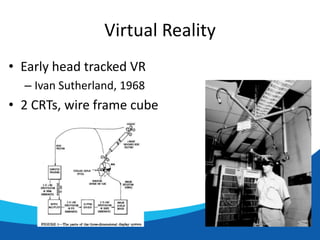
Virtual Reality
• Early head tracked VR
– Ivan Sutherland, 1968

• 2 CRTs, wire frame cube
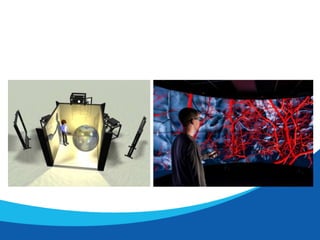
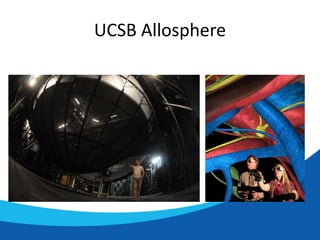
UCSB Allosphere
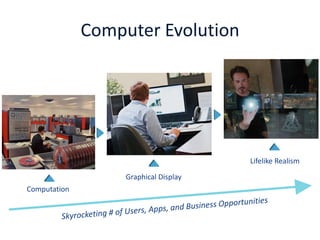
Computer Evolution

Lifelike Realism
Graphical Display
Computation
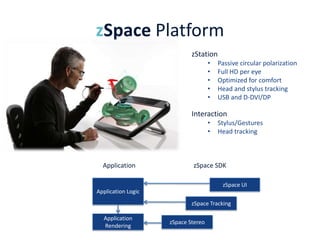
zSpace Platform
zStation
•
•
•
•
•

Passive circular polarization
Full HD per eye
Optimized for comfort
Head and stylus tracking
USB and D-DVI/DP

Interaction
•
•

Application

Stylus/Gestures
Head tracking

zSpace SDK
zSpace UI

Application Logic
zSpace Tracking
Application
Rendering

zSpace Stereo
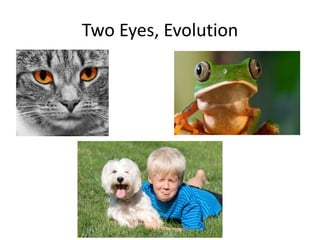
Two Eyes, Evolution
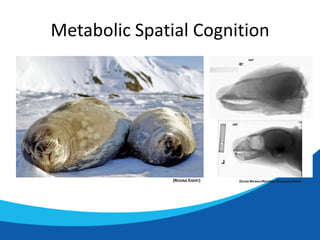
Metabolic Spatial Cognition

(REGINA EISERT)

(SUZAN MURRAY/NATIONAL ZOOLOGICAL PARK)
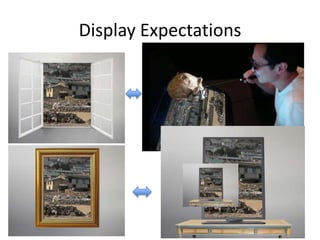
Display Expectations
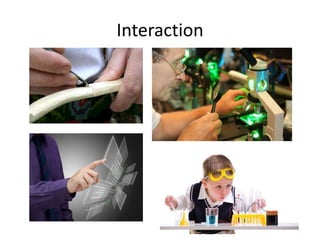
Interaction
How big is it?
• Beginning of a significant change
– zSpace represents a new information interaction
paradigm

• New powerful experience fits well
immediately
– Volumetric information: medical, biology,
architecture, product review

• First: Education, Healthcare, Training
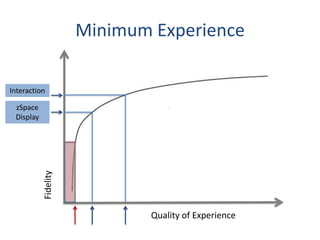
Minimum Experience
Interaction

Fidelity

zSpace
Display

Quality of Experience
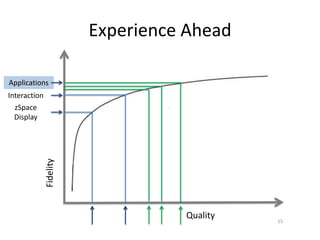
Experience Ahead
Applications

Fidelity

Interaction
zSpace
Display

Quality

15
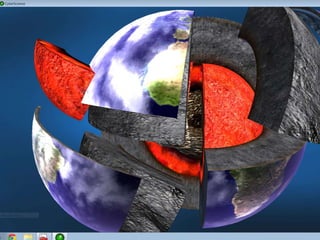
Education Earth
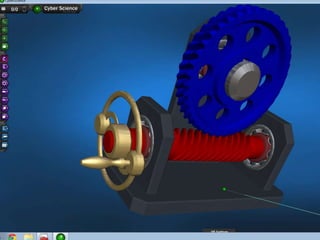
Education Worm Drive
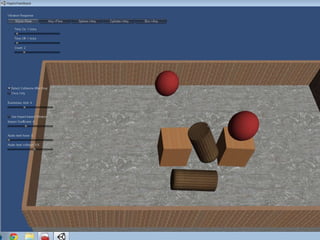
Newtonian Mechanics
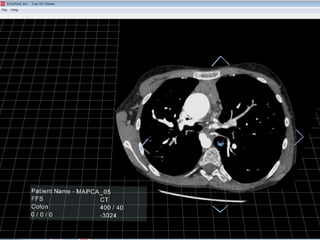
2D CT Scan
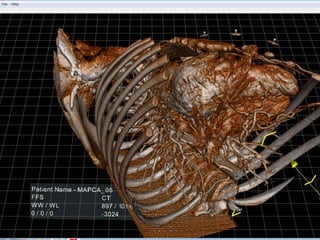
Medicine
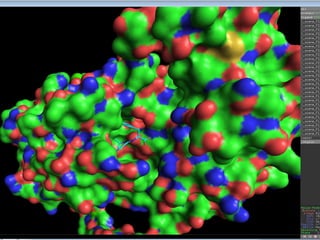
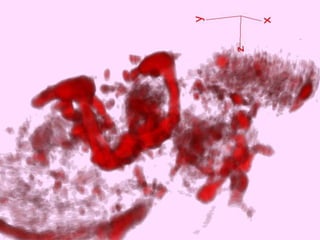
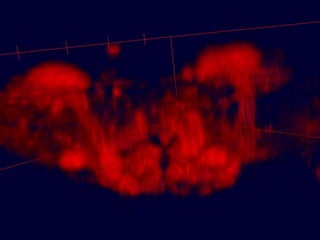
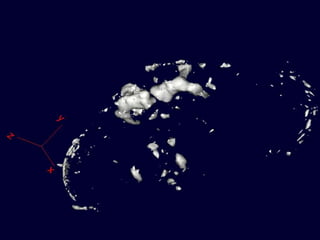
Drug Discovery
Drug Discovery
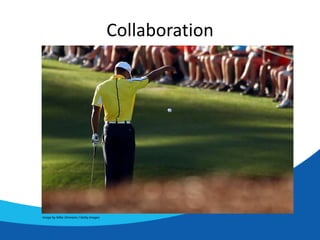
Collaboration

Image by Mike Ehrmann / Getty Images
Many Copies of a Single View
Single View For All
Same Dataset
Same Dataset
Same Dataset
Same Dataset
Same Dataset
Same Dataset
Same Dataset
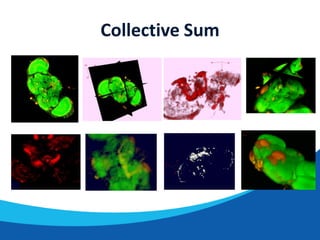
Collective Sum
Deep Recognition
Thank You

zSpace, the Wow Factor

Editor's Notes

  • #2 Poll audience
  • #3 Going to try to explain this reactionLots of data, high 90% Explain why this reaction is part of the essence of the impact of this technology in the future
  • #5 CHICAGO — Take a walk through a human brain? Fly over the surface of Mars? Computer scientists at the University of Illinois-Chicago are pushing science fiction closer to reality with a wraparound virtual world where a researcher wearing 3-D glasses can do all that and more.In the system, known as CAVE2, an 8-foot-high screen encircles the viewer 320 degrees. A panorama of images springs from 72 stereoscopic liquid-crystal display panels, conveying a dizzying sense of being able to touch what's not really there.
  • #6 The AlloSphere space consists of a 3-story cube that is treated with extensive sound absorption material making it one of the largest anechoic chambers in the world. Standing inside this chamber is a 5-meter-radius sphere constructed of perforated aluminum that is designed to be optically opaque and acoustically transparent.There are currently twelve high-resolution projectors mounted unobtrusively below the bridge and above the walkway entrance, approaching eye-limited resolution on large areas of the inner surface, with more on the way. The loudspeaker real-time sound synthesis cluster (140 individual speaker elements plus sub-woofers) is/will be suspended behind the aluminum screen resulting in 3-D audio. Computation clusters include simulation, sensor-array processing, real-time video processing for motion-capture and visual computing, render-farm/real-time ray-tracing and radiosity cluster, and content and prototyping environments.The AlloSphere Research Facility is differentiated from conventional virtual reality environments by its seamless surround-view capabilities and its focus on multiple sensory modalities and interaction. Building the AlloSphere was not an off-the-shelf enterprise. Designing a large-scale multimedia environment to deliver rich, coherent, interactive, high-resolution 3D video and audio streams from voluminous amounts of scientific data, all in real-time, was a non-trivial computational and systems engineering task that involved a significant number of faculty from diverse disciplines. Creating subsequent next generations of the instrument will again require genuine creativity to solve significant research and design challenges.the AlloSphere accommodates 20-30 people, not just one person, so the promise of a communal experience in the spheres of art, science, entertainment and education is achieved.
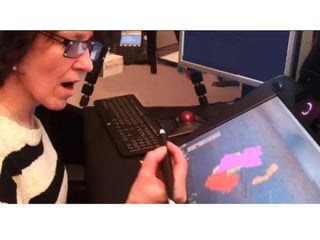
  • #8 zCon Video
  • #10 Nearly all complex life we know has 2 eyes. Not 1, or 3, but 2. Why? 1 eye compared to no eyes makes competitive sense.The 2nd eye could be a spare, but it represents quite a bit of energy from an evolutionary perspective. In many cases the 2nd eye offers safety as it widens the field of view. But the primary reason for 2 eyes has to be because we live in a volumetric, spatial, 3 dimensional world, and the 2nd eye used in concert with the other gives us very important depth information. zSpace provides that stereoscopic information, in a comfortable way. That is, in a way that is consistent with the way our physiological systems have evolved to interact with the world. In this regard, 2D displays are an artificial constraint, an intermediate step, created only because of technology limitations. As you’ve seen, interaction along with the zSpace display is a out of the park.
  • #11 But why does the newborn Weddell seal need such a large brain? Marine mammals need extra processing capacity to orient themselves in a three-dimensional underwater environment, and tend to have larger brains than comparable terrestrial species. (Living in trees, another kind of 3D environment, is also associated with larger brain size).As an added challenge, baby Weddell seals take up diving under the ice at less than three weeks old. Ice-diving is extremely dangerous for mammals, as they risk drowning if they cannot locate their exit in time. Most marine mammals will not dive under closed ice even as adults, with the exception of three species: the Baikal seal, the ringed seal and the Weddell seal.But such hyper-fast maturity comes with a cost. The brain is a metabolically expensive organ,
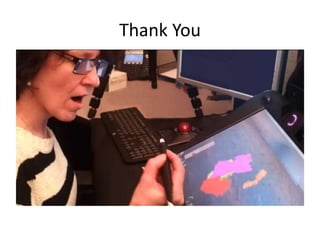
  • #12 It’s not perfect. It’s not the same as a window. But in a working volume at your desk, it can be very convincing. And then, what if you could interact?
  • #13 Well of course by now you all know in zSpace you can just reach in and play.But was it Expected? In our everyday world, of course. But no way in the virtual world.
  • #14 Free the artificial constraints of 2D displayszSpace will design and build leading edge systems, develop and integrate new technologiesEnhance tools for our application developersWork with partners to build the ecosystem
  • #15 There’s a threshold below which most people would not sit down and enjoy a comfortable experience. If the tracking were off, or the stylus jumpy, or the projections wrong, it doesn’t work. There are many many conflicting cues, in that middle zone, that all add up. It has to be very good to get people to say ‘Wow’. If things are not right, for example, if the Left and Right eye are swapped, it’s not ‘wow’, but other words, many with 4 letters. Like “what” or “ouch”. Or “get me outa here”It’s not hard to bring things down. If the computational load is too high, the framerate can drop. If the UI is clunky or non-intuitive, same thing.
  • #16 The experience looking aheadThe app community is going to continue and accelerate in developing applications that we can’t imagine. zSpace will develop and integrate new technologies into new products. We’ll enhance the tools available to the community to enable them to focus on the value in the apps. UI tools, We’ll push the technology ahead. We’ll keep enriching the community.
  • #17 Doesn’t look like a sphere, but it is! Depends on perspective, like illusion above.
  • #25 Millions of people watched this same scene. A few saw that Tiger didn’t drop his ball in the correct spot.
  • #26 Importance of “Believable, real life communication”
  • #27 Importance of “Believable, real life communication”
  • #28 Importance of “Believable, real life communication”
  • #29 Importance of “Believable, real life communication”
  • #30 Importance of “Believable, real life communication”
  • #31 Importance of “Believable, real life communication”
  • #32 Importance of “Believable, real life communication”
  • #33 Importance of “Believable, real life communication”
  • #34 Importance of “Believable, real life communication”
  • #35 Importance of “Believable, real life communication”
  • #36 Importance of “Believable, real life communication”
  • #37 Please come visit the ISID booth to experience zSpace.