Virtual Worlds
A Technology in Making
Online community that takes the
    form of a computer-based
 simulated environment through
  which users can interact with
 one another and use and create
             objects.
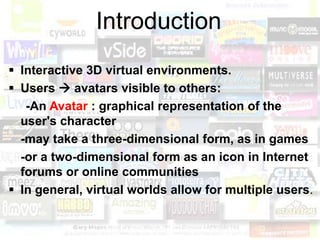
Introduction
 Interactive 3D virtual environments.
 Users  avatars visible to others:
   -An Avatar : graphical representation of the
  user's character
  -may take a three-dimensional form, as in games
  -or a two-dimensional form as an icon in Internet
  forums or online communities
 In general, virtual worlds allow for multiple users.
A look into Virtual Worlds:
 Such modeled worlds draw their essence
  from reality or fantasy worlds.
 Communication
 Most common forms; Games. Most based
  on fantasy, rarely based on reality.
 Virtual Worlds not limited to games, but
  extensions such as chatrooms, conferences
  etc.
 Use of emoticons in such places „‟ „‟
 Economist Edward Castronova argues that
  “synthetic world” is a better term.
Most common Examples Of Virtual
           Worlds:
    Social Networking
           Sites          3D movies
   Technical term,        Acronym for three-
    “Virtual                dimensional film
    communities”           motion picture that
   Lots of users, more     enhances
    than thousands          the illusion of depth
   Interacting through     perception.
    use of „Profiles‟.     Uses special
   For e.g., Facebook,     projection hardware
    Twitter .               or special eyewear
                           Examples
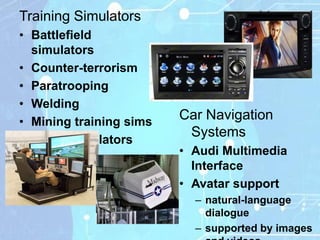
Training Simulators
• Battlefield
  simulators
• Counter-terrorism
• Paratrooping
• Welding
• Mining training sims
                         Car Navigation
                          Systems
• Flight Simulators
                         • Audi Multimedia
                           Interface
                         • Avatar support
                           – natural-language
                             dialogue
                           – supported by images
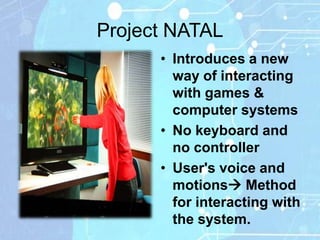
Project NATAL
      • Introduces a new
        way of interacting
        with games &
        computer systems
      • No keyboard and
        no controller
      • User's voice and
        motions Method
        for interacting with
        the system.
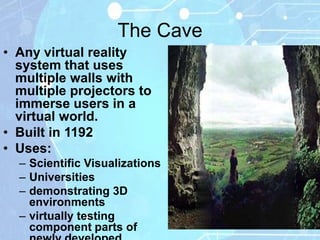
The Cave
• Any virtual reality
  system that uses
  multiple walls with
  multiple projectors to
  immerse users in a
  virtual world.
• Built in 1192
• Uses:
  – Scientific Visualizations
  – Universities
  – demonstrating 3D
    environments
  – virtually testing
    component parts of
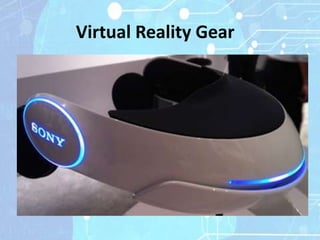
Virtual Reality Gear
• In order to play games in the “virtual world”,
  certain gadgets are required.
• These include:
1. Virtual reality goggles/glasses
2. Hand-held controls, Head Mounted
    Display (HMD) and speakers
3. Data suits
4. Workbench
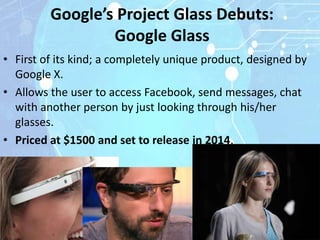
Google’s Project Glass Debuts:
                 Google Glass
• First of its kind; a completely unique product, designed by
  Google X.
• Allows the user to access Facebook, send messages, chat
  with another person by just looking through his/her
  glasses.
• Priced at $1500 and set to release in 2014.
Google Glass’ Commercial
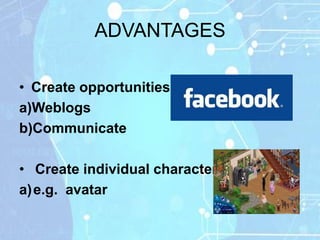
ADVANTAGES

• Create opportunities
a)Weblogs
b)Communicate

• Create individual character
a)e.g. avatar
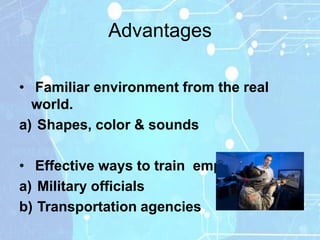
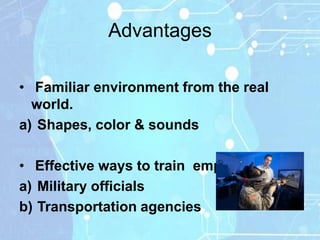
Advantages

• Familiar environment from the real
  world.
a) Shapes, color & sounds

• Effective ways to train employs.
a) Military officials
b) Transportation agencies
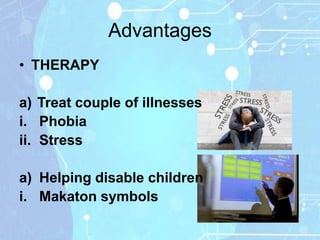
Advantages
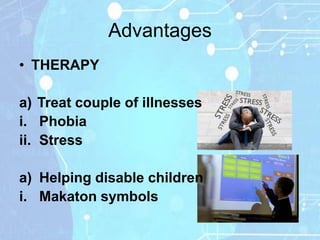
• THERAPY

a) Treat couple of illnesses
i. Phobia
ii. Stress

a) Helping disable children
i. Makaton symbols
ADVANTAGES

• Create opportunities
a)Weblogs
b)Communicate

• Create individual character
a)e.g. avatar
Advantages

• Familiar environment from the real
  world.
a) Shapes, color & sounds

• Effective ways to train employs.
a) Military officials
b) Transportation agencies
Advantages
• THERAPY

a) Treat couple of illnesses
i. Phobia
ii. Stress

a) Helping disable children
i. Makaton symbols
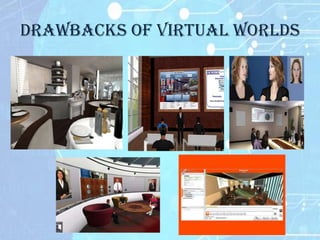
Drawbacks of Virtual Worlds
• Technology:
  Poses significant problems to developers
  and causes restrictions in attempts at
  widespread use and distribution.

• Social Impact:
   Social isolation (depression,
  disassociation and other conditions).

• Could lead to low self-esteem, feelings of
  worthlessness and insignificance, even
  self-destructive acts.
• Desensitization:
  risk of failing to recognize the true
  consequences for actions in which they
  are taking part or are viewing.

• Cost:
   Few people have the technical
  knowledge to maintain a virtual world
  system. Additionally most reality
  systems are not readily
  interchangeable with different
  hardware, increasing the cost.
Future of Virtual Worlds:

• Today, more than hundreds of virtual worlds
  in existence with varied themes.
• Like fantasy, science fiction or idealized
  modern environments like tropical islands,
  gardens etc
• Virtual worlds mostly exist in the form of
  games
• But in future, will expand into a broader
  range of fields like education, military,
  entertainment etc
Virtual and Real world- different or
               alike?
• Growth of virtual worlds is foreseen.
• Current virtual activity and use of avatars is
  removing the difference between the virtual
  and real worlds
• The boundary between the 2 may fade even
  more in the future
• The many uses and constant growth of
  Virtual Worlds depicts their further evolution
Virtual Worlds-New technology in
              making?
• Virtual Worlds becoming a part of daily life
  due to increased and better internet access
• This technology in making will bring a
  revolution in the world of science &
  technology
• It can be rightly said, that Virtual Worlds wil
  be no longer places “to visit”.
• And What‟s life without a new innovation?
THANK YOU!!

Virtual worlds (2)

  • 1.
  • 2.
    Online community thattakes the form of a computer-based simulated environment through which users can interact with one another and use and create objects.
  • 3.
    Introduction  Interactive 3Dvirtual environments.  Users  avatars visible to others: -An Avatar : graphical representation of the user's character -may take a three-dimensional form, as in games -or a two-dimensional form as an icon in Internet forums or online communities  In general, virtual worlds allow for multiple users.
  • 4.
    A look intoVirtual Worlds:  Such modeled worlds draw their essence from reality or fantasy worlds.  Communication  Most common forms; Games. Most based on fantasy, rarely based on reality.  Virtual Worlds not limited to games, but extensions such as chatrooms, conferences etc.  Use of emoticons in such places „‟ „‟  Economist Edward Castronova argues that “synthetic world” is a better term.
  • 5.
    Most common ExamplesOf Virtual Worlds: Social Networking Sites 3D movies  Technical term,  Acronym for three- “Virtual dimensional film communities”  motion picture that  Lots of users, more enhances than thousands the illusion of depth  Interacting through perception. use of „Profiles‟.  Uses special  For e.g., Facebook, projection hardware Twitter . or special eyewear  Examples
  • 7.
    Training Simulators • Battlefield simulators • Counter-terrorism • Paratrooping • Welding • Mining training sims Car Navigation Systems • Flight Simulators • Audi Multimedia Interface • Avatar support – natural-language dialogue – supported by images
  • 8.
    Project NATAL • Introduces a new way of interacting with games & computer systems • No keyboard and no controller • User's voice and motions Method for interacting with the system.
  • 9.
    The Cave • Anyvirtual reality system that uses multiple walls with multiple projectors to immerse users in a virtual world. • Built in 1192 • Uses: – Scientific Visualizations – Universities – demonstrating 3D environments – virtually testing component parts of
  • 10.
    Virtual Reality Gear •In order to play games in the “virtual world”, certain gadgets are required. • These include: 1. Virtual reality goggles/glasses 2. Hand-held controls, Head Mounted Display (HMD) and speakers 3. Data suits 4. Workbench
  • 11.
    Google’s Project GlassDebuts: Google Glass • First of its kind; a completely unique product, designed by Google X. • Allows the user to access Facebook, send messages, chat with another person by just looking through his/her glasses. • Priced at $1500 and set to release in 2014.
  • 12.
  • 13.
    ADVANTAGES • Create opportunities a)Weblogs b)Communicate •Create individual character a)e.g. avatar
  • 14.
    Advantages • Familiar environmentfrom the real world. a) Shapes, color & sounds • Effective ways to train employs. a) Military officials b) Transportation agencies
  • 15.
    Advantages • THERAPY a) Treatcouple of illnesses i. Phobia ii. Stress a) Helping disable children i. Makaton symbols
  • 16.
    ADVANTAGES • Create opportunities a)Weblogs b)Communicate •Create individual character a)e.g. avatar
  • 17.
    Advantages • Familiar environmentfrom the real world. a) Shapes, color & sounds • Effective ways to train employs. a) Military officials b) Transportation agencies
  • 18.
    Advantages • THERAPY a) Treatcouple of illnesses i. Phobia ii. Stress a) Helping disable children i. Makaton symbols
  • 19.
  • 20.
    • Technology: Poses significant problems to developers and causes restrictions in attempts at widespread use and distribution. • Social Impact: Social isolation (depression, disassociation and other conditions). • Could lead to low self-esteem, feelings of worthlessness and insignificance, even self-destructive acts.
  • 21.
    • Desensitization: risk of failing to recognize the true consequences for actions in which they are taking part or are viewing. • Cost: Few people have the technical knowledge to maintain a virtual world system. Additionally most reality systems are not readily interchangeable with different hardware, increasing the cost.
  • 22.
    Future of VirtualWorlds: • Today, more than hundreds of virtual worlds in existence with varied themes. • Like fantasy, science fiction or idealized modern environments like tropical islands, gardens etc • Virtual worlds mostly exist in the form of games • But in future, will expand into a broader range of fields like education, military, entertainment etc
  • 23.
    Virtual and Realworld- different or alike? • Growth of virtual worlds is foreseen. • Current virtual activity and use of avatars is removing the difference between the virtual and real worlds • The boundary between the 2 may fade even more in the future • The many uses and constant growth of Virtual Worlds depicts their further evolution
  • 24.
    Virtual Worlds-New technologyin making? • Virtual Worlds becoming a part of daily life due to increased and better internet access • This technology in making will bring a revolution in the world of science & technology • It can be rightly said, that Virtual Worlds wil be no longer places “to visit”. • And What‟s life without a new innovation?
  • 25.