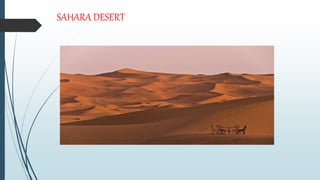
SAHARA DESERT
INTRODUCTION
 Sahara desert is a desert on the African continent .
 With an area of 9,200,000 square kilometers .
 it is the largest hot desert in the world and the third largest desert
 The name "Sahara" is derived from the Arabic word for "desert“
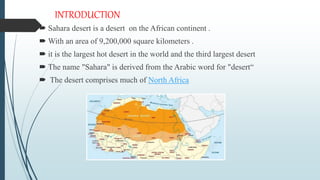
 The desert comprises much of North Africa
Geography
The Sahara covers large parts
of Algeria, Chad, Egypt, Libya, Mali, Mauritania, Morocco, Niger, W
estern Sahara, Sudan and Tunisia.
It covers 9 million square kilometres (3,500,000 sq mi), amounting to
31% of Africa.
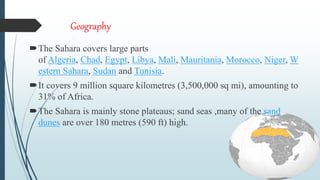
The Sahara is mainly stone plateaus; sand seas ,many of the sand
dunes are over 180 metres (590 ft) high.
Climate
The Sahara is the world's largest hot desert.[17][18] It is located
in the horse latitudes under the subtropical ridge
The permanent absence of clouds allows unhindered light
and thermal radiation.
 During daytime, the sand temperature is extremely high: it can easily reach
80 ° .
Flora
 The flora of the Sahara is highly diversified based on the bio-geographical
characteristics of this vast desert.
 The Saharan flora comprises around 2800 species of vascular plants.
 The central Sahara is estimated to include five hundred species of plants.
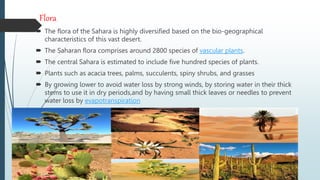
 Plants such as acacia trees, palms, succulents, spiny shrubs, and grasses
 By growing lower to avoid water loss by strong winds, by storing water in their thick
stems to use it in dry periods,and by having small thick leaves or needles to prevent
water loss by evapotranspiration
Fauna
Several species of fox live in the Sahara including: the fennec
fox, pale fox and Rüppell's fox.
The addax, a large white antelope, can go nearly a year in the desert
without drinking. The dorcas gazelle is a north African gazelle that
can also go for a long time without water
 The Saharan cheetah (northwest African cheetah) lives in Algeria, Togo, Niger,
Mali, Benin, and Burkina Faso. There are approximately 2000 mature individuals
left in the wild.
 Other animals include the monitor lizards, hyrax, sand vipers, African wild
dog, and red-necked ostrich. Other animals like birds African silverbill and black-
faced firefinch, The deathstalker scorpion can be 10 cm (3.9 in) long.
 Dromedary camels and goats are the domesticated animals most commonly found in
the Sahara.
People, culture, and languages
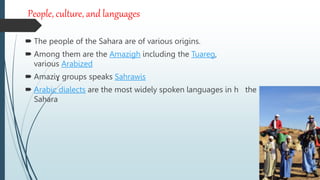
 The people of the Sahara are of various origins.
 Among them are the Amazigh including the Tuareg,
various Arabized
 Amaziɣ groups speaks Sahrawis
 Arabic dialects are the most widely spoken languages in h the
Sahara
THANK YOU
J Pandey

sahara dessert.pptx

  • 1.
  • 2.
    INTRODUCTION  Sahara desertis a desert on the African continent .  With an area of 9,200,000 square kilometers .  it is the largest hot desert in the world and the third largest desert  The name "Sahara" is derived from the Arabic word for "desert“  The desert comprises much of North Africa
  • 3.
    Geography The Sahara coverslarge parts of Algeria, Chad, Egypt, Libya, Mali, Mauritania, Morocco, Niger, W estern Sahara, Sudan and Tunisia. It covers 9 million square kilometres (3,500,000 sq mi), amounting to 31% of Africa. The Sahara is mainly stone plateaus; sand seas ,many of the sand dunes are over 180 metres (590 ft) high.
  • 4.
    Climate The Sahara isthe world's largest hot desert.[17][18] It is located in the horse latitudes under the subtropical ridge The permanent absence of clouds allows unhindered light and thermal radiation.  During daytime, the sand temperature is extremely high: it can easily reach 80 ° .
  • 5.
    Flora  The floraof the Sahara is highly diversified based on the bio-geographical characteristics of this vast desert.  The Saharan flora comprises around 2800 species of vascular plants.  The central Sahara is estimated to include five hundred species of plants.  Plants such as acacia trees, palms, succulents, spiny shrubs, and grasses  By growing lower to avoid water loss by strong winds, by storing water in their thick stems to use it in dry periods,and by having small thick leaves or needles to prevent water loss by evapotranspiration
  • 6.
    Fauna Several species offox live in the Sahara including: the fennec fox, pale fox and Rüppell's fox. The addax, a large white antelope, can go nearly a year in the desert without drinking. The dorcas gazelle is a north African gazelle that can also go for a long time without water  The Saharan cheetah (northwest African cheetah) lives in Algeria, Togo, Niger, Mali, Benin, and Burkina Faso. There are approximately 2000 mature individuals left in the wild.  Other animals include the monitor lizards, hyrax, sand vipers, African wild dog, and red-necked ostrich. Other animals like birds African silverbill and black- faced firefinch, The deathstalker scorpion can be 10 cm (3.9 in) long.  Dromedary camels and goats are the domesticated animals most commonly found in the Sahara.
  • 7.
    People, culture, andlanguages  The people of the Sahara are of various origins.  Among them are the Amazigh including the Tuareg, various Arabized  Amaziɣ groups speaks Sahrawis  Arabic dialects are the most widely spoken languages in h the Sahara
  • 8.