THE
INDIAN
DESERT
DESERTS
A desert is a landscape or region that
receives an extremely low amount of
precipitation, less than enough to
support growth of most plants.
DESERTS

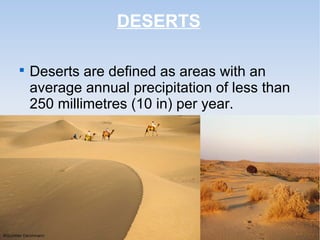
Deserts are defined as areas with an
average annual precipitation of less than
250 millimetres (10 in) per year.
DESERTS

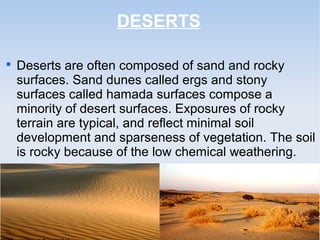
Deserts are often composed of sand and rocky
surfaces. Sand dunes called ergs and stony
surfaces called hamada surfaces compose a
minority of desert surfaces. Exposures of rocky
terrain are typical, and reflect minimal soil
development and sparseness of vegetation. The soil
is rocky because of the low chemical weathering.
THE INDIAN DESERT

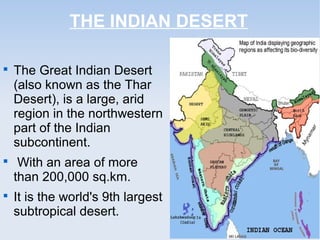
The Great Indian Desert
(also known as the Thar
Desert), is a large, arid
region in the northwestern
part of the Indian
subcontinent.

With an area of more
than 200,000 sq.km.

It is the world's 9th largest
subtropical desert.
THE INDIAN DESERT

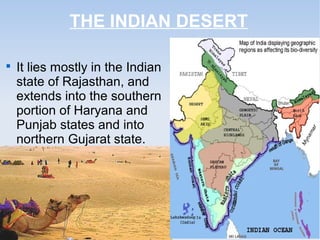
It lies mostly in the Indian
state of Rajasthan, and
extends into the southern
portion of Haryana and
Punjab states and into
northern Gujarat state.
THE INDIAN DESERT

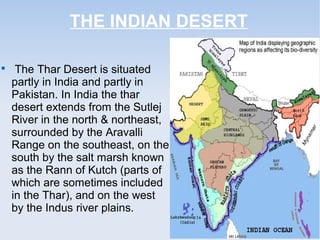
The Thar Desert is situated
partly in India and partly in
Pakistan. In India the thar
desert extends from the Sutlej
River in the north & northeast,
surrounded by the Aravalli
Range on the southeast, on the
south by the salt marsh known
as the Rann of Kutch (parts of
which are sometimes included
in the Thar), and on the west
by the Indus river plains.
INDIAN DESERT

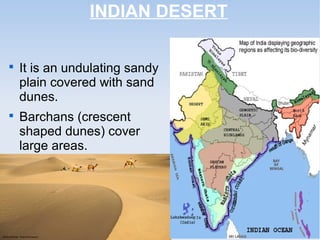
It is an undulating sandy
plain covered with sand
dunes.

Barchans (crescent
shaped dunes) cover
large areas.
INDIAN DESERT

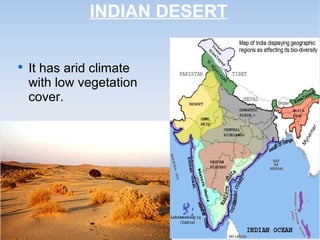
It has arid climate
with low vegetation
cover.
INDIAN DESERT

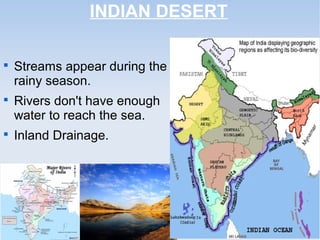
Streams appear during the
rainy season.

Rivers don't have enough
water to reach the sea.

Inland Drainage.

The desert g

  • 1.
  • 2.
    DESERTS A desert isa landscape or region that receives an extremely low amount of precipitation, less than enough to support growth of most plants.
  • 3.
    DESERTS  Deserts are definedas areas with an average annual precipitation of less than 250 millimetres (10 in) per year.
  • 4.
    DESERTS  Deserts are oftencomposed of sand and rocky surfaces. Sand dunes called ergs and stony surfaces called hamada surfaces compose a minority of desert surfaces. Exposures of rocky terrain are typical, and reflect minimal soil development and sparseness of vegetation. The soil is rocky because of the low chemical weathering.
  • 5.
    THE INDIAN DESERT  TheGreat Indian Desert (also known as the Thar Desert), is a large, arid region in the northwestern part of the Indian subcontinent.  With an area of more than 200,000 sq.km.  It is the world's 9th largest subtropical desert.
  • 6.
    THE INDIAN DESERT  Itlies mostly in the Indian state of Rajasthan, and extends into the southern portion of Haryana and Punjab states and into northern Gujarat state.
  • 7.
    THE INDIAN DESERT  TheThar Desert is situated partly in India and partly in Pakistan. In India the thar desert extends from the Sutlej River in the north & northeast, surrounded by the Aravalli Range on the southeast, on the south by the salt marsh known as the Rann of Kutch (parts of which are sometimes included in the Thar), and on the west by the Indus river plains.
  • 8.
    INDIAN DESERT  It isan undulating sandy plain covered with sand dunes.  Barchans (crescent shaped dunes) cover large areas.
  • 9.
    INDIAN DESERT  It hasarid climate with low vegetation cover.
  • 10.
    INDIAN DESERT  Streams appearduring the rainy season.  Rivers don't have enough water to reach the sea.  Inland Drainage.