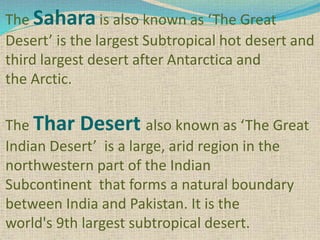
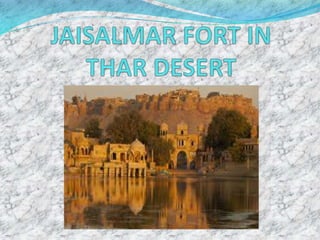
THAR
DESERT
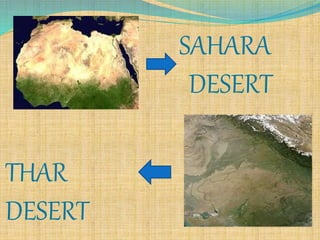
SAHARA
DESERT
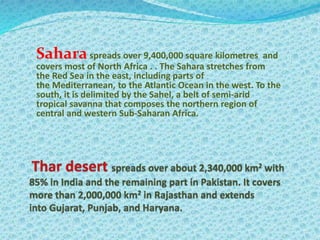
The Sahara is also known as ‘The Great
Desert’ is the largest Subtropical hot desert and
third largest desert after Antarctica and
the Arctic.
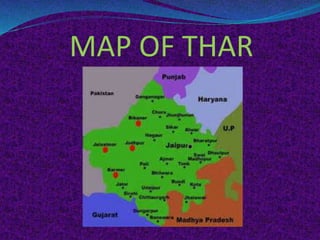
The Thar Desert also known as ‘The Great
Indian Desert’ is a large, arid region in the
northwestern part of the Indian
Subcontinent that forms a natural boundary
between India and Pakistan. It is the
world's 9th largest subtropical desert.
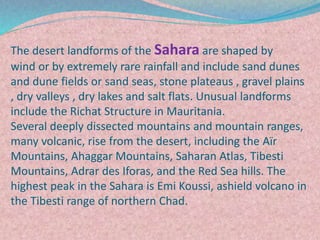
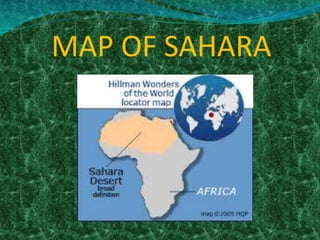
Saharaspreads over 9,400,000 square kilometres and
covers most of North Africa . . The Sahara stretches from
the Red Sea in the east, including parts of
the Mediterranean, to the Atlantic Ocean in the west. To the
south, it is delimited by the Sahel, a belt of semi-arid
tropical savanna that composes the northern region of
central and western Sub-Saharan Africa.
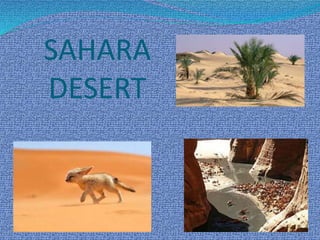
The desert landforms of the Sahara are shaped by
wind or by extremely rare rainfall and include sand dunes
and dune fields or sand seas, stone plateaus , gravel plains
, dry valleys , dry lakes and salt flats. Unusual landforms
include the Richat Structure in Mauritania.
Several deeply dissected mountains and mountain ranges,
many volcanic, rise from the desert, including the Aïr
Mountains, Ahaggar Mountains, Saharan Atlas, Tibesti
Mountains, Adrar des Iforas, and the Red Sea hills. The
highest peak in the Sahara is Emi Koussi, ashield volcano in
the Tibesti range of northern Chad.
The soil of the Thar Desert remains dry for much of the
year and is prone to wind erosion. High velocity winds
blow soil from the desert, depositing some on
neighboring fertile lands, and causing shifting sand
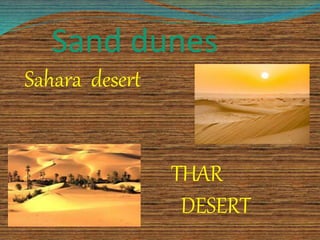
dunes within the desert. . Sand dunes are stabilised by
erecting micro-windbreak barriers with scrub material
and subsequent afforestation of the treated dunes with
seedlings of shrubs such as phog,senna, castor oil
plant and trees such as gum acacia, Prosopis
juliflora and lebbek tree.
Sand dunes
Sahara desert
THAR
DESERT
Occupation
The Thar Desert is one of most heavily populated
desert areas in the world and the main occupations of people
living here are agriculture and animal husbandry.
Agriculture is not a dependable proposition in this area—
after the rainy season, at least 33% of crops fail. Animal
husbandry, trees and grasses, intercropped with vegetables
or fruit trees, is the most viable model for arid, drought-
prone regions. The region faces frequent droughts.
Overgrazing due to high animal populations, wind and water
erosion, mining and other industries result in serious land
degradation.
FLORA And FAUNA
The Saharan flora comprises around 2800 species of vascular plants.
Approximately a quarter of these are endemic. About half of these
species are common to the flora of the Arabian deserts.
FAUNA comprises of many species like cheetah etc.
The central Sahara is estimated to include five hundred species of
plants, which is extremely low considering the huge extent of the area.
Plants such as acacia trees, palms, succulents, spiny shrubs, and
grasses have adapted to the arid conditions, by growing lower to avoid
water loss by strong winds, by storing water in their thick stems to use it
in dry periods, by having long roots that travel horizontally to reach the
maximum area of water and to find any surface moisture and by having
small thick leaves or needles to prevent water loss by evapo-
transpiration. Plant leaves may dry out totally and then recover.
FLORA And FAUNA
Stretches of sand in the desert are interspersed by hillocks and sandy and
gravel plains. Due to the diversified habitat and ecosystem, the vegetation,
human culture and animal life in this arid region is very rich in contrast to
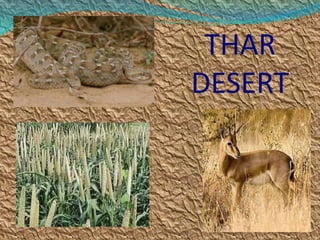
the other deserts of the world. About 23 species of lizard and 25 species of
snakes are found here and several of them are endemic to the region.
Some wildlife species, which are fast vanishing in other parts of India, are
found in the desert in large numbers such as the blackbuck, chinkara
and Indian wild ass in the Rann of Kutch. They have evolved excellent
survival strategies, their size is smaller than other similar animals living in
different conditions, and they are mainly nocturnal. There are certain other
factors responsible for the survival of these animals in the desert. Due to
the lack of water in this region, transformation of the grasslands into
cropland has been very slow. The protection provided to them by a local
community, the Bishnois, is also a factor. Other mammals of the Thar
Desert include a subspecies of red fox and the caracal.
THAR
DESERT
SAHARA
DESERT
MAP OF SAHARA
MAP OF THAR
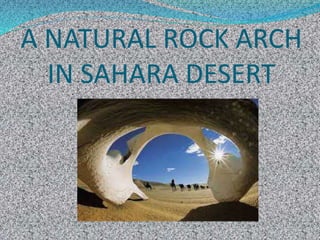
A NATURAL ROCK ARCH
IN SAHARA DESERT
Bm

Bm

  • 1.
  • 2.
    The Sahara isalso known as ‘The Great Desert’ is the largest Subtropical hot desert and third largest desert after Antarctica and the Arctic. The Thar Desert also known as ‘The Great Indian Desert’ is a large, arid region in the northwestern part of the Indian Subcontinent that forms a natural boundary between India and Pakistan. It is the world's 9th largest subtropical desert.
  • 3.
    Saharaspreads over 9,400,000square kilometres and covers most of North Africa . . The Sahara stretches from the Red Sea in the east, including parts of the Mediterranean, to the Atlantic Ocean in the west. To the south, it is delimited by the Sahel, a belt of semi-arid tropical savanna that composes the northern region of central and western Sub-Saharan Africa.
  • 4.
    The desert landformsof the Sahara are shaped by wind or by extremely rare rainfall and include sand dunes and dune fields or sand seas, stone plateaus , gravel plains , dry valleys , dry lakes and salt flats. Unusual landforms include the Richat Structure in Mauritania. Several deeply dissected mountains and mountain ranges, many volcanic, rise from the desert, including the Aïr Mountains, Ahaggar Mountains, Saharan Atlas, Tibesti Mountains, Adrar des Iforas, and the Red Sea hills. The highest peak in the Sahara is Emi Koussi, ashield volcano in the Tibesti range of northern Chad.
  • 5.
    The soil ofthe Thar Desert remains dry for much of the year and is prone to wind erosion. High velocity winds blow soil from the desert, depositing some on neighboring fertile lands, and causing shifting sand dunes within the desert. . Sand dunes are stabilised by erecting micro-windbreak barriers with scrub material and subsequent afforestation of the treated dunes with seedlings of shrubs such as phog,senna, castor oil plant and trees such as gum acacia, Prosopis juliflora and lebbek tree.
  • 6.
  • 9.
    Occupation The Thar Desertis one of most heavily populated desert areas in the world and the main occupations of people living here are agriculture and animal husbandry. Agriculture is not a dependable proposition in this area— after the rainy season, at least 33% of crops fail. Animal husbandry, trees and grasses, intercropped with vegetables or fruit trees, is the most viable model for arid, drought- prone regions. The region faces frequent droughts. Overgrazing due to high animal populations, wind and water erosion, mining and other industries result in serious land degradation.
  • 10.
    FLORA And FAUNA TheSaharan flora comprises around 2800 species of vascular plants. Approximately a quarter of these are endemic. About half of these species are common to the flora of the Arabian deserts. FAUNA comprises of many species like cheetah etc. The central Sahara is estimated to include five hundred species of plants, which is extremely low considering the huge extent of the area. Plants such as acacia trees, palms, succulents, spiny shrubs, and grasses have adapted to the arid conditions, by growing lower to avoid water loss by strong winds, by storing water in their thick stems to use it in dry periods, by having long roots that travel horizontally to reach the maximum area of water and to find any surface moisture and by having small thick leaves or needles to prevent water loss by evapo- transpiration. Plant leaves may dry out totally and then recover.
  • 11.
    FLORA And FAUNA Stretchesof sand in the desert are interspersed by hillocks and sandy and gravel plains. Due to the diversified habitat and ecosystem, the vegetation, human culture and animal life in this arid region is very rich in contrast to the other deserts of the world. About 23 species of lizard and 25 species of snakes are found here and several of them are endemic to the region. Some wildlife species, which are fast vanishing in other parts of India, are found in the desert in large numbers such as the blackbuck, chinkara and Indian wild ass in the Rann of Kutch. They have evolved excellent survival strategies, their size is smaller than other similar animals living in different conditions, and they are mainly nocturnal. There are certain other factors responsible for the survival of these animals in the desert. Due to the lack of water in this region, transformation of the grasslands into cropland has been very slow. The protection provided to them by a local community, the Bishnois, is also a factor. Other mammals of the Thar Desert include a subspecies of red fox and the caracal.
  • 12.
  • 13.
  • 14.
  • 15.
  • 16.
    A NATURAL ROCKARCH IN SAHARA DESERT