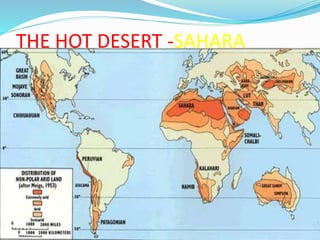
THE HOT DESERT -SAHARA
The desert is barren land . It is 
an arid region characteriesed by 
extremely high or low 
temperatures and has scarce 
vegetation.
SAHARA DESERT 
It is the world’s largest desert. It has an area of around 8.54 
million of sq. km. 
The hot desert lie between 20 degree and 30 degree latitudes 
north and south of the equator . 
To the north-west of the Sahara lies the Atlas mountains . 
Towards the south,the desert merges into the savanna grassland. 
The Sahara is spread across 11 countries. These are 
Morocco,Algeria,Libya,Egypt,Tunisia,Sudan,Chad, 
Mali,Mauritania,Niger & West Sahara. 
Sand is the most important feature of a hot desert. 
One-fourth of Sahara is under sand . It is a flat,waterless 
wasteland.Thus,Sahara is called “ El Khela ”which means 
emptiness. 
Sahara has not always been a wastland.Once it was a fertile region with thick 
forests. Over thousands of years , the forces of nature and various humans 
activities have converted this region into a barren wasteland. 
Mt.Emi Khoussi in Tibesti range (about 3,415 m) is the highest point.
CLIMATIC CONDITIONS 
The climate is very hot & extremely dry. 
Some of the world’s highest temperature have been 
recorded here. 
Al-Azizia , in Libya , recorded the highest temperature 
of 57.7 degree C in 1922. 
In Sahara , the temperature rises & humidity decreases as 
one goes from north to south. 
The dryness of the air keeps the sky cloudless and clear. 
Under clear skies , the temperature can range from below 
freezing point on a winter night to more than 55 degree C 
on a summer after noon . 
The amount of rainfall varies greatly from region to region 
& from year to year . In some areas there has been no 
rainfall for many years.
• The climatic conditions are not suitable for 
the growth of plants . 
• Plants which have long roots and waxy and 
leathery leaves can grow. 
• The main plants species are Cactus , Acacia 
,Baobab and Date palms. 
• In some places there are oasis – green 
islands with date palms surrounding them . 
• Camels ,Hyenas ,Jackals, Foxes ,Scorpions , 
many varieties of snakes and lizards are the 
prominent animal species living there.
• The life in the desert is difficult. 
• The Bedouins and Tuaregs are the important 
Nomadic Tribes who rear Goats,Sheeps,Camels and 
Horses. 
• The oasis in the Sahara and the Nile Valley in Egypt 
supports settled population. 
• Since water is available,the people grow date palms. 
•There are also plans to construct a trans-Sahara railroad. 
•The oases are also centres of trade. 
•Agriculture, local trading and hearding have become 
the basis of the economy. 
•Their dress is designed to protect them from hot wind 
and duststorms.
Sahara class VII
Sahara class VII
Sahara class VII

Sahara class VII

  • 1.
  • 2.
    The desert isbarren land . It is an arid region characteriesed by extremely high or low temperatures and has scarce vegetation.
  • 3.
    SAHARA DESERT Itis the world’s largest desert. It has an area of around 8.54 million of sq. km. The hot desert lie between 20 degree and 30 degree latitudes north and south of the equator . To the north-west of the Sahara lies the Atlas mountains . Towards the south,the desert merges into the savanna grassland. The Sahara is spread across 11 countries. These are Morocco,Algeria,Libya,Egypt,Tunisia,Sudan,Chad, Mali,Mauritania,Niger & West Sahara. Sand is the most important feature of a hot desert. One-fourth of Sahara is under sand . It is a flat,waterless wasteland.Thus,Sahara is called “ El Khela ”which means emptiness. Sahara has not always been a wastland.Once it was a fertile region with thick forests. Over thousands of years , the forces of nature and various humans activities have converted this region into a barren wasteland. Mt.Emi Khoussi in Tibesti range (about 3,415 m) is the highest point.
  • 4.
    CLIMATIC CONDITIONS Theclimate is very hot & extremely dry. Some of the world’s highest temperature have been recorded here. Al-Azizia , in Libya , recorded the highest temperature of 57.7 degree C in 1922. In Sahara , the temperature rises & humidity decreases as one goes from north to south. The dryness of the air keeps the sky cloudless and clear. Under clear skies , the temperature can range from below freezing point on a winter night to more than 55 degree C on a summer after noon . The amount of rainfall varies greatly from region to region & from year to year . In some areas there has been no rainfall for many years.
  • 5.
    • The climaticconditions are not suitable for the growth of plants . • Plants which have long roots and waxy and leathery leaves can grow. • The main plants species are Cactus , Acacia ,Baobab and Date palms. • In some places there are oasis – green islands with date palms surrounding them . • Camels ,Hyenas ,Jackals, Foxes ,Scorpions , many varieties of snakes and lizards are the prominent animal species living there.
  • 6.
    • The lifein the desert is difficult. • The Bedouins and Tuaregs are the important Nomadic Tribes who rear Goats,Sheeps,Camels and Horses. • The oasis in the Sahara and the Nile Valley in Egypt supports settled population. • Since water is available,the people grow date palms. •There are also plans to construct a trans-Sahara railroad. •The oases are also centres of trade. •Agriculture, local trading and hearding have become the basis of the economy. •Their dress is designed to protect them from hot wind and duststorms.