Anosh Ali

      &

Rodrigo Mojarro
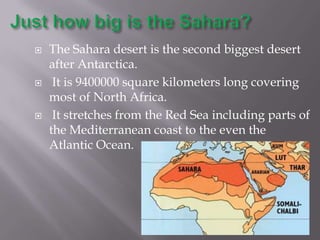
   The Sahara desert is the second biggest desert
    after Antarctica.
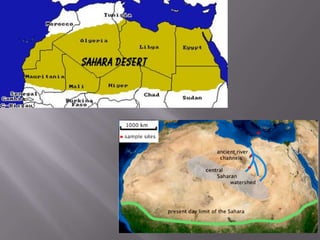
    It is 9400000 square kilometers long covering
    most of North Africa.
    It stretches from the Red Sea including parts of
    the Mediterranean coast to the even the
    Atlantic Ocean.
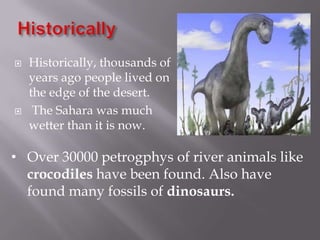
   Historically, thousands of
    years ago people lived on
    the edge of the desert.
    The Sahara was much
    wetter than it is now.

• Over 30000 petrogphys of river animals like
  crocodiles have been found. Also have
  found many fossils of dinosaurs.
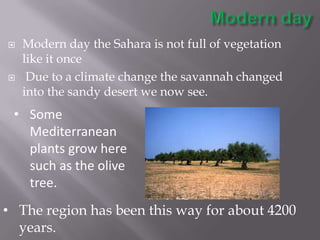
   Modern day the Sahara is not full of vegetation
    like it once
    Due to a climate change the savannah changed
    into the sandy desert we now see.
 • Some
   Mediterranean
   plants grow here
   such as the olive
   tree.
• The region has been this way for about 4200
  years.
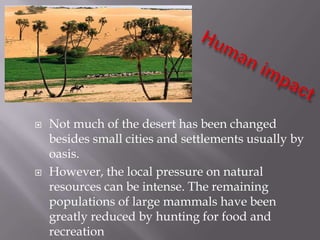
   Not much of the desert has been changed
    besides small cities and settlements usually by
    oasis.
   However, the local pressure on natural
    resources can be intense. The remaining
    populations of large mammals have been
    greatly reduced by hunting for food and
    recreation
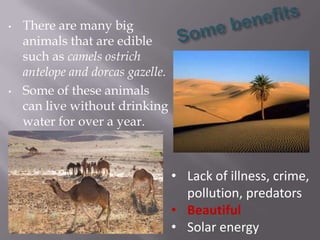
•   There are many big
    animals that are edible
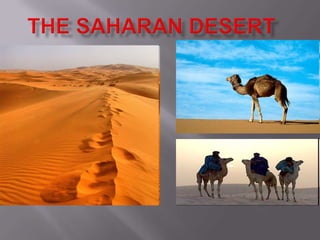
    such as camels ostrich
    antelope and dorcas gazelle.
•   Some of these animals
    can live without drinking
    water for over a year.


                                   • Lack of illness, crime,
                                     pollution, predators
                                   • Beautiful
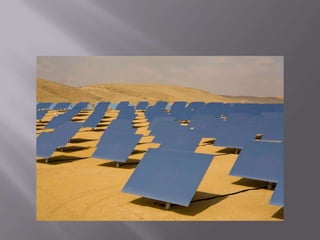
                                   • Solar energy
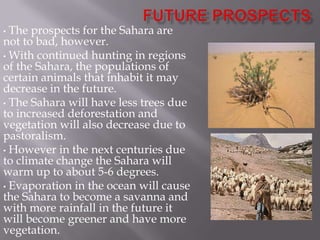
• The prospects for the Sahara are
not to bad, however.
• With continued hunting in regions
of the Sahara, the populations of
certain animals that inhabit it may
decrease in the future.
• The Sahara will have less trees due
to increased deforestation and
vegetation will also decrease due to
pastoralism.
• However in the next centuries due
to climate change the Sahara will
warm up to about 5-6 degrees.
• Evaporation in the ocean will cause
the Sahara to become a savanna and
with more rainfall in the future it
will become greener and have more
vegetation.
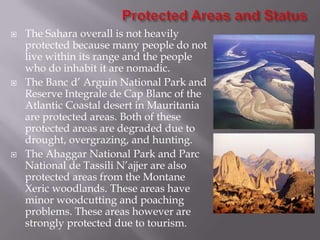
   The Sahara overall is not heavily
    protected because many people do not
    live within its range and the people
    who do inhabit it are nomadic.
   The Banc d’ Arguin National Park and
    Reserve Integrale de Cap Blanc of the
    Atlantic Coastal desert in Mauritania
    are protected areas. Both of these
    protected areas are degraded due to
    drought, overgrazing, and hunting.
   The Ahaggar National Park and Parc
    National de Tassili N’ajjer are also
    protected areas from the Montane
    Xeric woodlands. These areas have
    minor woodcutting and poaching
    problems. These areas however are
    strongly protected due to tourism.
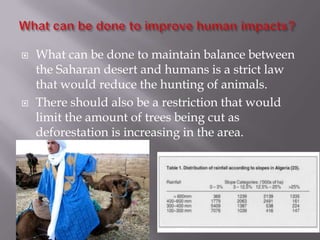
   What can be done to maintain balance between
    the Saharan desert and humans is a strict law
    that would reduce the hunting of animals.
   There should also be a restriction that would
    limit the amount of trees being cut as
    deforestation is increasing in the area.
   World Wildlife. 2011. World Wildlife Fund. 27 Nov 2011.
    http://www.worldwildlife.org/wildworld/profiles/terrestrial/pa/pa13
    04_full.html
   World Wildlife. 2011. World Wildlife Fund. 27 Nov 2011.
    http://www.worldwildlife.org/wildworld/profiles/terrestrial/pa/pa13
    32_full.html
   World Wildlife. 2011. World Wildlife Fund. 27 Nov 2011.
    http://www.worldwildlife.org/wildworld/profiles/terrestrial/pa/pa13
    27_full.html
   Discover Magazine. 25 Oct 2006. Kalmbach Publishing Company. 27 Nov
    2011. http://discovermagazine.com/2006/oct/sahara-desert-savanna-
    climate
   Wikipedia. 30 Nov 2011. Wikimedia Foundation Inc. 27 Nov 2011.
    http://en.wikipedia.org/wiki/Sahara_desert
   Foley A. Jonathan, Michael T. Coe, Marten Scheffer, and Guiling Wang.
    “Regime Shifts im the Sahara and Sahel: Interactions between Ecological
    and Climatic Systems in Northern Africa” Ecosystems 6.6 (2003): 527.
   Zaimeche Eddine Salah. “The Consequences of Rapid Deforestation: A
    North African Example” Ambio 23.2 (Mar., 1994): 138.

The Saharan Desert

  • 1.
    Anosh Ali & Rodrigo Mojarro
  • 4.
    The Sahara desert is the second biggest desert after Antarctica.  It is 9400000 square kilometers long covering most of North Africa.  It stretches from the Red Sea including parts of the Mediterranean coast to the even the Atlantic Ocean.
  • 5.
    Historically, thousands of years ago people lived on the edge of the desert.  The Sahara was much wetter than it is now. • Over 30000 petrogphys of river animals like crocodiles have been found. Also have found many fossils of dinosaurs.
  • 6.
    Modern day the Sahara is not full of vegetation like it once  Due to a climate change the savannah changed into the sandy desert we now see. • Some Mediterranean plants grow here such as the olive tree. • The region has been this way for about 4200 years.
  • 8.
    Not much of the desert has been changed besides small cities and settlements usually by oasis.  However, the local pressure on natural resources can be intense. The remaining populations of large mammals have been greatly reduced by hunting for food and recreation
  • 9.
    There are many big animals that are edible such as camels ostrich antelope and dorcas gazelle. • Some of these animals can live without drinking water for over a year. • Lack of illness, crime, pollution, predators • Beautiful • Solar energy
  • 11.
    • The prospectsfor the Sahara are not to bad, however. • With continued hunting in regions of the Sahara, the populations of certain animals that inhabit it may decrease in the future. • The Sahara will have less trees due to increased deforestation and vegetation will also decrease due to pastoralism. • However in the next centuries due to climate change the Sahara will warm up to about 5-6 degrees. • Evaporation in the ocean will cause the Sahara to become a savanna and with more rainfall in the future it will become greener and have more vegetation.
  • 12.
    The Sahara overall is not heavily protected because many people do not live within its range and the people who do inhabit it are nomadic.  The Banc d’ Arguin National Park and Reserve Integrale de Cap Blanc of the Atlantic Coastal desert in Mauritania are protected areas. Both of these protected areas are degraded due to drought, overgrazing, and hunting.  The Ahaggar National Park and Parc National de Tassili N’ajjer are also protected areas from the Montane Xeric woodlands. These areas have minor woodcutting and poaching problems. These areas however are strongly protected due to tourism.
  • 13.
    What can be done to maintain balance between the Saharan desert and humans is a strict law that would reduce the hunting of animals.  There should also be a restriction that would limit the amount of trees being cut as deforestation is increasing in the area.
  • 14.
    World Wildlife. 2011. World Wildlife Fund. 27 Nov 2011. http://www.worldwildlife.org/wildworld/profiles/terrestrial/pa/pa13 04_full.html  World Wildlife. 2011. World Wildlife Fund. 27 Nov 2011. http://www.worldwildlife.org/wildworld/profiles/terrestrial/pa/pa13 32_full.html  World Wildlife. 2011. World Wildlife Fund. 27 Nov 2011. http://www.worldwildlife.org/wildworld/profiles/terrestrial/pa/pa13 27_full.html  Discover Magazine. 25 Oct 2006. Kalmbach Publishing Company. 27 Nov 2011. http://discovermagazine.com/2006/oct/sahara-desert-savanna- climate  Wikipedia. 30 Nov 2011. Wikimedia Foundation Inc. 27 Nov 2011. http://en.wikipedia.org/wiki/Sahara_desert  Foley A. Jonathan, Michael T. Coe, Marten Scheffer, and Guiling Wang. “Regime Shifts im the Sahara and Sahel: Interactions between Ecological and Climatic Systems in Northern Africa” Ecosystems 6.6 (2003): 527.  Zaimeche Eddine Salah. “The Consequences of Rapid Deforestation: A North African Example” Ambio 23.2 (Mar., 1994): 138.