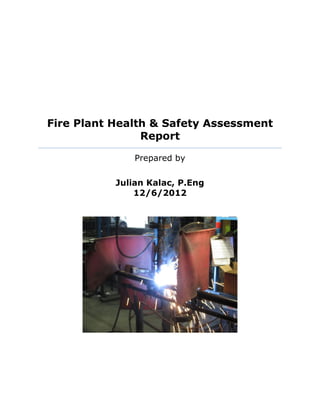
Fire Plant Health & Safety Assessment
Report
Prepared by
Julian Kalac, P.Eng
12/6/2012
To: Al LeMaitre, Kirk Daize, Eric St-Amant
C.C.: Jim Anderson
From: Julian Kalac, P.Eng License #90505462
Date: December 6, 2012
Re: Unaddressed Health & Safety Issues by Noble
(550 Applewood Crescent location)
Background of reviewer:
I am a Mechanical Engineer and a Professional Engineer (P.Eng.) with over 16 years of
experience in manufacturing with Industrial machines/equipment and processes. My
experience and training have made me very familiar with OSHA/MOL Regulations and
Standards.
OBJECTIVE:
There are 2 objectives in this report:
1. Review the open MOL orders and determine best ways to comply with
them ASAP to prevent MOL fines/penalties
2. Identify non-compliance, including non-compliance associated with
exposure to chemicals and other designated substances, indicate what
measures are necessary to bring the apparatus, structure, protective
element or reviewed process into compliance with applicable sections
referenced in Section 7 of Regulation 851.
Referenced Standards
CSA-Z432-94-- Safeguarding of Machinery
ISO-12100-1&2 Safety of Machinery: General Principles for MachineDesign
CSA A344. 1-05/A344.2-05 (Inspecting & Maintaining Steel Storage Racks)
CAN3-Z180.1-00 Compressed Breathing Air and Systems
CSA-W117.2-94 Safety in Welding, Cutting and Allied Processes
ANSI/B11.19-1990 (R97) Safeguarding Methods
ANSI/Z244.1-1982 Lockout/Tagout of Energy Sources
ANSI/ALI ALOIM-2000 Safety Requirements for Operation, Inspection and
Maintenance
ISO-14121 Safety of Machinery – Principles of Risk Assessment
OHSA Regulation 851, section 7
Ontario's Occupational Health and Safety Act (OHSA) governs workplace health and
safety in this province. Section 7 of Regulation 851 under OHSA deals with "Pre-Start"
Health and Safety Reviews. This type of Health and Safety Review is required in a
factory whenever a process or equipment addition or modification involves any of the
following:
1. Flammable Liquids,
2. Safeguarding Devices That Signal The Apparatus To Stop,
3. Rack Or Stacking Structures,
4. Risk Of Ignition Or Explosion,
5. Dust Collectors,
6. Molten Or Melted Material,
7. Lifting Devices, Travelling Cranes Or Automotive Hoists,
8. Exposure To Substances In Excess Of Regulated Limits. (Oel)
SAFETY ISSUES & MOL orders:
The following are Safety issues in relation to 851 prioritized in severity:
1. Open Mol Order’s Since Nov 11, 2011
2. Lack Of Safe Guarding (Welding & Plasma Cutting)
3. Lack Of Ventialtion Of Toxic/Hazardous Gases/Fumes
4. Types Of Hazards & Max Oel (STEL/ C & Twa) --??
5. Inadequate Plant Lighting
6. Poor Safety System
 Lack Of Mandatory Safety Training Ohsa Whimis, Hazmat, Jha, Fire-
Protection, Guarding, Lock-Out/Tag-Out, Etc.
 No Monthly Inspections, Inspection Reports, Worker Involvement
 Lack Of Hazard Recognition And Awareness
1. OPEN MOL ORDER’S (NOV 11, 2011)
There are 2 open MOL orders since Nov 11, 2011 which are still not addressed
A. In House Racking Validation
B. NOGEO Machine Guarding
In House Racking
 Management in charge of MOL orders did not notify Safe Engineering on-time to
come and validate the racks built and as a result the rack needs to be revaluated
for loading requirements.
 My preliminary calculations indicate this current rack design can be easily
modified as per Mechanics of Material by adding additional support rods at the
end positions to support the pipes and create uniformed load distribution with
equal supports on all sides (see below)
RACK # 4 IN QUESTION
NOGEO Machine Guarding
As per our meeting Oct 29th
, 2012 Maintenance was supposed to provide a fixed barrier
by around the perimeter where the Moving Chuck runs to guard/protect exposure of
moving chuck part and prevent exposure to any pinch-points hazards. This was the
easiest way to guard this area which is secluded in the back of the plant
LACK OF WELDING/PLASMA SAFE GUARDING
The welder is guarded with a make-shift blanket which requires the operator to close and
open every time.
Welding PPE does NOT EXIST. Operators are constantly exposed to radiation and
welding hazards without protection.
CSA Standard Z94.3-07, Eye and Face Protectors, CSA Standard Z94.3-02, Industrial
Eye and Face Protectors, or CAN/CSA-Z94.3-99, Industrial Eye and Face Protectors
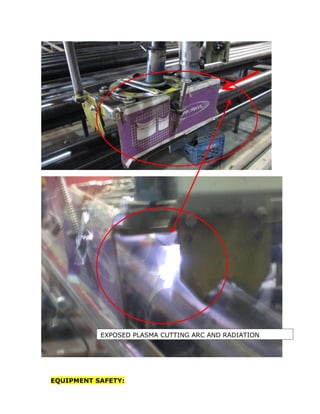
PLASMA CUTTER CARDBOARD GUARDING
OPERATOR EXPOSED TO WELDING HAZARDS
DURING OPERATION WITHOUT ANY SAFE GUARDING
The most serious and unsafe condition is the lack of safe guarding of the plasma
Burner/Cutter. IT HAS A CARDBOARD GUARD AS A SHIELD WHICH IS BOTH
HIGHLY FLAMMABLE AND DANGEROUS
THE PLASMA ARC PRODUCES RADIATION AND UV LIGHT WHICH IS EXPOSED
DURING OPERATION WITHOUT PROPER PROTECTION
BURN MARKS ON THE CARDOBOARD
EQUIPMENT SAFETY:
EXPOSED PLASMA CUTTING ARC AND RADIATION
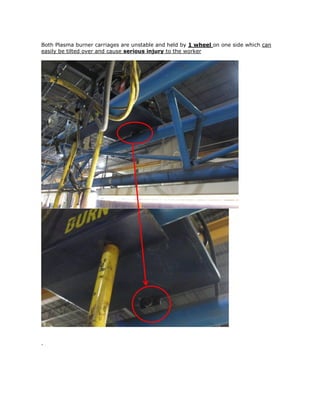
Both Plasma burner carriages are unstable and held by 1 wheel on one side which can
easily be tilted over and cause serious injury to the worker
.
LACK OF VENTILATION
Welding Gases/ Fumes
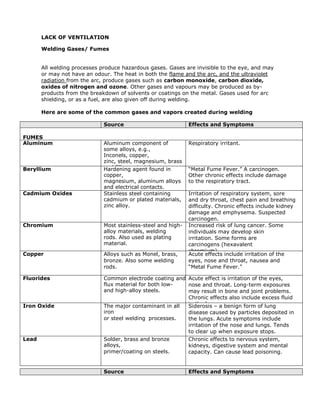
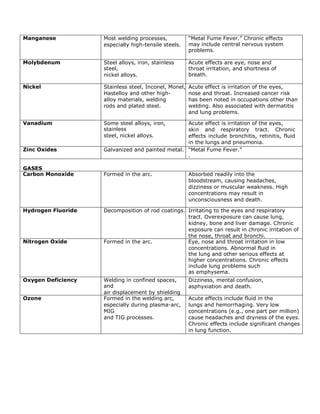
All welding processes produce hazardous gases. Gases are invisible to the eye, and may
or may not have an odour. The heat in both the flame and the arc, and the ultraviolet
radiation from the arc, produce gases such as carbon monoxide, carbon dioxide,
oxides of nitrogen and ozone. Other gases and vapours may be produced as by-
products from the breakdown of solvents or coatings on the metal. Gases used for arc
shielding, or as a fuel, are also given off during welding.
Here are some of the common gases and vapors created during welding
Source Effects and Symptoms
FUMES
Aluminum Aluminum component of
some alloys, e.g.,
Inconels, copper,
zinc, steel, magnesium, brass
and filler materials.
Respiratory irritant.
Beryllium Hardening agent found in
copper,
magnesium, aluminum alloys
and electrical contacts.
“Metal Fume Fever.” A carcinogen.
Other chronic effects include damage
to the respiratory tract.
Cadmium Oxides Stainless steel containing
cadmium or plated materials,
zinc alloy.
Irritation of respiratory system, sore
and dry throat, chest pain and breathing
difficulty. Chronic effects include kidney
damage and emphysema. Suspected
carcinogen.
Chromium Most stainless-steel and high-
alloy materials, welding
rods. Also used as plating
material.
Increased risk of lung cancer. Some
individuals may develop skin
irritation. Some forms are
carcinogens (hexavalent
chromium).
Copper Alloys such as Monel, brass,
bronze. Also some welding
rods.
Acute effects include irritation of the
eyes, nose and throat, nausea and
“Metal Fume Fever.”
Fluorides Common electrode coating and
flux material for both low-
and high-alloy steels.
Acute effect is irritation of the eyes,
nose and throat. Long-term exposures
may result in bone and joint problems.
Chronic effects also include excess fluid
in the lungs.Iron Oxide The major contaminant in all
iron
or steel welding processes.
Siderosis – a benign form of lung
disease caused by particles deposited in
the lungs. Acute symptoms include
irritation of the nose and lungs. Tends
to clear up when exposure stops.
Lead Solder, brass and bronze
alloys,
primer/coating on steels.
Chronic effects to nervous system,
kidneys, digestive system and mental
capacity. Can cause lead poisoning.
Source Effects and Symptoms
Manganese Most welding processes,
especially high-tensile steels.
“Metal Fume Fever.” Chronic effects
may include central nervous system
problems.
Molybdenum Steel alloys, iron, stainless
steel,
nickel alloys.
Acute effects are eye, nose and
throat irritation, and shortness of
breath.
Nickel Stainless steel, Inconel, Monel,
Hastelloy and other high-
alloy materials, welding
rods and plated steel.
Acute effect is irritation of the eyes,
nose and throat. Increased cancer risk
has been noted in occupations other than
welding. Also associated with dermatitis
and lung problems.
Vanadium Some steel alloys, iron,
stainless
steel, nickel alloys.
Acute effect is irritation of the eyes,
skin and respiratory tract. Chronic
effects include bronchitis, retinitis, fluid
in the lungs and pneumonia.
Zinc Oxides Galvanized and painted metal. “Metal Fume Fever.”
.
GASES
Carbon Monoxide Formed in the arc. Absorbed readily into the
bloodstream, causing headaches,
dizziness or muscular weakness. High
concentrations may result in
unconsciousness and death.
Hydrogen Fluoride Decomposition of rod coatings. Irritating to the eyes and respiratory
tract. Overexposure can cause lung,
kidney, bone and liver damage. Chronic
exposure can result in chronic irritation of
the nose, throat and bronchi.
Nitrogen Oxide Formed in the arc. Eye, nose and throat irritation in low
concentrations. Abnormal fluid in
the lung and other serious effects at
higher concentrations. Chronic effects
include lung problems such
as emphysema.
Oxygen Deficiency Welding in confined spaces,
and
air displacement by shielding
gas.
Dizziness, mental confusion,
asphyxiation and death.
Ozone Formed in the welding arc,
especially during plasma-arc,
MIG
and TIG processes.
Acute effects include fluid in the
lungs and hemorrhaging. Very low
concentrations (e.g., one part per million)
cause headaches and dryness of the eyes.
Chronic effects include significant changes
in lung function.
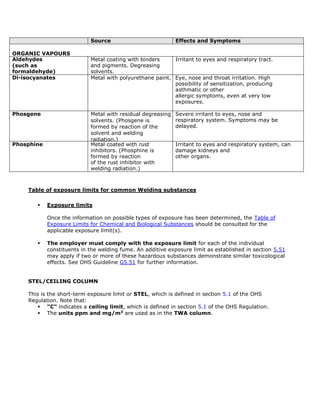
Source Effects and Symptoms
ORGANIC VAPOURS
Aldehydes
(such as
formaldehyde)
Metal coating with binders
and pigments. Degreasing
solvents.
Irritant to eyes and respiratory tract.
Di-isocyanates Metal with polyurethane paint. Eye, nose and throat irritation. High
possibility of sensitization, producing
asthmatic or other
allergic symptoms, even at very low
exposures.
Phosgene Metal with residual degreasing
solvents. (Phosgene is
formed by reaction of the
solvent and welding
radiation.)
Severe irritant to eyes, nose and
respiratory system. Symptoms may be
delayed.
Phosphine Metal coated with rust
inhibitors. (Phosphine is
formed by reaction
of the rust inhibitor with
welding radiation.)
Irritant to eyes and respiratory system, can
damage kidneys and
other organs.
Table of exposure limits for common Welding substances
 Exposure limits
Once the information on possible types of exposure has been determined, the Table of
Exposure Limits for Chemical and Biological Substances should be consulted for the
applicable exposure limit(s).
 The employer must comply with the exposure limit for each of the individual
constituents in the welding fume. An additive exposure limit as established in section 5.51
may apply if two or more of these hazardous substances demonstrate similar toxicological
effects. See OHS Guideline G5.51 for further information.
STEL/CEILING COLUMN
This is the short-term exposure limit or STEL, which is defined in section 5.1 of the OHS
Regulation. Note that:
 "C" indicates a ceiling limit, which is defined in section 5.1 of the OHS Regulation.
 The units ppm and mg/m3
are used as in the TWA column.
Page 12 of 14 Noble Fire PSHR 3 November 2012
Substance [CAS No.] TWA STEL/Ceiling Notations
Acetylene [74-86-2]
Simple
asphyxiant
Aluminum metal and insoluble compounds [7429-90-
5] , Respirable, Revised 2008
1.0 mg/m3
Beryllium and compounds, as Be [7440-41-7]
Revised 2009; 2010
0.002
mg/m3
0.01 mg/m3
Skin; S, A1,
1
Carbon black, Inhalable [1333-86-4] Revised 2011 3 mg/m3 2B
CARBON DIOXIDE [124-38-9] 5000 PPM 15,000 PPM
Carbon monoxide [630-08-0] 25 ppm 100 ppm R
Carbon tetrabromide [558-13-4] 0.1 ppm 0.3 ppm
Carbonyl fluoride [353-50-4] 2 ppm 5 ppm
Chromium - Metal [7440-47-3] 0.5 mg/m3
Copper - Fume, as Cu [7440-50-8] 0.2 mg/m3
Fluorides (as F)
2.5
mg/m3
Hydrogen fluoride, as F [7664-39-3] C 2 ppm
Iron oxide dust, as Fe [1309-37-1] 5 mg/m3
Iron oxide fume , as Fe [1309-37-1] 5 mg/m3 10 mg/m3
Molybdenum - Soluble compounds, as Mo, Respirable
[7439-98-7]
0.5 mg/m3
Nitric oxide [10102-43-9] 25 ppm
NITROUS OXIDE [10024-97-2] 25 PPM R
Oxygen difluoride [7783-41-7] C 0.05 ppm
Ozone - Heavy work [10028-15-6] 0.05 ppm
Ozone - Moderate work [10028-15-6] 0.08 ppm
Vanadium pentoxide, Respirable dust and fume, as
V2O5 [1314-62-1]
C 0.05 mg/m3 2B
Tin - Organic compounds, as Sn [7440-31-6] 0.1 mg/m3 0.2 mg/m3 Skin
Titanium dioxide [13463-67-7] Revised 2006
10 mg/m3
(N)
2B
Section 5.48 of the OHS Regulation states:
“Except as otherwise determined, the employer must ensure that no worker
is exposed to a substance that exceeds the ceiling limit, short-term
exposure limit, or 8-hour TWA limit
TWA is the employee's average airborne exposure in any 8-hour work shift of a 40-hour
work week which shall not be exceeded."
Page 13 of 14 Noble Fire PSHR 3 November 2012
Training
Several workers, including myself have not received any safety training this year. There are no
training sheets and no information on who has been trained and what is outstanding. There are
MANDATORY OHSA SAFETY TRAINING requirements for all employees. This mandatory annual
training is on the following topics:
1. WHMIS, MSDS, HAZMAT, FIRE PROTECTION,
2. Lock Out Tag Out, Machine Guarding,
3. JHA, Emergency Evacuation, First Aid, Blood Borne Pathogen,etc
CONCLUSION & RECOMMENDATIONS:
It is clear that the current Health & Safety system is not working and the plant is in grave danger
of a serious accident waiting to happen.
The external people in charge of Health & Safety have, for whatever reason, neglected the workers
and their safety and not been able to provide the needed leadership and training to the workers &
ensure their safety concerns are addressed.
The safety belongs to the people of Noble Fire and their leaders, Al, Kirk & the workers. They need
to be able to close out open MOL orders, implement effective the needed action items, which will
make the plant safer without having
PROPOSED SOLUTIONS:
As a Professional Engineer our duty to the public welfare & safety is considered paramount and
are expected to go above and beyond the call of duty if needed.
Therefore I Am Prepared To Take On Additional Responsibility Of The Following Action Items:.
MOL & SAFETY
 Work Together With Kirk And Al And Open MOL Orders
 Redesign The In-House Rack # 4 And Determine Maximum Load Requirements
 Design/Implement The Proper Guarding For The Welders/Plasma Cutters Which Would
Meet Identify The Exposure Substances And Develop Short Term Plans To Meet The
Occupational Exposure Limits
 Train The Workers On All The Needed Health & Safety Requirements And Implement A
HAZARD RECOGNITION SAFETY PROCESS Which Enable The Workers To Have A More
Meaningful Role In The Overall Plant Safety.
Production Capacity
 Complete the new outlet testing validation/qualification (70% completed)
 Finalize the new welding equipment specification and ventilation system which will
ensure proper extraction is designed into the equipment
 Look into ways to speed up the capacity improvement in order to reduce the 12 hr shifts
back to 8 hr shifts to reduce exposure time
 Overlook the design, build and proper implementation of the new equipment which will
ensure full OHSA compliance
Page 14 of 14 Noble Fire PSHR 3 November 2012
Assist Al and Kirk in all needed Health & Safety, Quality and Productivity action items in
order to make their plant a safer more productive plant
Sincerely,
Julian Kalac, P.Eng.

Fire Safety Report Nov 2 2012

  • 1.
    Fire Plant Health& Safety Assessment Report Prepared by Julian Kalac, P.Eng 12/6/2012
  • 2.
    To: Al LeMaitre,Kirk Daize, Eric St-Amant C.C.: Jim Anderson From: Julian Kalac, P.Eng License #90505462 Date: December 6, 2012 Re: Unaddressed Health & Safety Issues by Noble (550 Applewood Crescent location) Background of reviewer: I am a Mechanical Engineer and a Professional Engineer (P.Eng.) with over 16 years of experience in manufacturing with Industrial machines/equipment and processes. My experience and training have made me very familiar with OSHA/MOL Regulations and Standards. OBJECTIVE: There are 2 objectives in this report: 1. Review the open MOL orders and determine best ways to comply with them ASAP to prevent MOL fines/penalties 2. Identify non-compliance, including non-compliance associated with exposure to chemicals and other designated substances, indicate what measures are necessary to bring the apparatus, structure, protective element or reviewed process into compliance with applicable sections referenced in Section 7 of Regulation 851. Referenced Standards CSA-Z432-94-- Safeguarding of Machinery ISO-12100-1&2 Safety of Machinery: General Principles for MachineDesign CSA A344. 1-05/A344.2-05 (Inspecting & Maintaining Steel Storage Racks) CAN3-Z180.1-00 Compressed Breathing Air and Systems CSA-W117.2-94 Safety in Welding, Cutting and Allied Processes ANSI/B11.19-1990 (R97) Safeguarding Methods ANSI/Z244.1-1982 Lockout/Tagout of Energy Sources ANSI/ALI ALOIM-2000 Safety Requirements for Operation, Inspection and Maintenance ISO-14121 Safety of Machinery – Principles of Risk Assessment OHSA Regulation 851, section 7
  • 3.
    Ontario's Occupational Healthand Safety Act (OHSA) governs workplace health and safety in this province. Section 7 of Regulation 851 under OHSA deals with "Pre-Start" Health and Safety Reviews. This type of Health and Safety Review is required in a factory whenever a process or equipment addition or modification involves any of the following: 1. Flammable Liquids, 2. Safeguarding Devices That Signal The Apparatus To Stop, 3. Rack Or Stacking Structures, 4. Risk Of Ignition Or Explosion, 5. Dust Collectors, 6. Molten Or Melted Material, 7. Lifting Devices, Travelling Cranes Or Automotive Hoists, 8. Exposure To Substances In Excess Of Regulated Limits. (Oel) SAFETY ISSUES & MOL orders: The following are Safety issues in relation to 851 prioritized in severity: 1. Open Mol Order’s Since Nov 11, 2011 2. Lack Of Safe Guarding (Welding & Plasma Cutting) 3. Lack Of Ventialtion Of Toxic/Hazardous Gases/Fumes 4. Types Of Hazards & Max Oel (STEL/ C & Twa) --?? 5. Inadequate Plant Lighting 6. Poor Safety System  Lack Of Mandatory Safety Training Ohsa Whimis, Hazmat, Jha, Fire- Protection, Guarding, Lock-Out/Tag-Out, Etc.  No Monthly Inspections, Inspection Reports, Worker Involvement  Lack Of Hazard Recognition And Awareness 1. OPEN MOL ORDER’S (NOV 11, 2011) There are 2 open MOL orders since Nov 11, 2011 which are still not addressed A. In House Racking Validation B. NOGEO Machine Guarding In House Racking
  • 4.
     Management incharge of MOL orders did not notify Safe Engineering on-time to come and validate the racks built and as a result the rack needs to be revaluated for loading requirements.  My preliminary calculations indicate this current rack design can be easily modified as per Mechanics of Material by adding additional support rods at the end positions to support the pipes and create uniformed load distribution with equal supports on all sides (see below) RACK # 4 IN QUESTION NOGEO Machine Guarding As per our meeting Oct 29th , 2012 Maintenance was supposed to provide a fixed barrier by around the perimeter where the Moving Chuck runs to guard/protect exposure of moving chuck part and prevent exposure to any pinch-points hazards. This was the easiest way to guard this area which is secluded in the back of the plant LACK OF WELDING/PLASMA SAFE GUARDING
  • 5.
    The welder isguarded with a make-shift blanket which requires the operator to close and open every time. Welding PPE does NOT EXIST. Operators are constantly exposed to radiation and welding hazards without protection. CSA Standard Z94.3-07, Eye and Face Protectors, CSA Standard Z94.3-02, Industrial Eye and Face Protectors, or CAN/CSA-Z94.3-99, Industrial Eye and Face Protectors PLASMA CUTTER CARDBOARD GUARDING OPERATOR EXPOSED TO WELDING HAZARDS DURING OPERATION WITHOUT ANY SAFE GUARDING
  • 6.
    The most seriousand unsafe condition is the lack of safe guarding of the plasma Burner/Cutter. IT HAS A CARDBOARD GUARD AS A SHIELD WHICH IS BOTH HIGHLY FLAMMABLE AND DANGEROUS THE PLASMA ARC PRODUCES RADIATION AND UV LIGHT WHICH IS EXPOSED DURING OPERATION WITHOUT PROPER PROTECTION BURN MARKS ON THE CARDOBOARD
  • 7.
    EQUIPMENT SAFETY: EXPOSED PLASMACUTTING ARC AND RADIATION
  • 8.
    Both Plasma burnercarriages are unstable and held by 1 wheel on one side which can easily be tilted over and cause serious injury to the worker .
  • 9.
    LACK OF VENTILATION WeldingGases/ Fumes All welding processes produce hazardous gases. Gases are invisible to the eye, and may or may not have an odour. The heat in both the flame and the arc, and the ultraviolet radiation from the arc, produce gases such as carbon monoxide, carbon dioxide, oxides of nitrogen and ozone. Other gases and vapours may be produced as by- products from the breakdown of solvents or coatings on the metal. Gases used for arc shielding, or as a fuel, are also given off during welding. Here are some of the common gases and vapors created during welding Source Effects and Symptoms FUMES Aluminum Aluminum component of some alloys, e.g., Inconels, copper, zinc, steel, magnesium, brass and filler materials. Respiratory irritant. Beryllium Hardening agent found in copper, magnesium, aluminum alloys and electrical contacts. “Metal Fume Fever.” A carcinogen. Other chronic effects include damage to the respiratory tract. Cadmium Oxides Stainless steel containing cadmium or plated materials, zinc alloy. Irritation of respiratory system, sore and dry throat, chest pain and breathing difficulty. Chronic effects include kidney damage and emphysema. Suspected carcinogen. Chromium Most stainless-steel and high- alloy materials, welding rods. Also used as plating material. Increased risk of lung cancer. Some individuals may develop skin irritation. Some forms are carcinogens (hexavalent chromium). Copper Alloys such as Monel, brass, bronze. Also some welding rods. Acute effects include irritation of the eyes, nose and throat, nausea and “Metal Fume Fever.” Fluorides Common electrode coating and flux material for both low- and high-alloy steels. Acute effect is irritation of the eyes, nose and throat. Long-term exposures may result in bone and joint problems. Chronic effects also include excess fluid in the lungs.Iron Oxide The major contaminant in all iron or steel welding processes. Siderosis – a benign form of lung disease caused by particles deposited in the lungs. Acute symptoms include irritation of the nose and lungs. Tends to clear up when exposure stops. Lead Solder, brass and bronze alloys, primer/coating on steels. Chronic effects to nervous system, kidneys, digestive system and mental capacity. Can cause lead poisoning. Source Effects and Symptoms
  • 10.
    Manganese Most weldingprocesses, especially high-tensile steels. “Metal Fume Fever.” Chronic effects may include central nervous system problems. Molybdenum Steel alloys, iron, stainless steel, nickel alloys. Acute effects are eye, nose and throat irritation, and shortness of breath. Nickel Stainless steel, Inconel, Monel, Hastelloy and other high- alloy materials, welding rods and plated steel. Acute effect is irritation of the eyes, nose and throat. Increased cancer risk has been noted in occupations other than welding. Also associated with dermatitis and lung problems. Vanadium Some steel alloys, iron, stainless steel, nickel alloys. Acute effect is irritation of the eyes, skin and respiratory tract. Chronic effects include bronchitis, retinitis, fluid in the lungs and pneumonia. Zinc Oxides Galvanized and painted metal. “Metal Fume Fever.” . GASES Carbon Monoxide Formed in the arc. Absorbed readily into the bloodstream, causing headaches, dizziness or muscular weakness. High concentrations may result in unconsciousness and death. Hydrogen Fluoride Decomposition of rod coatings. Irritating to the eyes and respiratory tract. Overexposure can cause lung, kidney, bone and liver damage. Chronic exposure can result in chronic irritation of the nose, throat and bronchi. Nitrogen Oxide Formed in the arc. Eye, nose and throat irritation in low concentrations. Abnormal fluid in the lung and other serious effects at higher concentrations. Chronic effects include lung problems such as emphysema. Oxygen Deficiency Welding in confined spaces, and air displacement by shielding gas. Dizziness, mental confusion, asphyxiation and death. Ozone Formed in the welding arc, especially during plasma-arc, MIG and TIG processes. Acute effects include fluid in the lungs and hemorrhaging. Very low concentrations (e.g., one part per million) cause headaches and dryness of the eyes. Chronic effects include significant changes in lung function.
  • 11.
    Source Effects andSymptoms ORGANIC VAPOURS Aldehydes (such as formaldehyde) Metal coating with binders and pigments. Degreasing solvents. Irritant to eyes and respiratory tract. Di-isocyanates Metal with polyurethane paint. Eye, nose and throat irritation. High possibility of sensitization, producing asthmatic or other allergic symptoms, even at very low exposures. Phosgene Metal with residual degreasing solvents. (Phosgene is formed by reaction of the solvent and welding radiation.) Severe irritant to eyes, nose and respiratory system. Symptoms may be delayed. Phosphine Metal coated with rust inhibitors. (Phosphine is formed by reaction of the rust inhibitor with welding radiation.) Irritant to eyes and respiratory system, can damage kidneys and other organs. Table of exposure limits for common Welding substances  Exposure limits Once the information on possible types of exposure has been determined, the Table of Exposure Limits for Chemical and Biological Substances should be consulted for the applicable exposure limit(s).  The employer must comply with the exposure limit for each of the individual constituents in the welding fume. An additive exposure limit as established in section 5.51 may apply if two or more of these hazardous substances demonstrate similar toxicological effects. See OHS Guideline G5.51 for further information. STEL/CEILING COLUMN This is the short-term exposure limit or STEL, which is defined in section 5.1 of the OHS Regulation. Note that:  "C" indicates a ceiling limit, which is defined in section 5.1 of the OHS Regulation.  The units ppm and mg/m3 are used as in the TWA column.
  • 12.
    Page 12 of14 Noble Fire PSHR 3 November 2012 Substance [CAS No.] TWA STEL/Ceiling Notations Acetylene [74-86-2] Simple asphyxiant Aluminum metal and insoluble compounds [7429-90- 5] , Respirable, Revised 2008 1.0 mg/m3 Beryllium and compounds, as Be [7440-41-7] Revised 2009; 2010 0.002 mg/m3 0.01 mg/m3 Skin; S, A1, 1 Carbon black, Inhalable [1333-86-4] Revised 2011 3 mg/m3 2B CARBON DIOXIDE [124-38-9] 5000 PPM 15,000 PPM Carbon monoxide [630-08-0] 25 ppm 100 ppm R Carbon tetrabromide [558-13-4] 0.1 ppm 0.3 ppm Carbonyl fluoride [353-50-4] 2 ppm 5 ppm Chromium - Metal [7440-47-3] 0.5 mg/m3 Copper - Fume, as Cu [7440-50-8] 0.2 mg/m3 Fluorides (as F) 2.5 mg/m3 Hydrogen fluoride, as F [7664-39-3] C 2 ppm Iron oxide dust, as Fe [1309-37-1] 5 mg/m3 Iron oxide fume , as Fe [1309-37-1] 5 mg/m3 10 mg/m3 Molybdenum - Soluble compounds, as Mo, Respirable [7439-98-7] 0.5 mg/m3 Nitric oxide [10102-43-9] 25 ppm NITROUS OXIDE [10024-97-2] 25 PPM R Oxygen difluoride [7783-41-7] C 0.05 ppm Ozone - Heavy work [10028-15-6] 0.05 ppm Ozone - Moderate work [10028-15-6] 0.08 ppm Vanadium pentoxide, Respirable dust and fume, as V2O5 [1314-62-1] C 0.05 mg/m3 2B Tin - Organic compounds, as Sn [7440-31-6] 0.1 mg/m3 0.2 mg/m3 Skin Titanium dioxide [13463-67-7] Revised 2006 10 mg/m3 (N) 2B Section 5.48 of the OHS Regulation states: “Except as otherwise determined, the employer must ensure that no worker is exposed to a substance that exceeds the ceiling limit, short-term exposure limit, or 8-hour TWA limit TWA is the employee's average airborne exposure in any 8-hour work shift of a 40-hour work week which shall not be exceeded."
  • 13.
    Page 13 of14 Noble Fire PSHR 3 November 2012 Training Several workers, including myself have not received any safety training this year. There are no training sheets and no information on who has been trained and what is outstanding. There are MANDATORY OHSA SAFETY TRAINING requirements for all employees. This mandatory annual training is on the following topics: 1. WHMIS, MSDS, HAZMAT, FIRE PROTECTION, 2. Lock Out Tag Out, Machine Guarding, 3. JHA, Emergency Evacuation, First Aid, Blood Borne Pathogen,etc CONCLUSION & RECOMMENDATIONS: It is clear that the current Health & Safety system is not working and the plant is in grave danger of a serious accident waiting to happen. The external people in charge of Health & Safety have, for whatever reason, neglected the workers and their safety and not been able to provide the needed leadership and training to the workers & ensure their safety concerns are addressed. The safety belongs to the people of Noble Fire and their leaders, Al, Kirk & the workers. They need to be able to close out open MOL orders, implement effective the needed action items, which will make the plant safer without having PROPOSED SOLUTIONS: As a Professional Engineer our duty to the public welfare & safety is considered paramount and are expected to go above and beyond the call of duty if needed. Therefore I Am Prepared To Take On Additional Responsibility Of The Following Action Items:. MOL & SAFETY  Work Together With Kirk And Al And Open MOL Orders  Redesign The In-House Rack # 4 And Determine Maximum Load Requirements  Design/Implement The Proper Guarding For The Welders/Plasma Cutters Which Would Meet Identify The Exposure Substances And Develop Short Term Plans To Meet The Occupational Exposure Limits  Train The Workers On All The Needed Health & Safety Requirements And Implement A HAZARD RECOGNITION SAFETY PROCESS Which Enable The Workers To Have A More Meaningful Role In The Overall Plant Safety. Production Capacity  Complete the new outlet testing validation/qualification (70% completed)  Finalize the new welding equipment specification and ventilation system which will ensure proper extraction is designed into the equipment  Look into ways to speed up the capacity improvement in order to reduce the 12 hr shifts back to 8 hr shifts to reduce exposure time  Overlook the design, build and proper implementation of the new equipment which will ensure full OHSA compliance
  • 14.
    Page 14 of14 Noble Fire PSHR 3 November 2012 Assist Al and Kirk in all needed Health & Safety, Quality and Productivity action items in order to make their plant a safer more productive plant Sincerely, Julian Kalac, P.Eng.