Trelleborg AVS
Employee Site Induction.Employee Site Induction.
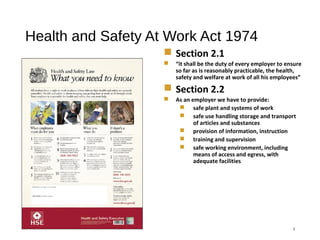
Health and Safety At Work Act 1974
2
 Section 2.1
 “it shall be the duty of every employer to ensure
so far as is reasonably practicable, the health,
safety and welfare at work of all his employees”
 Section 2.2
 As an employer we have to provide:
 safe plant and systems of work
 safe use handling storage and transport
of articles and substances
 provision of information, instruction
 training and supervision
 safe working environment, including
means of access and egress, with
adequate facilities
Health and Safety At Work Act 1974
3
 Section 7/8
 Employees Must :
 Take reasonable care for their own
health and safety
 Co-operate with their employer
 Not interfere with anything provided
for H&S
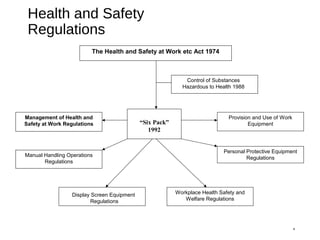
Health and Safety
Regulations
4
The Health and Safety at Work etc Act 1974
“Six Pack”
1992
Provision and Use of Work
Equipment
Personal Protective Equipment
Regulations
Management of Health and
Safety at Work Regulations
Manual Handling Operations
Regulations
Workplace Health Safety and
Welfare Regulations
Display Screen Equipment
Regulations
Control of Substances
Hazardous to Health 1988
Management of H&S at Work Regs
•Employers must :
• Carry out risk assessments
• Train Employees
• Ensure employees have a safe place to work
•Employees must :
• Co-operate and use all control measures (Training,
equipment etc)
• Report all hazards and issues in the safety
arrangements to their supervisor
• Exercise their Duty of Care to look after themselves and others around
them
5
Hazards & Risk
Hazards: Any way in which a persons H&S
can be harmed
Machinery, electricity, working at heights.
Can be health issue as well – dermatitis, N.I.H.L`
Risk: Chances of harm actually occurring
6
Workplace Health Safety and Welfare Regs
• Hygiene and Welfare
• Clean ventilated toilets - separate or lockable
• Wash basins with hot/cold running water
• Showers for dirty work and emergencies
• Soap and hand towels(dryers)
• Skin cleansers and conditions where necessary
• Drying facilities for wet clothes, lockers, changing facilities
• Clean drinking water
• Rest facilities for eating food
• Special arrangements for pregnant women and nursing mothers.
7
Workplace Health Safety and Welfare Regs
• Fire Precautions
• Provide enough exits, fire doors and escape routes marked
• Out opening doors
• Test fire alarm (each Wednesday at 12.00)
• Provide enough extinguishers
• Clear evacuation procedures
• Comfortable conditions
• Reasonable working temperature – usually 13° / 16°
• Local heating/cooling where comfortable temperatures cannot be
maintained
• Thermal clothing and rest facilities for extreme conditions
• Good ventilation – avoid draughts
• Heating equipment must be safe – no fumes
• Sufficient space
8
SAFETY COMMITTEE
• The site Safety Committee consists of the following:
Managers
Union Reps
Supervisor / Team Leader
Shop Floor employee
The meetings are held every other month.
If you have a safety issue then inform somebody straight away.
If it is a non urgent issue then inform your Union Rep or Supervisor and request it
be brought up at the meeting.
Minutes of the meeting are placed on the H&S notice board in the employee
entrance.
9
Display Screen Equipment
• Using DSE can cause injury if used incorrectly.
• If used correctly DSE is safe
• To ensure safe use you should :
• Adjust your workstation to suit yourself
• Take regular breaks
• Use equipment provided e.g.
• Foot Rests
• Document Holders
• Report any defects
• Carry out DSE assessment (contact HS&E Manager ext. 332 for assessment sheet)
10
Health and Safety(Display Screen Equipment) Regulations
Display Screen Equipment
11
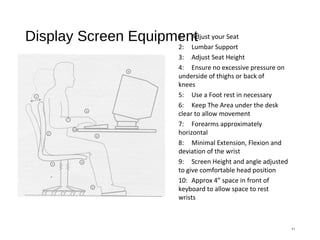
1: Adjust your Seat
2: Lumbar Support
3: Adjust Seat Height
4: Ensure no excessive pressure on
underside of thighs or back of
knees
5: Use a Foot rest in necessary
6: Keep The Area under the desk
clear to allow movement
7: Forearms approximately
horizontal
8: Minimal Extension, Flexion and
deviation of the wrist
9: Screen Height and angle adjusted
to give comfortable head position
10: Approx 4” space in front of
keyboard to allow space to rest
wrists
Manual Handling Legislation
12
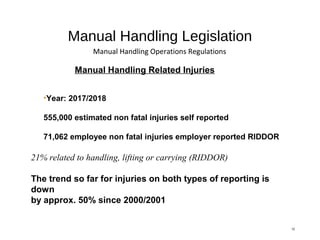
Manual Handling Operations Regulations
Manual Handling Related Injuries
•Year: 2017/2018
555,000 estimated non fatal injuries self reported
71,062 employee non fatal injuries employer reported RIDDOR
21% related to handling, lifting or carrying (RIDDOR)
The trend so far for injuries on both types of reporting is
down
by approx. 50% since 2000/2001
Manual
Handling
Manual Handling Operations Regulations
Employers Duties:
1) Avoid the need for his employees to undertake any manual
handling operations at work which involve a risk of their being injured.
2) Where it is not reasonably practicable to avoid the need for any
manual handling operations which involve a risk of their being injured:
• Make a Suitable and Sufficient Assessment
• Take appropriate steps to reduce the risk of injury to lowest level
• Provide employees with mechanical means of lifting where practicable
• TAVS at Leicester provide: FLT, Stacker Trucks, Pallet trucks, cranes &
scissor tables
13
Manual
Handling
To move a load safely follow these simple steps:
Am I capable of lifting the load
If Yes:
Position your feet correctly : 9 - 12 inches apart
At an angle of 90o
Pointing in the direction of travel
Bend your knees
Grip the object with a palm diagonal grip
Raise your chin (protects the spine’s curvature)
Breath in (supports your spine and provides oxygen)
Raise the load by straightening your knees
Keep the load close to your body
Step off in the direction your feet are pointing
If No: get help, do not attempt to lift an object if it is too heavy
you may injure yourself.
14
The Safe Lift.
Control of Noise at Work
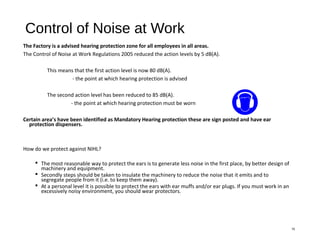
The Factory is a advised hearing protection zone for all employees in all areas.
The Control of Noise at Work Regulations 2005 reduced the action levels by 5 dB(A).
This means that the first action level is now 80 dB(A).
- the point at which hearing protection is advised
The second action level has been reduced to 85 dB(A).
- the point at which hearing protection must be worn
Certain area’s have been identified as Mandatory Hearing protection these are sign posted and have ear
protection dispensers.
How do we protect against NIHL?
 The most reasonable way to protect the ears is to generate less noise in the first place, by better design of
machinery and equipment.
 Secondly steps should be taken to insulate the machinery to reduce the noise that it emits and to
segregate people from it (i.e. to keep them away).
 At a personal level it is possible to protect the ears with ear muffs and/or ear plugs. If you must work in an
excessively noisy environment, you should wear protectors.
15
Control of Noise at Work
16
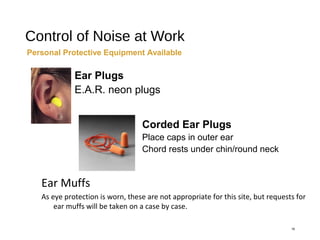
Personal Protective Equipment Available
Ear Muffs
As eye protection is worn, these are not appropriate for this site, but requests for
ear muffs will be taken on a case by case.
Ear Plugs
E.A.R. neon plugs
Corded Ear Plugs
Place caps in outer ear
Chord rests under chin/round neck
Control of Noise at Work
17
P.P.E. Available
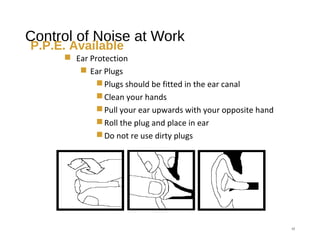
 Ear Protection
 Ear Plugs
Plugs should be fitted in the ear canal
Clean your hands
Pull your ear upwards with your opposite hand
Roll the plug and place in ear
Do not re use dirty plugs
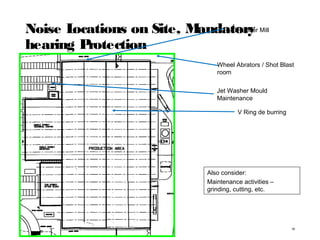
Noise Locations on Site, Mandatory
hearing Protection
18
Also consider:
Maintenance activities –
grinding, cutting, etc.
Wheel Abrators / Shot Blast
room
Jet Washer Mould
Maintenance
V Ring de burring
84” Rubber Mill
Personal Protective Equipment
19
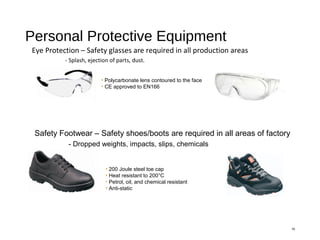
Eye Protection – Safety glasses are required in all production areas
- Splash, ejection of parts, dust.
Safety Footwear – Safety shoes/boots are required in all areas of factory
- Dropped weights, impacts, slips, chemicals
• Polycarbonate lens contoured to the face
• CE approved to EN166
• 200 Joule steel toe cap
• Heat resistant to 200°C
• Petrol, oil, and chemical resistant
• Anti-static
Personal Protective Equipment
20
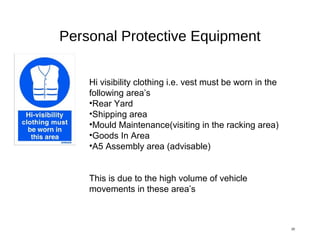
Hi visibility clothing i.e. vest must be worn in the
following area’s
•Rear Yard
•Shipping area
•Mould Maintenance(visiting in the racking area)
•Goods In Area
•A5 Assembly area (advisable)
This is due to the high volume of vehicle
movements in these area’s
Chemical Hazards
• COSHH 2004
• These regulations require the employer to
 Assess all likely exposure
 Put in place control measures
 Prevent exposure
 Monitor exposure and health effects
 To inform employees of hazards and controls
 The COSHH Assessment system has recently been re written
• Chemical information is available on INTERSOLIA a live web based system.
All supervisors have a read only access to this system. For more information
contact HS&E Manager
• These regulations require employees to use all control measures
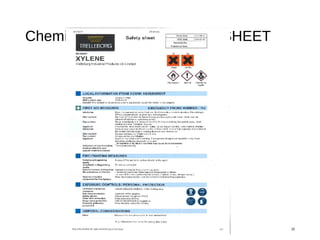
• Chemical Safety Sheets are available in Supervisors Office or in Specific
Departments
21
Chemical Hazards – SAFETY SHEET
22
Chemical Hazards
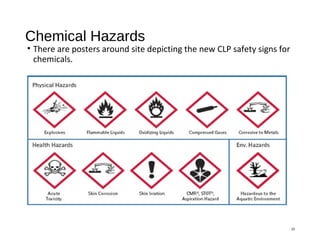
• There are posters around site depicting the new CLP safety signs for
chemicals.
23
Chemical Hazards
• There are hazardous substances in all work areas e.g.:
 Rubber Fume
 Solvents
 Paints
 Photocopy toner
 Ozone
• All these substances can be very harmful, however if used correctly and with the correct
PPE (where necessary) they are safe.
The consumption of food is not permitted in the factory.
Cold and hot drinks can only be consumed in the canteen or at the at the point of dispensing
in the factory.
• Mobile phones may only be used in accordance with site policy
24
Machinery Hazards
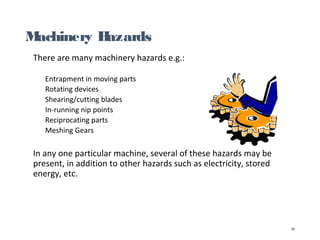
There are many machinery hazards e.g.:
Entrapment in moving parts
Rotating devices
Shearing/cutting blades
In-running nip points
Reciprocating parts
Meshing Gears
In any one particular machine, several of these hazards may be
present, in addition to other hazards such as electricity, stored
energy, etc.
25
Machinery Hazards
Be aware of the potential for hazards
ALWAYS follow operational procedures
Wear eye protection Mandatory
Keep clothing tucked in
Do not wear jewellery or other apparel that might become entangled in moving
parts
Keep long hair tied back
Do not wear gloves with rotating machinery – REFER TO GLOVE SELECTION
CHART
Ear plugs must be used when identified
Face Shields must be worn when operating buffing machine
Arm protectors must be worn when moulding
Some machinery operations can create fine dust/fumes
• Ensure that L.E.V is operational
• Use identified P.P.E.
26
Risk Assessments & Training
• Task Risk Assessments are being reviewed and new documents
compiled, ensure you read the relevant risk assessments for the
area / task you are going to be undertaking and sign as having read
and understood the assessment. This is a Health & Safety
requirement.
• Risk Assessments are held in the Supervisors office or specific
departments.
• If you are moved to another dept. ensure you read the risk
assessment for that dept.
• If you are required to use an overhead crane you must have
completed on site training before you can use them.
• Do not use any machine you have not been trained to use.
27
Lone Working
• There is a lone worker alarm system installed on site.
• If there is occasion for you to work alone you must use the system.
• The system consists of a pager type device that you sign out and pair
with the alarm board.
• The system is located in the shop floor Supervisors office.
• If you require to use the system then ask your Supervisor to carry out
training for you to use.
28
Accident / Incident Reporting Procedure
• What is an Accident?
• An unplanned event resulting in damage to person or property
• What is a Near Miss accident?
• An unplanned event that caused no loss ( property damage or injury)
• What can accidents teach us?
• They can teach us not to do the same thing again
29
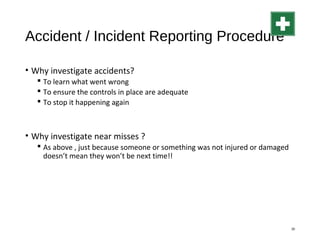
Accident / Incident Reporting Procedure
• Why investigate accidents?
 To learn what went wrong
 To ensure the controls in place are adequate
 To stop it happening again
• Why investigate near misses ?
 As above , just because someone or something was not injured or damaged
doesn’t mean they won’t be next time!!
30
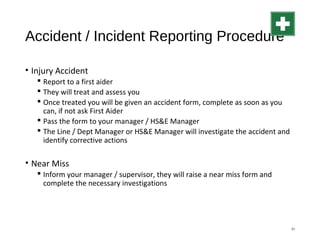
Accident / Incident Reporting Procedure
• Injury Accident
 Report to a first aider
 They will treat and assess you
 Once treated you will be given an accident form, complete as soon as you
can, if not ask First Aider
 Pass the form to your manager / HS&E Manager
 The Line / Dept Manager or HS&E Manager will investigate the accident and
identify corrective actions
• Near Miss
 Inform your manager / supervisor, they will raise a near miss form and
complete the necessary investigations
31
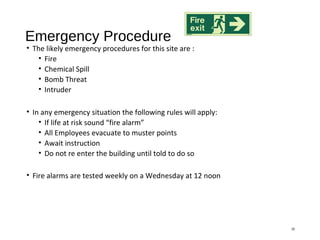
Emergency Procedure
• The likely emergency procedures for this site are :
• Fire
• Chemical Spill
• Bomb Threat
• Intruder
• In any emergency situation the following rules will apply:
• If life at risk sound “fire alarm”
• All Employees evacuate to muster points
• Await instruction
• Do not re enter the building until told to do so
• Fire alarms are tested weekly on a Wednesday at 12 noon
32
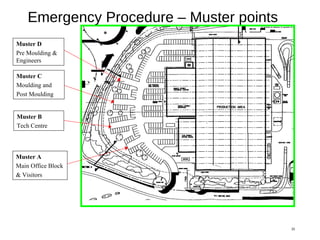
Emergency Procedure – Muster points
33
Muster D
Pre Moulding &
Engineers
Muster A
Main Office Block
& Visitors
Muster B
Tech Centre
Muster C
Moulding and
Post Moulding
Emergency Procedures - Spills
• Chemical emergencies are typically caused by:
 Spillage
 Fire
 In appropriate storage
• In the event you see a chemical spill you must inform the area
supervisor as soon as possible. Take all possible steps to prevent it
going to drain.
 Use Emergency Spill Kits
• Surround the spill
• Prevent it entering watercourses/land
• Absorb it
• Report it to Supervision and HS&E Advisor
34
Emergency Procedures – Fire
awareness
35
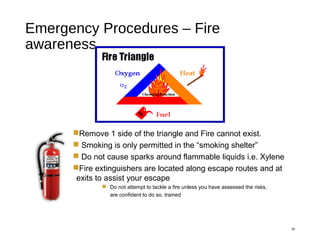
Remove 1 side of the triangle and Fire cannot exist.
 Smoking is only permitted in the “smoking shelter”
 Do not cause sparks around flammable liquids i.e. Xylene
Fire extinguishers are located along escape routes and at
exits to assist your escape
 Do not attempt to tackle a fire unless you have assessed the risks,
are confident to do so, trained
Environment & Health & Safety Systems
• We operate to BSEN ISO14001:2015
- Environmental Management System
• Aspects and Impacts of the site can be found on CMS, these include:
• Use of Electricity/Gas – Use of natural resource
• Generation of solvent gasses – Ozone depletion
• Generation of waste materials – The majority of our waste is
recycled or reused
We also have accreditation to OHSAS 18001 Health & Safety Management System,
we strive to ensure that all our employees, visitors and contractors are safe
when working on our site.
Both Management Systems are subject to continuous improvement
36
Environmental issues
• As a Company we have to comply with numerous environmental
issues some of which are:
• Noise
• Dust
• Solvents - Storage and Use
• Fume / Smell
• Discharge to Sewer
• Use of Electricity / Gas
• Waste Notifiable Waste
37
Refer to Standard Operations and follow Procedures for Waste control
- if in doubt always ask
THANK YOU FOR YOUR TIME
ENJOY YOUR STAY WITH TAVS
•THINK SAFE
•WORK SAFE
•BE SAFE
38

Induction current

  • 1.
    Trelleborg AVS Employee SiteInduction.Employee Site Induction.
  • 2.
    Health and SafetyAt Work Act 1974 2  Section 2.1  “it shall be the duty of every employer to ensure so far as is reasonably practicable, the health, safety and welfare at work of all his employees”  Section 2.2  As an employer we have to provide:  safe plant and systems of work  safe use handling storage and transport of articles and substances  provision of information, instruction  training and supervision  safe working environment, including means of access and egress, with adequate facilities
  • 3.
    Health and SafetyAt Work Act 1974 3  Section 7/8  Employees Must :  Take reasonable care for their own health and safety  Co-operate with their employer  Not interfere with anything provided for H&S
  • 4.
    Health and Safety Regulations 4 TheHealth and Safety at Work etc Act 1974 “Six Pack” 1992 Provision and Use of Work Equipment Personal Protective Equipment Regulations Management of Health and Safety at Work Regulations Manual Handling Operations Regulations Workplace Health Safety and Welfare Regulations Display Screen Equipment Regulations Control of Substances Hazardous to Health 1988
  • 5.
    Management of H&Sat Work Regs •Employers must : • Carry out risk assessments • Train Employees • Ensure employees have a safe place to work •Employees must : • Co-operate and use all control measures (Training, equipment etc) • Report all hazards and issues in the safety arrangements to their supervisor • Exercise their Duty of Care to look after themselves and others around them 5
  • 6.
    Hazards & Risk Hazards:Any way in which a persons H&S can be harmed Machinery, electricity, working at heights. Can be health issue as well – dermatitis, N.I.H.L` Risk: Chances of harm actually occurring 6
  • 7.
    Workplace Health Safetyand Welfare Regs • Hygiene and Welfare • Clean ventilated toilets - separate or lockable • Wash basins with hot/cold running water • Showers for dirty work and emergencies • Soap and hand towels(dryers) • Skin cleansers and conditions where necessary • Drying facilities for wet clothes, lockers, changing facilities • Clean drinking water • Rest facilities for eating food • Special arrangements for pregnant women and nursing mothers. 7
  • 8.
    Workplace Health Safetyand Welfare Regs • Fire Precautions • Provide enough exits, fire doors and escape routes marked • Out opening doors • Test fire alarm (each Wednesday at 12.00) • Provide enough extinguishers • Clear evacuation procedures • Comfortable conditions • Reasonable working temperature – usually 13° / 16° • Local heating/cooling where comfortable temperatures cannot be maintained • Thermal clothing and rest facilities for extreme conditions • Good ventilation – avoid draughts • Heating equipment must be safe – no fumes • Sufficient space 8
  • 9.
    SAFETY COMMITTEE • Thesite Safety Committee consists of the following: Managers Union Reps Supervisor / Team Leader Shop Floor employee The meetings are held every other month. If you have a safety issue then inform somebody straight away. If it is a non urgent issue then inform your Union Rep or Supervisor and request it be brought up at the meeting. Minutes of the meeting are placed on the H&S notice board in the employee entrance. 9
  • 10.
    Display Screen Equipment •Using DSE can cause injury if used incorrectly. • If used correctly DSE is safe • To ensure safe use you should : • Adjust your workstation to suit yourself • Take regular breaks • Use equipment provided e.g. • Foot Rests • Document Holders • Report any defects • Carry out DSE assessment (contact HS&E Manager ext. 332 for assessment sheet) 10 Health and Safety(Display Screen Equipment) Regulations
  • 11.
    Display Screen Equipment 11 1:Adjust your Seat 2: Lumbar Support 3: Adjust Seat Height 4: Ensure no excessive pressure on underside of thighs or back of knees 5: Use a Foot rest in necessary 6: Keep The Area under the desk clear to allow movement 7: Forearms approximately horizontal 8: Minimal Extension, Flexion and deviation of the wrist 9: Screen Height and angle adjusted to give comfortable head position 10: Approx 4” space in front of keyboard to allow space to rest wrists
  • 12.
    Manual Handling Legislation 12 ManualHandling Operations Regulations Manual Handling Related Injuries •Year: 2017/2018 555,000 estimated non fatal injuries self reported 71,062 employee non fatal injuries employer reported RIDDOR 21% related to handling, lifting or carrying (RIDDOR) The trend so far for injuries on both types of reporting is down by approx. 50% since 2000/2001
  • 13.
    Manual Handling Manual Handling OperationsRegulations Employers Duties: 1) Avoid the need for his employees to undertake any manual handling operations at work which involve a risk of their being injured. 2) Where it is not reasonably practicable to avoid the need for any manual handling operations which involve a risk of their being injured: • Make a Suitable and Sufficient Assessment • Take appropriate steps to reduce the risk of injury to lowest level • Provide employees with mechanical means of lifting where practicable • TAVS at Leicester provide: FLT, Stacker Trucks, Pallet trucks, cranes & scissor tables 13
  • 14.
    Manual Handling To move aload safely follow these simple steps: Am I capable of lifting the load If Yes: Position your feet correctly : 9 - 12 inches apart At an angle of 90o Pointing in the direction of travel Bend your knees Grip the object with a palm diagonal grip Raise your chin (protects the spine’s curvature) Breath in (supports your spine and provides oxygen) Raise the load by straightening your knees Keep the load close to your body Step off in the direction your feet are pointing If No: get help, do not attempt to lift an object if it is too heavy you may injure yourself. 14 The Safe Lift.
  • 15.
    Control of Noiseat Work The Factory is a advised hearing protection zone for all employees in all areas. The Control of Noise at Work Regulations 2005 reduced the action levels by 5 dB(A). This means that the first action level is now 80 dB(A). - the point at which hearing protection is advised The second action level has been reduced to 85 dB(A). - the point at which hearing protection must be worn Certain area’s have been identified as Mandatory Hearing protection these are sign posted and have ear protection dispensers. How do we protect against NIHL?  The most reasonable way to protect the ears is to generate less noise in the first place, by better design of machinery and equipment.  Secondly steps should be taken to insulate the machinery to reduce the noise that it emits and to segregate people from it (i.e. to keep them away).  At a personal level it is possible to protect the ears with ear muffs and/or ear plugs. If you must work in an excessively noisy environment, you should wear protectors. 15
  • 16.
    Control of Noiseat Work 16 Personal Protective Equipment Available Ear Muffs As eye protection is worn, these are not appropriate for this site, but requests for ear muffs will be taken on a case by case. Ear Plugs E.A.R. neon plugs Corded Ear Plugs Place caps in outer ear Chord rests under chin/round neck
  • 17.
    Control of Noiseat Work 17 P.P.E. Available  Ear Protection  Ear Plugs Plugs should be fitted in the ear canal Clean your hands Pull your ear upwards with your opposite hand Roll the plug and place in ear Do not re use dirty plugs
  • 18.
    Noise Locations onSite, Mandatory hearing Protection 18 Also consider: Maintenance activities – grinding, cutting, etc. Wheel Abrators / Shot Blast room Jet Washer Mould Maintenance V Ring de burring 84” Rubber Mill
  • 19.
    Personal Protective Equipment 19 EyeProtection – Safety glasses are required in all production areas - Splash, ejection of parts, dust. Safety Footwear – Safety shoes/boots are required in all areas of factory - Dropped weights, impacts, slips, chemicals • Polycarbonate lens contoured to the face • CE approved to EN166 • 200 Joule steel toe cap • Heat resistant to 200°C • Petrol, oil, and chemical resistant • Anti-static
  • 20.
    Personal Protective Equipment 20 Hivisibility clothing i.e. vest must be worn in the following area’s •Rear Yard •Shipping area •Mould Maintenance(visiting in the racking area) •Goods In Area •A5 Assembly area (advisable) This is due to the high volume of vehicle movements in these area’s
  • 21.
    Chemical Hazards • COSHH2004 • These regulations require the employer to  Assess all likely exposure  Put in place control measures  Prevent exposure  Monitor exposure and health effects  To inform employees of hazards and controls  The COSHH Assessment system has recently been re written • Chemical information is available on INTERSOLIA a live web based system. All supervisors have a read only access to this system. For more information contact HS&E Manager • These regulations require employees to use all control measures • Chemical Safety Sheets are available in Supervisors Office or in Specific Departments 21
  • 22.
    Chemical Hazards –SAFETY SHEET 22
  • 23.
    Chemical Hazards • Thereare posters around site depicting the new CLP safety signs for chemicals. 23
  • 24.
    Chemical Hazards • Thereare hazardous substances in all work areas e.g.:  Rubber Fume  Solvents  Paints  Photocopy toner  Ozone • All these substances can be very harmful, however if used correctly and with the correct PPE (where necessary) they are safe. The consumption of food is not permitted in the factory. Cold and hot drinks can only be consumed in the canteen or at the at the point of dispensing in the factory. • Mobile phones may only be used in accordance with site policy 24
  • 25.
    Machinery Hazards There aremany machinery hazards e.g.: Entrapment in moving parts Rotating devices Shearing/cutting blades In-running nip points Reciprocating parts Meshing Gears In any one particular machine, several of these hazards may be present, in addition to other hazards such as electricity, stored energy, etc. 25
  • 26.
    Machinery Hazards Be awareof the potential for hazards ALWAYS follow operational procedures Wear eye protection Mandatory Keep clothing tucked in Do not wear jewellery or other apparel that might become entangled in moving parts Keep long hair tied back Do not wear gloves with rotating machinery – REFER TO GLOVE SELECTION CHART Ear plugs must be used when identified Face Shields must be worn when operating buffing machine Arm protectors must be worn when moulding Some machinery operations can create fine dust/fumes • Ensure that L.E.V is operational • Use identified P.P.E. 26
  • 27.
    Risk Assessments &Training • Task Risk Assessments are being reviewed and new documents compiled, ensure you read the relevant risk assessments for the area / task you are going to be undertaking and sign as having read and understood the assessment. This is a Health & Safety requirement. • Risk Assessments are held in the Supervisors office or specific departments. • If you are moved to another dept. ensure you read the risk assessment for that dept. • If you are required to use an overhead crane you must have completed on site training before you can use them. • Do not use any machine you have not been trained to use. 27
  • 28.
    Lone Working • Thereis a lone worker alarm system installed on site. • If there is occasion for you to work alone you must use the system. • The system consists of a pager type device that you sign out and pair with the alarm board. • The system is located in the shop floor Supervisors office. • If you require to use the system then ask your Supervisor to carry out training for you to use. 28
  • 29.
    Accident / IncidentReporting Procedure • What is an Accident? • An unplanned event resulting in damage to person or property • What is a Near Miss accident? • An unplanned event that caused no loss ( property damage or injury) • What can accidents teach us? • They can teach us not to do the same thing again 29
  • 30.
    Accident / IncidentReporting Procedure • Why investigate accidents?  To learn what went wrong  To ensure the controls in place are adequate  To stop it happening again • Why investigate near misses ?  As above , just because someone or something was not injured or damaged doesn’t mean they won’t be next time!! 30
  • 31.
    Accident / IncidentReporting Procedure • Injury Accident  Report to a first aider  They will treat and assess you  Once treated you will be given an accident form, complete as soon as you can, if not ask First Aider  Pass the form to your manager / HS&E Manager  The Line / Dept Manager or HS&E Manager will investigate the accident and identify corrective actions • Near Miss  Inform your manager / supervisor, they will raise a near miss form and complete the necessary investigations 31
  • 32.
    Emergency Procedure • Thelikely emergency procedures for this site are : • Fire • Chemical Spill • Bomb Threat • Intruder • In any emergency situation the following rules will apply: • If life at risk sound “fire alarm” • All Employees evacuate to muster points • Await instruction • Do not re enter the building until told to do so • Fire alarms are tested weekly on a Wednesday at 12 noon 32
  • 33.
    Emergency Procedure –Muster points 33 Muster D Pre Moulding & Engineers Muster A Main Office Block & Visitors Muster B Tech Centre Muster C Moulding and Post Moulding
  • 34.
    Emergency Procedures -Spills • Chemical emergencies are typically caused by:  Spillage  Fire  In appropriate storage • In the event you see a chemical spill you must inform the area supervisor as soon as possible. Take all possible steps to prevent it going to drain.  Use Emergency Spill Kits • Surround the spill • Prevent it entering watercourses/land • Absorb it • Report it to Supervision and HS&E Advisor 34
  • 35.
    Emergency Procedures –Fire awareness 35 Remove 1 side of the triangle and Fire cannot exist.  Smoking is only permitted in the “smoking shelter”  Do not cause sparks around flammable liquids i.e. Xylene Fire extinguishers are located along escape routes and at exits to assist your escape  Do not attempt to tackle a fire unless you have assessed the risks, are confident to do so, trained
  • 36.
    Environment & Health& Safety Systems • We operate to BSEN ISO14001:2015 - Environmental Management System • Aspects and Impacts of the site can be found on CMS, these include: • Use of Electricity/Gas – Use of natural resource • Generation of solvent gasses – Ozone depletion • Generation of waste materials – The majority of our waste is recycled or reused We also have accreditation to OHSAS 18001 Health & Safety Management System, we strive to ensure that all our employees, visitors and contractors are safe when working on our site. Both Management Systems are subject to continuous improvement 36
  • 37.
    Environmental issues • Asa Company we have to comply with numerous environmental issues some of which are: • Noise • Dust • Solvents - Storage and Use • Fume / Smell • Discharge to Sewer • Use of Electricity / Gas • Waste Notifiable Waste 37 Refer to Standard Operations and follow Procedures for Waste control - if in doubt always ask
  • 38.
    THANK YOU FORYOUR TIME ENJOY YOUR STAY WITH TAVS •THINK SAFE •WORK SAFE •BE SAFE 38