INDUSTRIAL SAFETY AND
ENVIRONMENT
 Ropes, Chains, Sling, Hoops, Clamps
 Arresting gears and Prime movers
 Ergonomic consideration in material handling
 Design, installation, operation and maintenance of Conveying equipment
 Hoisting, travelling and slewing mechanisms
 Selection, operation and maintenance of industrial trucks
 Selection, operation and maintenance of Mobile cranes and Tower crane
 Storage and Retrieval of common goods of various shapes and sizes in a
general store of a big industry
Tuesday, October 19, 2021
2 Renuraman J
SAFETY IN MATERIAL HANDLING
Material Handling
 Material handling is the job done by every worker in an industry from unloading raw
materials dispatching the finished product and Materials handled between operations in
every department or plant of the company.
 Mechanized material handling equipment has come into the industry to eliminate the
human handling or to assist the person to handle move, varied and heavy objects.
 Mechanical handling of materials reduces manufacturing cost and increases the
productivity. At the same time mechanical handling has , a new set of hazards and injuries.
 The accidents in material handling are almost due to human failure or unsafe acts rather
than mechanical failures or unsafe conditions. The ratio between unsafe acts and unsafe
conditions in material handling accidents is 4 to 1.
Tuesday, October 19, 2021
3 Renuraman J
The following statistics , highlights the magnitude of material handling problems
to be solved in eliminating the unsafe acts and conditions .
 For every ton of finished product 50 to 120 ton of equivalent material has to be
handled.
 2/3 of manufacturing cycle is material handling.
 40% accidents are due to unsafe material handling.
 80% accidents in material handling are due to human failure or unsafe acts.
Tuesday, October 19, 2021
4 Renuraman J
MATERIALS ARE HANDLED IN THREE
METHODS
 Manual handling
 With the help of hand tool
 Mechanized material handling
Tuesday, October 19, 2021
5 Renuraman J
THE ACCIDENTS AND INJURIES THAT ARE COMMON
IN UNSAFE MATERIAL HANDLING WORK ARE
 Dropping or slipping of objects on the foot.
 Body organs Pressed in between objects and lifting tackles.
 Cuts due to sharp edges.
 Burns due to hot or corrosive substance.
 Sprains while lifting materials by wrong method.
 Scalp injuries while working in confined spaces
Tuesday, October 19, 2021
6 Renuraman J
MANUAL HANDLING
 Manual handling means using physical strength to move Materials
 This method increases the possibilities of injuries and adds to the cost of
product.
 To reduce the number of material handling injuries and increase the efficiency,
material handling to be minimized by combining and eliminating operations or
mechanization.
 Even after all elimination and mechanization there will be still objects to be
lifted manually
 for which the following factors are to be taken into consideration for safe acts
in materials handling.
Tuesday, October 19, 2021
7 Renuraman J
 Material to be handled, terrain or the surface.
 The distance to be moved.
 The direction of the load to be taken.
 Volume and weight, shape and size.
 Frequency.
 Mode of handling.
FACTORS TO BE CONSIDERED BEFORE
ATTEMPTING TO LIFT A LOAD
Tuesday, October 19, 2021
8 Renuraman J
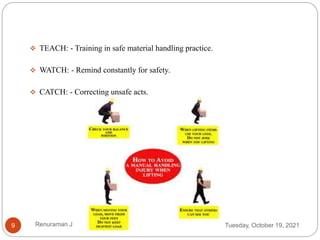
 TEACH: - Training in safe material handling practice.
 WATCH: - Remind constantly for safety.
 CATCH: - Correcting unsafe acts.
Tuesday, October 19, 2021
9 Renuraman J
TRAINING AND CONSTANT SUPERVISION
WILL REDUCE THE UNSAFE ACTS
 Inspect materials for sleeves, jagged edges burns, rough or slippery surfaces.
 Get a firm grip on the object.
 Keep fingers away from material resting points, especially when setting down on the
rollers.
 When handling timber, pipe or other long objects keep hands away from the ends to
prevent them from being pinched.
 Wipe of greasy, wet, slippery or dirty objects before trying to handle them.
 Most strains and back injuries occur while lifting and setting down objects by hands.
Tuesday, October 19, 2021
10 Renuraman J
PROPER METHOD OF MANUAL
HANDLING
 Consider the size, weight and shape of the object to be carried. Do not lift more
than the object that can be handled comfortably. If necessary get help from
others.
 Set feet solidly. One foot can be slightly ahead of the other for increased
effectiveness. Feet should be enough apart to give good balance and stability(
approximately the width of the shoulder).
 Get close to the load as possible. Bend legs about 90 degrees at the knees.
Crouch do not squat. It takes about twice as much effort to get up from squat.
 Keep the back as straight as possible. Bend at the hips, not the middle of the
back. Tuesday, October 19, 2021
11 Renuraman J
PROPER METHOD OF MANUAL
HANDLING
 Grip the object firmly. Maintain the grip while lifting or carrying. Before changing
or adjusting the grip set the object down again.
 Straighten the legs to lift the object, and at the same time bring the back to a vertical
position. Look upward when beginning to lift.
 Never carry a load you cannot see over or around. Make sure the path of travel is
clear. Carry the object close to the body.
 Never turn at the waist, to change the direction or to put an object down. Turn the
whole body and crouch down to lower the object. To keep hands from being pinched
against down first, so that the fingers can be removed from under the sides.
Tuesday, October 19, 2021
12 Renuraman J
TEAM LIFTING AND CARRYING
 When two or more men must carry a single object, they should adjust the load so
that it rides in level and so that each person carries an equal part of the load. Trial
lifts can be made before proceeding.
 When two men carry long sections of pipe or any lengthy material, they should not
carry on the same shoulder and walk in unison. Shoulder pads will prevent cutting
of shoulders and help to reduce fatigue.
 When a gang of men carries a heavy object like a rail, the foreman or the leader
should direct the work and special tools such as tongs should be used.
 Normally the gang leader has different signals, like blowing whistle or hand
clapping for different operations of which the men are familiar.
 New employees and men who move slowly need special attention.
Tuesday, October 19, 2021
13 Renuraman J
HANDLING MATERIALS OF
SPECIFIC SHAPES
 Sheet metal:
Sharp edges of sheet metal is to considered and leather
hand gloves and safety boot to be used
 Barrel and Drum:
Barrel lifting handle or manila rope to roll up or down on a
ramp to be used.
 Glass panes:
Hand gloves and long leather sleeves, apron, leg guard
and safety boot to be worn.
 Long objects:
Long pieces of pipes, bars, timber should be carried over
the shoulders with the front end raised to prevent striking
other employees. Shoulder pads to protect abrasion on the
shoulder to be used.
Tuesday, October 19, 2021
14 Renuraman J
HANDLING MATERIALS OF
SPECIFIC SHAPES
 Scrap metals:
The irregularly shaped jagged, mingled objects and strips or pieces may fly when piece is
removed from a pile. Workmen should wear goggles, leather gloves, safety boot, leg
guard and apron.
 Gas cylinders:
Compressed gas cylinders should be handled carefully. Do not drag the cylinders on
floors.
 Boxes,cartons & sacks:
The best way to handle boxes and cartons is to grasp the alternate top and bottom
corners. While handling materials manually the safety equipments should be appropriate
to the type of material. Where toxic or irritating solids are handled, workmen should take
daily showers to remove the materials from the persons. Tuesday, October 19, 2021
15 Renuraman J
MECHANISED MATERIAL HANDLING
EQUIPMENTS AND ACCESSORIES
Cranes:
 EOT or MOBILE cranes they should not be over loaded. EOT crane is to be used to lift and move
materials and not to be used as side pulling. Cranes should not be stopped with jerky motion, where
the swinging material will fall due to displacement of slings.
 Crane movements, while material is being moved or repair work is being done should be governed by
a standard code of signals transmitted to the crane operator . Clear signals only to be taken, when the
signal is not clear , crane should not be operated .
 The operator should move the hoisting apparatus only on signals from the proper person, but to stop
signal should be obeyed regardless of who gives it, otherwise it would result an accident.
 The operator should be governed absolutely by the signal. Crane rigger should be distinguishable from
others, for easy spotting by the crane operators.
 Employees who work near cranes or assist in hooking on or arranging loads should be instructed to
keep out from and under load.
Tuesday, October 19, 2021
16 Renuraman J
SAFE ACTS IN OPERATING A
CRANE
 No one but an authorized operator be allowed to use any crane.
 When on duty, authorized operator should remain in the crane cabin ready for
prompt service.
 Operator should never go on top of the crane or permit anyone else to do so without
opening the main power disconnect switch and looking it ‘OFF’ with a padlock.
 Before moving the trolley or crane bridge, operator should be sure that the hook is
high enough to clear obstacles.
 Operator should never permit the crane to bump into another crane or the buffers.
Tuesday, October 19, 2021
17 Renuraman J
SAFE ACTS IN OPERATING A
CRANE
 Operator should Examine the crane at the start of every shift for loose or defective
gears, keys, runway railings, warning bell, signs, switches, down shop leads and
cables and report defects. Make sure that the crane is kept clear and well lubricated.
 While hoisting equipment is in operation, the operator should not be permitted to
perform any other work and he should not leave his position at the controls until the
load has been safely landed or returned to ground.
 Operator should not carry the load over men on the floor, sound the bell when
necessary.
 Operator should not allow men to ride on a load or on crane hooks.
 If the power goes off, move the controller to ‘OFF’ position until power is available
again.
 Fire extinguisher should be kept filled and in working condition.
Tuesday, October 19, 2021
18 Renuraman J
SAFETY RULES FOR CRANE
OPERATORS
1. Never pick up a load which is beyond the rated load capacity of the crane.
2. Never move the load or the crane unless you understand the signal.
3. Do not allow the load to swing.
4. When hoisting or lowering the load have clear space between load and adjacent
machineries or objects.
5. Do not smoke while operating a crane.
6. Never leave a load suspended.
Tuesday, October 19, 2021
19 Renuraman J
SAFETY RULES FOR SLINGERS
1. Check the slings before taking it for use at the beginning of each shift.
2. A sling that has a stretched leg should not be used.
3. Choose the proper sling (SWL, wire or chain) according to the weight of the
object to be lifted.
4. Use proper attachments so that, when lifted the object will not fall or tilt.
5. Satisfy yourself before giving orders to crane operator that all slings are
securely holding.
6. Distribute the load equally on the legs of the sling.
Tuesday, October 19, 2021
20 Renuraman J

Safety in Material Handling

  • 1.
  • 2.
     Ropes, Chains,Sling, Hoops, Clamps  Arresting gears and Prime movers  Ergonomic consideration in material handling  Design, installation, operation and maintenance of Conveying equipment  Hoisting, travelling and slewing mechanisms  Selection, operation and maintenance of industrial trucks  Selection, operation and maintenance of Mobile cranes and Tower crane  Storage and Retrieval of common goods of various shapes and sizes in a general store of a big industry Tuesday, October 19, 2021 2 Renuraman J SAFETY IN MATERIAL HANDLING
  • 3.
    Material Handling  Materialhandling is the job done by every worker in an industry from unloading raw materials dispatching the finished product and Materials handled between operations in every department or plant of the company.  Mechanized material handling equipment has come into the industry to eliminate the human handling or to assist the person to handle move, varied and heavy objects.  Mechanical handling of materials reduces manufacturing cost and increases the productivity. At the same time mechanical handling has , a new set of hazards and injuries.  The accidents in material handling are almost due to human failure or unsafe acts rather than mechanical failures or unsafe conditions. The ratio between unsafe acts and unsafe conditions in material handling accidents is 4 to 1. Tuesday, October 19, 2021 3 Renuraman J
  • 4.
    The following statistics, highlights the magnitude of material handling problems to be solved in eliminating the unsafe acts and conditions .  For every ton of finished product 50 to 120 ton of equivalent material has to be handled.  2/3 of manufacturing cycle is material handling.  40% accidents are due to unsafe material handling.  80% accidents in material handling are due to human failure or unsafe acts. Tuesday, October 19, 2021 4 Renuraman J
  • 5.
    MATERIALS ARE HANDLEDIN THREE METHODS  Manual handling  With the help of hand tool  Mechanized material handling Tuesday, October 19, 2021 5 Renuraman J
  • 6.
    THE ACCIDENTS ANDINJURIES THAT ARE COMMON IN UNSAFE MATERIAL HANDLING WORK ARE  Dropping or slipping of objects on the foot.  Body organs Pressed in between objects and lifting tackles.  Cuts due to sharp edges.  Burns due to hot or corrosive substance.  Sprains while lifting materials by wrong method.  Scalp injuries while working in confined spaces Tuesday, October 19, 2021 6 Renuraman J
  • 7.
    MANUAL HANDLING  Manualhandling means using physical strength to move Materials  This method increases the possibilities of injuries and adds to the cost of product.  To reduce the number of material handling injuries and increase the efficiency, material handling to be minimized by combining and eliminating operations or mechanization.  Even after all elimination and mechanization there will be still objects to be lifted manually  for which the following factors are to be taken into consideration for safe acts in materials handling. Tuesday, October 19, 2021 7 Renuraman J
  • 8.
     Material tobe handled, terrain or the surface.  The distance to be moved.  The direction of the load to be taken.  Volume and weight, shape and size.  Frequency.  Mode of handling. FACTORS TO BE CONSIDERED BEFORE ATTEMPTING TO LIFT A LOAD Tuesday, October 19, 2021 8 Renuraman J
  • 9.
     TEACH: -Training in safe material handling practice.  WATCH: - Remind constantly for safety.  CATCH: - Correcting unsafe acts. Tuesday, October 19, 2021 9 Renuraman J
  • 10.
    TRAINING AND CONSTANTSUPERVISION WILL REDUCE THE UNSAFE ACTS  Inspect materials for sleeves, jagged edges burns, rough or slippery surfaces.  Get a firm grip on the object.  Keep fingers away from material resting points, especially when setting down on the rollers.  When handling timber, pipe or other long objects keep hands away from the ends to prevent them from being pinched.  Wipe of greasy, wet, slippery or dirty objects before trying to handle them.  Most strains and back injuries occur while lifting and setting down objects by hands. Tuesday, October 19, 2021 10 Renuraman J
  • 11.
    PROPER METHOD OFMANUAL HANDLING  Consider the size, weight and shape of the object to be carried. Do not lift more than the object that can be handled comfortably. If necessary get help from others.  Set feet solidly. One foot can be slightly ahead of the other for increased effectiveness. Feet should be enough apart to give good balance and stability( approximately the width of the shoulder).  Get close to the load as possible. Bend legs about 90 degrees at the knees. Crouch do not squat. It takes about twice as much effort to get up from squat.  Keep the back as straight as possible. Bend at the hips, not the middle of the back. Tuesday, October 19, 2021 11 Renuraman J
  • 12.
    PROPER METHOD OFMANUAL HANDLING  Grip the object firmly. Maintain the grip while lifting or carrying. Before changing or adjusting the grip set the object down again.  Straighten the legs to lift the object, and at the same time bring the back to a vertical position. Look upward when beginning to lift.  Never carry a load you cannot see over or around. Make sure the path of travel is clear. Carry the object close to the body.  Never turn at the waist, to change the direction or to put an object down. Turn the whole body and crouch down to lower the object. To keep hands from being pinched against down first, so that the fingers can be removed from under the sides. Tuesday, October 19, 2021 12 Renuraman J
  • 13.
    TEAM LIFTING ANDCARRYING  When two or more men must carry a single object, they should adjust the load so that it rides in level and so that each person carries an equal part of the load. Trial lifts can be made before proceeding.  When two men carry long sections of pipe or any lengthy material, they should not carry on the same shoulder and walk in unison. Shoulder pads will prevent cutting of shoulders and help to reduce fatigue.  When a gang of men carries a heavy object like a rail, the foreman or the leader should direct the work and special tools such as tongs should be used.  Normally the gang leader has different signals, like blowing whistle or hand clapping for different operations of which the men are familiar.  New employees and men who move slowly need special attention. Tuesday, October 19, 2021 13 Renuraman J
  • 14.
    HANDLING MATERIALS OF SPECIFICSHAPES  Sheet metal: Sharp edges of sheet metal is to considered and leather hand gloves and safety boot to be used  Barrel and Drum: Barrel lifting handle or manila rope to roll up or down on a ramp to be used.  Glass panes: Hand gloves and long leather sleeves, apron, leg guard and safety boot to be worn.  Long objects: Long pieces of pipes, bars, timber should be carried over the shoulders with the front end raised to prevent striking other employees. Shoulder pads to protect abrasion on the shoulder to be used. Tuesday, October 19, 2021 14 Renuraman J
  • 15.
    HANDLING MATERIALS OF SPECIFICSHAPES  Scrap metals: The irregularly shaped jagged, mingled objects and strips or pieces may fly when piece is removed from a pile. Workmen should wear goggles, leather gloves, safety boot, leg guard and apron.  Gas cylinders: Compressed gas cylinders should be handled carefully. Do not drag the cylinders on floors.  Boxes,cartons & sacks: The best way to handle boxes and cartons is to grasp the alternate top and bottom corners. While handling materials manually the safety equipments should be appropriate to the type of material. Where toxic or irritating solids are handled, workmen should take daily showers to remove the materials from the persons. Tuesday, October 19, 2021 15 Renuraman J
  • 16.
    MECHANISED MATERIAL HANDLING EQUIPMENTSAND ACCESSORIES Cranes:  EOT or MOBILE cranes they should not be over loaded. EOT crane is to be used to lift and move materials and not to be used as side pulling. Cranes should not be stopped with jerky motion, where the swinging material will fall due to displacement of slings.  Crane movements, while material is being moved or repair work is being done should be governed by a standard code of signals transmitted to the crane operator . Clear signals only to be taken, when the signal is not clear , crane should not be operated .  The operator should move the hoisting apparatus only on signals from the proper person, but to stop signal should be obeyed regardless of who gives it, otherwise it would result an accident.  The operator should be governed absolutely by the signal. Crane rigger should be distinguishable from others, for easy spotting by the crane operators.  Employees who work near cranes or assist in hooking on or arranging loads should be instructed to keep out from and under load. Tuesday, October 19, 2021 16 Renuraman J
  • 17.
    SAFE ACTS INOPERATING A CRANE  No one but an authorized operator be allowed to use any crane.  When on duty, authorized operator should remain in the crane cabin ready for prompt service.  Operator should never go on top of the crane or permit anyone else to do so without opening the main power disconnect switch and looking it ‘OFF’ with a padlock.  Before moving the trolley or crane bridge, operator should be sure that the hook is high enough to clear obstacles.  Operator should never permit the crane to bump into another crane or the buffers. Tuesday, October 19, 2021 17 Renuraman J
  • 18.
    SAFE ACTS INOPERATING A CRANE  Operator should Examine the crane at the start of every shift for loose or defective gears, keys, runway railings, warning bell, signs, switches, down shop leads and cables and report defects. Make sure that the crane is kept clear and well lubricated.  While hoisting equipment is in operation, the operator should not be permitted to perform any other work and he should not leave his position at the controls until the load has been safely landed or returned to ground.  Operator should not carry the load over men on the floor, sound the bell when necessary.  Operator should not allow men to ride on a load or on crane hooks.  If the power goes off, move the controller to ‘OFF’ position until power is available again.  Fire extinguisher should be kept filled and in working condition. Tuesday, October 19, 2021 18 Renuraman J
  • 19.
    SAFETY RULES FORCRANE OPERATORS 1. Never pick up a load which is beyond the rated load capacity of the crane. 2. Never move the load or the crane unless you understand the signal. 3. Do not allow the load to swing. 4. When hoisting or lowering the load have clear space between load and adjacent machineries or objects. 5. Do not smoke while operating a crane. 6. Never leave a load suspended. Tuesday, October 19, 2021 19 Renuraman J
  • 20.
    SAFETY RULES FORSLINGERS 1. Check the slings before taking it for use at the beginning of each shift. 2. A sling that has a stretched leg should not be used. 3. Choose the proper sling (SWL, wire or chain) according to the weight of the object to be lifted. 4. Use proper attachments so that, when lifted the object will not fall or tilt. 5. Satisfy yourself before giving orders to crane operator that all slings are securely holding. 6. Distribute the load equally on the legs of the sling. Tuesday, October 19, 2021 20 Renuraman J