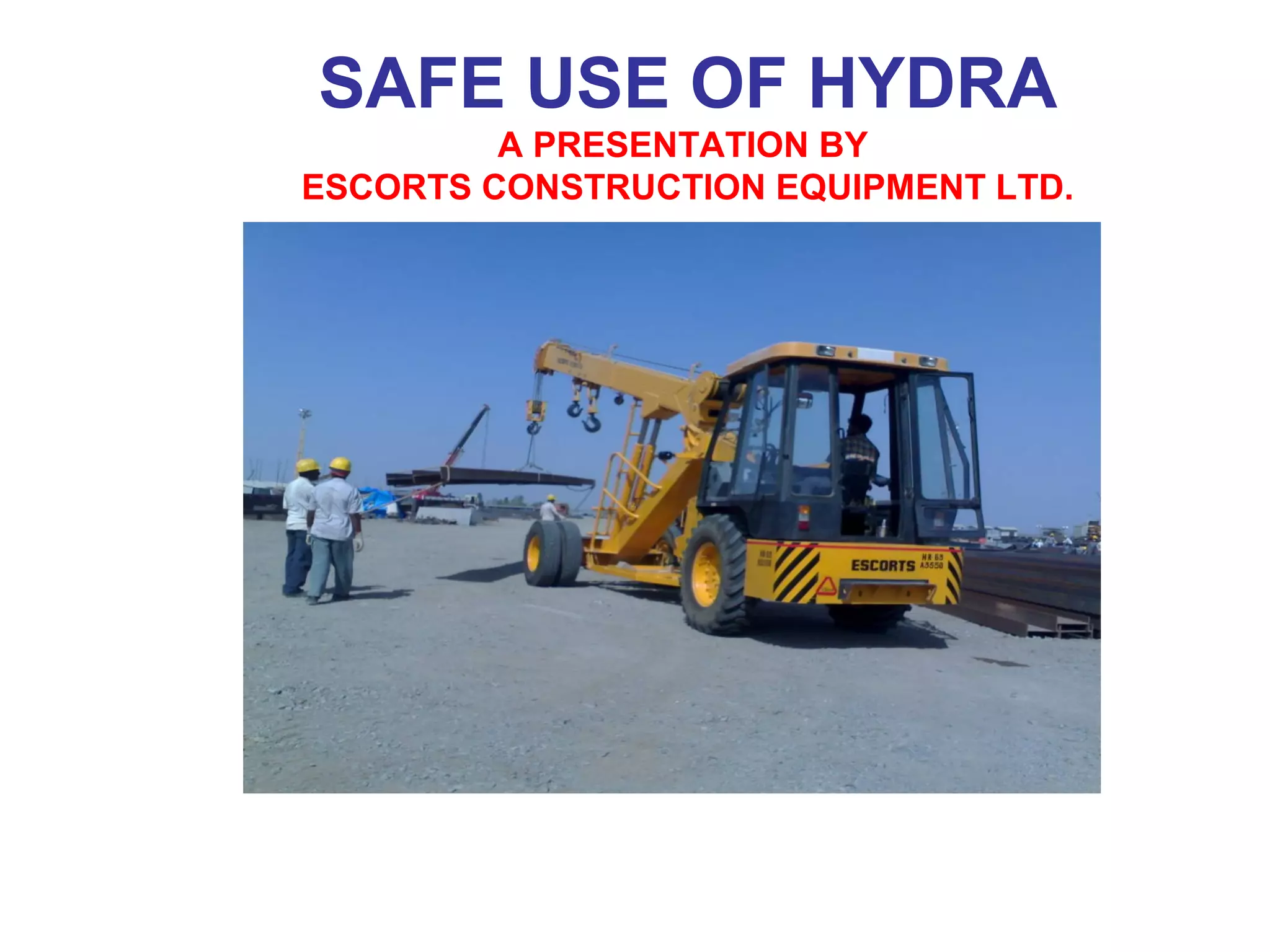

SAFE USE OF HYDRA
A PRESENTATION BY
ESCORTS CONSTRUCTION EQUIPMENT LTD.
WELCOME
TO ALL
IN THIS
PROGRAM
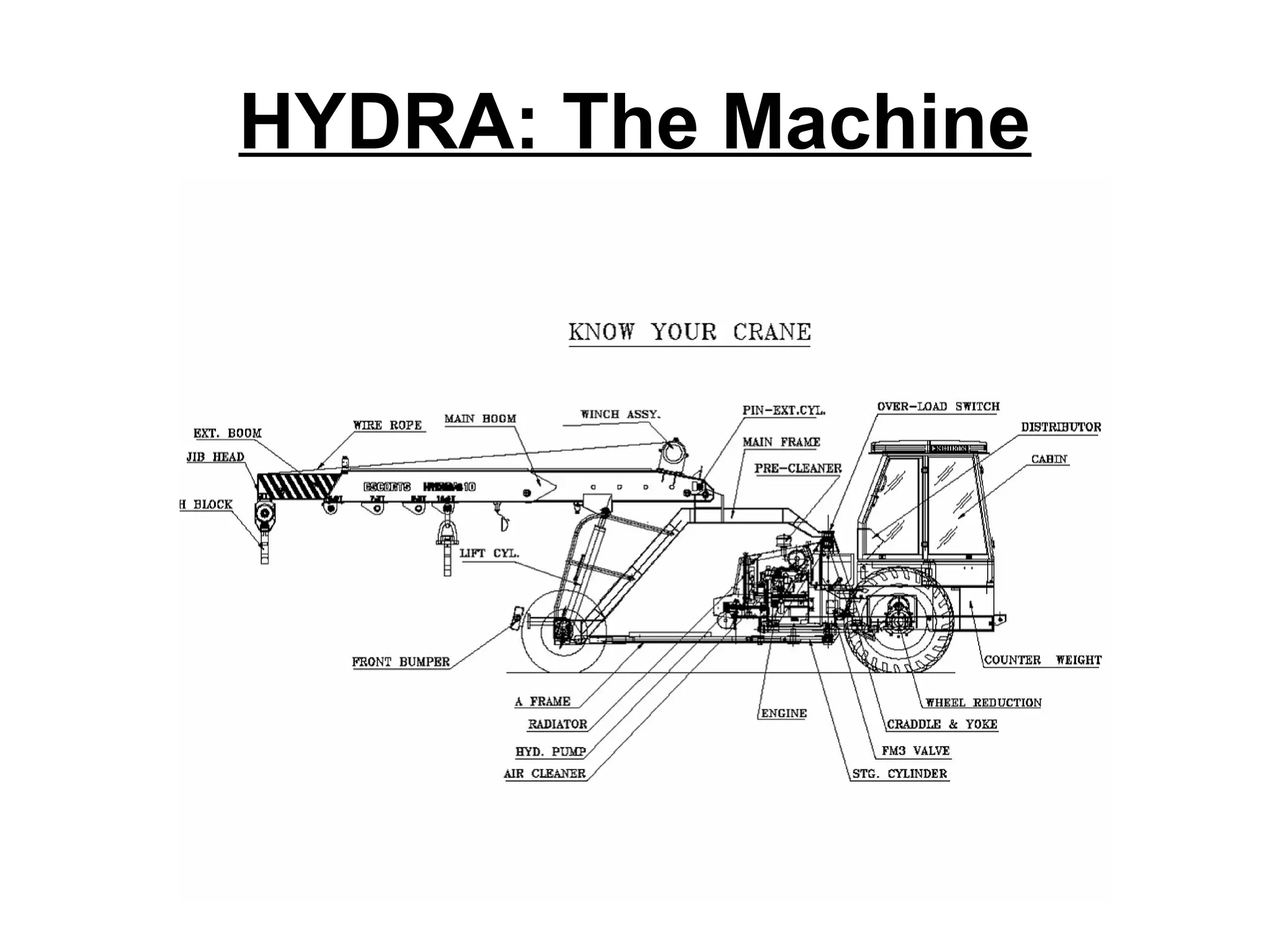
HYDRA: The Machine
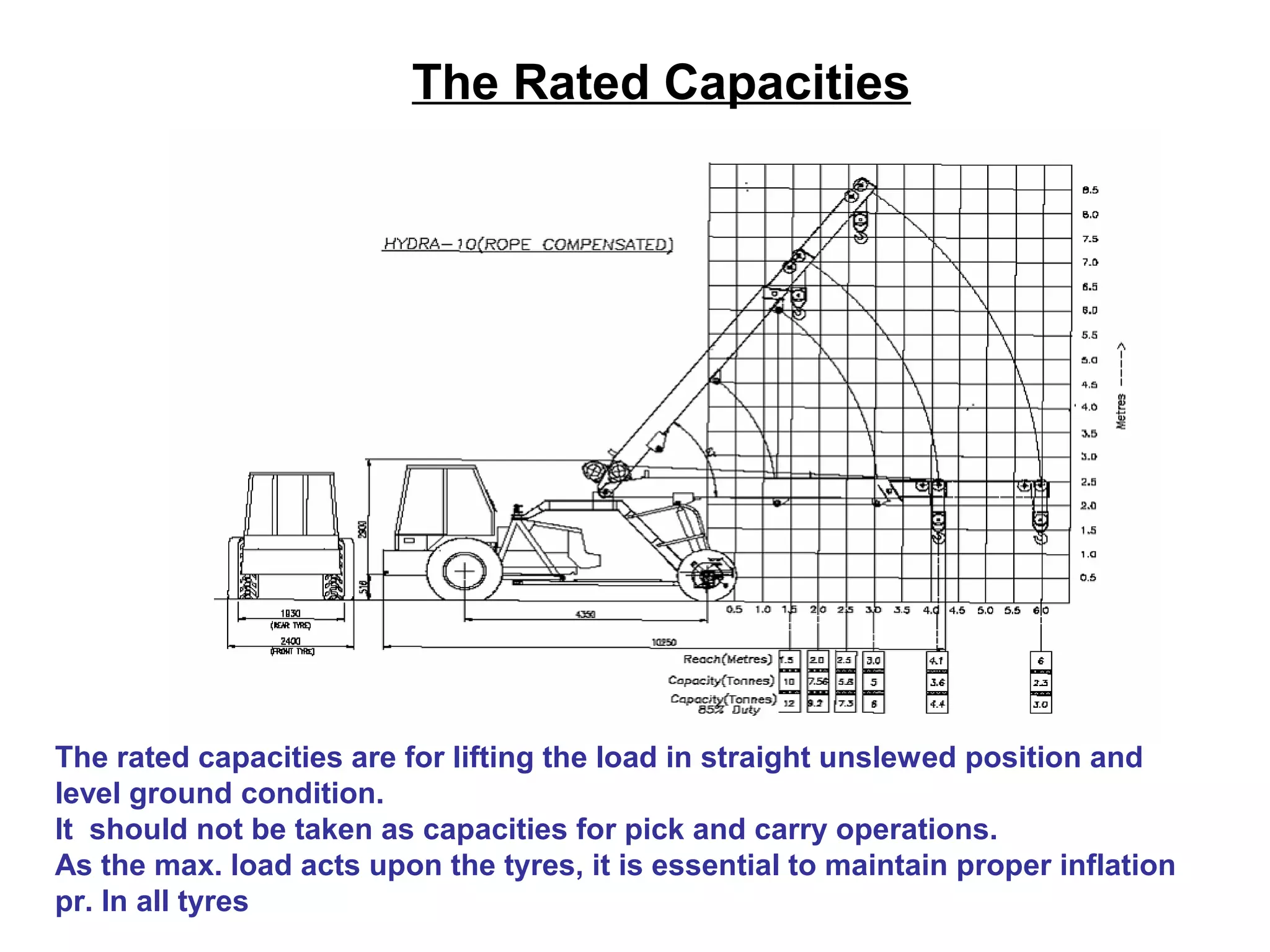
The Rated Capacities
The rated capacities are for lifting the load in straight unslewed position and
level ground condition.
It should not be taken as capacities for pick and carry operations.
As the max. load acts upon the tyres, it is essential to maintain proper inflation
pr. In all tyres
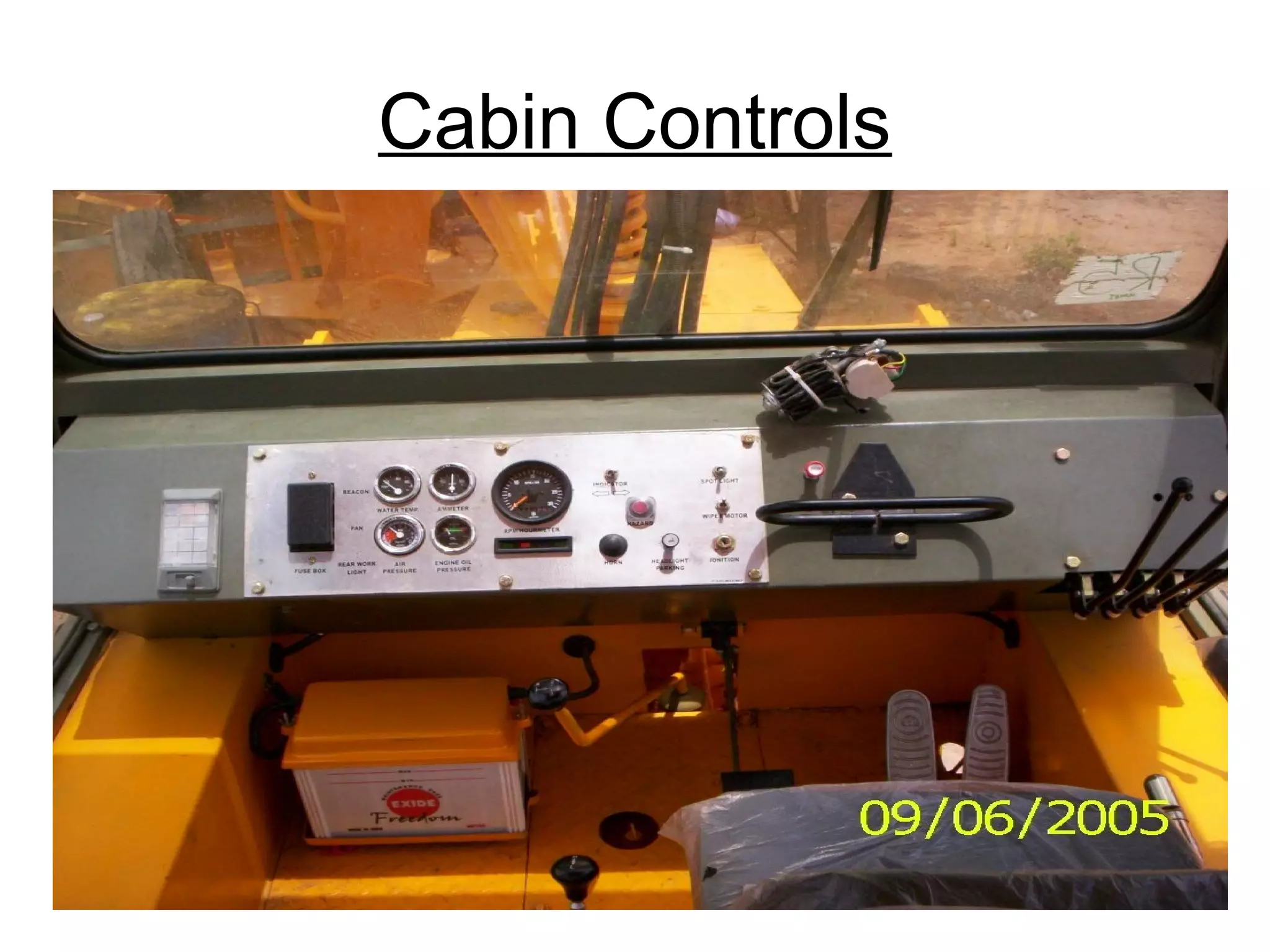
Cabin Controls
MARCHING WITHOUT LOAD
• Traveling Speed without load should not be
more than 10 km/h.
• Boom should be fully retracted and hook block
should be fully raised.
• A Helper should always be available with the
operator on the machine. While marching he
should guide the operator about the safe
distance from the things around the Hydra.
• DON’T OVERTAKE any vehicle while marching
• Always give indicators while traveling/ turning
and stopping
MARCHING WITH LOAD
• Maintain a max speed of 2-3 km/h.
• Match with the speed of riggers/helper
walking along with you.
• Always travel in Low 1st gear and don’t
change the gears while marching with load.
• Load should not be at more than 0.5
meters height from the ground while
marching.
• Always march with boom fully retracted and
in lowest convenient position.
• Load should be stable while marching.
• Always use tag lines
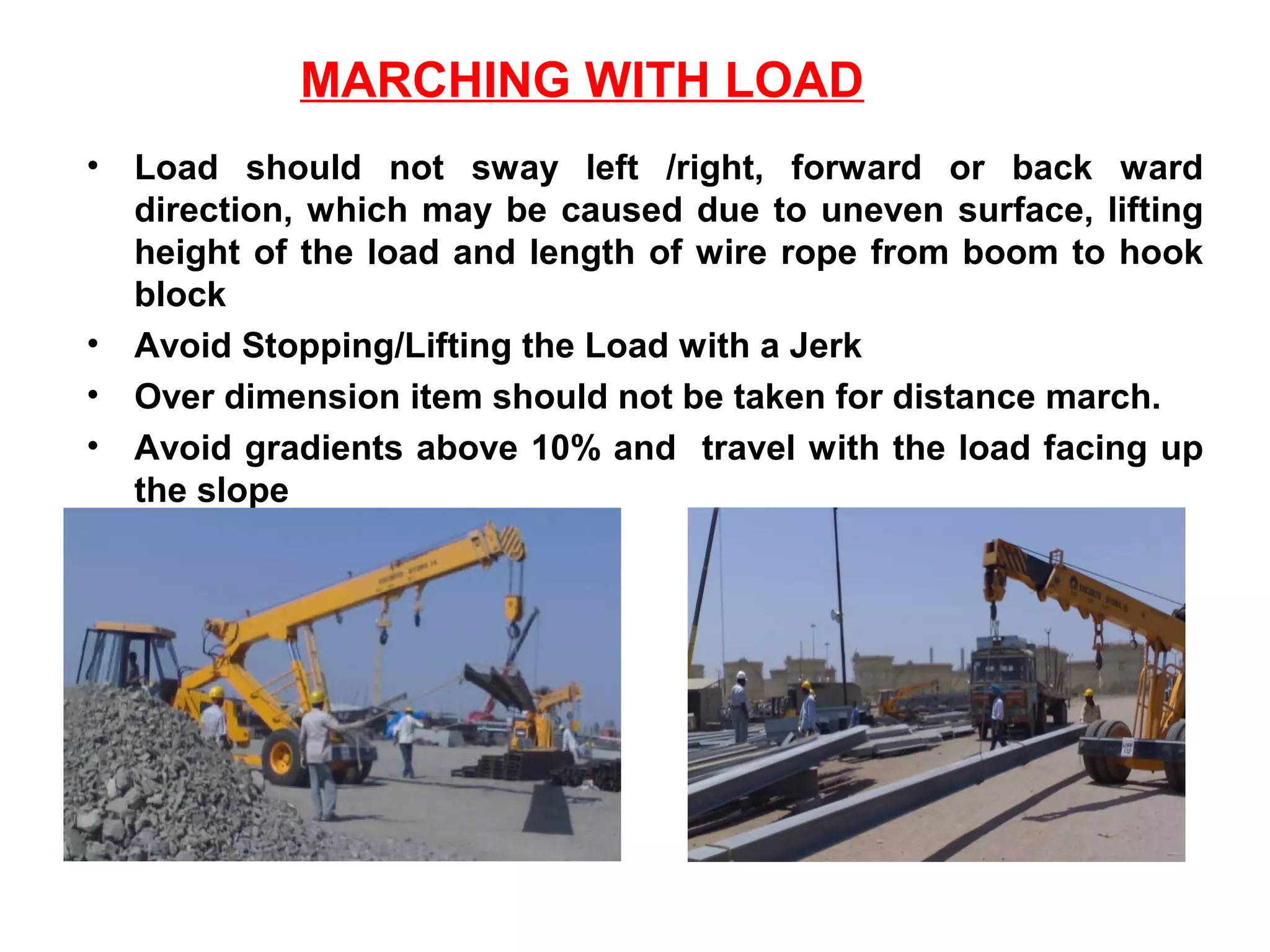
MARCHING WITH LOAD
• Load should not sway left /right, forward or back ward
direction, which may be caused due to uneven surface, lifting
height of the load and length of wire rope from boom to hook
block
• Avoid Stopping/Lifting the Load with a Jerk
• Over dimension item should not be taken for distance march.
• Avoid gradients above 10% and travel with the load facing up
the slope
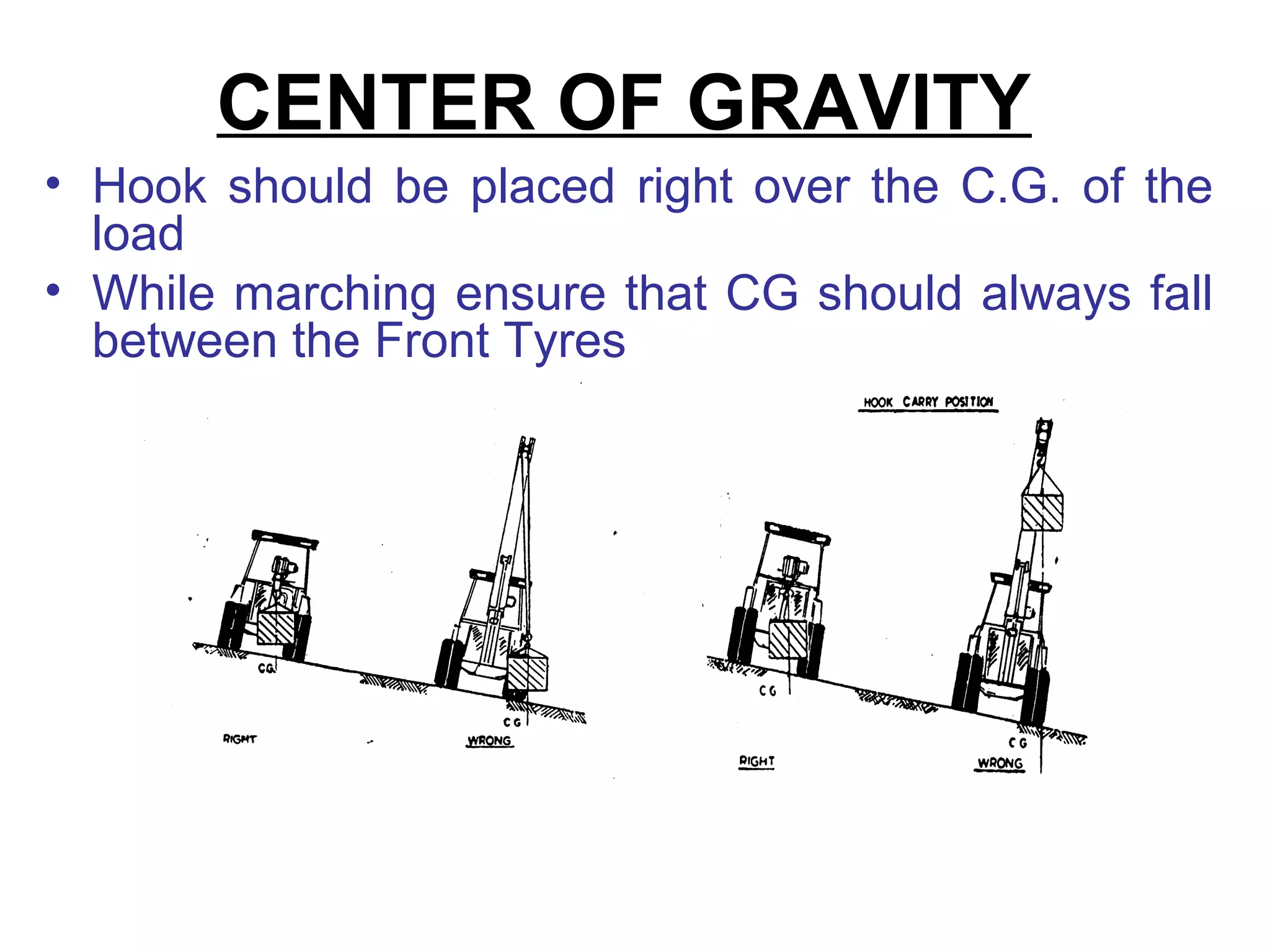
CENTER OF GRAVITY
• Hook should be placed right over the C.G. of the
load
• While marching ensure that CG should always fall
between the Front Tyres
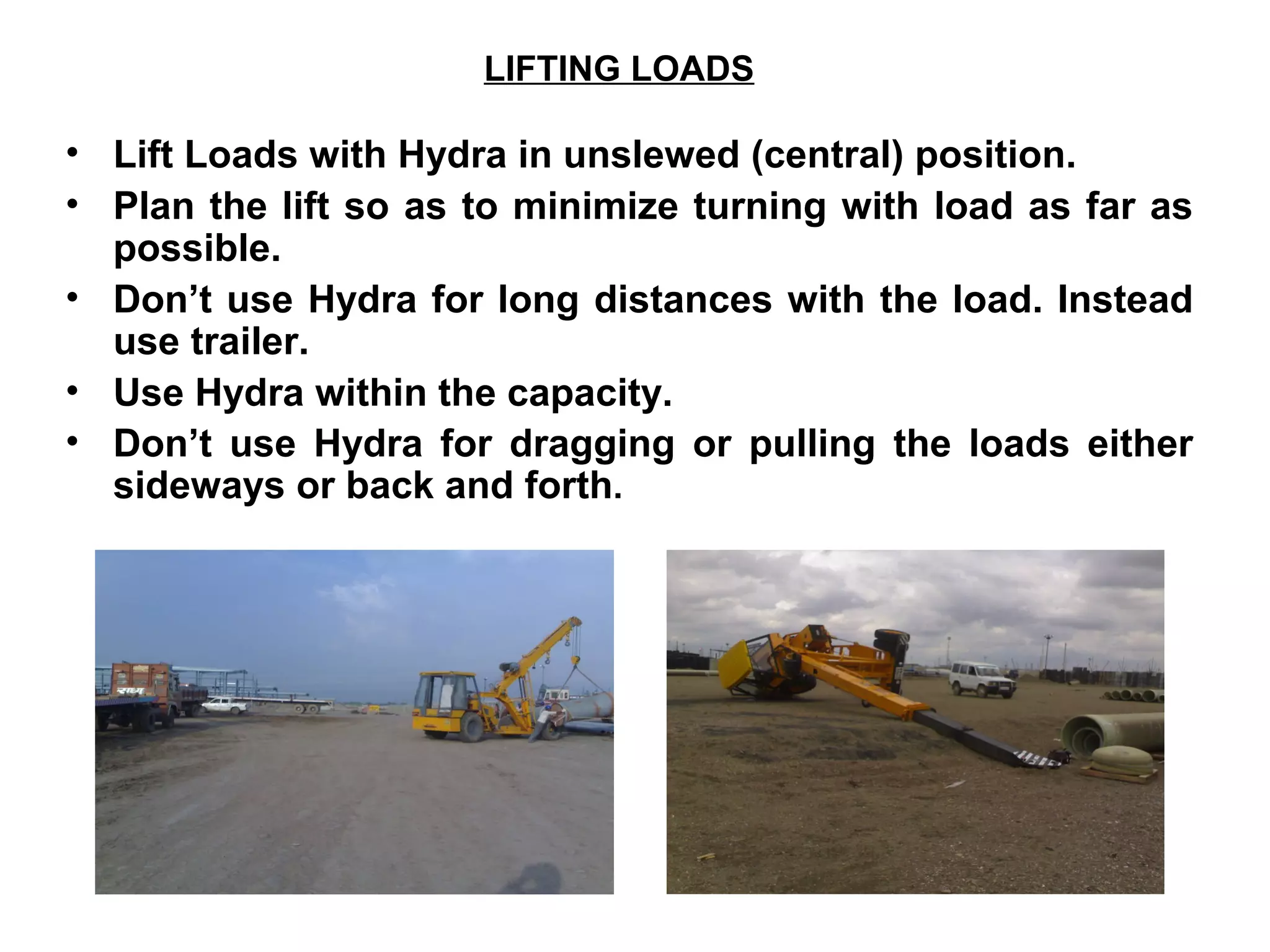
LIFTING LOADS
• Lift Loads with Hydra in unslewed (central) position.
• Plan the lift so as to minimize turning with load as far as
possible.
• Don’t use Hydra for long distances with the load. Instead
use trailer.
• Use Hydra within the capacity.
• Don’t use Hydra for dragging or pulling the loads either
sideways or back and forth.
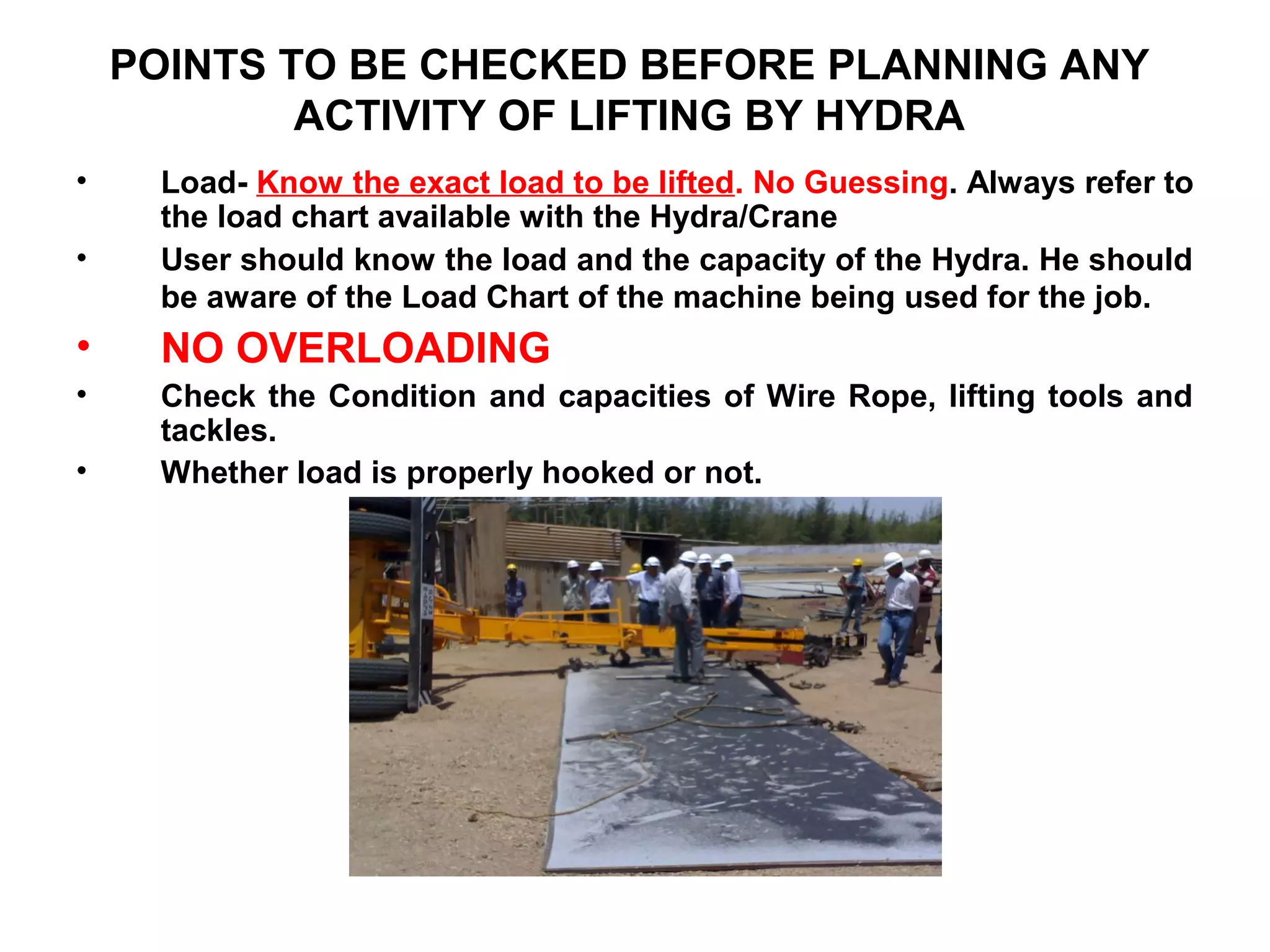
POINTS TO BE CHECKED BEFORE PLANNING ANY
ACTIVITY OF LIFTING BY HYDRA
• Load- Know the exact load to be lifted. No Guessing. Always refer to
the load chart available with the Hydra/Crane
• User should know the load and the capacity of the Hydra. He should
be aware of the Load Chart of the machine being used for the job.
• NO OVERLOADING
• Check the Condition and capacities of Wire Rope, lifting tools and
tackles.
• Whether load is properly hooked or not.
Ground Condition / Side Slope
• The terrain should be reasonably hard and should be able to bear
the load of the crane. Soft, Marshy land is likely to bog down the
crane. During rainy season beware of soft ground conditions and
ditches.
• Check for any Inclination, Any Soft Surface, and Uneven Ground.
Always keep the loading area as level as possible. Check your
route before marching with the load.
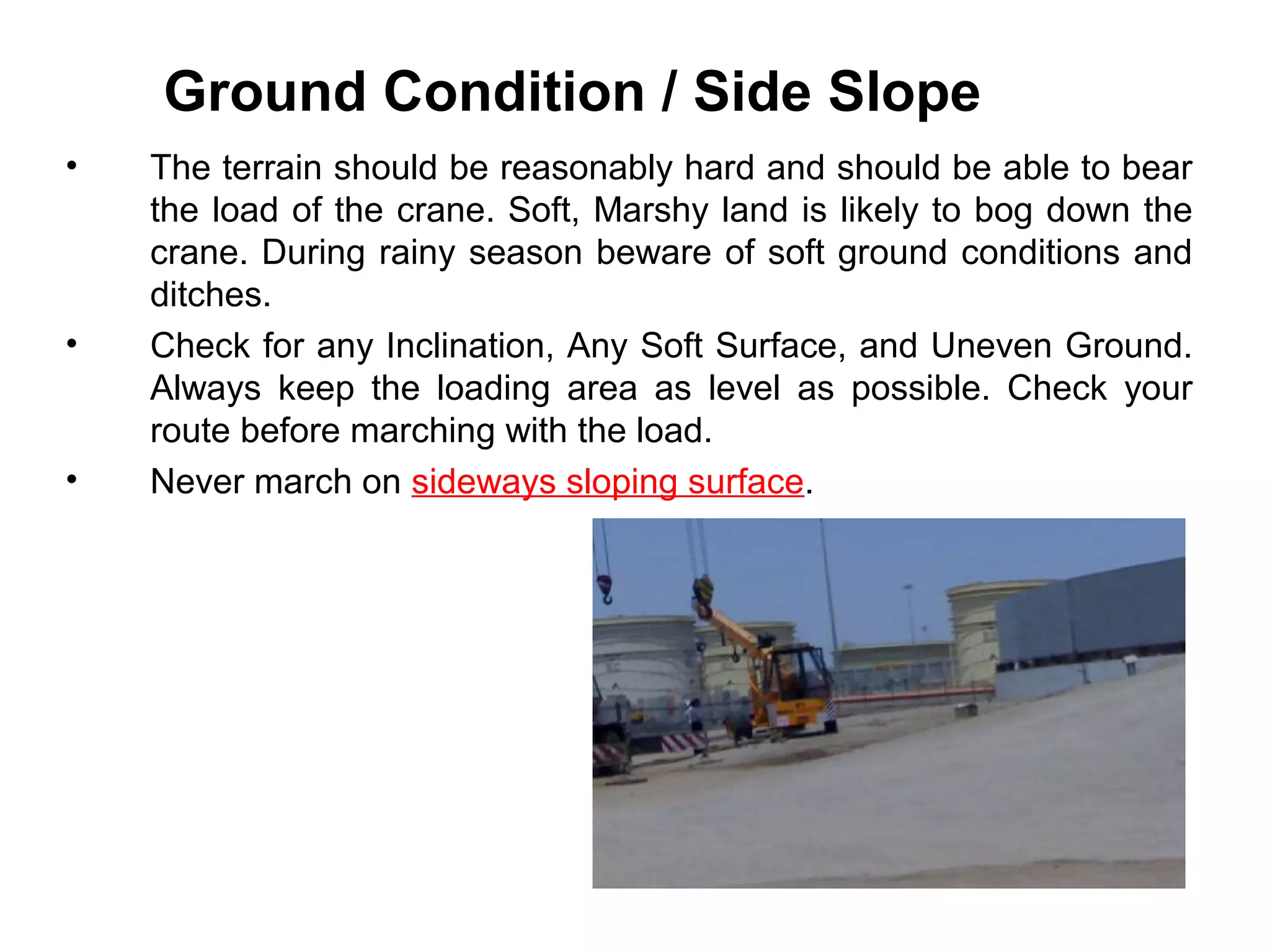
• Never march on sideways sloping surface.
Avoid Accidents by avoiding ‘unsafe conditions and unsafe practices’
Most accidents ,whether they occur in the industry, on the farm, at home or
on the highway, are caused by the failure of some individual to follow
simple and fundamental safety rules or precautions.
For this reason most accidents can be prevented by recognizing
the real cause and doing something before accident occurs.
Regardless of the care used in the design and construction of any
type of equipment , there are many conditions that cannot be
completely safe guarded against without interfering with reasonable
accessibility and efficient operation.
A careful operator is the best insurance against an accident .The complete
observance if one simple rule would prevent many thousand serious injury each year.
That rule is :
Never attempt to clean, oil or adjust the machine while
it is in motion.
“National Safety Council”
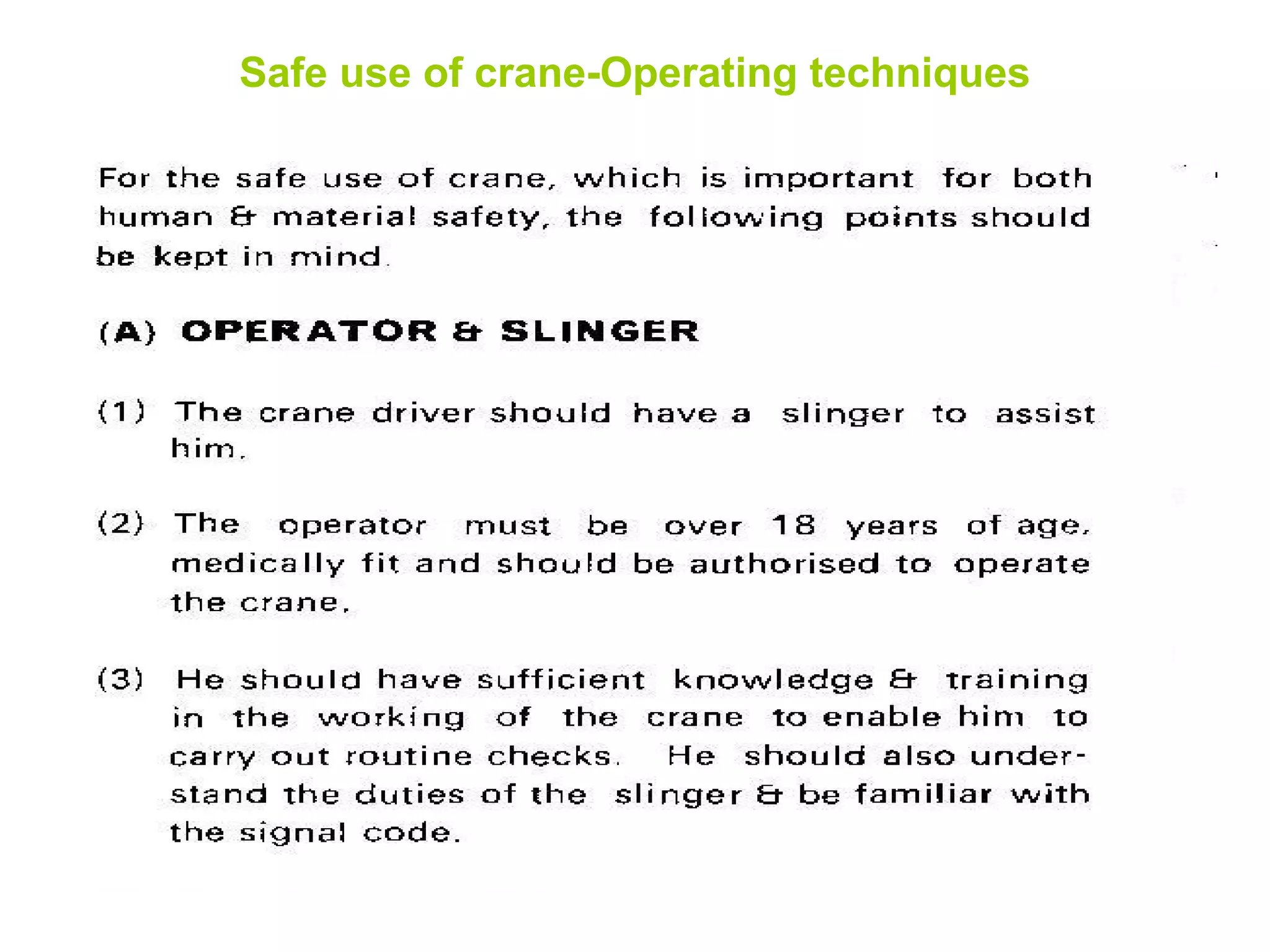
Safe use of crane-Operating techniques
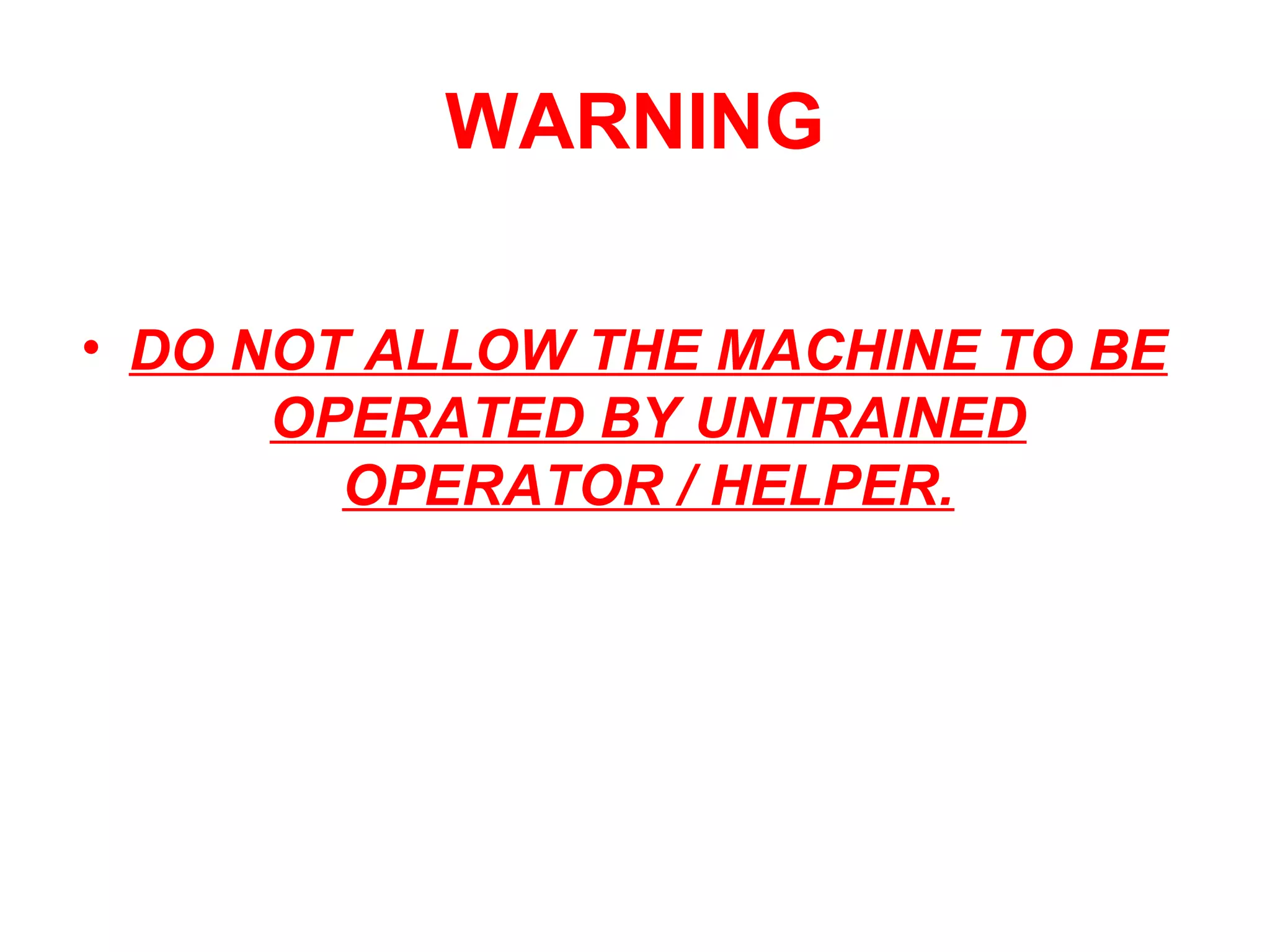
WARNING
• DO NOT ALLOW THE MACHINE TO BE
OPERATED BY UNTRAINED
OPERATOR / HELPER.
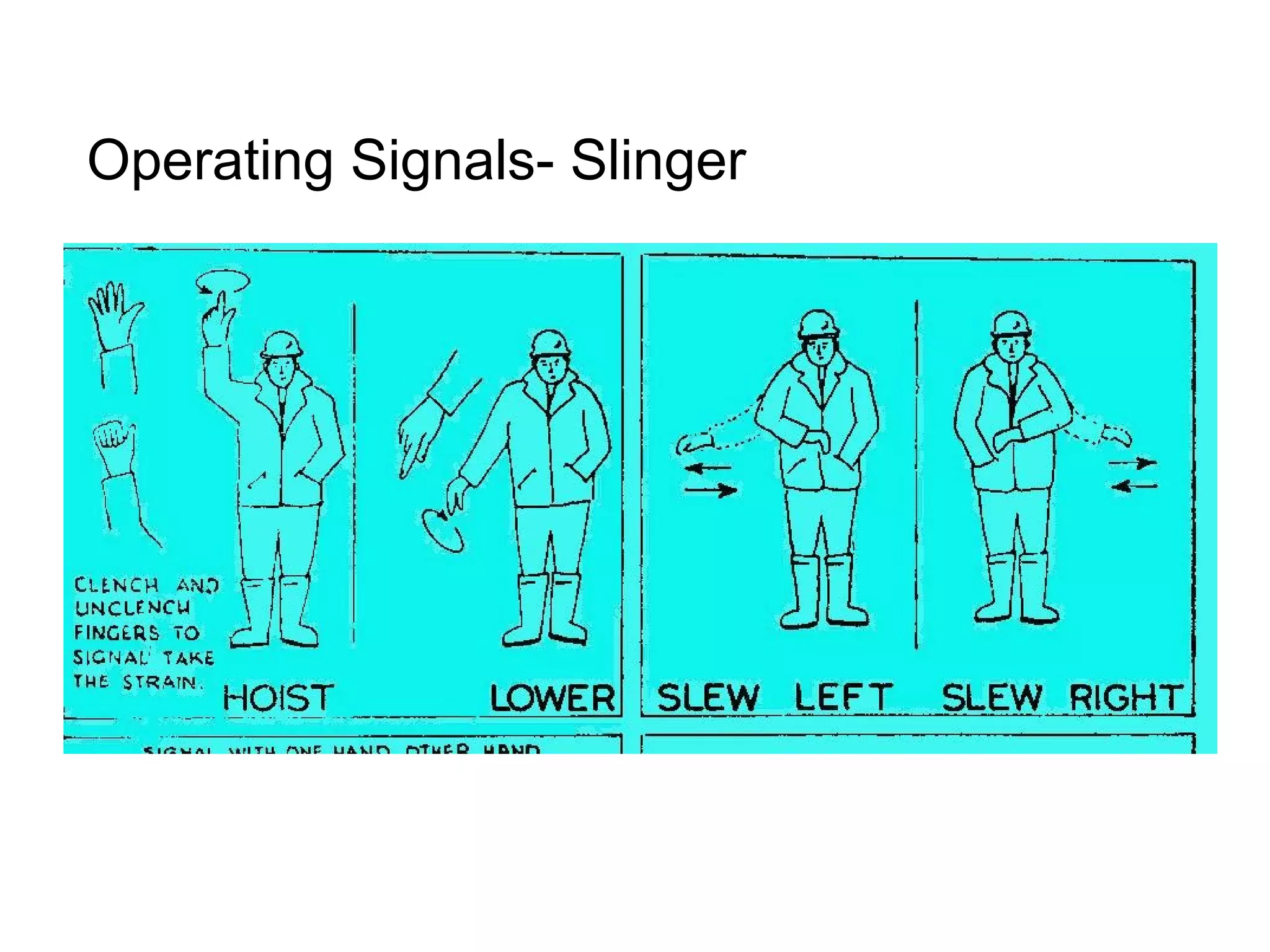
Operating Signals- Slinger
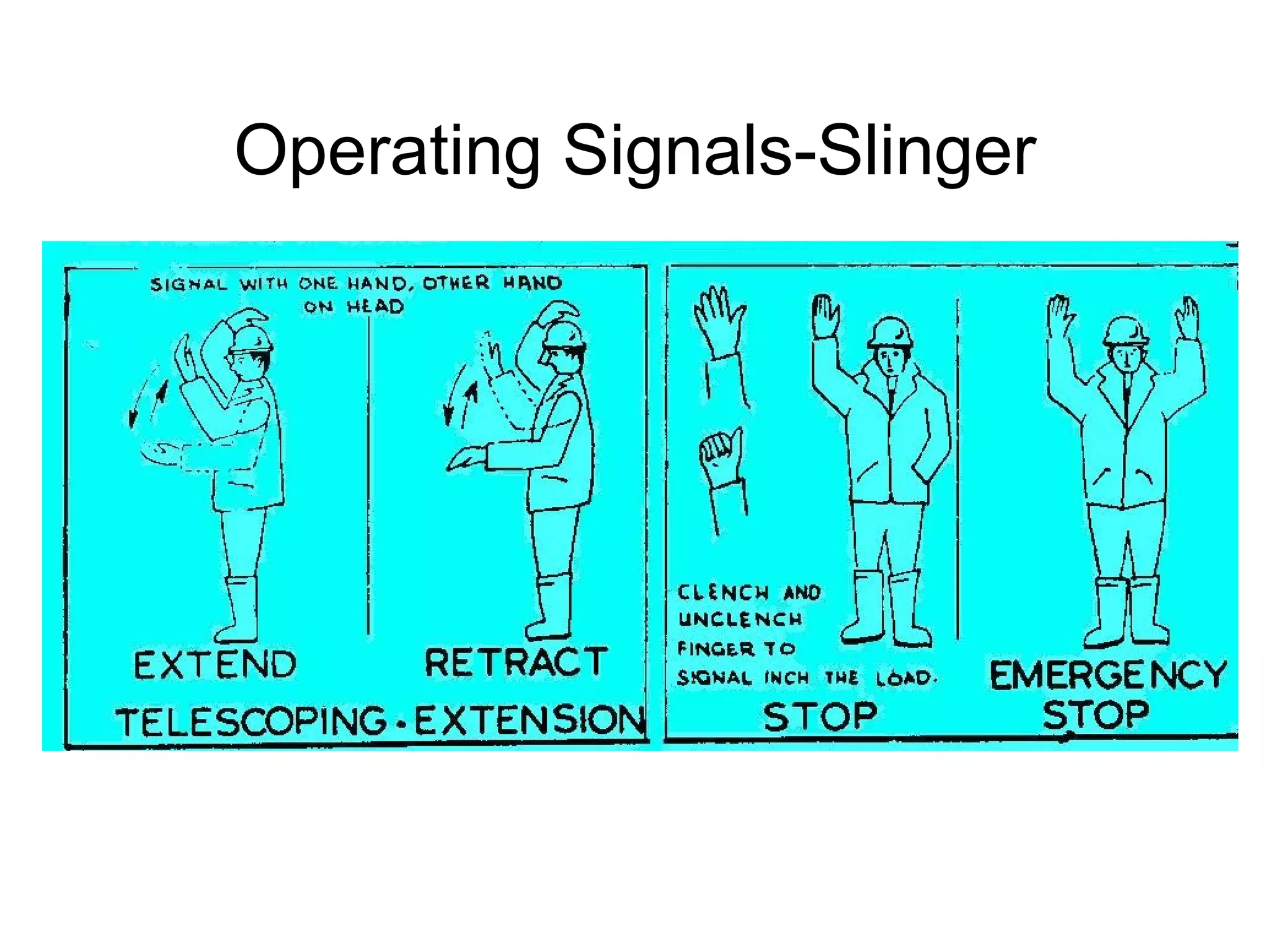
Operating Signals-Slinger
Slings safety procedure
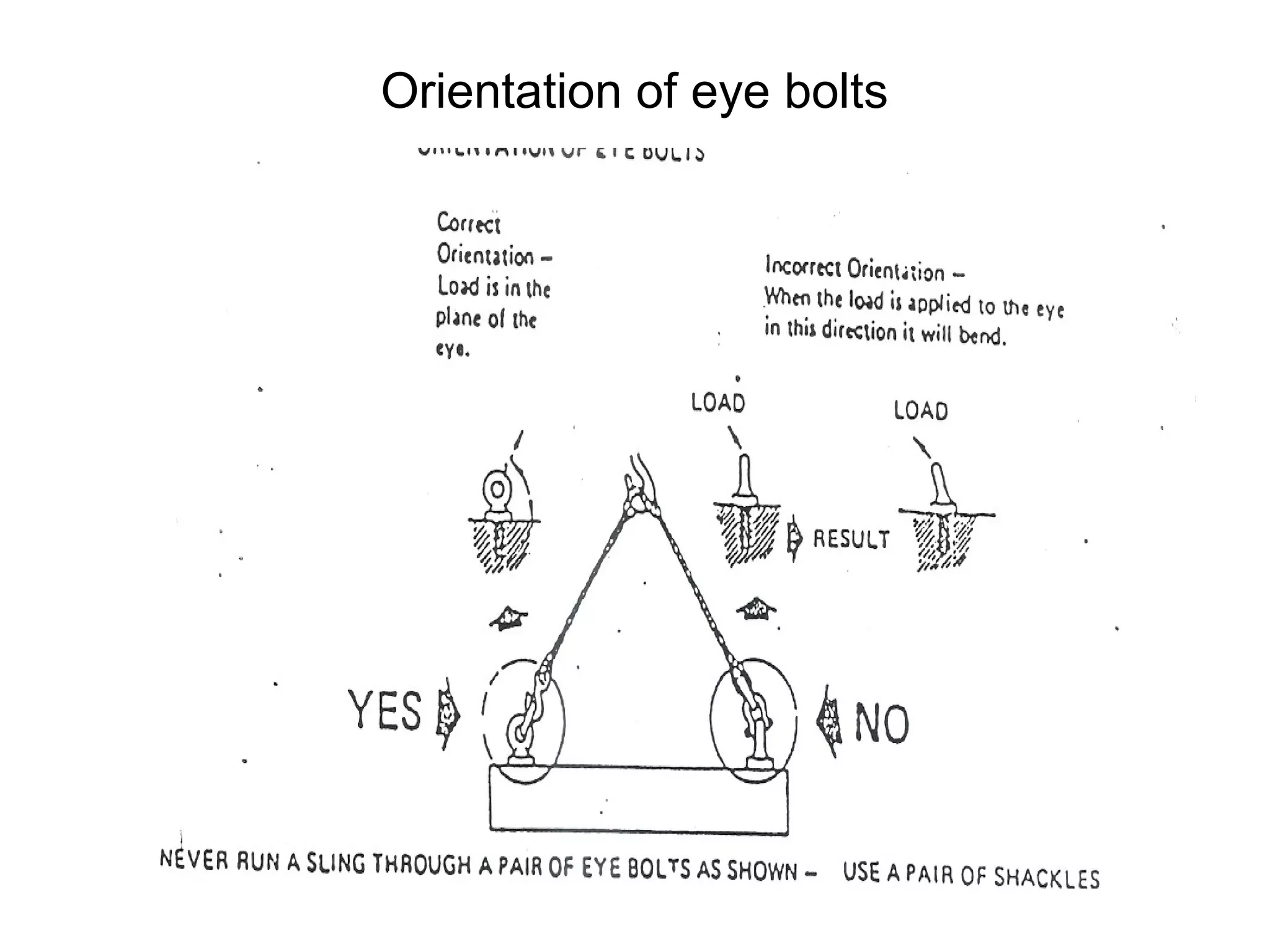
Orientation of eye bolts
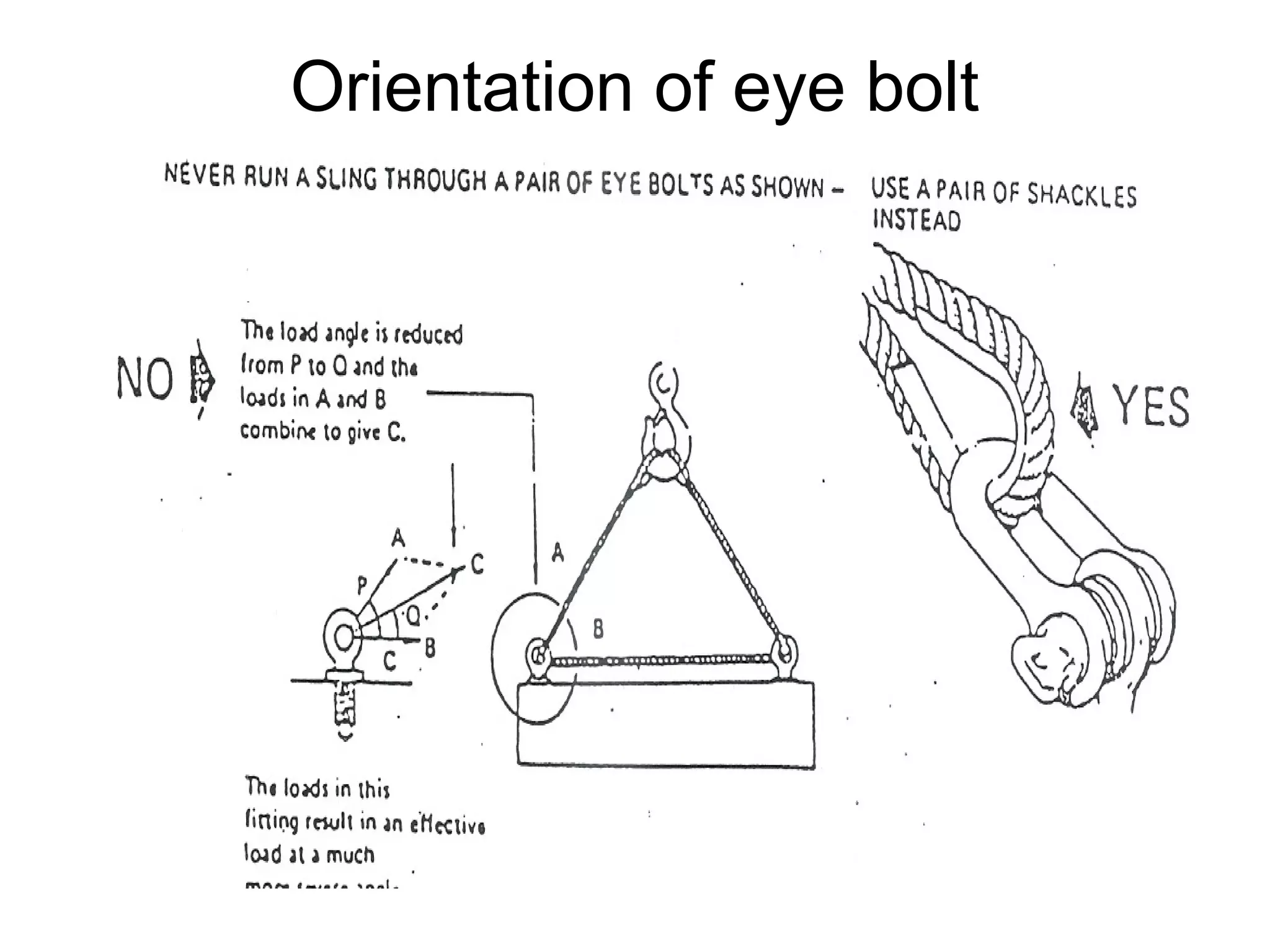
Orientation of eye bolt
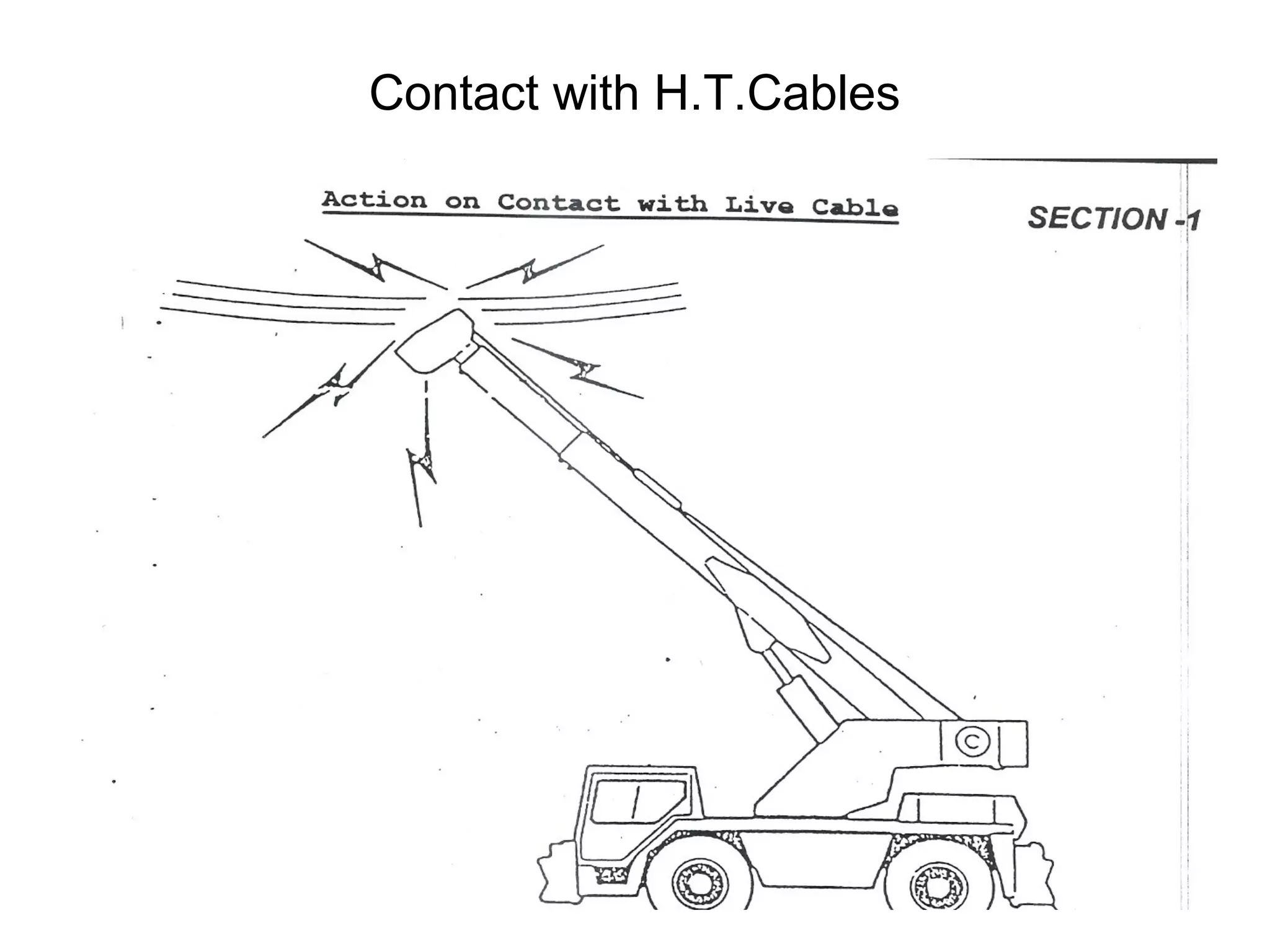
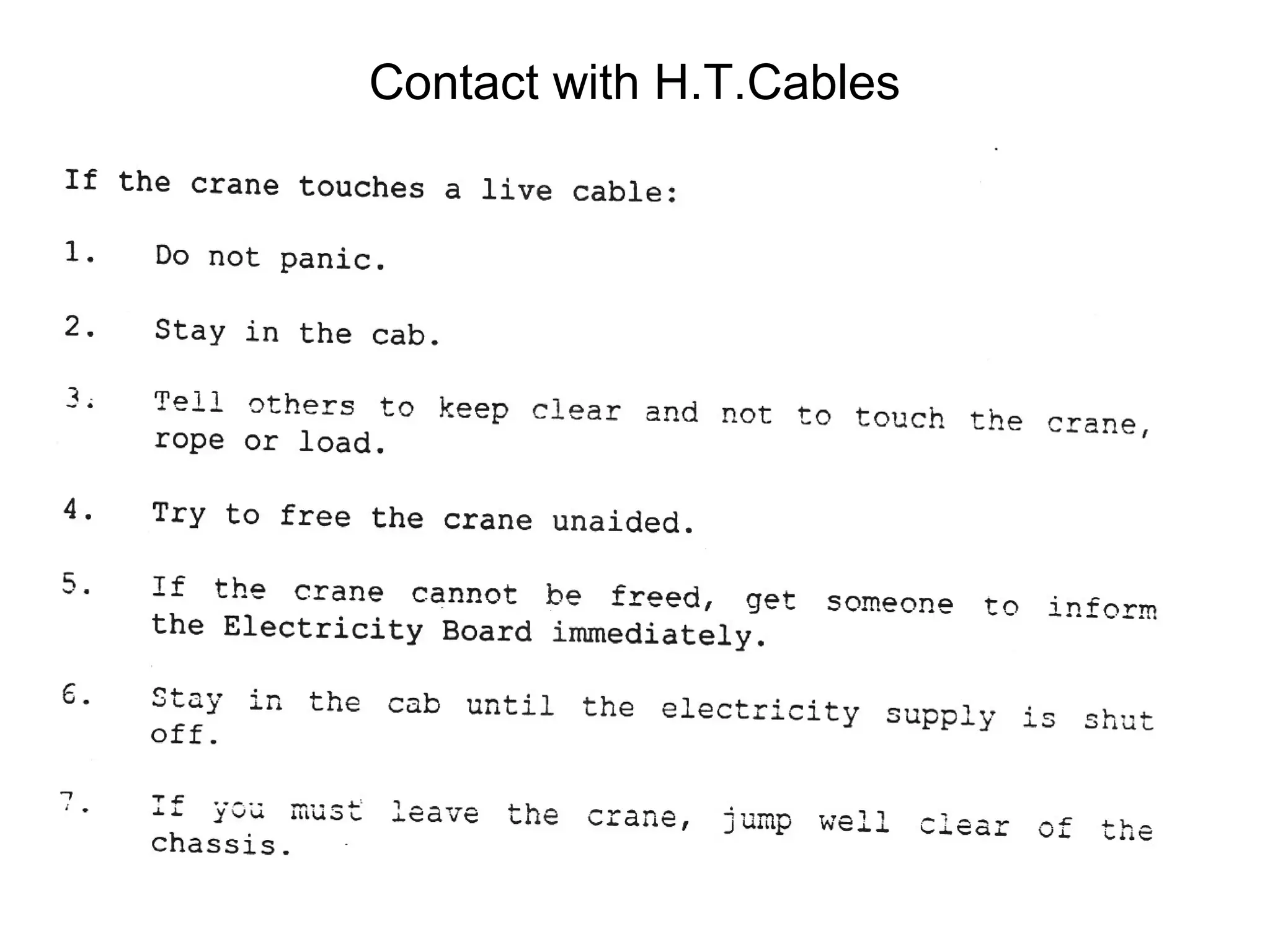
Contact with H.T.Cables
THANK YOU

Safe use of hydra

  • 1.
    SAFE USE OFHYDRA A PRESENTATION BY ESCORTS CONSTRUCTION EQUIPMENT LTD.
  • 2.
  • 3.
  • 4.
    The Rated Capacities Therated capacities are for lifting the load in straight unslewed position and level ground condition. It should not be taken as capacities for pick and carry operations. As the max. load acts upon the tyres, it is essential to maintain proper inflation pr. In all tyres
  • 5.
  • 6.
    MARCHING WITHOUT LOAD •Traveling Speed without load should not be more than 10 km/h. • Boom should be fully retracted and hook block should be fully raised. • A Helper should always be available with the operator on the machine. While marching he should guide the operator about the safe distance from the things around the Hydra. • DON’T OVERTAKE any vehicle while marching • Always give indicators while traveling/ turning and stopping
  • 7.
    MARCHING WITH LOAD •Maintain a max speed of 2-3 km/h. • Match with the speed of riggers/helper walking along with you. • Always travel in Low 1st gear and don’t change the gears while marching with load. • Load should not be at more than 0.5 meters height from the ground while marching. • Always march with boom fully retracted and in lowest convenient position. • Load should be stable while marching. • Always use tag lines
  • 8.
    MARCHING WITH LOAD •Load should not sway left /right, forward or back ward direction, which may be caused due to uneven surface, lifting height of the load and length of wire rope from boom to hook block • Avoid Stopping/Lifting the Load with a Jerk • Over dimension item should not be taken for distance march. • Avoid gradients above 10% and travel with the load facing up the slope
  • 9.
    CENTER OF GRAVITY •Hook should be placed right over the C.G. of the load • While marching ensure that CG should always fall between the Front Tyres
  • 10.
    LIFTING LOADS • LiftLoads with Hydra in unslewed (central) position. • Plan the lift so as to minimize turning with load as far as possible. • Don’t use Hydra for long distances with the load. Instead use trailer. • Use Hydra within the capacity. • Don’t use Hydra for dragging or pulling the loads either sideways or back and forth.
  • 11.
    POINTS TO BECHECKED BEFORE PLANNING ANY ACTIVITY OF LIFTING BY HYDRA • Load- Know the exact load to be lifted. No Guessing. Always refer to the load chart available with the Hydra/Crane • User should know the load and the capacity of the Hydra. He should be aware of the Load Chart of the machine being used for the job. • NO OVERLOADING • Check the Condition and capacities of Wire Rope, lifting tools and tackles. • Whether load is properly hooked or not.
  • 12.
    Ground Condition /Side Slope • The terrain should be reasonably hard and should be able to bear the load of the crane. Soft, Marshy land is likely to bog down the crane. During rainy season beware of soft ground conditions and ditches. • Check for any Inclination, Any Soft Surface, and Uneven Ground. Always keep the loading area as level as possible. Check your route before marching with the load. • Never march on sideways sloping surface.
  • 13.
    Avoid Accidents byavoiding ‘unsafe conditions and unsafe practices’ Most accidents ,whether they occur in the industry, on the farm, at home or on the highway, are caused by the failure of some individual to follow simple and fundamental safety rules or precautions. For this reason most accidents can be prevented by recognizing the real cause and doing something before accident occurs. Regardless of the care used in the design and construction of any type of equipment , there are many conditions that cannot be completely safe guarded against without interfering with reasonable accessibility and efficient operation. A careful operator is the best insurance against an accident .The complete observance if one simple rule would prevent many thousand serious injury each year. That rule is : Never attempt to clean, oil or adjust the machine while it is in motion. “National Safety Council”
  • 14.
    Safe use ofcrane-Operating techniques
  • 15.
    WARNING • DO NOTALLOW THE MACHINE TO BE OPERATED BY UNTRAINED OPERATOR / HELPER.
  • 16.
  • 17.
  • 18.
  • 19.
  • 20.
  • 21.
  • 22.
  • 23.