The university of Faisalabad
Practical file of data communication and networks
Last Working of whole semester
Submitted by :
“Saad ur Rehman”
Submitted to :
“Mam Sana Hafeez”
Department :
“Computer science”
Reg. No:
“ BSCS-FA18-094”
LAB Manual #1
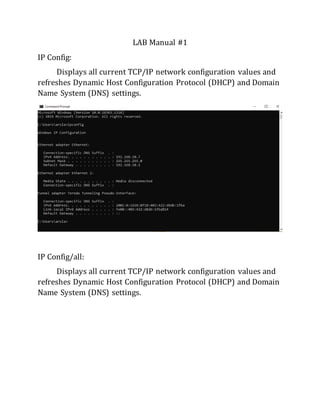
IP Config:
Displays all current TCP/IP network configuration values and
refreshes Dynamic Host Configuration Protocol (DHCP) and Domain
Name System (DNS) settings.
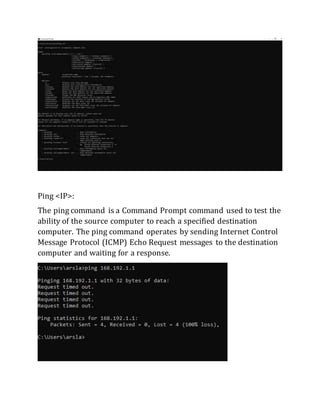
IP Config/all:
Displays all current TCP/IP network configuration values and
refreshes Dynamic Host Configuration Protocol (DHCP) and Domain
Name System (DNS) settings.
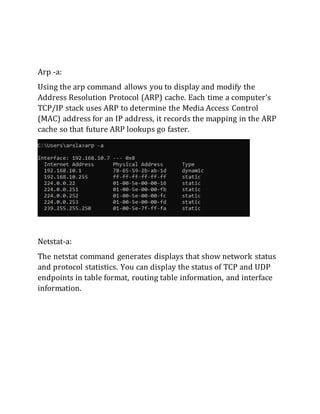
Ping <IP>:
The ping command is a Command Prompt command used to test the
ability of the source computer to reach a specified destination
computer. The ping command operates by sending Internet Control
Message Protocol (ICMP) Echo Request messages to the destination
computer and waiting for a response.
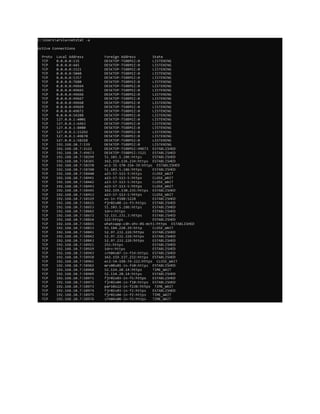
Arp -a:
Using the arp command allows you to display and modify the
Address Resolution Protocol (ARP) cache. Each time a computer's
TCP/IP stack uses ARP to determine the Media Access Control
(MAC) address for an IP address, it records the mapping in the ARP
cache so that future ARP lookups go faster.
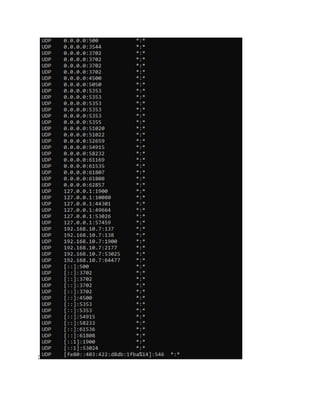
Netstat-a:
The netstat command generates displays that show network status
and protocol statistics. You can display the status of TCP and UDP
endpoints in table format, routing table information, and interface
information.
:
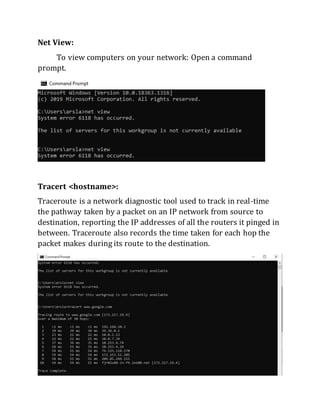
Net View:
To view computers on your network: Open a command
prompt.
Tracert <hostname>:
Traceroute is a network diagnostic tool used to track in real-time
the pathway taken by a packet on an IP network from source to
destination, reporting the IP addresses of all the routers it pinged in
between. Traceroute also records the time taken for each hop the
packet makes during its route to the destination.
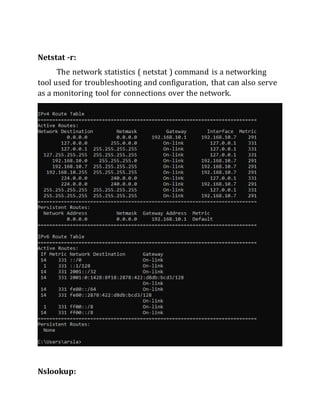
Netstat -r:
The network statistics ( netstat ) command is a networking
tool used for troubleshooting and configuration, that can also serve
as a monitoring tool for connections over the network.
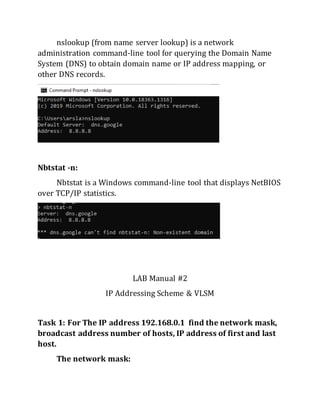
Nslookup:
nslookup (from name server lookup) is a network
administration command-line tool for querying the Domain Name
System (DNS) to obtain domain name or IP address mapping, or
other DNS records.
Nbtstat -n:
Nbtstat is a Windows command-line tool that displays NetBIOS
over TCP/IP statistics.
LAB Manual #2
IP Addressing Scheme & VLSM
Task 1: For The IP address 192.168.0.1 find the network mask,
broadcast address number of hosts, IP address of first and last
host.
The network mask:
Netmask is 255.255.255.0 = 24
Broadcast address number of hosts:
Broadcast Address is 192.168.0.255
24 number of hosts in decimal
IP address of first and last host:
Network address will be 192.168.0.0
First IP address of network will be 192.168.0.1
Last IP address 192.168.15.254
Introduction to Subnetting
Task 1: For The following IPs find the first two and last two
Subnets and give their Pc range and Broadcast address.
1. 10.0.0.0 for 1025 subnets.
2. 212.31.30.0 for 21 subnets.
3. 190.38.0.0 for 645 subnets.
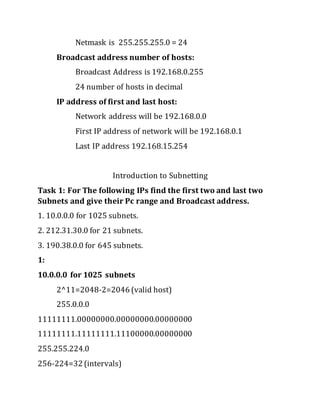
1:
10.0.0.0 for 1025 subnets
2^11=2048-2=2046 (valid host)
255.0.0.0
11111111.00000000.00000000.00000000
11111111.11111111.11100000.00000000
255.255.224.0
256-224=32 (intervals)
First two bits:
10.0.0.0=>10.0.31.255
10.0.32.0=>10.0.63.255
Last two bits:
10.255.255.255=>10.255.224.0
10.255.223.255=>10.255.192.0
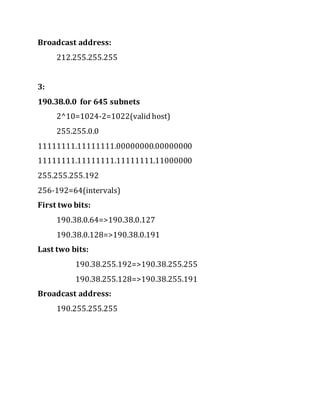
Broadcast address:
10.255.255.255
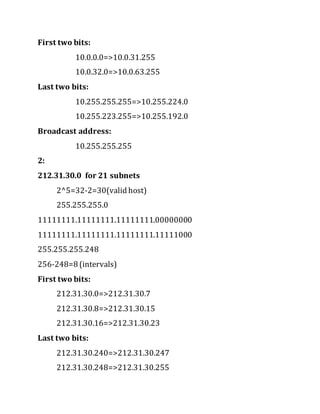
2:
212.31.30.0 for 21 subnets
2^5=32-2=30(valid host)
255.255.255.0
11111111.11111111.11111111.00000000
11111111.11111111.11111111.11111000
255.255.255.248
256-248=8 (intervals)
First two bits:
212.31.30.0=>212.31.30.7
212.31.30.8=>212.31.30.15
212.31.30.16=>212.31.30.23
Last two bits:
212.31.30.240=>212.31.30.247
212.31.30.248=>212.31.30.255
Broadcast address:
212.255.255.255
3:
190.38.0.0 for 645 subnets
2^10=1024-2=1022(valid host)
255.255.0.0
11111111.11111111.00000000.00000000
11111111.11111111.11111111.11000000
255.255.255.192
256-192=64(intervals)
First two bits:
190.38.0.64=>190.38.0.127
190.38.0.128=>190.38.0.191
Last two bits:
190.38.255.192=>190.38.255.255
190.38.255.128=>190.38.255.191
Broadcast address:
190.255.255.255
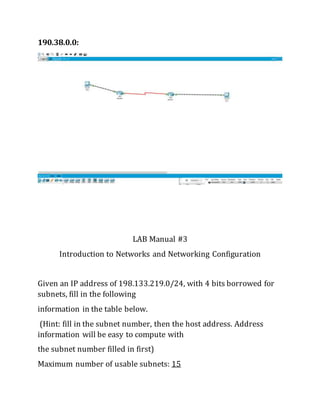
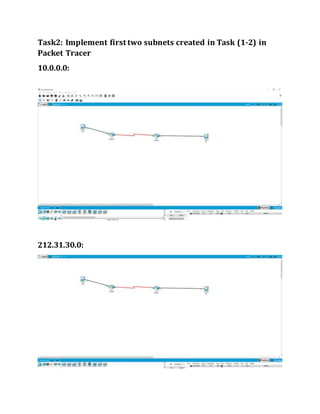
Task2: Implement first two subnets created in Task (1-2) in
Packet Tracer
10.0.0.0:
212.31.30.0:
190.38.0.0:
LAB Manual #3
Introduction to Networks and Networking Configuration
Given an IP address of 198.133.219.0/24, with 4 bits borrowed for
subnets, fill in the following
information in the table below.
(Hint: fill in the subnet number, then the host address. Address
information will be easy to compute with
the subnet number filled in first)
Maximum number of usable subnets: 15
Number of usable hosts per subnet: 16
IP Address: Subnet mask:
# Subnet First host
address
Last host
address
Broadcast
0 198.138.219.
0
198.138.219.
1
198.138.219.1
4
198.138.219.1
5
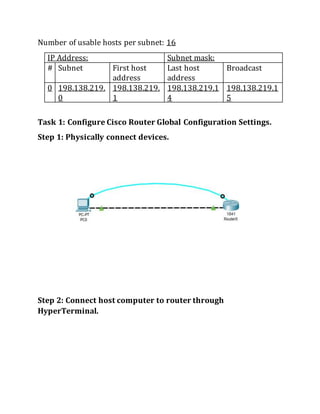
Task 1: Configure Cisco Router Global Configuration Settings.
Step 1: Physically connect devices.
Step 2: Connect host computer to router through
HyperTerminal.
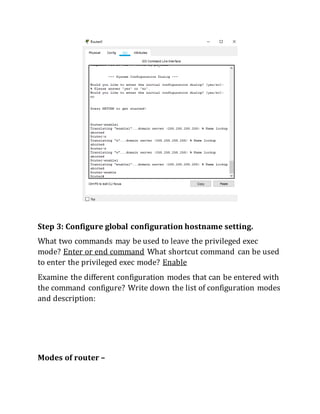
Step 3: Configure global configuration hostname setting.
What two commands may be used to leave the privileged exec
mode? Enter or end command What shortcut command can be used
to enter the privileged exec mode? Enable
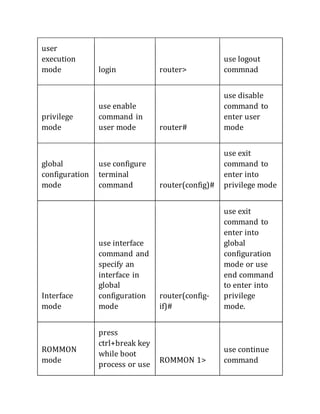
Examine the different configuration modes that can be entered with
the command configure? Write down the list of configuration modes
and description:
Modes of router –
user
execution
mode login router>
use logout
commnad
privilege
mode
use enable
command in
user mode router#
use disable
command to
enter user
mode
global
configuration
mode
use configure
terminal
command router(config)#
use exit
command to
enter into
privilege mode
Interface
mode
use interface
command and
specify an
interface in
global
configuration
mode
router(config-
if)#
use exit
command to
enter into
global
configuration
mode or use
end command
to enter into
privilege
mode.
ROMMON
mode
press
ctrl+break key
while boot
process or use
ROMMON 1>
use continue
command
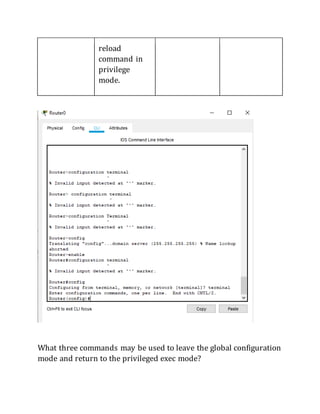
reload
command in
privilege
mode.
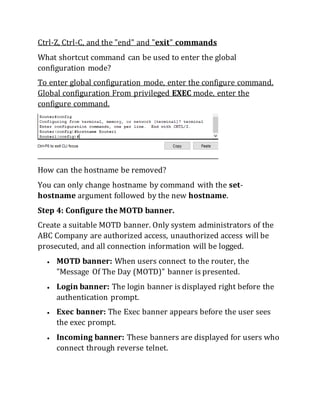
What three commands may be used to leave the global configuration
mode and return to the privileged exec mode?
Ctrl-Z, Ctrl-C, and the "end" and "exit" commands
What shortcut command can be used to enter the global
configuration mode?
To enter global configuration mode, enter the configure command.
Global configuration From privileged EXEC mode, enter the
configure command.
How can the hostname be removed?
You can only change hostname by command with the set-
hostname argument followed by the new hostname.
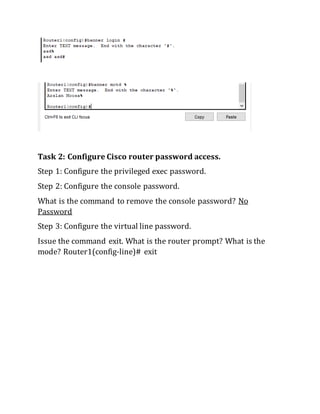
Step 4: Configure the MOTD banner.
Create a suitable MOTD banner. Only system administrators of the
ABC Company are authorized access, unauthorized access will be
prosecuted, and all connection information will be logged.
 MOTD banner: When users connect to the router, the
"Message Of The Day (MOTD)" banner is presented.
 Login banner: The login banner is displayed right before the
authentication prompt.
 Exec banner: The Exec banner appears before the user sees
the exec prompt.
 Incoming banner: These banners are displayed for users who
connect through reverse telnet.
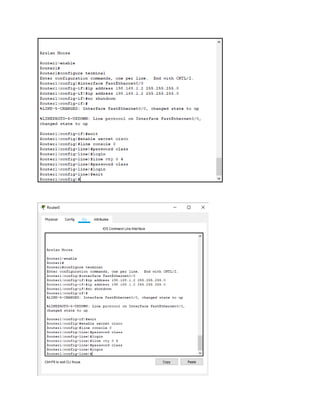
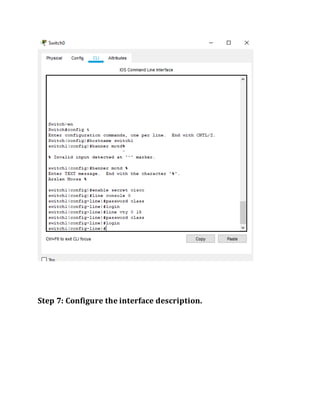
Task 2: Configure Cisco router password access.
Step 1: Configure the privileged exec password.
Step 2: Configure the console password.
What is the command to remove the console password? No
Password
Step 3: Configure the virtual line password.
Issue the command exit. What is the router prompt? What is the
mode? Router1(config-line)# exit
Task 3: Configure Cisco Router Interfaces.
Write down your subnet number and mask: 198.138.219.0
The first IP address will be used to configure the host computer
LAN. Write down the first IP Address: 198.138.219.1
The last IP address will be used to configure the router fa0/0
interface. Write down the last IP Address: 198.138.219.14
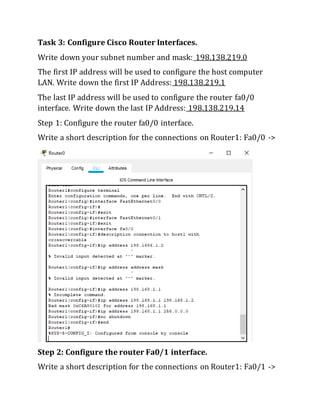
Step 1: Configure the router fa0/0 interface.
Write a short description for the connections on Router1: Fa0/0 ->
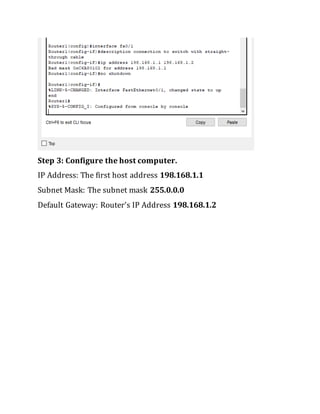
Step 2: Configure the router Fa0/1 interface.
Write a short description for the connections on Router1: Fa0/1 ->
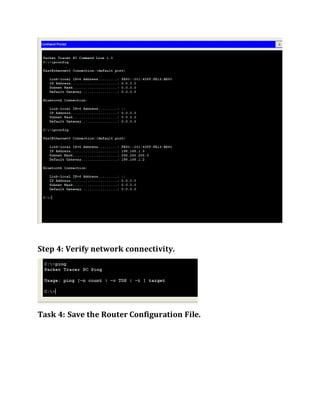
Step 3: Configure the host computer.
IP Address: The first host address 198.168.1.1
Subnet Mask: The subnet mask 255.0.0.0
Default Gateway: Router’s IP Address 198.168.1.2
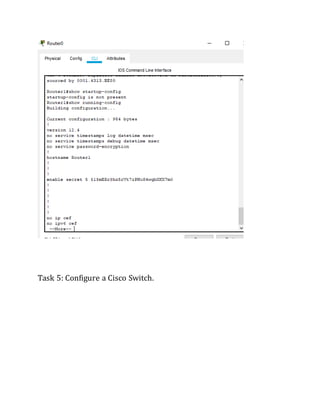
Step 4: Verify network connectivity.
Task 4: Save the Router Configuration File.
Task 5: Configure a Cisco Switch.
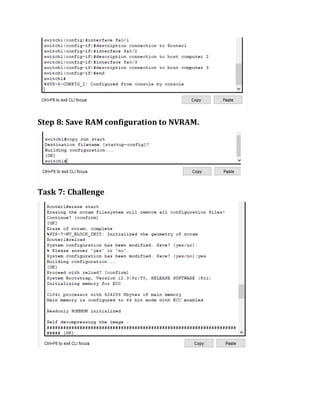
Step 7: Configure the interface description.
Step 8: Save RAM configuration to NVRAM.
Task 7: Challenge
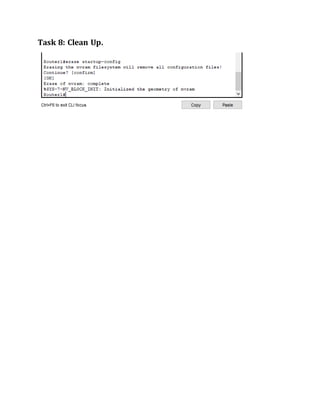
Task 8: Clean Up.

Saad baig practical file

  • 1.
    The university ofFaisalabad Practical file of data communication and networks Last Working of whole semester Submitted by : “Saad ur Rehman” Submitted to : “Mam Sana Hafeez” Department : “Computer science” Reg. No: “ BSCS-FA18-094”
  • 2.
    LAB Manual #1 IPConfig: Displays all current TCP/IP network configuration values and refreshes Dynamic Host Configuration Protocol (DHCP) and Domain Name System (DNS) settings. IP Config/all: Displays all current TCP/IP network configuration values and refreshes Dynamic Host Configuration Protocol (DHCP) and Domain Name System (DNS) settings.
  • 3.
    Ping <IP>: The pingcommand is a Command Prompt command used to test the ability of the source computer to reach a specified destination computer. The ping command operates by sending Internet Control Message Protocol (ICMP) Echo Request messages to the destination computer and waiting for a response.
  • 4.
    Arp -a: Using thearp command allows you to display and modify the Address Resolution Protocol (ARP) cache. Each time a computer's TCP/IP stack uses ARP to determine the Media Access Control (MAC) address for an IP address, it records the mapping in the ARP cache so that future ARP lookups go faster. Netstat-a: The netstat command generates displays that show network status and protocol statistics. You can display the status of TCP and UDP endpoints in table format, routing table information, and interface information.
  • 6.
  • 7.
    Net View: To viewcomputers on your network: Open a command prompt. Tracert <hostname>: Traceroute is a network diagnostic tool used to track in real-time the pathway taken by a packet on an IP network from source to destination, reporting the IP addresses of all the routers it pinged in between. Traceroute also records the time taken for each hop the packet makes during its route to the destination.
  • 8.
    Netstat -r: The networkstatistics ( netstat ) command is a networking tool used for troubleshooting and configuration, that can also serve as a monitoring tool for connections over the network. Nslookup:
  • 9.
    nslookup (from nameserver lookup) is a network administration command-line tool for querying the Domain Name System (DNS) to obtain domain name or IP address mapping, or other DNS records. Nbtstat -n: Nbtstat is a Windows command-line tool that displays NetBIOS over TCP/IP statistics. LAB Manual #2 IP Addressing Scheme & VLSM Task 1: For The IP address 192.168.0.1 find the network mask, broadcast address number of hosts, IP address of first and last host. The network mask:
  • 10.
    Netmask is 255.255.255.0= 24 Broadcast address number of hosts: Broadcast Address is 192.168.0.255 24 number of hosts in decimal IP address of first and last host: Network address will be 192.168.0.0 First IP address of network will be 192.168.0.1 Last IP address 192.168.15.254 Introduction to Subnetting Task 1: For The following IPs find the first two and last two Subnets and give their Pc range and Broadcast address. 1. 10.0.0.0 for 1025 subnets. 2. 212.31.30.0 for 21 subnets. 3. 190.38.0.0 for 645 subnets. 1: 10.0.0.0 for 1025 subnets 2^11=2048-2=2046 (valid host) 255.0.0.0 11111111.00000000.00000000.00000000 11111111.11111111.11100000.00000000 255.255.224.0 256-224=32 (intervals)
  • 11.
    First two bits: 10.0.0.0=>10.0.31.255 10.0.32.0=>10.0.63.255 Lasttwo bits: 10.255.255.255=>10.255.224.0 10.255.223.255=>10.255.192.0 Broadcast address: 10.255.255.255 2: 212.31.30.0 for 21 subnets 2^5=32-2=30(valid host) 255.255.255.0 11111111.11111111.11111111.00000000 11111111.11111111.11111111.11111000 255.255.255.248 256-248=8 (intervals) First two bits: 212.31.30.0=>212.31.30.7 212.31.30.8=>212.31.30.15 212.31.30.16=>212.31.30.23 Last two bits: 212.31.30.240=>212.31.30.247 212.31.30.248=>212.31.30.255
  • 12.
    Broadcast address: 212.255.255.255 3: 190.38.0.0 for645 subnets 2^10=1024-2=1022(valid host) 255.255.0.0 11111111.11111111.00000000.00000000 11111111.11111111.11111111.11000000 255.255.255.192 256-192=64(intervals) First two bits: 190.38.0.64=>190.38.0.127 190.38.0.128=>190.38.0.191 Last two bits: 190.38.255.192=>190.38.255.255 190.38.255.128=>190.38.255.191 Broadcast address: 190.255.255.255
  • 13.
    Task2: Implement firsttwo subnets created in Task (1-2) in Packet Tracer 10.0.0.0: 212.31.30.0:
  • 14.
    190.38.0.0: LAB Manual #3 Introductionto Networks and Networking Configuration Given an IP address of 198.133.219.0/24, with 4 bits borrowed for subnets, fill in the following information in the table below. (Hint: fill in the subnet number, then the host address. Address information will be easy to compute with the subnet number filled in first) Maximum number of usable subnets: 15
  • 15.
    Number of usablehosts per subnet: 16 IP Address: Subnet mask: # Subnet First host address Last host address Broadcast 0 198.138.219. 0 198.138.219. 1 198.138.219.1 4 198.138.219.1 5 Task 1: Configure Cisco Router Global Configuration Settings. Step 1: Physically connect devices. Step 2: Connect host computer to router through HyperTerminal.
  • 16.
    Step 3: Configureglobal configuration hostname setting. What two commands may be used to leave the privileged exec mode? Enter or end command What shortcut command can be used to enter the privileged exec mode? Enable Examine the different configuration modes that can be entered with the command configure? Write down the list of configuration modes and description: Modes of router –
  • 17.
    user execution mode login router> uselogout commnad privilege mode use enable command in user mode router# use disable command to enter user mode global configuration mode use configure terminal command router(config)# use exit command to enter into privilege mode Interface mode use interface command and specify an interface in global configuration mode router(config- if)# use exit command to enter into global configuration mode or use end command to enter into privilege mode. ROMMON mode press ctrl+break key while boot process or use ROMMON 1> use continue command
  • 18.
    reload command in privilege mode. What threecommands may be used to leave the global configuration mode and return to the privileged exec mode?
  • 19.
    Ctrl-Z, Ctrl-C, andthe "end" and "exit" commands What shortcut command can be used to enter the global configuration mode? To enter global configuration mode, enter the configure command. Global configuration From privileged EXEC mode, enter the configure command. How can the hostname be removed? You can only change hostname by command with the set- hostname argument followed by the new hostname. Step 4: Configure the MOTD banner. Create a suitable MOTD banner. Only system administrators of the ABC Company are authorized access, unauthorized access will be prosecuted, and all connection information will be logged.  MOTD banner: When users connect to the router, the "Message Of The Day (MOTD)" banner is presented.  Login banner: The login banner is displayed right before the authentication prompt.  Exec banner: The Exec banner appears before the user sees the exec prompt.  Incoming banner: These banners are displayed for users who connect through reverse telnet.
  • 20.
    Task 2: ConfigureCisco router password access. Step 1: Configure the privileged exec password. Step 2: Configure the console password. What is the command to remove the console password? No Password Step 3: Configure the virtual line password. Issue the command exit. What is the router prompt? What is the mode? Router1(config-line)# exit
  • 22.
    Task 3: ConfigureCisco Router Interfaces. Write down your subnet number and mask: 198.138.219.0 The first IP address will be used to configure the host computer LAN. Write down the first IP Address: 198.138.219.1 The last IP address will be used to configure the router fa0/0 interface. Write down the last IP Address: 198.138.219.14 Step 1: Configure the router fa0/0 interface. Write a short description for the connections on Router1: Fa0/0 -> Step 2: Configure the router Fa0/1 interface. Write a short description for the connections on Router1: Fa0/1 ->
  • 23.
    Step 3: Configurethe host computer. IP Address: The first host address 198.168.1.1 Subnet Mask: The subnet mask 255.0.0.0 Default Gateway: Router’s IP Address 198.168.1.2
  • 24.
    Step 4: Verifynetwork connectivity. Task 4: Save the Router Configuration File.
  • 25.
    Task 5: Configurea Cisco Switch.
  • 26.
    Step 7: Configurethe interface description.
  • 27.
    Step 8: SaveRAM configuration to NVRAM. Task 7: Challenge
  • 28.