IOT Network architecture
and Design
 The discipline of IoT network architecture is new and
requires a fresh perspective.
 It is important to note that while some similarities
between IT and IoT architectures do exist for the most
part, the challenges and requirements of IoT systems
are radically different from those of traditional IT
networks.
Overview of the module
 Drivers Behind New Network Architectures: OT
networks drive core industrial business operations.
They have unique characteristics and constraints that
are not easily supported by traditional IT network
architectures.
 Comparing IoT Architectures: Several architectures
have been published for IoT, including those by ETSI
and the IoT World Forum.
Overview of the module
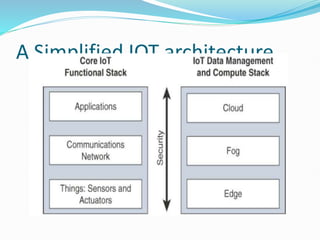
 A Simplified IoT Architecture: While several IoT
architectures exist, a simplified model is presented in this
section to lay a foundation for rest of the topics
 The Core IoT Functional Stack: The IoT network must
be designed to support its unique requirements and
constraints. This section provides an overview of the full
networking stack, from sensors all the way to the
applications layer.
 IoT Data Management and Compute Stack: This
section introduces data management, including storage
and compute resource models for IoT, and involves edge,
fog, and cloud computing.
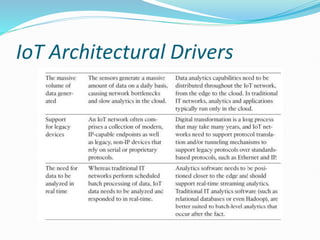
IoT Architectural Drivers
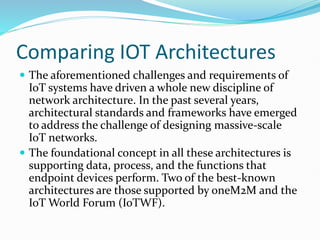
Comparing IOT Architectures
 The aforementioned challenges and requirements of
IoT systems have driven a whole new discipline of
network architecture. In the past several years,
architectural standards and frameworks have emerged
to address the challenge of designing massive-scale
IoT networks.
 The foundational concept in all these architectures is
supporting data, process, and the functions that
endpoint devices perform. Two of the best-known
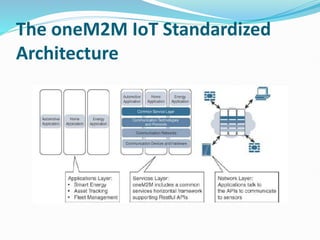
architectures are those supported by oneM2M and the
IoT World Forum (IoTWF).
The oneM2M IoT Standardized
Architecture
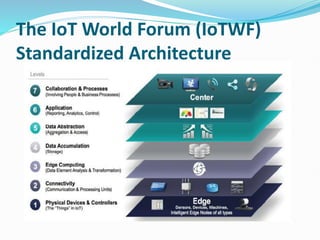
The IoT World Forum (IoTWF)
Standardized Architecture
 Physical Devices and Controllers Layer
This layer is home to the “things” in the Internet of
Things, including the various endpoint devices and
sensors that send and receive information. The size of
these “things” can range from almost microscopic
sensors to giant machines in a factory. Their primary
function is generating data and being capable of being
queried and/or controlled over a network.
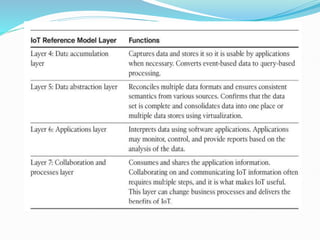
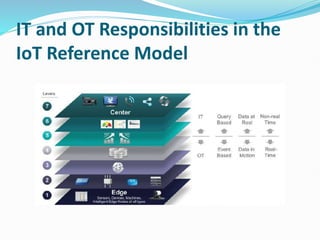
IT and OT Responsibilities in the
IoT Reference Model
A Simplified IOT architecture
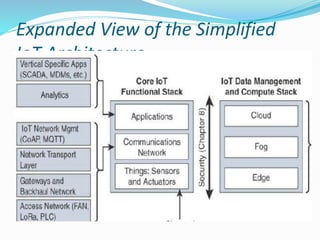
Expanded View of the Simplified
IoT Architecture
The Core IoT Functional Stack
 “Things” layer: At this layer, the physical devices need to fit the constraints of the
environment in which they are deployed while still being able to provide the
information needed.
 Communications network layer: When smart objects are not self-contained, they
need to communicate with an external system. In many cases, this communication
uses a wireless technology. This layer has four sub layers:
 Access network sub layer: The last mile of the IoT network is the access network.
This is typically made up of wireless technologies such as 802.11ah, 802.15.4g, and
LoRa. The sensors connected to the access network may also be wired.
 Gateways and backhaul network sublayer: The gateway communicates directly
with the smart objects. The role of the gateway is to forward the collected
information through a longer-range medium (called the backhaul) to a headend
central station where the information is processed.. On IP networks, this gateway
also forwards packets from one IP network to another, and it therefore acts as a
router.
The Core IoT Functional Stack
 Network transport sub layer: For communication to be successful, network
and transport layer protocols such as IP and UDP must be implemented to
support the variety of devices to connect and media to use.
 IoT network management sublayer: Additional protocols must be in place
to allow the headend applications to exchange data with the sensors.
Examples include CoAP and MQTT.
 Application and analytics layer: At the upper layer, an application needs
to process the collected data, not only to control the smart objects when
necessary, but to make intelligent decision based on the information
collected and, in turn, instruct the “things” or other systems to adapt to the
analyzed conditions and change their behaviors or parameters.
Layer 1: Things: Sensors and Actuators Layer
Battery-powered or power-connected:
Mobile or static
Low or high reporting frequency
Simple or rich data
Report range
Object density per cell
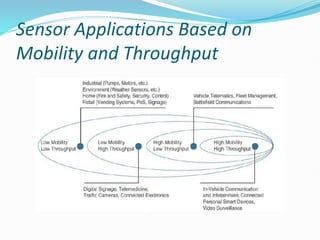
Sensor Applications Based on
Mobility and Throughput
Layer 2: Communications Network
Layer
 Access Network Sub layer
 There is a direct relationship between the IoT network
technology you choose and the type of connectivity topology
this technology allows.
 Each technology was designed with a certain number of use
cases in mind (what to connect, where to connect, how much
data to transport at what interval and over what distance).
 These use cases determined the frequency band that was
expected to be most suitable, the frame structure matching the
expected data pattern (packet size and communication
intervals), and the possible topologies that these use cases
illustrate.
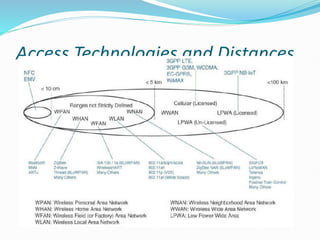
Access Technologies and Distances
Range Estimate Groups
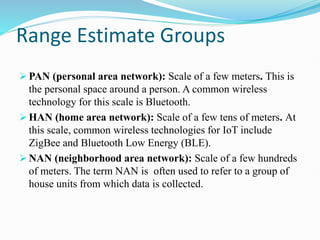
 PAN (personal area network): Scale of a few meters. This is
the personal space around a person. A common wireless
technology for this scale is Bluetooth.
 HAN (home area network): Scale of a few tens of meters. At
this scale, common wireless technologies for IoT include
ZigBee and Bluetooth Low Energy (BLE).
 NAN (neighborhood area network): Scale of a few hundreds
of meters. The term NAN is often used to refer to a group of
house units from which data is collected.
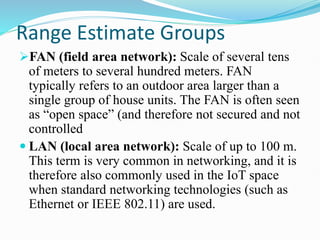
Range Estimate Groups
FAN (field area network): Scale of several tens
of meters to several hundred meters. FAN
typically refers to an outdoor area larger than a
single group of house units. The FAN is often seen
as “open space” (and therefore not secured and not
controlled
 LAN (local area network): Scale of up to 100 m.
This term is very common in networking, and it is
therefore also commonly used in the IoT space
when standard networking technologies (such as
Ethernet or IEEE 802.11) are used.
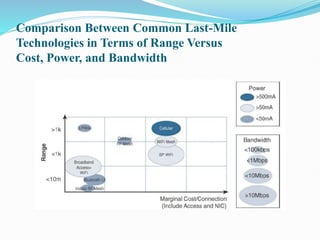
Comparison Between Common Last-Mile
Technologies in Terms of Range Versus
Cost, Power, and Bandwidth
Gateways and Backhaul Sublayer
Data collected from a smart object may need to be
forwarded to a central station where data is processed.
As this station is often in a different location from the
smart object, data directly received from the sensor
through an access technology needs to be forwarded to
another medium (the backhaul) and transported to
the central station.
 The gateway is in charge of this inter-medium
communication.
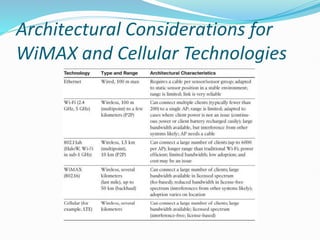
Architectural Considerations for
WiMAX and Cellular Technologies
Network Transport Sublayer
 The communication structure may involve peer-to-peer (for
example, meter to meter), point-to-point (meter to headend
station), point-to-multipoint (gateway or head-end to multiple
meters), unicast and multicast communications (software
update to one or multiple systems
 To allow good communication structure, a network protocol
with specific characteristics needs to be implemented. The
protocol needs to be open and standard-based to accommodate
multiple industries and multiple media. Scalability (to
accommodate thousands or millions of sensors in a single
network) and security are also common requirements.
IoT Network Management
Sublayer
Following the IP logic, some IoT implementers have
suggested HTTP for the data transfer phase. After all,
HTTP has a client and server component. The sensor
could use the client part to establish a connection to the
IoT central application (the server), and then data can be
exchanged
Web Socket is part of the HTML5 specification, and
provides a simple bidirectional connection over a single
connection. Some IoT solutions use Web Socket to
manage the connection between the smart object and an
external application. Web Socket is often combined with
other protocols, such as MQTT (described shortly) to
handle the IoT-specific part of the communication
XMPP
With the same logic of reusing well-known methods,
Extensible Messaging and Presence Protocol (XMPP)
was created. XMPP is based on instant messaging and
presence. It allows the exchange of data between two
or more systems and supports presence and contact
list maintenance.
A limitation of XMPP is its reliance on TCP, which may
force subscribers to maintain open sessions to other
systems and may be a limitation for memory-
constrained objects.
CoAP
CoAP uses some methods similar to those of HTTP
(such as Get, Post, Put, and Delete) but implements a
shorter list, thus limiting the size of the header. CoAP
also runs on UDP (whereas HTTP typically uses TCP).
CoAP also adds a feature that is lacking in HTTP and
very useful for IoT: observation. Observation allows
the streaming of state changes as they occur, without
requiring the receiver to query for these changes.
MQTT
MQTT uses a broker-based architecture. The sensor can
be set to be an MQTT publisher (publishes a piece of
information), the application that needs to receive the
information can be set as the MQTT subscriber, and any
intermediary system can be set as a broker to relay the
information between the publisher and the subscriber(s).
MQTT client typically holds a connection open to the
broker at all times. This may be a limiting factor in
environments where loss is high or where computing
resources are limited.

IOT Network architecture and Design.pptx

  • 1.
  • 2.
     The disciplineof IoT network architecture is new and requires a fresh perspective.  It is important to note that while some similarities between IT and IoT architectures do exist for the most part, the challenges and requirements of IoT systems are radically different from those of traditional IT networks.
  • 3.
    Overview of themodule  Drivers Behind New Network Architectures: OT networks drive core industrial business operations. They have unique characteristics and constraints that are not easily supported by traditional IT network architectures.  Comparing IoT Architectures: Several architectures have been published for IoT, including those by ETSI and the IoT World Forum.
  • 4.
    Overview of themodule  A Simplified IoT Architecture: While several IoT architectures exist, a simplified model is presented in this section to lay a foundation for rest of the topics  The Core IoT Functional Stack: The IoT network must be designed to support its unique requirements and constraints. This section provides an overview of the full networking stack, from sensors all the way to the applications layer.  IoT Data Management and Compute Stack: This section introduces data management, including storage and compute resource models for IoT, and involves edge, fog, and cloud computing.
  • 5.
  • 6.
  • 7.
    Comparing IOT Architectures The aforementioned challenges and requirements of IoT systems have driven a whole new discipline of network architecture. In the past several years, architectural standards and frameworks have emerged to address the challenge of designing massive-scale IoT networks.  The foundational concept in all these architectures is supporting data, process, and the functions that endpoint devices perform. Two of the best-known architectures are those supported by oneM2M and the IoT World Forum (IoTWF).
  • 8.
    The oneM2M IoTStandardized Architecture
  • 9.
    The IoT WorldForum (IoTWF) Standardized Architecture
  • 10.
     Physical Devicesand Controllers Layer This layer is home to the “things” in the Internet of Things, including the various endpoint devices and sensors that send and receive information. The size of these “things” can range from almost microscopic sensors to giant machines in a factory. Their primary function is generating data and being capable of being queried and/or controlled over a network.
  • 14.
    IT and OTResponsibilities in the IoT Reference Model
  • 15.
    A Simplified IOTarchitecture
  • 16.
    Expanded View ofthe Simplified IoT Architecture
  • 17.
    The Core IoTFunctional Stack  “Things” layer: At this layer, the physical devices need to fit the constraints of the environment in which they are deployed while still being able to provide the information needed.  Communications network layer: When smart objects are not self-contained, they need to communicate with an external system. In many cases, this communication uses a wireless technology. This layer has four sub layers:  Access network sub layer: The last mile of the IoT network is the access network. This is typically made up of wireless technologies such as 802.11ah, 802.15.4g, and LoRa. The sensors connected to the access network may also be wired.  Gateways and backhaul network sublayer: The gateway communicates directly with the smart objects. The role of the gateway is to forward the collected information through a longer-range medium (called the backhaul) to a headend central station where the information is processed.. On IP networks, this gateway also forwards packets from one IP network to another, and it therefore acts as a router.
  • 18.
    The Core IoTFunctional Stack  Network transport sub layer: For communication to be successful, network and transport layer protocols such as IP and UDP must be implemented to support the variety of devices to connect and media to use.  IoT network management sublayer: Additional protocols must be in place to allow the headend applications to exchange data with the sensors. Examples include CoAP and MQTT.  Application and analytics layer: At the upper layer, an application needs to process the collected data, not only to control the smart objects when necessary, but to make intelligent decision based on the information collected and, in turn, instruct the “things” or other systems to adapt to the analyzed conditions and change their behaviors or parameters.
  • 19.
    Layer 1: Things:Sensors and Actuators Layer Battery-powered or power-connected: Mobile or static Low or high reporting frequency Simple or rich data Report range Object density per cell
  • 20.
    Sensor Applications Basedon Mobility and Throughput
  • 21.
    Layer 2: CommunicationsNetwork Layer  Access Network Sub layer  There is a direct relationship between the IoT network technology you choose and the type of connectivity topology this technology allows.  Each technology was designed with a certain number of use cases in mind (what to connect, where to connect, how much data to transport at what interval and over what distance).  These use cases determined the frequency band that was expected to be most suitable, the frame structure matching the expected data pattern (packet size and communication intervals), and the possible topologies that these use cases illustrate.
  • 22.
  • 23.
    Range Estimate Groups PAN (personal area network): Scale of a few meters. This is the personal space around a person. A common wireless technology for this scale is Bluetooth.  HAN (home area network): Scale of a few tens of meters. At this scale, common wireless technologies for IoT include ZigBee and Bluetooth Low Energy (BLE).  NAN (neighborhood area network): Scale of a few hundreds of meters. The term NAN is often used to refer to a group of house units from which data is collected.
  • 24.
    Range Estimate Groups FAN(field area network): Scale of several tens of meters to several hundred meters. FAN typically refers to an outdoor area larger than a single group of house units. The FAN is often seen as “open space” (and therefore not secured and not controlled  LAN (local area network): Scale of up to 100 m. This term is very common in networking, and it is therefore also commonly used in the IoT space when standard networking technologies (such as Ethernet or IEEE 802.11) are used.
  • 25.
    Comparison Between CommonLast-Mile Technologies in Terms of Range Versus Cost, Power, and Bandwidth
  • 26.
    Gateways and BackhaulSublayer Data collected from a smart object may need to be forwarded to a central station where data is processed. As this station is often in a different location from the smart object, data directly received from the sensor through an access technology needs to be forwarded to another medium (the backhaul) and transported to the central station.  The gateway is in charge of this inter-medium communication.
  • 27.
    Architectural Considerations for WiMAXand Cellular Technologies
  • 28.
    Network Transport Sublayer The communication structure may involve peer-to-peer (for example, meter to meter), point-to-point (meter to headend station), point-to-multipoint (gateway or head-end to multiple meters), unicast and multicast communications (software update to one or multiple systems  To allow good communication structure, a network protocol with specific characteristics needs to be implemented. The protocol needs to be open and standard-based to accommodate multiple industries and multiple media. Scalability (to accommodate thousands or millions of sensors in a single network) and security are also common requirements.
  • 29.
    IoT Network Management Sublayer Followingthe IP logic, some IoT implementers have suggested HTTP for the data transfer phase. After all, HTTP has a client and server component. The sensor could use the client part to establish a connection to the IoT central application (the server), and then data can be exchanged Web Socket is part of the HTML5 specification, and provides a simple bidirectional connection over a single connection. Some IoT solutions use Web Socket to manage the connection between the smart object and an external application. Web Socket is often combined with other protocols, such as MQTT (described shortly) to handle the IoT-specific part of the communication
  • 30.
    XMPP With the samelogic of reusing well-known methods, Extensible Messaging and Presence Protocol (XMPP) was created. XMPP is based on instant messaging and presence. It allows the exchange of data between two or more systems and supports presence and contact list maintenance. A limitation of XMPP is its reliance on TCP, which may force subscribers to maintain open sessions to other systems and may be a limitation for memory- constrained objects.
  • 31.
    CoAP CoAP uses somemethods similar to those of HTTP (such as Get, Post, Put, and Delete) but implements a shorter list, thus limiting the size of the header. CoAP also runs on UDP (whereas HTTP typically uses TCP). CoAP also adds a feature that is lacking in HTTP and very useful for IoT: observation. Observation allows the streaming of state changes as they occur, without requiring the receiver to query for these changes.
  • 32.
    MQTT MQTT uses abroker-based architecture. The sensor can be set to be an MQTT publisher (publishes a piece of information), the application that needs to receive the information can be set as the MQTT subscriber, and any intermediary system can be set as a broker to relay the information between the publisher and the subscriber(s). MQTT client typically holds a connection open to the broker at all times. This may be a limiting factor in environments where loss is high or where computing resources are limited.