กิจกรรม : Mind Reader Predictable/Controlled และ Unpredictable/Un controlled Problem Procedure: Select a number between 2 and 9. This number is to be kept to yourself. Multiply the selected number by 9. If the result has two digits then add them together. Now subtract 5 from this amount. Relate this number to alphabet, so that 1 is letter ‘a’, 2 is letter ‘b’ Think of a country that starts with that letter. Take the second letter of that country and think of an animal starting with that letter. Discussion Point : 1. How many people had this same solution? 2. How did it happen? 3. Is it manipulation? 4. How does this game relate to this course?
บทที่ 3Phase 2 : Systems Analysis “ System Analysis is the investigation of the business and user requirements of an information system” ขั้นตอนการทำงานในระบบปัจจุบัน ปัญหาที่เกิดขึ้น ความต้องการที่อยากให้มีในระบบใหม่
5.
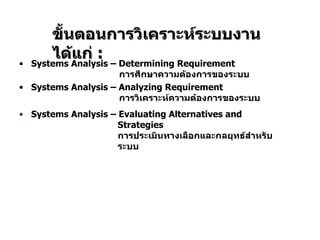
Systems Analysis –Determining Requirement ก าร ศึกษา ความต้องการของระบบ Systems Analysis – Analyzing Requirement การวิเคราะห์ความต้องการของระบบ Systems Analysis – Evaluating Alternatives and Strategies การประเมินทางเลือก และกลยุทธ์ สำหรับ ระบบ ขั้นตอนการวิเคราะห์ระบบงาน ได้แก่ :
6.
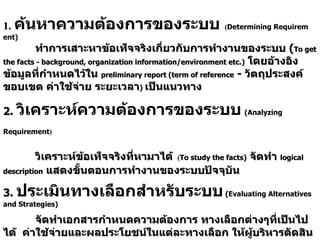
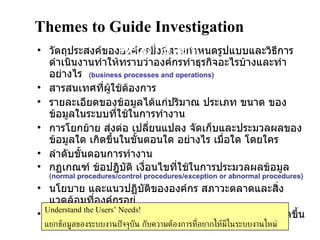
บทที่ 3Phase 2 :Systems Analysis 1. ค้นห าความต้องการของระบบ ( Determining Requirement) ทำการเสาะหาข้อเท็จจริงเกี่ยวกับการทำงานของระบบ ( To get the facts - background, organization information/environment etc.) โดยอ้างอิงข้อมูลที่กำหนดไว้ใน preliminary report (term of reference - วัตถุประสงค์ ขอบเขต ค่าใช้จ่าย ระยะเวลา ) เป็นแนวทาง 2. วิเคราะห์ความต้องการของระบบ ( Analyzing Requirement ) วิเคราะห์ข้อเท็จจริงที่หามาได้ ( To study the facts) จัดทำ logical description แสดงขั้นตอนการทำงานของระบบปัจจุบัน 3. ประเมินทางเลือกสำหรับระบบ ( Evaluating Alternatives and Strategies) จัดทำเอกสารกำหนดความต้องการ ทางเลือกต่างๆที่เป็นไปได้ ค่าใช้จ่ายและผลประโยชน์ในแต่ละทางเลือก ให้ผู้บริหารตัดสินใจ ( Prepare the systems requirements document)
7.
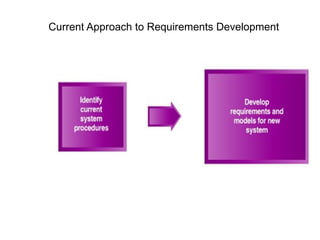
บทที่ 3Phase 2 :Systems Analysis Current Approach to Requirements Development
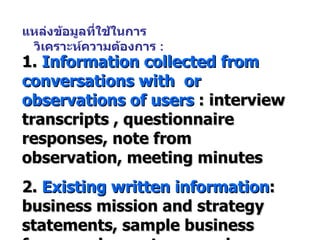
แหล่งข้อมูลที่ใช้ในการวิเคราะห์ความต้องการ :1. Information collected from conversations with or observations of users : interview transcripts , questionnaire responses, note from observation, meeting minutes 2. Existing written information : business mission and strategy statements, sample business forms and reports, procedure manuals, job descriptions, flowchart etc. 3. Computer-based information : screen displays, report etc.
กิจกรรม The Orange Procedure : 1. The story about two little girls. “ Both little girls walked into the kitchen wanting an orange, but found only one orange left on the table.” Question: What options should be suggested about this story?
13.
W hat vitalpiece of information we need to know but haven’t asked for yet. กิจกรรม The Orange
14.
กิจกรรม The Orange One girl wanted the rind of the orange to make a cake. The other girl wanted the juice for a drink. Discussion point: 1.Why do we tend to go straight for a solution before we identify what the problem is? 2. How can we overcome this problem. Solutions sometimes impossible without first establishing the needs of all parties concerned .
15.
เทคนิคที่ใช้ในการเสาะหาข้อเท็จจริง ได้แก่ การสัมภาษณ์ (Interview) Conduct interviews and discussion with users การทบทวน ตรวจสอบจากเอกสาร (Document reviews) Review existing reports, forms, and procedure descriptions การสังเกตการณ์ (Observation) Observe business processes and workflows แบบสอบถาม (Questionnaires) Distribute and collect stakeholder questionnaires สุ่มตัวอย่าง (Sampling) การวิจัย (Research)
16.
บทที่ 3Phase 2 :Systems Analysis – Determining Requirement Interviews and Discussions Most effective way to understand business functions and rules Time-consuming and resource-expensive May require multiple sessions
17.
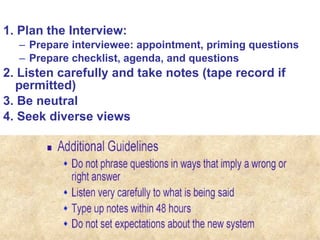
1. Plan theInterview: Prepare interviewee: appointment, priming questions Prepare checklist, agenda, and questions 2. Listen carefully and take notes (tape record if permitted) 3. Be neutral 4. Seek diverse views
Choosing Interview Questions: Open-ended questions - difficult to summarized - take time to answer - reveal unknown information - interviewees feel at ease - give the interviewees more sense of involvement and control the interview
21.
Choosing Interview Questions: Close-ended questions - เหมาะสำหรับคำถามที่มีคำตอบแน่ชัด - ใช้เวลาในการตอบไม่นาน - ตั้งคำถามครอบคลุมเนื้อหาได้กว้าง - useful information may be overlooked
22.
Advantages/ Disadvantages highinformation richness good chance to follow up and clarification questions interviewee is known to interviewer interviewee is involved and committed can see body language and hear voice tone (better than questionnaire ) limited numbers (but complete responses ) can be expensive can be time consuming
23.
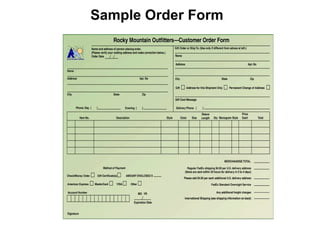
บทที่ 3Phase 2 :Systems Analysis – Determining Requirement Review Existing Reports, Forms, and Procedure Descriptions Purposes ใช้เป็นวิธีที่ทำความเข้าใจเบื้องต้นใน process ต่างๆ เป็น Guidelines หรือ / visual cues ก่อนทำการสัมภาษณ์ Identify business rules, discrepancies, and redundancies Be cautious of outdated material
24.
บทที่ 3Phase 2 :Systems Analysis – Determining Requirement Review Existing Reports, Forms, and Procedure Descriptions In documents you can find information about : ปัญหาที่มีในการทำงานของระบบปัจจุบัน (e.g. missing information, redundant steps) ความต้องการที่ควรเพิ่มเติมในระบบงานใหม่ (if only certain information are available) ชื่อและตำแหน่งของ key individuals ขั้นตอนการทำงานในสถานการณ์ที่ไม่ปกติซึ่งไม่ได้เกิดขึ้นเป็นประจำ กฎเกณฑ์ ข้อบังคับในการประมวลผลข้อมูล
Choosing Questionnaires Respondents: Those convenient to sample (local site, willingness) A random group ( e.g. every n th on the list) A purposeful sample (people who satisfy certain criteria, work more than 2 years etc.) A stratified sample (you have several categories of people- choose a random set from each category)
29.
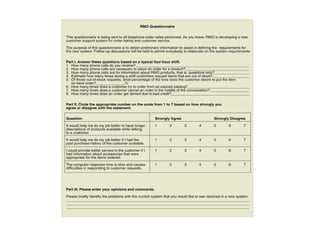
Designing Questionnaires :on paper in person over the phone (resembling a structures interview) on diskette or web site
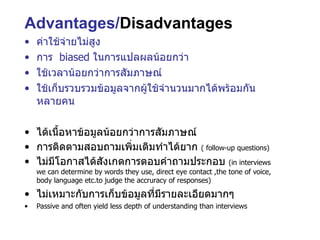
Advantages/ Disadvantages ค่าใช้จ่ายไม่สูง การ biased ในการแปลผลน้อยกว่า ใช้เวลาน้อยกว่าการสัมภาษณ์ ใช้เก็บรวบรวมข้อมูลจากผู้ใช้จำนวนมากได้พร้อมกันหลายคน ได้เนื้อหาข้อมูลน้อยกว่าการสัมภาษณ์ การติดตามสอบถามเพิ่มเติมทำได้ยาก ( follow-up questions) ไม่มีโอกาสได้สังเกตการตอบคำถามประกอบ (in interviews we can determine by words they use, direct eye contact ,the tone of voice, body language etc. to judge the accruracy of responses ) ไม่เหมาะกับการเก็บข้อมูลที่มีรายละเอียดมากๆ Passive and often yield less depth of understanding than interviews
Observe Business Processesand Workflows From office walkthrough to performing actual tasks May make users nervous Not necessary to observe all processes at same level of detail
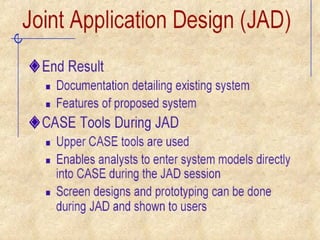
บทที่ 3Phase 2 :Systems Analysis – Determining Requirement JAD Sessions Joint Application Design เป็นการร่วมมือกันในการทำงานในกลุ่มของ stakeholders Used to expedite the investigation of systems requirements Seeks to compress fact-finding, modeling, policy formation, and verification activities into a shorter time frame Critical factor is to have all important stakeholders present
41.
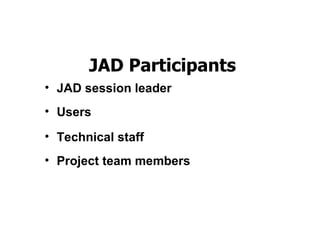
บทที่ 3Phase 2 :Systems Analysis – Determining Requirement JAD Participants JAD session leader Users Technical staff Project team members
42.
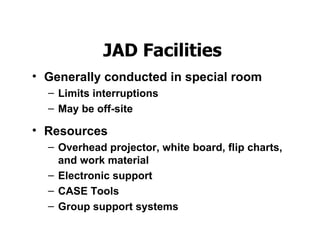
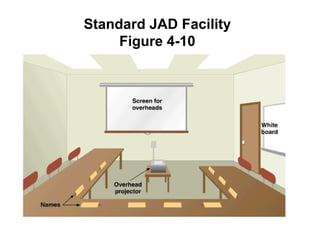
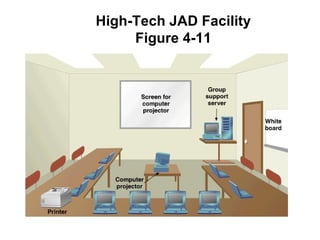
บทที่ 3Phase 2 :Systems Analysis – Determining Requirement JAD Facilities Generally conducted in special room Limits interruptions May be off-site Resources Overhead projector, white board, flip charts, and work material Electronic support CASE Tools Group support systems
กิจกรรม : Information Overloaded - “Bus Stop” You are driving a bus which has 50 people on board. The bus makes a stop, 10 people get off, and 3 get on. At next stop 8 people get off, and 2 people get on. There are 2 more stops, at which 4 people get off at each. At this point the bus has to stop because of mechanical problems. Some of the passengers are in hurry, so they decide to walk. So 7 people get off the bus. When the mechanical problem is fixed, the bus goes directly to the last stop, and the rest of the people get off.
49.
กิจกรรม : Information Overloaded - “Bus Stop” Question : What was the bus driver’s name? 1 . Why didn’t everyone know the name of the driver? 2. What were the essential facts? 3. How does this relate to the information we need to give to others?
Objectives Define systemrequirements and differentiate between functional and nonfunctional requirements. Understand the activity of problem analysis and be able to create an Ishikawa (fishbone) diagram. Understand the concept of requirements management. Identify and characterize seven fact-finding techniques. Understand six guidelines for effective listening. Understand body language and proxemics. Characterize the typical participants in a JRP session. Complete the planning process for a JRP session. Describe benefits of JRP as fact-finding technique. Describe a fact-finding strategy that will make the most of your time with end-users.
53.
54.
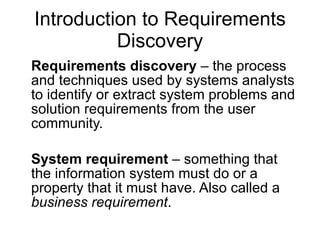
Introduction to RequirementsDiscovery Requirements discovery – the process and techniques used by systems analysts to identify or extract system problems and solution requirements from the user community. System requirement – something that the information system must do or a property that it must have. Also called a business requirement .
55.
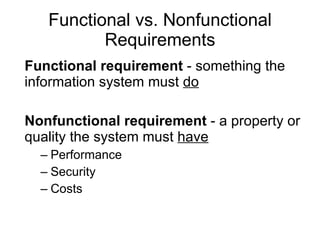
Functional vs. NonfunctionalRequirements Functional requirement - something the information system must do Nonfunctional requirement - a property or quality the system must have Performance Security Costs
56.
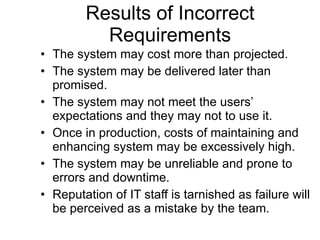
Results of IncorrectRequirements The system may cost more than projected. The system may be delivered later than promised. The system may not meet the users’ expectations and they may not to use it. Once in production, costs of maintaining and enhancing system may be excessively high. The system may be unreliable and prone to errors and downtime. Reputation of IT staff is tarnished as failure will be perceived as a mistake by the team.
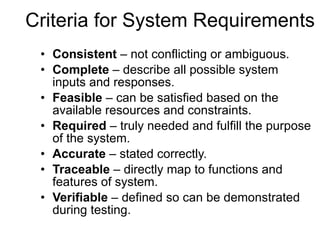
Criteria for SystemRequirements Consistent – not conflicting or ambiguous. Complete – describe all possible system inputs and responses. Feasible – can be satisfied based on the available resources and constraints. Required – truly needed and fulfill the purpose of the system. Accurate – stated correctly. Traceable – directly map to functions and features of system. Verifiable – defined so can be demonstrated during testing.
59.
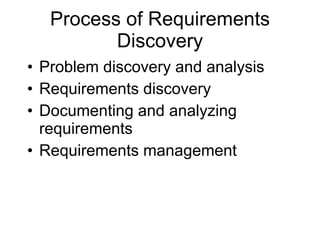
Process of RequirementsDiscovery Problem discovery and analysis Requirements discovery Documenting and analyzing requirements Requirements management
60.
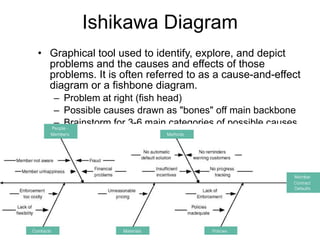
Ishikawa Diagram Graphicaltool used to identify, explore, and depict problems and the causes and effects of those problems. It is often referred to as a cause-and-effect diagram or a fishbone diagram. Problem at right (fish head) Possible causes drawn as "bones" off main backbone Brainstorm for 3-6 main categories of possible causes
61.
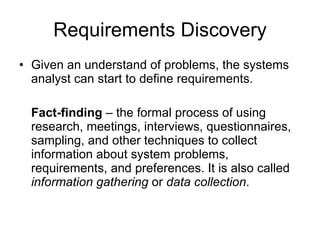
Requirements Discovery Givenan understand of problems, the systems analyst can start to define requirements. Fact-finding – the formal process of using research, meetings, interviews, questionnaires, sampling, and other techniques to collect information about system problems, requirements, and preferences. It is also called information gathering or data collection .
62.
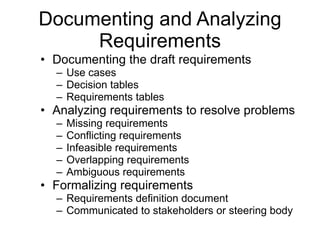
Documenting and AnalyzingRequirements Documenting the draft requirements Use cases Decision tables Requirements tables Analyzing requirements to resolve problems Missing requirements Conflicting requirements Infeasible requirements Overlapping requirements Ambiguous requirements Formalizing requirements Requirements definition document Communicated to stakeholders or steering body
63.
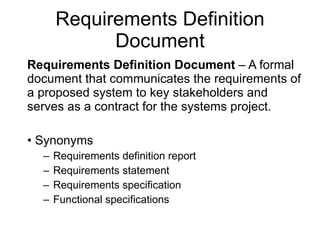
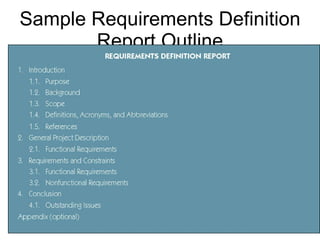
Requirements Definition DocumentRequirements Definition Document – A formal document that communicates the requirements of a proposed system to key stakeholders and serves as a contract for the systems project. Synonyms Requirements definition report Requirements statement Requirements specification Functional specifications
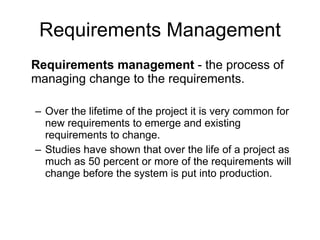
Requirements Management Requirementsmanagement - the process of managing change to the requirements. Over the lifetime of the project it is very common for new requirements to emerge and existing requirements to change. Studies have shown that over the life of a project as much as 50 percent or more of the requirements will change before the system is put into production.
66.
Fact-Finding Ethics Fact-Findingoften brings systems analysts into contact with sensitive information. Company plans Employee salaries or medical history Customer credit card, social security, or other information Ethical behavior Systems analysts must not misuse information. Systems analysts must protect information from people who would misuse it. Otherwise Systems analyst loses respect, credibility, and confidence of users and management, impairing ability to do job Organization and systems analyst could have legal liability Systems analyst could lose job
67.
Seven Fact-Finding MethodsSampling of existing documentation, forms, and databases. Research and site visits. Observation of the work environment. Questionnaires. Interviews. Prototyping. Joint requirements planning (JRP).
68.
Sampling Existing Documentation,Forms, & Files Sampling –process of collecting a representative sample of documents, forms, and records. Organization chart Memos and other documents that describe the problem Standard operating procedures for current system Completed forms Manual and computerized screens and reports Samples of databases Flowcharts and other system documentation And more
69.
Things to beGleaned from Documents Symptoms and causes of problems Persons in organization who have understanding of problem Business functions that support the present system Type of data to be collected and reported by the system Questions that need to be covered in interviews
70.
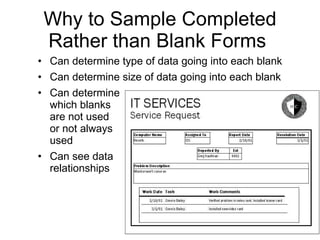
Why to SampleCompleted Rather than Blank Forms Can determine type of data going into each blank Can determine size of data going into each blank Can determine which blanks are not used or not always used Can see data relationships
71.
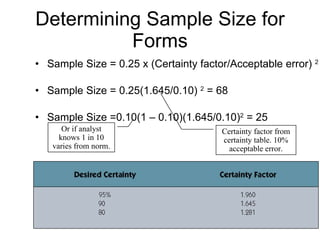
Determining Sample Sizefor Forms Sample Size = 0.25 x (Certainty factor/Acceptable error) 2 Sample Size = 0.25(1.645/0.10) 2 = 68 Sample Size =0.10(1 – 0.10)(1.645/0.10) 2 = 25 Or if analyst knows 1 in 10 varies from norm. Certainty factor from certainty table. 10% acceptable error.
72.
Sampling Techniques Randomization – a sampling technique characterized by having no predetermined pattern or plan for selecting sample data. Stratification – a systematic sampling technique that attempts to reduce the variance of the estimates by spreading out the sampling—for example, choosing documents or records by formula—and by avoiding very high or low estimates.
73.
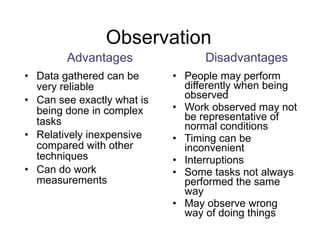
Observation Observation – a fact-finding technique wherein the systems analyst either participates in or watches a person perform activities to learn about the system. Advantages? Disadvantages? Work sampling - a fact-finding technique that involves a large number of observations taken at random intervals.
74.
Observation Data gatheredcan be very reliable Can see exactly what is being done in complex tasks Relatively inexpensive compared with other techniques Can do work measurements People may perform differently when being observed Work observed may not be representative of normal conditions Timing can be inconvenient Interruptions Some tasks not always performed the same way May observe wrong way of doing things Advantages Disadvantages
75.
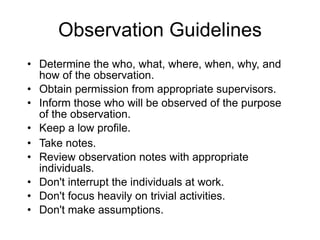
Observation Guidelines Determinethe who, what, where, when, why, and how of the observation. Obtain permission from appropriate supervisors. Inform those who will be observed of the purpose of the observation. Keep a low profile. Take notes. Review observation notes with appropriate individuals. Don't interrupt the individuals at work. Don't focus heavily on trivial activities. Don't make assumptions.
76.
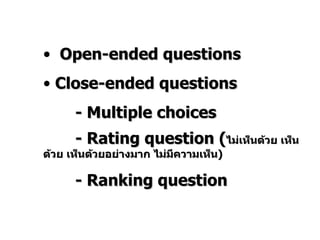
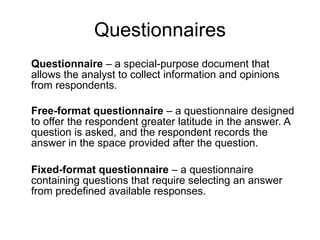
Questionnaires Questionnaire – a special-purpose document that allows the analyst to collect information and opinions from respondents. Free-format questionnaire – a questionnaire designed to offer the respondent greater latitude in the answer. A question is asked, and the respondent records the answer in the space provided after the question. Fixed-format questionnaire – a questionnaire containing questions that require selecting an answer from predefined available responses.
77.
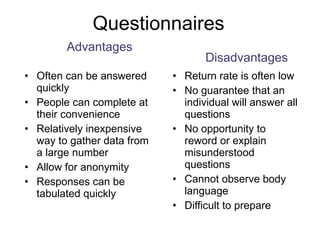
Questionnaires Often canbe answered quickly People can complete at their convenience Relatively inexpensive way to gather data from a large number Allow for anonymity Responses can be tabulated quickly Return rate is often low No guarantee that an individual will answer all questions No opportunity to reword or explain misunderstood questions Cannot observe body language Difficult to prepare Advantages Disadvantages
78.
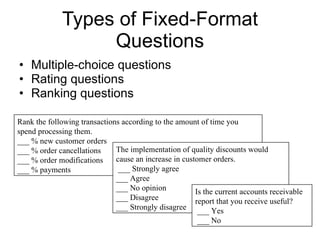
Types of Fixed-FormatQuestions Multiple-choice questions Rating questions Ranking questions Rank the following transactions according to the amount of time you spend processing them. ___ % new customer orders ___ % order cancellations ___ % order modifications ___ % payments The implementation of quality discounts would cause an increase in customer orders. ___ Strongly agree ___ Agree ___ No opinion ___ Disagree ___ Strongly disagree Is the current accounts receivable report that you receive useful? ___ Yes ___ No
79.
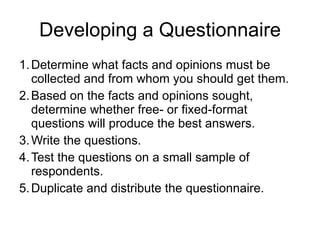
Developing a QuestionnaireDetermine what facts and opinions must be collected and from whom you should get them. Based on the facts and opinions sought, determine whether free- or fixed-format questions will produce the best answers. Write the questions. Test the questions on a small sample of respondents. Duplicate and distribute the questionnaire.
80.
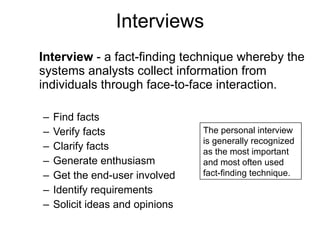
Interviews Interview - a fact-finding technique whereby the systems analysts collect information from individuals through face-to-face interaction. Find facts Verify facts Clarify facts Generate enthusiasm Get the end-user involved Identify requirements Solicit ideas and opinions The personal interview is generally recognized as the most important and most often used fact-finding technique.
81.
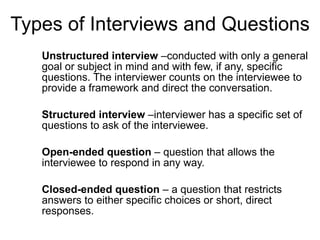
Types of Interviewsand Questions Unstructured interview –conducted with only a general goal or subject in mind and with few, if any, specific questions. The interviewer counts on the interviewee to provide a framework and direct the conversation. Structured interview –interviewer has a specific set of questions to ask of the interviewee. Open-ended question – question that allows the interviewee to respond in any way. Closed-ended question – a question that restricts answers to either specific choices or short, direct responses.
82.
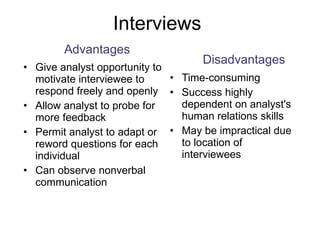
Interviews Give analystopportunity to motivate interviewee to respond freely and openly Allow analyst to probe for more feedback Permit analyst to adapt or reword questions for each individual Can observe nonverbal communication Time-consuming Success highly dependent on analyst's human relations skills May be impractical due to location of interviewees Advantages Disadvantages
83.
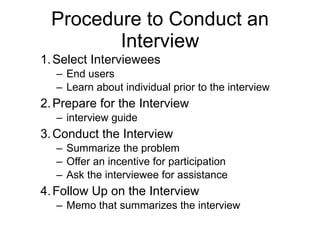
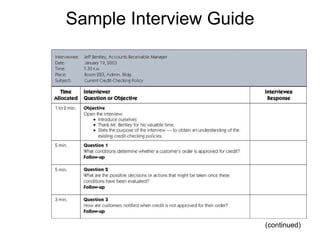
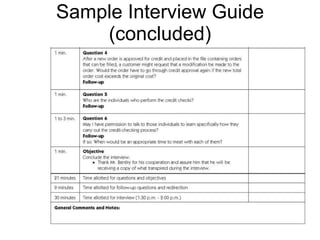
Procedure to Conductan Interview Select Interviewees End users Learn about individual prior to the interview Prepare for the Interview interview guide Conduct the Interview Summarize the problem Offer an incentive for participation Ask the interviewee for assistance Follow Up on the Interview Memo that summarizes the interview
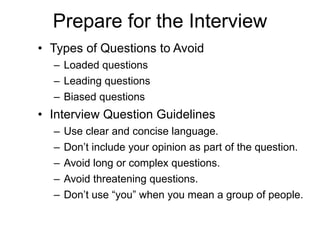
Prepare for theInterview Types of Questions to Avoid Loaded questions Leading questions Biased questions Interview Question Guidelines Use clear and concise language. Don’t include your opinion as part of the question. Avoid long or complex questions. Avoid threatening questions. Don’t use “you” when you mean a group of people.
87.
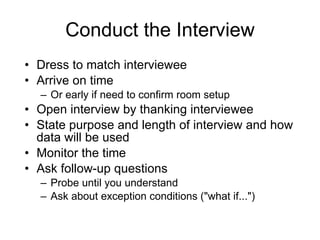
Conduct the InterviewDress to match interviewee Arrive on time Or early if need to confirm room setup Open interview by thanking interviewee State purpose and length of interview and how data will be used Monitor the time Ask follow-up questions Probe until you understand Ask about exception conditions ("what if...")
88.
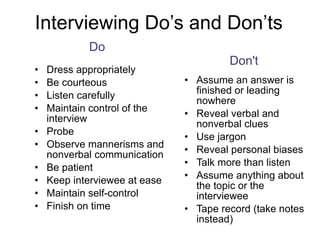
Interviewing Do’s andDon’ts Dress appropriately Be courteous Listen carefully Maintain control of the interview Probe Observe mannerisms and nonverbal communication Be patient Keep interviewee at ease Maintain self-control Finish on time Assume an answer is finished or leading nowhere Reveal verbal and nonverbal clues Use jargon Reveal personal biases Talk more than listen Assume anything about the topic or the interviewee Tape record (take notes instead) Do Don't
89.
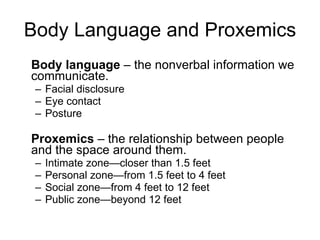
Body Language andProxemics Body language – the nonverbal information we communicate. Facial disclosure Eye contact Posture Proxemics – the relationship between people and the space around them. Intimate zone—closer than 1.5 feet Personal zone—from 1.5 feet to 4 feet Social zone—from 4 feet to 12 feet Public zone—beyond 12 feet
90.
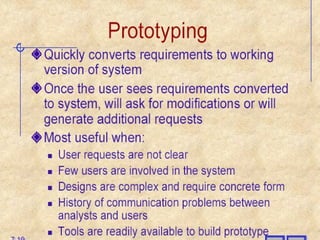
Discovery Prototyping Discoveryprototyping – the act of building a small-scale, representative or working model of the users’ requirements in order to discover or verify those requirements.
91.
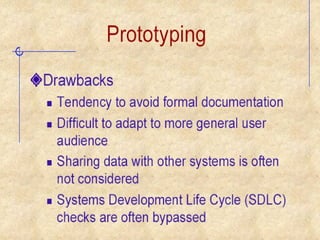
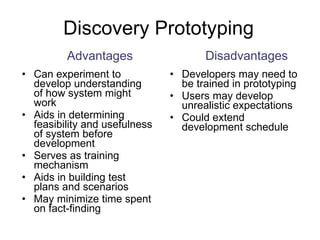
Discovery Prototyping Canexperiment to develop understanding of how system might work Aids in determining feasibility and usefulness of system before development Serves as training mechanism Aids in building test plans and scenarios May minimize time spent on fact-finding Developers may need to be trained in prototyping Users may develop unrealistic expectations Could extend development schedule Advantages Disadvantages
92.
Joint Requirements PlanningJoint requirements planning (JRP) – a process whereby highly structured group meetings are conducted for the purpose of analyzing problems and defining requirements. JRP is a subset of a more comprehensive joint application development or JAD technique that encompasses the entire systems development process.
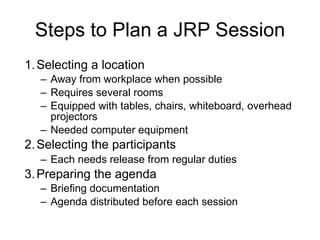
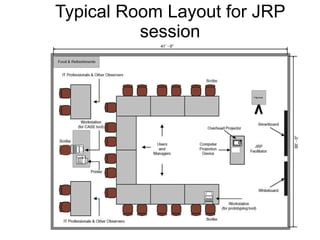
Steps to Plana JRP Session Selecting a location Away from workplace when possible Requires several rooms Equipped with tables, chairs, whiteboard, overhead projectors Needed computer equipment Selecting the participants Each needs release from regular duties Preparing the agenda Briefing documentation Agenda distributed before each session
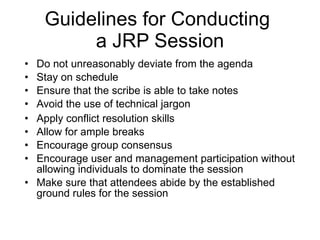
Guidelines for Conducting a JRP Session Do not unreasonably deviate from the agenda Stay on schedule Ensure that the scribe is able to take notes Avoid the use of technical jargon Apply conflict resolution skills Allow for ample breaks Encourage group consensus Encourage user and management participation without allowing individuals to dominate the session Make sure that attendees abide by the established ground rules for the session
97.
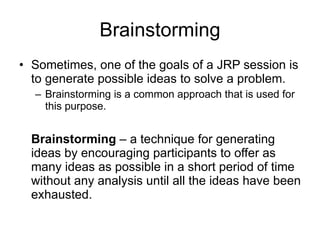
Brainstorming Sometimes, oneof the goals of a JRP session is to generate possible ideas to solve a problem. Brainstorming is a common approach that is used for this purpose. Brainstorming – a technique for generating ideas by encouraging participants to offer as many ideas as possible in a short period of time without any analysis until all the ideas have been exhausted.
98.
Brainstorming Guidelines Isolateappropriate people in a place that free from distractions and interruptions. Make sure everyone understands purpose of the meeting. Appoint one person to record ideas. Remind everyone of brainstorming rules. Within a specified time period, team members call out their ideas as quickly as they can think of them. After group has run out of ideas and all ideas have been recorded, then and only then should ideas be evaluated. Refine, combine, and improve ideas generated earlier.
99.
Benefits of JRPJRP actively involves users and management in the development project (encouraging them to take “ownership” in the project). JRP reduces the amount of time required to develop systems. When JRP incorporates prototyping as a means for confirming requirements and obtaining design approvals, the benefits of prototyping are realized
100.
A Fact-Finding StrategyLearn from existing documents, forms, reports, and files. If appropriate, observe the system in action. Given all the facts that already collected, design and distribute questionnaires to clear up things that aren’t fully understood. Conduct interviews (or group work sessions). (Optional). Build discovery prototypes for any functional requirements that are not understood or for requirements that need to be validated. Follow up to verify facts.