Games and Virtual Worlds Training C enter for the  A dvancement of  D istance  E ducation University of Illinois at Chicago Kevin Harvey ( a.k.a. Qwerty Hansen ) Assistant Director,  [email_address] http://www.uic.edu/sph/cade http://www.virtualpublichealth.com
About CADE CADE  has ~50 employees that do: Games, simulations, and virtual worlds Public Health preparedness and training Research data management Multimedia and webcasting Web development Online database development 2
Why Games for Emergency Preparedness? High level of engagement Easily distributable and update-able Can practice a scenario (over and over again)  Individuals can practice multiple roles  Tracks Compliance and Competency (LMS) Ability to generate reports Appropriate to the Audience 3
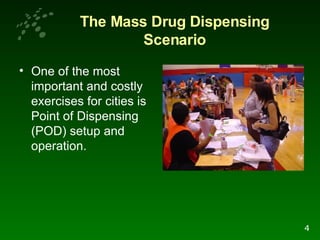
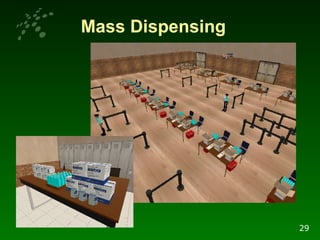
The Mass Drug Dispensing Scenario One of the most important and costly exercises for cities is Point of Dispensing (POD) setup and operation. 4
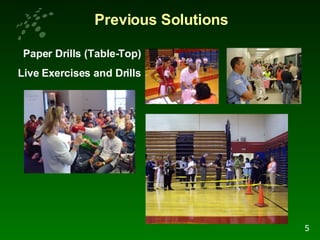
Previous Solutions Paper Drills (Table-Top) Live Exercises and Drills 5
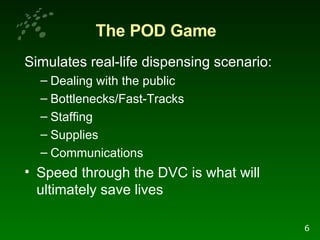
The POD Game Simulates real-life dispensing scenario: Dealing with the public Bottlenecks/Fast-Tracks Staffing Supplies Communications Speed through the DVC is what will ultimately save lives 6
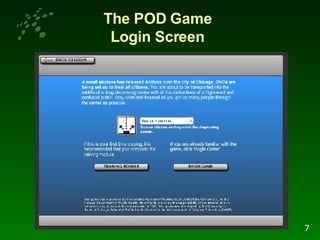
The POD Game Login Screen 7
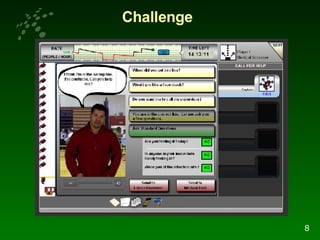
Challenge 8
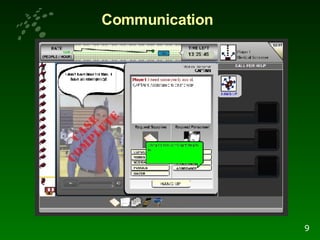
Communication 9
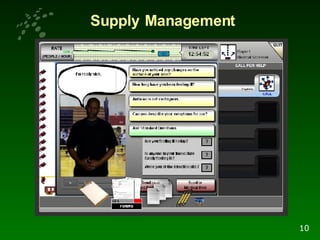
Supply   Management 10
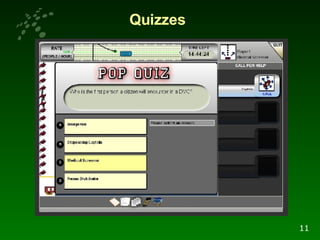
Quizzes 11
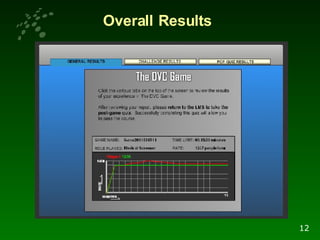
Overall   Results 12
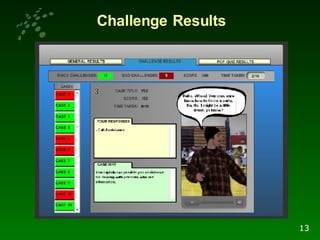
Challenge   Results 13
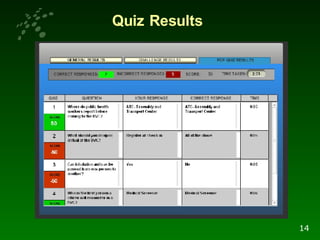
Quiz   Results 14
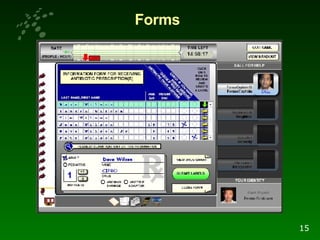
Forms 15
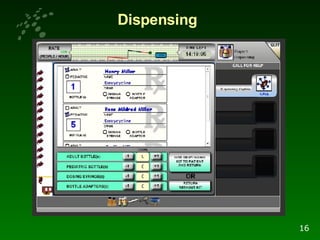
Dispensing 16
General conclusion:  The game was just as effective at increasing knowledge about the DVC as the face to face training, even among a population that has a fairly low level of skill using computers.  Game   Evaluation 17
65 Clinical Coordinators (randomized) 35 in Game Group / 30 in Face-to-Face Game group Computer Skills self assessment Didactic Game Training Game Play Post-test Satisfaction Survey Face-to-Face Same as Game Group, except replaced Didactic, Game Training, and Game Play with 30 minute Face-to-Face training  Game   Evaluation 18
Comments:  “ Game is very practical and useful and an excellent teaching tool.” “ Very interesting...fun way to learn.” “ Excellent. This game requires the screener to multitask during the situation.” “ I thought this game would be easy, but it really required me to think critically about my decisions. thanks” “ It was fun.” Game   Evaluation 19
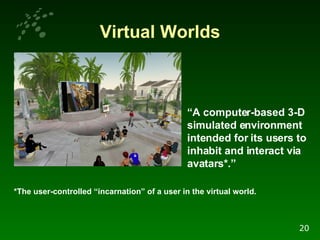
Virtual Worlds “ A computer-based 3-D simulated environment intended for its users to inhabit and interact via avatars*.”   *The user-controlled “incarnation” of a user in the virtual world. 20
Virtual Worlds Businesses use virtual world as an extension of their real world for communication between world-wide employees, allowing for a sense of “togetherness” and community.  21
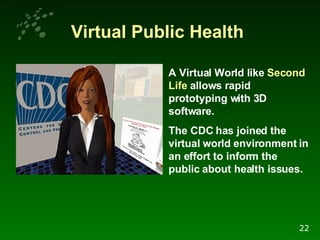
Virtual Public Health A Virtual World like  Second Life  allows rapid prototyping with 3D software.  The CDC has joined the virtual world environment in an effort to inform the public about health issues.   22
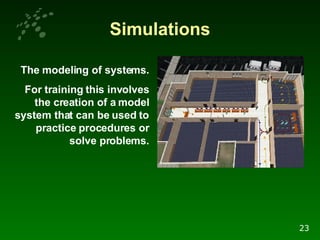
Simulations The modeling of systems. For training this involves the creation of a model system that can be used to practice procedures or solve problems. 23
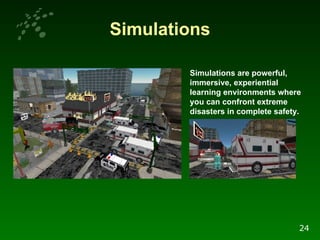
Simulations Simulations are powerful, immersive, experiential learning environments where you can confront extreme disasters in complete safety. 24
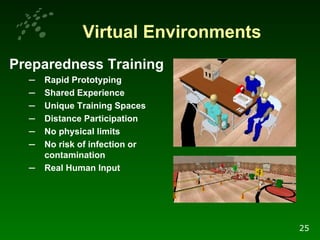
Virtual Environments Preparedness Training Rapid Prototyping Shared Experience Unique Training Spaces  Distance Participation No physical limits No risk of infection or contamination Real Human Input 25
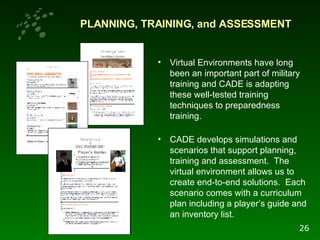
PLANNING, TRAINING, and ASSESSMENT Virtual Environments have long been an important part of military training and CADE is adapting these well-tested training techniques to preparedness training.  CADE develops simulations and scenarios that support planning, training and assessment.  The virtual environment allows us to create end-to-end solutions.  Each scenario comes with a curriculum plan including a player’s guide and an inventory list. 26
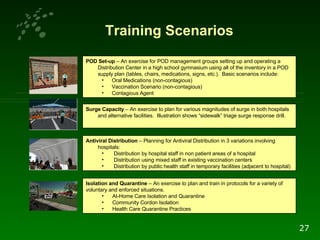
Training Scenarios 27 Surge Capacity  – An exercise to plan for various magnitudes of surge in both hospitals and alternative facilities.  Illustration shows “sidewalk” triage surge response drill.  POD Set-up  – An exercise for POD management groups setting up and operating a Distribution Center in a high school gymnasium using all of the inventory in a POD supply plan (tables, chairs, medications, signs, etc.).  Basic scenarios include: Oral Medications (non-contagious) Vaccination Scenario (non-contagious) Contagious Agent Antiviral Distribution  – Planning for Antiviral Distribution in 3 variations involving hospitals: Distribution by hospital staff in non patient areas of a hospital Distribution using mixed staff in existing vaccination centers Distribution by public health staff in temporary facilities (adjacent to hospital) Isolation and Quarantine  – An exercise to plan and train in protocols for a variety of voluntary and enforced situations.  At-Home Care Isolation and Quarantine Community Cordon Isolation Health Care Quarantine Practices
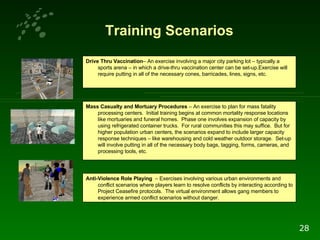
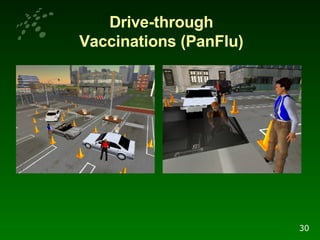
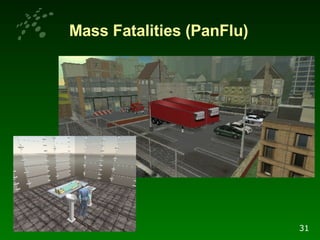
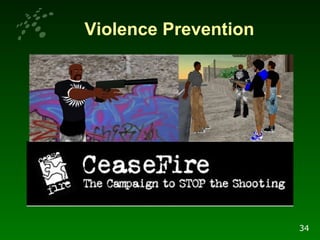
Training Scenarios 28 Mass Casualty and Mortuary Procedures  – An exercise to plan for mass fatality processing centers.  Initial training begins at common mortality response locations like mortuaries and funeral homes.  Phase one involves expansion of capacity by using refrigerated container trucks.  For rural communities this may suffice.  But for higher population urban centers, the scenarios expand to include larger capacity response techniques – like warehousing and cold weather outdoor storage.  Set-up will involve putting in all of the necessary body bags, tagging, forms, cameras, and processing tools, etc. Drive Thru Vaccination – An exercise involving a major city parking lot – typically a sports arena – in which a drive-thru vaccination center can be set-up.Exercise will require putting in all of the necessary cones, barricades, lines, signs, etc. Anti-Violence Role Playing   – Exercises involving various urban environments and conflict scenarios where players learn to resolve conflicts by interacting according to Project Ceasefire protocols.  The virtual environment allows gang members to experience armed conflict scenarios without danger.
Mass Dispensing 29
Drive-through Vaccinations (PanFlu) 30
Mass Fatalities (PanFlu) 31
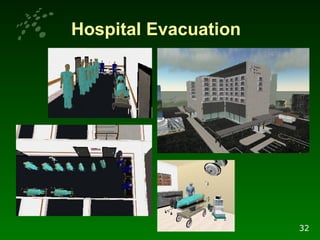
Hospital Evacuation 32
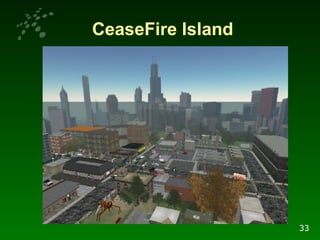
CeaseFire Island 33
Violence Prevention 34
CADE’s Hands-On Technology Exercise Held April 6, 2007  at the California Distance Learning Conference Building Capacity: Reaching New Heights in Global Preparedness South Lake Tahoe, CA   3 Virtual Worlds Missions Tahoe 35
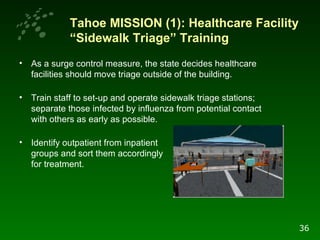
Tahoe MISSION (1): Healthcare Facility “Sidewalk Triage” Training As a surge control measure, the state decides healthcare facilities should move triage outside of the building.  Train staff to set-up and operate sidewalk triage stations; separate those infected by influenza from potential contact with others as early as possible.  Identify outpatient from inpatient  groups and sort them accordingly  for treatment. 36
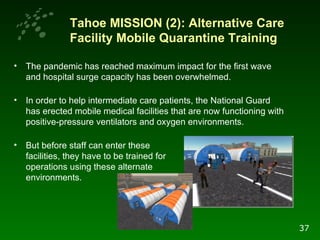
Tahoe MISSION (2): Alternative Care Facility Mobile Quarantine Training  The pandemic has reached maximum impact for the first wave and hospital surge capacity has been overwhelmed.  In order to help intermediate care patients, the National Guard has erected mobile medical facilities that are now functioning with positive-pressure ventilators and oxygen environments.  But before staff can enter these  facilities, they have to be trained for  operations using these alternate  environments. 37
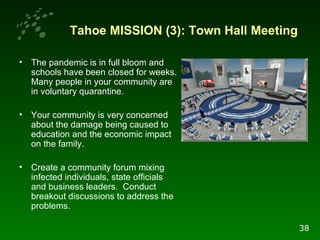
Tahoe MISSION (3): Town Hall Meeting The pandemic is in full bloom and schools have been closed for weeks. Many people in your community are in voluntary quarantine.  Your community is very concerned about the damage being caused to education and the economic impact on the family.  Create a community forum mixing infected individuals, state officials and business leaders.  Conduct breakout discussions to address the problems.  38
Discussion

CADE Games and Virtual Worlds Training

  • 1.
    Games and VirtualWorlds Training C enter for the A dvancement of D istance E ducation University of Illinois at Chicago Kevin Harvey ( a.k.a. Qwerty Hansen ) Assistant Director, [email_address] http://www.uic.edu/sph/cade http://www.virtualpublichealth.com
  • 2.
    About CADE CADE has ~50 employees that do: Games, simulations, and virtual worlds Public Health preparedness and training Research data management Multimedia and webcasting Web development Online database development 2
  • 3.
    Why Games forEmergency Preparedness? High level of engagement Easily distributable and update-able Can practice a scenario (over and over again) Individuals can practice multiple roles Tracks Compliance and Competency (LMS) Ability to generate reports Appropriate to the Audience 3
  • 4.
    The Mass DrugDispensing Scenario One of the most important and costly exercises for cities is Point of Dispensing (POD) setup and operation. 4
  • 5.
    Previous Solutions PaperDrills (Table-Top) Live Exercises and Drills 5
  • 6.
    The POD GameSimulates real-life dispensing scenario: Dealing with the public Bottlenecks/Fast-Tracks Staffing Supplies Communications Speed through the DVC is what will ultimately save lives 6
  • 7.
    The POD GameLogin Screen 7
  • 8.
  • 9.
  • 10.
    Supply Management 10
  • 11.
  • 12.
    Overall Results 12
  • 13.
    Challenge Results 13
  • 14.
    Quiz Results 14
  • 15.
  • 16.
  • 17.
    General conclusion: The game was just as effective at increasing knowledge about the DVC as the face to face training, even among a population that has a fairly low level of skill using computers. Game Evaluation 17
  • 18.
    65 Clinical Coordinators(randomized) 35 in Game Group / 30 in Face-to-Face Game group Computer Skills self assessment Didactic Game Training Game Play Post-test Satisfaction Survey Face-to-Face Same as Game Group, except replaced Didactic, Game Training, and Game Play with 30 minute Face-to-Face training Game Evaluation 18
  • 19.
    Comments: “Game is very practical and useful and an excellent teaching tool.” “ Very interesting...fun way to learn.” “ Excellent. This game requires the screener to multitask during the situation.” “ I thought this game would be easy, but it really required me to think critically about my decisions. thanks” “ It was fun.” Game Evaluation 19
  • 20.
    Virtual Worlds “A computer-based 3-D simulated environment intended for its users to inhabit and interact via avatars*.” *The user-controlled “incarnation” of a user in the virtual world. 20
  • 21.
    Virtual Worlds Businessesuse virtual world as an extension of their real world for communication between world-wide employees, allowing for a sense of “togetherness” and community. 21
  • 22.
    Virtual Public HealthA Virtual World like Second Life allows rapid prototyping with 3D software. The CDC has joined the virtual world environment in an effort to inform the public about health issues. 22
  • 23.
    Simulations The modelingof systems. For training this involves the creation of a model system that can be used to practice procedures or solve problems. 23
  • 24.
    Simulations Simulations arepowerful, immersive, experiential learning environments where you can confront extreme disasters in complete safety. 24
  • 25.
    Virtual Environments PreparednessTraining Rapid Prototyping Shared Experience Unique Training Spaces Distance Participation No physical limits No risk of infection or contamination Real Human Input 25
  • 26.
    PLANNING, TRAINING, andASSESSMENT Virtual Environments have long been an important part of military training and CADE is adapting these well-tested training techniques to preparedness training. CADE develops simulations and scenarios that support planning, training and assessment. The virtual environment allows us to create end-to-end solutions. Each scenario comes with a curriculum plan including a player’s guide and an inventory list. 26
  • 27.
    Training Scenarios 27Surge Capacity – An exercise to plan for various magnitudes of surge in both hospitals and alternative facilities. Illustration shows “sidewalk” triage surge response drill. POD Set-up – An exercise for POD management groups setting up and operating a Distribution Center in a high school gymnasium using all of the inventory in a POD supply plan (tables, chairs, medications, signs, etc.). Basic scenarios include: Oral Medications (non-contagious) Vaccination Scenario (non-contagious) Contagious Agent Antiviral Distribution – Planning for Antiviral Distribution in 3 variations involving hospitals: Distribution by hospital staff in non patient areas of a hospital Distribution using mixed staff in existing vaccination centers Distribution by public health staff in temporary facilities (adjacent to hospital) Isolation and Quarantine – An exercise to plan and train in protocols for a variety of voluntary and enforced situations. At-Home Care Isolation and Quarantine Community Cordon Isolation Health Care Quarantine Practices
  • 28.
    Training Scenarios 28Mass Casualty and Mortuary Procedures – An exercise to plan for mass fatality processing centers. Initial training begins at common mortality response locations like mortuaries and funeral homes. Phase one involves expansion of capacity by using refrigerated container trucks. For rural communities this may suffice. But for higher population urban centers, the scenarios expand to include larger capacity response techniques – like warehousing and cold weather outdoor storage. Set-up will involve putting in all of the necessary body bags, tagging, forms, cameras, and processing tools, etc. Drive Thru Vaccination – An exercise involving a major city parking lot – typically a sports arena – in which a drive-thru vaccination center can be set-up.Exercise will require putting in all of the necessary cones, barricades, lines, signs, etc. Anti-Violence Role Playing – Exercises involving various urban environments and conflict scenarios where players learn to resolve conflicts by interacting according to Project Ceasefire protocols. The virtual environment allows gang members to experience armed conflict scenarios without danger.
  • 29.
  • 30.
  • 31.
  • 32.
  • 33.
  • 34.
  • 35.
    CADE’s Hands-On TechnologyExercise Held April 6, 2007 at the California Distance Learning Conference Building Capacity: Reaching New Heights in Global Preparedness South Lake Tahoe, CA 3 Virtual Worlds Missions Tahoe 35
  • 36.
    Tahoe MISSION (1):Healthcare Facility “Sidewalk Triage” Training As a surge control measure, the state decides healthcare facilities should move triage outside of the building. Train staff to set-up and operate sidewalk triage stations; separate those infected by influenza from potential contact with others as early as possible. Identify outpatient from inpatient groups and sort them accordingly for treatment. 36
  • 37.
    Tahoe MISSION (2):Alternative Care Facility Mobile Quarantine Training The pandemic has reached maximum impact for the first wave and hospital surge capacity has been overwhelmed. In order to help intermediate care patients, the National Guard has erected mobile medical facilities that are now functioning with positive-pressure ventilators and oxygen environments. But before staff can enter these facilities, they have to be trained for operations using these alternate environments. 37
  • 38.
    Tahoe MISSION (3):Town Hall Meeting The pandemic is in full bloom and schools have been closed for weeks. Many people in your community are in voluntary quarantine. Your community is very concerned about the damage being caused to education and the economic impact on the family. Create a community forum mixing infected individuals, state officials and business leaders. Conduct breakout discussions to address the problems. 38
  • 39.