Developmental Psychology
 When considering an issue related to a living
organism, did it become the way it is due to
genetics, life experiences, or both.
 Nature is defined as the genetic factors
or influences
 Nurture is defined as the
environmental factors & learning.
 We consider the things that may have contributed
to a person’s biological, emotional, cognitive,
personal, and social development.

 Is personality development due to
genetics or environmental factors?
 Answer: BOTH!
 Are social skills due to genetics or
learning?
 Answer: BOTH!
 Are physical/psychological illnesses
due to genetics or environmental
factors?
 Answer: BOTH!
 Jean Piaget is cited as one of the first
and most prolific researchers to
investigate cognitive development.
 Cognitive strategies are age-related
 The way that children think about things
changes with age regardless of the
specific nature of what they were
thinking about.
 Criticized for under-estimating abilities
 Jean Piaget’s Theories of Cognition
 Schemas or Schemes: actions or
mental representations that organize
knowledge (a mental picture)
 Limited when dealing with new concepts and
experiences, but improves with exposure and
experience.
How do we interpret the world around
us?
 Assimilation: interpreting new
information using existing ways of
thinking.
 Accommodation: the process of
changing existing ways of thinking to
adjust to and better understand new
experiences.
 Birds
 The neighbor’s great dane
 The “Tow Truck Story”
 My sister’s first intestinal virus
 Stages of cognitive development
 1.) Sensorimotor (birth -24 months)
 2.) Preoperational (2-7 years)
 3.) Concrete Operational (7-12 years)
 4.) Formal Operational (12+ years)
 1.) Sensorimotor Stage: period of time
from birth to two years of age, in
which a child understands the world
around them by using and
coordinating their senses and their
ever increasing ability to move
around and expose themselves to new
experiences.
 2.) Piaget’s Preoperational Stage
 Approximately age 2 – 7
 Use of symbols to represent experience (use of words,
images and drawings)
 Stable concepts begin to form
 Presence of Egocentrism
 Presence of Magical Thinking / Beliefs
 Beginning stages of reasoning
 2.) Piaget’s Preoperational Stage
 Mental representation
 Intuition/hypothesis  decision making
 Characteristics of preoperational thought =
inflexible
 Appearance & reality
 Easily fooled by appearance
 Symbolic representation vs Reality
 Make-believe play = pretend play
1. More sophisticated form = sociodramatic play
** Evidence of children’s understanding of representational
function
 Object Permanence: the understanding
that objects or events continue to exist
even if they can no longer be seen,
touched or heard.
 Occurs during sensorimotor stage
 Develops between 4 & 12 months
 Peek-a-boo
 Hiding objects to distract
 Distress when left alone (mommy leaves)
 Egocentrism / Egocentric Thinking:
the tendency for children to view the
world:
 as being centered around themselves
 ONLY from their point-of-view and
having difficulties appreciating someone
else’s point-of-view
 If they don’t experience it, neither does
anyone else.
Egocentrism
 Can’t understand that others have
different feelings, perceptions, attitudes,
likes and dislikes
 Believe that if they experience
something, that all others do as well
 Child nodding on phone with grandma
 Child likes frogs and mother doesn’t
 Child takes another child’s toy
 Centration:
 The focusing of attention on one
characteristic to the exclusion of all
others
 The young child’s tendency to think in
the world in terms of one variable at a
time
 Choosing what to wear for the day
 3.) Concrete Operational Stage:
Children between the ages of 7 and 12
start to reason logically about specific
or concrete events or examples.
 Not yet able to imagine the steps necessary to complete
an algebraic equation, which is too abstract for
thinking at this stage.
 Concrete operations allow a child the ability to
consider several characteristics rather than focus on a
single property of an object.
 Formal Operations Stage: The
adolescent reasons in more abstract,
idealistic, and logical ways.
 12 years and older
 Begin to entertain thoughts about their
‘possible’ future
 More systematic in solving problems
 Develop hypotheses about why
something happens
 Humans have the capacity to develop a
varying ability to display and control
their emotions.
 Humans also have the capacity to
develop varying abilities that allow
them to initiate social interactions with
others around them.
3 Categories of Temperament
(Thomas & Chess Research)
 Easy Child: a child who is generally in
a positive mood, who quickly
establishes regular routines in
infancy, and who adapts easily to new
experiences.
 Regular eating and sleeping routines; happy
 40% of children studied
 Difficult Child: A child who tends to
react negatively and cries frequently,
who engages in irregular daily
routines, and who is slow to accept
new experiences.
 Less regular with bodily functions and are slow to
develop regular eating and sleeping patterns; react
vigorously and negatively to change; difficulty
adapting; cry more than others (higher pitched); easily
irritated
 10% of children studied
 Slow-to-warm-up Child: A child who
has a low activity level, is somewhat
negative, and displays a low intensity
of mood.
 Not as negative as difficult children; show mild or
passive resistance; few intense reactions; once adapted-
fairly positive
 15% of children studied
 NOTE: 35% did not fit into any of the 3 categories.
 Goodness of fit: Refers to the match
between a child’s temperament and
the environmental demands with
which the child must cope.
 Expectations by parents, grandparents, etc
 Expectations in childcare/daycare, etc
 Lack of fit can result in adjustment problems
 Changes in the way we think,
feel and relate to the world
and the people in it.
 Many different
issues and theories
exist within the realm of the
psychosocial perspective.
 Attachment: The intense emotional
tie or bond between two
individuals, such as a parent and a
child.
 Parents, older siblings, grandparents,
other consistent caregivers
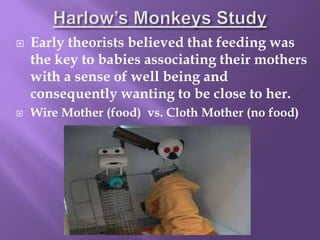
 Early theorists believed that feeding was
the key to babies associating their mothers
with a sense of well being and
consequently wanting to be close to her.
 Wire Mother (food) vs. Cloth Mother (no food)
 Harry Harlow’s study with Rhesus
monkeys eliminated this belief.
 Contact comfort found to be more
important than the gratification of being
fed.
 “The Strange Situation”: An
observational measure of infant
attachment that requires the infant to
move through a series of introduction,
separations, and reunions with the
caregiver and an adult stranger in a
prescribed order.
 Used to classify infants into 4 categories of attachment
 http://www.youtube.com/watch?v=QTsewNrHUHU
 Securely Attached Babies: babies that
use the caregiver as a secure base from
which to explore their environment.
 Not overly upset by separations
 Happy with reunions
 Comfortable exploring
 Not overly upset by strangers (also uses social
referencing)
 Insecure-Avoidant Babies: Babies
show insecurity by avoiding their
caregiver.
 Interacts little while caregiver is in the room
 Not distressed by separations
 Usually does not reestablish contact when reunited
 Avoid contact with stranger
 If contact is established, they may lean or pull away,
look away and even ignore (more passive resistance)
 Insecure-Resistant Babies: Babies that
often cling to the caregiver, then resist
him or her by fighting against the
closeness, perhaps by kicking or
pushing away (active resistance).
 Cling anxiously to caregiver
 Frightened by stranger
 Will not explore room and toys
 Cries loudly / terribly upset when separated
 Resists attempts to comfort when reunited /
inconsolable
 Insecure-Disorganized/Disoriented: an
infant that lacks a cohesive strategy in
coping with the strange situation
 The greatest insecurity (least prevalent)
 Show a variety of confused and conflicted
behaviors (may cling to mother while leaning
away)
 Approach / withdraw behaviors
 Emotions vary greatly over time (calm, then cry)
 Diana Baumrind’s Research
 4 Aspects of Family Functioning
 Warmth or Nurturance
 Control: Clarity & consistency of rules
 Level of expectations, called “Maturity Demands”
 Communication between the parent and the child
 Permissive Style: highly involved
with their children, but place few
demands or controls on them.
 High in nurturance, but low in control,
communication, and maturity demands.
 Let their children do what they want hoping to create
creative, confident children
 Rarely learn respect for others and have difficulty
controlling their behavior, difficult, noncompliant,
difficulties in peer relations.
 Authoritarian Style: a restrictive,
punitive style in which parents exhort
the child to obey their rules.
 “You do what I say, when I say…no discussion!”
 Low in nurturance and communication, but high in
maturity demands and control
 Enforce rules rigidly, but do not explain them
 Children grow to be fearful, anxious, and have weak
communication skills, low self-esteem, do less well in
school, aggressive
 Rejecting-Neglectful Style: parent is
very uninvolved with the child’s life
 Lowe in control, maturity demands, communication
and nurturance
 Children tend to be socially incompetent, poor self-
control, low self-esteem, immature, may be alienated
from family.
 Don’t handle independence well
 Less achievement oriented in school, more impulsive,
and are often antisocial.
 Authoritative Style: encourage
children to be independent, but still
place limits and control on their
actions.
 High in nurturance, communication, maturity demands
and control
 Inductive Discipline: explaining to a child why a
punished behavior is wrong
 Most consistently positive results: higher self-esteem,
more independent, self-confident, better grades,
altruistic behaviors
 Only theory of psychosocial development
that covers the entire lifespan
 Eight stages, each involves specific
personal or social tasks that must be
accomplished if development is to proceed
in a healthy fashion.
 Overcome a specific crisis or conflict
between “internal needs” and the
environment that they are currently in.
 1.) Trust vs. Mistrust
 Birth – 18 months
 Infants learn to trust when they are cared for in a
consistent, predictable, timely, and nurturing manner.
(needs are met by caregivers)
 Infants learn mistrust if their needs are not met in a
consistent, reliable, timely and nurturing manner.
 2.) Autonomy vs. Shame & Doubt: Child
begins to assert their independence and
express individuality (learning to do
things for themselves)
 Toddle years: 18 months – 3 years
 Will; new physical skills lead to demand for more
choices, most often seen as saying, “no” to caregivers;
child learns self-care skills such as toileting
 Parents view interactions with child as a series of
troublesome encounters; stubborn insistence by child
 3.) Initiative vs. Guilt: Child learns to
initiate tasks and to follow through with
plans.
 Motivation, curiosity, autonomy
 Conflict occurs when they make a decision to do
something on their own (pick up an item in a
store, choose their outfit for the day, talk to a
stranger). Do they feel comfortable making the
decision or are they worried about (or punished
for) offending or letting down their parents.
 Overprotective parents?
 4.) Industry vs. Inferiority: children
direct their energy toward mastering
knowledge and intellectual skills
(and social skills), or end up feeling
incompetent or inferior compared to
others.
 5.) Identity vs. Role Confusion: an
adolescent explores who they are,
what they stand for, and where they
are going in life.
 Positive outcome = solid identity
development
 Negative outcome = unsure of who they
are
 6.) Intimacy vs. Isolation: an
individual must find a life partner or
supportive friends in order to avoid
social isolation.
 Intimacy: the capacity to engage in a
supportive, affectionate relationship
without losing one’s sense of self; the
ability to be totally honest with an other,
and be one’s self without fear of
judgment from the other.
 7.) Generativity vs. Stagnation:
 Generativity: Finding meaning in
mentoring, helping or contributing to the
development of younger individuals
(own children, grandchildren, other
young family members, friends’ or
others’ children, working with younger
people).
 Stagnation: sometimes called “self-
absorption”, develops when
individuals sense that they have done
little or nothing for the next
generation.
 Stage 8: Integrity vs. Despair: involves
reflecting on the past and either
piecing together a positive review or
concluding that one’s life has not been
well spent.
 DANIEL LEVINSON
 Who is he?
 Daniel Levinson graduated from Yale as a
psychologist. He later developed a
comprehensive theory of adult
development. This theory is important because
it is one of the only ones which suggests that
development and growth happens well into the
adult years.
 The life structure: an underlying pattern of
an individual's life at any given point in
time.
 A person's life structure is shaped mainly by their
social and physical environment, and it primarily
involves family and work.
 Other variables such as religion, race, and status
are often important as well.
 There are 6 stages of adulthood in Levinson's
theory titled "Seasons of a Man's Life":
In his theory there are two key concepts:
1) the Stable Period - This is the time when a
person makes crucial choices in life.
2) the Transitional Period - This is the end of a
person's stage and the beginning of a new one.
Life during these transitions can be either
rocky or smooth, but the quality and
significance of one’s life commitments often
change between the beginning and end of a
period.
1) Early adult transition (17-22) - leave adolescence,
make preliminary choices for adult life
2) Entering the adult world (22-28) - make initial
choices in love, occupation, friendship, values,
lifestyle
3) Age 30 transition (28-33) - changes occur in life
structure, either a moderate change or, more often, a
severe and stressful crisis
4) Settling down (33-40) - establish a niche in society,
progress on a timetable, in both family and career
accomplishments
 People are expected to think and behave like a
parent, so they are facing more demanding roles
and expectations .
5) Mid-life transition (40-45) - life structure comes
into question, usually a time of crisis in the
meaning, direction, and value of each person's life.
 Neglected parts of the self (talents, desires,
aspirations) seek expression.
 Men are seen more as parents than as “brothers” to
other men who are somewhat younger than them and
this message comes as an irritation at first.
 Also at this time, men becoming increasingly aware of
death and they are reminded of how short life really
is. They become involved in trying to leave a legacy
and this usually forms the core of the second half of his
life.
6) Entering middle adulthood (45-50) - choices must
be made, a new life structure formed. People must
commit to new tasks.
 Some sources also stated that there was a late
adulthood stage during which time a man
spent time reflecting on past achievements and
regrets, and making peace with one's self and
others (including God).

S. Sherrill - General Psychology - Chapter 9 (M1)

  • 1.
  • 2.
     When consideringan issue related to a living organism, did it become the way it is due to genetics, life experiences, or both.  Nature is defined as the genetic factors or influences  Nurture is defined as the environmental factors & learning.  We consider the things that may have contributed to a person’s biological, emotional, cognitive, personal, and social development.
  • 3.
     Is personalitydevelopment due to genetics or environmental factors?  Answer: BOTH!  Are social skills due to genetics or learning?  Answer: BOTH!  Are physical/psychological illnesses due to genetics or environmental factors?  Answer: BOTH!
  • 4.
     Jean Piagetis cited as one of the first and most prolific researchers to investigate cognitive development.  Cognitive strategies are age-related  The way that children think about things changes with age regardless of the specific nature of what they were thinking about.  Criticized for under-estimating abilities
  • 5.
     Jean Piaget’sTheories of Cognition  Schemas or Schemes: actions or mental representations that organize knowledge (a mental picture)  Limited when dealing with new concepts and experiences, but improves with exposure and experience.
  • 6.
    How do weinterpret the world around us?  Assimilation: interpreting new information using existing ways of thinking.  Accommodation: the process of changing existing ways of thinking to adjust to and better understand new experiences.
  • 7.
     Birds  Theneighbor’s great dane  The “Tow Truck Story”  My sister’s first intestinal virus
  • 8.
     Stages ofcognitive development  1.) Sensorimotor (birth -24 months)  2.) Preoperational (2-7 years)  3.) Concrete Operational (7-12 years)  4.) Formal Operational (12+ years)
  • 9.
     1.) SensorimotorStage: period of time from birth to two years of age, in which a child understands the world around them by using and coordinating their senses and their ever increasing ability to move around and expose themselves to new experiences.
  • 10.
     2.) Piaget’sPreoperational Stage  Approximately age 2 – 7  Use of symbols to represent experience (use of words, images and drawings)  Stable concepts begin to form  Presence of Egocentrism  Presence of Magical Thinking / Beliefs  Beginning stages of reasoning
  • 11.
     2.) Piaget’sPreoperational Stage  Mental representation  Intuition/hypothesis  decision making  Characteristics of preoperational thought = inflexible  Appearance & reality  Easily fooled by appearance  Symbolic representation vs Reality  Make-believe play = pretend play 1. More sophisticated form = sociodramatic play ** Evidence of children’s understanding of representational function
  • 12.
     Object Permanence:the understanding that objects or events continue to exist even if they can no longer be seen, touched or heard.  Occurs during sensorimotor stage  Develops between 4 & 12 months  Peek-a-boo  Hiding objects to distract  Distress when left alone (mommy leaves)
  • 13.
     Egocentrism /Egocentric Thinking: the tendency for children to view the world:  as being centered around themselves  ONLY from their point-of-view and having difficulties appreciating someone else’s point-of-view  If they don’t experience it, neither does anyone else.
  • 14.
    Egocentrism  Can’t understandthat others have different feelings, perceptions, attitudes, likes and dislikes  Believe that if they experience something, that all others do as well  Child nodding on phone with grandma  Child likes frogs and mother doesn’t  Child takes another child’s toy
  • 15.
     Centration:  Thefocusing of attention on one characteristic to the exclusion of all others  The young child’s tendency to think in the world in terms of one variable at a time  Choosing what to wear for the day
  • 16.
     3.) ConcreteOperational Stage: Children between the ages of 7 and 12 start to reason logically about specific or concrete events or examples.  Not yet able to imagine the steps necessary to complete an algebraic equation, which is too abstract for thinking at this stage.  Concrete operations allow a child the ability to consider several characteristics rather than focus on a single property of an object.
  • 17.
     Formal OperationsStage: The adolescent reasons in more abstract, idealistic, and logical ways.  12 years and older  Begin to entertain thoughts about their ‘possible’ future  More systematic in solving problems  Develop hypotheses about why something happens
  • 18.
     Humans havethe capacity to develop a varying ability to display and control their emotions.  Humans also have the capacity to develop varying abilities that allow them to initiate social interactions with others around them.
  • 19.
    3 Categories ofTemperament (Thomas & Chess Research)  Easy Child: a child who is generally in a positive mood, who quickly establishes regular routines in infancy, and who adapts easily to new experiences.  Regular eating and sleeping routines; happy  40% of children studied
  • 20.
     Difficult Child:A child who tends to react negatively and cries frequently, who engages in irregular daily routines, and who is slow to accept new experiences.  Less regular with bodily functions and are slow to develop regular eating and sleeping patterns; react vigorously and negatively to change; difficulty adapting; cry more than others (higher pitched); easily irritated  10% of children studied
  • 21.
     Slow-to-warm-up Child:A child who has a low activity level, is somewhat negative, and displays a low intensity of mood.  Not as negative as difficult children; show mild or passive resistance; few intense reactions; once adapted- fairly positive  15% of children studied  NOTE: 35% did not fit into any of the 3 categories.
  • 22.
     Goodness offit: Refers to the match between a child’s temperament and the environmental demands with which the child must cope.  Expectations by parents, grandparents, etc  Expectations in childcare/daycare, etc  Lack of fit can result in adjustment problems
  • 23.
     Changes inthe way we think, feel and relate to the world and the people in it.  Many different issues and theories exist within the realm of the psychosocial perspective.
  • 24.
     Attachment: Theintense emotional tie or bond between two individuals, such as a parent and a child.  Parents, older siblings, grandparents, other consistent caregivers
  • 25.
     Early theoristsbelieved that feeding was the key to babies associating their mothers with a sense of well being and consequently wanting to be close to her.  Wire Mother (food) vs. Cloth Mother (no food)
  • 26.
     Harry Harlow’sstudy with Rhesus monkeys eliminated this belief.  Contact comfort found to be more important than the gratification of being fed.
  • 27.
     “The StrangeSituation”: An observational measure of infant attachment that requires the infant to move through a series of introduction, separations, and reunions with the caregiver and an adult stranger in a prescribed order.  Used to classify infants into 4 categories of attachment  http://www.youtube.com/watch?v=QTsewNrHUHU
  • 28.
     Securely AttachedBabies: babies that use the caregiver as a secure base from which to explore their environment.  Not overly upset by separations  Happy with reunions  Comfortable exploring  Not overly upset by strangers (also uses social referencing)
  • 29.
     Insecure-Avoidant Babies:Babies show insecurity by avoiding their caregiver.  Interacts little while caregiver is in the room  Not distressed by separations  Usually does not reestablish contact when reunited  Avoid contact with stranger  If contact is established, they may lean or pull away, look away and even ignore (more passive resistance)
  • 30.
     Insecure-Resistant Babies:Babies that often cling to the caregiver, then resist him or her by fighting against the closeness, perhaps by kicking or pushing away (active resistance).  Cling anxiously to caregiver  Frightened by stranger  Will not explore room and toys  Cries loudly / terribly upset when separated  Resists attempts to comfort when reunited / inconsolable
  • 31.
     Insecure-Disorganized/Disoriented: an infantthat lacks a cohesive strategy in coping with the strange situation  The greatest insecurity (least prevalent)  Show a variety of confused and conflicted behaviors (may cling to mother while leaning away)  Approach / withdraw behaviors  Emotions vary greatly over time (calm, then cry)
  • 32.
     Diana Baumrind’sResearch  4 Aspects of Family Functioning  Warmth or Nurturance  Control: Clarity & consistency of rules  Level of expectations, called “Maturity Demands”  Communication between the parent and the child
  • 33.
     Permissive Style:highly involved with their children, but place few demands or controls on them.  High in nurturance, but low in control, communication, and maturity demands.  Let their children do what they want hoping to create creative, confident children  Rarely learn respect for others and have difficulty controlling their behavior, difficult, noncompliant, difficulties in peer relations.
  • 34.
     Authoritarian Style:a restrictive, punitive style in which parents exhort the child to obey their rules.  “You do what I say, when I say…no discussion!”  Low in nurturance and communication, but high in maturity demands and control  Enforce rules rigidly, but do not explain them  Children grow to be fearful, anxious, and have weak communication skills, low self-esteem, do less well in school, aggressive
  • 35.
     Rejecting-Neglectful Style:parent is very uninvolved with the child’s life  Lowe in control, maturity demands, communication and nurturance  Children tend to be socially incompetent, poor self- control, low self-esteem, immature, may be alienated from family.  Don’t handle independence well  Less achievement oriented in school, more impulsive, and are often antisocial.
  • 36.
     Authoritative Style:encourage children to be independent, but still place limits and control on their actions.  High in nurturance, communication, maturity demands and control  Inductive Discipline: explaining to a child why a punished behavior is wrong  Most consistently positive results: higher self-esteem, more independent, self-confident, better grades, altruistic behaviors
  • 37.
     Only theoryof psychosocial development that covers the entire lifespan  Eight stages, each involves specific personal or social tasks that must be accomplished if development is to proceed in a healthy fashion.  Overcome a specific crisis or conflict between “internal needs” and the environment that they are currently in.
  • 38.
     1.) Trustvs. Mistrust  Birth – 18 months  Infants learn to trust when they are cared for in a consistent, predictable, timely, and nurturing manner. (needs are met by caregivers)  Infants learn mistrust if their needs are not met in a consistent, reliable, timely and nurturing manner.
  • 39.
     2.) Autonomyvs. Shame & Doubt: Child begins to assert their independence and express individuality (learning to do things for themselves)  Toddle years: 18 months – 3 years  Will; new physical skills lead to demand for more choices, most often seen as saying, “no” to caregivers; child learns self-care skills such as toileting  Parents view interactions with child as a series of troublesome encounters; stubborn insistence by child
  • 40.
     3.) Initiativevs. Guilt: Child learns to initiate tasks and to follow through with plans.  Motivation, curiosity, autonomy  Conflict occurs when they make a decision to do something on their own (pick up an item in a store, choose their outfit for the day, talk to a stranger). Do they feel comfortable making the decision or are they worried about (or punished for) offending or letting down their parents.  Overprotective parents?
  • 41.
     4.) Industryvs. Inferiority: children direct their energy toward mastering knowledge and intellectual skills (and social skills), or end up feeling incompetent or inferior compared to others.
  • 42.
     5.) Identityvs. Role Confusion: an adolescent explores who they are, what they stand for, and where they are going in life.  Positive outcome = solid identity development  Negative outcome = unsure of who they are
  • 43.
     6.) Intimacyvs. Isolation: an individual must find a life partner or supportive friends in order to avoid social isolation.  Intimacy: the capacity to engage in a supportive, affectionate relationship without losing one’s sense of self; the ability to be totally honest with an other, and be one’s self without fear of judgment from the other.
  • 44.
     7.) Generativityvs. Stagnation:  Generativity: Finding meaning in mentoring, helping or contributing to the development of younger individuals (own children, grandchildren, other young family members, friends’ or others’ children, working with younger people).
  • 45.
     Stagnation: sometimescalled “self- absorption”, develops when individuals sense that they have done little or nothing for the next generation.
  • 46.
     Stage 8:Integrity vs. Despair: involves reflecting on the past and either piecing together a positive review or concluding that one’s life has not been well spent.
  • 47.
     DANIEL LEVINSON Who is he?  Daniel Levinson graduated from Yale as a psychologist. He later developed a comprehensive theory of adult development. This theory is important because it is one of the only ones which suggests that development and growth happens well into the adult years.
  • 48.
     The lifestructure: an underlying pattern of an individual's life at any given point in time.  A person's life structure is shaped mainly by their social and physical environment, and it primarily involves family and work.  Other variables such as religion, race, and status are often important as well.  There are 6 stages of adulthood in Levinson's theory titled "Seasons of a Man's Life":
  • 49.
    In his theorythere are two key concepts: 1) the Stable Period - This is the time when a person makes crucial choices in life. 2) the Transitional Period - This is the end of a person's stage and the beginning of a new one. Life during these transitions can be either rocky or smooth, but the quality and significance of one’s life commitments often change between the beginning and end of a period.
  • 50.
    1) Early adulttransition (17-22) - leave adolescence, make preliminary choices for adult life 2) Entering the adult world (22-28) - make initial choices in love, occupation, friendship, values, lifestyle 3) Age 30 transition (28-33) - changes occur in life structure, either a moderate change or, more often, a severe and stressful crisis
  • 51.
    4) Settling down(33-40) - establish a niche in society, progress on a timetable, in both family and career accomplishments  People are expected to think and behave like a parent, so they are facing more demanding roles and expectations .
  • 52.
    5) Mid-life transition(40-45) - life structure comes into question, usually a time of crisis in the meaning, direction, and value of each person's life.  Neglected parts of the self (talents, desires, aspirations) seek expression.  Men are seen more as parents than as “brothers” to other men who are somewhat younger than them and this message comes as an irritation at first.  Also at this time, men becoming increasingly aware of death and they are reminded of how short life really is. They become involved in trying to leave a legacy and this usually forms the core of the second half of his life.
  • 53.
    6) Entering middleadulthood (45-50) - choices must be made, a new life structure formed. People must commit to new tasks.  Some sources also stated that there was a late adulthood stage during which time a man spent time reflecting on past achievements and regrets, and making peace with one's self and others (including God).