An investigation of why Social
Networking sites go E-Commerce

                Vidoushi D. Bahadur-Somrah
      MSc Information Systems with Management Studies

                  Supervisor: Mary Thomson


                   KINGSTON UNIVERSITY
  Faculty of Computing, Information Systems & Mathematics
Reasons for conducting this investigation
To gain an in-depth understanding of:


 What is Social Commerce (S-Commerce).
 The reasons behind the merge between E-Commerce & Social Networking.
 The psychology of online shoppers compared to high-street shoppers.
 The marketing techniques & cost(s) of implementing S-Commerce by
  retailers...and
 How will the new S-Commerce shopping experience benefit both retailers &
  customers.
Reasons for conducting this investigation
and to back the research findings from the points mentioned above by:

 Launching a survey questionnaire (online & offline) based on Social
  Networking, shopping habits and S-Commerce experience.
 Analysing the results collected once converted into useable formats
 Discussing the results collected & being able to make
  comparisons, recommendations & conclusions
So what is Social Commerce?
                                        Definition:
‘SocialCommerceToday’ Blog defines it is a subset of E-Commerce that involves

using social media, online media that supports social interaction and user
contributions, to assist in the online buying and selling of products and services.

 Let’s have a look at how it evolved:
                           Mobile technology
                                                      Mobile
              Internet                                Commerce       S-Commerce
              (1990s)                                                accessible
                                                                     from the
Traditional              Electronic                                  Internet &
Commerce                 Commerce                                    Mobiles
                                                      Social
                                                      Commerce
                             Social Media
Examples of E-Commerce & Social Media Integration
Social Networking                                           E-Commerce

Facebook                                                    ASOS Clothing

MySpace                                                     Dove

Twitter                                                     Delta Airlines

LinkedIn                                                    1-800
                                                            flowers.com
Bebo

Hi5

Friendster
                                   These retailers have fully integrated
                                    S-Commerce platforms available
                                                  already
Why are retailers targeting Social Networking platforms?
Let us look at the facts & figures of Social Networking:

 Facebook: 750 million active users + 700 billion minutes spent monthly!

 Dec 09: A significant increase of 82% in the amount of time spent on Social
   Network sites such as Facebook, Twitter, MySpace etc compared to 2008.

 Online users spent an average of 6 hours each month on Facebook alone
   compared to just over 3 hours in 2008 on Facebook and Twitter combined.

 May 09: almost 80% of all age groups visited a social site & represents an avg.
   time of 4.6 hours/visit. 67% of people age 55+ spend almost 3.7 hours/sites.

 May 08 - 09: shows an increase of 7% in the total UK internet audience on social
   sites.

 Facebook announce profits of $500m (£300m +) in first half of 2011
comScore World Metrix for 2008 & 2009
UK figures of Social Networking:


      Table 1: UK age group visitors visit   Table 2: UK Social Networking sites visit
Psychology of online shoppers compared to high-street shoppers
There are 3 types of shoppers:
 Vague shopper – Need others opinion/feedback before making a purchase
 Cost conscious shopper – Want to get the best value for money
 Window shopper – Browse but never or rarely buys


The psychology of both online shoppers & high-street shoppers appears to be similar.
Issues that retailers face with the above shoppers are:

 Shopping baskets are abandoned & payment not completed at the last minute
 Hours are spent browsing products but no purchase is made.
 Shopping basket is used as a wish-list without any intention to buy.
 No sales are made if feedbacks have not yet been left on the product.
 Shoppers    buy solely on price and do                   not   consider    after     sales
  benefits, warranties or customer service quality.
So how can retailers influence these types of shoppers to buy

Every individual is influenced by the following:

 Normative influence - Influenced by the desire to be liked by others.

 Informational influence    - Influenced by the facts, figures, information
   available, information provided by expert shoppers and the desire to be
   correct.

 Combination of normative and informational influence

 Group and collective influence – Influenced by the majority’s choice in a
   group
So how can retailers influence these types of shoppers to buy

Retailers have used the power of influence factors above and made use of the new S-
Commerce platform to overcome this issue in such manner:

 Use Social Networking sites to bring shoppers with common interest
  together.

 Use the possibility to leave comments such as feedbacks, reviews and
  opinions on Social Networking sites.

 Make shoppers feel part of a community or group.

 Use the word-of-mouth concept and interaction between online users as a
  brand promotion and an advertising benefit.

 Use the info from customers reviews and feedbacks to improve services and
  products.
Marketing techniques available within S-Commerce


                         SCRM


           Social                    Word-Of-
         Shopping                     Mouth

                         Social
                       Commerce


        Open-Source                   Viral


                      Customer-to-
                       Customer
Marketing techniques available within S-Commerce
SCRM: Close engagement between customers and retailers to provide a long-
term relationship based on trust and brand loyalty.

Word-of-Mouth: Sharing of personal opinion or recommendation of one user
to others.

Social Shopping: Informed shopping from Social Networking sites based on
reviews, feedbacks or recommendations made by friends, family or contacts.

Customer-to-Customer: Platform which permits a transaction from one
customer directly to another, e.g. eBay.

Open-Source: Platform where online users can discuss and share their ideas
on products or services among each other freely and anytime.

Viral: Mass advertising by using email footers, spam, or ads.
Smart S-Commerce decision-making process - ‘CEPEA’


 Improved customer decision journey with S-Commerce platform
Cost of implementing S-Commerce by retailers e.g., Facebook
 Facebook has 6 third-party applications where retailers can incorporate their E-
  Commerce store & have the S-Commerce retail platform.
 The costs to retailers to apply these apps are:
1. Voiyk – Free for 1st month & $69 per year after that (no per-item fees, transaction
   fees or extra charges)
2. ShopTap – Flat monthly fee (start from $10 for up to 500 products)
3. Sortprice - $149 monthly fee for up to 1,000 products to $ 400 monthly for up to
   50,000 products (free store app – existing customers).
4. Shoutlet – Enterprise-level companies annual fee is as high as $ 50,000 and smaller
   retailers: yearly fee from $ 5,000 to $10,000.
5. My Merch Store – Provides retailers who are ‘Zazzle’ customers to input their
   products on Facebook and share them with friends.
6. LetMeIntroduce – 50 cents every time coupon code gets accessed by customers.
Survey Questionnaire & Results Analysis

      Online Survey – 27 questions total

      Offline survey – Informal interviews was conducted at
       home, workplace and shopping malls.

      77 respondents recorded over 2 weeks duration. 52
       respondents from online source and 25 respondents from
       informal interview source.

      Survey launched on Google Documents site (free)

      Survey questions based on ‘Social Networking
       experience’, ‘Shopping habits ‘ and ‘Social Commerce
       understanding and views’
Results on Social Networking experience
Results on which Social Network sites participants are registered with:
 Facebook most popular with 74 out of a total 77 participants with an account (96%).
 Twitter and LinkedIn came in 2nd and 3rd position with 26% and 25% responses
  respectively.
How many times users tend to check their    Average duration of each session users tend
accounts daily:                             to spend on their social sites (daily basis):
 29% check between 5 & 10 times daily       66% of participants spend less than 30
 21% check more than 10 times a day          minutes per session
 Other - described their social             35% - less than 10 minutes
  networking site being always online via    14% - between 30 & 60 minutes
  their smartphones and mobile data plan     16 % - More than 60 minutes
                                             Other (4%) – Always online via their
                                              smartphones & the session never ends
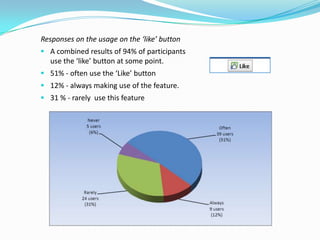
Responses on the usage on the ‘like’ button
 A combined results of 94% of participants
  use the ‘like’ button at some point.
 51% - often use the ‘Like’ button
 12% - always making use of the feature.
 31 % - rarely use this feature
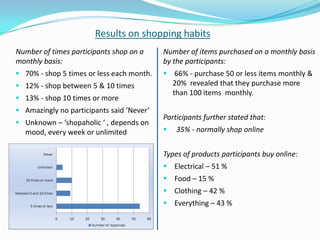
Results on shopping habits
Number of times participants shop on a     Number of items purchased on a monthly basis
monthly basis:                             by the participants:
 70% - shop 5 times or less each month.    66% - purchase 50 or less items monthly &
 12% - shop between 5 & 10 times            20% revealed that they purchase more
                                             than 100 items monthly.
 13% - shop 10 times or more
 Amazingly no participants said ‘Never’
                                           Participants further stated that:
 Unknown – ‘shopaholic ‘ , depends on
  mood, every week or unlimited               35% - normally shop online


                                           Types of products participants buy online:
                                            Electrical – 51 %
                                            Food – 15 %
                                            Clothing – 42 %
                                            Everything – 43 %
65 % stated that shopping online offer         An insight on the type of information that
better value compared to high street           participants share among social networkers
retailers.                                     are:
                                                Gossip - 29%
Participants further described the benefits:    Daily news – 34%
 Money saving – 74 %                           Pictures / photos - 77%
 Time saving – 78 %                            Fashion news - 16%
 Wider choice – 48 %                           Chat - 73 %
 Convenience – 67 %                            Comments - 60%
 Other – 4 %                                   Other - 4 %
25 participants (32 %) claimed they do share their shopping experiences on their network
site(s).


The combined result (32 %) was split as follows:
 14 % - Often
 8% - Always
 10% - Rarely


                                                    61 participants (79 %) states that
                                                    they prefer to have
                                                    feedback/reviews before conducting
                                                    any purchase of product.
Results on Social Commerce knowledge
 39 % - gave a correct description of S- Commerce
 23% - have used Social Commerce on Facebook before
 62% - were aware of retailers’ presence on social sites
 55% - keen to shop & share their shopping experiences within the new platform.
 61% - were keen to share /gain knowledge on their friends’ product preferences on their
  network.
 55% - say that they would like to get the latest updates on deals and promotional
  savings.
Success Stories of S-Commerce
Companies                             Successful Stories
 Groupon                     $11 Million in one day sales for GAP
 Spinback       $2.10 average incremental revenues from each Facebook wall
               post + an impressive 10.9 % conversion rate on Facebook shares .

 Pampers         Pampers sold 1,000 Diapers in 1 hour on its Facebook store.

Baby & me                 50% of online sales come from Facebook
 Spinback        10.9% - Conversion rate for Facebook shares that leads to a
                                         purchase.
Livingsocial                              42,000 +
                    Facebook shares in 1-day for the $20 Amazon voucher.
 Ticketfly         3.25 average sales generated through Facebook shares.
   F&F                                  £2 million +
                         Generated in sales with Facebook vouchers
Benefits of S-Commerce for shoppers

                                  Informed
                                  purchases
            Single log-                                   Reviews /
                in                                        feedbacks


     Group-
buy, promotional
 vouchers, latest              Social Commerce                 Info
      deals                                                  Sharing


        Transparency                               Recommendation

                                  Feel part of a
                                   community
Benefits of S-Commerce for retailers

               Target vast             Gain insight on
              audience at                 popular
              one location                products

                                                         Ability to act on
  Increased                                              negative product
demand, sales                                             reviews and re-
 and profits                   Social                     gain customers
                             Commerce                          trust


  Obtain product-
 shopper data and                                    Use the word-of-
use it for marketing             Closer              mouth referral to
   and business               customer-              increase demand
      decisions                 retailer                  & profit
                             relationship
Discussions
The following sections have been investigated in depth in the dissertation report:
 Evaluation of the Social Commerce concept with its advantages as well as
  disadvantages identified from the survey results.
 Discussion of survey results including problems encountered from some
  responses and a comparison of the results obtained against other researchers’
  work.
 Short or long term impact(s) on High-Street retailers.
 Security issue on social sites.
 If Social Networking websites become payable to shoppers.
 Language translation facility within S-Commerce for non-English speaking or
  writing social shopping users within the community of S-Commerce.
Some recommendations to enhance the S-Commerce platform

 Implementation of Loyalty Schemes to provide further discounts, free
  gifts, vouchers, bonus points, social credit rewards etc to boost S-Commerce.


 A transparent logistic view on their purchased product(s) via an Electronic Data
  Interchange (EDI).


 Improved News Feeds for Social Shoppers to enhance advertising.
Any Questions?

S commerce

  • 1.
    An investigation ofwhy Social Networking sites go E-Commerce Vidoushi D. Bahadur-Somrah MSc Information Systems with Management Studies Supervisor: Mary Thomson KINGSTON UNIVERSITY Faculty of Computing, Information Systems & Mathematics
  • 2.
    Reasons for conductingthis investigation To gain an in-depth understanding of:  What is Social Commerce (S-Commerce).  The reasons behind the merge between E-Commerce & Social Networking.  The psychology of online shoppers compared to high-street shoppers.  The marketing techniques & cost(s) of implementing S-Commerce by retailers...and  How will the new S-Commerce shopping experience benefit both retailers & customers.
  • 3.
    Reasons for conductingthis investigation and to back the research findings from the points mentioned above by:  Launching a survey questionnaire (online & offline) based on Social Networking, shopping habits and S-Commerce experience.  Analysing the results collected once converted into useable formats  Discussing the results collected & being able to make comparisons, recommendations & conclusions
  • 4.
    So what isSocial Commerce? Definition: ‘SocialCommerceToday’ Blog defines it is a subset of E-Commerce that involves using social media, online media that supports social interaction and user contributions, to assist in the online buying and selling of products and services. Let’s have a look at how it evolved: Mobile technology Mobile Internet Commerce S-Commerce (1990s) accessible from the Traditional Electronic Internet & Commerce Commerce Mobiles Social Commerce Social Media
  • 5.
    Examples of E-Commerce& Social Media Integration Social Networking E-Commerce Facebook ASOS Clothing MySpace Dove Twitter Delta Airlines LinkedIn 1-800 flowers.com Bebo Hi5 Friendster These retailers have fully integrated S-Commerce platforms available already
  • 6.
    Why are retailerstargeting Social Networking platforms? Let us look at the facts & figures of Social Networking:  Facebook: 750 million active users + 700 billion minutes spent monthly!  Dec 09: A significant increase of 82% in the amount of time spent on Social Network sites such as Facebook, Twitter, MySpace etc compared to 2008.  Online users spent an average of 6 hours each month on Facebook alone compared to just over 3 hours in 2008 on Facebook and Twitter combined.  May 09: almost 80% of all age groups visited a social site & represents an avg. time of 4.6 hours/visit. 67% of people age 55+ spend almost 3.7 hours/sites.  May 08 - 09: shows an increase of 7% in the total UK internet audience on social sites.  Facebook announce profits of $500m (£300m +) in first half of 2011
  • 7.
    comScore World Metrixfor 2008 & 2009 UK figures of Social Networking: Table 1: UK age group visitors visit Table 2: UK Social Networking sites visit
  • 8.
    Psychology of onlineshoppers compared to high-street shoppers There are 3 types of shoppers:  Vague shopper – Need others opinion/feedback before making a purchase  Cost conscious shopper – Want to get the best value for money  Window shopper – Browse but never or rarely buys The psychology of both online shoppers & high-street shoppers appears to be similar. Issues that retailers face with the above shoppers are:  Shopping baskets are abandoned & payment not completed at the last minute  Hours are spent browsing products but no purchase is made.  Shopping basket is used as a wish-list without any intention to buy.  No sales are made if feedbacks have not yet been left on the product.  Shoppers buy solely on price and do not consider after sales benefits, warranties or customer service quality.
  • 9.
    So how canretailers influence these types of shoppers to buy Every individual is influenced by the following:  Normative influence - Influenced by the desire to be liked by others.  Informational influence - Influenced by the facts, figures, information available, information provided by expert shoppers and the desire to be correct.  Combination of normative and informational influence  Group and collective influence – Influenced by the majority’s choice in a group
  • 10.
    So how canretailers influence these types of shoppers to buy Retailers have used the power of influence factors above and made use of the new S- Commerce platform to overcome this issue in such manner:  Use Social Networking sites to bring shoppers with common interest together.  Use the possibility to leave comments such as feedbacks, reviews and opinions on Social Networking sites.  Make shoppers feel part of a community or group.  Use the word-of-mouth concept and interaction between online users as a brand promotion and an advertising benefit.  Use the info from customers reviews and feedbacks to improve services and products.
  • 11.
    Marketing techniques availablewithin S-Commerce SCRM Social Word-Of- Shopping Mouth Social Commerce Open-Source Viral Customer-to- Customer
  • 12.
    Marketing techniques availablewithin S-Commerce SCRM: Close engagement between customers and retailers to provide a long- term relationship based on trust and brand loyalty. Word-of-Mouth: Sharing of personal opinion or recommendation of one user to others. Social Shopping: Informed shopping from Social Networking sites based on reviews, feedbacks or recommendations made by friends, family or contacts. Customer-to-Customer: Platform which permits a transaction from one customer directly to another, e.g. eBay. Open-Source: Platform where online users can discuss and share their ideas on products or services among each other freely and anytime. Viral: Mass advertising by using email footers, spam, or ads.
  • 13.
    Smart S-Commerce decision-makingprocess - ‘CEPEA’ Improved customer decision journey with S-Commerce platform
  • 14.
    Cost of implementingS-Commerce by retailers e.g., Facebook  Facebook has 6 third-party applications where retailers can incorporate their E- Commerce store & have the S-Commerce retail platform.  The costs to retailers to apply these apps are: 1. Voiyk – Free for 1st month & $69 per year after that (no per-item fees, transaction fees or extra charges) 2. ShopTap – Flat monthly fee (start from $10 for up to 500 products) 3. Sortprice - $149 monthly fee for up to 1,000 products to $ 400 monthly for up to 50,000 products (free store app – existing customers). 4. Shoutlet – Enterprise-level companies annual fee is as high as $ 50,000 and smaller retailers: yearly fee from $ 5,000 to $10,000. 5. My Merch Store – Provides retailers who are ‘Zazzle’ customers to input their products on Facebook and share them with friends. 6. LetMeIntroduce – 50 cents every time coupon code gets accessed by customers.
  • 15.
    Survey Questionnaire &Results Analysis  Online Survey – 27 questions total  Offline survey – Informal interviews was conducted at home, workplace and shopping malls.  77 respondents recorded over 2 weeks duration. 52 respondents from online source and 25 respondents from informal interview source.  Survey launched on Google Documents site (free)  Survey questions based on ‘Social Networking experience’, ‘Shopping habits ‘ and ‘Social Commerce understanding and views’
  • 16.
    Results on SocialNetworking experience Results on which Social Network sites participants are registered with:  Facebook most popular with 74 out of a total 77 participants with an account (96%).  Twitter and LinkedIn came in 2nd and 3rd position with 26% and 25% responses respectively.
  • 17.
    How many timesusers tend to check their Average duration of each session users tend accounts daily: to spend on their social sites (daily basis):  29% check between 5 & 10 times daily  66% of participants spend less than 30  21% check more than 10 times a day minutes per session  Other - described their social  35% - less than 10 minutes networking site being always online via  14% - between 30 & 60 minutes their smartphones and mobile data plan  16 % - More than 60 minutes  Other (4%) – Always online via their smartphones & the session never ends
  • 18.
    Responses on theusage on the ‘like’ button  A combined results of 94% of participants use the ‘like’ button at some point.  51% - often use the ‘Like’ button  12% - always making use of the feature.  31 % - rarely use this feature
  • 19.
    Results on shoppinghabits Number of times participants shop on a Number of items purchased on a monthly basis monthly basis: by the participants:  70% - shop 5 times or less each month.  66% - purchase 50 or less items monthly &  12% - shop between 5 & 10 times 20% revealed that they purchase more than 100 items monthly.  13% - shop 10 times or more  Amazingly no participants said ‘Never’ Participants further stated that:  Unknown – ‘shopaholic ‘ , depends on mood, every week or unlimited  35% - normally shop online Types of products participants buy online:  Electrical – 51 %  Food – 15 %  Clothing – 42 %  Everything – 43 %
  • 20.
    65 % statedthat shopping online offer An insight on the type of information that better value compared to high street participants share among social networkers retailers. are:  Gossip - 29% Participants further described the benefits:  Daily news – 34%  Money saving – 74 %  Pictures / photos - 77%  Time saving – 78 %  Fashion news - 16%  Wider choice – 48 %  Chat - 73 %  Convenience – 67 %  Comments - 60%  Other – 4 %  Other - 4 %
  • 21.
    25 participants (32%) claimed they do share their shopping experiences on their network site(s). The combined result (32 %) was split as follows:  14 % - Often  8% - Always  10% - Rarely 61 participants (79 %) states that they prefer to have feedback/reviews before conducting any purchase of product.
  • 22.
    Results on SocialCommerce knowledge  39 % - gave a correct description of S- Commerce  23% - have used Social Commerce on Facebook before  62% - were aware of retailers’ presence on social sites  55% - keen to shop & share their shopping experiences within the new platform.  61% - were keen to share /gain knowledge on their friends’ product preferences on their network.  55% - say that they would like to get the latest updates on deals and promotional savings.
  • 23.
    Success Stories ofS-Commerce Companies Successful Stories Groupon $11 Million in one day sales for GAP Spinback $2.10 average incremental revenues from each Facebook wall post + an impressive 10.9 % conversion rate on Facebook shares . Pampers Pampers sold 1,000 Diapers in 1 hour on its Facebook store. Baby & me 50% of online sales come from Facebook Spinback 10.9% - Conversion rate for Facebook shares that leads to a purchase. Livingsocial 42,000 + Facebook shares in 1-day for the $20 Amazon voucher. Ticketfly 3.25 average sales generated through Facebook shares. F&F £2 million + Generated in sales with Facebook vouchers
  • 24.
    Benefits of S-Commercefor shoppers Informed purchases Single log- Reviews / in feedbacks Group- buy, promotional vouchers, latest Social Commerce Info deals Sharing Transparency Recommendation Feel part of a community
  • 25.
    Benefits of S-Commercefor retailers Target vast Gain insight on audience at popular one location products Ability to act on Increased negative product demand, sales reviews and re- and profits Social gain customers Commerce trust Obtain product- shopper data and Use the word-of- use it for marketing Closer mouth referral to and business customer- increase demand decisions retailer & profit relationship
  • 26.
    Discussions The following sectionshave been investigated in depth in the dissertation report:  Evaluation of the Social Commerce concept with its advantages as well as disadvantages identified from the survey results.  Discussion of survey results including problems encountered from some responses and a comparison of the results obtained against other researchers’ work.  Short or long term impact(s) on High-Street retailers.  Security issue on social sites.  If Social Networking websites become payable to shoppers.  Language translation facility within S-Commerce for non-English speaking or writing social shopping users within the community of S-Commerce.
  • 27.
    Some recommendations toenhance the S-Commerce platform  Implementation of Loyalty Schemes to provide further discounts, free gifts, vouchers, bonus points, social credit rewards etc to boost S-Commerce.  A transparent logistic view on their purchased product(s) via an Electronic Data Interchange (EDI).  Improved News Feeds for Social Shoppers to enhance advertising.
  • 28.

Editor's Notes

  • #6 http://www.tribalcafe.co.uk/wp-content/uploads/2010/12/Social-Commerce5.jpg
  • #7 http://www.techradar.com/news/internet/facebook-profits-double-in-first-half-of-2011-1018004
  • #8 Table 1: Sachoff M., 2009a. Facebook Most Popular Social Site in the U.K: Age profile ranked by category visitors. WebProNews [online news magazine and blog] 20th July. Available at: <http://www.webpronews.com/facebook-most-popular-social-site-in-the-uk-2009-07> [Accessed on 29/07/2011]. Table 2: Sachoff M., 2009b. Top 10 Social Networking sites ranked by total UK unique visitors. WebProNews [online news magazine and blog] 20th July. Available at: <http://www.webpronews.com/facebook-most-popular-social-site-in-the-uk-2009-07> [Accessed on 29/07/2011].
  • #12 Social Shopping: Shopping with social tools
  • #14 http://174.132.79.98/~brcampbe/2011/05/15/social-commerce-has-arrived/
  • #15 Zazzle is an online retailer that allows users to upload images and create their own merchandise (clothing, posters, etc.), or buy merchandise created by other users, as well as use images from participating companies.
  • #18 As a result, it can be considered that social networking sites are fully integrated into the social lives of users with plenty of facilities to gain access to accounts such as smartphones, wireless broadband and smart TVs.
  • #23 http://www.computing.co.uk/IMG/337/108337/livingsocial-jpg4747-370x229.jpg?1301609591http://arstechnica.com/web/news/2011/04/deals-on-facebook-arrives-ready-to-take-on-groupon.ars