PRESENTED BY :- ARIF KHAN
POONAM SOMRA
HEMANT JAIN
PRESENTED TO :- DR.
MANJOO SARASWAT
GROUP DECISION
MAKING
TECHNIQUES
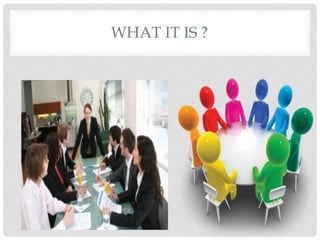
WHAT IT IS ?
TECHNIQUES OF GROUP DECISION
MAKING
• BRAIN STORMING
• NOMINAL GROUP TECHNIQUE
• DELPHI TECHNIQUE
• DEVIL’S ADVOCACY
• ELECTRONIC MEETING
• FISH BOWLING
• DIDATIC INTERACTION
• INTERACTING GROUPS
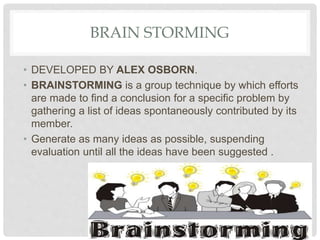
BRAIN STORMING
• DEVELOPED BY ALEX OSBORN.
• BRAINSTORMING is a group technique by which efforts
are made to find a conclusion for a specific problem by
gathering a list of ideas spontaneously contributed by its
member.
• Generate as many ideas as possible, suspending
evaluation until all the ideas have been suggested .
NOMINAL GROUP TECHNIQUE
• Developed by Andre Delbecq and Andrew Van de Ven
at the university of Wisconsin.
• Individuals silently list their ideas.
• Ideas are written on a chart one at a time until all ideas
are listed.
• Discussion is permitted but only to clarify the ideas. No
criticism allowed.
• A written vote is taken.
DELPHI TECHNIQUE
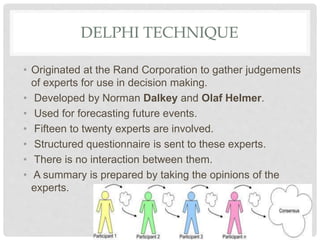
• Originated at the Rand Corporation to gather judgements
of experts for use in decision making.
• Developed by Norman Dalkey and Olaf Helmer.
• Used for forecasting future events.
• Fifteen to twenty experts are involved.
• Structured questionnaire is sent to these experts.
• There is no interaction between them.
• A summary is prepared by taking the opinions of the
experts.
DEVIL’S ADVOCACY
• An individual is given the role of critic whose task is to
come up with the potential problems in proposed
decision.
• Helps to avoid costly mistakes by identifying pitfalls in
advance.
ELECTRONIC MEETINGS
• The members of the group interact with the help of
computers through connected computer terminals.
• Projector screen is used to show the individual
comments and votes on an issue.
• This method reduces group think and the time wasted in
socializing the meeting.
FISH BOWLING
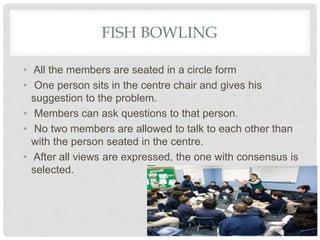
• All the members are seated in a circle form
• One person sits in the centre chair and gives his
suggestion to the problem.
• Members can ask questions to that person.
• No two members are allowed to talk to each other than
with the person seated in the centre.
• After all views are expressed, the one with consensus is
selected.
DIDATIC INTERACTION
• This is used only where there is YES- NO application.
• Two groups:
• One favouring YES
• Other favouring NO
• Both groups discuss their view points and find out
weaknesses in their sides.
• Finally it results in mutual acceptance of facts.
INTERACTING GROUPS
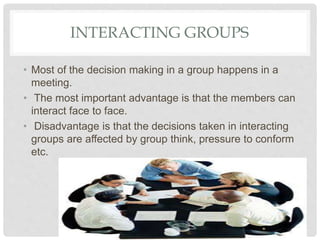
• Most of the decision making in a group happens in a
meeting.
• The most important advantage is that the members can
interact face to face.
• Disadvantage is that the decisions taken in interacting
groups are affected by group think, pressure to conform
etc.
REFERNCES :-
www.google.com
www.slideshare.com
www.wikipedia.org
www.tutorialspoint.com
www.study.com
ANY
QUESTIONS
Group decision making technique

Group decision making technique

  • 1.
    PRESENTED BY :-ARIF KHAN POONAM SOMRA HEMANT JAIN PRESENTED TO :- DR. MANJOO SARASWAT GROUP DECISION MAKING TECHNIQUES
  • 2.
  • 3.
    TECHNIQUES OF GROUPDECISION MAKING • BRAIN STORMING • NOMINAL GROUP TECHNIQUE • DELPHI TECHNIQUE • DEVIL’S ADVOCACY • ELECTRONIC MEETING • FISH BOWLING • DIDATIC INTERACTION • INTERACTING GROUPS
  • 4.
    BRAIN STORMING • DEVELOPEDBY ALEX OSBORN. • BRAINSTORMING is a group technique by which efforts are made to find a conclusion for a specific problem by gathering a list of ideas spontaneously contributed by its member. • Generate as many ideas as possible, suspending evaluation until all the ideas have been suggested .
  • 5.
    NOMINAL GROUP TECHNIQUE •Developed by Andre Delbecq and Andrew Van de Ven at the university of Wisconsin. • Individuals silently list their ideas. • Ideas are written on a chart one at a time until all ideas are listed. • Discussion is permitted but only to clarify the ideas. No criticism allowed. • A written vote is taken.
  • 6.
    DELPHI TECHNIQUE • Originatedat the Rand Corporation to gather judgements of experts for use in decision making. • Developed by Norman Dalkey and Olaf Helmer. • Used for forecasting future events. • Fifteen to twenty experts are involved. • Structured questionnaire is sent to these experts. • There is no interaction between them. • A summary is prepared by taking the opinions of the experts.
  • 7.
    DEVIL’S ADVOCACY • Anindividual is given the role of critic whose task is to come up with the potential problems in proposed decision. • Helps to avoid costly mistakes by identifying pitfalls in advance.
  • 8.
    ELECTRONIC MEETINGS • Themembers of the group interact with the help of computers through connected computer terminals. • Projector screen is used to show the individual comments and votes on an issue. • This method reduces group think and the time wasted in socializing the meeting.
  • 9.
    FISH BOWLING • Allthe members are seated in a circle form • One person sits in the centre chair and gives his suggestion to the problem. • Members can ask questions to that person. • No two members are allowed to talk to each other than with the person seated in the centre. • After all views are expressed, the one with consensus is selected.
  • 10.
    DIDATIC INTERACTION • Thisis used only where there is YES- NO application. • Two groups: • One favouring YES • Other favouring NO • Both groups discuss their view points and find out weaknesses in their sides. • Finally it results in mutual acceptance of facts.
  • 11.
    INTERACTING GROUPS • Mostof the decision making in a group happens in a meeting. • The most important advantage is that the members can interact face to face. • Disadvantage is that the decisions taken in interacting groups are affected by group think, pressure to conform etc.
  • 12.
  • 13.