Group Decision Making
KENNEDY V. RODRIGUEZ
REYNALDO L. DE ASIS
Need for group decisions
⚫Topool diverse expertise in order to coordinate the actions
of all for acommon goal
⚫Decisions made bygroups are superior to the decisions made
byindividuals
⚫Groups outperfom individuals
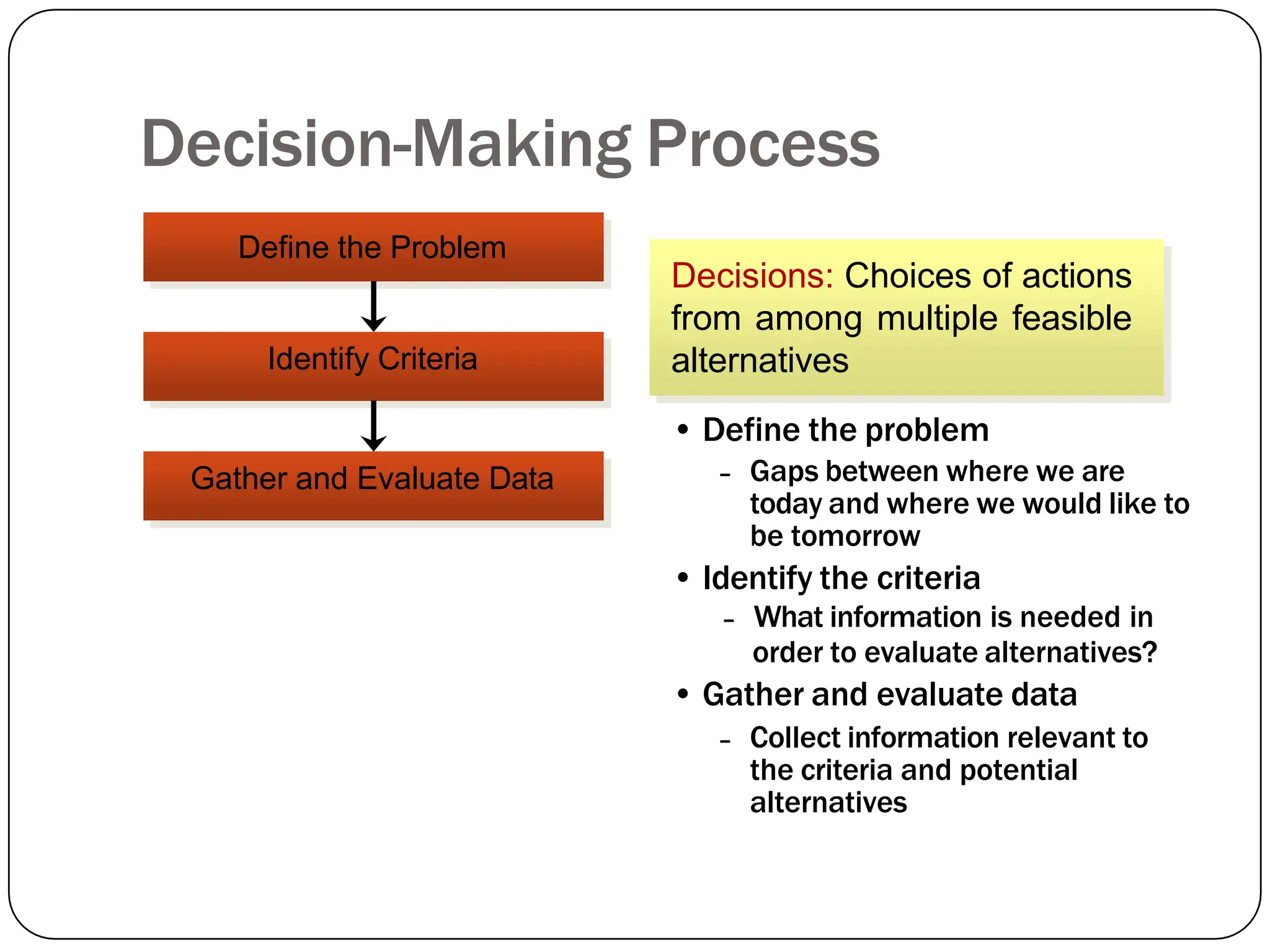
Decision-Making Process
Define the Problem
Identify Criteria
Gather and Evaluate Data
Decisions: Choices of actions
from among multiple feasible
alternatives
• Define the problem
– Gaps between where we are
today and where we would like to
be tomorrow
• Identify the criteria
– What information is needed in
order to evaluate alternatives?
• Gather and evaluate data
– Collect information relevant to
the criteria and potential
alternatives
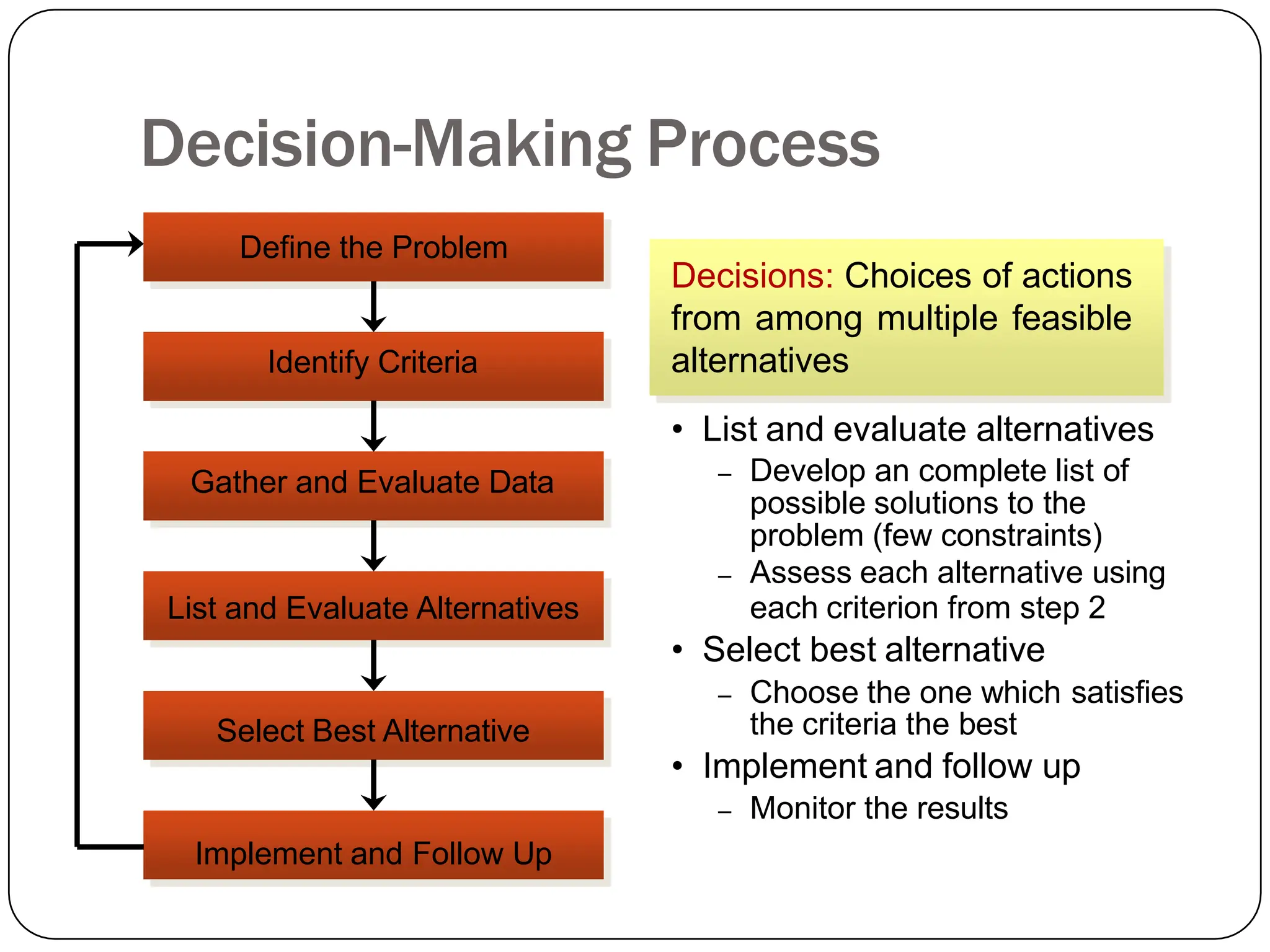
Decision-Making Process
Define the Problem
Identify Criteria
Gather and Evaluate Data
List and Evaluate Alternatives
Select Best Alternative
Implement and Follow Up
Decisions: Choices of actions
from among multiple feasible
alternatives
• List and evaluate alternatives
– Develop an complete list of
possible solutions to the
problem (few constraints)
– Assess each alternative using
each criterion from step 2
• Select best alternative
– Choose the one which satisfies
the criteria the best
• Implement and follow up
– Monitor the results
Optimal versus Satisfactory Decisions
⚫ Optimal decision
⚫ The maximizing decision, yielding the absolute best result
⚫ Satisficingdecision
⚫ Satisfactory rather than optimal decision
⚫ Lackcapability to collect and process all of the information relevant for a
particular decision
⚫ Will never know if all possible alternatives havebeen identified
⚫ Lackof time and other necessary resources for completing all of the decision
activities
⚫ Thus,a tendency to choose the first satisfactory alternative discovered
Decision-Making Styles
⚫Individual’s predispositions can affect decision process at two
critical stages
⚫Gathering(Perceiving) of information
⚫ Sensing style
⚫ Intuition style
⚫Evaluating(Judging) of alternatives
⚫ Thinking style
⚫ Feelingstyle
Decision-Making Styles
Define the Problem
Identify Criteria
Gather and
Evaluate Data
Develop and
Evaluate List of
Alternatives
Choose Best
Alternative
Implement and
Follow Up
Perceptual
Influences
Using abstractions
and describing the
“big picture”
Intuition
Using subjective
values with emotional
and personal factors
Feeling
Using the five
senses to identify
factual details
Sensing
Using objective
analysis and
rational procedures
Thinking
Perceptual
Influences
Feedback
Degree of Acceptable Risk
⚫Risk exists when the outcome of achosen course of action is
not certain
⚫Risk-taking propensity (Willingness to take chances)
⚫Lowrisk takers
⚫ Maycollect and evaluate more information
⚫ Maybecome paralyzed by trying to obtain and consider too much
information
⚫Highrisk takers
⚫ Maymaydecisions based on too little information
⚫ Mayjump to decisions too quickly
Why do groups make
bad decision?
⚫Information sharing biases
⚫Risky shift phenomenon
⚫Social loafing
⚫Conformity
Team Building
Types of Team
⚫RecommenderTeams: those that recommend things –
task forces or project groups
⚫DoerTeams:those that make or do things – manufacturing,
operations,or marketing groups
⚫ManagingTeams:those that run things – groups that
oversee some significant functional activity
Types of Team
⚫ RecommenderTeams are often part-time; great for
reviewing work but can lack a “teamengine”for getting detailed
work done
⚫ Managing Teams are often staffed with senior executives
who have serious time management challenges and are unlikely to
engage with traditional team communication
⚫ Doer teams are great for doing things but their networks
maybe limited to their own functional areas which can blindthem
to some innovation and cross-functional opportunities
Types of Team
⚫Task Force - a temporary team assembled to investigate a
specificissue or problem
⚫Problem SolvingTeam - atemporary team assembled to
solve a specific problem
⚫Product DesignTeam - atemporary team assembled to
design anew product or service
⚫Committee - atemporary or permanent group of people
assembled to act upon some matter
Types of Team
⚫ Work Group - apermanent group of workers who receive
direction from adesignatedleader
⚫ WorkTeam (Self-DirectedWorkTeam) - an ongoing group of
workers who share a common mission who collectively manage
their own affairs within predetermined boundaries
⚫ Quality Circle - agroup of workers from the same functional
area who meet regularly to uncover and solve work-related
problems and seek work improvement opportunities
Stages of Team Development
STORMING
FORMING
PERFORMING
NORMING
Team Development Stages
Forming Stage
Becoming Acquainted and Organized
Forming Stage
Feelings of . . .
 Excitement
 Suspicion
 Fear
 Anticipation
 Optimism
 Anxiety
Storming Stage
Clarifying project needs and goals
Storming Stage
Feelings of . . .
⚫ Resistance to the task
⚫ Uncertainty about the team’s success
⚫ Impatience
⚫ Hostility
⚫ Discomfort
Norming Stage
Determining solution methods
Norming Stage
Feelings of . . .
⚫ Safety and security
⚫ Acceptance
⚫ Relief
⚫ Renewed Energy
Performing Stage
Implementing the project
Performing Stage
Feelings of . . .
⚫ Satisfaction
⚫ Pride
⚫ Excitement
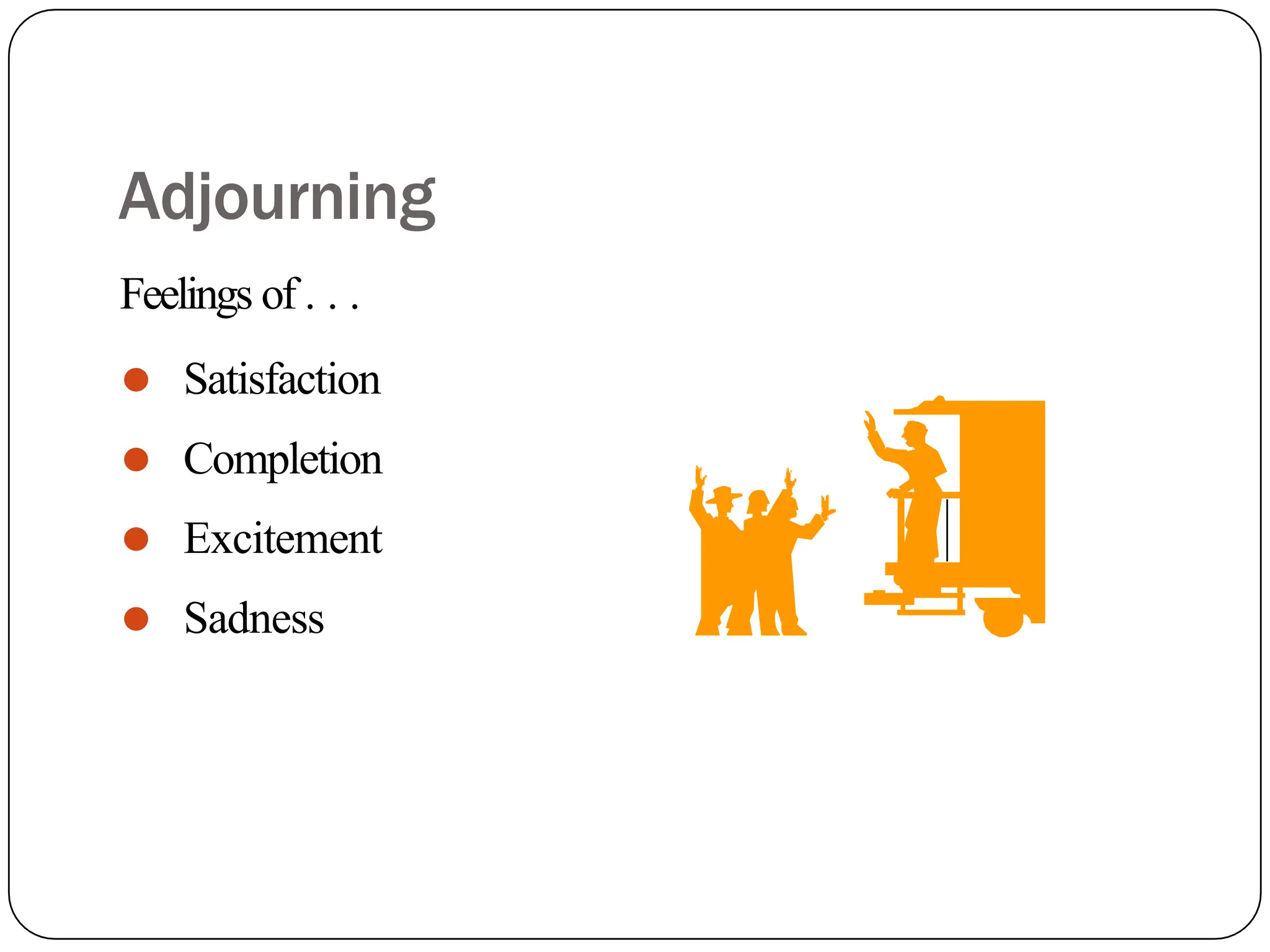
Adjourning
Feelings of . . .
⚫ Satisfaction
⚫ Completion
⚫ Excitement
⚫ Sadness
Team Development Stages
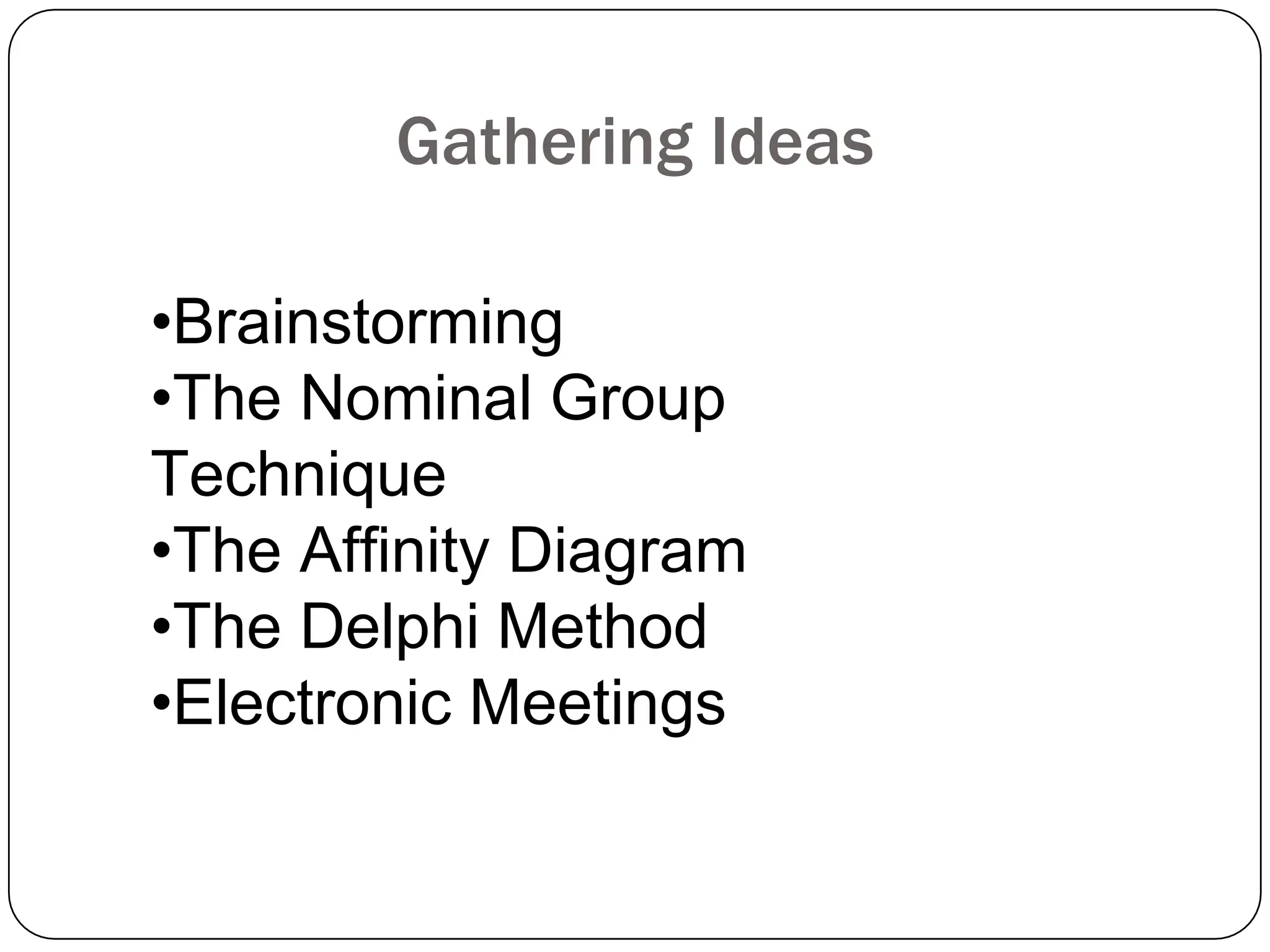
Gathering Ideas
•Brainstorming
•The Nominal Group
Technique
•The Affinity Diagram
•The Delphi Method
•Electronic Meetings
Brainstorming
•Topic
•Take turns sharing ideas
•Record each idea
•No comments/criticisms
•Keep the tempo moving
•One idea per turn
•Members may pass
•Keep going until ideas are
exhausted
Mangers Should Follow This Advice for
Successful Brainstorming
•List all ideas.
•Do not Evaluate any ideas during the initial stages.
•Encourage creativity.
•Offer ideas related to those already listed.
•Ask each participant to offer a specific number
(e.g. five to ten) of new ideas.
•Set a time for brainstorming.
Nominal Group Technique
A generic name for face-to-face group techniques in which
instructions are given to group members not to interact with
each other except at specific steps in the process.
•Silent idea generations,
•Round-robin sharing of ideas,
•Feedback to the group,
•Explanatory group discussion,
•Individual re-assessment, and
•Mathematical aggregation of revised
judgements.
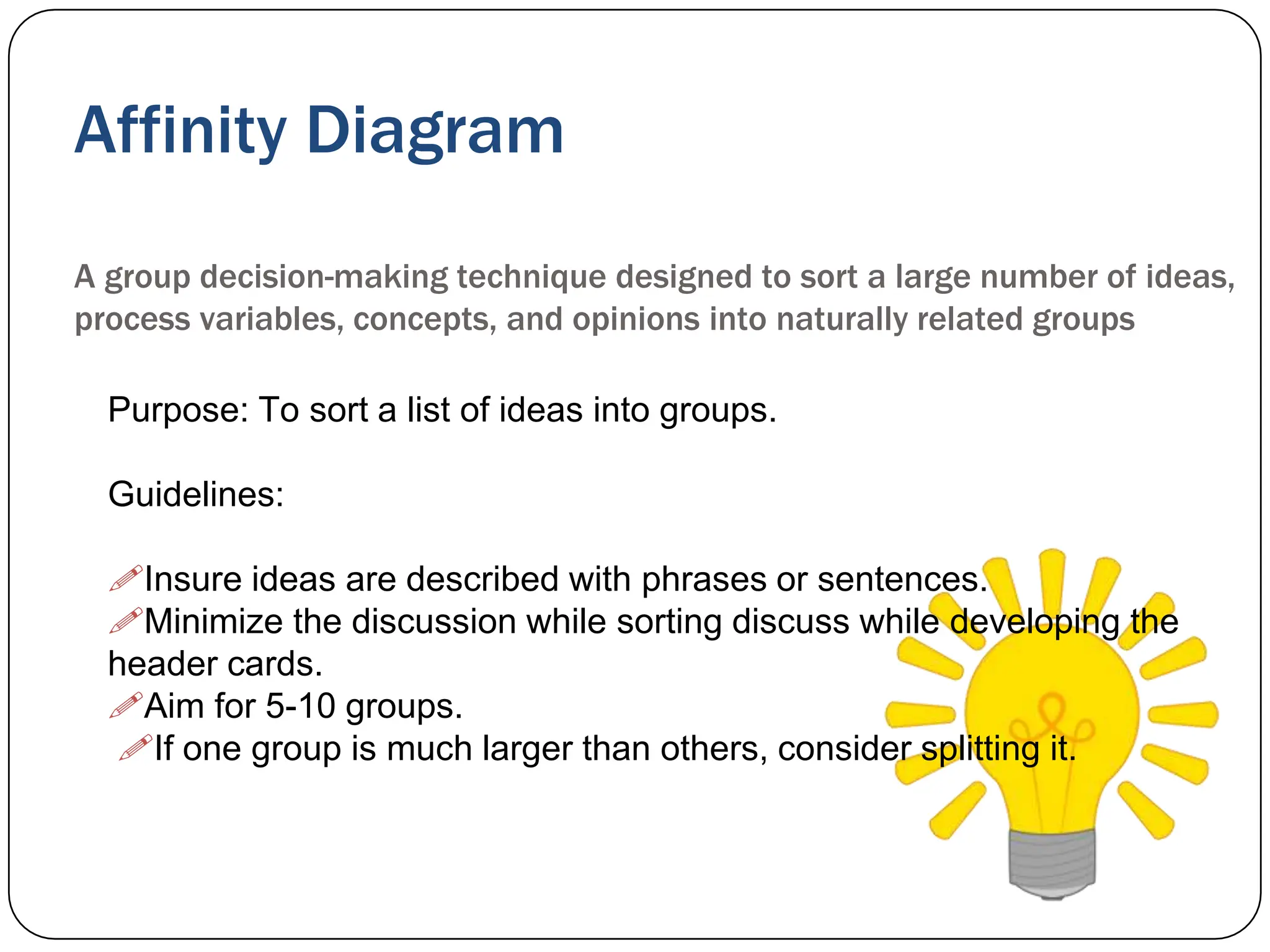
Affinity Diagram
A group decision-making technique designed to sort a large number of ideas,
process variables, concepts, and opinions into naturally related groups
Purpose: To sort a list of ideas into groups.
Guidelines:
Insure ideas are described with phrases or sentences.
Minimize the discussion while sorting discuss while developing the
header cards.
Aim for 5-10 groups.
If one group is much larger than others, consider splitting it.
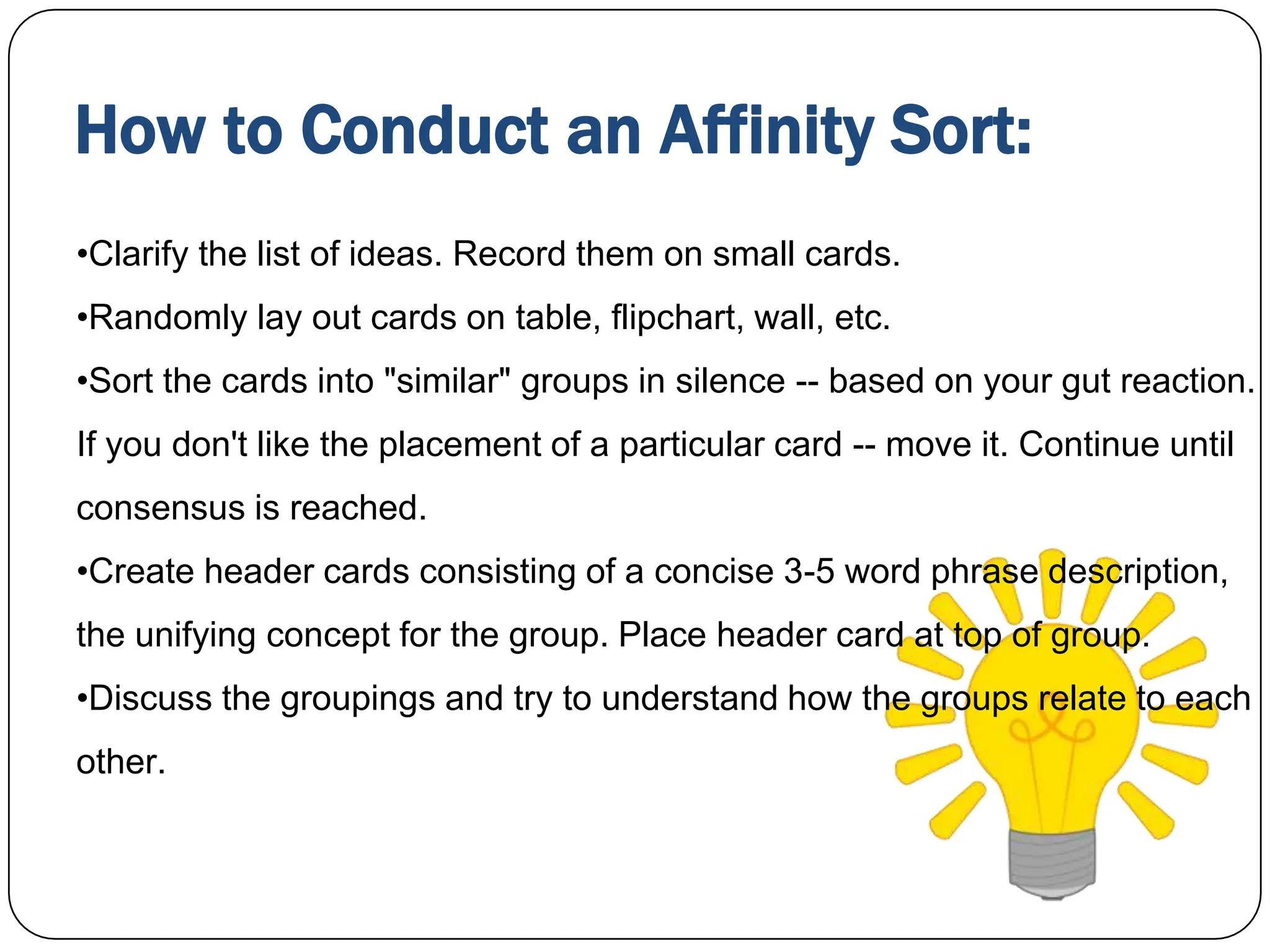
How to Conduct an Affinity Sort:
•Clarify the list of ideas. Record them on small cards.
•Randomly lay out cards on table, flipchart, wall, etc.
•Sort the cards into "similar" groups in silence -- based on your gut reaction.
If you don't like the placement of a particular card -- move it. Continue until
consensus is reached.
•Create header cards consisting of a concise 3-5 word phrase description,
the unifying concept for the group. Place header card at top of group.
•Discuss the groupings and try to understand how the groups relate to each
other.
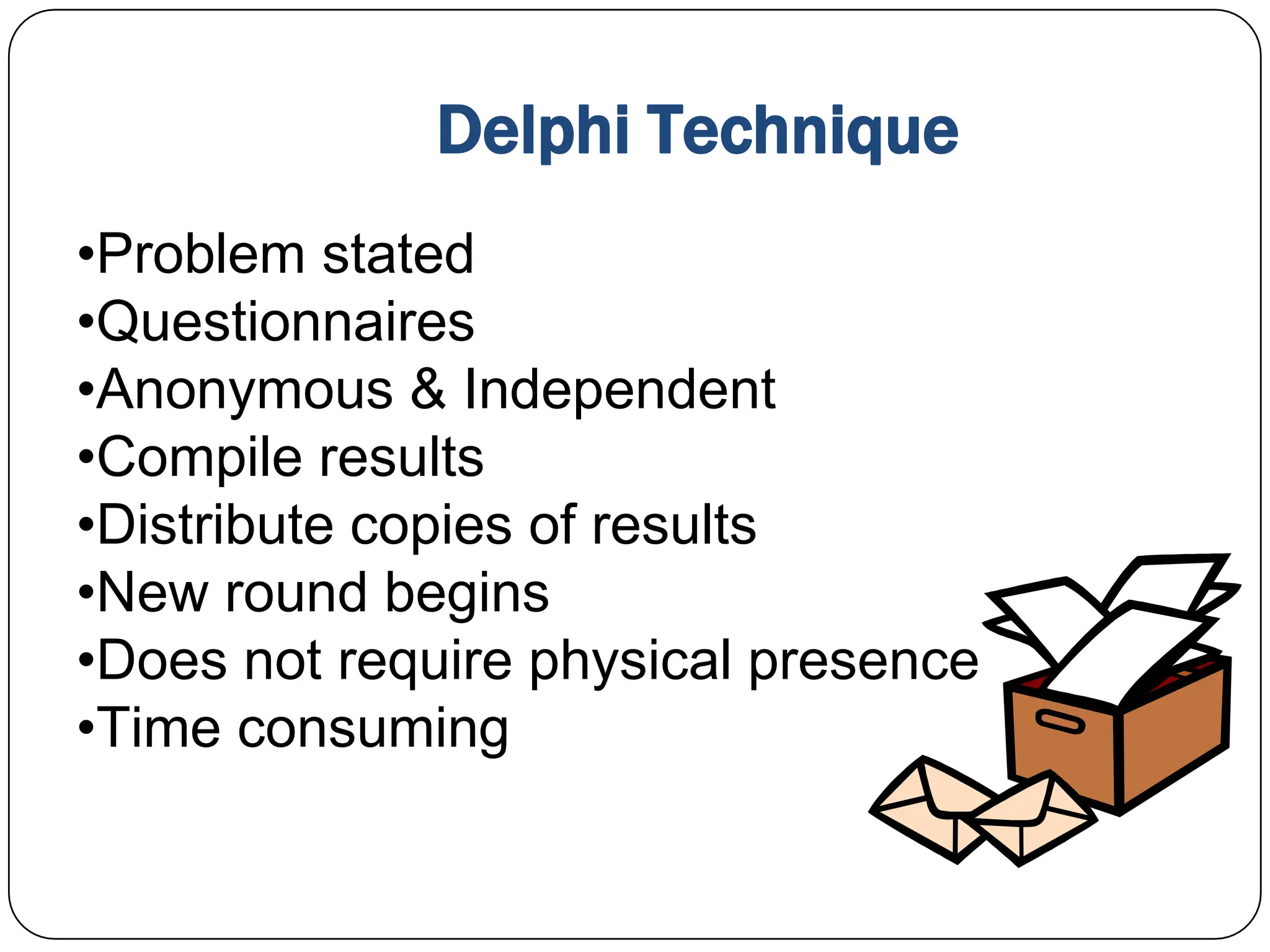
Delphi Technique
•Problem stated
•Questionnaires
•Anonymous & Independent
•Compile results
•Distribute copies of results
•New round begins
•Does not require physical presence
•Time consuming
Electronic Meetings
•Horseshoe-shaped table
•Up to 50 participants
•Issues are presented
•Responses typed
•Projection screen display
•Anonymity, honesty, & speed
•55% faster than traditional
•Lacks credit
•Fastest typist gets there first
•No face-to-face interchange
Team Effectiveness
Team Effectiveness Model
⚫Goals
⚫Roles
⚫Procedures
⚫Relationships
⚫Leadership
Effectiveness in Teams
Teammembers . . .
 Sharethe same goal. The team works together to accomplish a
common aim
 Believethey are more productive working together than by
themselves
 Eachfeel that he or she hasan important contribution to make to
the team
 Are supportive of one another
 Haveagood“coach”or leader who provides
direction and guidance
Effective Individual
Productivity
Team
Personal
Follow up
Self
Discipline
Personal
Conduct
Atmosphere
Synergy
Team
Productivity
Coordination
Momentum
Critical
Events
Innovation
Measurement
Punctuated Equilibrium Model
⚫Explains temporary group with deadlines.These temporary
groups go through transitions between inertia and activity
Punctuated Equilibrium Model
Sequence of Actions
1. Setting group direction
2. First phase of inertia
3. Half-waypoint transition
4. Major changes
5. Second phase of inertia
6. Accelerated activities
Requirements
⚫Common purpose or goals or objectives
⚫Awareness of membership and commitment
⚫Common operating norms
⚫Aneed for each other/interdependence
⚫Accountability to ahigher level
Components of an effective team
⚫Positive corporate culture
⚫Giverecognition
⚫ Outstanding performance
⚫ Continued performance
⚫ Improved performance
⚫Positive feedback
⚫Provide new opportunities
Team Creativity
Team Creativity
⚫Creativity skills contribute to teams working smarter and
exceeding their previous levels of performance
Team Creativity
⚫Brainstorming
⚫Nominal group technique
⚫Structured team interaction
⚫Scenario Planning
⚫“Surprise free”scenario
⚫ Continuation ofthe present
⚫ Worst possible events
⚫ “One plus two”formula
⚫ Working backwards
Characteristics of Team Creativity
⚫Preparation
⚫Challenging individuals
⚫Maximizing participation
⚫Structured presentation
⚫Supportive climate
Technique for Team Creativity
⚫Brainstorming
⚫Reverse brainstorming
THANK YOU!!
KENNEDY V. RODRIGUEZ
REYNALDO L. DE ASIS

GROUP DECISION MAKING, GARBAGE CAN MODEL

  • 1.
    Group Decision Making KENNEDYV. RODRIGUEZ REYNALDO L. DE ASIS
  • 2.
    Need for groupdecisions ⚫Topool diverse expertise in order to coordinate the actions of all for acommon goal ⚫Decisions made bygroups are superior to the decisions made byindividuals ⚫Groups outperfom individuals
  • 3.
    Decision-Making Process Define theProblem Identify Criteria Gather and Evaluate Data Decisions: Choices of actions from among multiple feasible alternatives • Define the problem – Gaps between where we are today and where we would like to be tomorrow • Identify the criteria – What information is needed in order to evaluate alternatives? • Gather and evaluate data – Collect information relevant to the criteria and potential alternatives
  • 4.
    Decision-Making Process Define theProblem Identify Criteria Gather and Evaluate Data List and Evaluate Alternatives Select Best Alternative Implement and Follow Up Decisions: Choices of actions from among multiple feasible alternatives • List and evaluate alternatives – Develop an complete list of possible solutions to the problem (few constraints) – Assess each alternative using each criterion from step 2 • Select best alternative – Choose the one which satisfies the criteria the best • Implement and follow up – Monitor the results
  • 5.
    Optimal versus SatisfactoryDecisions ⚫ Optimal decision ⚫ The maximizing decision, yielding the absolute best result ⚫ Satisficingdecision ⚫ Satisfactory rather than optimal decision ⚫ Lackcapability to collect and process all of the information relevant for a particular decision ⚫ Will never know if all possible alternatives havebeen identified ⚫ Lackof time and other necessary resources for completing all of the decision activities ⚫ Thus,a tendency to choose the first satisfactory alternative discovered
  • 6.
    Decision-Making Styles ⚫Individual’s predispositionscan affect decision process at two critical stages ⚫Gathering(Perceiving) of information ⚫ Sensing style ⚫ Intuition style ⚫Evaluating(Judging) of alternatives ⚫ Thinking style ⚫ Feelingstyle
  • 7.
    Decision-Making Styles Define theProblem Identify Criteria Gather and Evaluate Data Develop and Evaluate List of Alternatives Choose Best Alternative Implement and Follow Up Perceptual Influences Using abstractions and describing the “big picture” Intuition Using subjective values with emotional and personal factors Feeling Using the five senses to identify factual details Sensing Using objective analysis and rational procedures Thinking Perceptual Influences Feedback
  • 8.
    Degree of AcceptableRisk ⚫Risk exists when the outcome of achosen course of action is not certain ⚫Risk-taking propensity (Willingness to take chances) ⚫Lowrisk takers ⚫ Maycollect and evaluate more information ⚫ Maybecome paralyzed by trying to obtain and consider too much information ⚫Highrisk takers ⚫ Maymaydecisions based on too little information ⚫ Mayjump to decisions too quickly
  • 9.
    Why do groupsmake bad decision? ⚫Information sharing biases ⚫Risky shift phenomenon ⚫Social loafing ⚫Conformity
  • 10.
  • 11.
    Types of Team ⚫RecommenderTeams:those that recommend things – task forces or project groups ⚫DoerTeams:those that make or do things – manufacturing, operations,or marketing groups ⚫ManagingTeams:those that run things – groups that oversee some significant functional activity
  • 12.
    Types of Team ⚫RecommenderTeams are often part-time; great for reviewing work but can lack a “teamengine”for getting detailed work done ⚫ Managing Teams are often staffed with senior executives who have serious time management challenges and are unlikely to engage with traditional team communication ⚫ Doer teams are great for doing things but their networks maybe limited to their own functional areas which can blindthem to some innovation and cross-functional opportunities
  • 13.
    Types of Team ⚫TaskForce - a temporary team assembled to investigate a specificissue or problem ⚫Problem SolvingTeam - atemporary team assembled to solve a specific problem ⚫Product DesignTeam - atemporary team assembled to design anew product or service ⚫Committee - atemporary or permanent group of people assembled to act upon some matter
  • 14.
    Types of Team ⚫Work Group - apermanent group of workers who receive direction from adesignatedleader ⚫ WorkTeam (Self-DirectedWorkTeam) - an ongoing group of workers who share a common mission who collectively manage their own affairs within predetermined boundaries ⚫ Quality Circle - agroup of workers from the same functional area who meet regularly to uncover and solve work-related problems and seek work improvement opportunities
  • 15.
    Stages of TeamDevelopment
  • 16.
  • 17.
  • 18.
    Forming Stage Feelings of. . .  Excitement  Suspicion  Fear  Anticipation  Optimism  Anxiety
  • 19.
  • 20.
    Storming Stage Feelings of. . . ⚫ Resistance to the task ⚫ Uncertainty about the team’s success ⚫ Impatience ⚫ Hostility ⚫ Discomfort
  • 21.
  • 22.
    Norming Stage Feelings of. . . ⚫ Safety and security ⚫ Acceptance ⚫ Relief ⚫ Renewed Energy
  • 23.
  • 24.
    Performing Stage Feelings of. . . ⚫ Satisfaction ⚫ Pride ⚫ Excitement
  • 25.
    Adjourning Feelings of .. . ⚫ Satisfaction ⚫ Completion ⚫ Excitement ⚫ Sadness
  • 26.
  • 27.
    Gathering Ideas •Brainstorming •The NominalGroup Technique •The Affinity Diagram •The Delphi Method •Electronic Meetings
  • 28.
    Brainstorming •Topic •Take turns sharingideas •Record each idea •No comments/criticisms •Keep the tempo moving •One idea per turn •Members may pass •Keep going until ideas are exhausted
  • 29.
    Mangers Should FollowThis Advice for Successful Brainstorming •List all ideas. •Do not Evaluate any ideas during the initial stages. •Encourage creativity. •Offer ideas related to those already listed. •Ask each participant to offer a specific number (e.g. five to ten) of new ideas. •Set a time for brainstorming.
  • 30.
    Nominal Group Technique Ageneric name for face-to-face group techniques in which instructions are given to group members not to interact with each other except at specific steps in the process. •Silent idea generations, •Round-robin sharing of ideas, •Feedback to the group, •Explanatory group discussion, •Individual re-assessment, and •Mathematical aggregation of revised judgements.
  • 31.
    Affinity Diagram A groupdecision-making technique designed to sort a large number of ideas, process variables, concepts, and opinions into naturally related groups Purpose: To sort a list of ideas into groups. Guidelines: Insure ideas are described with phrases or sentences. Minimize the discussion while sorting discuss while developing the header cards. Aim for 5-10 groups. If one group is much larger than others, consider splitting it.
  • 32.
    How to Conductan Affinity Sort: •Clarify the list of ideas. Record them on small cards. •Randomly lay out cards on table, flipchart, wall, etc. •Sort the cards into "similar" groups in silence -- based on your gut reaction. If you don't like the placement of a particular card -- move it. Continue until consensus is reached. •Create header cards consisting of a concise 3-5 word phrase description, the unifying concept for the group. Place header card at top of group. •Discuss the groupings and try to understand how the groups relate to each other.
  • 33.
    Delphi Technique •Problem stated •Questionnaires •Anonymous& Independent •Compile results •Distribute copies of results •New round begins •Does not require physical presence •Time consuming
  • 34.
    Electronic Meetings •Horseshoe-shaped table •Upto 50 participants •Issues are presented •Responses typed •Projection screen display •Anonymity, honesty, & speed •55% faster than traditional •Lacks credit •Fastest typist gets there first •No face-to-face interchange
  • 35.
  • 36.
  • 37.
    Effectiveness in Teams Teammembers. . .  Sharethe same goal. The team works together to accomplish a common aim  Believethey are more productive working together than by themselves  Eachfeel that he or she hasan important contribution to make to the team  Are supportive of one another  Haveagood“coach”or leader who provides direction and guidance
  • 38.
  • 39.
    Punctuated Equilibrium Model ⚫Explainstemporary group with deadlines.These temporary groups go through transitions between inertia and activity
  • 40.
  • 41.
    Sequence of Actions 1.Setting group direction 2. First phase of inertia 3. Half-waypoint transition 4. Major changes 5. Second phase of inertia 6. Accelerated activities
  • 42.
    Requirements ⚫Common purpose orgoals or objectives ⚫Awareness of membership and commitment ⚫Common operating norms ⚫Aneed for each other/interdependence ⚫Accountability to ahigher level
  • 43.
    Components of aneffective team ⚫Positive corporate culture ⚫Giverecognition ⚫ Outstanding performance ⚫ Continued performance ⚫ Improved performance ⚫Positive feedback ⚫Provide new opportunities
  • 44.
  • 45.
    Team Creativity ⚫Creativity skillscontribute to teams working smarter and exceeding their previous levels of performance
  • 46.
    Team Creativity ⚫Brainstorming ⚫Nominal grouptechnique ⚫Structured team interaction ⚫Scenario Planning ⚫“Surprise free”scenario ⚫ Continuation ofthe present ⚫ Worst possible events ⚫ “One plus two”formula ⚫ Working backwards
  • 47.
    Characteristics of TeamCreativity ⚫Preparation ⚫Challenging individuals ⚫Maximizing participation ⚫Structured presentation ⚫Supportive climate
  • 48.
    Technique for TeamCreativity ⚫Brainstorming ⚫Reverse brainstorming
  • 49.
    THANK YOU!! KENNEDY V.RODRIGUEZ REYNALDO L. DE ASIS