What Makes a Teacher Effective? Chapter Six
Questions Reflective Teachers Ask What am I doing and why? How can I better meet my students’ needs? What are some alternative learning activities to achieve these objectives? How could I have encouraged more involvement or learning on the part of the students?
Three Stages of  Decision Making Planning decisions Implementing decisions Evaluating decisions
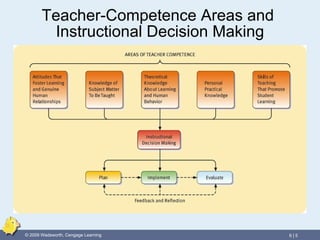
Aspects of Reflective  Decision Making Attitudes  that foster learning and genuine human relationships Knowledge Subject Matter Knowledge Theoretical Knowledge Personal Practical Knowledge Teaching skills  that promote student learning
Teacher-Competence Areas and  Instructional Decision Making
What Attitudes Does  the Effective Teacher Possess? Attitude toward self  - achieved through reflection, study, and participant observation Attitude toward children  - positive attitude toward children; high expectations for students; willingness to examine own negative attitudes Attitude   toward colleagues and parents  - collaborative Attitude toward subject matter  - enthusiasm
VIDEO CASE:  Elementary Writing Instruction: Process Writing
Teacher Expectations Influenced by race, social class, gender, other teachers, and more May be unconscious Communicated to students Affect student behavior & performance Self-fulfilling prophecy
Influences on Attitudes Toward Colleagues & Families Authority    Collaboration Competition    Cooperation Superiority and Prejudice    Acceptance
What Subject-Matter  Knowledge Does the Effective Teacher Possess? Discipline content  - structure, elements, logic, possible uses, and social biases of subject content Curriculum content  - school and district curriculum and standards  Pedagogical content  - best practices for teaching particular content
Theories  v.  Theories in Use Theory Unproved explanation of why something happens the way it does Basis for hypotheses, further study, research Theory in Use Idea held by a person and used as basis of dealing with others Often unexamined, but assumed true
Approaches to  Classroom Management
Kounin’s Research  on Effective Classroom Management Effective teachers use these skills: Withitness Smoothness Momentum Effective teachers avoid these slow-down behaviors: Overdwelling Fragmentation
Guidelines for Effective Classroom Management Establish rules and routines Define them clearly Have students help  Ensure students’ compliance Establish positive relationships  Be willing to administer consequences Involve families Communicate Make sure they understand rules
Effective Questioning Techniques Phrase questions clearly; ask brief questions. Link questions to lesson objectives. Ask thought-provoking questions. Avoid yes/no and leading questions. Question a range of students. Balance volunteers with non-volunteers. Extend wait-time. Encourage students to respond in some way to every question. Probe & provide feedback on responses.

Chapter 6: What Makes a Teacher Effective?

  • 1.
    What Makes aTeacher Effective? Chapter Six
  • 2.
    Questions Reflective TeachersAsk What am I doing and why? How can I better meet my students’ needs? What are some alternative learning activities to achieve these objectives? How could I have encouraged more involvement or learning on the part of the students?
  • 3.
    Three Stages of Decision Making Planning decisions Implementing decisions Evaluating decisions
  • 4.
    Aspects of Reflective Decision Making Attitudes that foster learning and genuine human relationships Knowledge Subject Matter Knowledge Theoretical Knowledge Personal Practical Knowledge Teaching skills that promote student learning
  • 5.
    Teacher-Competence Areas and Instructional Decision Making
  • 6.
    What Attitudes Does the Effective Teacher Possess? Attitude toward self - achieved through reflection, study, and participant observation Attitude toward children - positive attitude toward children; high expectations for students; willingness to examine own negative attitudes Attitude toward colleagues and parents - collaborative Attitude toward subject matter - enthusiasm
  • 7.
    VIDEO CASE: Elementary Writing Instruction: Process Writing
  • 8.
    Teacher Expectations Influencedby race, social class, gender, other teachers, and more May be unconscious Communicated to students Affect student behavior & performance Self-fulfilling prophecy
  • 9.
    Influences on AttitudesToward Colleagues & Families Authority  Collaboration Competition  Cooperation Superiority and Prejudice  Acceptance
  • 10.
    What Subject-Matter Knowledge Does the Effective Teacher Possess? Discipline content - structure, elements, logic, possible uses, and social biases of subject content Curriculum content - school and district curriculum and standards Pedagogical content - best practices for teaching particular content
  • 11.
    Theories v. Theories in Use Theory Unproved explanation of why something happens the way it does Basis for hypotheses, further study, research Theory in Use Idea held by a person and used as basis of dealing with others Often unexamined, but assumed true
  • 12.
    Approaches to Classroom Management
  • 13.
    Kounin’s Research on Effective Classroom Management Effective teachers use these skills: Withitness Smoothness Momentum Effective teachers avoid these slow-down behaviors: Overdwelling Fragmentation
  • 14.
    Guidelines for EffectiveClassroom Management Establish rules and routines Define them clearly Have students help Ensure students’ compliance Establish positive relationships Be willing to administer consequences Involve families Communicate Make sure they understand rules
  • 15.
    Effective Questioning TechniquesPhrase questions clearly; ask brief questions. Link questions to lesson objectives. Ask thought-provoking questions. Avoid yes/no and leading questions. Question a range of students. Balance volunteers with non-volunteers. Extend wait-time. Encourage students to respond in some way to every question. Probe & provide feedback on responses.