What Is Taught? Chapter Five
Formal  v.  Hidden Curriculum Formal Curriculum Explicitly taught Planned Students learn subject-matter information Organized and intended experiences of the student for which the school accepts responsibility Hidden Curriculum Taught informally Often unplanned Students learn attitudes, values, beliefs, behavior
Content Standards Subject- specific What students should: know be able to do Standards movement is influential, widespread, but controversial
Current Curriculum: Language Arts General Reading Writing Listening  Speaking Issues and Trends Whole language versus phonics Balanced combination approach is best New media
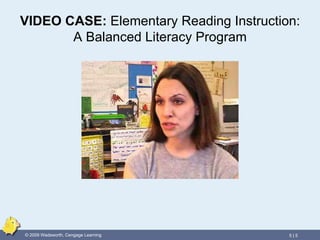
VIDEO CASE:  Elementary Reading Instruction: A Balanced Literacy Program
Current Curriculum: Mathematics General Computational skills and structure Issues and Trends Use of manipulatives in early grades More calculator and computer use Integrating math skills Constructivist approaches, conceptual reasoning  v.  procedures, drill
Current Curriculum: Science General Early grades: topics of natural curiosity Middle school: expanded curriculum High school: year-long courses in branches of science Issues and Trends Training next generation of scientists Teaching all students to reason scientifically, make informed judgments Project 2061
Current Curriculum:  Social Studies General Study of people, their ideas & relationships Dominated by history, government Issues and Trends Diversity in history/concern for non-European cultures Geography coming back The “new” civics Standards across different social studies
Current Curriculum:  Foreign Languages General American students unprepared, compared to rest of world Spanish, French popular in high schools Issues and Trends Expanded offerings Cultural understanding Emphasis on relevance Early introduction: elementary school emphasis
Current Curriculum: The Arts General Visual arts Music Dance Theatre Issues and Trends Emphasis on aesthetic education and art as a way of knowing and perceiving the world  Integrating arts into the curriculum In danger from budget cuts
Current Curriculum: Physical Education and Health General Goals are to promote health of American public Topics include injury prevention and safety, prevention and control of disease (including AIDS), substance abuse, nutrition, family life (sexuality), consumer health, and mental and emotional health Issues and Trends Lack of emphasis in public schools
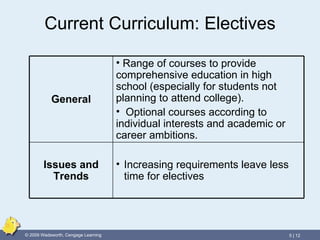
Current Curriculum: Electives General Range of courses to provide comprehensive education in high school (especially for students not planning to attend college). Optional courses according to individual interests and academic or career ambitions. Issues and Trends Increasing requirements leave less time for electives
Current Curriculum:  Career and Technical Education General Preparation for employment after high school graduation Issues and Trends Increasing academic requirements leading to declining enrollment More focus on achieving necessary skills Improving school-to-work transitions “ Tech prep”
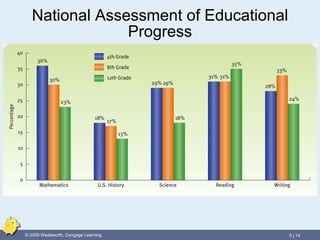
National Assessment of Educational Progress
Sample Interdisciplinary Approach
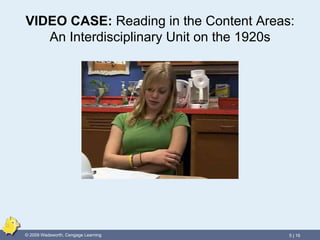
VIDEO CASE:  Reading in the Content Areas: An Interdisciplinary Unit on the 1920s
Key Characteristics of Cooperative Learning Group goals Individual accountability Equal opportunities for success
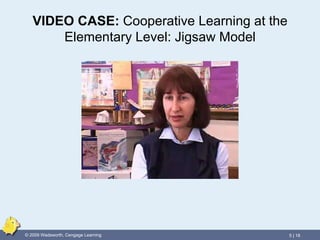
VIDEO CASE:  Cooperative Learning at the Elementary Level: Jigsaw Model
Some Cooperative  Learning Strategies Student team learning Jigsaw/Jigsaw 2 Group Investigation Think-Pair-Share
VIDEO CASE:  Cooperative Learning: High School History Lesson
Critical Thinking and  Problem Solving Critical Thinking Evaluating the worth of ideas, opinions, or evidence before making a decision or judgment. Problem Solving Awareness of the conditions, procedures, or steps taken to solve a problem and the ability to implement them.
Strategies for Differentiating Instruction Stations Compacting Complex Instruction Choice Boards Problem-Based Learning Entry Points Orbital Studies 4Mat Project Approach
VIDEO CASE:  Academic Diversity: Differentiated Instruction
Curriculum Controversies Core versus Multicultural curriculum Tracking Relevant to Today’s Society? Curriculum as a social bet
Core V. Multicultural Curriculum Core Curriculum Promotes cultural unity Encourages same basic “cultural literacy” for all Core Knowledge says cultural literacy needed for success Multicultural Curriculum Embraces cultural pluralism, celebrates diversity Some promote Afrocentric or other “centric” curricula

Chapter 5: What Is Taught?

  • 1.
    What Is Taught?Chapter Five
  • 2.
    Formal v. Hidden Curriculum Formal Curriculum Explicitly taught Planned Students learn subject-matter information Organized and intended experiences of the student for which the school accepts responsibility Hidden Curriculum Taught informally Often unplanned Students learn attitudes, values, beliefs, behavior
  • 3.
    Content Standards Subject-specific What students should: know be able to do Standards movement is influential, widespread, but controversial
  • 4.
    Current Curriculum: LanguageArts General Reading Writing Listening Speaking Issues and Trends Whole language versus phonics Balanced combination approach is best New media
  • 5.
    VIDEO CASE: Elementary Reading Instruction: A Balanced Literacy Program
  • 6.
    Current Curriculum: MathematicsGeneral Computational skills and structure Issues and Trends Use of manipulatives in early grades More calculator and computer use Integrating math skills Constructivist approaches, conceptual reasoning v. procedures, drill
  • 7.
    Current Curriculum: ScienceGeneral Early grades: topics of natural curiosity Middle school: expanded curriculum High school: year-long courses in branches of science Issues and Trends Training next generation of scientists Teaching all students to reason scientifically, make informed judgments Project 2061
  • 8.
    Current Curriculum: Social Studies General Study of people, their ideas & relationships Dominated by history, government Issues and Trends Diversity in history/concern for non-European cultures Geography coming back The “new” civics Standards across different social studies
  • 9.
    Current Curriculum: Foreign Languages General American students unprepared, compared to rest of world Spanish, French popular in high schools Issues and Trends Expanded offerings Cultural understanding Emphasis on relevance Early introduction: elementary school emphasis
  • 10.
    Current Curriculum: TheArts General Visual arts Music Dance Theatre Issues and Trends Emphasis on aesthetic education and art as a way of knowing and perceiving the world Integrating arts into the curriculum In danger from budget cuts
  • 11.
    Current Curriculum: PhysicalEducation and Health General Goals are to promote health of American public Topics include injury prevention and safety, prevention and control of disease (including AIDS), substance abuse, nutrition, family life (sexuality), consumer health, and mental and emotional health Issues and Trends Lack of emphasis in public schools
  • 12.
    Current Curriculum: ElectivesGeneral Range of courses to provide comprehensive education in high school (especially for students not planning to attend college). Optional courses according to individual interests and academic or career ambitions. Issues and Trends Increasing requirements leave less time for electives
  • 13.
    Current Curriculum: Career and Technical Education General Preparation for employment after high school graduation Issues and Trends Increasing academic requirements leading to declining enrollment More focus on achieving necessary skills Improving school-to-work transitions “ Tech prep”
  • 14.
    National Assessment ofEducational Progress
  • 15.
  • 16.
    VIDEO CASE: Reading in the Content Areas: An Interdisciplinary Unit on the 1920s
  • 17.
    Key Characteristics ofCooperative Learning Group goals Individual accountability Equal opportunities for success
  • 18.
    VIDEO CASE: Cooperative Learning at the Elementary Level: Jigsaw Model
  • 19.
    Some Cooperative Learning Strategies Student team learning Jigsaw/Jigsaw 2 Group Investigation Think-Pair-Share
  • 20.
    VIDEO CASE: Cooperative Learning: High School History Lesson
  • 21.
    Critical Thinking and Problem Solving Critical Thinking Evaluating the worth of ideas, opinions, or evidence before making a decision or judgment. Problem Solving Awareness of the conditions, procedures, or steps taken to solve a problem and the ability to implement them.
  • 22.
    Strategies for DifferentiatingInstruction Stations Compacting Complex Instruction Choice Boards Problem-Based Learning Entry Points Orbital Studies 4Mat Project Approach
  • 23.
    VIDEO CASE: Academic Diversity: Differentiated Instruction
  • 24.
    Curriculum Controversies Coreversus Multicultural curriculum Tracking Relevant to Today’s Society? Curriculum as a social bet
  • 25.
    Core V. MulticulturalCurriculum Core Curriculum Promotes cultural unity Encourages same basic “cultural literacy” for all Core Knowledge says cultural literacy needed for success Multicultural Curriculum Embraces cultural pluralism, celebrates diversity Some promote Afrocentric or other “centric” curricula