 Presented By: Dipanshu Yadav
 ERP:20BPHR0002
 Subject : Pharmacognosy
 Submitted To :Mr.Bhupendra Kumar
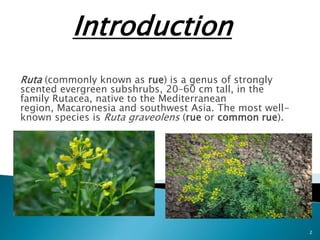
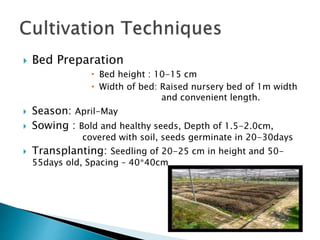
Ruta (commonly known as rue) is a genus of strongly
scented evergreen subshrubs, 20–60 cm tall, in the
family Rutacea, native to the Mediterranean
region, Macaronesia and southwest Asia. The most well-
known species is Ruta graveolens (rue or common rue).
2
Introduction
 The leaves are bipinnate or tripinnate, with a
feathery appearance, and green to strongly
glaucous blue-green in colour.
The flowers are yellow, with 4–5 petals, about
1 cm diameter, and borne in cymes.
The fruit is a 4–5-lobed capsule, containing
numerous seeds.
 Ruta was first mentioned by Turner in 1562.
 Hippocrates specially commended it,and it
constituted a chief ingredient of the famous
antidote to poison
 The Greeks regarded it as an antimagical herb,
because it serves as remedy for indigestion.
 In the Middle ages and later, it was considered-in
many parts of europe –a powerful defence against
witches.
 Pliny- reported ruta to be effective for the
preservation of eyesight.
 Grows well in sandy loamy soils with medium
fertility
 Soils with well decomposed FYM found best
for germination and better survival of
seedling and productivity
 Soil pH: 6.0 to 8.0
 It requires mild, cold and tropical climates.
 It tolerates hot and dry conditions and prefers
open spaces under bright sunlight .
 Optimum Temprature: 15-28 degree Celsius
 Relative humidity: 60-75%
 Commonly by- Seeds and Stems cuttings
 Commercialy- Seeds, Viable 2-3 years
 Seeds Rate- 250-300g/ha
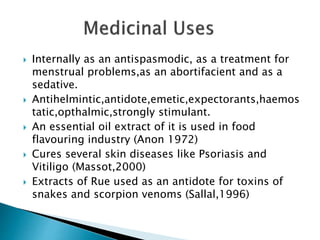
 Bed Preparation
 Bed height : 10-15 cm
 Width of bed: Raised nursery bed of 1m width
and convenient length.
 Season: April-May
 Sowing : Bold and healthy seeds, Depth of 1.5-2.0cm,
covered with soil, seeds germinate in 20-30days
 Transplanting: Seedling of 20-25 cm in height and 50-
55days old, Spacing – 40*40cm
 Internally as an antispasmodic, as a treatment for
menstrual problems,as an abortifacient and as a
sedative.
 Antihelmintic,antidote,emetic,expectorants,haemos
tatic,opthalmic,strongly stimulant.
 An essential oil extract of it is used in food
flavouring industry (Anon 1972)
 Cures several skin diseases like Psoriasis and
Vitiligo (Massot,2000)
 Extracts of Rue used as an antidote for toxins of
snakes and scorpion venoms (Sallal,1996)
 The oil acts as a stimulant for uterine and
nervous systems
 The fresh leaves are used for rheumatalgia
 The juice obtained from the leaves is given to
children for helminthic infections and is good
for odontalgia and otalgia
 The dried leaves,powdered and combined
with aromatics,are given as a remedy for
dyspesia and with the fresh leaves a tincture
is made which is used as an external remedy
in the first stages of paralysis
Ruta.pptx
Ruta.pptx
Ruta.pptx

Ruta.pptx

  • 1.
     Presented By:Dipanshu Yadav  ERP:20BPHR0002  Subject : Pharmacognosy  Submitted To :Mr.Bhupendra Kumar
  • 2.
    Ruta (commonly knownas rue) is a genus of strongly scented evergreen subshrubs, 20–60 cm tall, in the family Rutacea, native to the Mediterranean region, Macaronesia and southwest Asia. The most well- known species is Ruta graveolens (rue or common rue). 2 Introduction
  • 3.
     The leavesare bipinnate or tripinnate, with a feathery appearance, and green to strongly glaucous blue-green in colour. The flowers are yellow, with 4–5 petals, about 1 cm diameter, and borne in cymes. The fruit is a 4–5-lobed capsule, containing numerous seeds.
  • 5.
     Ruta wasfirst mentioned by Turner in 1562.  Hippocrates specially commended it,and it constituted a chief ingredient of the famous antidote to poison  The Greeks regarded it as an antimagical herb, because it serves as remedy for indigestion.  In the Middle ages and later, it was considered-in many parts of europe –a powerful defence against witches.  Pliny- reported ruta to be effective for the preservation of eyesight.
  • 7.
     Grows wellin sandy loamy soils with medium fertility  Soils with well decomposed FYM found best for germination and better survival of seedling and productivity  Soil pH: 6.0 to 8.0
  • 8.
     It requiresmild, cold and tropical climates.  It tolerates hot and dry conditions and prefers open spaces under bright sunlight .  Optimum Temprature: 15-28 degree Celsius  Relative humidity: 60-75%
  • 9.
     Commonly by-Seeds and Stems cuttings  Commercialy- Seeds, Viable 2-3 years  Seeds Rate- 250-300g/ha
  • 10.
     Bed Preparation Bed height : 10-15 cm  Width of bed: Raised nursery bed of 1m width and convenient length.  Season: April-May  Sowing : Bold and healthy seeds, Depth of 1.5-2.0cm, covered with soil, seeds germinate in 20-30days  Transplanting: Seedling of 20-25 cm in height and 50- 55days old, Spacing – 40*40cm
  • 11.
     Internally asan antispasmodic, as a treatment for menstrual problems,as an abortifacient and as a sedative.  Antihelmintic,antidote,emetic,expectorants,haemos tatic,opthalmic,strongly stimulant.  An essential oil extract of it is used in food flavouring industry (Anon 1972)  Cures several skin diseases like Psoriasis and Vitiligo (Massot,2000)  Extracts of Rue used as an antidote for toxins of snakes and scorpion venoms (Sallal,1996)
  • 12.
     The oilacts as a stimulant for uterine and nervous systems  The fresh leaves are used for rheumatalgia  The juice obtained from the leaves is given to children for helminthic infections and is good for odontalgia and otalgia  The dried leaves,powdered and combined with aromatics,are given as a remedy for dyspesia and with the fresh leaves a tincture is made which is used as an external remedy in the first stages of paralysis