OUR HERBAL ROOTS
Presentation By: Brigitte Zettl
Our Herbal Roots?



-

Our relationship with
roots goes back a long
way!
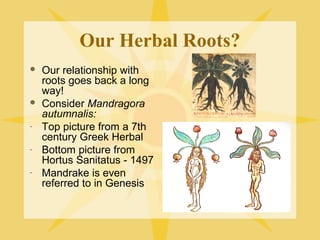
Consider Mandragora
autumnalis:
Top picture from a 7th
century Greek Herbal
Bottom picture from
Hortus Sanitatus - 1497
Mandrake is even
referred to in Genesis
When to Harvest Roots?


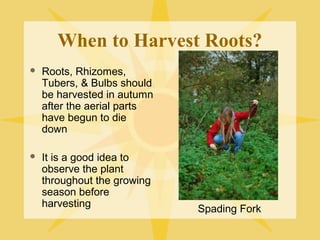
Roots, Rhizomes,
Tubers, & Bulbs should
be harvested in autumn
after the aerial parts
have begun to die
down



It is a good idea to
observe the plant
throughout the growing
season before
harvesting

Spading Fork
Proper Identification

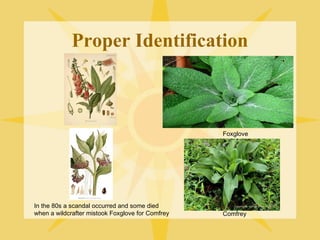
Foxglove

In the 80s a scandal occurred and some died
when a wildcrafter mistook Foxglove for Comfrey

Comfrey
Wildcrafting Ethics





Especially important
when harvesting roots!
1 in 20 rule for natives
Leave a portion of root
so the plant can return!
With ‘To Watch’ or
U.P.S. listed plants it is
better to grow them
yourself!
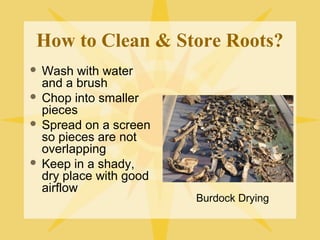
How to Clean & Store Roots?
Wash with water
and a brush
 Chop into smaller
pieces
 Spread on a screen
so pieces are not
overlapping
 Keep in a shady,
dry place with good
airflow


Burdock Drying
Storage & Use
Keep fully dried
roots in an airtight
glass container
 Use or extract
within one year to
maintain potency

What Phytochemicals are
Commonly Found in Roots?
Polysaccharides
Mucilages
Sterols
Triterpenes
Alkaloids
o

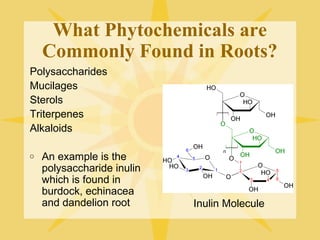
An example is the
polysaccharide inulin
which is found in
burdock, echinacea
and dandelion root

Inulin Molecule
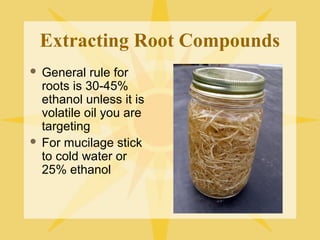
Extracting Root Compounds
General rule for
roots is 30-45%
ethanol unless it is
volatile oil you are
targeting
 For mucilage stick
to cold water or
25% ethanol

Tinctures Making is Easy!
You need at least 30% alcohol for your extraction to stay good
without refrigeration
 Everclear is about 100% alcohol so it is easy to mix with water
and get the correct percentage.
Let’s do an example:
o You plan to do a 1:5 ratio extraction in 40% alcohol (as
suggested by Tilgner’s chart - see recommended reading at
the end)
o Your container holds just over 10 ounces of liquid so you need
4 ounces of Everclear, and 6 ounces of water for 40% alcohol
o 10 ounces is = to about 300 mL so you will need 60 grams of
herb (60:300 = 1:5)
o Then just mix all the ingredients, seal the lid of the jar and
shake daily for 10-14 days until straining and pressing the
tincture out through cheesecloth.

Using Your Tincture
o

o





It is important to check out a good Herb/Drug interaction book
if you are already taking medication so you can make sure the
combination of this herb and your drug is safe! Just like
certain foods, herbs can conflict with pharmaceuticals.
When you are ready to use your tincture you will want to look
at a reliable source to find out how many grams of herb are
recommended per dose, and how many times a day you will
need to take your dose
Once you know the recommended grams of herb per dose for
your ailment, you just need to multiply that number by your mL
ratio on your tincture.
For example: It is recommended that you take 3 grams of herb
per dose, your tincture has 1 gram herb/5 mL liquid. 5 mL x 3
grams = 15 mL per dose
Missouri’s Herbal Roots

Criteria = Available - Useful - Mostly Safe
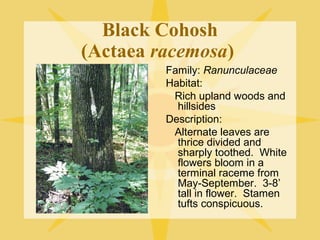
Black Cohosh
(Actaea racemosa)
Family: Ranunculaceae
Habitat:
Rich upland woods and
hillsides
Description:
Alternate leaves are
thrice divided and
sharply toothed. White
flowers bloom in a
terminal raceme from
May-September. 3-8’
tall in flower. Stamen
tufts conspicuous.
Black Cohosh
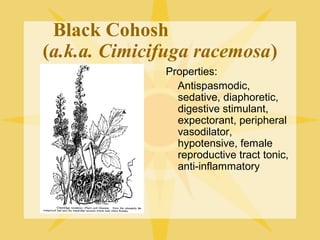
(a.k.a. Cimicifuga racemosa)
Properties:
Antispasmodic,
sedative, diaphoretic,
digestive stimulant,
expectorant, peripheral
vasodilator,
hypotensive, female
reproductive tract tonic,
anti-inflammatory
Black Cohosh
o

o

o

o
o

o

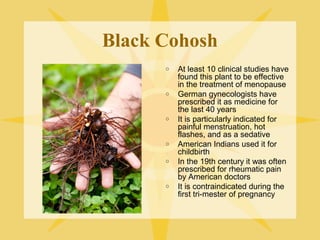
At least 10 clinical studies have
found this plant to be effective
in the treatment of menopause
German gynecologists have
prescribed it as medicine for
the last 40 years
It is particularly indicated for
painful menstruation, hot
flashes, and as a sedative
American Indians used it for
childbirth
In the 19th century it was often
prescribed for rheumatic pain
by American doctors
It is contraindicated during the
first tri-mester of pregnancy
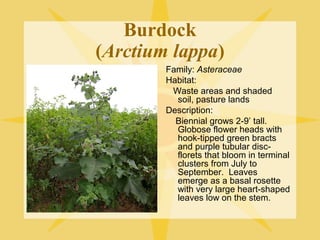
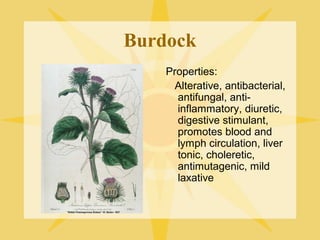
Burdock
(Arctium lappa)
Family: Asteraceae
Habitat:
Waste areas and shaded
soil, pasture lands
Description:
Biennial grows 2-9’ tall.
Globose flower heads with
hook-tipped green bracts
and purple tubular discflorets that bloom in terminal
clusters from July to
September. Leaves
emerge as a basal rosette
with very large heart-shaped
leaves low on the stem.
Burdock
Properties:
Alterative, antibacterial,
antifungal, antiinflammatory, diuretic,
digestive stimulant,
promotes blood and
lymph circulation, liver
tonic, choleretic,
antimutagenic, mild
laxative
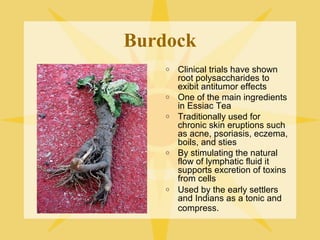
Burdock
o

o
o

o

o

Clinical trials have shown
root polysaccharides to
exibit antitumor effects
One of the main ingredients
in Essiac Tea
Traditionally used for
chronic skin eruptions such
as acne, psoriasis, eczema,
boils, and sties
By stimulating the natural
flow of lymphatic fluid it
supports excretion of toxins
from cells
Used by the early settlers
and Indians as a tonic and
compress.
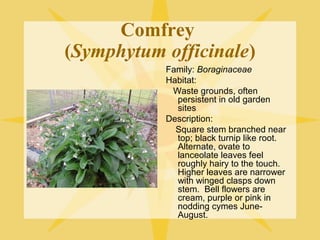
Comfrey
(Symphytum officinale)
Family: Boraginaceae
Habitat:
Waste grounds, often
persistent in old garden
sites
Description:
Square stem branched near
top; black turnip like root.
Alternate, ovate to
lanceolate leaves feel
roughly hairy to the touch.
Higher leaves are narrower
with winged clasps down
stem. Bell flowers are
cream, purple or pink in
nodding cymes JuneAugust.
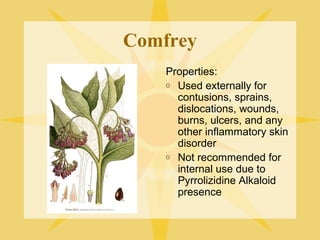
Comfrey
Properties:
o Used externally for
contusions, sprains,
dislocations, wounds,
burns, ulcers, and any
other inflammatory skin
disorder
o Not recommended for
internal use due to
Pyrrolizidine Alkaloid
presence
Comfrey
o

o

o

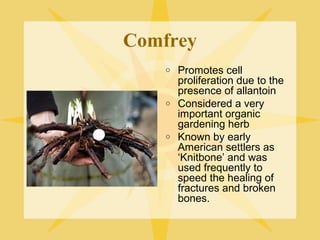
Promotes cell
proliferation due to the
presence of allantoin
Considered a very
important organic
gardening herb
Known by early
American settlers as
‘Knitbone’ and was
used frequently to
speed the healing of
fractures and broken
bones.
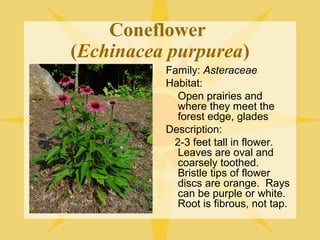
Coneflower
(Echinacea purpurea)
Family: Asteraceae
Habitat:
Open prairies and
where they meet the
forest edge, glades
Description:
2-3 feet tall in flower.
Leaves are oval and
coarsely toothed.
Bristle tips of flower
discs are orange. Rays
can be purple or white.
Root is fibrous, not tap.
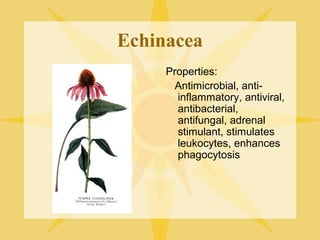
Echinacea
Properties:
Antimicrobial, antiinflammatory, antiviral,
antibacterial,
antifungal, adrenal
stimulant, stimulates
leukocytes, enhances
phagocytosis
Echinacea
o

o

o

o

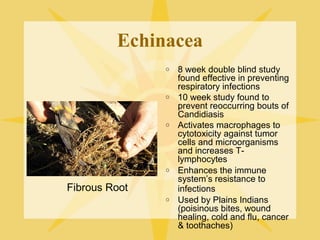
Fibrous Root
o

8 week double blind study
found effective in preventing
respiratory infections
10 week study found to
prevent reoccurring bouts of
Candidiasis
Activates macrophages to
cytotoxicity against tumor
cells and microorganisms
and increases Tlymphocytes
Enhances the immune
system’s resistance to
infections
Used by Plains Indians
(poisinous bites, wound
healing, cold and flu, cancer
& toothaches)
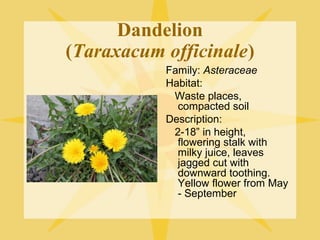
Dandelion
(Taraxacum officinale)
Family: Asteraceae
Habitat:
Waste places,
compacted soil
Description:
2-18” in height,
flowering stalk with
milky juice, leaves
jagged cut with
downward toothing.
Yellow flower from May
- September
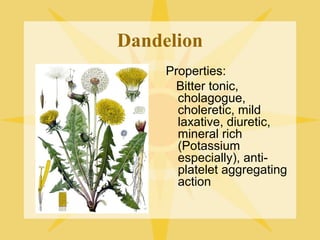
Dandelion
Properties:
Bitter tonic,
cholagogue,
choleretic, mild
laxative, diuretic,
mineral rich
(Potassium
especially), antiplatelet aggregating
action
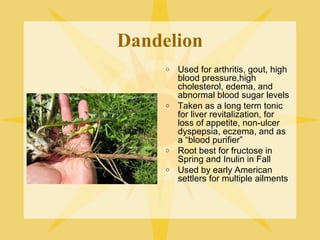
Dandelion
o

o

o
o

Used for arthritis, gout, high
blood pressure,high
cholesterol, edema, and
abnormal blood sugar levels
Taken as a long term tonic
for liver revitalization, for
loss of appetite, non-ulcer
dyspepsia, eczema, and as
a “blood purifier”
Root best for fructose in
Spring and Inulin in Fall
Used by early American
settlers for multiple ailments
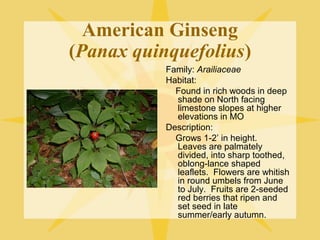
American Ginseng
(Panax quinquefolius)
Family: Arailiaceae
Habitat:
Found in rich woods in deep
shade on North facing
limestone slopes at higher
elevations in MO
Description:
Grows 1-2’ in height.
Leaves are palmately
divided, into sharp toothed,
oblong-lance shaped
leaflets. Flowers are whitish
in round umbels from June
to July. Fruits are 2-seeded
red berries that ripen and
set seed in late
summer/early autumn.
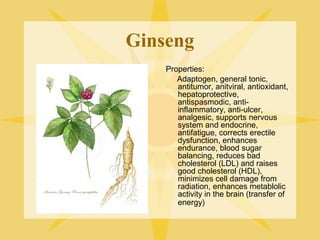
Ginseng
Properties:
Adaptogen, general tonic,
antitumor, anitviral, antioxidant,
hepatoprotective,
antispasmodic, antiinflammatory, anti-ulcer,
analgesic, supports nervous
system and endocrine,
antifatigue, corrects erectile
dysfunction, enhances
endurance, blood sugar
balancing, reduces bad
cholesterol (LDL) and raises
good cholesterol (HDL),
minimizes cell damage from
radiation, enhances metablolic
activity in the brain (transfer of
energy)
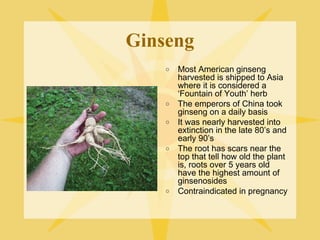
Ginseng
o

o
o

o

o

Most American ginseng
harvested is shipped to Asia
where it is considered a
‘Fountain of Youth’ herb
The emperors of China took
ginseng on a daily basis
It was nearly harvested into
extinction in the late 80’s and
early 90’s
The root has scars near the
top that tell how old the plant
is, roots over 5 years old
have the highest amount of
ginsenosides
Contraindicated in pregnancy
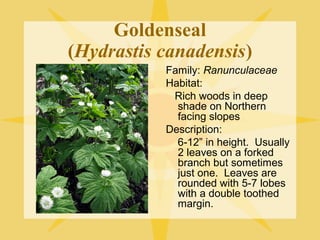
Goldenseal
(Hydrastis canadensis)
Family: Ranunculaceae
Habitat:
Rich woods in deep
shade on Northern
facing slopes
Description:
6-12” in height. Usually
2 leaves on a forked
branch but sometimes
just one. Leaves are
rounded with 5-7 lobes
with a double toothed
margin.
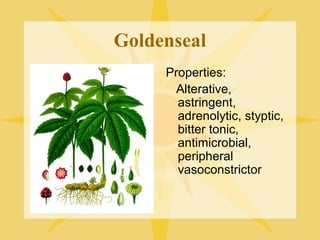
Goldenseal
Properties:
Alterative,
astringent,
adrenolytic, styptic,
bitter tonic,
antimicrobial,
peripheral
vasoconstrictor
Goldenseal
o

o
o
o

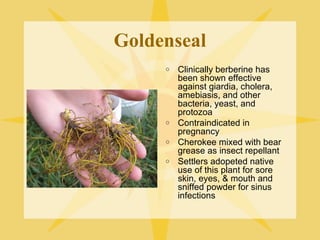
Clinically berberine has
been shown effective
against giardia, cholera,
amebiasis, and other
bacteria, yeast, and
protozoa
Contraindicated in
pregnancy
Cherokee mixed with bear
grease as insect repellant
Settlers adopeted native
use of this plant for sore
skin, eyes, & mouth and
sniffed powder for sinus
infections
Joe Pye Weed
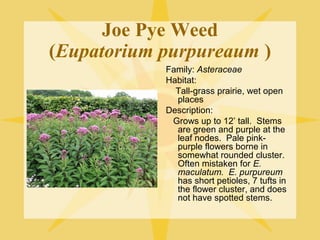
(Eupatorium purpureaum )
Family: Asteraceae
Habitat:
Tall-grass prairie, wet open
places
Description:
Grows up to 12’ tall. Stems
are green and purple at the
leaf nodes. Pale pinkpurple flowers borne in
somewhat rounded cluster.
Often mistaken for E.
maculatum. E. purpureum
has short petioles, 7 tufts in
the flower cluster, and does
not have spotted stems.
Joe Pye Weed
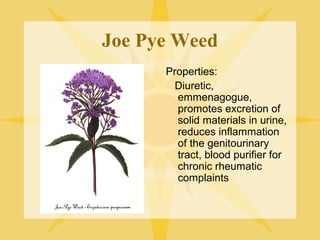
Properties:
Diuretic,
emmenagogue,
promotes excretion of
solid materials in urine,
reduces inflammation
of the genitourinary
tract, blood purifier for
chronic rheumatic
complaints
Joe Pye Weed
o

o

o
o
o

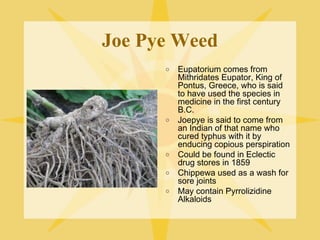
Eupatorium comes from
Mithridates Eupator, King of
Pontus, Greece, who is said
to have used the species in
medicine in the first century
B.C.
Joepye is said to come from
an Indian of that name who
cured typhus with it by
enducing copious perspiration
Could be found in Eclectic
drug stores in 1859
Chippewa used as a wash for
sore joints
May contain Pyrrolizidine
Alkaloids
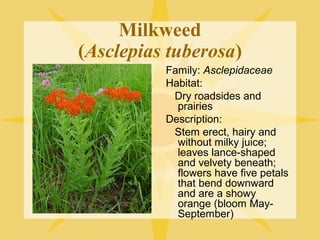
Milkweed
(Asclepias tuberosa)
Family: Asclepidaceae
Habitat:
Dry roadsides and
prairies
Description:
Stem erect, hairy and
without milky juice;
leaves lance-shaped
and velvety beneath;
flowers have five petals
that bend downward
and are a showy
orange (bloom MaySeptember)
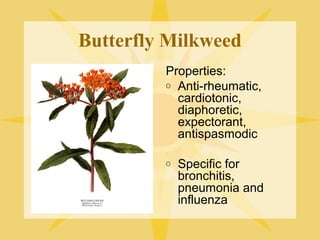
Butterfly Milkweed
Properties:
o Anti-rheumatic,
cardiotonic,
diaphoretic,
expectorant,
antispasmodic
o

Specific for
bronchitis,
pneumonia and
influenza
Butterfly Milkweed
o

o

o

o

o

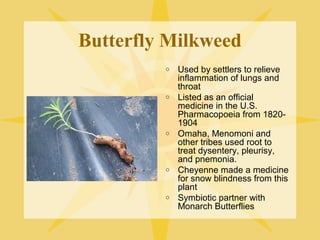
Used by settlers to relieve
inflammation of lungs and
throat
Listed as an official
medicine in the U.S.
Pharmacopoeia from 18201904
Omaha, Menomoni and
other tribes used root to
treat dysentery, pleurisy,
and pnemonia.
Cheyenne made a medicine
for snow blindness from this
plant
Symbiotic partner with
Monarch Butterflies
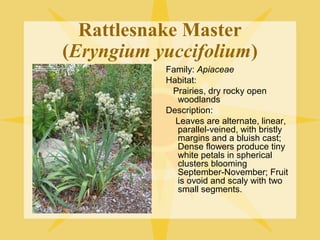
Rattlesnake Master
(Eryngium yuccifolium)
Family: Apiaceae
Habitat:
Prairies, dry rocky open
woodlands
Description:
Leaves are alternate, linear,
parallel-veined, with bristly
margins and a bluish cast;
Dense flowers produce tiny
white petals in spherical
clusters blooming
September-November; Fruit
is ovoid and scaly with two
small segments.
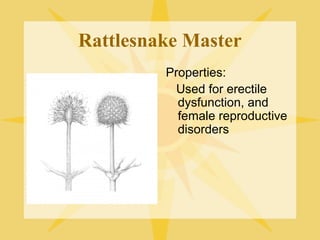
Rattlesnake Master
Properties:
Used for erectile
dysfunction, and
female reproductive
disorders
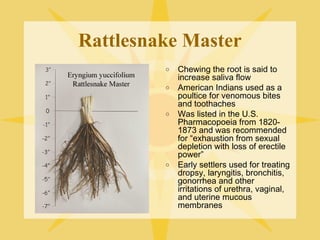
Rattlesnake Master
o
o

o

o

Chewing the root is said to
increase saliva flow
American Indians used as a
poultice for venomous bites
and toothaches
Was listed in the U.S.
Pharmacopoeia from 18201873 and was recommended
for “exhaustion from sexual
depletion with loss of erectile
power”
Early settlers used for treating
dropsy, laryngitis, bronchitis,
gonorrhea and other
irritations of urethra, vaginal,
and uterine mucous
membranes
A Few Left Out















Sassafras (Sassafras albidum)
Hydrangea (Hydrangea arborescens)
Wild Yam (Dioscorea villosa)
Plantain (Plantago lanceolata)
Yellow Dock (Rumex crispus)
Sarsasparilla (Smilax racemosa)
Sweet Cicely (Osmorhiza spp.)
Bloodroot (Sanguinaria canadensis)
Wild Geranium (Geranium maculata)
May Apple (Podophyllum peltatum)
Wild Ginger (Asaurum canadensis)
Snakeroot (Arisaema spp.)
Blue Cohosh (Caulophyllum thalictroides)
Chicory (Cichorium intybus)

Our Herbal Roots - Presentation by Brigitte Zettl

  • 1.
  • 2.
    Our Herbal Roots?   - Ourrelationship with roots goes back a long way! Consider Mandragora autumnalis: Top picture from a 7th century Greek Herbal Bottom picture from Hortus Sanitatus - 1497 Mandrake is even referred to in Genesis
  • 3.
    When to HarvestRoots?  Roots, Rhizomes, Tubers, & Bulbs should be harvested in autumn after the aerial parts have begun to die down  It is a good idea to observe the plant throughout the growing season before harvesting Spading Fork
  • 4.
    Proper Identification Foxglove In the80s a scandal occurred and some died when a wildcrafter mistook Foxglove for Comfrey Comfrey
  • 5.
    Wildcrafting Ethics     Especially important whenharvesting roots! 1 in 20 rule for natives Leave a portion of root so the plant can return! With ‘To Watch’ or U.P.S. listed plants it is better to grow them yourself!
  • 6.
    How to Clean& Store Roots? Wash with water and a brush  Chop into smaller pieces  Spread on a screen so pieces are not overlapping  Keep in a shady, dry place with good airflow  Burdock Drying
  • 7.
    Storage & Use Keepfully dried roots in an airtight glass container  Use or extract within one year to maintain potency 
  • 8.
    What Phytochemicals are CommonlyFound in Roots? Polysaccharides Mucilages Sterols Triterpenes Alkaloids o An example is the polysaccharide inulin which is found in burdock, echinacea and dandelion root Inulin Molecule
  • 9.
    Extracting Root Compounds Generalrule for roots is 30-45% ethanol unless it is volatile oil you are targeting  For mucilage stick to cold water or 25% ethanol 
  • 10.
    Tinctures Making isEasy! You need at least 30% alcohol for your extraction to stay good without refrigeration  Everclear is about 100% alcohol so it is easy to mix with water and get the correct percentage. Let’s do an example: o You plan to do a 1:5 ratio extraction in 40% alcohol (as suggested by Tilgner’s chart - see recommended reading at the end) o Your container holds just over 10 ounces of liquid so you need 4 ounces of Everclear, and 6 ounces of water for 40% alcohol o 10 ounces is = to about 300 mL so you will need 60 grams of herb (60:300 = 1:5) o Then just mix all the ingredients, seal the lid of the jar and shake daily for 10-14 days until straining and pressing the tincture out through cheesecloth. 
  • 11.
    Using Your Tincture o o   Itis important to check out a good Herb/Drug interaction book if you are already taking medication so you can make sure the combination of this herb and your drug is safe! Just like certain foods, herbs can conflict with pharmaceuticals. When you are ready to use your tincture you will want to look at a reliable source to find out how many grams of herb are recommended per dose, and how many times a day you will need to take your dose Once you know the recommended grams of herb per dose for your ailment, you just need to multiply that number by your mL ratio on your tincture. For example: It is recommended that you take 3 grams of herb per dose, your tincture has 1 gram herb/5 mL liquid. 5 mL x 3 grams = 15 mL per dose
  • 12.
    Missouri’s Herbal Roots Criteria= Available - Useful - Mostly Safe
  • 13.
    Black Cohosh (Actaea racemosa) Family:Ranunculaceae Habitat: Rich upland woods and hillsides Description: Alternate leaves are thrice divided and sharply toothed. White flowers bloom in a terminal raceme from May-September. 3-8’ tall in flower. Stamen tufts conspicuous.
  • 14.
    Black Cohosh (a.k.a. Cimicifugaracemosa) Properties: Antispasmodic, sedative, diaphoretic, digestive stimulant, expectorant, peripheral vasodilator, hypotensive, female reproductive tract tonic, anti-inflammatory
  • 15.
    Black Cohosh o o o o o o At least10 clinical studies have found this plant to be effective in the treatment of menopause German gynecologists have prescribed it as medicine for the last 40 years It is particularly indicated for painful menstruation, hot flashes, and as a sedative American Indians used it for childbirth In the 19th century it was often prescribed for rheumatic pain by American doctors It is contraindicated during the first tri-mester of pregnancy
  • 16.
    Burdock (Arctium lappa) Family: Asteraceae Habitat: Wasteareas and shaded soil, pasture lands Description: Biennial grows 2-9’ tall. Globose flower heads with hook-tipped green bracts and purple tubular discflorets that bloom in terminal clusters from July to September. Leaves emerge as a basal rosette with very large heart-shaped leaves low on the stem.
  • 17.
    Burdock Properties: Alterative, antibacterial, antifungal, antiinflammatory,diuretic, digestive stimulant, promotes blood and lymph circulation, liver tonic, choleretic, antimutagenic, mild laxative
  • 18.
    Burdock o o o o o Clinical trials haveshown root polysaccharides to exibit antitumor effects One of the main ingredients in Essiac Tea Traditionally used for chronic skin eruptions such as acne, psoriasis, eczema, boils, and sties By stimulating the natural flow of lymphatic fluid it supports excretion of toxins from cells Used by the early settlers and Indians as a tonic and compress.
  • 19.
    Comfrey (Symphytum officinale) Family: Boraginaceae Habitat: Wastegrounds, often persistent in old garden sites Description: Square stem branched near top; black turnip like root. Alternate, ovate to lanceolate leaves feel roughly hairy to the touch. Higher leaves are narrower with winged clasps down stem. Bell flowers are cream, purple or pink in nodding cymes JuneAugust.
  • 20.
    Comfrey Properties: o Used externallyfor contusions, sprains, dislocations, wounds, burns, ulcers, and any other inflammatory skin disorder o Not recommended for internal use due to Pyrrolizidine Alkaloid presence
  • 21.
    Comfrey o o o Promotes cell proliferation dueto the presence of allantoin Considered a very important organic gardening herb Known by early American settlers as ‘Knitbone’ and was used frequently to speed the healing of fractures and broken bones.
  • 22.
    Coneflower (Echinacea purpurea) Family: Asteraceae Habitat: Openprairies and where they meet the forest edge, glades Description: 2-3 feet tall in flower. Leaves are oval and coarsely toothed. Bristle tips of flower discs are orange. Rays can be purple or white. Root is fibrous, not tap.
  • 23.
    Echinacea Properties: Antimicrobial, antiinflammatory, antiviral, antibacterial, antifungal,adrenal stimulant, stimulates leukocytes, enhances phagocytosis
  • 24.
    Echinacea o o o o Fibrous Root o 8 weekdouble blind study found effective in preventing respiratory infections 10 week study found to prevent reoccurring bouts of Candidiasis Activates macrophages to cytotoxicity against tumor cells and microorganisms and increases Tlymphocytes Enhances the immune system’s resistance to infections Used by Plains Indians (poisinous bites, wound healing, cold and flu, cancer & toothaches)
  • 25.
    Dandelion (Taraxacum officinale) Family: Asteraceae Habitat: Wasteplaces, compacted soil Description: 2-18” in height, flowering stalk with milky juice, leaves jagged cut with downward toothing. Yellow flower from May - September
  • 26.
    Dandelion Properties: Bitter tonic, cholagogue, choleretic, mild laxative,diuretic, mineral rich (Potassium especially), antiplatelet aggregating action
  • 27.
    Dandelion o o o o Used for arthritis,gout, high blood pressure,high cholesterol, edema, and abnormal blood sugar levels Taken as a long term tonic for liver revitalization, for loss of appetite, non-ulcer dyspepsia, eczema, and as a “blood purifier” Root best for fructose in Spring and Inulin in Fall Used by early American settlers for multiple ailments
  • 28.
    American Ginseng (Panax quinquefolius) Family:Arailiaceae Habitat: Found in rich woods in deep shade on North facing limestone slopes at higher elevations in MO Description: Grows 1-2’ in height. Leaves are palmately divided, into sharp toothed, oblong-lance shaped leaflets. Flowers are whitish in round umbels from June to July. Fruits are 2-seeded red berries that ripen and set seed in late summer/early autumn.
  • 29.
    Ginseng Properties: Adaptogen, general tonic, antitumor,anitviral, antioxidant, hepatoprotective, antispasmodic, antiinflammatory, anti-ulcer, analgesic, supports nervous system and endocrine, antifatigue, corrects erectile dysfunction, enhances endurance, blood sugar balancing, reduces bad cholesterol (LDL) and raises good cholesterol (HDL), minimizes cell damage from radiation, enhances metablolic activity in the brain (transfer of energy)
  • 30.
    Ginseng o o o o o Most American ginseng harvestedis shipped to Asia where it is considered a ‘Fountain of Youth’ herb The emperors of China took ginseng on a daily basis It was nearly harvested into extinction in the late 80’s and early 90’s The root has scars near the top that tell how old the plant is, roots over 5 years old have the highest amount of ginsenosides Contraindicated in pregnancy
  • 31.
    Goldenseal (Hydrastis canadensis) Family: Ranunculaceae Habitat: Richwoods in deep shade on Northern facing slopes Description: 6-12” in height. Usually 2 leaves on a forked branch but sometimes just one. Leaves are rounded with 5-7 lobes with a double toothed margin.
  • 32.
  • 33.
    Goldenseal o o o o Clinically berberine has beenshown effective against giardia, cholera, amebiasis, and other bacteria, yeast, and protozoa Contraindicated in pregnancy Cherokee mixed with bear grease as insect repellant Settlers adopeted native use of this plant for sore skin, eyes, & mouth and sniffed powder for sinus infections
  • 34.
    Joe Pye Weed (Eupatoriumpurpureaum ) Family: Asteraceae Habitat: Tall-grass prairie, wet open places Description: Grows up to 12’ tall. Stems are green and purple at the leaf nodes. Pale pinkpurple flowers borne in somewhat rounded cluster. Often mistaken for E. maculatum. E. purpureum has short petioles, 7 tufts in the flower cluster, and does not have spotted stems.
  • 35.
    Joe Pye Weed Properties: Diuretic, emmenagogue, promotesexcretion of solid materials in urine, reduces inflammation of the genitourinary tract, blood purifier for chronic rheumatic complaints
  • 36.
    Joe Pye Weed o o o o o Eupatoriumcomes from Mithridates Eupator, King of Pontus, Greece, who is said to have used the species in medicine in the first century B.C. Joepye is said to come from an Indian of that name who cured typhus with it by enducing copious perspiration Could be found in Eclectic drug stores in 1859 Chippewa used as a wash for sore joints May contain Pyrrolizidine Alkaloids
  • 37.
    Milkweed (Asclepias tuberosa) Family: Asclepidaceae Habitat: Dryroadsides and prairies Description: Stem erect, hairy and without milky juice; leaves lance-shaped and velvety beneath; flowers have five petals that bend downward and are a showy orange (bloom MaySeptember)
  • 38.
  • 39.
    Butterfly Milkweed o o o o o Used bysettlers to relieve inflammation of lungs and throat Listed as an official medicine in the U.S. Pharmacopoeia from 18201904 Omaha, Menomoni and other tribes used root to treat dysentery, pleurisy, and pnemonia. Cheyenne made a medicine for snow blindness from this plant Symbiotic partner with Monarch Butterflies
  • 40.
    Rattlesnake Master (Eryngium yuccifolium) Family:Apiaceae Habitat: Prairies, dry rocky open woodlands Description: Leaves are alternate, linear, parallel-veined, with bristly margins and a bluish cast; Dense flowers produce tiny white petals in spherical clusters blooming September-November; Fruit is ovoid and scaly with two small segments.
  • 41.
    Rattlesnake Master Properties: Used forerectile dysfunction, and female reproductive disorders
  • 42.
    Rattlesnake Master o o o o Chewing theroot is said to increase saliva flow American Indians used as a poultice for venomous bites and toothaches Was listed in the U.S. Pharmacopoeia from 18201873 and was recommended for “exhaustion from sexual depletion with loss of erectile power” Early settlers used for treating dropsy, laryngitis, bronchitis, gonorrhea and other irritations of urethra, vaginal, and uterine mucous membranes
  • 43.
    A Few LeftOut               Sassafras (Sassafras albidum) Hydrangea (Hydrangea arborescens) Wild Yam (Dioscorea villosa) Plantain (Plantago lanceolata) Yellow Dock (Rumex crispus) Sarsasparilla (Smilax racemosa) Sweet Cicely (Osmorhiza spp.) Bloodroot (Sanguinaria canadensis) Wild Geranium (Geranium maculata) May Apple (Podophyllum peltatum) Wild Ginger (Asaurum canadensis) Snakeroot (Arisaema spp.) Blue Cohosh (Caulophyllum thalictroides) Chicory (Cichorium intybus)

Editor's Notes

  • #3 Top picture from Naples Dioscurides a 7th Century Greek Herbal Lower illustration from Hortus Sanitatus 1497 Referenced in the book of Genesis as a means to remove sterility Used in the days of Pliny as a surgical anesthetic Was said to utter such shrieks and groans upon being dug that anyone who heard would die (dog’s tail)
  • #5 Digitalis vs. Comfrey…a deadly mistake
  • #13 Criteria - available, useful, mostly safe