The Russian Revolution  By 1915 Russia is in trouble  2 million soldiers killed or wounded  Food shortages people blame Czar as they had done in the past  Legislature set up after 1905 (Duma) has no real power ~ Czar refuses advice
Impact of  World War I  Czar Nicholas II goes to the front  Czarina Alexandra left in charge; relies upon  Rasputin ’s advice
Rasputin   Holy man and healer  Claimed ability to cure son Alexei’s hemophilia {in reality used hypnosis}  Held influence over Czar and Czarina  Influence=danger; Rasputin killed in 1916 by czar’s nephew


The Russian Revolution: 1917   The March [February] Uprising: Women  in  Petrograd  Protest  Bread Shortages    Touches off  Protest  of  300,000 Workers  Demanding The  Overthrow of the Monarchy  Troops  Fire on the  Crowd  of  Protesters  Czar  abdicates ;  revolutionary socialists   set up   Soviets    The  Czar  and His Family Are  Placed Under Arrest
Soviets = councils of workers and soldiers
The Russian Revolution: 1917  New government continues war against Germany
The Russian Revolution: 1917  New government continues war against Germany  Vladimir Lenin returns to Russia in April  Lenin and followers, the Bolsheviks (majority), start second revolution; Promise “Peace, Land, Bread” and win control of government in November 1917.
Vladimir Lenin ~ Notes  Had been exiled to Switzerland for spreading Marxist ideas to factory workers  Older brother hanged for trying to kill Alexander III
Vladimir Lenin ~ More Notes Lenin returns from Switzerland with German assistance and issues his  April theses (Peace, Land, Bread) This called for  Overthrow of Government End to war Soviets to form new government  Land given to peasants State to control factories and banks
 
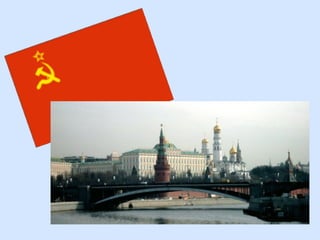
Lenin’s Russia: 1917-1924  The Bolsheviks took control of the government in an almost bloodless coup between November 8-11, 1917.  Lenin is assisted by Leon Trotsky; forces = “Red Guard” attack, take over provisional gov’t, then take over other cities, Moscow becomes capital, Kremlin = HQ  New Flag = Red w/ hammer and sickle to symbolize union between workers and peasants; “Bolsheviks”  “Communist”  Lenin adapts Marxist ideas to Russian conditions “dictatorship of the proletariat"
 
Dictatorship of the Proletariat 1848 Karl Marx wrote   The Communist Manifesto  Marx called upon factory workers (proletariat) to rise against factory owners (bourgeoisie) and take control of factory production.  Russia doesn’t have much industry so Lenin called for an elite group to lead the revolution and set up a  dictatorship of the proletariat
Lenin’s Russia: 1917-1924 November 19: Bolsheviks Call for an Immediate Armistice On All Fronts   December 1: Bolsheviks meet With Central Powers at Brest-Litovsk    December 15: Russia and the Central Powers declare a cease fire
The Treaty of Brest Litovsk  Russia lost more than 300,000 square miles of territory   The treaty helped to establish [for the time being,] the independence of Estonia, Finland, Latvia , Lithuania and Poland.
Lenin’s Russia: 1917-1924 November 19: Bolsheviks Call for an Immediate Armistice On All Fronts   December 1: Bolsheviks meet With Central Powers at Brest-Litovsk    December 15: Russia and the Central Powers declare a cease fire  Russia’s loss of lands  Civil War: Reds vs. Whites (counter revolutionaries loyal to czar); Allies support Whites (roused Russian nationalism); Japan seizes land in East Asia; Czar and family murdered; Trotsky “every 10th man in army killed for poor performance”
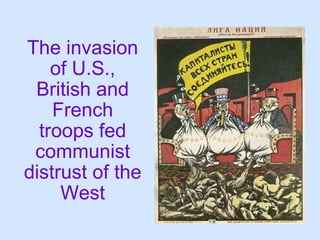
The invasion of U.S., British and French troops fed communist distrust of the West
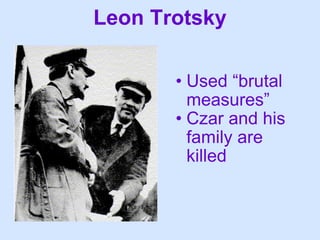
Leon Trotsky Used “brutal measures” Czar and his family are killed
From Lenin to Stalin: 1924-1939  By 1921 Communists defeated all foes; Russia in chaos; Lenin rebuilding  creates constitution, legislature “Supreme Soviet;” Most of old empire USSR; economic recovery=NEP; foreign policy=Comintern
Rebuilding = immense job Economy = in ruins; prices 10x higher than before WWI “ Supreme Soviet” elected by anyone over 18 USSR = Union of Soviet Socialist Republics NEP = “New Economic Policy” allowed for some capitalism (banks were gov’t owned, but some small businesses could make profit) Comintern = “Communist International” to aid revolutionary groups around the world and encourage colonial people to rise up against imperial powers
From Lenin to Stalin: 1924-1939  By 1921 Communists defeated all foes; Russia in chaos; Lenin rebuilding  creates constitution, legislature “Supreme Soviet;” Most of old empire USSR; economic recovery=NEP; foreign policy=Comintern Lenin dies suddenly in 1924    Trotsky vs. Stalin*
Lenin’s body displayed for 65 years Stalin – had changed name to  “ man of steel”  (from Djugashvili)
From Lenin to Stalin: 1924-1939  By 1921 Communists defeated all foes; Russia in chaos; Lenin rebuilding  creates constitution, legislature “Supreme Soviet;” Most of old empire USSR; economic recovery=NEP; foreign policy=Comintern Lenin dies suddenly in 1924    Trotsky vs. Stalin*    Stalin’s goal = Soviet Union as industrial power: Several “five-year plans;” command economy; production grows (machinery not consumer goods); collective farming; standard of living remains poor
5-year plans take USSR back to real communism Command economy = government officials make all economic decisions Collective farming – large farms owned and operated by peasants as a group; the state sets prices and supplies
From Lenin to Stalin: 1924-1939  By 1921 Communists defeated all foes; Russia in chaos; Lenin rebuilding  creates constitution, legislature “Supreme Soviet;” Most of old empire USSR; economic recovery=NEP; foreign policy=Comintern Lenin dies suddenly in 1924    Trotsky vs. Stalin*    Stalin’s goal = Soviet Union as industrial power: Several “five-year plans;” command economy; production grows (machinery not consumer goods); collective farming; standard of living remains poor  Ruthless policy, kulaks targeted;  Great Purge  1934: secret police crack down on opponents    labor camps in Siberia, execution 800,000 of 4 million “purged”  Propaganda, war on religion maintains totalitarian state
Kulaks = wealthy peasants; many sent to Siberia or killed in “Great Purge” Secret police =  Cheka Propaganda against capitalism leads to  Red Scare  in U.S. in 1920s

Russian Revolution-Presentation no animation

  • 1.
    The Russian Revolution By 1915 Russia is in trouble  2 million soldiers killed or wounded  Food shortages people blame Czar as they had done in the past  Legislature set up after 1905 (Duma) has no real power ~ Czar refuses advice
  • 2.
    Impact of World War I  Czar Nicholas II goes to the front  Czarina Alexandra left in charge; relies upon Rasputin ’s advice
  • 3.
    Rasputin Holy man and healer  Claimed ability to cure son Alexei’s hemophilia {in reality used hypnosis}  Held influence over Czar and Czarina  Influence=danger; Rasputin killed in 1916 by czar’s nephew
  • 4.
  • 5.
  • 6.
  • 7.
    The Russian Revolution:1917  The March [February] Uprising: Women in Petrograd Protest Bread Shortages  Touches off Protest of 300,000 Workers Demanding The Overthrow of the Monarchy  Troops Fire on the Crowd of Protesters  Czar abdicates ; revolutionary socialists set up Soviets  The Czar and His Family Are Placed Under Arrest
  • 8.
    Soviets = councilsof workers and soldiers
  • 9.
    The Russian Revolution:1917  New government continues war against Germany
  • 10.
    The Russian Revolution:1917  New government continues war against Germany  Vladimir Lenin returns to Russia in April  Lenin and followers, the Bolsheviks (majority), start second revolution; Promise “Peace, Land, Bread” and win control of government in November 1917.
  • 11.
    Vladimir Lenin ~Notes  Had been exiled to Switzerland for spreading Marxist ideas to factory workers  Older brother hanged for trying to kill Alexander III
  • 12.
    Vladimir Lenin ~More Notes Lenin returns from Switzerland with German assistance and issues his April theses (Peace, Land, Bread) This called for Overthrow of Government End to war Soviets to form new government Land given to peasants State to control factories and banks
  • 13.
  • 14.
    Lenin’s Russia: 1917-1924 The Bolsheviks took control of the government in an almost bloodless coup between November 8-11, 1917.  Lenin is assisted by Leon Trotsky; forces = “Red Guard” attack, take over provisional gov’t, then take over other cities, Moscow becomes capital, Kremlin = HQ  New Flag = Red w/ hammer and sickle to symbolize union between workers and peasants; “Bolsheviks”  “Communist”  Lenin adapts Marxist ideas to Russian conditions “dictatorship of the proletariat"
  • 15.
  • 16.
    Dictatorship of theProletariat 1848 Karl Marx wrote The Communist Manifesto  Marx called upon factory workers (proletariat) to rise against factory owners (bourgeoisie) and take control of factory production.  Russia doesn’t have much industry so Lenin called for an elite group to lead the revolution and set up a  dictatorship of the proletariat
  • 17.
    Lenin’s Russia: 1917-1924November 19: Bolsheviks Call for an Immediate Armistice On All Fronts  December 1: Bolsheviks meet With Central Powers at Brest-Litovsk  December 15: Russia and the Central Powers declare a cease fire
  • 18.
    The Treaty ofBrest Litovsk  Russia lost more than 300,000 square miles of territory  The treaty helped to establish [for the time being,] the independence of Estonia, Finland, Latvia , Lithuania and Poland.
  • 19.
    Lenin’s Russia: 1917-1924November 19: Bolsheviks Call for an Immediate Armistice On All Fronts  December 1: Bolsheviks meet With Central Powers at Brest-Litovsk  December 15: Russia and the Central Powers declare a cease fire  Russia’s loss of lands  Civil War: Reds vs. Whites (counter revolutionaries loyal to czar); Allies support Whites (roused Russian nationalism); Japan seizes land in East Asia; Czar and family murdered; Trotsky “every 10th man in army killed for poor performance”
  • 20.
    The invasion ofU.S., British and French troops fed communist distrust of the West
  • 21.
    Leon Trotsky Used“brutal measures” Czar and his family are killed
  • 22.
    From Lenin toStalin: 1924-1939  By 1921 Communists defeated all foes; Russia in chaos; Lenin rebuilding  creates constitution, legislature “Supreme Soviet;” Most of old empire USSR; economic recovery=NEP; foreign policy=Comintern
  • 23.
    Rebuilding = immensejob Economy = in ruins; prices 10x higher than before WWI “ Supreme Soviet” elected by anyone over 18 USSR = Union of Soviet Socialist Republics NEP = “New Economic Policy” allowed for some capitalism (banks were gov’t owned, but some small businesses could make profit) Comintern = “Communist International” to aid revolutionary groups around the world and encourage colonial people to rise up against imperial powers
  • 24.
    From Lenin toStalin: 1924-1939  By 1921 Communists defeated all foes; Russia in chaos; Lenin rebuilding  creates constitution, legislature “Supreme Soviet;” Most of old empire USSR; economic recovery=NEP; foreign policy=Comintern Lenin dies suddenly in 1924  Trotsky vs. Stalin*
  • 25.
    Lenin’s body displayedfor 65 years Stalin – had changed name to “ man of steel” (from Djugashvili)
  • 26.
    From Lenin toStalin: 1924-1939  By 1921 Communists defeated all foes; Russia in chaos; Lenin rebuilding  creates constitution, legislature “Supreme Soviet;” Most of old empire USSR; economic recovery=NEP; foreign policy=Comintern Lenin dies suddenly in 1924  Trotsky vs. Stalin*  Stalin’s goal = Soviet Union as industrial power: Several “five-year plans;” command economy; production grows (machinery not consumer goods); collective farming; standard of living remains poor
  • 27.
    5-year plans takeUSSR back to real communism Command economy = government officials make all economic decisions Collective farming – large farms owned and operated by peasants as a group; the state sets prices and supplies
  • 28.
    From Lenin toStalin: 1924-1939  By 1921 Communists defeated all foes; Russia in chaos; Lenin rebuilding  creates constitution, legislature “Supreme Soviet;” Most of old empire USSR; economic recovery=NEP; foreign policy=Comintern Lenin dies suddenly in 1924  Trotsky vs. Stalin*  Stalin’s goal = Soviet Union as industrial power: Several “five-year plans;” command economy; production grows (machinery not consumer goods); collective farming; standard of living remains poor  Ruthless policy, kulaks targeted; Great Purge 1934: secret police crack down on opponents  labor camps in Siberia, execution 800,000 of 4 million “purged”  Propaganda, war on religion maintains totalitarian state
  • 29.
    Kulaks = wealthypeasants; many sent to Siberia or killed in “Great Purge” Secret police = Cheka Propaganda against capitalism leads to Red Scare in U.S. in 1920s