 Rum is a distilled alcoholic beverage made
from sugarcane byproducts, such as molasses,
or directly from sugarcane juice, by a process of
fermentation and distillation. The distillate, a
clear liquid, is then usually aged in oak barrels.
 Manual Harvesting
 In many countries even today harvesting is
done manually using various types of hand
knives or hand axes.Among the several tools
the cutting blade is usually heavier and
facilitates easier and efficient cutting of cane.

 Manual harvesting requires skilled labourers as
improper harvest of cane leads to loss of cane
& sugar yield, poor juice quality and problems
in milling due to extraneous matter
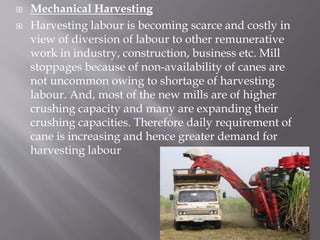
 Mechanical Harvesting
 Harvesting labour is becoming scarce and costly in
view of diversion of labour to other remunerative
work in industry, construction, business etc. Mill
stoppages because of non-availability of canes are
not uncommon owing to shortage of harvesting
labour. And, most of the new mills are of higher
crushing capacity and many are expanding their
crushing capacities. Therefore daily requirement of
cane is increasing and hence greater demand for
harvesting labour
 Juice extraction by milling is the process of
squeezing the juice from the cane under high
pressure between heavy iron rollers. Cane
diffusion is the process of leeching the juice
from the cane by repeatedly wasing the cane
with water and low concentration cane juice
 As with all other aspects of rum production, no
standard method is used for distillation. While
some producers work in batches using pot
stills, most rum production is done using
column still distillation. Pot still output
contains more congeners than the output from
column stills, so produces fuller-tasting rums.
 Many countries require rum to be aged for at least one year. This
aging is commonly performed in used bourbon casks, but may
also be performed in other types of wooden casks or stainless steel
tanks. The aging process determines the color of the rum. When
aged in oak casks, it becomes dark, whereas rum aged in stainless
steel tanks remains virtually colorless.
 Due to the tropical climate common to most rum-producing areas,
rum matures at a much higher rate than is typical for whisky or
brandy. An indication of this higher rate is the angels' share, or
amount of product lost to evaporation. While products aged in
France or Scotland see about 2% loss each year, tropical rum
producers may see as much as 10%.
 After aging, rum is normally blended to ensure a consistent flavor.
Blending is the final step in the rum-making process. As part of
this blending process, light rums may be filtered to remove any
color gained during aging. For darker rums, caramel may be
added to adjust the color of the final product.
 Sugarcane is harvested to make sugarcane juice
and molasses.
 Yeast and water are added to the base
ingredient to start the fermentation process.
While some rum producers allow wild yeasts
to perform the fermentation, most use specific
strains of yeast to help provide a consistent
taste and predictable fermentation time.
 Dark rums, also known by their particular color, such as brown, black, or red
rums, are classes a grade darker than gold rums. They are usually made from
caramelized sugar or molasses. They are generally aged longer, in heavily
charred barrels, giving them much stronger flavors than either light or gold
rums, and hints of spices can be detected, along with a strong molasses or
caramel overtone. They commonly provide substance in rum drinks, as well as
color. In addition, dark rum is the type most commonly used in cooking. Most
dark rums come from areas such as Jamaica, Haiti, and Martinique.
 Flavored rums are infused with flavors of fruits, such as banana, mango,
orange, citrus, coconut, starfruit or lime. These are generally less than 40%
ABV [80 proof]. They mostly serve to flavor similarly-themed tropical drinks
but are also often drunk neat or with ice.
 Gold rums, also called "amber" rums, are medium-bodied rums that are
generally aged. These gain their dark color from aging in wooden barrels
(usually the charred, white oak barrels that are the byproduct of Bourbon
whiskey). They have more flavor and are stronger-tasting than light rum, and
can be considered midway between light rum and the darker varieties.
 Light rums, also referred to as "silver" or "white" rums, in general, have very little
flavor aside from a general sweetness. Light rums are sometimes filtered after
aging to remove any color. The Brazilian cachaça is generally this type, but some
varieties are more akin to "gold rums". The majority of light rums come from
Puerto Rico. Their milder flavors make them popular for use in mixed drinks, as
opposed to drinking them straight.
 Overproof rums are much higher than the standard 40% ABV [80 proof], with
many as high as 75% [150 proof] to 80% [160 proof] available. One example is
Bacardi 151 or Pitorro moonshine. They are usually used in mixed drinks.
 Premium rums, as with other sipping spirits such as Cognac and Scotch, are in a
special market category. These are generally from boutique brands that sell
carefully produced and aged rums. They have more character and flavor than their
"mixing" counterparts and are generally consumed straight.
 Spiced rums obtain their flavors through the addition of spices and, sometimes,
caramel. Most are darker in color, and based on gold rums. Some are significantly
darker, while many cheaper brands are made from inexpensive white rums and
darkened with caramel.
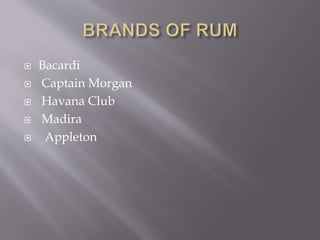
 Bacardi
 Captain Morgan
 Havana Club
 Madira
 Appleton
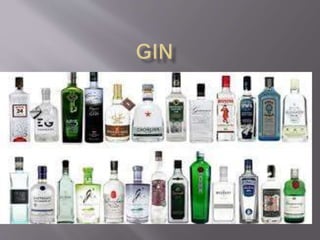
 Another style of gin, and history says it’s the
first style, is the Dutch Genever. Rather than
starting with a neutral grain spirit, a genever
starts with a malted grain mash, more like
whiskey. The process lends itself to barrel-
aging, whereas making English gins is a very
quick process, sometimes taking no longer than
a day. The soft yellow spirit has been making a
comeback lately.
 1. London Dry Gin
The one that is most familiar as “gin” and most
widely available is a style called London Dry Gin.
Curiously, a London Dry does not have to be made
in London, instead it’s defined by getting its
juniper flavor from neutral spirits (grain alcohol)
re-distilled with botanicals, with nothing added
after the re-distillation process. Some cocktail
historians and purveyors of urban cocktail legend
say that the origin of the expression “dry martini”
comes not from the amount of vermouth added to
the cocktail, but from a shortening of the request
for a “London Dry Martini.”
 3. Old Tom
Old Tom gin is yet another style that has fallen
out of favor, and production, until recently.
Old Toms are characterized by sugar in the re-
distillation process that makes them sweeter
than a London Dry.

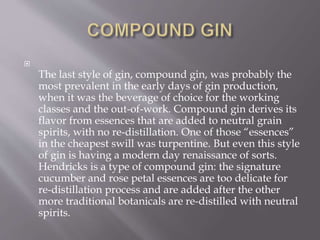
The last style of gin, compound gin, was probably the
most prevalent in the early days of gin production,
when it was the beverage of choice for the working
classes and the out-of-work. Compound gin derives its
flavor from essences that are added to neutral grain
spirits, with no re-distillation. One of those “essences”
in the cheapest swill was turpentine. But even this style
of gin is having a modern day renaissance of sorts.
Hendricks is a type of compound gin: the signature
cucumber and rose petal essences are too delicate for
re-distillation process and are added after the other
more traditional botanicals are re-distilled with neutral
spirits.
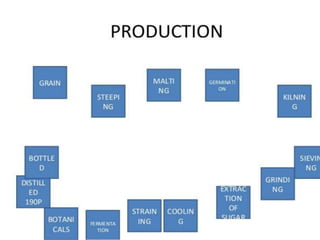
 SELECTING THE GRAIN
 We source our grain through Farm.harvest the
most consistent high quality grains.
 MASHING
 The grain is milled at fine consistency before
mashing.
 Hot water, milled grain, enzymes and some
citric acid are the only ingredients used in our
mashes. Grains are not separated from the
resulting wash.
 FERMENTATION
 After “Mashing”, the contents of the mash are cooled
and yeast is added.Fermentation is usually a five day
process. Cooling is required to keep a consistent
temperature during this time. This also helps with the
development of consistent flavor profiles and
maximum productive efficiency of the conversion of
sugars to alcohol.
 DISTILLATION
 Distill the liquid for three times when producing clear
spirits such as vodka. The use of a plate column and a
lot of cooling water to achieve maximum reflux helps
to produce a clean balance spirit devoid of noticeable
impurities. These distillations are more time
consuming and costly than the whiskey distillations.
However, the result is a spirit that does not require
aging and is usually of higher quality.
BLENDING
 We do not have a romantic story to write about the
source of our blending water. The water is from New
Richmond and we strip it of all unwanted minerals via
deionization and reverse osmosis. The objective is to
not allow the water affect the flavor of the alcohol we
have distilled.
FILTERING
 Clear spirits are often filtered three times.
 Carbon filtering is for removing impurities that make it
through distillation.
 Chill filtering is for removing possible coagulating
proteins in the distillate
 Polishing filtering is to remove any unsightly particles
before bottling
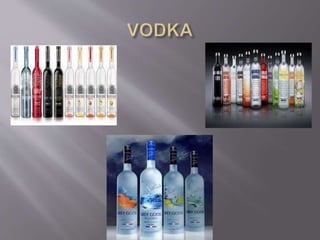
 ABSOLUT PEACH, ABSOLUT VANILLA,
ABSLOUT CITRON, ABSOLUT CURRANT,
 ABSOLUT MANDRIN, SKYY ORANGE, SKYY
CITRUS, STOLI CITRUS, STOLI PEACH
 GREY GOOSE ORANGE, GREYGOOSE
CITRON
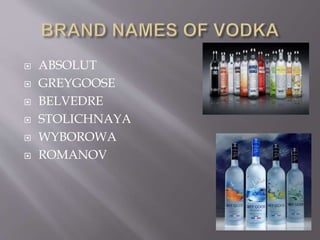
 ABSOLUT
 GREYGOOSE
 BELVEDRE
 STOLICHNAYA
 WYBOROWA
 ROMANOV
THANK YOU

RUM/GIN/VODKA - MANOJ

  • 2.
     Rum isa distilled alcoholic beverage made from sugarcane byproducts, such as molasses, or directly from sugarcane juice, by a process of fermentation and distillation. The distillate, a clear liquid, is then usually aged in oak barrels.
  • 3.
     Manual Harvesting In many countries even today harvesting is done manually using various types of hand knives or hand axes.Among the several tools the cutting blade is usually heavier and facilitates easier and efficient cutting of cane.   Manual harvesting requires skilled labourers as improper harvest of cane leads to loss of cane & sugar yield, poor juice quality and problems in milling due to extraneous matter
  • 4.
     Mechanical Harvesting Harvesting labour is becoming scarce and costly in view of diversion of labour to other remunerative work in industry, construction, business etc. Mill stoppages because of non-availability of canes are not uncommon owing to shortage of harvesting labour. And, most of the new mills are of higher crushing capacity and many are expanding their crushing capacities. Therefore daily requirement of cane is increasing and hence greater demand for harvesting labour
  • 5.
     Juice extractionby milling is the process of squeezing the juice from the cane under high pressure between heavy iron rollers. Cane diffusion is the process of leeching the juice from the cane by repeatedly wasing the cane with water and low concentration cane juice
  • 6.
     As withall other aspects of rum production, no standard method is used for distillation. While some producers work in batches using pot stills, most rum production is done using column still distillation. Pot still output contains more congeners than the output from column stills, so produces fuller-tasting rums.
  • 7.
     Many countriesrequire rum to be aged for at least one year. This aging is commonly performed in used bourbon casks, but may also be performed in other types of wooden casks or stainless steel tanks. The aging process determines the color of the rum. When aged in oak casks, it becomes dark, whereas rum aged in stainless steel tanks remains virtually colorless.  Due to the tropical climate common to most rum-producing areas, rum matures at a much higher rate than is typical for whisky or brandy. An indication of this higher rate is the angels' share, or amount of product lost to evaporation. While products aged in France or Scotland see about 2% loss each year, tropical rum producers may see as much as 10%.  After aging, rum is normally blended to ensure a consistent flavor. Blending is the final step in the rum-making process. As part of this blending process, light rums may be filtered to remove any color gained during aging. For darker rums, caramel may be added to adjust the color of the final product.
  • 8.
     Sugarcane isharvested to make sugarcane juice and molasses.  Yeast and water are added to the base ingredient to start the fermentation process. While some rum producers allow wild yeasts to perform the fermentation, most use specific strains of yeast to help provide a consistent taste and predictable fermentation time.
  • 9.
     Dark rums,also known by their particular color, such as brown, black, or red rums, are classes a grade darker than gold rums. They are usually made from caramelized sugar or molasses. They are generally aged longer, in heavily charred barrels, giving them much stronger flavors than either light or gold rums, and hints of spices can be detected, along with a strong molasses or caramel overtone. They commonly provide substance in rum drinks, as well as color. In addition, dark rum is the type most commonly used in cooking. Most dark rums come from areas such as Jamaica, Haiti, and Martinique.  Flavored rums are infused with flavors of fruits, such as banana, mango, orange, citrus, coconut, starfruit or lime. These are generally less than 40% ABV [80 proof]. They mostly serve to flavor similarly-themed tropical drinks but are also often drunk neat or with ice.  Gold rums, also called "amber" rums, are medium-bodied rums that are generally aged. These gain their dark color from aging in wooden barrels (usually the charred, white oak barrels that are the byproduct of Bourbon whiskey). They have more flavor and are stronger-tasting than light rum, and can be considered midway between light rum and the darker varieties.
  • 10.
     Light rums,also referred to as "silver" or "white" rums, in general, have very little flavor aside from a general sweetness. Light rums are sometimes filtered after aging to remove any color. The Brazilian cachaça is generally this type, but some varieties are more akin to "gold rums". The majority of light rums come from Puerto Rico. Their milder flavors make them popular for use in mixed drinks, as opposed to drinking them straight.  Overproof rums are much higher than the standard 40% ABV [80 proof], with many as high as 75% [150 proof] to 80% [160 proof] available. One example is Bacardi 151 or Pitorro moonshine. They are usually used in mixed drinks.  Premium rums, as with other sipping spirits such as Cognac and Scotch, are in a special market category. These are generally from boutique brands that sell carefully produced and aged rums. They have more character and flavor than their "mixing" counterparts and are generally consumed straight.  Spiced rums obtain their flavors through the addition of spices and, sometimes, caramel. Most are darker in color, and based on gold rums. Some are significantly darker, while many cheaper brands are made from inexpensive white rums and darkened with caramel.
  • 11.
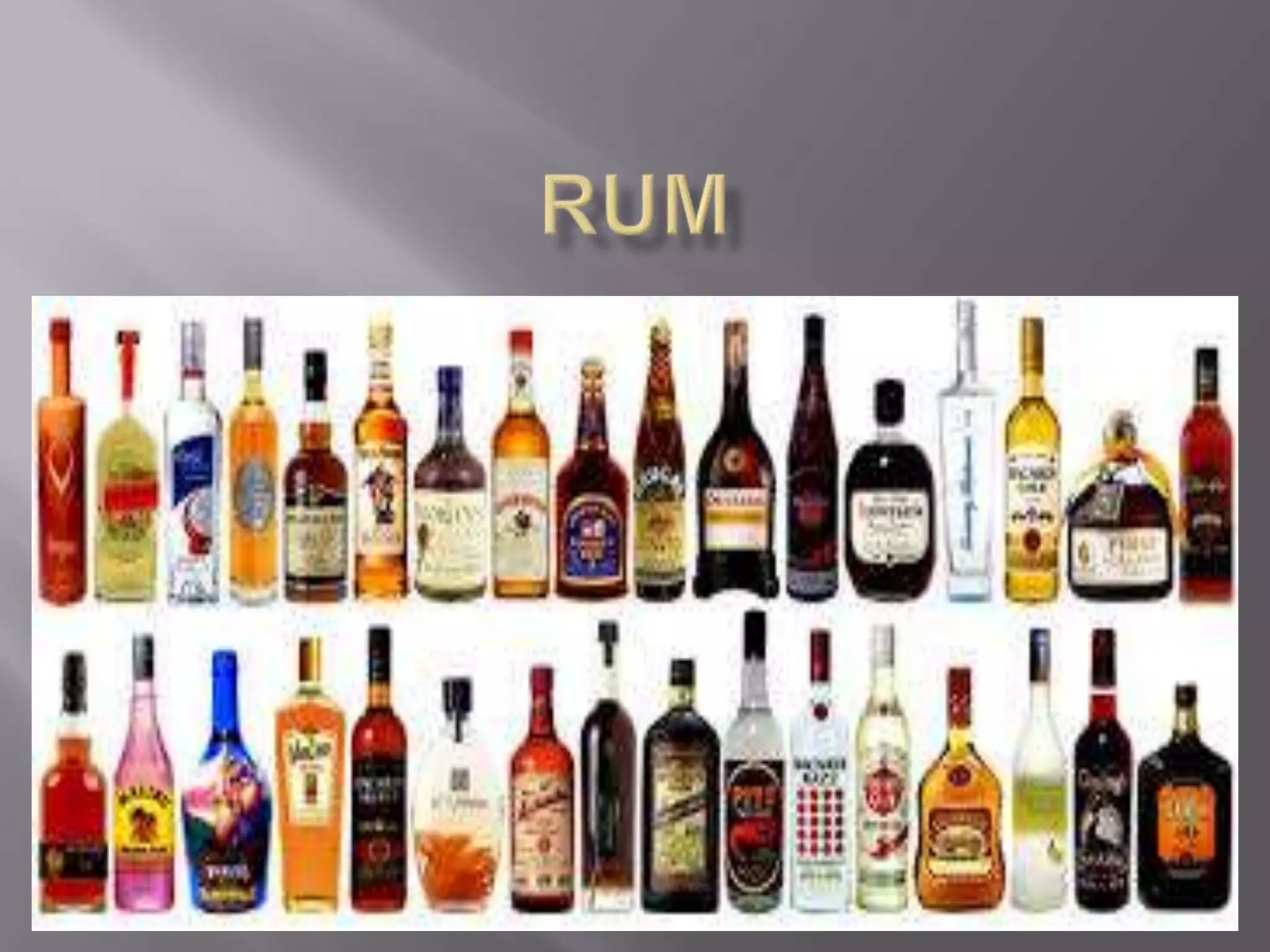
     Bacardi  CaptainMorgan  Havana Club  Madira  Appleton
  • 16.
     Another styleof gin, and history says it’s the first style, is the Dutch Genever. Rather than starting with a neutral grain spirit, a genever starts with a malted grain mash, more like whiskey. The process lends itself to barrel- aging, whereas making English gins is a very quick process, sometimes taking no longer than a day. The soft yellow spirit has been making a comeback lately.
  • 17.
     1. LondonDry Gin The one that is most familiar as “gin” and most widely available is a style called London Dry Gin. Curiously, a London Dry does not have to be made in London, instead it’s defined by getting its juniper flavor from neutral spirits (grain alcohol) re-distilled with botanicals, with nothing added after the re-distillation process. Some cocktail historians and purveyors of urban cocktail legend say that the origin of the expression “dry martini” comes not from the amount of vermouth added to the cocktail, but from a shortening of the request for a “London Dry Martini.”
  • 18.
     3. OldTom Old Tom gin is yet another style that has fallen out of favor, and production, until recently. Old Toms are characterized by sugar in the re- distillation process that makes them sweeter than a London Dry.
  • 19.
     The last styleof gin, compound gin, was probably the most prevalent in the early days of gin production, when it was the beverage of choice for the working classes and the out-of-work. Compound gin derives its flavor from essences that are added to neutral grain spirits, with no re-distillation. One of those “essences” in the cheapest swill was turpentine. But even this style of gin is having a modern day renaissance of sorts. Hendricks is a type of compound gin: the signature cucumber and rose petal essences are too delicate for re-distillation process and are added after the other more traditional botanicals are re-distilled with neutral spirits.
  • 23.
     SELECTING THEGRAIN  We source our grain through Farm.harvest the most consistent high quality grains.  MASHING  The grain is milled at fine consistency before mashing.  Hot water, milled grain, enzymes and some citric acid are the only ingredients used in our mashes. Grains are not separated from the resulting wash.
  • 24.
     FERMENTATION  After“Mashing”, the contents of the mash are cooled and yeast is added.Fermentation is usually a five day process. Cooling is required to keep a consistent temperature during this time. This also helps with the development of consistent flavor profiles and maximum productive efficiency of the conversion of sugars to alcohol.  DISTILLATION  Distill the liquid for three times when producing clear spirits such as vodka. The use of a plate column and a lot of cooling water to achieve maximum reflux helps to produce a clean balance spirit devoid of noticeable impurities. These distillations are more time consuming and costly than the whiskey distillations. However, the result is a spirit that does not require aging and is usually of higher quality.
  • 25.
    BLENDING  We donot have a romantic story to write about the source of our blending water. The water is from New Richmond and we strip it of all unwanted minerals via deionization and reverse osmosis. The objective is to not allow the water affect the flavor of the alcohol we have distilled. FILTERING  Clear spirits are often filtered three times.  Carbon filtering is for removing impurities that make it through distillation.  Chill filtering is for removing possible coagulating proteins in the distillate  Polishing filtering is to remove any unsightly particles before bottling
  • 26.
     ABSOLUT PEACH,ABSOLUT VANILLA, ABSLOUT CITRON, ABSOLUT CURRANT,  ABSOLUT MANDRIN, SKYY ORANGE, SKYY CITRUS, STOLI CITRUS, STOLI PEACH  GREY GOOSE ORANGE, GREYGOOSE CITRON
  • 27.
     ABSOLUT  GREYGOOSE BELVEDRE  STOLICHNAYA  WYBOROWA  ROMANOV
  • 28.