The Power Rule
and other
Rules for Differentiation
Mr. Miehl
miehlm@tesd.net
Rules for Differentiation
Taking the derivative by using the definition is a lot of work.
Perhaps there is an easy way to find the derivative.
Objective
 To differentiate functions using the
power rule, constant rule, constant
multiple rule, and sum and difference
rules.
The Derivative is …
 Used to find the “slope” of a function at a point.
 Used to find the “slope of the tangent line” to
the graph of a function at a point.
 Used to find the “instantaneous rate of change”
of a function at a point.
 Computed by finding the limit of the difference
quotient as ∆x approaches 0. (Limit Definition)
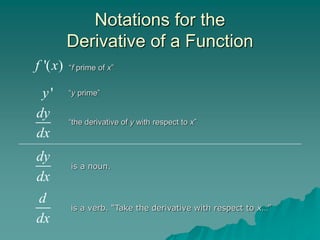
Notations for the
Derivative of a Function
d
dx
'( )
f x
'
y
dy
dx
dy
dx
“f prime of x”
“y prime”
“the derivative of y with respect to x”
is a verb. “Take the derivative with respect to x…”
is a noun.
Rules for Differentiation
 Differentiation is the process of
computing the derivative of a
function.
You may be asked to:
 Differentiate.
 Derive.
 Find the derivative of…
Video Clip from
Calculus-Help.com
The Power Rule
Rules for Differentiation
 Working with the definition of the
derivative is important because it
helps you really understand what the
derivative means.
The Power Rule
1
[ ] , is any real number
N N
d
x Nx N
dx


[ ] 1
d
x
dx

The Constant Rule
 The derivative of a constant function
is zero.
[ ] 0, is a constant
d
c c
dx

The Constant Multiple Rule
   
[ ( ) ] '( ) , is a constant
d
c f x c f x c
dx

 The derivative of a constant times a
function is equal to the constant
times the derivative of the function.
The Sum and Difference Rules
[ ( ) ( )] '( ) '( )
d
f x g x f x g x
dx
  
[ ( ) ( )] '( ) '( )
d
f x g x f x g x
dx
  
The derivative of a sum is the sum of the derivatives.
The derivative of a difference is the difference of the derivatives.
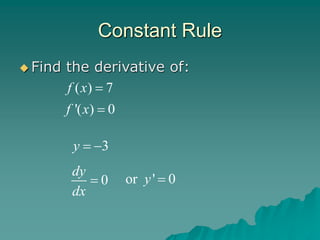
Constant Rule
 Find the derivative of:
( ) 7
f x 
'( ) 0
f x 
3
y  
0
dy
dx
 or ' 0
y 
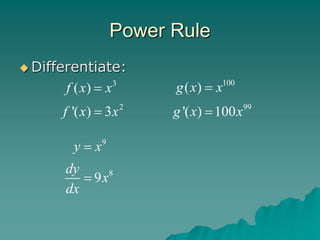
Power Rule
 Differentiate:
3
( )
f x x

2
'( ) 3
f x x

9
y x

8
9
dy
x
dx

100
( )
g x x

99
'( ) 100
g x x

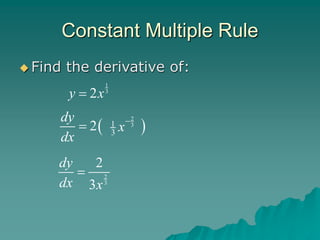
Constant Multiple Rule
 Find the derivative of:
1
3
2
y x

 
2
dy
dx

2
3
1
3 x

2
3
2
3
dy
dx x

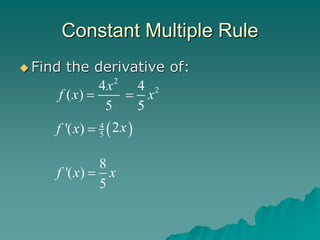
Constant Multiple Rule
 Find the derivative of:
2
4
( )
5
x
f x 
 
4
5
'( )
f x  2x
8
'( )
5
f x x

2
4
5
x

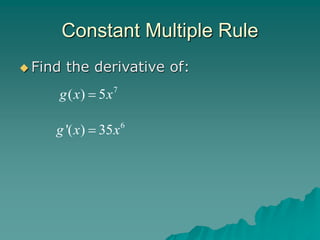
Constant Multiple Rule
 Find the derivative of:
7
( ) 5
g x x

6
'( ) 35
g x x

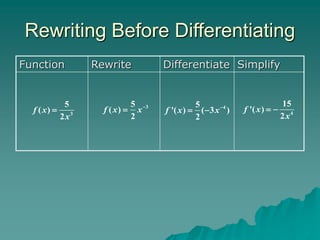
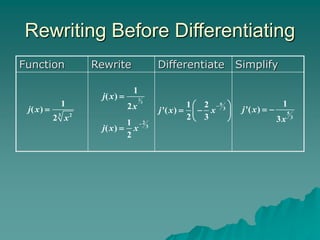
Rewriting Before Differentiating
Function Rewrite Differentiate Simplify
3
5
( )
2
f x
x
 3
5
( )
2
f x x
 4
5
'( ) ( 3 )
2
f x x
  4
15
'( )
2
f x
x
 
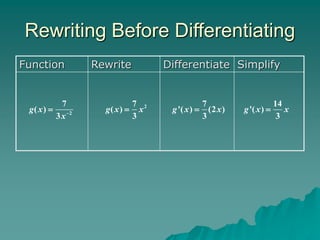
Rewriting Before Differentiating
Function Rewrite Differentiate Simplify
2
7
( )
3
g x
x
 2
7
( )
3
g x x

7
'( ) (2 )
3
g x x

14
'( )
3
g x x

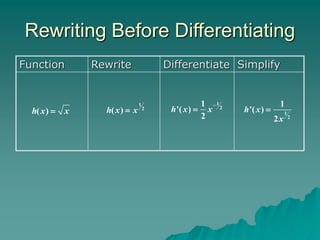
Rewriting Before Differentiating
Function Rewrite Differentiate Simplify
( )
h x x

1
2
( )
h x x

1
2
1
'( )
2
h x x

 1
2
1
'( )
2
h x
x

Rewriting Before Differentiating
Function Rewrite Differentiate Simplify
2
3
1
( )
2
j x
x

2
3
1
( )
2
j x
x

5
3
1 2
'( )
2 3
j x x

 
 
 
 
5
3
1
'( )
3
j x
x
 
2
3
1
( )
2
j x x


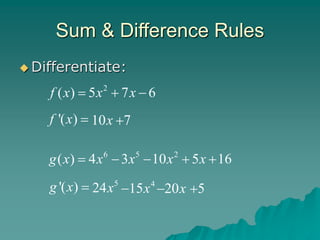
Sum & Difference Rules
 Differentiate:
2
( ) 5 7 6
f x x x
  
'( )
f x 
6 5 2
( ) 4 3 10 5 16
g x x x x x
    
'( )
g x 
10x 7

5
24x 4
15x
 20x
 5

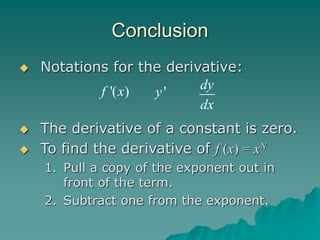
Conclusion
 Notations for the derivative:
 The derivative of a constant is zero.
 To find the derivative of f (x) = xN
1. Pull a copy of the exponent out in
front of the term.
2. Subtract one from the exponent.
'( )
f x '
y
dy
dx

Rules_for_Differentiation.ppt

  • 1.
    The Power Rule andother Rules for Differentiation Mr. Miehl miehlm@tesd.net
  • 2.
    Rules for Differentiation Takingthe derivative by using the definition is a lot of work. Perhaps there is an easy way to find the derivative.
  • 3.
    Objective  To differentiatefunctions using the power rule, constant rule, constant multiple rule, and sum and difference rules.
  • 4.
    The Derivative is…  Used to find the “slope” of a function at a point.  Used to find the “slope of the tangent line” to the graph of a function at a point.  Used to find the “instantaneous rate of change” of a function at a point.  Computed by finding the limit of the difference quotient as ∆x approaches 0. (Limit Definition)
  • 5.
    Notations for the Derivativeof a Function d dx '( ) f x ' y dy dx dy dx “f prime of x” “y prime” “the derivative of y with respect to x” is a verb. “Take the derivative with respect to x…” is a noun.
  • 6.
    Rules for Differentiation Differentiation is the process of computing the derivative of a function. You may be asked to:  Differentiate.  Derive.  Find the derivative of…
  • 7.
  • 8.
    Rules for Differentiation Working with the definition of the derivative is important because it helps you really understand what the derivative means.
  • 9.
    The Power Rule 1 [] , is any real number N N d x Nx N dx   [ ] 1 d x dx 
  • 10.
    The Constant Rule The derivative of a constant function is zero. [ ] 0, is a constant d c c dx 
  • 11.
    The Constant MultipleRule     [ ( ) ] '( ) , is a constant d c f x c f x c dx   The derivative of a constant times a function is equal to the constant times the derivative of the function.
  • 12.
    The Sum andDifference Rules [ ( ) ( )] '( ) '( ) d f x g x f x g x dx    [ ( ) ( )] '( ) '( ) d f x g x f x g x dx    The derivative of a sum is the sum of the derivatives. The derivative of a difference is the difference of the derivatives.
  • 13.
    Constant Rule  Findthe derivative of: ( ) 7 f x  '( ) 0 f x  3 y   0 dy dx  or ' 0 y 
  • 14.
    Power Rule  Differentiate: 3 () f x x  2 '( ) 3 f x x  9 y x  8 9 dy x dx  100 ( ) g x x  99 '( ) 100 g x x 
  • 15.
    Constant Multiple Rule Find the derivative of: 1 3 2 y x    2 dy dx  2 3 1 3 x  2 3 2 3 dy dx x 
  • 16.
    Constant Multiple Rule Find the derivative of: 2 4 ( ) 5 x f x    4 5 '( ) f x  2x 8 '( ) 5 f x x  2 4 5 x 
  • 17.
    Constant Multiple Rule Find the derivative of: 7 ( ) 5 g x x  6 '( ) 35 g x x 
  • 18.
    Rewriting Before Differentiating FunctionRewrite Differentiate Simplify 3 5 ( ) 2 f x x  3 5 ( ) 2 f x x  4 5 '( ) ( 3 ) 2 f x x   4 15 '( ) 2 f x x  
  • 19.
    Rewriting Before Differentiating FunctionRewrite Differentiate Simplify 2 7 ( ) 3 g x x  2 7 ( ) 3 g x x  7 '( ) (2 ) 3 g x x  14 '( ) 3 g x x 
  • 20.
    Rewriting Before Differentiating FunctionRewrite Differentiate Simplify ( ) h x x  1 2 ( ) h x x  1 2 1 '( ) 2 h x x   1 2 1 '( ) 2 h x x 
  • 21.
    Rewriting Before Differentiating FunctionRewrite Differentiate Simplify 2 3 1 ( ) 2 j x x  2 3 1 ( ) 2 j x x  5 3 1 2 '( ) 2 3 j x x          5 3 1 '( ) 3 j x x   2 3 1 ( ) 2 j x x  
  • 22.
    Sum & DifferenceRules  Differentiate: 2 ( ) 5 7 6 f x x x    '( ) f x  6 5 2 ( ) 4 3 10 5 16 g x x x x x      '( ) g x  10x 7  5 24x 4 15x  20x  5 
  • 23.
    Conclusion  Notations forthe derivative:  The derivative of a constant is zero.  To find the derivative of f (x) = xN 1. Pull a copy of the exponent out in front of the term. 2. Subtract one from the exponent. '( ) f x ' y dy dx