Prepared by :
Upadhyay Rakshita R.
Div : ME-1(power system )
Er no : 140370707018
1. Research Methodology
Introduction
Structure and process of research
Types of research
Research method vs research methodology
Introduction
 Research…
 the application of the scientific method
 a systematic process of collecting and logically analyzing
information (data)
 Research Methods (Methodology)…
 the ways one collects and analyzes data
 methods developed for acquiring trustworthy
knowledge via reliable and valid procedures
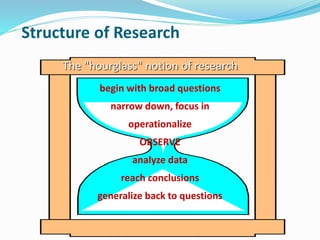
Structure of Research
begin with broad questions
narrow down, focus in
operationalize
OBSERVE
analyze data
reach conclusions
generalize back to questions
The "hourglass" notion of research
5
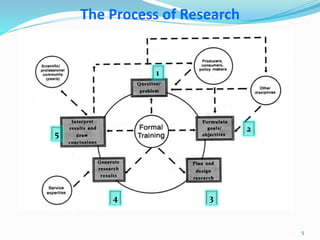
1
2
34
5
The Process of Research
Types of research
Descriptive vs analytical
Applied vs fundamental
Quantitative vs qualitative
Conceptual vs empirical
Research method vs research
methodology
 First group : collection of data
 Second group : statistical technique
 Third group : method use for evaluating accuracy
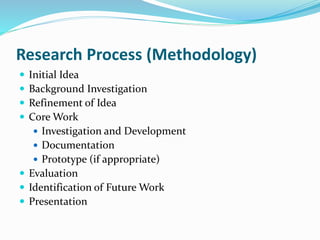
Research Process (Methodology)
 Initial Idea
 Background Investigation
 Refinement of Idea
 Core Work
 Investigation and Development
 Documentation
 Prototype (if appropriate)
 Evaluation
 Identification of Future Work
 Presentation
Scope of Research
 Varies by level of work
 Ph.D. students – contribution expected at world level;
e.g.
 background investigation on all past work
 make meaningful addition to world knowledge
 Undergraduate students – contribution can be at local to
national to world level; e.g.
 background investigation at university up to world
level
 make meaningful addition to university up to world
level of knowledge
2. Power system Reliability
 Introduction
 Analysis of reliability….hierarchial levels
 Reliability Indices
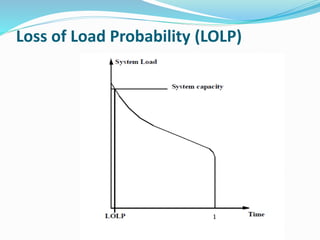
 Loss of Load Probability (LOLP)
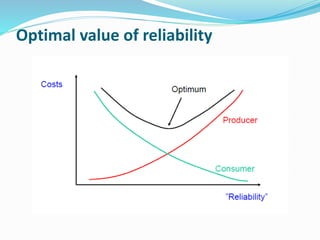
 Optimal value of reliability
Introduction
 A measure of the ability of a system, generally given as
numerical indices, to deliver power to all points of
utilizasation within acceptable standards and in amounts
desired. Power system reliability (comprising generation
and transmission & distribution facilities) can be described
by two basic functional attributes: adequacy and security.
(Cigré definition)
 Reliability is the probability of a device or a system
performing its function adequately, for the period of time
intended, under the operating conditions intended. (IEEE
PES definition)
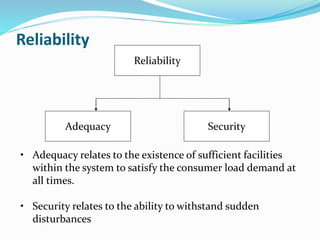
Reliability
Reliability
SecurityAdequacy
• Adequacy relates to the existence of sufficient facilities
within the system to satisfy the consumer load demand at
all times.
• Security relates to the ability to withstand sudden
disturbances
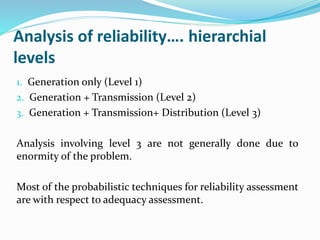
Analysis of reliability…. hierarchial
levels
1. Generation only (Level 1)
2. Generation + Transmission (Level 2)
3. Generation + Transmission+ Distribution (Level 3)
Analysis involving level 3 are not generally done due to
enormity of the problem.
Most of the probabilistic techniques for reliability assessment
are with respect to adequacy assessment.
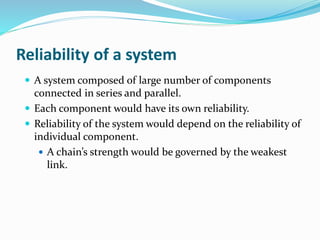
Reliability of a system
 A system composed of large number of components
connected in series and parallel.
 Each component would have its own reliability.
 Reliability of the system would depend on the reliability of
individual component.
 A chain’s strength would be governed by the weakest
link.
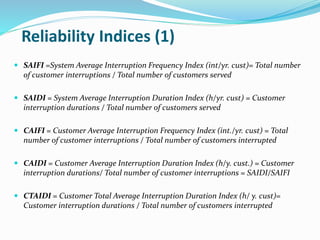
Reliability Indices (1)
 SAIFI =System Average Interruption Frequency Index (int/yr. cust)= Total number
of customer interruptions / Total number of customers served
 SAIDI = System Average Interruption Duration Index (h/yr. cust) = Customer
interruption durations / Total number of customers served
 CAIFI = Customer Average Interruption Frequency Index (int./yr. cust) = Total
number of customer interruptions / Total number of customers interrupted
 CAIDI = Customer Average Interruption Duration Index (h/y. cust.) = Customer
interruption durations/ Total number of customer interruptions = SAIDI/SAIFI
 CTAIDI = Customer Total Average Interruption Duration Index (h/ y. cust)=
Customer interruption durations / Total number of customers interrupted
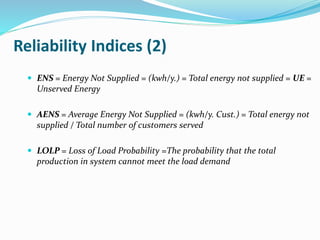
Reliability Indices (2)
 ENS = Energy Not Supplied = (kwh/y.) = Total energy not supplied = UE =
Unserved Energy
 AENS = Average Energy Not Supplied = (kwh/y. Cust.) = Total energy not
supplied / Total number of customers served
 LOLP = Loss of Load Probability =The probability that the total
production in system cannot meet the load demand
Reliability Indices (3)
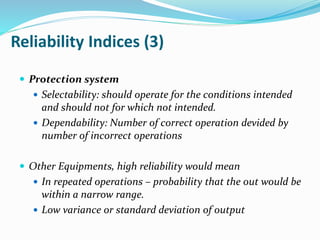
 Protection system
 Selectability: should operate for the conditions intended
and should not for which not intended.
 Dependability: Number of correct operation devided by
number of incorrect operations
 Other Equipments, high reliability would mean
 In repeated operations – probability that the out would be
within a narrow range.
 Low variance or standard deviation of output
Loss of Load Probability (LOLP)
Optimal value of reliability
Optimal value of reliability (2)
 The costs of the producer = CR
 The costs of the consumers = CIC
 CIC = Customer Interruption Costs (= VOLL = Value of
Lost Load)
 At the optimum : ∆CR = - ∆ CIC (= -∆ VOLL)
Conclusion
 From these we can conclude that how the research is done
and what is research methodology and we can now easily
do research in a appropriate manner and also we have
studied the basic concept of power system reliability and its
indices.
References
• http://www.cs.indiana.edu/mit.research.how.to/mit.research.
how.to.html
• http://www.honors.ucr.edu/research.htm
• http://www.utexas.edu/research/eureka/resources/why/in
dex.php
• Roy Billinton and Ronald N Allan, ‘Reliability Assessment
of Large Electric Power Systems’, Kluwer Academic
Publishers
• Roy Billinton and w.li , reliability assesment of power
system using monetocarlo method , plenum press , new
york,USA,1994
Rs methodologyandreliability

Rs methodologyandreliability

  • 1.
    Prepared by : UpadhyayRakshita R. Div : ME-1(power system ) Er no : 140370707018
  • 2.
    1. Research Methodology Introduction Structureand process of research Types of research Research method vs research methodology
  • 3.
    Introduction  Research…  theapplication of the scientific method  a systematic process of collecting and logically analyzing information (data)  Research Methods (Methodology)…  the ways one collects and analyzes data  methods developed for acquiring trustworthy knowledge via reliable and valid procedures
  • 4.
    Structure of Research beginwith broad questions narrow down, focus in operationalize OBSERVE analyze data reach conclusions generalize back to questions The "hourglass" notion of research
  • 5.
  • 6.
    Types of research Descriptivevs analytical Applied vs fundamental Quantitative vs qualitative Conceptual vs empirical
  • 7.
    Research method vsresearch methodology  First group : collection of data  Second group : statistical technique  Third group : method use for evaluating accuracy
  • 9.
    Research Process (Methodology) Initial Idea  Background Investigation  Refinement of Idea  Core Work  Investigation and Development  Documentation  Prototype (if appropriate)  Evaluation  Identification of Future Work  Presentation
  • 10.
    Scope of Research Varies by level of work  Ph.D. students – contribution expected at world level; e.g.  background investigation on all past work  make meaningful addition to world knowledge  Undergraduate students – contribution can be at local to national to world level; e.g.  background investigation at university up to world level  make meaningful addition to university up to world level of knowledge
  • 11.
    2. Power systemReliability  Introduction  Analysis of reliability….hierarchial levels  Reliability Indices  Loss of Load Probability (LOLP)  Optimal value of reliability
  • 12.
    Introduction  A measureof the ability of a system, generally given as numerical indices, to deliver power to all points of utilizasation within acceptable standards and in amounts desired. Power system reliability (comprising generation and transmission & distribution facilities) can be described by two basic functional attributes: adequacy and security. (Cigré definition)  Reliability is the probability of a device or a system performing its function adequately, for the period of time intended, under the operating conditions intended. (IEEE PES definition)
  • 13.
    Reliability Reliability SecurityAdequacy • Adequacy relatesto the existence of sufficient facilities within the system to satisfy the consumer load demand at all times. • Security relates to the ability to withstand sudden disturbances
  • 14.
    Analysis of reliability….hierarchial levels 1. Generation only (Level 1) 2. Generation + Transmission (Level 2) 3. Generation + Transmission+ Distribution (Level 3) Analysis involving level 3 are not generally done due to enormity of the problem. Most of the probabilistic techniques for reliability assessment are with respect to adequacy assessment.
  • 15.
    Reliability of asystem  A system composed of large number of components connected in series and parallel.  Each component would have its own reliability.  Reliability of the system would depend on the reliability of individual component.  A chain’s strength would be governed by the weakest link.
  • 16.
    Reliability Indices (1) SAIFI =System Average Interruption Frequency Index (int/yr. cust)= Total number of customer interruptions / Total number of customers served  SAIDI = System Average Interruption Duration Index (h/yr. cust) = Customer interruption durations / Total number of customers served  CAIFI = Customer Average Interruption Frequency Index (int./yr. cust) = Total number of customer interruptions / Total number of customers interrupted  CAIDI = Customer Average Interruption Duration Index (h/y. cust.) = Customer interruption durations/ Total number of customer interruptions = SAIDI/SAIFI  CTAIDI = Customer Total Average Interruption Duration Index (h/ y. cust)= Customer interruption durations / Total number of customers interrupted
  • 17.
    Reliability Indices (2) ENS = Energy Not Supplied = (kwh/y.) = Total energy not supplied = UE = Unserved Energy  AENS = Average Energy Not Supplied = (kwh/y. Cust.) = Total energy not supplied / Total number of customers served  LOLP = Loss of Load Probability =The probability that the total production in system cannot meet the load demand
  • 18.
    Reliability Indices (3) Protection system  Selectability: should operate for the conditions intended and should not for which not intended.  Dependability: Number of correct operation devided by number of incorrect operations  Other Equipments, high reliability would mean  In repeated operations – probability that the out would be within a narrow range.  Low variance or standard deviation of output
  • 19.
    Loss of LoadProbability (LOLP)
  • 20.
    Optimal value ofreliability
  • 21.
    Optimal value ofreliability (2)  The costs of the producer = CR  The costs of the consumers = CIC  CIC = Customer Interruption Costs (= VOLL = Value of Lost Load)  At the optimum : ∆CR = - ∆ CIC (= -∆ VOLL)
  • 22.
    Conclusion  From thesewe can conclude that how the research is done and what is research methodology and we can now easily do research in a appropriate manner and also we have studied the basic concept of power system reliability and its indices.
  • 23.
    References • http://www.cs.indiana.edu/mit.research.how.to/mit.research. how.to.html • http://www.honors.ucr.edu/research.htm •http://www.utexas.edu/research/eureka/resources/why/in dex.php • Roy Billinton and Ronald N Allan, ‘Reliability Assessment of Large Electric Power Systems’, Kluwer Academic Publishers • Roy Billinton and w.li , reliability assesment of power system using monetocarlo method , plenum press , new york,USA,1994