COMETS, METEORS AND METEORITES
                                                       Carolyn Grande: BEEd IIIA General
Comet
   is an icy member of our solar system
   were named for their appearance. Both the Greek word kometes and
      the Latin word cometa mean “long-haired.”.
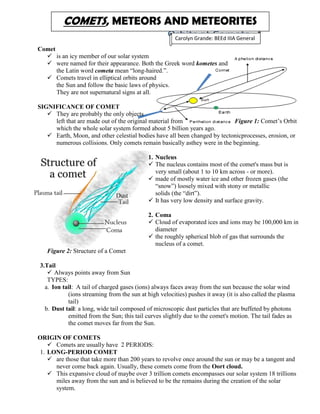
   Comets travel in elliptical orbits around
      the Sun and follow the basic laws of physics.
      They are not supernatural signs at all.

SIGNIFICANCE OF COMET
    They are probably the only objects
     left that are made out of the original material from                  Figure 1: Comet’s Orbit
     which the whole solar system formed about 5 billion years ago.
    Earth, Moon, and other celestial bodies have all been changed by tectonicprocesses, erosion, or
     numerous collisions. Only comets remain basically asthey were in the beginning.

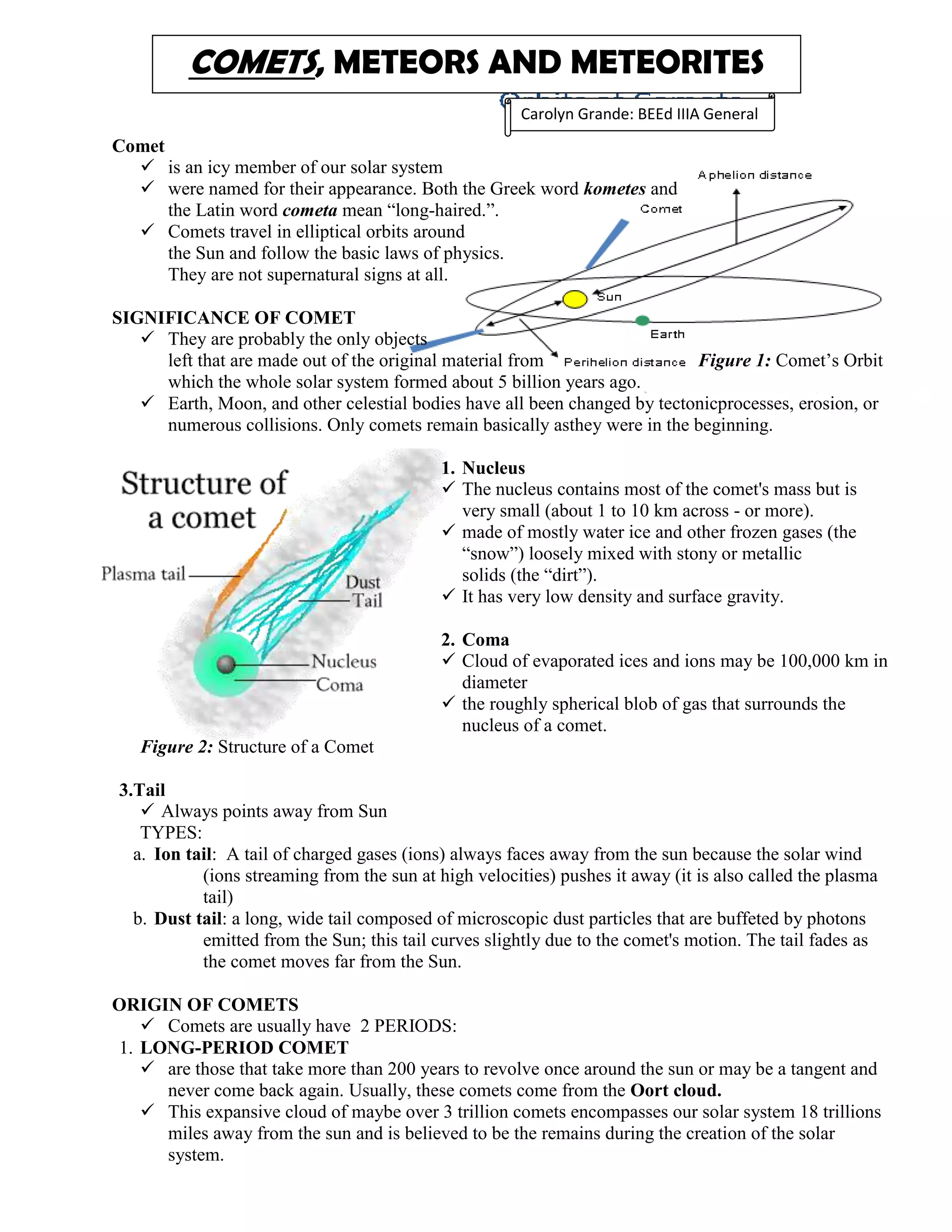
                                            1. Nucleus
                                             The nucleus contains most of the comet's mass but is
                                               very small (about 1 to 10 km across - or more).
                                             made of mostly water ice and other frozen gases (the
                                               “snow”) loosely mixed with stony or metallic
                                               solids (the “dirt”).
                                             It has very low density and surface gravity.

                                            2. Coma
                                             Cloud of evaporated ices and ions may be 100,000 km in
                                               diameter
                                             the roughly spherical blob of gas that surrounds the
                                               nucleus of a comet.
   Figure 2: Structure of a Comet

3.Tail
    Always points away from Sun
   TYPES:
  a. Ion tail: A tail of charged gases (ions) always faces away from the sun because the solar wind
           (ions streaming from the sun at high velocities) pushes it away (it is also called the plasma
           tail)
  b. Dust tail: a long, wide tail composed of microscopic dust particles that are buffeted by photons
           emitted from the Sun; this tail curves slightly due to the comet's motion. The tail fades as
           the comet moves far from the Sun.

ORIGIN OF COMETS
    Comets are usually have 2 PERIODS:
1. LONG-PERIOD COMET
    are those that take more than 200 years to revolve once around the sun or may be a tangent and
     never come back again. Usually, these comets come from the Oort cloud.
    This expansive cloud of maybe over 3 trillion comets encompasses our solar system 18 trillions
     miles away from the sun and is believed to be the remains during the creation of the solar
     system.
2. SHORT-PERIOD COMET:
    comets that have a revolution around the sun in less than 200 years – are believed to have come
     from the Kuiper Belt.
    This belt, located beyond the orbit of Neptune, is also believed to be remnants during the
     creation of the universe and acts as a reservoir for short term comets. One such comet is the
     Halley's Comet. After numerous perihelion passages, periodic comets finally lose all their
     volatile material. only fragments of nonvolatile solids may survive.

PERIODIC COMETS
   Astronomers have catalogued about 150 short-period, or periodic comets, that have periods of
     revolution around the Sun of a few years or decades up to 200 years.
   They shine periodically in the sky every time they come close to the Sun.
   The most consistently bright and most famous is Comet Halley, with 30 consecutive perihelion
     passages recorded since 240 B.C.
   Sighted telescopically for over three years before and after its February 9, 1986, perihelion
     passage, Comet Halley is also the best-analyzed comet so far.

TABLE 1: Some Periodic Comets
        Comet             Period a(years)                 Closest Approach to Sun (in AU)

        2P/Encke                       3.3                               0.34
   21P/Giacobini-Zinner                6.6                               1.03
        14P/Wolf                       8.2                               2.41
    55P/Tempel-Tuttle                 33.2                               0.98
        1P/Halley                     76.0                               0.59

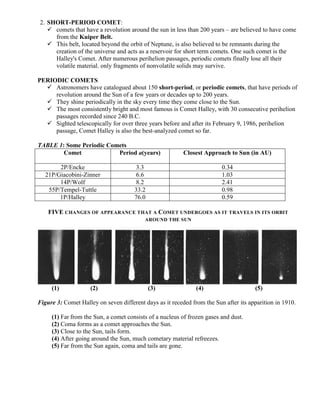
    FIVE CHANGES OF APPEARANCE THAT A COMET UNDERGOES AS IT TRAVELS IN ITS ORBIT
                                          AROUND THE SUN


     (1)             (2)                     (3)               (4)                    (5)

Figure 3: Comet Halley on seven different days as it receded from the Sun after its apparition in 1910.

     (1) Far from the Sun, a comet consists of a nucleus of frozen gases and dust.
     (2) Coma forms as a comet approaches the Sun.
     (3) Close to the Sun, tails form.
     (4) After going around the Sun, much cometary material refreezes.
     (5) Far from the Sun again, coma and tails are gone.

Comets Hand out (i Made)

  • 1.
    COMETS, METEORS ANDMETEORITES Carolyn Grande: BEEd IIIA General Comet  is an icy member of our solar system  were named for their appearance. Both the Greek word kometes and the Latin word cometa mean “long-haired.”.  Comets travel in elliptical orbits around the Sun and follow the basic laws of physics. They are not supernatural signs at all. SIGNIFICANCE OF COMET  They are probably the only objects left that are made out of the original material from Figure 1: Comet’s Orbit which the whole solar system formed about 5 billion years ago.  Earth, Moon, and other celestial bodies have all been changed by tectonicprocesses, erosion, or numerous collisions. Only comets remain basically asthey were in the beginning. 1. Nucleus  The nucleus contains most of the comet's mass but is very small (about 1 to 10 km across - or more).  made of mostly water ice and other frozen gases (the “snow”) loosely mixed with stony or metallic solids (the “dirt”).  It has very low density and surface gravity. 2. Coma  Cloud of evaporated ices and ions may be 100,000 km in diameter  the roughly spherical blob of gas that surrounds the nucleus of a comet. Figure 2: Structure of a Comet 3.Tail  Always points away from Sun TYPES: a. Ion tail: A tail of charged gases (ions) always faces away from the sun because the solar wind (ions streaming from the sun at high velocities) pushes it away (it is also called the plasma tail) b. Dust tail: a long, wide tail composed of microscopic dust particles that are buffeted by photons emitted from the Sun; this tail curves slightly due to the comet's motion. The tail fades as the comet moves far from the Sun. ORIGIN OF COMETS  Comets are usually have 2 PERIODS: 1. LONG-PERIOD COMET  are those that take more than 200 years to revolve once around the sun or may be a tangent and never come back again. Usually, these comets come from the Oort cloud.  This expansive cloud of maybe over 3 trillion comets encompasses our solar system 18 trillions miles away from the sun and is believed to be the remains during the creation of the solar system.
  • 2.
    2. SHORT-PERIOD COMET:  comets that have a revolution around the sun in less than 200 years – are believed to have come from the Kuiper Belt.  This belt, located beyond the orbit of Neptune, is also believed to be remnants during the creation of the universe and acts as a reservoir for short term comets. One such comet is the Halley's Comet. After numerous perihelion passages, periodic comets finally lose all their volatile material. only fragments of nonvolatile solids may survive. PERIODIC COMETS  Astronomers have catalogued about 150 short-period, or periodic comets, that have periods of revolution around the Sun of a few years or decades up to 200 years.  They shine periodically in the sky every time they come close to the Sun.  The most consistently bright and most famous is Comet Halley, with 30 consecutive perihelion passages recorded since 240 B.C.  Sighted telescopically for over three years before and after its February 9, 1986, perihelion passage, Comet Halley is also the best-analyzed comet so far. TABLE 1: Some Periodic Comets Comet Period a(years) Closest Approach to Sun (in AU) 2P/Encke 3.3 0.34 21P/Giacobini-Zinner 6.6 1.03 14P/Wolf 8.2 2.41 55P/Tempel-Tuttle 33.2 0.98 1P/Halley 76.0 0.59 FIVE CHANGES OF APPEARANCE THAT A COMET UNDERGOES AS IT TRAVELS IN ITS ORBIT AROUND THE SUN (1) (2) (3) (4) (5) Figure 3: Comet Halley on seven different days as it receded from the Sun after its apparition in 1910. (1) Far from the Sun, a comet consists of a nucleus of frozen gases and dust. (2) Coma forms as a comet approaches the Sun. (3) Close to the Sun, tails form. (4) After going around the Sun, much cometary material refreezes. (5) Far from the Sun again, coma and tails are gone.