Comets, Meteors, and Asteroids
Curriculum
Guide
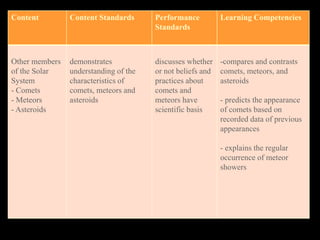
Content Content Standards Performance
Standards
Learning Competencies
Other members
of the Solar
System
- Comets
- Meteors
- Asteroids
demonstrates
understanding of the
characteristics of
comets, meteors and
asteroids
discusses whether
or not beliefs and
practices about
comets and
meteors have
scientific basis
-compares and contrasts
comets, meteors, and
asteroids
- predicts the appearance
of comets based on
recorded data of previous
appearances
- explains the regular
occurrence of meteor
showers
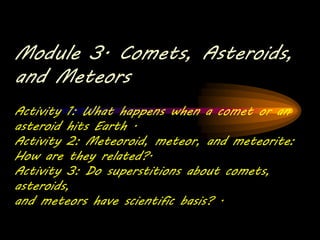
Module 3. Comets, Asteroids,
and Meteors
Activity 1: What happens when a comet or an
asteroid hits Earth .
Activity 2: Meteoroid, meteor, and meteorite:
How are they related?.
Activity 3: Do superstitions about comets,
asteroids,
and meteors have scientific basis? .
Mash Up Songfest!
SKY IS THE LIMIT!
Group students into 5 groups, and assign each group with the songs
stanza telling about the night sky.
Group 1 – Vincent
Group 2 – Twinkle Twinkle Little Star
Group 3 – I Swear
Group 4 – Yellow
Group 5 – Wish Upon A Star
Are stars the
only objects we
see in the night
sky?
Truth or Fiction:
1. What we call a falling star is not really a star!
2. Meteors are bigger than asteroids.
3. Asteroids are also called planetoids.
4. Comets orbit the sun!
5. Meteors are debris of comets and asteroids.
6. Appearance of comets foretells war and famine.
7. Meteorites are bigger than meteors.
8. Comets contain water.
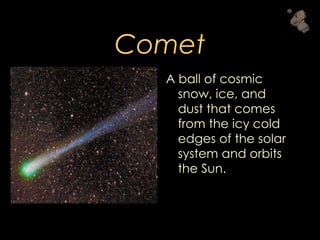
Comet
A ball of cosmic
snow, ice, and
dust that comes
from the icy cold
edges of the solar
system and orbits
the Sun.
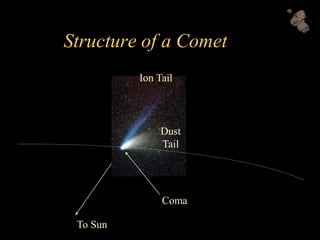
Structure of a Comet
To Sun
Ion Tail
Dust
Tail
Coma
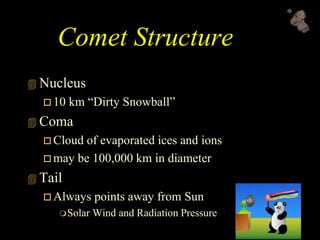
Comet Structure
 Nucleus
 10 km “Dirty Snowball”
 Coma
 Cloud of evaporated ices and ions
 may be 100,000 km in diameter
 Tail
 Always points away from Sun
Solar Wind and Radiation Pressure
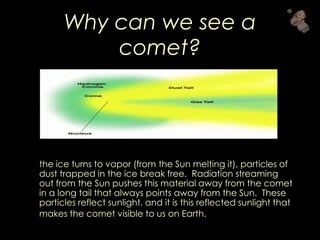
Why can we see a
comet?
We can see comets because it does not encounter enough
friction in space to cause it to heat up and burn. When
the ice turns to vapor (from the Sun melting it), particles of
dust trapped in the ice break free. Radiation streaming
out from the Sun pushes this material away from the comet
in a long tail that always points away from the Sun. These
particles reflect sunlight, and it is this reflected sunlight that
makes the comet visible to us on Earth.
If comets have ice
where do you think
they come from?
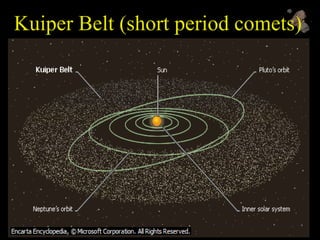
Kuiper Belt (short period comets)
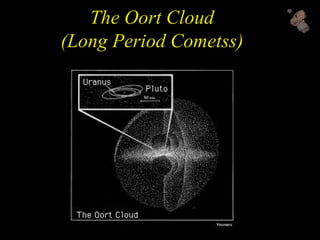
The Oort Cloud
(Long Period Cometss)
Known Comets
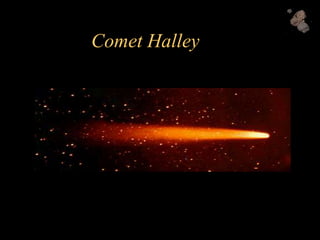
Comet Halley
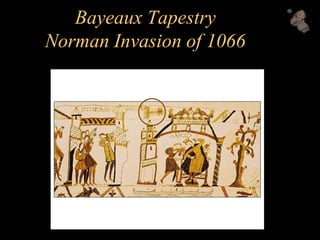
Bayeaux Tapestry
Norman Invasion of 1066
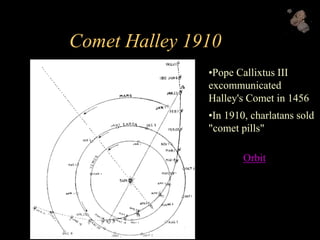
Comet Halley 1910
•Pope Callixtus III
excommunicated
Halley's Comet in 1456
•In 1910, charlatans sold
"comet pills"
Orbit
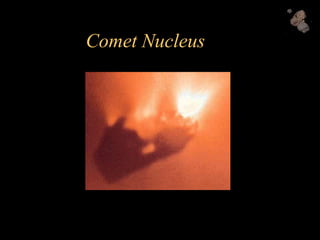
Comet Nucleus
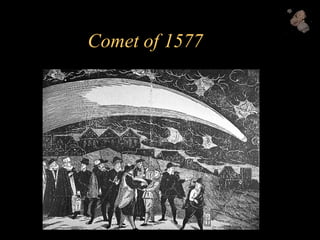
Comet of 1577
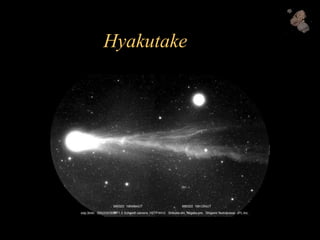
Hyakutake
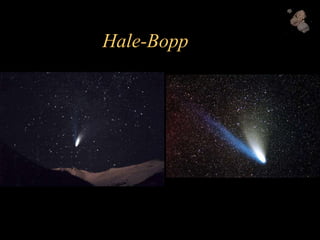
Hale-Bopp
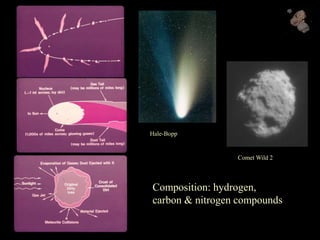
Composition: hydrogen,
carbon & nitrogen compounds
Comet Wild 2
Hale-Bopp
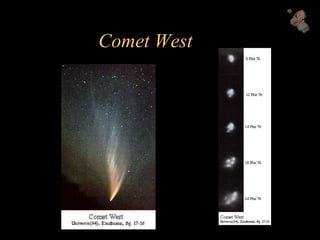
Comet West
ENRICHMENT:
PHET SIMULATION
My Solar System!
Remember December
21,2012?
What made it scary
for some?
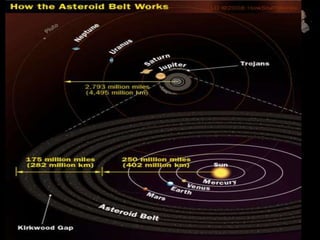
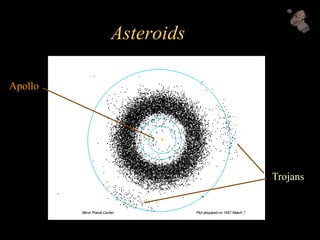
Asteroid
-small rocky or metallic body that orbits the Sun. Hundreds
of thousands of asteroids exist in the solar system.
-range in size from a few meters to over 500 km (300 mi)
wide.
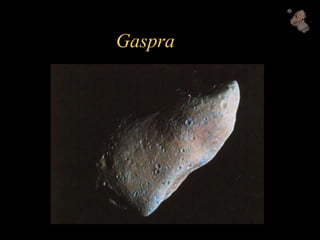
- generally irregular in shape and often have surfaces
covered with craters.
- like icy comets, asteroids are primitive objects left over
from the time when the planets formed.
Asteroids
Apollo
Trojans
Some Asteroids
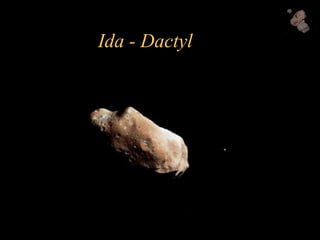
Ida - Dactyl
Gaspra
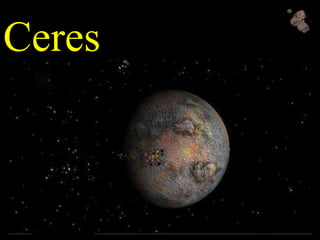
What asteroid is
considered as a
planetoid or minor
planet?
Ceres
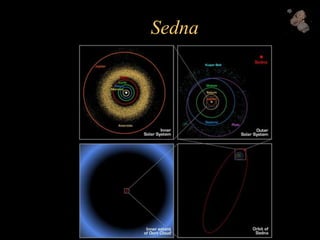
Sedna
What killed the
dinosaurs?
Activity 1:
What happens when a
comet or an asteroid hits
Earth?
Objectives:
After performing this activity, you should be able to:
1. describe how impact craters are formed when a comet or asteroid
hits Earth based on a simulation; and
2. present observations on simulating a comet or asteroid impact
using drawings.
Materials Needed:
1 rectangular container (aluminum tray or plastic)
1 pebble (1-4 cm in diameter)
colored flour/colored starch
pencil
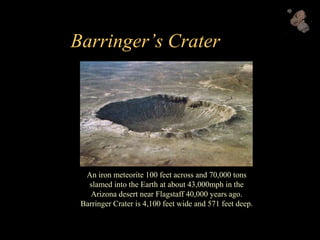
Barringer’s Crater
An iron meteorite 100 feet across and 70,000 tons
slamed into the Earth at about 43,000mph in the
Arizona desert near Flagstaff 40,000 years ago.
Barringer Crater is 4,100 feet wide and 571 feet deep.
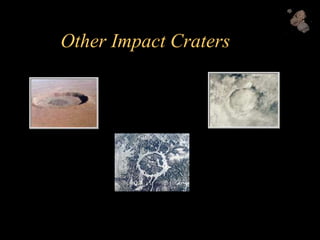
Other Impact Craters
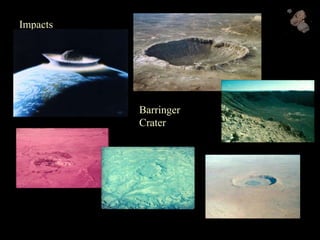
Impacts
!
Barringer
Crater
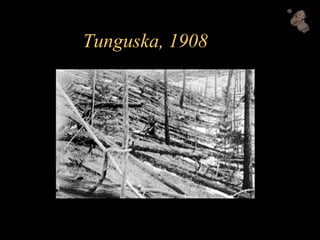
Tunguska, 1908
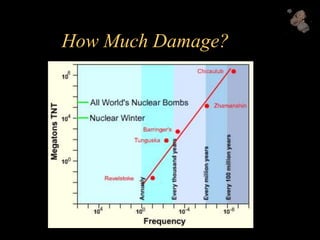
How Much Damage?
ENRICHMENT:
PHET SIMULATION
My Solar System!
Have you seen a
falling star? What
thing comes to your
mind first whenever
you see it?
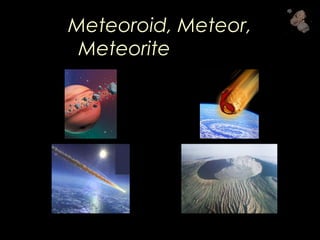
Meteoroid, Meteor,
Meteorite, Crater
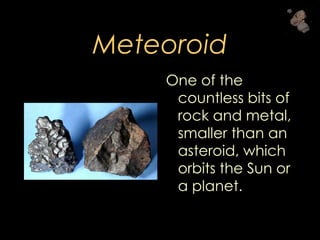
Meteoroid
One of the
countless bits of
rock and metal,
smaller than an
asteroid, which
orbits the Sun or
a planet.
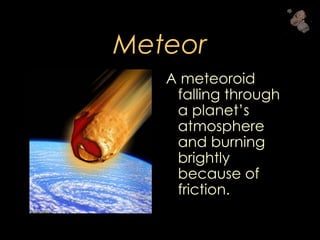
Meteor
A meteoroid
falling through
a planet’s
atmosphere
and burning
brightly
because of
friction.
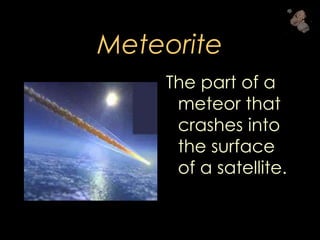
Meteorite
The part of a
meteor that
crashes into
the surface
of a satellite.
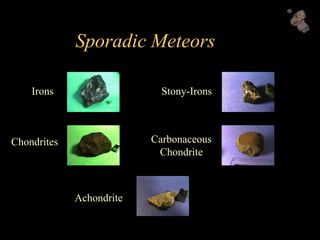
Sporadic Meteors
Irons Stony-Irons
Chondrites Carbonaceous
Chondrite
Achondrite
What is a
Meteor shower?
When does this
happen?
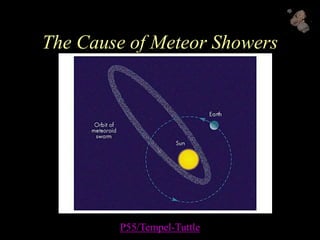
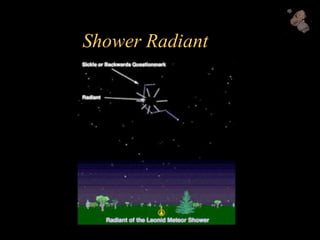
The Cause of Meteor Showers
P55/Tempel-Tuttle
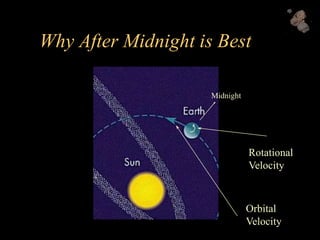
Why After Midnight is Best
Rotational
Velocity
Orbital
Velocity
Midnight
Shower Radiant
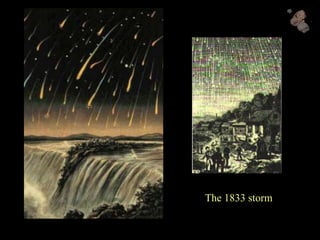
The 1833 storm
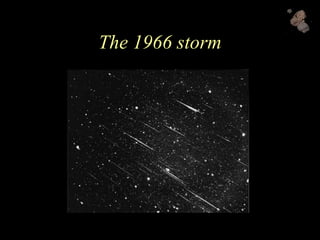
The 1966 storm
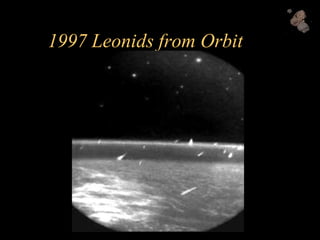
1997 Leonids from Orbit
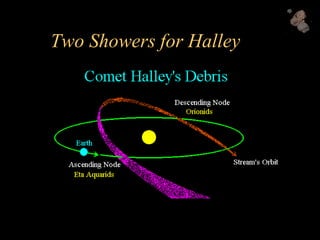
Two Showers for Halley
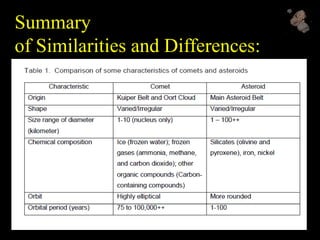
Summary
of Similarities and Differences:
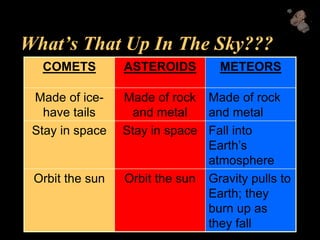
What’s That Up In The Sky???
COMETS ASTEROIDS METEORS
Made of ice-
have tails
Made of rock
and metal
Made of rock
and metal
Stay in space Stay in space Fall into
Earth’s
atmosphere
Orbit the sun Orbit the sun Gravity pulls to
Earth; they
burn up as
they fall
SAMPLE
ASSESSMENT
PROCESS/SKILLS:
1. Make a modified Venn Diagram using three overlapping
circles namely Meteor, Asteroid, and Comet.
2. Guessing Game (Hula Bira Game Format) using the following
keywords:
Meteor
Meteorite
Meteoroid
Commet
Tail
Coma
Ceres
UNDERSTANDING:
1. A falling star is reportedly seen to hit a ricefield at midnight. A
talk in the town said that doomsday is ahead. As a junior
scientist, how would you prove these talks to be false?
2. Your neighbor found a piece of meteorite and used it as his
amulet. How would you convince him that it is not true that
meteorite will give him a supernatural power? How would you
revere him for the rare find by explaining to him the significance
of collecting meteorite?
OUTPUT/PERFORMANCE:
A science magazine is looking for a good article of speculative
fiction to publish in their anniversary issue about Earth’s Asteroid
Collision Aftermath. The article would also vie for the Palanca’s
new literary category: Science/Speculative Fiction.
As a junior science writer write an article following the given
criteria:
Research based speculation …………………… 40%
Scientific Understanding ………………………. 30%
Use of layman’s term to explain ……………….. 30%
100%
Aja! Margaret Atwood !!!
Thank you!!!

Asteroids-Comets-Meteors12345678901234567890.ppt

  • 1.
  • 2.
  • 3.
    Content Content StandardsPerformance Standards Learning Competencies Other members of the Solar System - Comets - Meteors - Asteroids demonstrates understanding of the characteristics of comets, meteors and asteroids discusses whether or not beliefs and practices about comets and meteors have scientific basis -compares and contrasts comets, meteors, and asteroids - predicts the appearance of comets based on recorded data of previous appearances - explains the regular occurrence of meteor showers
  • 4.
    Module 3. Comets,Asteroids, and Meteors Activity 1: What happens when a comet or an asteroid hits Earth . Activity 2: Meteoroid, meteor, and meteorite: How are they related?. Activity 3: Do superstitions about comets, asteroids, and meteors have scientific basis? .
  • 5.
    Mash Up Songfest! SKYIS THE LIMIT! Group students into 5 groups, and assign each group with the songs stanza telling about the night sky. Group 1 – Vincent Group 2 – Twinkle Twinkle Little Star Group 3 – I Swear Group 4 – Yellow Group 5 – Wish Upon A Star
  • 6.
    Are stars the onlyobjects we see in the night sky?
  • 7.
    Truth or Fiction: 1.What we call a falling star is not really a star! 2. Meteors are bigger than asteroids. 3. Asteroids are also called planetoids. 4. Comets orbit the sun! 5. Meteors are debris of comets and asteroids. 6. Appearance of comets foretells war and famine. 7. Meteorites are bigger than meteors. 8. Comets contain water.
  • 8.
    Comet A ball ofcosmic snow, ice, and dust that comes from the icy cold edges of the solar system and orbits the Sun.
  • 9.
    Structure of aComet To Sun Ion Tail Dust Tail Coma
  • 10.
    Comet Structure  Nucleus 10 km “Dirty Snowball”  Coma  Cloud of evaporated ices and ions  may be 100,000 km in diameter  Tail  Always points away from Sun Solar Wind and Radiation Pressure
  • 11.
    Why can wesee a comet? We can see comets because it does not encounter enough friction in space to cause it to heat up and burn. When the ice turns to vapor (from the Sun melting it), particles of dust trapped in the ice break free. Radiation streaming out from the Sun pushes this material away from the comet in a long tail that always points away from the Sun. These particles reflect sunlight, and it is this reflected sunlight that makes the comet visible to us on Earth.
  • 12.
    If comets haveice where do you think they come from?
  • 13.
    Kuiper Belt (shortperiod comets)
  • 14.
    The Oort Cloud (LongPeriod Cometss)
  • 15.
  • 16.
  • 17.
  • 18.
    Comet Halley 1910 •PopeCallixtus III excommunicated Halley's Comet in 1456 •In 1910, charlatans sold "comet pills" Orbit
  • 19.
  • 20.
  • 21.
  • 22.
  • 23.
    Composition: hydrogen, carbon &nitrogen compounds Comet Wild 2 Hale-Bopp
  • 24.
  • 25.
  • 26.
  • 27.
    Asteroid -small rocky ormetallic body that orbits the Sun. Hundreds of thousands of asteroids exist in the solar system. -range in size from a few meters to over 500 km (300 mi) wide. - generally irregular in shape and often have surfaces covered with craters. - like icy comets, asteroids are primitive objects left over from the time when the planets formed.
  • 29.
  • 30.
  • 31.
  • 32.
  • 33.
    What asteroid is consideredas a planetoid or minor planet?
  • 34.
  • 35.
  • 36.
  • 37.
    Activity 1: What happenswhen a comet or an asteroid hits Earth?
  • 38.
    Objectives: After performing thisactivity, you should be able to: 1. describe how impact craters are formed when a comet or asteroid hits Earth based on a simulation; and 2. present observations on simulating a comet or asteroid impact using drawings. Materials Needed: 1 rectangular container (aluminum tray or plastic) 1 pebble (1-4 cm in diameter) colored flour/colored starch pencil
  • 39.
    Barringer’s Crater An ironmeteorite 100 feet across and 70,000 tons slamed into the Earth at about 43,000mph in the Arizona desert near Flagstaff 40,000 years ago. Barringer Crater is 4,100 feet wide and 571 feet deep.
  • 40.
  • 41.
  • 42.
  • 43.
  • 44.
  • 45.
    Have you seena falling star? What thing comes to your mind first whenever you see it?
  • 46.
  • 47.
    Meteoroid One of the countlessbits of rock and metal, smaller than an asteroid, which orbits the Sun or a planet.
  • 48.
    Meteor A meteoroid falling through aplanet’s atmosphere and burning brightly because of friction.
  • 49.
    Meteorite The part ofa meteor that crashes into the surface of a satellite.
  • 50.
    Sporadic Meteors Irons Stony-Irons ChondritesCarbonaceous Chondrite Achondrite
  • 51.
    What is a Meteorshower? When does this happen?
  • 52.
    The Cause ofMeteor Showers P55/Tempel-Tuttle
  • 53.
    Why After Midnightis Best Rotational Velocity Orbital Velocity Midnight
  • 54.
  • 55.
  • 56.
  • 57.
  • 58.
  • 59.
  • 60.
    What’s That UpIn The Sky??? COMETS ASTEROIDS METEORS Made of ice- have tails Made of rock and metal Made of rock and metal Stay in space Stay in space Fall into Earth’s atmosphere Orbit the sun Orbit the sun Gravity pulls to Earth; they burn up as they fall
  • 61.
  • 62.
    PROCESS/SKILLS: 1. Make amodified Venn Diagram using three overlapping circles namely Meteor, Asteroid, and Comet. 2. Guessing Game (Hula Bira Game Format) using the following keywords: Meteor Meteorite Meteoroid Commet Tail Coma Ceres
  • 63.
    UNDERSTANDING: 1. A fallingstar is reportedly seen to hit a ricefield at midnight. A talk in the town said that doomsday is ahead. As a junior scientist, how would you prove these talks to be false? 2. Your neighbor found a piece of meteorite and used it as his amulet. How would you convince him that it is not true that meteorite will give him a supernatural power? How would you revere him for the rare find by explaining to him the significance of collecting meteorite?
  • 64.
    OUTPUT/PERFORMANCE: A science magazineis looking for a good article of speculative fiction to publish in their anniversary issue about Earth’s Asteroid Collision Aftermath. The article would also vie for the Palanca’s new literary category: Science/Speculative Fiction. As a junior science writer write an article following the given criteria: Research based speculation …………………… 40% Scientific Understanding ………………………. 30% Use of layman’s term to explain ……………….. 30% 100% Aja! Margaret Atwood !!!
  • 65.