1
Indian Telecom Industry FrameworkIndian Telecom Industry Framework
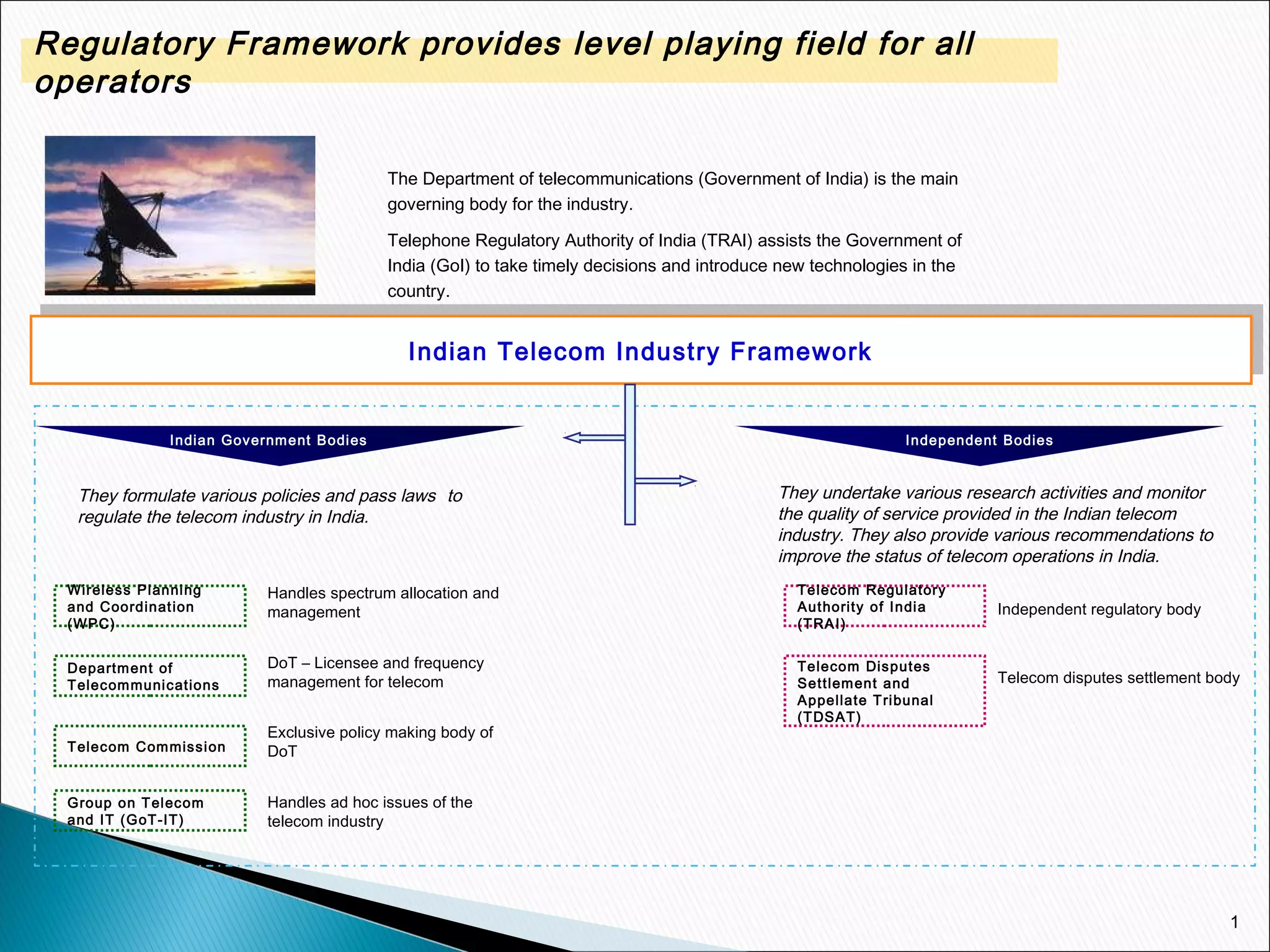
Indian Government Bodies Independent Bodies
Wireless Planning
and Coordination
(WPC)
Department of
Telecommunications
Telecom Commission
Group on Telecom
and IT (GoT-IT)
Telecom Regulatory
Authority of India
(TRAI)
Telecom Disputes
Settlement and
Appellate Tribunal
(TDSAT)
Handles spectrum allocation and
management
DoT – Licensee and frequency
management for telecom
Exclusive policy making body of
DoT
Handles ad hoc issues of the
telecom industry
Independent regulatory body
Telecom disputes settlement body
Regulatory Framework provides level playing field for all
operators
They formulate various policies and pass laws to
regulate the telecom industry in India.
They undertake various research activities and monitor
the quality of service provided in the Indian telecom
industry. They also provide various recommendations to
improve the status of telecom operations in India.
The Department of telecommunications (Government of India) is the main
governing body for the industry.
Telephone Regulatory Authority of India (TRAI) assists the Government of
India (GoI) to take timely decisions and introduce new technologies in the
country.
2
Go-ahead to
the CDMA
technology
INDIA
Private players
were allowed in
Value Added
Services
National
Telecom Policy
(NTP) was
formulated
1992
1994
1997
Independent
regulator, TRAI,
was established
NTP-99 led to
migration from high-
cost fixed license
fee to low-cost
revenue sharing
regime
1999
2000
2002
BSNL was
established
by DoT
ILD services was
opened to
competition
Internet
telephony
initiated
Reduction of
licence fees
2003
Calling Party Pays
(CPP) was
implemented
Unified Access
Licensing
(UASL) regime
was introduced
Reference
Interconnect
order was
issued
2004
Intra-circle merger
guidelines were
established
Broadband
policy 2004
was formulated
—targeting 20
million
subscribers by
2010
2005
FDI limit was
increased from
49 to 74 percent
Attempted to
boost Rural
telephony
2006
Number portability
was proposed
Decision on 3G
services (awaited)
2007
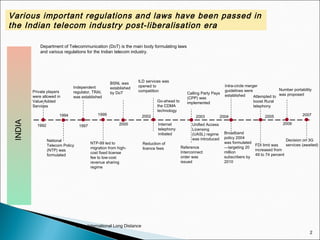
Department of Telecommunication (DoT) is the main body formulating laws
and various regulations for the Indian telecom industry.
Various important regulations and laws have been passed in
the Indian telecom industry post-liberalisation era
ILD – International Long Distance
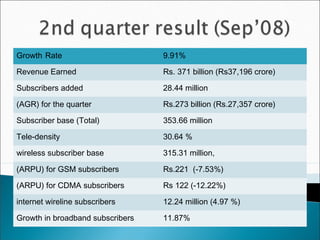
Growth Rate 9.91%
Revenue Earned Rs. 371 billion (Rs37,196 crore)
Subscribers added 28.44 million
(AGR) for the quarter Rs.273 billion (Rs.27,357 crore)
Subscriber base (Total) 353.66 million
Tele-density 30.64 %
wireless subscriber base 315.31 million,
(ARPU) for GSM subscribers Rs.221 (-7.53%)
(ARPU) for CDMA subscribers Rs 122 (-12.22%)
internet wireline subscribers 12.24 million (4.97 %)
Growth in broadband subscribers 11.87%
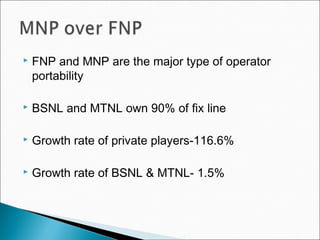
 FNP and MNP are the major type of operator
portability
 BSNL and MTNL own 90% of fix line
 Growth rate of private players-116.6%
 Growth rate of BSNL & MTNL- 1.5%
 The existing numbering for fixed phones in India is SDCA based.
Therefore if Fixed Number Portability (FNP) is implemented it will be
limited to the SDCA level only until numbering scheme is modified.
 Apart from the incumbent, other fixed line service providers are not
present in all the SDCAs of a circle, hence even after FNP implementation
in such SDCAs the subscribers will not be having the choice to change
their service providers.
 The present trends indicate that there is growth in the mobile segment and
not in the landline segment.
Step 1
Port Initiation:-
 Donor Initiation
 Recipient Initiation
In India as per TRAI recommendation ROI will be
implemented
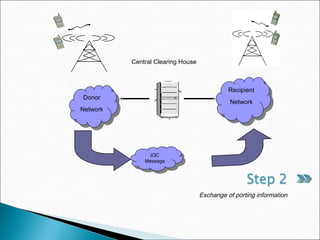
Exchange of porting information
Donor
Network
Donor
Network
Recipient
Network
Recipient
Network
IOC
Message
IOC
Message
Central Clearing House
 Port Timing
 Level of Automation and System Integration
 Cooperation between Operators:
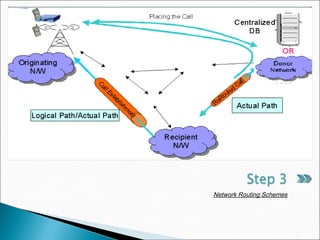
Network Routing Schemes
Although there are many variations and hybrids, solutions exists for
routing of incoming calls in a ported environment but broadly they
can be categorized in four schemes .
 Onward Routing (OR)
 Query on Release (QOR)
 Call Drop Back (CDB)
 All Call Query (ACQ)
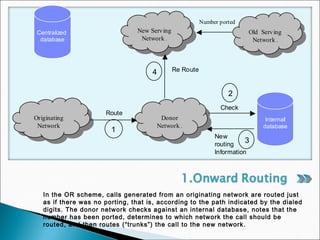
In the OR scheme, calls generated from an originating network are routed just
as if there was no porting, that is, according to the path indicated by the dialed
digits. The donor network checks against an internal database, notes that the
number has been ported, determines to which network the call should be
routed, and then routes (“trunks”) the call to the new network.
Number ported
New
routing
Information
Check
Re Route
Centralized
database
New Serving
Network .
New Serving
Network . Old Serving
Network .
Old Serving
Network .
Donor
Network .
Donor
Network .
Originating
Network
Originating
Network
Internal
database
Route
4
3
2
1
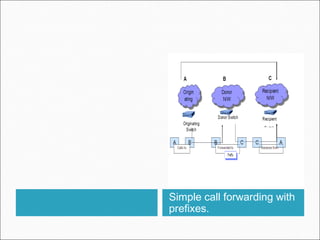
Simple call forwarding with
prefixes.
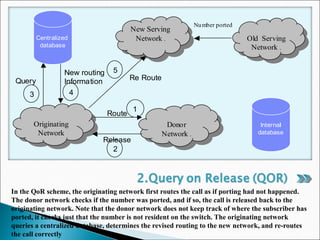
In the QoR scheme, the originating network first routes the call as if porting had not happened.
The donor network checks if the number was ported, and if so, the call is released back to the
originating network. Note that the donor network does not keep track of where the subscriber has
ported, it checks just that the number is not resident on the switch. The originating network
queries a centralized database, determines the revised routing to the new network, and re-routes
the call correctly
Number ported
New routing
InformationQuery Re Route
Centralized
database
New Serving
Network .
New Serving
Network .
Old Serving
Network .
Old Serving
Network .
Donor
Network .
Donor
Network .
Originating
Network
Originating
Network
Internal
database
Route
Release
5
43
2
1
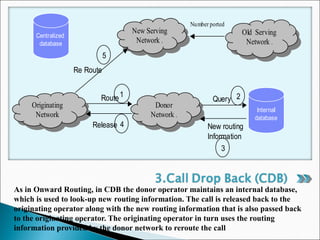
As in Onward Routing, in CDB the donor operator maintains an internal database,
which is used to look-up new routing information. The call is released back to the
originating operator along with the new routing information that is also passed back
to the originating operator. The originating operator in turn uses the routing
information provided by the donor network to reroute the call
Number ported
New routing
Information
Query
Re Route
Centralized
database
New Serving
Network .
New Serving
Network .
Old Serving
Network .
Old Serving
Network .
Donor
Network .
Donor
Network .
Originating
Network
Originating
Network
Internal
database
Route
Release
5
4
3
21
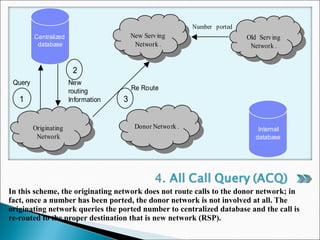
In this scheme, the originating network does not route calls to the donor network; in
fact, once a number has been ported, the donor network is not involved at all. The
originating network queries the ported number to centralized database and the call is
re-routed to the proper destination that is new network (RSP).
Number ported
New
routing
Information
Query
Re Route
Centralized
database
New Serving
Network .
New Serving
Network . Old Serving
Network .
Old Serving
Network .
Donor Network .
Donor Network .
Originating
Network
Originating
Network
Internal
database
3
2
1

RP_Presentation1

  • 1.
    1 Indian Telecom IndustryFrameworkIndian Telecom Industry Framework Indian Government Bodies Independent Bodies Wireless Planning and Coordination (WPC) Department of Telecommunications Telecom Commission Group on Telecom and IT (GoT-IT) Telecom Regulatory Authority of India (TRAI) Telecom Disputes Settlement and Appellate Tribunal (TDSAT) Handles spectrum allocation and management DoT – Licensee and frequency management for telecom Exclusive policy making body of DoT Handles ad hoc issues of the telecom industry Independent regulatory body Telecom disputes settlement body Regulatory Framework provides level playing field for all operators They formulate various policies and pass laws to regulate the telecom industry in India. They undertake various research activities and monitor the quality of service provided in the Indian telecom industry. They also provide various recommendations to improve the status of telecom operations in India. The Department of telecommunications (Government of India) is the main governing body for the industry. Telephone Regulatory Authority of India (TRAI) assists the Government of India (GoI) to take timely decisions and introduce new technologies in the country.
  • 2.
    2 Go-ahead to the CDMA technology INDIA Privateplayers were allowed in Value Added Services National Telecom Policy (NTP) was formulated 1992 1994 1997 Independent regulator, TRAI, was established NTP-99 led to migration from high- cost fixed license fee to low-cost revenue sharing regime 1999 2000 2002 BSNL was established by DoT ILD services was opened to competition Internet telephony initiated Reduction of licence fees 2003 Calling Party Pays (CPP) was implemented Unified Access Licensing (UASL) regime was introduced Reference Interconnect order was issued 2004 Intra-circle merger guidelines were established Broadband policy 2004 was formulated —targeting 20 million subscribers by 2010 2005 FDI limit was increased from 49 to 74 percent Attempted to boost Rural telephony 2006 Number portability was proposed Decision on 3G services (awaited) 2007 Department of Telecommunication (DoT) is the main body formulating laws and various regulations for the Indian telecom industry. Various important regulations and laws have been passed in the Indian telecom industry post-liberalisation era ILD – International Long Distance
  • 3.
    Growth Rate 9.91% RevenueEarned Rs. 371 billion (Rs37,196 crore) Subscribers added 28.44 million (AGR) for the quarter Rs.273 billion (Rs.27,357 crore) Subscriber base (Total) 353.66 million Tele-density 30.64 % wireless subscriber base 315.31 million, (ARPU) for GSM subscribers Rs.221 (-7.53%) (ARPU) for CDMA subscribers Rs 122 (-12.22%) internet wireline subscribers 12.24 million (4.97 %) Growth in broadband subscribers 11.87%
  • 4.
     FNP andMNP are the major type of operator portability  BSNL and MTNL own 90% of fix line  Growth rate of private players-116.6%  Growth rate of BSNL & MTNL- 1.5%
  • 5.
     The existingnumbering for fixed phones in India is SDCA based. Therefore if Fixed Number Portability (FNP) is implemented it will be limited to the SDCA level only until numbering scheme is modified.  Apart from the incumbent, other fixed line service providers are not present in all the SDCAs of a circle, hence even after FNP implementation in such SDCAs the subscribers will not be having the choice to change their service providers.  The present trends indicate that there is growth in the mobile segment and not in the landline segment.
  • 6.
    Step 1 Port Initiation:- Donor Initiation  Recipient Initiation In India as per TRAI recommendation ROI will be implemented
  • 7.
    Exchange of portinginformation Donor Network Donor Network Recipient Network Recipient Network IOC Message IOC Message Central Clearing House
  • 8.
     Port Timing Level of Automation and System Integration  Cooperation between Operators:
  • 9.
  • 10.
    Although there aremany variations and hybrids, solutions exists for routing of incoming calls in a ported environment but broadly they can be categorized in four schemes .  Onward Routing (OR)  Query on Release (QOR)  Call Drop Back (CDB)  All Call Query (ACQ)
  • 11.
    In the ORscheme, calls generated from an originating network are routed just as if there was no porting, that is, according to the path indicated by the dialed digits. The donor network checks against an internal database, notes that the number has been ported, determines to which network the call should be routed, and then routes (“trunks”) the call to the new network. Number ported New routing Information Check Re Route Centralized database New Serving Network . New Serving Network . Old Serving Network . Old Serving Network . Donor Network . Donor Network . Originating Network Originating Network Internal database Route 4 3 2 1
  • 12.
    Simple call forwardingwith prefixes.
  • 13.
    In the QoRscheme, the originating network first routes the call as if porting had not happened. The donor network checks if the number was ported, and if so, the call is released back to the originating network. Note that the donor network does not keep track of where the subscriber has ported, it checks just that the number is not resident on the switch. The originating network queries a centralized database, determines the revised routing to the new network, and re-routes the call correctly Number ported New routing InformationQuery Re Route Centralized database New Serving Network . New Serving Network . Old Serving Network . Old Serving Network . Donor Network . Donor Network . Originating Network Originating Network Internal database Route Release 5 43 2 1
  • 14.
    As in OnwardRouting, in CDB the donor operator maintains an internal database, which is used to look-up new routing information. The call is released back to the originating operator along with the new routing information that is also passed back to the originating operator. The originating operator in turn uses the routing information provided by the donor network to reroute the call Number ported New routing Information Query Re Route Centralized database New Serving Network . New Serving Network . Old Serving Network . Old Serving Network . Donor Network . Donor Network . Originating Network Originating Network Internal database Route Release 5 4 3 21
  • 15.
    In this scheme,the originating network does not route calls to the donor network; in fact, once a number has been ported, the donor network is not involved at all. The originating network queries the ported number to centralized database and the call is re-routed to the proper destination that is new network (RSP). Number ported New routing Information Query Re Route Centralized database New Serving Network . New Serving Network . Old Serving Network . Old Serving Network . Donor Network . Donor Network . Originating Network Originating Network Internal database 3 2 1