PRESENTED BY:
@LIGHT_READING #SDOAUTOMATION
Introduction and
Heavy Reading Research Presentation
James Crawshaw
P R E S E N T E D B Y :
@LIGHT_READING #CNGEUROPE
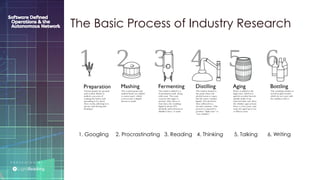
1. Googling 4. Thinking3. Reading2. Procrastinating 5. Talking 6. Writing
The Basic Process of Industry Research
P R E S E N T E D B Y :
@LIGHT_READING #CNGEUROPE
Today’s siloed approach to OSS represents a big cost burden. Operators’ legacy OSS is often made up of thousands of vendor-specific, technology-specific and service-specific
network management tools. And you need manual processes to knit these disparate tools together. Greater automation would enable telcos to reduce the cost burden of OSS which
today makes up around 15% of their operating expense. But modernizing or transforming OSS is not just about cost savings. It’s also about making operators more agile by reducing the
lead-time to launch new products and services. Currently it can take as much as a year to make the necessary changes to OSS/BSS, from billing through to activation, to launch a new
service. This stops operators from responding quickly to changing consumer interests and competitive dynamics. Greater automation in OSS would mean less manual “knitting
together” of separate OSS functions and so shorter delays to stand up new services. So NFV brings the need for new employee skills some of which are shown here. But this list is by no
means exclusive. You could add cloud computing, artificial intelligence and open source software as other key topics that telecom operations staff will need to swot up on. I think the
key thing is that by taking advantage of analytics and artificial intelligence we can remove people from a lot of the dull, minute-by-minute decision making activities in a network
operations center and redeploy their time to deal with complex exceptions that automated systems fail to resolve and that require their deep understanding of networks. One of the
key challenges NFV faces is defining the interactions between existing OSS functions and the new MANO function so that end-to-end services that cross virtual and physical networks
can deliver the required Quality of Service. The NFV management and orchestration component takes care of the NFV infrastructure, the virtual network functions and virtual network
services but it doesn’t handle services that span the physical side. Hybrid network services are likely to be the reality for most operators for the foreseeable future. So does that require a
new layer of management on top of the OSS and MANO or an enhancement to the existing OSS? A lot of vendors hope so. Another area of debate is around common information
and data models. ETSI has suggested that the Os-Ma interface should be based on TMForum’s Shared Information and Data Model, SID. My understanding though is that although
operators like the SID approach it is not that widespread in their networks today. So perhaps NFV-MANO will become a catalyst for greater adoption of SID or perhaps an alternative
approach that is easier to implement is required.
Competing open source MANO initiatives is causing a bit of uncertainty about how best to implement NFV. What’s clear from all three MANO initiatives is that while OSS aspects like
service activation and provisioning might be addressed by MANO, other aspects like service assurance, fault finding and long-term capacity planning are not. This can either be fixed
by adding to the capabilities of MANO or by greater integration with traditional OSS. So here are some high level requirements for an NFV-ready OSS. Systems should be interoperable
and modular to enable re-use. The key enablers for this are common information models, open APIs, and a catalog-driven approach. Common information models defined by
standards bodies like TMForum enable interoperability between different vendors’ solutions. Open APIs enable developers within and outside the telco to write software that interacts
with and leverages software functions that the telco already has running. A catalog-driven approach to OSS implies technical abstraction and simplification. This enables faster time-
to-market through process repeatability. What else? This is turning into a bit of a shopping list isn’t it? OSS should be highly automated – manual processes should be removed
wherever cost effective. The holy grail of automation is policy-driven, closed-loop provisioning and service assurance. OSS should be analytics led – using algorithms, machine learning
and artificial intelligence to drive continuous improvement in efficiency. OSS should be real time – operators will need a live view of network and service inventory. Batch processes for
managing the network can’t cope with the dynamic nature of NFV. Systems like inventory and service assurance need to move to near real time.
And of course, NFV-ready OSS should be capable of being virtualised itself. Most OSS runs on standard hardware anyway but running the software on virtual machines could lead to
some cost savings. APIs Just to expand on the API point. The telecom industry has been slow to automate network operations and this is largely due to the use of proprietary
Command Line Interfaces in network software as opposed to the more open APIs found in IT. This needs to change as manual operations are limiting operators' ability to compete in a
cloud-driven world where customers want network services on demand. Open, standard API implementations from organizations like TMForum and 3GPP need more work to facilitate
information collection and processing. As the chart here from TMForum shows, the range of APIs required in a telecom OSS and BSS system is vast. Just to expand on the automation
aspect - these are some examples of automation opportunities across the lifecycle of a telecom service. I won’t go through each of these now but I would highlight one of the key
opportunities is giving greater control to enterprise customers to self-serve services like VPNs. Enterprises are able to order cloud compute and storage services from Amazon, Google,
etc. very easily but when it comes to ordering a dedicated network connection to the cloud they find telcos are very slow to deliver. This is one of the key use cases for NFV – with
virtualised CPE the telco should be able to easily enable the enterprise for new services without the need to deploy and configure new equipment. Service providers also benefit from
automation by reducing the scope for manual errors which helps to lower their operating costs. Evolution Not Revolution So in summary … when it comes to preparing the telecom
industry for the shift toward virtualization - OSS should not be an afterthought.
Software Defined Memo
P R E S E N T E D B Y :
@LIGHT_READING #CNGEUROPE
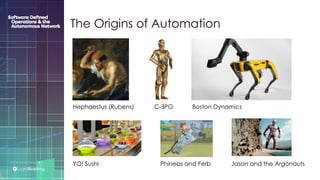
The Origins of Automation
Hephaestus (Rubens) Boston Dynamics
YO! Sushi
C-3PO
Phineas and Ferb Jason and the Argonauts
P R E S E N T E D B Y :
@LIGHT_READING #CNGEUROPE
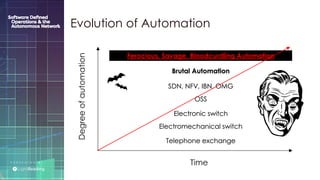
Degreeofautomation
Time
Electromechanical switch
Electronic switch
OSS
Telephone exchange
SDN, NFV, IBN, OMG
Brutal Automation
Ferocious, Savage, Bloodcurdling Automation
Evolution of Automation
P R E S E N T E D B Y :
@LIGHT_READING #CNGEUROPE
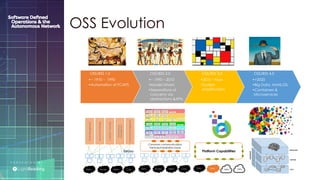
OSS Evolution
FaultManagement
ServiceProvisioning
CapacityPlanning
Performance
Management
InventoryManagement
Prem. Access Metro Core
EMSes
Prem. Access Metro Core
Common communication
Vehicle/mediation layer
Platform Capabilities
PNFs PNFs VNFs VNFs
OSS/BSS 1.0
•~ 1970 – 1990
•Automation of FCAPS
OSS/BSS 2.0
•~ 1990 – 2010
•Model Driven
•Separations of
concerns via
abstractions &APIs
OSS/BSS 3.0
•2010 – Now
•System
simplification
OSS/BSS 4.0
•>2020
•Big Data, AI/ML/DL
•Containers &
Microservices
P R E S E N T E D B Y :
@LIGHT_READING #CNGEUROPE
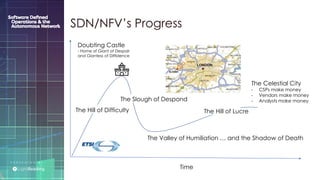
The Hill of Difficulty
The Slough of Despond
The Celestial City
- CSPs make money
- Vendors make money
- Analysts make money
The Hill of Lucre
The Valley of Humiliation … and the Shadow of Death
Doubting Castle
- Home of Giant of Despair
and Giantess of Diffidence
SDN/NFV’s Progress
Time
P R E S E N T E D B Y :
@LIGHT_READING #CNGEUROPE
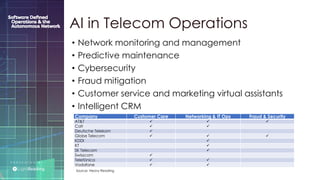
AI in Telecom Operations
• Network monitoring and management
• Predictive maintenance
• Cybersecurity
• Fraud mitigation
• Customer service and marketing virtual assistants
• Intelligent CRM
Company Customer Care Networking & IT Ops Fraud & Security
AT&T ✓ ✓ ✓
Colt ✓ ✓
Deutsche Telekom ✓
Globe Telecom ✓ ✓ ✓
KDDI ✓
KT ✓
SK Telecom ✓
Swisscom ✓
Telefónica ✓ ✓
Vodafone ✓ ✓
Source: Heavy Reading
P R E S E N T E D B Y :
@LIGHT_READING #CNGEUROPE
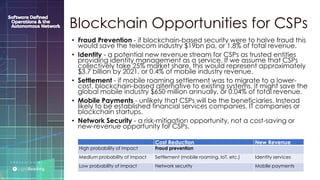
Blockchain Opportunities for CSPs
• Fraud Prevention - if blockchain-based security were to halve fraud this
would save the telecom industry $19bn pa, or 1.8% of total revenue.
• Identity - a potential new revenue stream for CSPs as trusted entities
providing identity management as a service. If we assume that CSPs
collectively take 25% market share, this would represent approximately
$3.7 billion by 2021, or 0.4% of mobile industry revenue.
• Settlement - if mobile roaming settlement was to migrate to a lower-
cost, blockchain-based alternative to existing systems, it might save the
global mobile industry $650 million annually, or 0.04% of total revenue.
• Mobile Payments - unlikely that CSPs will be the beneficiaries. Instead
likely to be established financial services companies, IT companies or
blockchain startups.
• Network Security - a risk-mitigation opportunity, not a cost-saving or
new-revenue opportunity for CSPs.
Cost Reduction New Revenue
High probability of impact Fraud prevention
Medium probability of impact Settlement (mobile roaming, IoT, etc.) Identity services
Low probability of impact Network security Mobile payments
P R E S E N T E D B Y :
@LIGHT_READING #CNGEUROPE
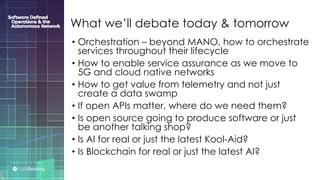
• Orchestration – beyond MANO, how to orchestrate
services throughout their lifecycle
• How to enable service assurance as we move to
5G and cloud native networks
• How to get value from telemetry and not just
create a data swamp
• If open APIs matter, where do we need them?
• Is open source going to produce software or just
be another talking shop?
• Is AI for real or just the latest Kool-Aid?
• Is Blockchain for real or just the latest AI?
What we’ll debate today & tomorrow
P R E S E N T E D B Y :
@LIGHT_READING #CNGEUROPE
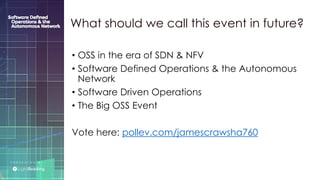
• OSS in the era of SDN & NFV
• Software Defined Operations & the Autonomous
Network
• Software Driven Operations
• The Big OSS Event
Vote here: pollev.com/jamescrawsha760
What should we call this event in future?

Software Defined Operations Research Presentation

  • 1.
    PRESENTED BY: @LIGHT_READING #SDOAUTOMATION Introductionand Heavy Reading Research Presentation James Crawshaw
  • 2.
    P R ES E N T E D B Y : @LIGHT_READING #CNGEUROPE 1. Googling 4. Thinking3. Reading2. Procrastinating 5. Talking 6. Writing The Basic Process of Industry Research
  • 3.
    P R ES E N T E D B Y : @LIGHT_READING #CNGEUROPE Today’s siloed approach to OSS represents a big cost burden. Operators’ legacy OSS is often made up of thousands of vendor-specific, technology-specific and service-specific network management tools. And you need manual processes to knit these disparate tools together. Greater automation would enable telcos to reduce the cost burden of OSS which today makes up around 15% of their operating expense. But modernizing or transforming OSS is not just about cost savings. It’s also about making operators more agile by reducing the lead-time to launch new products and services. Currently it can take as much as a year to make the necessary changes to OSS/BSS, from billing through to activation, to launch a new service. This stops operators from responding quickly to changing consumer interests and competitive dynamics. Greater automation in OSS would mean less manual “knitting together” of separate OSS functions and so shorter delays to stand up new services. So NFV brings the need for new employee skills some of which are shown here. But this list is by no means exclusive. You could add cloud computing, artificial intelligence and open source software as other key topics that telecom operations staff will need to swot up on. I think the key thing is that by taking advantage of analytics and artificial intelligence we can remove people from a lot of the dull, minute-by-minute decision making activities in a network operations center and redeploy their time to deal with complex exceptions that automated systems fail to resolve and that require their deep understanding of networks. One of the key challenges NFV faces is defining the interactions between existing OSS functions and the new MANO function so that end-to-end services that cross virtual and physical networks can deliver the required Quality of Service. The NFV management and orchestration component takes care of the NFV infrastructure, the virtual network functions and virtual network services but it doesn’t handle services that span the physical side. Hybrid network services are likely to be the reality for most operators for the foreseeable future. So does that require a new layer of management on top of the OSS and MANO or an enhancement to the existing OSS? A lot of vendors hope so. Another area of debate is around common information and data models. ETSI has suggested that the Os-Ma interface should be based on TMForum’s Shared Information and Data Model, SID. My understanding though is that although operators like the SID approach it is not that widespread in their networks today. So perhaps NFV-MANO will become a catalyst for greater adoption of SID or perhaps an alternative approach that is easier to implement is required. Competing open source MANO initiatives is causing a bit of uncertainty about how best to implement NFV. What’s clear from all three MANO initiatives is that while OSS aspects like service activation and provisioning might be addressed by MANO, other aspects like service assurance, fault finding and long-term capacity planning are not. This can either be fixed by adding to the capabilities of MANO or by greater integration with traditional OSS. So here are some high level requirements for an NFV-ready OSS. Systems should be interoperable and modular to enable re-use. The key enablers for this are common information models, open APIs, and a catalog-driven approach. Common information models defined by standards bodies like TMForum enable interoperability between different vendors’ solutions. Open APIs enable developers within and outside the telco to write software that interacts with and leverages software functions that the telco already has running. A catalog-driven approach to OSS implies technical abstraction and simplification. This enables faster time- to-market through process repeatability. What else? This is turning into a bit of a shopping list isn’t it? OSS should be highly automated – manual processes should be removed wherever cost effective. The holy grail of automation is policy-driven, closed-loop provisioning and service assurance. OSS should be analytics led – using algorithms, machine learning and artificial intelligence to drive continuous improvement in efficiency. OSS should be real time – operators will need a live view of network and service inventory. Batch processes for managing the network can’t cope with the dynamic nature of NFV. Systems like inventory and service assurance need to move to near real time. And of course, NFV-ready OSS should be capable of being virtualised itself. Most OSS runs on standard hardware anyway but running the software on virtual machines could lead to some cost savings. APIs Just to expand on the API point. The telecom industry has been slow to automate network operations and this is largely due to the use of proprietary Command Line Interfaces in network software as opposed to the more open APIs found in IT. This needs to change as manual operations are limiting operators' ability to compete in a cloud-driven world where customers want network services on demand. Open, standard API implementations from organizations like TMForum and 3GPP need more work to facilitate information collection and processing. As the chart here from TMForum shows, the range of APIs required in a telecom OSS and BSS system is vast. Just to expand on the automation aspect - these are some examples of automation opportunities across the lifecycle of a telecom service. I won’t go through each of these now but I would highlight one of the key opportunities is giving greater control to enterprise customers to self-serve services like VPNs. Enterprises are able to order cloud compute and storage services from Amazon, Google, etc. very easily but when it comes to ordering a dedicated network connection to the cloud they find telcos are very slow to deliver. This is one of the key use cases for NFV – with virtualised CPE the telco should be able to easily enable the enterprise for new services without the need to deploy and configure new equipment. Service providers also benefit from automation by reducing the scope for manual errors which helps to lower their operating costs. Evolution Not Revolution So in summary … when it comes to preparing the telecom industry for the shift toward virtualization - OSS should not be an afterthought. Software Defined Memo
  • 4.
    P R ES E N T E D B Y : @LIGHT_READING #CNGEUROPE The Origins of Automation Hephaestus (Rubens) Boston Dynamics YO! Sushi C-3PO Phineas and Ferb Jason and the Argonauts
  • 5.
    P R ES E N T E D B Y : @LIGHT_READING #CNGEUROPE Degreeofautomation Time Electromechanical switch Electronic switch OSS Telephone exchange SDN, NFV, IBN, OMG Brutal Automation Ferocious, Savage, Bloodcurdling Automation Evolution of Automation
  • 6.
    P R ES E N T E D B Y : @LIGHT_READING #CNGEUROPE OSS Evolution FaultManagement ServiceProvisioning CapacityPlanning Performance Management InventoryManagement Prem. Access Metro Core EMSes Prem. Access Metro Core Common communication Vehicle/mediation layer Platform Capabilities PNFs PNFs VNFs VNFs OSS/BSS 1.0 •~ 1970 – 1990 •Automation of FCAPS OSS/BSS 2.0 •~ 1990 – 2010 •Model Driven •Separations of concerns via abstractions &APIs OSS/BSS 3.0 •2010 – Now •System simplification OSS/BSS 4.0 •>2020 •Big Data, AI/ML/DL •Containers & Microservices
  • 7.
    P R ES E N T E D B Y : @LIGHT_READING #CNGEUROPE The Hill of Difficulty The Slough of Despond The Celestial City - CSPs make money - Vendors make money - Analysts make money The Hill of Lucre The Valley of Humiliation … and the Shadow of Death Doubting Castle - Home of Giant of Despair and Giantess of Diffidence SDN/NFV’s Progress Time
  • 8.
    P R ES E N T E D B Y : @LIGHT_READING #CNGEUROPE AI in Telecom Operations • Network monitoring and management • Predictive maintenance • Cybersecurity • Fraud mitigation • Customer service and marketing virtual assistants • Intelligent CRM Company Customer Care Networking & IT Ops Fraud & Security AT&T ✓ ✓ ✓ Colt ✓ ✓ Deutsche Telekom ✓ Globe Telecom ✓ ✓ ✓ KDDI ✓ KT ✓ SK Telecom ✓ Swisscom ✓ Telefónica ✓ ✓ Vodafone ✓ ✓ Source: Heavy Reading
  • 9.
    P R ES E N T E D B Y : @LIGHT_READING #CNGEUROPE Blockchain Opportunities for CSPs • Fraud Prevention - if blockchain-based security were to halve fraud this would save the telecom industry $19bn pa, or 1.8% of total revenue. • Identity - a potential new revenue stream for CSPs as trusted entities providing identity management as a service. If we assume that CSPs collectively take 25% market share, this would represent approximately $3.7 billion by 2021, or 0.4% of mobile industry revenue. • Settlement - if mobile roaming settlement was to migrate to a lower- cost, blockchain-based alternative to existing systems, it might save the global mobile industry $650 million annually, or 0.04% of total revenue. • Mobile Payments - unlikely that CSPs will be the beneficiaries. Instead likely to be established financial services companies, IT companies or blockchain startups. • Network Security - a risk-mitigation opportunity, not a cost-saving or new-revenue opportunity for CSPs. Cost Reduction New Revenue High probability of impact Fraud prevention Medium probability of impact Settlement (mobile roaming, IoT, etc.) Identity services Low probability of impact Network security Mobile payments
  • 10.
    P R ES E N T E D B Y : @LIGHT_READING #CNGEUROPE • Orchestration – beyond MANO, how to orchestrate services throughout their lifecycle • How to enable service assurance as we move to 5G and cloud native networks • How to get value from telemetry and not just create a data swamp • If open APIs matter, where do we need them? • Is open source going to produce software or just be another talking shop? • Is AI for real or just the latest Kool-Aid? • Is Blockchain for real or just the latest AI? What we’ll debate today & tomorrow
  • 11.
    P R ES E N T E D B Y : @LIGHT_READING #CNGEUROPE • OSS in the era of SDN & NFV • Software Defined Operations & the Autonomous Network • Software Driven Operations • The Big OSS Event Vote here: pollev.com/jamescrawsha760 What should we call this event in future?