INDUSTRIAL INTERNSHIP ON BASIC TELECOM
This presentation is by SARPAVARAPU BHARAT, Registration Number 42130425.
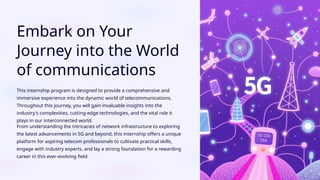
Embark on Your
Journey into the World
of communications
This internship program is designed to provide a comprehensive and
immersive experience into the dynamic world of telecommunications.
Throughout this journey, you will gain invaluable insights into the
industry's complexities, cutting-edge technologies, and the vital role it
plays in our interconnected world.
From understanding the intricacies of network infrastructure to exploring
the latest advancements in 5G and beyond, this internship offers a unique
platform for aspiring telecom professionals to cultivate practical skills,
engage with industry experts, and lay a strong foundation for a rewarding
career in this ever-evolving field.
The Telecommunications Landscape: A Global Perspective
Global Reach
The telecommunications industry is truly
global, connecting people and businesses
across continents. From the bustling streets
of Tokyo to the remote villages of Africa,
telecom networks have become the invisible
threads that bind us together, facilitating
communication and driving economic
growth.
Local Impact
Within each country, a network of telecom
providers ensures seamless connectivity,
from local calls to international roaming. The
local telecom landscape is shaped by factors
like government regulations, competition,
and technological advancements, leading to
a diverse range of services and offerings.
Technological Advancements
The telecom industry is propelled by
constant innovation. From the early days of
GSM (Global System for Mobile
Communications) to the lightning-fast
speeds of 5G, each generation of technology
brings faster speeds, greater capacity, and
new possibilities for communication and data
transfer.
Delving into Key Technologies and Protocols
1
GSM/LTE
GSM, the second generation
(2G) standard, revolutionized
mobile communication,
enabling voice calls and basic
data services. Its successor, LTE
(Long Term Evolution), brought
high-speed data and multimedia
capabilities to the forefront,
paving the way for the data-
driven world we live in today.
2
VoIP
VoIP (Voice over Internet
Protocol) emerged as a cost-
effective alternative to
traditional phone lines, allowing
voice calls to be transmitted
over the internet. It has become
widely adopted for both
personal and business
communication, offering
flexibility and affordability.
3
5G and Beyond
5G, the latest generation of
mobile communication,
promises unprecedented
speeds, ultra-low latency, and
the ability to connect a massive
number of devices. It is set to
revolutionize industries,
enabling innovations like
autonomous vehicles, smart
cities, and immersive
entertainment.
Telecom Network Infrastructure: Building the
Backbone
1 BTS, BSC, and MSC
Base Transceiver Stations
(BTS), Base Station
Controllers (BSC), and Mobile
Switching Centers (MSC) are
essential components of a
cellular network. BTS handles
communication with mobile
phones, BSC manages
multiple BTS, and MSC routes
calls between mobile users
and other networks.
2 Fiber Optics, Small Cells,
and DAS
Fiber optic cables provide
high-bandwidth backhaul,
connecting cell towers and
core network elements. Small
cells enhance coverage and
capacity in densely populated
areas. Distributed Antenna
Systems (DAS) improve
indoor coverage in large
buildings and stadiums.
3 Core and Access
Networks
The core network forms the
central part, responsible for
routing calls, managing data,
and connecting to other
networks. The access
network connects users to
the core network through
various technologies like
cellular towers, fiber optic
cables, and wireless access
points.
Telecom Software and Tools: Managing
the Network
Network Management Systems
(NMS)
NMS provides a centralized view of the
network, allowing operators to monitor
performance, detect faults, and
troubleshoot issues. They offer real-time
insights into network health, traffic
patterns, and device status.
Operations Support Systems (OSS)
OSS encompasses a suite of tools for
managing network operations, including
provisioning new services, managing
customer accounts, and analyzing network
performance. They streamline operational
processes and ensure efficient service
delivery.
Billing Systems
Billing systems handle the complex task of customer billing and charging. They track usage,
generate invoices, process payments, and manage customer accounts, ensuring accurate and
timely billing for telecom services.
Skills and Knowledge Acquired: Your
Telecom Toolkit
1 Network Setup and
Configuration
Gain practical experience in
configuring network devices, setting
up connections, and optimizing
network parameters. You'll learn
how to build and maintain the
infrastructure that enables
communication.
2 Fault Detection and
Troubleshooting
Develop the skills to identify,
diagnose, and resolve network
issues. You'll learn to use diagnostic
tools, analyze error logs, and
implement solutions to keep the
network running smoothly.
3 Customer Service and Quality Standards
Understand the importance of delivering exceptional customer service in the
telecom industry. Learn about industry-standard metrics for measuring network
performance and quality of service.
Inside Telecom Operations and
Maintenance
Network Operations Center (NOC)
Experience the nerve center of a telecom company - the NOC. Witness how teams
monitor network performance, respond to alarms, and ensure uninterrupted service
for millions of users.
Fault Management
Learn about proactive and reactive strategies for managing network faults,
minimizing downtime, and restoring services quickly. Understand the importance of
escalation procedures and root cause analysis.
Performance Monitoring and Optimization
Explore tools and techniques used to monitor network health, identify bottlenecks,
and optimize performance. Gain insights into capacity planning and ensuring a
seamless user experience.
Emerging Technologies: Shaping the Future of Telecom
5G and Beyond
Explore the capabilities of 5G and its potential to revolutionize
industries. Discuss the challenges of 5G deployment and the
ongoing research into future generations of wireless technology.
NFV and SDN
Understand how Network Function Virtualization (NFV) and
Software-Defined Networking (SDN) are transforming network
architecture, enabling flexibility, scalability, and cost-efficiency.
Discuss their role in enabling new services and applications.
Navigating Regulations and Compliance
Regulatory Bodies
Learn about the role of regulatory
bodies like the TRAI (Telecom
Regulatory Authority of India) and FCC
(Federal Communications Commission)
in shaping the telecom landscape,
ensuring fair competition, and
protecting consumer interests.
Spectrum Management
Understand the importance of
spectrum allocation and licensing in
deploying wireless networks. Discuss
the challenges of managing a scarce
resource and the role of auctions and
regulations in ensuring equitable
access to spectrum.
Privacy and Security
Explore the critical aspects of privacy
and security in telecommunications.
Discuss data protection regulations,
encryption methods, and the
importance of safeguarding user data
from unauthorized access and cyber
threats.
Telecom in Action: Real-World Applications and Impact
Mobile Networks
From connecting families and friends to enabling mobile banking and e-commerce, mobile networks have become an integral part of our daily lives. Explore the evolution of
mobile technology and its impact on society.
Internet Service Providers (ISPs)
ISPs provide the gateway to the internet, enabling access to information, entertainment, and communication. Learn about different types of internet access technologies and the
role of ISPs in bridging the digital divide.
Transforming Industries
Telecom plays a vital role in supporting industries like healthcare (telemedicine), education (e-learning), and transportation (connected vehicles). Explore how telecom is enabling
innovation and efficiency across various sectors.
INTERSHIP CERTIFICATE
CERTIFICATE
CERTIFICATE
CERTIFICATE

INDUSTRIAL-INTERNSHIP-ON-BASIC-TELECOM.pptx

  • 1.
    INDUSTRIAL INTERNSHIP ONBASIC TELECOM This presentation is by SARPAVARAPU BHARAT, Registration Number 42130425.
  • 2.
    Embark on Your Journeyinto the World of communications This internship program is designed to provide a comprehensive and immersive experience into the dynamic world of telecommunications. Throughout this journey, you will gain invaluable insights into the industry's complexities, cutting-edge technologies, and the vital role it plays in our interconnected world. From understanding the intricacies of network infrastructure to exploring the latest advancements in 5G and beyond, this internship offers a unique platform for aspiring telecom professionals to cultivate practical skills, engage with industry experts, and lay a strong foundation for a rewarding career in this ever-evolving field.
  • 3.
    The Telecommunications Landscape:A Global Perspective Global Reach The telecommunications industry is truly global, connecting people and businesses across continents. From the bustling streets of Tokyo to the remote villages of Africa, telecom networks have become the invisible threads that bind us together, facilitating communication and driving economic growth. Local Impact Within each country, a network of telecom providers ensures seamless connectivity, from local calls to international roaming. The local telecom landscape is shaped by factors like government regulations, competition, and technological advancements, leading to a diverse range of services and offerings. Technological Advancements The telecom industry is propelled by constant innovation. From the early days of GSM (Global System for Mobile Communications) to the lightning-fast speeds of 5G, each generation of technology brings faster speeds, greater capacity, and new possibilities for communication and data transfer.
  • 4.
    Delving into KeyTechnologies and Protocols 1 GSM/LTE GSM, the second generation (2G) standard, revolutionized mobile communication, enabling voice calls and basic data services. Its successor, LTE (Long Term Evolution), brought high-speed data and multimedia capabilities to the forefront, paving the way for the data- driven world we live in today. 2 VoIP VoIP (Voice over Internet Protocol) emerged as a cost- effective alternative to traditional phone lines, allowing voice calls to be transmitted over the internet. It has become widely adopted for both personal and business communication, offering flexibility and affordability. 3 5G and Beyond 5G, the latest generation of mobile communication, promises unprecedented speeds, ultra-low latency, and the ability to connect a massive number of devices. It is set to revolutionize industries, enabling innovations like autonomous vehicles, smart cities, and immersive entertainment.
  • 5.
    Telecom Network Infrastructure:Building the Backbone 1 BTS, BSC, and MSC Base Transceiver Stations (BTS), Base Station Controllers (BSC), and Mobile Switching Centers (MSC) are essential components of a cellular network. BTS handles communication with mobile phones, BSC manages multiple BTS, and MSC routes calls between mobile users and other networks. 2 Fiber Optics, Small Cells, and DAS Fiber optic cables provide high-bandwidth backhaul, connecting cell towers and core network elements. Small cells enhance coverage and capacity in densely populated areas. Distributed Antenna Systems (DAS) improve indoor coverage in large buildings and stadiums. 3 Core and Access Networks The core network forms the central part, responsible for routing calls, managing data, and connecting to other networks. The access network connects users to the core network through various technologies like cellular towers, fiber optic cables, and wireless access points.
  • 6.
    Telecom Software andTools: Managing the Network Network Management Systems (NMS) NMS provides a centralized view of the network, allowing operators to monitor performance, detect faults, and troubleshoot issues. They offer real-time insights into network health, traffic patterns, and device status. Operations Support Systems (OSS) OSS encompasses a suite of tools for managing network operations, including provisioning new services, managing customer accounts, and analyzing network performance. They streamline operational processes and ensure efficient service delivery. Billing Systems Billing systems handle the complex task of customer billing and charging. They track usage, generate invoices, process payments, and manage customer accounts, ensuring accurate and timely billing for telecom services.
  • 7.
    Skills and KnowledgeAcquired: Your Telecom Toolkit 1 Network Setup and Configuration Gain practical experience in configuring network devices, setting up connections, and optimizing network parameters. You'll learn how to build and maintain the infrastructure that enables communication. 2 Fault Detection and Troubleshooting Develop the skills to identify, diagnose, and resolve network issues. You'll learn to use diagnostic tools, analyze error logs, and implement solutions to keep the network running smoothly. 3 Customer Service and Quality Standards Understand the importance of delivering exceptional customer service in the telecom industry. Learn about industry-standard metrics for measuring network performance and quality of service.
  • 8.
    Inside Telecom Operationsand Maintenance Network Operations Center (NOC) Experience the nerve center of a telecom company - the NOC. Witness how teams monitor network performance, respond to alarms, and ensure uninterrupted service for millions of users. Fault Management Learn about proactive and reactive strategies for managing network faults, minimizing downtime, and restoring services quickly. Understand the importance of escalation procedures and root cause analysis. Performance Monitoring and Optimization Explore tools and techniques used to monitor network health, identify bottlenecks, and optimize performance. Gain insights into capacity planning and ensuring a seamless user experience.
  • 9.
    Emerging Technologies: Shapingthe Future of Telecom 5G and Beyond Explore the capabilities of 5G and its potential to revolutionize industries. Discuss the challenges of 5G deployment and the ongoing research into future generations of wireless technology. NFV and SDN Understand how Network Function Virtualization (NFV) and Software-Defined Networking (SDN) are transforming network architecture, enabling flexibility, scalability, and cost-efficiency. Discuss their role in enabling new services and applications.
  • 10.
    Navigating Regulations andCompliance Regulatory Bodies Learn about the role of regulatory bodies like the TRAI (Telecom Regulatory Authority of India) and FCC (Federal Communications Commission) in shaping the telecom landscape, ensuring fair competition, and protecting consumer interests. Spectrum Management Understand the importance of spectrum allocation and licensing in deploying wireless networks. Discuss the challenges of managing a scarce resource and the role of auctions and regulations in ensuring equitable access to spectrum. Privacy and Security Explore the critical aspects of privacy and security in telecommunications. Discuss data protection regulations, encryption methods, and the importance of safeguarding user data from unauthorized access and cyber threats.
  • 11.
    Telecom in Action:Real-World Applications and Impact Mobile Networks From connecting families and friends to enabling mobile banking and e-commerce, mobile networks have become an integral part of our daily lives. Explore the evolution of mobile technology and its impact on society. Internet Service Providers (ISPs) ISPs provide the gateway to the internet, enabling access to information, entertainment, and communication. Learn about different types of internet access technologies and the role of ISPs in bridging the digital divide. Transforming Industries Telecom plays a vital role in supporting industries like healthcare (telemedicine), education (e-learning), and transportation (connected vehicles). Explore how telecom is enabling innovation and efficiency across various sectors.
  • 12.
  • 13.
  • 14.
  • 15.