Routing
An Engineering Approach to Computer Networking
What is it?
■
■ Process of finding a path from a source to every destination in
Process of finding a path from a source to every destination in
the network
the network
■
■ Suppose you want to connect to Antarctica from your desktop
Suppose you want to connect to Antarctica from your desktop
◆
◆ what route should you take?
what route should you take?
◆
◆ does a shorter route exist?
does a shorter route exist?
◆
◆ what if a link along the route goes down?
what if a link along the route goes down?
◆
◆ what if you’re on a mobile wireless link?
what if you’re on a mobile wireless link?
■
■ Routing deals with these types of issues
Routing deals with these types of issues
Basics
■
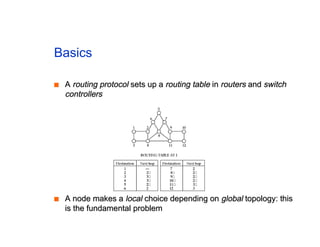
■ A
A routing protocol
routing protocol sets up a
sets up a routing table
routing table in
in routers
routers and
and switch
switch
controllers
controllers
■
■ A node makes a
A node makes a local
local choice depending on
choice depending on global
global topology: this
topology: this
is the fundamental
is the fundamental problem
problem
Key problem
■
■ How to make correct local decisions?
How to make correct local decisions?
◆
◆ each router must know
each router must know something
something about global state
■
■ Global state
Global state
◆
◆ inherently large
inherently large
◆
◆ dynamic
dynamic
◆
◆ hard to collect
hard to collect
■
■ A routing protocol must intelligently summarize relevant
A routing protocol must intelligently summarize relevant
information
information
Requirements
■
■ Minimize routing table space
Minimize routing table space
◆
◆ fast to look up
fast to look up
◆
◆ less to exchange
less to exchange
■
■ Minimize number and frequency of control messages
Minimize number and frequency of control messages
■
■ Robustness: avoid
Robustness: avoid
◆
◆ black holes
black holes
◆
◆ loops
loops
◆
◆ oscillations
oscillations
■
■ Use optimal path
Use optimal path
Choices
■
■ Centralized vs. distributed routing
Centralized vs. distributed routing
◆
◆ centralized is simpler, but prone to failure and congestion
centralized is simpler, but prone to failure and congestion
■
■ Source-based vs. hop-by-hop
Source-based vs. hop-by-hop
◆
◆ how much is in packet header?
how much is in packet header?
◆
◆ Intermediate:
Intermediate: loose source route
loose source route
■
■ Stochastic vs. deterministic
Stochastic vs. deterministic
◆
◆ stochastic spreads load, avoiding oscillations, but misorders
stochastic spreads load, avoiding oscillations, but misorders
■
■ Single vs. multiple path
Single vs. multiple path
◆
◆ primary and alternative paths (compare with stochastic)
primary and alternative paths (compare with stochastic)
■
■ State-dependent vs. state-independent
State-dependent vs. state-independent
◆
◆ do routes depend on current network state (e.g. delay)
do routes depend on current network state (e.g. delay)
Outline
■
■ Routing in telephone networks
Routing in telephone networks
■
■ Distance-vector routing
Distance-vector routing
■
■ Link-state routing
Link-state routing
■
■ Choosing link costs
Choosing link costs
■
■ Hierarchical routing
Hierarchical routing
■
■ Internet routing protocols
Internet routing protocols
■
■ Routing within a broadcast LAN
Routing within a broadcast LAN
■
■ Multicast routing
Multicast routing
■
■ Routing with policy constraints
Routing with policy constraints
■
■ Routing for mobile hosts
Routing for mobile hosts
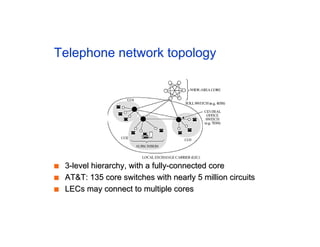
Telephone network topology
■
■ 3-level hierarchy, with a fully-connected core
3-level hierarchy, with a fully-connected core
■
■ AT&T: 135 core switches with nearly 5 million circuits
AT&T: 135 core switches with nearly 5 million circuits
■
■ LECs may connect to multiple cores
LECs may connect to multiple cores
Routing algorithm
■
■ If endpoints are within same CO, directly connect
If endpoints are within same CO, directly connect
■
■ If call is between COs in same LEC, use one-hop path between
If call is between COs in same LEC, use one-hop path between
COs
COs
■
■ Otherwise send call to one of the cores
Otherwise send call to one of the cores
■
■ Only major decision is at toll switch
Only major decision is at toll switch
◆
◆ one-hop or two-hop path to the destination toll switch
one-hop or two-hop path to the destination toll switch
◆
◆ (why don’t we need longer paths?)
(why don’t we need longer paths?)
■
■ Essence of problem
Essence of problem
◆
◆ which two-hop path to use if one-hop path is full
which two-hop path to use if one-hop path is full
Features of telephone network routing
■
■ Stable load
Stable load
◆
◆ can predict pairwise load throughout the day
can predict pairwise load throughout the day
◆
◆ can choose optimal routes in advance
can choose optimal routes in advance
■
■ Extremely reliable switches
Extremely reliable switches
◆
◆ downtime is less than a few minutes per year
downtime is less than a few minutes per year
◆
◆ can assume that a chosen route is available
can assume that a chosen route is available
◆
◆ can’t do this in the Internet
can’t do this in the Internet
■
■ Single organization controls entire core
Single organization controls entire core
◆
◆ can collect global statistics and implement global changes
can collect global statistics and implement global changes
■
■ Very highly connected network
Very highly connected network
■
■ Connections require resources (but all need the same)
Connections require resources (but all need the same)
The cost of simplicity
■
■ Simplicity of routing a historical necessity
Simplicity of routing a historical necessity
■
■ But requires
But requires
◆
◆ reliability in every component
reliability in every component
◆
◆ logically fully-connected core
logically fully-connected core
■
■ Can we build an alternative that has same features as the
Can we build an alternative that has same features as the
telephone network, but is cheaper because it uses more
sophisticated routing?
◆
◆ Yes: that is one of the motivations for ATM
Yes: that is one of the motivations for ATM
◆
◆ But 80% of the cost is in the local loop
But 80% of the cost is in the local loop
✦
✦ not affected by changes in core routing
not affected by changes in core routing
◆
◆ Moreover, many of the software systems assume topology
Moreover, many of the software systems assume topology
✦
✦ too expensive to change them
too expensive to change them
Dynamic nonhierarchical routing (DNHR)
■
■ Simplest core routing protocol
Simplest core routing protocol
◆
◆ accept call if one-hop path is available, else drop
accept call if one-hop path is available, else drop
■
■ DNHR
DNHR
◆
◆ divides day into around 10-periods
divides day into around 10-periods
◆
◆ in each period, each toll switch is assigned a primary one-
in each period, each toll switch is assigned a primary one-
hop path and a list of alternatives
◆
◆ can overflow to alternative if needed
can overflow to alternative if needed
◆
◆ drop only if all alternate paths are busy
drop only if all alternate paths are busy
✦
✦ crankback
crankback
■
■ Problems
Problems
◆
◆ does not work well if actual traffic differs from prediction
does not work well if actual traffic differs from prediction
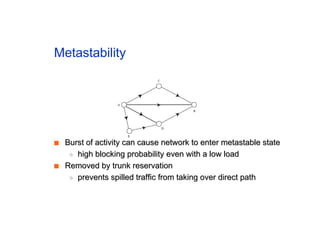
Metastability
■
■ Burst of activity can cause network to enter metastable state
Burst of activity can cause network to enter metastable state
◆
◆ high blocking probability even with a low load
high blocking probability even with a low load
■
■ Removed by trunk reservation
Removed by trunk reservation
◆
◆ prevents spilled traffic from taking over direct path
prevents spilled traffic from taking over direct path
Trunk status map routing (TSMR)
■
■ DNHR measures traffic once a week
DNHR measures traffic once a week
■
■ TSMR updates measurements once an hour or so
TSMR updates measurements once an hour or so
◆
◆ only if it changes “significantly”
only if it changes “significantly”
■
■ List of alternative paths is more up to date
List of alternative paths is more up to date
Real-time network routing (RTNR)
■
■ No centralized control
No centralized control
■
■ Each toll switch maintains a list of lightly loaded links
Each toll switch maintains a list of lightly loaded links
■
■ Intersection of source and destination lists gives set of lightly
Intersection of source and destination lists gives set of lightly
loaded paths
loaded paths
■
■ Example
Example
◆
◆ At A, list is C, D, E => links AC, AD, AE lightly loaded
At A, list is C, D, E => links AC, AD, AE lightly loaded
◆
◆ At B, list is D, F, G => links BD, BF, BG lightly loaded
At B, list is D, F, G => links BD, BF, BG lightly loaded
◆
◆ A asks B for its list
A asks B for its list
◆
◆ Intersection = D => AD and BD lightly loaded => ADB lightly
Intersection = D => AD and BD lightly loaded => ADB lightly
loaded => it is a good alternative path
■
■ Very effective in practice: only about a couple of calls blocked in
Very effective in practice: only about a couple of calls blocked in
core out of about 250 million calls attempted every day
Outline
■
■ Routing in telephone networks
Routing in telephone networks
■
■ Distance-vector routing
Distance-vector routing
■
■ Link-state routing
Link-state routing
■
■ Choosing link costs
Choosing link costs
■
■ Hierarchical routing
Hierarchical routing
■
■ Internet routing protocols
Internet routing protocols
■
■ Routing within a broadcast LAN
Routing within a broadcast LAN
■
■ Multicast routing
Multicast routing
■
■ Routing with policy constraints
Routing with policy constraints
■
■ Routing for mobile hosts
Routing for mobile hosts
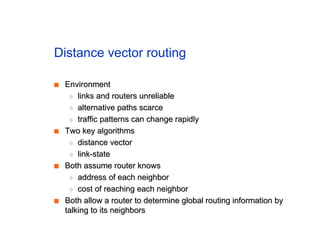
Distance vector routing
■
■ Environment
Environment
◆
◆ links and routers unreliable
links and routers unreliable
◆
◆ alternative paths scarce
alternative paths scarce
◆
◆ traffic patterns can change rapidly
traffic patterns can change rapidly
■
■ Two key algorithms
Two key algorithms
◆
◆ distance vector
distance vector
◆
◆ link-state
link-state
■
■ Both assume router knows
Both assume router knows
◆
◆ address of each neighbor
address of each neighbor
◆
◆ cost of reaching each neighbor
cost of reaching each neighbor
■
■ Both allow a router to determine global routing information by
Both allow a router to determine global routing information by
talking to its neighbors
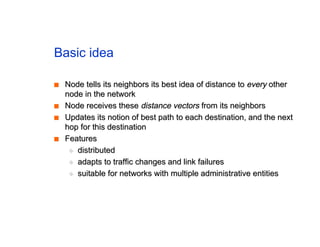
Basic idea
■
■ Node tells its neighbors its best idea of distance to
Node tells its neighbors its best idea of distance to every
every other
other
node in the network
node in the network
■
■ Node receives these
Node receives these distance vectors
distance vectors from its neighbors
from its neighbors
■
■ Updates its notion of best path to each destination, and the next
Updates its notion of best path to each destination, and the next
hop for this destination
■
■ Features
Features
◆
◆ distributed
distributed
◆
◆ adapts to traffic changes and link failures
adapts to traffic changes and link failures
◆
◆ suitable for networks with multiple administrative entities
suitable for networks with multiple administrative entities
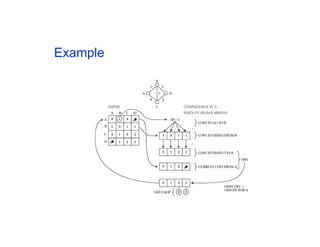
Example
Ô
Ô
2
Ô
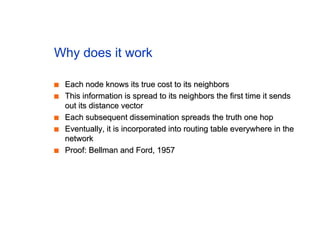
Why does it work
■
■ Each node knows its true cost to its neighbors
Each node knows its true cost to its neighbors
■
■ This information is spread to its neighbors the first time it sends
This information is spread to its neighbors the first time it sends
out its distance vector
■
■ Each subsequent dissemination spreads the truth one hop
Each subsequent dissemination spreads the truth one hop
■
■ Eventually, it is incorporated into routing table everywhere in the
Eventually, it is incorporated into routing table everywhere in the
network
network
■
■ Proof: Bellman and Ford, 1957
Proof: Bellman and Ford, 1957
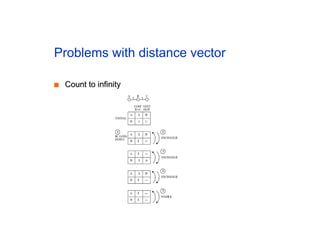
Problems with distance vector
■
■ Count to infinity
Count to infinity
Dealing with the problem
■
■ Path vector
Path vector
◆
◆ DV carries path to reach each destination
DV carries path to reach each destination
■
■ Split horizon
Split horizon
◆
◆ never tell neighbor cost to X if neighbor is next hop to X
never tell neighbor cost to X if neighbor is next hop to X
◆
◆ doesn’t work for 3-way count to infinity (see exercise)
doesn’t work for 3-way count to infinity (see exercise)
■
■ Triggered updates
Triggered updates
◆
◆ exchange routes on change, instead of on timer
exchange routes on change, instead of on timer
◆
◆ faster count up to infinity
faster count up to infinity
■
■ More complicated
More complicated
◆
◆ source tracing
source tracing
◆
◆ DUAL
DUAL
Outline
■
■ Routing in telephone networks
Routing in telephone networks
■
■ Distance-vector routing
Distance-vector routing
■
■ Link-state routing
Link-state routing
■
■ Choosing link costs
Choosing link costs
■
■ Hierarchical routing
Hierarchical routing
■
■ Internet routing protocols
Internet routing protocols
■
■ Routing within a broadcast LAN
Routing within a broadcast LAN
■
■ Multicast routing
Multicast routing
■
■ Routing with policy constraints
Routing with policy constraints
■
■ Routing for mobile hosts
Routing for mobile hosts
Link state routing
■
■ In distance vector, router knows only
In distance vector, router knows only cost
cost to each destination
to each destination
◆
◆ hides information, causing problems
hides information, causing problems
■
■ In link state, router knows entire network topology, and
In link state, router knows entire network topology, and
computes shortest path by itself
◆
◆ independent computation of routes
independent computation of routes
◆
◆ potentially less robust
potentially less robust
■
■ Key elements
Key elements
◆
◆ topology dissemination
topology dissemination
◆
◆ computing shortest routes
computing shortest routes
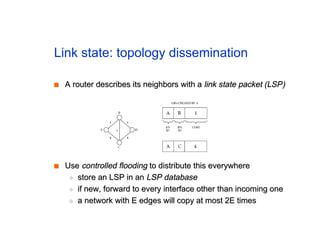
Link state: topology dissemination
■
■ A router describes its neighbors with a
A router describes its neighbors with a link state packet (LSP)
link state packet (LSP)
■
■ Use
Use controlled flooding
controlled flooding to distribute this everywhere
to distribute this everywhere
◆
◆ store an LSP in an
store an LSP in an LSP database
LSP database
◆
◆ if new, forward to every interface other than incoming one
if new, forward to every interface other than incoming one
◆
◆ a network with E edges will copy at most 2E times
a network with E edges will copy at most 2E times
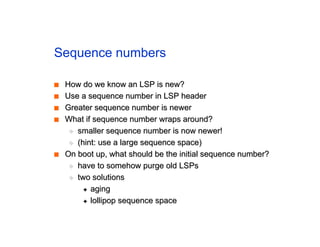
Sequence numbers
■
■ How do we know an LSP is new?
How do we know an LSP is new?
■
■ Use a sequence number in LSP header
Use a sequence number in LSP header
■
■ Greater sequence number is newer
Greater sequence number is newer
■
■ What if sequence number wraps around?
What if sequence number wraps around?
◆
◆ smaller sequence number is now newer!
smaller sequence number is now newer!
◆
◆ (hint: use a large sequence space)
(hint: use a large sequence space)
■
■ On boot up, what should be the initial sequence number?
On boot up, what should be the initial sequence number?
◆
◆ have to somehow purge old LSPs
have to somehow purge old LSPs
◆
◆ two solutions
two solutions
✦
✦ aging
aging
✦
✦ lollipop sequence space
lollipop sequence space
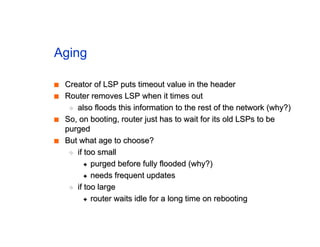
Aging
■
■ Creator of LSP puts timeout value in the header
Creator of LSP puts timeout value in the header
■
■ Router removes LSP when it times out
Router removes LSP when it times out
◆
◆ also floods this information to the rest of the network (why?)
also floods this information to the rest of the network (why?)
■
■ So, on booting, router just has to wait for its old LSPs to be
So, on booting, router just has to wait for its old LSPs to be
purged
purged
■
■ But what age to choose?
But what age to choose?
◆
◆ if too small
if too small
✦
✦ purged before fully flooded (why?)
purged before fully flooded (why?)
✦
✦ needs frequent updates
needs frequent updates
◆
◆ if too large
if too large
✦
✦ router waits idle for a long time on rebooting
router waits idle for a long time on rebooting
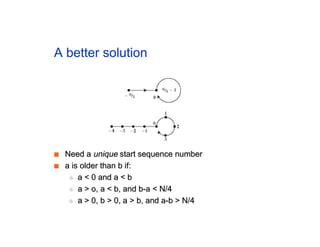
A better solution
■
■ Need a
Need a unique
unique start sequence number
start sequence number
■
■ a is older than b if:
a is older than b if:
◆
◆ a < 0 and a < b
a < 0 and a < b
◆
◆ a > o, a < b, and b-a < N/4
a > o, a < b, and b-a < N/4
◆
◆ a > 0, b > 0, a > b, and a-b > N/4
a > 0, b > 0, a > b, and a-b > N/4
More on lollipops
■
■ If a router gets an older LSP, it tells the sender about the newer
If a router gets an older LSP, it tells the sender about the newer
LSP
LSP
■
■ So, newly booted router quickly finds out its most recent
So, newly booted router quickly finds out its most recent
sequence number
sequence number
■
■ It jumps to one more than that
It jumps to one more than that
■
■ -N/2 is a
-N/2 is a trigger
trigger to evoke a response from community memory
to evoke a response from community memory
Recovering from a partition
■
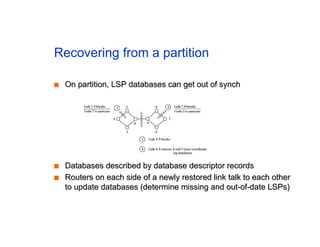
■ On partition, LSP databases can get out of synch
On partition, LSP databases can get out of synch
■
■ Databases described by database descriptor records
Databases described by database descriptor records
■
■ Routers on each side of a newly restored link talk to each other
Routers on each side of a newly restored link talk to each other
to update databases (determine missing and out-of-date LSPs)
Router failure
■
■ How to detect?
How to detect?
◆
◆ HELLO protocol
HELLO protocol
■
■ HELLO packet may be corrupted
HELLO packet may be corrupted
◆
◆ so age anyway
so age anyway
◆
◆ on a timeout, flood the information
on a timeout, flood the information
Securing LSP databases
■
■ LSP databases
LSP databases must
must be consistent to avoid routing loops
be consistent to avoid routing loops
■
■ Malicious agent may inject spurious LSPs
Malicious agent may inject spurious LSPs
■
■ Routers must actively protect their databases
Routers must actively protect their databases
◆
◆ checksum LSPs
checksum LSPs
◆
◆ ack LSP exchanges
ack LSP exchanges
◆
◆ passwords
passwords
Computing shortest paths
■
■ Basic idea
Basic idea
◆
◆ maintain a set of nodes P to whom we know shortest path
maintain a set of nodes P to whom we know shortest path
◆
◆ consider every node one hop away from nodes in P = T
consider every node one hop away from nodes in P = T
◆
◆ find every way in which to reach a given node in T, and
find every way in which to reach a given node in T, and
choose shortest one
choose shortest one
◆
◆ then add this node to P
then add this node to P
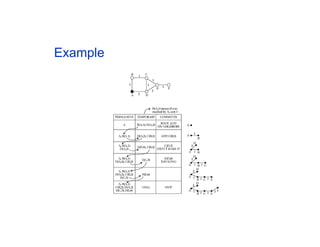
Example
Link state vs. distance vector
■
■ Criteria
Criteria
◆
◆ stability
stability
◆
◆ multiple routing metrics
multiple routing metrics
◆
◆ convergence time after a change
convergence time after a change
◆
◆ communication overhead
communication overhead
◆
◆ memory overhead
memory overhead
■
■ Both are evenly matched
Both are evenly matched
■
■ Both widely used
Both widely used
Outline
■
■ Routing in telephone networks
Routing in telephone networks
■
■ Distance-vector routing
Distance-vector routing
■
■ Link-state routing
Link-state routing
■
■ Choosing link costs
Choosing link costs
■
■ Hierarchical routing
Hierarchical routing
■
■ Internet routing protocols
Internet routing protocols
■
■ Routing within a broadcast LAN
Routing within a broadcast LAN
■
■ Multicast routing
Multicast routing
■
■ Routing with policy constraints
Routing with policy constraints
■
■ Routing for mobile hosts
Routing for mobile hosts
Choosing link costs
■
■ Shortest path uses link costs
Shortest path uses link costs
■
■ Can use either static of dynamic costs
Can use either static of dynamic costs
■
■ In both cases: cost determine amount of traffic on the link
In both cases: cost determine amount of traffic on the link
◆
◆ lower the cost, more the expected traffic
lower the cost, more the expected traffic
◆
◆ if dynamic cost depends on load, can have oscillations
if dynamic cost depends on load, can have oscillations
(why?)
(why?)
Static metrics
■
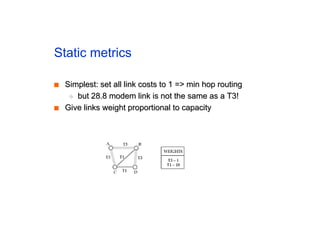
■ Simplest: set all link costs to 1 => min hop routing
Simplest: set all link costs to 1 => min hop routing
◆
◆ but 28.8 modem link is not the same as a T3!
but 28.8 modem link is not the same as a T3!
■
■ Give links weight proportional to capacity
Give links weight proportional to capacity
Dynamic metrics
■
■ A first cut (ARPAnet original)
A first cut (ARPAnet original)
■
■ Cost proportional to length of router queue
Cost proportional to length of router queue
◆
◆ independent of link capacity
independent of link capacity
■
■ Many problems when network is loaded
Many problems when network is loaded
◆
◆ queue length averaged over a small time => transient spikes
queue length averaged over a small time => transient spikes
caused major rerouting
◆
◆ wide dynamic range => network completely ignored paths
wide dynamic range => network completely ignored paths
with high costs
with high costs
◆
◆ queue length assumed to predict future loads => opposite is
queue length assumed to predict future loads => opposite is
true (why?)
true (why?)
◆
◆ no restriction on successively reported costs => oscillations
no restriction on successively reported costs => oscillations
◆
◆ all tables computed simultaneously => low cost link flooded
all tables computed simultaneously => low cost link flooded
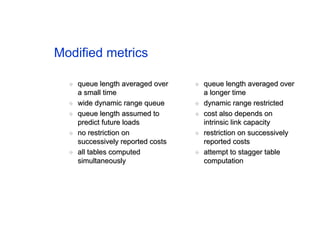
Modified metrics
◆
◆ queue length averaged over
queue length averaged over
a small time
a small time
◆
◆ wide dynamic range queue
wide dynamic range queue
◆
◆ queue length assumed to
queue length assumed to
predict future loads
◆
◆ no restriction on
no restriction on
successively reported costs
◆
◆ all tables computed
all tables computed
simultaneously
simultaneously
◆
◆ queue length averaged over
queue length averaged over
a longer time
a longer time
◆
◆ dynamic range restricted
dynamic range restricted
◆
◆ cost also depends on
cost also depends on
intrinsic link capacity
◆
◆ restriction on successively
restriction on successively
reported costs
reported costs
◆
◆ attempt to stagger table
attempt to stagger table
computation
computation
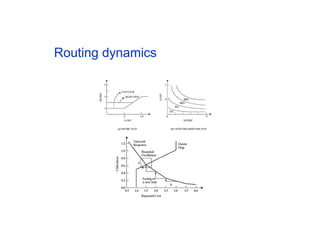
Routing dynamics
Outline
■
■ Routing in telephone networks
Routing in telephone networks
■
■ Distance-vector routing
Distance-vector routing
■
■ Link-state routing
Link-state routing
■
■ Choosing link costs
Choosing link costs
■
■ Hierarchical routing
Hierarchical routing
■
■ Internet routing protocols
Internet routing protocols
■
■ Routing within a broadcast LAN
Routing within a broadcast LAN
■
■ Multicast routing
Multicast routing
■
■ Routing with policy constraints
Routing with policy constraints
■
■ Routing for mobile hosts
Routing for mobile hosts
Hierarchical routing
■
■ Large networks need large routing tables
Large networks need large routing tables
◆
◆ more computation to find shortest paths
more computation to find shortest paths
◆
◆ more bandwidth wasted on exchanging DVs and LSPs
more bandwidth wasted on exchanging DVs and LSPs
■
■ Solution:
Solution:
◆
◆ hierarchical routing
hierarchical routing
■
■ Key idea
Key idea
◆
◆ divide network into a set of domains
divide network into a set of domains
◆
◆ gateways connect domains
gateways connect domains
◆
◆ computers within domain unaware of outside computers
computers within domain unaware of outside computers
◆
◆ gateways know only about other gateways
gateways know only about other gateways
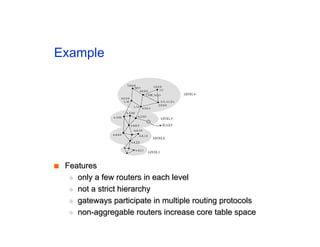
Example
■
■ Features
Features
◆
◆ only a few routers in each level
only a few routers in each level
◆
◆ not a strict hierarchy
not a strict hierarchy
◆
◆ gateways participate in multiple routing protocols
gateways participate in multiple routing protocols
◆
◆ non-aggregable routers increase core table space
non-aggregable routers increase core table space
Hierarchy in the Internet
■
■ Three-level hierarchy in addresses
Three-level hierarchy in addresses
◆
◆ network number
network number
◆
◆ subnet number
subnet number
◆
◆ host number
host number
■
■ Core advertises routes only to networks, not to subnets
Core advertises routes only to networks, not to subnets
◆
◆ e.g. 135.104.*, 192.20.225.*
e.g. 135.104.*, 192.20.225.*
■
■ Even so, about 80,000 networks in core routers (1996)
Even so, about 80,000 networks in core routers (1996)
■
■ Gateways talk to backbone to find best next-hop to every other
Gateways talk to backbone to find best next-hop to every other
network in the Internet
External and summary records
■
■ If a domain has multiple gateways
If a domain has multiple gateways
◆
◆ external
external records tell hosts in a domain which one to pick to
records tell hosts in a domain which one to pick to
reach a host in an external domain
✦
✦ e.g allows 6.4.0.0 to discover shortest path to 5.* is
e.g allows 6.4.0.0 to discover shortest path to 5.* is
through 6.0.0.0
through 6.0.0.0
◆
◆ summary
summary records tell backbone which gateway to use to
records tell backbone which gateway to use to
reach an internal node
✦
✦ e.g. allows 5.0.0.0 to discover shortest path to 6.4.0.0 is
e.g. allows 5.0.0.0 to discover shortest path to 6.4.0.0 is
through 6.0.0.0
through 6.0.0.0
■
■ External and summary records contain distance from gateway to
External and summary records contain distance from gateway to
external or internal node
◆
◆ unifies distance vector and link state algorithms
unifies distance vector and link state algorithms
Interior and exterior protocols
■
■ Internet has three levels of routing
Internet has three levels of routing
◆
◆ highest is at
highest is at backbone
backbone level, connecting
level, connecting autonomous
autonomous
systems (AS)
systems (AS)
◆
◆ next level is within AS
next level is within AS
◆
◆ lowest is within a LAN
lowest is within a LAN
■
■ Protocol between AS gateways: exterior gateway protocol
Protocol between AS gateways: exterior gateway protocol
■
■ Protocol within AS: interior gateway protocol
Protocol within AS: interior gateway protocol
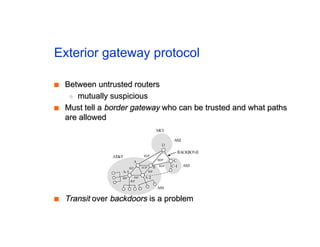
Exterior gateway protocol
■
■ Between untrusted routers
Between untrusted routers
◆
◆ mutually suspicious
mutually suspicious
■
■ Must tell a
Must tell a border gateway
border gateway who can be trusted and what paths
who can be trusted and what paths
are allowed
are allowed
■
■ Transit
Transit over
over backdoors
backdoors is a problem
is a problem
Interior protocols
■
■ Much easier to implement
Much easier to implement
■
■ Typically partition an AS into
Typically partition an AS into areas
areas
■
■ Exterior and summary records used between areas
Exterior and summary records used between areas
Issues in interconnection
■
■ May use different schemes (DV vs. LS)
May use different schemes (DV vs. LS)
■
■ Cost metrics may differ
Cost metrics may differ
■
■ Need to:
Need to:
◆
◆ convert from one scheme to another (how?)
convert from one scheme to another (how?)
◆
◆ use the lowest common denominator for costs
use the lowest common denominator for costs
◆
◆ manually intervene if necessary
manually intervene if necessary
Outline
■
■ Routing in telephone networks
Routing in telephone networks
■
■ Distance-vector routing
Distance-vector routing
■
■ Link-state routing
Link-state routing
■
■ Choosing link costs
Choosing link costs
■
■ Hierarchical routing
Hierarchical routing
■
■ Internet routing protocols
Internet routing protocols
■
■ Routing within a broadcast LAN
Routing within a broadcast LAN
■
■ Multicast routing
Multicast routing
■
■ Routing with policy constraints
Routing with policy constraints
■
■ Routing for mobile hosts
Routing for mobile hosts
Common routing protocols
■
■ Interior
Interior
◆
◆ RIP
RIP
◆
◆ OSPF
OSPF
■
■ Exterior
Exterior
◆
◆ EGP
EGP
◆
◆ BGP
BGP
■
■ ATM
ATM
◆
◆ PNNI
PNNI
RIP
■
■ Distance vector
Distance vector
■
■ Cost metric is hop count
Cost metric is hop count
■
■ Infinity = 16
Infinity = 16
■
■ Exchange distance vectors every 30 s
Exchange distance vectors every 30 s
■
■ Split horizon
Split horizon
■
■ Useful for small subnets
Useful for small subnets
◆
◆ easy to install
easy to install
OSPF
■
■ Link-state
Link-state
■
■ Uses areas to route packets hierarchically within AS
Uses areas to route packets hierarchically within AS
■
■ Complex
Complex
◆
◆ LSP databases to be protected
LSP databases to be protected
■
■ Uses
Uses designated routers
designated routers to reduce number of endpoints
to reduce number of endpoints
EGP
■
■ Original exterior gateway protocol
Original exterior gateway protocol
■
■ Distance-vector
Distance-vector
■
■ Costs are either 128 (reachable) or 255 (unreachable) =>
Costs are either 128 (reachable) or 255 (unreachable) =>
reachability protocol => backbone must be loop free (why?)
■
■ Allows administrators to pick neighbors to peer with
Allows administrators to pick neighbors to peer with
■
■ Allows backdoors (by setting backdoor cost < 128)
Allows backdoors (by setting backdoor cost < 128)
BGP
■
■ Path-vector
Path-vector
◆
◆ distance vector annotated with entire path
distance vector annotated with entire path
◆
◆ also with policy attributes
also with policy attributes
◆
◆ guaranteed loop-free
guaranteed loop-free
■
■ Can use non-tree backbone topologies
Can use non-tree backbone topologies
■
■ Uses TCP to disseminate DVs
Uses TCP to disseminate DVs
◆
◆ reliable
reliable
◆
◆ but subject to TCP flow control
but subject to TCP flow control
■
■ Policies are complex to set up
Policies are complex to set up
PNNI
■
■ Link-state
Link-state
■
■ Many levels of hierarchy
Many levels of hierarchy
■
■ Switch controllers at each level form a peer group
Switch controllers at each level form a peer group
■
■ Group has a group leader
Group has a group leader
■
■ Leaders are members of the next higher level group
Leaders are members of the next higher level group
■
■ Leaders summarize information about group to tell higher level
Leaders summarize information about group to tell higher level
peers
peers
■
■ All records received by leader are flooded to lower level
All records received by leader are flooded to lower level
■
■ LSPs can be annotated with per-link QoS metrics
LSPs can be annotated with per-link QoS metrics
■
■ Switch controller uses this to compute source routes for call-
Switch controller uses this to compute source routes for call-
setup packets
setup packets
Outline
■
■ Routing in telephone networks
Routing in telephone networks
■
■ Distance-vector routing
Distance-vector routing
■
■ Link-state routing
Link-state routing
■
■ Choosing link costs
Choosing link costs
■
■ Hierarchical routing
Hierarchical routing
■
■ Internet routing protocols
Internet routing protocols
■
■ Routing within a broadcast LAN
Routing within a broadcast LAN
■
■ Multicast routing
Multicast routing
■
■ Routing with policy constraints
Routing with policy constraints
■
■ Routing for mobile hosts
Routing for mobile hosts
Routing within a broadcast LAN
■
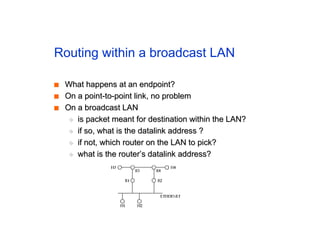
■ What happens at an endpoint?
What happens at an endpoint?
■
■ On a point-to-point link, no problem
On a point-to-point link, no problem
■
■ On a broadcast LAN
On a broadcast LAN
◆
◆ is packet meant for destination within the LAN?
is packet meant for destination within the LAN?
◆
◆ if so, what is the datalink address ?
if so, what is the datalink address ?
◆
◆ if not, which router on the LAN to pick?
if not, which router on the LAN to pick?
◆
◆ what is the router’s datalink address?
what is the router’s datalink address?
Internet solution
■
■ All hosts on the LAN have the same subnet address
All hosts on the LAN have the same subnet address
■
■ So, easy to determine if destination is on the same LAN
So, easy to determine if destination is on the same LAN
■
■ Destination’s datalink address determined using ARP
Destination’s datalink address determined using ARP
◆
◆ broadcast a request
broadcast a request
◆
◆ owner of IP address replies
owner of IP address replies
■
■ To discover routers
To discover routers
◆
◆ routers periodically sends router advertisements
routers periodically sends router advertisements
✦
✦ with preference level and time to live
with preference level and time to live
◆
◆ pick most preferred router
pick most preferred router
◆
◆ delete overage records
delete overage records
◆
◆ can also force routers to reply with
can also force routers to reply with solicitation message
solicitation message
Redirection
■
■ How to pick the best router?
How to pick the best router?
■
■ Send message to arbitrary router
Send message to arbitrary router
■
■ If that router’s next hop is another router on the same LAN, host
If that router’s next hop is another router on the same LAN, host
gets a
gets a redirect
redirect message
message
■
■ It uses this for subsequent messages
It uses this for subsequent messages
Outline
■
■ Routing in telephone networks
Routing in telephone networks
■
■ Distance-vector routing
Distance-vector routing
■
■ Link-state routing
Link-state routing
■
■ Choosing link costs
Choosing link costs
■
■ Hierarchical routing
Hierarchical routing
■
■ Internet routing protocols
Internet routing protocols
■
■ Routing within a broadcast LAN
Routing within a broadcast LAN
■
■ Multicast routing
Multicast routing
■
■ Routing with policy constraints
Routing with policy constraints
■
■ Routing for mobile hosts
Routing for mobile hosts
Multicast routing
■
■ Unicast: single source sends to a single destination
Unicast: single source sends to a single destination
■
■ Multicast: hosts are part of a
Multicast: hosts are part of a multicast group
multicast group
◆
◆ packet sent by
packet sent by any
any member of a group are received by
member of a group are received by all
all
■
■ Useful for
Useful for
◆
◆ multiparty videoconference
multiparty videoconference
◆
◆ distance learning
distance learning
◆
◆ resource location
resource location
Multicast group
■
■ Associates a set of senders and receivers with each other
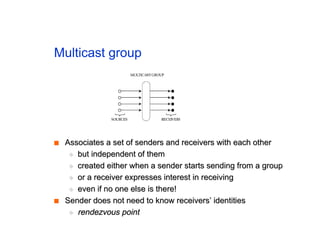
Associates a set of senders and receivers with each other
◆
◆ but independent of them
but independent of them
◆
◆ created either when a sender starts sending from a group
created either when a sender starts sending from a group
◆
◆ or a receiver expresses interest in receiving
or a receiver expresses interest in receiving
◆
◆ even if no one else is there!
even if no one else is there!
■
■ Sender does not need to know receivers’ identities
Sender does not need to know receivers’ identities
◆
◆ rendezvous point
rendezvous point
Addressing
■
■ Multicast group in the Internet has its own Class D address
Multicast group in the Internet has its own Class D address
◆
◆ looks like a host address, but isn’t
looks like a host address, but isn’t
■
■ Senders send to the address
Senders send to the address
■
■ Receivers anywhere in the world request packets from that
Receivers anywhere in the world request packets from that
address
address
■
■ “Magic” is in associating the two:
“Magic” is in associating the two: dynamic directory service
dynamic directory service
■
■ Four problems
Four problems
◆
◆ which groups are currently active
which groups are currently active
◆
◆ how to express interest in joining a group
how to express interest in joining a group
◆
◆ discovering the set of receivers in a group
discovering the set of receivers in a group
◆
◆ delivering data to members of a group
delivering data to members of a group
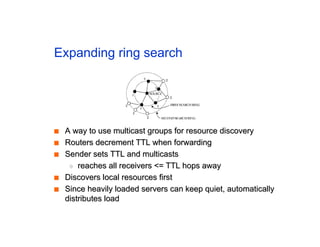
Expanding ring search
■
■ A way to use multicast groups for resource discovery
A way to use multicast groups for resource discovery
■
■ Routers decrement TTL when forwarding
Routers decrement TTL when forwarding
■
■ Sender sets TTL and multicasts
Sender sets TTL and multicasts
◆
◆ reaches all receivers <= TTL hops away
reaches all receivers <= TTL hops away
■
■ Discovers local resources first
Discovers local resources first
■
■ Since heavily loaded servers can keep quiet, automatically
Since heavily loaded servers can keep quiet, automatically
distributes load
distributes load
Multicast flavors
■
■ Unicast: point to point
Unicast: point to point
■
■ Multicast:
Multicast:
◆
◆ point to multipoint
point to multipoint
◆
◆ multipoint to multipoint
multipoint to multipoint
■
■ Can simulate point to multipoint by a set of point to point
Can simulate point to multipoint by a set of point to point
unicasts
unicasts
■
■ Can simulate multipoint to multipoint by a set of point to
Can simulate multipoint to multipoint by a set of point to
multipoint multicasts
■
■ The difference is efficiency
The difference is efficiency
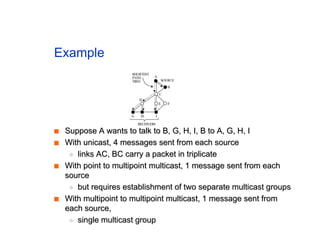
Example
■
■ Suppose A wants to talk to B, G, H, I, B to A, G, H, I
Suppose A wants to talk to B, G, H, I, B to A, G, H, I
■
■ With unicast, 4 messages sent from each source
With unicast, 4 messages sent from each source
◆
◆ links AC, BC carry a packet in triplicate
links AC, BC carry a packet in triplicate
■
■ With point to multipoint multicast, 1 message sent from each
With point to multipoint multicast, 1 message sent from each
source
source
◆
◆ but requires establishment of two separate multicast groups
but requires establishment of two separate multicast groups
■
■ With multipoint to multipoint multicast, 1 message sent from
With multipoint to multipoint multicast, 1 message sent from
each source,
each source,
◆
◆ single multicast group
single multicast group
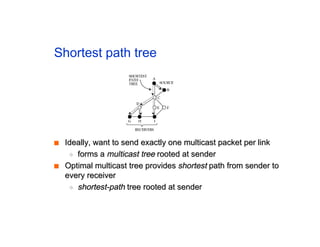
Shortest path tree
■
■ Ideally, want to send exactly one multicast packet per link
Ideally, want to send exactly one multicast packet per link
◆
◆ forms a
forms a multicast tree
multicast tree rooted at sender
rooted at sender
■
■ Optimal multicast tree provides
Optimal multicast tree provides shortest
shortest path from sender to
path from sender to
every receiver
every receiver
◆
◆ shortest-path
shortest-path tree rooted at sender
tree rooted at sender
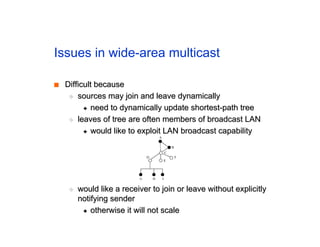
Issues in wide-area multicast
■
■ Difficult because
Difficult because
◆
◆ sources may join and leave dynamically
sources may join and leave dynamically
✦
✦ need to dynamically update shortest-path tree
need to dynamically update shortest-path tree
◆
◆ leaves of tree are often members of broadcast LAN
leaves of tree are often members of broadcast LAN
✦
✦ would like to exploit LAN broadcast capability
would like to exploit LAN broadcast capability
◆
◆ would like a receiver to join or leave without explicitly
would like a receiver to join or leave without explicitly
notifying sender
notifying sender
✦
✦ otherwise it will not scale
otherwise it will not scale
Multicast in a broadcast LAN
■
■ Wide area multicast can exploit a LAN’s broadcast capability
Wide area multicast can exploit a LAN’s broadcast capability
■
■ E.g. Ethernet will multicast all packets with multicast bit set on
E.g. Ethernet will multicast all packets with multicast bit set on
destination address
destination address
■
■ Two problems:
Two problems:
◆
◆ what multicast MAC address corresponds to a given Class D
what multicast MAC address corresponds to a given Class D
IP address?
IP address?
◆
◆ does the LAN have contain any members for a given group
does the LAN have contain any members for a given group
(why do we need to know this?)
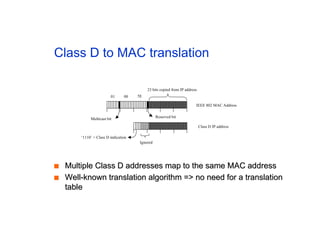
Class D to MAC translation
■
■ Multiple Class D addresses map to the same MAC address
Multiple Class D addresses map to the same MAC address
■
■ Well-known translation algorithm => no need for a translation
Well-known translation algorithm => no need for a translation
table
table
01 00 5E
23 bits copied from IP address
IEEE 802 MAC Address
Class D IP address
Ignored
‘1110’ = Class D indication
Multicast bit Reserved bit
Internet Group Management Protocol
■
■ Detects if a LAN has any members for a particular group
Detects if a LAN has any members for a particular group
◆
◆ If no members, then we can
If no members, then we can prune
prune the shortest path tree for
the shortest path tree for
that group by telling parent
■
■ Router periodically broadcasts a
Router periodically broadcasts a query
query message
message
■
■ Hosts reply with the list of groups they are interested in
Hosts reply with the list of groups they are interested in
■
■ To suppress traffic
To suppress traffic
◆
◆ reply after random timeout
reply after random timeout
◆
◆ broadcast reply
broadcast reply
◆
◆ if someone else has expressed interest in a group, drop out
if someone else has expressed interest in a group, drop out
■
■ To receive multicast packets:
To receive multicast packets:
◆
◆ translate from class D to MAC and configure adapter
translate from class D to MAC and configure adapter
Wide area multicast
■
■ Assume
Assume
◆
◆ each endpoint is a router
each endpoint is a router
◆
◆ a router can use IGMP to discover all the members in its
a router can use IGMP to discover all the members in its
LAN that want to subscribe to each multicast group
■
■ Goal
Goal
◆
◆ distribute packets coming from any sender directed to a
distribute packets coming from any sender directed to a
given group to all routers on the path to a group member
Simplest solution
■
■ Flood packets from a source to entire network
Flood packets from a source to entire network
■
■ If a router has not seen a packet before, forward it to all
If a router has not seen a packet before, forward it to all
interfaces except the incoming one
■
■ Pros
Pros
◆
◆ simple
simple
◆
◆ always works!
always works!
■
■ Cons
Cons
◆
◆ routers receive duplicate packets
routers receive duplicate packets
◆
◆ detecting that a packet is a duplicate requires storage, which
detecting that a packet is a duplicate requires storage, which
can be expensive for long multicast sessions
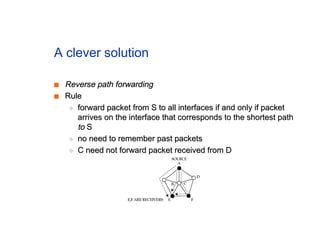
A clever solution
■
■ Reverse path forwarding
Reverse path forwarding
■
■ Rule
Rule
◆
◆ forward packet from S to all interfaces if and only if packet
forward packet from S to all interfaces if and only if packet
arrives on the interface that corresponds to the shortest path
to
to S
S
◆
◆ no need to remember past packets
no need to remember past packets
◆
◆ C need not forward packet received from D
C need not forward packet received from D
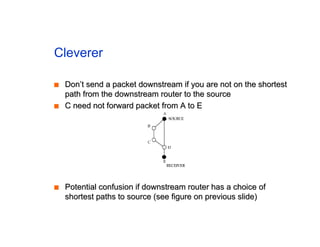
Cleverer
■
■ Don’t send a packet downstream if you are not on the shortest
Don’t send a packet downstream if you are not on the shortest
path from the downstream router to the source
■
■ C need not forward packet from A to E
C need not forward packet from A to E
■
■ Potential confusion if downstream router has a choice of
Potential confusion if downstream router has a choice of
shortest paths to source (see figure on previous slide)
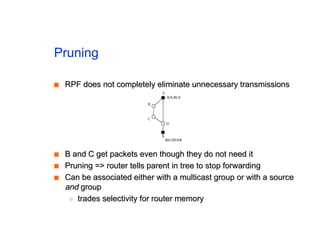
Pruning
■
■ RPF does not completely eliminate unnecessary transmissions
RPF does not completely eliminate unnecessary transmissions
■
■ B and C get packets even though they do not need it
B and C get packets even though they do not need it
■
■ Pruning => router tells parent in tree to stop forwarding
Pruning => router tells parent in tree to stop forwarding
■
■ Can be associated either with a multicast group or with a source
Can be associated either with a multicast group or with a source
and
and group
group
◆
◆ trades selectivity for router memory
trades selectivity for router memory
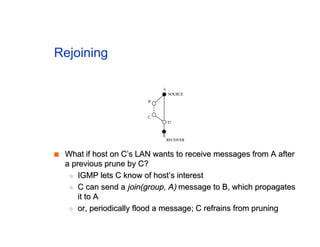
Rejoining
■
■ What if host on C’s LAN wants to receive messages from A after
What if host on C’s LAN wants to receive messages from A after
a previous prune by C?
◆
◆ IGMP lets C know of host’s interest
IGMP lets C know of host’s interest
◆
◆ C can send a
C can send a join(group, A)
join(group, A) message to B, which propagates
message to B, which propagates
it to A
it to A
◆
◆ or, periodically flood a message; C refrains from pruning
or, periodically flood a message; C refrains from pruning
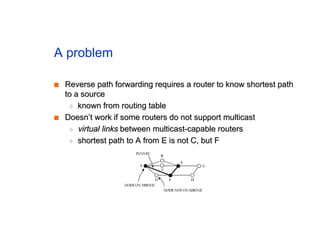
A problem
■
■ Reverse path forwarding requires a router to know shortest path
Reverse path forwarding requires a router to know shortest path
to a source
to a source
◆
◆ known from routing table
known from routing table
■
■ Doesn’t work if some routers do not support multicast
Doesn’t work if some routers do not support multicast
◆
◆ virtual links
virtual links between multicast-capable routers
between multicast-capable routers
◆
◆ shortest path to A from E is not C, but F
shortest path to A from E is not C, but F
A problem (contd.)
■
■ Two problems
Two problems
◆
◆ how to build virtual links
how to build virtual links
◆
◆ how to construct routing table for a network with virtual links
how to construct routing table for a network with virtual links
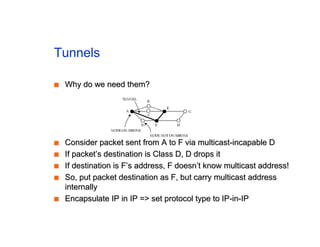
Tunnels
■
■ Why do we need them?
Why do we need them?
■
■ Consider packet sent from A to F via multicast-incapable D
Consider packet sent from A to F via multicast-incapable D
■
■ If packet’s destination is Class D, D drops it
If packet’s destination is Class D, D drops it
■
■ If destination is F’s address, F doesn’t know multicast address!
If destination is F’s address, F doesn’t know multicast address!
■
■ So, put packet destination as F, but carry multicast address
So, put packet destination as F, but carry multicast address
internally
internally
■
■ Encapsulate IP in IP => set protocol type to IP-in-IP
Encapsulate IP in IP => set protocol type to IP-in-IP
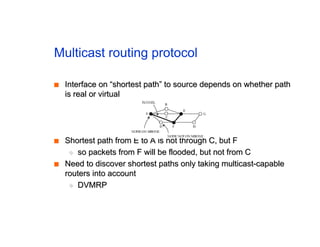
Multicast routing protocol
■
■ Interface on “shortest path” to source depends on whether path
Interface on “shortest path” to source depends on whether path
is real or virtual
is real or virtual
■
■ Shortest path from E to A is not through C, but F
Shortest path from E to A is not through C, but F
◆
◆ so packets from F will be flooded, but not from C
so packets from F will be flooded, but not from C
■
■ Need to discover shortest paths only taking multicast-capable
Need to discover shortest paths only taking multicast-capable
routers into account
◆
◆ DVMRP
DVMRP
DVMRP
■
■ Distance-vector Multicast routing protocol
Distance-vector Multicast routing protocol
■
■ Very similar to RIP
Very similar to RIP
◆
◆ distance vector
distance vector
◆
◆ hop count metric
hop count metric
■
■ Used in conjunction with
Used in conjunction with
◆
◆ flood-and-prune (to determine memberships)
flood-and-prune (to determine memberships)
✦
✦ prunes store per-source and per-group information
prunes store per-source and per-group information
◆
◆ reverse-path forwarding (to decide where to forward a
reverse-path forwarding (to decide where to forward a
packet)
packet)
◆
◆ explicit join messages to reduce join latency (but no source
explicit join messages to reduce join latency (but no source
info, so still need flooding)
MOSPF
■
■ Multicast extension to OSPF
Multicast extension to OSPF
■
■ Routers flood group membership information with LSPs
Routers flood group membership information with LSPs
■
■ Each router independently computes shortest-path tree that only
Each router independently computes shortest-path tree that only
includes multicast-capable routers
◆
◆ no need to flood and prune
no need to flood and prune
■
■ Complex
Complex
◆
◆ interactions with external and summary records
interactions with external and summary records
◆
◆ need storage per group per link
need storage per group per link
◆
◆ need to compute shortest path tree per source and group
need to compute shortest path tree per source and group
Core-based trees
■
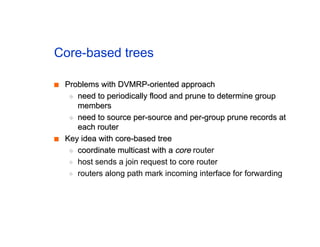
■ Problems with DVMRP-oriented approach
Problems with DVMRP-oriented approach
◆
◆ need to periodically flood and prune to determine group
need to periodically flood and prune to determine group
members
members
◆
◆ need to source per-source and per-group prune records at
need to source per-source and per-group prune records at
each router
each router
■
■ Key idea with core-based tree
Key idea with core-based tree
◆
◆ coordinate multicast with a
coordinate multicast with a core
core router
◆ host sends a join request to core router
◆ routers along path mark incoming interface for forwarding
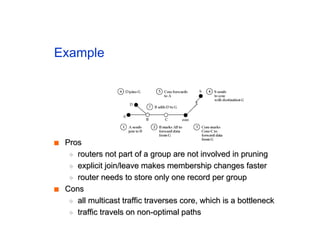
Example
■
■ Pros
Pros
◆
◆ routers not part of a group are not involved in pruning
routers not part of a group are not involved in pruning
◆
◆ explicit join/leave makes membership changes faster
explicit join/leave makes membership changes faster
◆
◆ router needs to store only one record per group
router needs to store only one record per group
■
■ Cons
Cons
◆
◆ all multicast traffic traverses core, which is a bottleneck
all multicast traffic traverses core, which is a bottleneck
◆
◆ traffic travels on non-optimal paths
traffic travels on non-optimal paths
Protocol independent multicast (PIM)
■
■ Tries to bring together best aspects of CBT and DVMRP
Tries to bring together best aspects of CBT and DVMRP
■
■ Choose different strategies depending on whether multicast tree
Choose different strategies depending on whether multicast tree
is
is dense
dense or
or sparse
sparse
◆
◆ flood and prune good for dense groups
flood and prune good for dense groups
✦
✦ only need a few prunes
only need a few prunes
✦
✦ CBT needs explicit join per source/group
CBT needs explicit join per source/group
◆
◆ CBT good for sparse groups
CBT good for sparse groups
■
■ Dense mode PIM == DVMRP
Dense mode PIM == DVMRP
■
■ Sparse mode PIM is similar to CBT
Sparse mode PIM is similar to CBT
◆
◆ but receivers can switch from CBT to a shortest-path tree
but receivers can switch from CBT to a shortest-path tree
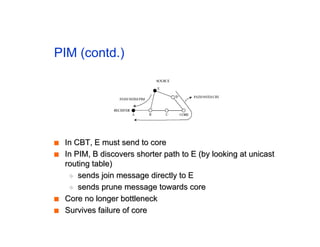
PIM (contd.)
■
■ In CBT, E must send to core
In CBT, E must send to core
■
■ In PIM, B discovers shorter path to E (by looking at unicast
In PIM, B discovers shorter path to E (by looking at unicast
routing table)
routing table)
◆
◆ sends join message directly to E
sends join message directly to E
◆
◆ sends prune message towards core
sends prune message towards core
■
■ Core no longer bottleneck
Core no longer bottleneck
■
■ Survives failure of core
Survives failure of core
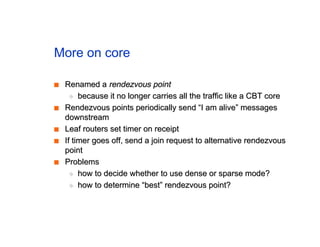
More on core
■
■ Renamed a
Renamed a rendezvous point
rendezvous point
◆
◆ because it no longer carries all the traffic like a CBT core
because it no longer carries all the traffic like a CBT core
■
■ Rendezvous points periodically send “I am alive” messages
Rendezvous points periodically send “I am alive” messages
downstream
downstream
■
■ Leaf routers set timer on receipt
Leaf routers set timer on receipt
■
■ If timer goes off, send a join request to alternative rendezvous
If timer goes off, send a join request to alternative rendezvous
point
point
■
■ Problems
Problems
◆
◆ how to decide whether to use dense or sparse mode?
how to decide whether to use dense or sparse mode?
◆
◆ how to determine “best” rendezvous point?
how to determine “best” rendezvous point?
Outline
■
■ Routing in telephone networks
Routing in telephone networks
■
■ Distance-vector routing
Distance-vector routing
■
■ Link-state routing
Link-state routing
■
■ Choosing link costs
Choosing link costs
■
■ Hierarchical routing
Hierarchical routing
■
■ Internet routing protocols
Internet routing protocols
■
■ Routing within a broadcast LAN
Routing within a broadcast LAN
■
■ Multicast routing
Multicast routing
■
■ Routing with policy constraints
Routing with policy constraints
■
■ Routing for mobile hosts
Routing for mobile hosts
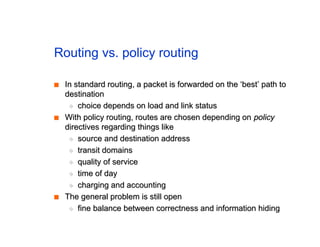
Routing vs. policy routing
■
■ In standard routing, a packet is forwarded on the ‘best’ path to
In standard routing, a packet is forwarded on the ‘best’ path to
destination
destination
◆
◆ choice depends on load and link status
choice depends on load and link status
■
■ With policy routing, routes are chosen depending on
With policy routing, routes are chosen depending on policy
policy
directives regarding things like
◆
◆ source and destination address
source and destination address
◆
◆ transit domains
transit domains
◆
◆ quality of service
quality of service
◆
◆ time of day
time of day
◆
◆ charging and accounting
charging and accounting
■
■ The general problem is still open
The general problem is still open
◆
◆ fine balance between correctness and information hiding
fine balance between correctness and information hiding
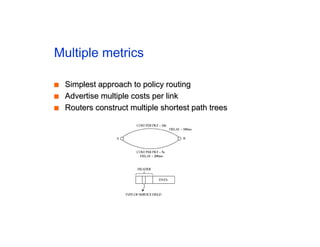
Multiple metrics
■
■ Simplest approach to policy routing
Simplest approach to policy routing
■
■ Advertise multiple costs per link
Advertise multiple costs per link
■
■ Routers construct multiple shortest path trees
Routers construct multiple shortest path trees
Problems with multiple metrics
■
■ All routers must use the same rule in computing paths
All routers must use the same rule in computing paths
■
■ Remote routers may misinterpret policy
Remote routers may misinterpret policy
◆
◆ source routing may solve this
source routing may solve this
◆
◆ but introduces other problems (what?)
but introduces other problems (what?)
Provider selection
■
■ Another simple approach
Another simple approach
■
■ Assume that a single service provider provides almost all the
Assume that a single service provider provides almost all the
path from source to destination
◆
◆ e.g. AT&T or MCI
e.g. AT&T or MCI
■
■ Then, choose policy simply by choosing provider
Then, choose policy simply by choosing provider
◆
◆ this could be dynamic (agents!)
this could be dynamic (agents!)
■
■ In Internet, can use a loose source route through service
In Internet, can use a loose source route through service
provider’s access point
■
■ Or, multiple addresses/names per host
Or, multiple addresses/names per host
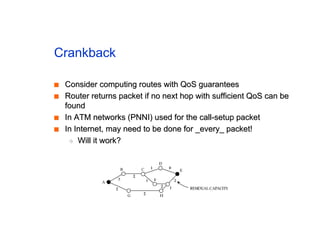
Crankback
■
■ Consider computing routes with QoS guarantees
Consider computing routes with QoS guarantees
■
■ Router returns packet if no next hop with sufficient QoS can be
Router returns packet if no next hop with sufficient QoS can be
found
found
■
■ In ATM networks (PNNI) used for the call-setup packet
In ATM networks (PNNI) used for the call-setup packet
■
■ In Internet, may need to be done for _every_ packet!
In Internet, may need to be done for _every_ packet!
◆
◆ Will it work?
Will it work?
Outline
■
■ Routing in telephone networks
Routing in telephone networks
■
■ Distance-vector routing
Distance-vector routing
■
■ Link-state routing
Link-state routing
■
■ Choosing link costs
Choosing link costs
■
■ Hierarchical routing
Hierarchical routing
■
■ Internet routing protocols
Internet routing protocols
■
■ Routing within a broadcast LAN
Routing within a broadcast LAN
■
■ Multicast routing
Multicast routing
■
■ Routing with policy constraints
Routing with policy constraints
■
■ Routing for mobile hosts
Routing for mobile hosts
Mobile routing
■
■ How to find a mobile host?
How to find a mobile host?
■
■ Two sub-problems
Two sub-problems
◆
◆ location (where is the host?)
location (where is the host?)
◆
◆ routing (how to get packets to it?)
routing (how to get packets to it?)
■
■ We will study mobile routing in the Internet and in the telephone
We will study mobile routing in the Internet and in the telephone
network
network
Mobile routing in the telephone network
■
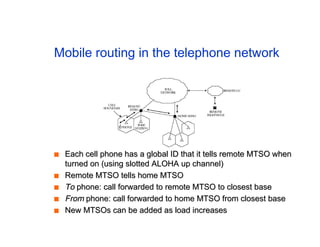
■ Each cell phone has a global ID that it tells remote MTSO when
Each cell phone has a global ID that it tells remote MTSO when
turned on (using slotted ALOHA up channel)
■
■ Remote MTSO tells home MTSO
Remote MTSO tells home MTSO
■
■ To
To phone: call forwarded to remote MTSO to closest base
phone: call forwarded to remote MTSO to closest base
■
■ From
From phone: call forwarded to home MTSO from closest base
phone: call forwarded to home MTSO from closest base
■
■ New MTSOs can be added as load increases
New MTSOs can be added as load increases
Mobile routing in the Internet
■
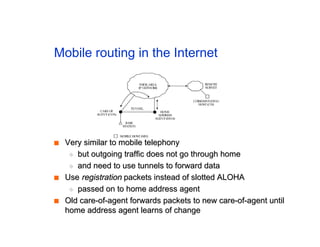
■ Very similar to mobile telephony
Very similar to mobile telephony
◆
◆ but outgoing traffic does not go through home
but outgoing traffic does not go through home
◆
◆ and need to use tunnels to forward data
and need to use tunnels to forward data
■
■ Use
Use registration
registration packets instead of slotted ALOHA
packets instead of slotted ALOHA
◆
◆ passed on to home address agent
passed on to home address agent
■
■ Old care-of-agent forwards packets to new care-of-agent until
Old care-of-agent forwards packets to new care-of-agent until
home address agent learns of change
Problems
■
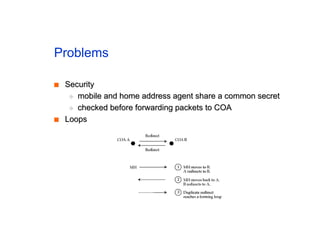
■ Security
Security
◆
◆ mobile and home address agent share a common secret
mobile and home address agent share a common secret
◆
◆ checked before forwarding packets to COA
checked before forwarding packets to COA
■
■ Loops
Loops

Routing protocols and how communication happens

  • 1.
    Routing An Engineering Approachto Computer Networking An Engineering Approach to Computer Networking
  • 2.
    What is it? ■ ■Process of finding a path from a source to every destination in Process of finding a path from a source to every destination in the network the network ■ ■ Suppose you want to connect to Antarctica from your desktop Suppose you want to connect to Antarctica from your desktop ◆ ◆ what route should you take? what route should you take? ◆ ◆ does a shorter route exist? does a shorter route exist? ◆ ◆ what if a link along the route goes down? what if a link along the route goes down? ◆ ◆ what if you’re on a mobile wireless link? what if you’re on a mobile wireless link? ■ ■ Routing deals with these types of issues Routing deals with these types of issues
  • 3.
    Basics ■ ■ A A routingprotocol routing protocol sets up a sets up a routing table routing table in in routers routers and and switch switch controllers controllers ■ ■ A node makes a A node makes a local local choice depending on choice depending on global global topology: this topology: this is the fundamental is the fundamental problem problem
  • 4.
    Key problem ■ ■ Howto make correct local decisions? How to make correct local decisions? ◆ ◆ each router must know each router must know something something about global state ■ ■ Global state Global state ◆ ◆ inherently large inherently large ◆ ◆ dynamic dynamic ◆ ◆ hard to collect hard to collect ■ ■ A routing protocol must intelligently summarize relevant A routing protocol must intelligently summarize relevant information information
  • 5.
    Requirements ■ ■ Minimize routingtable space Minimize routing table space ◆ ◆ fast to look up fast to look up ◆ ◆ less to exchange less to exchange ■ ■ Minimize number and frequency of control messages Minimize number and frequency of control messages ■ ■ Robustness: avoid Robustness: avoid ◆ ◆ black holes black holes ◆ ◆ loops loops ◆ ◆ oscillations oscillations ■ ■ Use optimal path Use optimal path
  • 6.
    Choices ■ ■ Centralized vs.distributed routing Centralized vs. distributed routing ◆ ◆ centralized is simpler, but prone to failure and congestion centralized is simpler, but prone to failure and congestion ■ ■ Source-based vs. hop-by-hop Source-based vs. hop-by-hop ◆ ◆ how much is in packet header? how much is in packet header? ◆ ◆ Intermediate: Intermediate: loose source route loose source route ■ ■ Stochastic vs. deterministic Stochastic vs. deterministic ◆ ◆ stochastic spreads load, avoiding oscillations, but misorders stochastic spreads load, avoiding oscillations, but misorders ■ ■ Single vs. multiple path Single vs. multiple path ◆ ◆ primary and alternative paths (compare with stochastic) primary and alternative paths (compare with stochastic) ■ ■ State-dependent vs. state-independent State-dependent vs. state-independent ◆ ◆ do routes depend on current network state (e.g. delay) do routes depend on current network state (e.g. delay)
  • 7.
    Outline ■ ■ Routing intelephone networks Routing in telephone networks ■ ■ Distance-vector routing Distance-vector routing ■ ■ Link-state routing Link-state routing ■ ■ Choosing link costs Choosing link costs ■ ■ Hierarchical routing Hierarchical routing ■ ■ Internet routing protocols Internet routing protocols ■ ■ Routing within a broadcast LAN Routing within a broadcast LAN ■ ■ Multicast routing Multicast routing ■ ■ Routing with policy constraints Routing with policy constraints ■ ■ Routing for mobile hosts Routing for mobile hosts
  • 8.
    Telephone network topology ■ ■3-level hierarchy, with a fully-connected core 3-level hierarchy, with a fully-connected core ■ ■ AT&T: 135 core switches with nearly 5 million circuits AT&T: 135 core switches with nearly 5 million circuits ■ ■ LECs may connect to multiple cores LECs may connect to multiple cores
  • 9.
    Routing algorithm ■ ■ Ifendpoints are within same CO, directly connect If endpoints are within same CO, directly connect ■ ■ If call is between COs in same LEC, use one-hop path between If call is between COs in same LEC, use one-hop path between COs COs ■ ■ Otherwise send call to one of the cores Otherwise send call to one of the cores ■ ■ Only major decision is at toll switch Only major decision is at toll switch ◆ ◆ one-hop or two-hop path to the destination toll switch one-hop or two-hop path to the destination toll switch ◆ ◆ (why don’t we need longer paths?) (why don’t we need longer paths?) ■ ■ Essence of problem Essence of problem ◆ ◆ which two-hop path to use if one-hop path is full which two-hop path to use if one-hop path is full
  • 10.
    Features of telephonenetwork routing ■ ■ Stable load Stable load ◆ ◆ can predict pairwise load throughout the day can predict pairwise load throughout the day ◆ ◆ can choose optimal routes in advance can choose optimal routes in advance ■ ■ Extremely reliable switches Extremely reliable switches ◆ ◆ downtime is less than a few minutes per year downtime is less than a few minutes per year ◆ ◆ can assume that a chosen route is available can assume that a chosen route is available ◆ ◆ can’t do this in the Internet can’t do this in the Internet ■ ■ Single organization controls entire core Single organization controls entire core ◆ ◆ can collect global statistics and implement global changes can collect global statistics and implement global changes ■ ■ Very highly connected network Very highly connected network ■ ■ Connections require resources (but all need the same) Connections require resources (but all need the same)
  • 11.
    The cost ofsimplicity ■ ■ Simplicity of routing a historical necessity Simplicity of routing a historical necessity ■ ■ But requires But requires ◆ ◆ reliability in every component reliability in every component ◆ ◆ logically fully-connected core logically fully-connected core ■ ■ Can we build an alternative that has same features as the Can we build an alternative that has same features as the telephone network, but is cheaper because it uses more telephone network, but is cheaper because it uses more sophisticated routing? sophisticated routing? ◆ ◆ Yes: that is one of the motivations for ATM Yes: that is one of the motivations for ATM ◆ ◆ But 80% of the cost is in the local loop But 80% of the cost is in the local loop ✦ ✦ not affected by changes in core routing not affected by changes in core routing ◆ ◆ Moreover, many of the software systems assume topology Moreover, many of the software systems assume topology ✦ ✦ too expensive to change them too expensive to change them
  • 12.
    Dynamic nonhierarchical routing(DNHR) ■ ■ Simplest core routing protocol Simplest core routing protocol ◆ ◆ accept call if one-hop path is available, else drop accept call if one-hop path is available, else drop ■ ■ DNHR DNHR ◆ ◆ divides day into around 10-periods divides day into around 10-periods ◆ ◆ in each period, each toll switch is assigned a primary one- in each period, each toll switch is assigned a primary one- hop path and a list of alternatives hop path and a list of alternatives ◆ ◆ can overflow to alternative if needed can overflow to alternative if needed ◆ ◆ drop only if all alternate paths are busy drop only if all alternate paths are busy ✦ ✦ crankback crankback ■ ■ Problems Problems ◆ ◆ does not work well if actual traffic differs from prediction does not work well if actual traffic differs from prediction
  • 13.
    Metastability ■ ■ Burst ofactivity can cause network to enter metastable state Burst of activity can cause network to enter metastable state ◆ ◆ high blocking probability even with a low load high blocking probability even with a low load ■ ■ Removed by trunk reservation Removed by trunk reservation ◆ ◆ prevents spilled traffic from taking over direct path prevents spilled traffic from taking over direct path
  • 14.
    Trunk status maprouting (TSMR) ■ ■ DNHR measures traffic once a week DNHR measures traffic once a week ■ ■ TSMR updates measurements once an hour or so TSMR updates measurements once an hour or so ◆ ◆ only if it changes “significantly” only if it changes “significantly” ■ ■ List of alternative paths is more up to date List of alternative paths is more up to date
  • 15.
    Real-time network routing(RTNR) ■ ■ No centralized control No centralized control ■ ■ Each toll switch maintains a list of lightly loaded links Each toll switch maintains a list of lightly loaded links ■ ■ Intersection of source and destination lists gives set of lightly Intersection of source and destination lists gives set of lightly loaded paths loaded paths ■ ■ Example Example ◆ ◆ At A, list is C, D, E => links AC, AD, AE lightly loaded At A, list is C, D, E => links AC, AD, AE lightly loaded ◆ ◆ At B, list is D, F, G => links BD, BF, BG lightly loaded At B, list is D, F, G => links BD, BF, BG lightly loaded ◆ ◆ A asks B for its list A asks B for its list ◆ ◆ Intersection = D => AD and BD lightly loaded => ADB lightly Intersection = D => AD and BD lightly loaded => ADB lightly loaded => it is a good alternative path loaded => it is a good alternative path ■ ■ Very effective in practice: only about a couple of calls blocked in Very effective in practice: only about a couple of calls blocked in core out of about 250 million calls attempted every day core out of about 250 million calls attempted every day
  • 16.
    Outline ■ ■ Routing intelephone networks Routing in telephone networks ■ ■ Distance-vector routing Distance-vector routing ■ ■ Link-state routing Link-state routing ■ ■ Choosing link costs Choosing link costs ■ ■ Hierarchical routing Hierarchical routing ■ ■ Internet routing protocols Internet routing protocols ■ ■ Routing within a broadcast LAN Routing within a broadcast LAN ■ ■ Multicast routing Multicast routing ■ ■ Routing with policy constraints Routing with policy constraints ■ ■ Routing for mobile hosts Routing for mobile hosts
  • 17.
    Distance vector routing ■ ■Environment Environment ◆ ◆ links and routers unreliable links and routers unreliable ◆ ◆ alternative paths scarce alternative paths scarce ◆ ◆ traffic patterns can change rapidly traffic patterns can change rapidly ■ ■ Two key algorithms Two key algorithms ◆ ◆ distance vector distance vector ◆ ◆ link-state link-state ■ ■ Both assume router knows Both assume router knows ◆ ◆ address of each neighbor address of each neighbor ◆ ◆ cost of reaching each neighbor cost of reaching each neighbor ■ ■ Both allow a router to determine global routing information by Both allow a router to determine global routing information by talking to its neighbors talking to its neighbors
  • 18.
    Basic idea ■ ■ Nodetells its neighbors its best idea of distance to Node tells its neighbors its best idea of distance to every every other other node in the network node in the network ■ ■ Node receives these Node receives these distance vectors distance vectors from its neighbors from its neighbors ■ ■ Updates its notion of best path to each destination, and the next Updates its notion of best path to each destination, and the next hop for this destination hop for this destination ■ ■ Features Features ◆ ◆ distributed distributed ◆ ◆ adapts to traffic changes and link failures adapts to traffic changes and link failures ◆ ◆ suitable for networks with multiple administrative entities suitable for networks with multiple administrative entities
  • 19.
  • 20.
    Why does itwork ■ ■ Each node knows its true cost to its neighbors Each node knows its true cost to its neighbors ■ ■ This information is spread to its neighbors the first time it sends This information is spread to its neighbors the first time it sends out its distance vector out its distance vector ■ ■ Each subsequent dissemination spreads the truth one hop Each subsequent dissemination spreads the truth one hop ■ ■ Eventually, it is incorporated into routing table everywhere in the Eventually, it is incorporated into routing table everywhere in the network network ■ ■ Proof: Bellman and Ford, 1957 Proof: Bellman and Ford, 1957
  • 21.
    Problems with distancevector ■ ■ Count to infinity Count to infinity
  • 22.
    Dealing with theproblem ■ ■ Path vector Path vector ◆ ◆ DV carries path to reach each destination DV carries path to reach each destination ■ ■ Split horizon Split horizon ◆ ◆ never tell neighbor cost to X if neighbor is next hop to X never tell neighbor cost to X if neighbor is next hop to X ◆ ◆ doesn’t work for 3-way count to infinity (see exercise) doesn’t work for 3-way count to infinity (see exercise) ■ ■ Triggered updates Triggered updates ◆ ◆ exchange routes on change, instead of on timer exchange routes on change, instead of on timer ◆ ◆ faster count up to infinity faster count up to infinity ■ ■ More complicated More complicated ◆ ◆ source tracing source tracing ◆ ◆ DUAL DUAL
  • 23.
    Outline ■ ■ Routing intelephone networks Routing in telephone networks ■ ■ Distance-vector routing Distance-vector routing ■ ■ Link-state routing Link-state routing ■ ■ Choosing link costs Choosing link costs ■ ■ Hierarchical routing Hierarchical routing ■ ■ Internet routing protocols Internet routing protocols ■ ■ Routing within a broadcast LAN Routing within a broadcast LAN ■ ■ Multicast routing Multicast routing ■ ■ Routing with policy constraints Routing with policy constraints ■ ■ Routing for mobile hosts Routing for mobile hosts
  • 24.
    Link state routing ■ ■In distance vector, router knows only In distance vector, router knows only cost cost to each destination to each destination ◆ ◆ hides information, causing problems hides information, causing problems ■ ■ In link state, router knows entire network topology, and In link state, router knows entire network topology, and computes shortest path by itself computes shortest path by itself ◆ ◆ independent computation of routes independent computation of routes ◆ ◆ potentially less robust potentially less robust ■ ■ Key elements Key elements ◆ ◆ topology dissemination topology dissemination ◆ ◆ computing shortest routes computing shortest routes
  • 25.
    Link state: topologydissemination ■ ■ A router describes its neighbors with a A router describes its neighbors with a link state packet (LSP) link state packet (LSP) ■ ■ Use Use controlled flooding controlled flooding to distribute this everywhere to distribute this everywhere ◆ ◆ store an LSP in an store an LSP in an LSP database LSP database ◆ ◆ if new, forward to every interface other than incoming one if new, forward to every interface other than incoming one ◆ ◆ a network with E edges will copy at most 2E times a network with E edges will copy at most 2E times
  • 26.
    Sequence numbers ■ ■ Howdo we know an LSP is new? How do we know an LSP is new? ■ ■ Use a sequence number in LSP header Use a sequence number in LSP header ■ ■ Greater sequence number is newer Greater sequence number is newer ■ ■ What if sequence number wraps around? What if sequence number wraps around? ◆ ◆ smaller sequence number is now newer! smaller sequence number is now newer! ◆ ◆ (hint: use a large sequence space) (hint: use a large sequence space) ■ ■ On boot up, what should be the initial sequence number? On boot up, what should be the initial sequence number? ◆ ◆ have to somehow purge old LSPs have to somehow purge old LSPs ◆ ◆ two solutions two solutions ✦ ✦ aging aging ✦ ✦ lollipop sequence space lollipop sequence space
  • 27.
    Aging ■ ■ Creator ofLSP puts timeout value in the header Creator of LSP puts timeout value in the header ■ ■ Router removes LSP when it times out Router removes LSP when it times out ◆ ◆ also floods this information to the rest of the network (why?) also floods this information to the rest of the network (why?) ■ ■ So, on booting, router just has to wait for its old LSPs to be So, on booting, router just has to wait for its old LSPs to be purged purged ■ ■ But what age to choose? But what age to choose? ◆ ◆ if too small if too small ✦ ✦ purged before fully flooded (why?) purged before fully flooded (why?) ✦ ✦ needs frequent updates needs frequent updates ◆ ◆ if too large if too large ✦ ✦ router waits idle for a long time on rebooting router waits idle for a long time on rebooting
  • 28.
    A better solution ■ ■Need a Need a unique unique start sequence number start sequence number ■ ■ a is older than b if: a is older than b if: ◆ ◆ a < 0 and a < b a < 0 and a < b ◆ ◆ a > o, a < b, and b-a < N/4 a > o, a < b, and b-a < N/4 ◆ ◆ a > 0, b > 0, a > b, and a-b > N/4 a > 0, b > 0, a > b, and a-b > N/4
  • 29.
    More on lollipops ■ ■If a router gets an older LSP, it tells the sender about the newer If a router gets an older LSP, it tells the sender about the newer LSP LSP ■ ■ So, newly booted router quickly finds out its most recent So, newly booted router quickly finds out its most recent sequence number sequence number ■ ■ It jumps to one more than that It jumps to one more than that ■ ■ -N/2 is a -N/2 is a trigger trigger to evoke a response from community memory to evoke a response from community memory
  • 30.
    Recovering from apartition ■ ■ On partition, LSP databases can get out of synch On partition, LSP databases can get out of synch ■ ■ Databases described by database descriptor records Databases described by database descriptor records ■ ■ Routers on each side of a newly restored link talk to each other Routers on each side of a newly restored link talk to each other to update databases (determine missing and out-of-date LSPs) to update databases (determine missing and out-of-date LSPs)
  • 31.
    Router failure ■ ■ Howto detect? How to detect? ◆ ◆ HELLO protocol HELLO protocol ■ ■ HELLO packet may be corrupted HELLO packet may be corrupted ◆ ◆ so age anyway so age anyway ◆ ◆ on a timeout, flood the information on a timeout, flood the information
  • 32.
    Securing LSP databases ■ ■LSP databases LSP databases must must be consistent to avoid routing loops be consistent to avoid routing loops ■ ■ Malicious agent may inject spurious LSPs Malicious agent may inject spurious LSPs ■ ■ Routers must actively protect their databases Routers must actively protect their databases ◆ ◆ checksum LSPs checksum LSPs ◆ ◆ ack LSP exchanges ack LSP exchanges ◆ ◆ passwords passwords
  • 33.
    Computing shortest paths ■ ■Basic idea Basic idea ◆ ◆ maintain a set of nodes P to whom we know shortest path maintain a set of nodes P to whom we know shortest path ◆ ◆ consider every node one hop away from nodes in P = T consider every node one hop away from nodes in P = T ◆ ◆ find every way in which to reach a given node in T, and find every way in which to reach a given node in T, and choose shortest one choose shortest one ◆ ◆ then add this node to P then add this node to P
  • 34.
  • 35.
    Link state vs.distance vector ■ ■ Criteria Criteria ◆ ◆ stability stability ◆ ◆ multiple routing metrics multiple routing metrics ◆ ◆ convergence time after a change convergence time after a change ◆ ◆ communication overhead communication overhead ◆ ◆ memory overhead memory overhead ■ ■ Both are evenly matched Both are evenly matched ■ ■ Both widely used Both widely used
  • 36.
    Outline ■ ■ Routing intelephone networks Routing in telephone networks ■ ■ Distance-vector routing Distance-vector routing ■ ■ Link-state routing Link-state routing ■ ■ Choosing link costs Choosing link costs ■ ■ Hierarchical routing Hierarchical routing ■ ■ Internet routing protocols Internet routing protocols ■ ■ Routing within a broadcast LAN Routing within a broadcast LAN ■ ■ Multicast routing Multicast routing ■ ■ Routing with policy constraints Routing with policy constraints ■ ■ Routing for mobile hosts Routing for mobile hosts
  • 37.
    Choosing link costs ■ ■Shortest path uses link costs Shortest path uses link costs ■ ■ Can use either static of dynamic costs Can use either static of dynamic costs ■ ■ In both cases: cost determine amount of traffic on the link In both cases: cost determine amount of traffic on the link ◆ ◆ lower the cost, more the expected traffic lower the cost, more the expected traffic ◆ ◆ if dynamic cost depends on load, can have oscillations if dynamic cost depends on load, can have oscillations (why?) (why?)
  • 38.
    Static metrics ■ ■ Simplest:set all link costs to 1 => min hop routing Simplest: set all link costs to 1 => min hop routing ◆ ◆ but 28.8 modem link is not the same as a T3! but 28.8 modem link is not the same as a T3! ■ ■ Give links weight proportional to capacity Give links weight proportional to capacity
  • 39.
    Dynamic metrics ■ ■ Afirst cut (ARPAnet original) A first cut (ARPAnet original) ■ ■ Cost proportional to length of router queue Cost proportional to length of router queue ◆ ◆ independent of link capacity independent of link capacity ■ ■ Many problems when network is loaded Many problems when network is loaded ◆ ◆ queue length averaged over a small time => transient spikes queue length averaged over a small time => transient spikes caused major rerouting caused major rerouting ◆ ◆ wide dynamic range => network completely ignored paths wide dynamic range => network completely ignored paths with high costs with high costs ◆ ◆ queue length assumed to predict future loads => opposite is queue length assumed to predict future loads => opposite is true (why?) true (why?) ◆ ◆ no restriction on successively reported costs => oscillations no restriction on successively reported costs => oscillations ◆ ◆ all tables computed simultaneously => low cost link flooded all tables computed simultaneously => low cost link flooded
  • 40.
    Modified metrics ◆ ◆ queuelength averaged over queue length averaged over a small time a small time ◆ ◆ wide dynamic range queue wide dynamic range queue ◆ ◆ queue length assumed to queue length assumed to predict future loads predict future loads ◆ ◆ no restriction on no restriction on successively reported costs successively reported costs ◆ ◆ all tables computed all tables computed simultaneously simultaneously ◆ ◆ queue length averaged over queue length averaged over a longer time a longer time ◆ ◆ dynamic range restricted dynamic range restricted ◆ ◆ cost also depends on cost also depends on intrinsic link capacity intrinsic link capacity ◆ ◆ restriction on successively restriction on successively reported costs reported costs ◆ ◆ attempt to stagger table attempt to stagger table computation computation
  • 41.
  • 42.
    Outline ■ ■ Routing intelephone networks Routing in telephone networks ■ ■ Distance-vector routing Distance-vector routing ■ ■ Link-state routing Link-state routing ■ ■ Choosing link costs Choosing link costs ■ ■ Hierarchical routing Hierarchical routing ■ ■ Internet routing protocols Internet routing protocols ■ ■ Routing within a broadcast LAN Routing within a broadcast LAN ■ ■ Multicast routing Multicast routing ■ ■ Routing with policy constraints Routing with policy constraints ■ ■ Routing for mobile hosts Routing for mobile hosts
  • 43.
    Hierarchical routing ■ ■ Largenetworks need large routing tables Large networks need large routing tables ◆ ◆ more computation to find shortest paths more computation to find shortest paths ◆ ◆ more bandwidth wasted on exchanging DVs and LSPs more bandwidth wasted on exchanging DVs and LSPs ■ ■ Solution: Solution: ◆ ◆ hierarchical routing hierarchical routing ■ ■ Key idea Key idea ◆ ◆ divide network into a set of domains divide network into a set of domains ◆ ◆ gateways connect domains gateways connect domains ◆ ◆ computers within domain unaware of outside computers computers within domain unaware of outside computers ◆ ◆ gateways know only about other gateways gateways know only about other gateways
  • 44.
    Example ■ ■ Features Features ◆ ◆ onlya few routers in each level only a few routers in each level ◆ ◆ not a strict hierarchy not a strict hierarchy ◆ ◆ gateways participate in multiple routing protocols gateways participate in multiple routing protocols ◆ ◆ non-aggregable routers increase core table space non-aggregable routers increase core table space
  • 45.
    Hierarchy in theInternet ■ ■ Three-level hierarchy in addresses Three-level hierarchy in addresses ◆ ◆ network number network number ◆ ◆ subnet number subnet number ◆ ◆ host number host number ■ ■ Core advertises routes only to networks, not to subnets Core advertises routes only to networks, not to subnets ◆ ◆ e.g. 135.104.*, 192.20.225.* e.g. 135.104.*, 192.20.225.* ■ ■ Even so, about 80,000 networks in core routers (1996) Even so, about 80,000 networks in core routers (1996) ■ ■ Gateways talk to backbone to find best next-hop to every other Gateways talk to backbone to find best next-hop to every other network in the Internet network in the Internet
  • 46.
    External and summaryrecords ■ ■ If a domain has multiple gateways If a domain has multiple gateways ◆ ◆ external external records tell hosts in a domain which one to pick to records tell hosts in a domain which one to pick to reach a host in an external domain reach a host in an external domain ✦ ✦ e.g allows 6.4.0.0 to discover shortest path to 5.* is e.g allows 6.4.0.0 to discover shortest path to 5.* is through 6.0.0.0 through 6.0.0.0 ◆ ◆ summary summary records tell backbone which gateway to use to records tell backbone which gateway to use to reach an internal node reach an internal node ✦ ✦ e.g. allows 5.0.0.0 to discover shortest path to 6.4.0.0 is e.g. allows 5.0.0.0 to discover shortest path to 6.4.0.0 is through 6.0.0.0 through 6.0.0.0 ■ ■ External and summary records contain distance from gateway to External and summary records contain distance from gateway to external or internal node external or internal node ◆ ◆ unifies distance vector and link state algorithms unifies distance vector and link state algorithms
  • 47.
    Interior and exteriorprotocols ■ ■ Internet has three levels of routing Internet has three levels of routing ◆ ◆ highest is at highest is at backbone backbone level, connecting level, connecting autonomous autonomous systems (AS) systems (AS) ◆ ◆ next level is within AS next level is within AS ◆ ◆ lowest is within a LAN lowest is within a LAN ■ ■ Protocol between AS gateways: exterior gateway protocol Protocol between AS gateways: exterior gateway protocol ■ ■ Protocol within AS: interior gateway protocol Protocol within AS: interior gateway protocol
  • 48.
    Exterior gateway protocol ■ ■Between untrusted routers Between untrusted routers ◆ ◆ mutually suspicious mutually suspicious ■ ■ Must tell a Must tell a border gateway border gateway who can be trusted and what paths who can be trusted and what paths are allowed are allowed ■ ■ Transit Transit over over backdoors backdoors is a problem is a problem
  • 49.
    Interior protocols ■ ■ Mucheasier to implement Much easier to implement ■ ■ Typically partition an AS into Typically partition an AS into areas areas ■ ■ Exterior and summary records used between areas Exterior and summary records used between areas
  • 50.
    Issues in interconnection ■ ■May use different schemes (DV vs. LS) May use different schemes (DV vs. LS) ■ ■ Cost metrics may differ Cost metrics may differ ■ ■ Need to: Need to: ◆ ◆ convert from one scheme to another (how?) convert from one scheme to another (how?) ◆ ◆ use the lowest common denominator for costs use the lowest common denominator for costs ◆ ◆ manually intervene if necessary manually intervene if necessary
  • 51.
    Outline ■ ■ Routing intelephone networks Routing in telephone networks ■ ■ Distance-vector routing Distance-vector routing ■ ■ Link-state routing Link-state routing ■ ■ Choosing link costs Choosing link costs ■ ■ Hierarchical routing Hierarchical routing ■ ■ Internet routing protocols Internet routing protocols ■ ■ Routing within a broadcast LAN Routing within a broadcast LAN ■ ■ Multicast routing Multicast routing ■ ■ Routing with policy constraints Routing with policy constraints ■ ■ Routing for mobile hosts Routing for mobile hosts
  • 52.
    Common routing protocols ■ ■Interior Interior ◆ ◆ RIP RIP ◆ ◆ OSPF OSPF ■ ■ Exterior Exterior ◆ ◆ EGP EGP ◆ ◆ BGP BGP ■ ■ ATM ATM ◆ ◆ PNNI PNNI
  • 53.
    RIP ■ ■ Distance vector Distancevector ■ ■ Cost metric is hop count Cost metric is hop count ■ ■ Infinity = 16 Infinity = 16 ■ ■ Exchange distance vectors every 30 s Exchange distance vectors every 30 s ■ ■ Split horizon Split horizon ■ ■ Useful for small subnets Useful for small subnets ◆ ◆ easy to install easy to install
  • 54.
    OSPF ■ ■ Link-state Link-state ■ ■ Usesareas to route packets hierarchically within AS Uses areas to route packets hierarchically within AS ■ ■ Complex Complex ◆ ◆ LSP databases to be protected LSP databases to be protected ■ ■ Uses Uses designated routers designated routers to reduce number of endpoints to reduce number of endpoints
  • 55.
    EGP ■ ■ Original exteriorgateway protocol Original exterior gateway protocol ■ ■ Distance-vector Distance-vector ■ ■ Costs are either 128 (reachable) or 255 (unreachable) => Costs are either 128 (reachable) or 255 (unreachable) => reachability protocol => backbone must be loop free (why?) reachability protocol => backbone must be loop free (why?) ■ ■ Allows administrators to pick neighbors to peer with Allows administrators to pick neighbors to peer with ■ ■ Allows backdoors (by setting backdoor cost < 128) Allows backdoors (by setting backdoor cost < 128)
  • 56.
    BGP ■ ■ Path-vector Path-vector ◆ ◆ distancevector annotated with entire path distance vector annotated with entire path ◆ ◆ also with policy attributes also with policy attributes ◆ ◆ guaranteed loop-free guaranteed loop-free ■ ■ Can use non-tree backbone topologies Can use non-tree backbone topologies ■ ■ Uses TCP to disseminate DVs Uses TCP to disseminate DVs ◆ ◆ reliable reliable ◆ ◆ but subject to TCP flow control but subject to TCP flow control ■ ■ Policies are complex to set up Policies are complex to set up
  • 57.
    PNNI ■ ■ Link-state Link-state ■ ■ Manylevels of hierarchy Many levels of hierarchy ■ ■ Switch controllers at each level form a peer group Switch controllers at each level form a peer group ■ ■ Group has a group leader Group has a group leader ■ ■ Leaders are members of the next higher level group Leaders are members of the next higher level group ■ ■ Leaders summarize information about group to tell higher level Leaders summarize information about group to tell higher level peers peers ■ ■ All records received by leader are flooded to lower level All records received by leader are flooded to lower level ■ ■ LSPs can be annotated with per-link QoS metrics LSPs can be annotated with per-link QoS metrics ■ ■ Switch controller uses this to compute source routes for call- Switch controller uses this to compute source routes for call- setup packets setup packets
  • 58.
    Outline ■ ■ Routing intelephone networks Routing in telephone networks ■ ■ Distance-vector routing Distance-vector routing ■ ■ Link-state routing Link-state routing ■ ■ Choosing link costs Choosing link costs ■ ■ Hierarchical routing Hierarchical routing ■ ■ Internet routing protocols Internet routing protocols ■ ■ Routing within a broadcast LAN Routing within a broadcast LAN ■ ■ Multicast routing Multicast routing ■ ■ Routing with policy constraints Routing with policy constraints ■ ■ Routing for mobile hosts Routing for mobile hosts
  • 59.
    Routing within abroadcast LAN ■ ■ What happens at an endpoint? What happens at an endpoint? ■ ■ On a point-to-point link, no problem On a point-to-point link, no problem ■ ■ On a broadcast LAN On a broadcast LAN ◆ ◆ is packet meant for destination within the LAN? is packet meant for destination within the LAN? ◆ ◆ if so, what is the datalink address ? if so, what is the datalink address ? ◆ ◆ if not, which router on the LAN to pick? if not, which router on the LAN to pick? ◆ ◆ what is the router’s datalink address? what is the router’s datalink address?
  • 60.
    Internet solution ■ ■ Allhosts on the LAN have the same subnet address All hosts on the LAN have the same subnet address ■ ■ So, easy to determine if destination is on the same LAN So, easy to determine if destination is on the same LAN ■ ■ Destination’s datalink address determined using ARP Destination’s datalink address determined using ARP ◆ ◆ broadcast a request broadcast a request ◆ ◆ owner of IP address replies owner of IP address replies ■ ■ To discover routers To discover routers ◆ ◆ routers periodically sends router advertisements routers periodically sends router advertisements ✦ ✦ with preference level and time to live with preference level and time to live ◆ ◆ pick most preferred router pick most preferred router ◆ ◆ delete overage records delete overage records ◆ ◆ can also force routers to reply with can also force routers to reply with solicitation message solicitation message
  • 61.
    Redirection ■ ■ How topick the best router? How to pick the best router? ■ ■ Send message to arbitrary router Send message to arbitrary router ■ ■ If that router’s next hop is another router on the same LAN, host If that router’s next hop is another router on the same LAN, host gets a gets a redirect redirect message message ■ ■ It uses this for subsequent messages It uses this for subsequent messages
  • 62.
    Outline ■ ■ Routing intelephone networks Routing in telephone networks ■ ■ Distance-vector routing Distance-vector routing ■ ■ Link-state routing Link-state routing ■ ■ Choosing link costs Choosing link costs ■ ■ Hierarchical routing Hierarchical routing ■ ■ Internet routing protocols Internet routing protocols ■ ■ Routing within a broadcast LAN Routing within a broadcast LAN ■ ■ Multicast routing Multicast routing ■ ■ Routing with policy constraints Routing with policy constraints ■ ■ Routing for mobile hosts Routing for mobile hosts
  • 63.
    Multicast routing ■ ■ Unicast:single source sends to a single destination Unicast: single source sends to a single destination ■ ■ Multicast: hosts are part of a Multicast: hosts are part of a multicast group multicast group ◆ ◆ packet sent by packet sent by any any member of a group are received by member of a group are received by all all ■ ■ Useful for Useful for ◆ ◆ multiparty videoconference multiparty videoconference ◆ ◆ distance learning distance learning ◆ ◆ resource location resource location
  • 64.
    Multicast group ■ ■ Associatesa set of senders and receivers with each other Associates a set of senders and receivers with each other ◆ ◆ but independent of them but independent of them ◆ ◆ created either when a sender starts sending from a group created either when a sender starts sending from a group ◆ ◆ or a receiver expresses interest in receiving or a receiver expresses interest in receiving ◆ ◆ even if no one else is there! even if no one else is there! ■ ■ Sender does not need to know receivers’ identities Sender does not need to know receivers’ identities ◆ ◆ rendezvous point rendezvous point
  • 65.
    Addressing ■ ■ Multicast groupin the Internet has its own Class D address Multicast group in the Internet has its own Class D address ◆ ◆ looks like a host address, but isn’t looks like a host address, but isn’t ■ ■ Senders send to the address Senders send to the address ■ ■ Receivers anywhere in the world request packets from that Receivers anywhere in the world request packets from that address address ■ ■ “Magic” is in associating the two: “Magic” is in associating the two: dynamic directory service dynamic directory service ■ ■ Four problems Four problems ◆ ◆ which groups are currently active which groups are currently active ◆ ◆ how to express interest in joining a group how to express interest in joining a group ◆ ◆ discovering the set of receivers in a group discovering the set of receivers in a group ◆ ◆ delivering data to members of a group delivering data to members of a group
  • 66.
    Expanding ring search ■ ■A way to use multicast groups for resource discovery A way to use multicast groups for resource discovery ■ ■ Routers decrement TTL when forwarding Routers decrement TTL when forwarding ■ ■ Sender sets TTL and multicasts Sender sets TTL and multicasts ◆ ◆ reaches all receivers <= TTL hops away reaches all receivers <= TTL hops away ■ ■ Discovers local resources first Discovers local resources first ■ ■ Since heavily loaded servers can keep quiet, automatically Since heavily loaded servers can keep quiet, automatically distributes load distributes load
  • 67.
    Multicast flavors ■ ■ Unicast:point to point Unicast: point to point ■ ■ Multicast: Multicast: ◆ ◆ point to multipoint point to multipoint ◆ ◆ multipoint to multipoint multipoint to multipoint ■ ■ Can simulate point to multipoint by a set of point to point Can simulate point to multipoint by a set of point to point unicasts unicasts ■ ■ Can simulate multipoint to multipoint by a set of point to Can simulate multipoint to multipoint by a set of point to multipoint multicasts multipoint multicasts ■ ■ The difference is efficiency The difference is efficiency
  • 68.
    Example ■ ■ Suppose Awants to talk to B, G, H, I, B to A, G, H, I Suppose A wants to talk to B, G, H, I, B to A, G, H, I ■ ■ With unicast, 4 messages sent from each source With unicast, 4 messages sent from each source ◆ ◆ links AC, BC carry a packet in triplicate links AC, BC carry a packet in triplicate ■ ■ With point to multipoint multicast, 1 message sent from each With point to multipoint multicast, 1 message sent from each source source ◆ ◆ but requires establishment of two separate multicast groups but requires establishment of two separate multicast groups ■ ■ With multipoint to multipoint multicast, 1 message sent from With multipoint to multipoint multicast, 1 message sent from each source, each source, ◆ ◆ single multicast group single multicast group
  • 69.
    Shortest path tree ■ ■Ideally, want to send exactly one multicast packet per link Ideally, want to send exactly one multicast packet per link ◆ ◆ forms a forms a multicast tree multicast tree rooted at sender rooted at sender ■ ■ Optimal multicast tree provides Optimal multicast tree provides shortest shortest path from sender to path from sender to every receiver every receiver ◆ ◆ shortest-path shortest-path tree rooted at sender tree rooted at sender
  • 70.
    Issues in wide-areamulticast ■ ■ Difficult because Difficult because ◆ ◆ sources may join and leave dynamically sources may join and leave dynamically ✦ ✦ need to dynamically update shortest-path tree need to dynamically update shortest-path tree ◆ ◆ leaves of tree are often members of broadcast LAN leaves of tree are often members of broadcast LAN ✦ ✦ would like to exploit LAN broadcast capability would like to exploit LAN broadcast capability ◆ ◆ would like a receiver to join or leave without explicitly would like a receiver to join or leave without explicitly notifying sender notifying sender ✦ ✦ otherwise it will not scale otherwise it will not scale
  • 71.
    Multicast in abroadcast LAN ■ ■ Wide area multicast can exploit a LAN’s broadcast capability Wide area multicast can exploit a LAN’s broadcast capability ■ ■ E.g. Ethernet will multicast all packets with multicast bit set on E.g. Ethernet will multicast all packets with multicast bit set on destination address destination address ■ ■ Two problems: Two problems: ◆ ◆ what multicast MAC address corresponds to a given Class D what multicast MAC address corresponds to a given Class D IP address? IP address? ◆ ◆ does the LAN have contain any members for a given group does the LAN have contain any members for a given group (why do we need to know this?) (why do we need to know this?)
  • 72.
    Class D toMAC translation ■ ■ Multiple Class D addresses map to the same MAC address Multiple Class D addresses map to the same MAC address ■ ■ Well-known translation algorithm => no need for a translation Well-known translation algorithm => no need for a translation table table 01 00 5E 23 bits copied from IP address IEEE 802 MAC Address Class D IP address Ignored ‘1110’ = Class D indication Multicast bit Reserved bit
  • 73.
    Internet Group ManagementProtocol ■ ■ Detects if a LAN has any members for a particular group Detects if a LAN has any members for a particular group ◆ ◆ If no members, then we can If no members, then we can prune prune the shortest path tree for the shortest path tree for that group by telling parent that group by telling parent ■ ■ Router periodically broadcasts a Router periodically broadcasts a query query message message ■ ■ Hosts reply with the list of groups they are interested in Hosts reply with the list of groups they are interested in ■ ■ To suppress traffic To suppress traffic ◆ ◆ reply after random timeout reply after random timeout ◆ ◆ broadcast reply broadcast reply ◆ ◆ if someone else has expressed interest in a group, drop out if someone else has expressed interest in a group, drop out ■ ■ To receive multicast packets: To receive multicast packets: ◆ ◆ translate from class D to MAC and configure adapter translate from class D to MAC and configure adapter
  • 74.
    Wide area multicast ■ ■Assume Assume ◆ ◆ each endpoint is a router each endpoint is a router ◆ ◆ a router can use IGMP to discover all the members in its a router can use IGMP to discover all the members in its LAN that want to subscribe to each multicast group LAN that want to subscribe to each multicast group ■ ■ Goal Goal ◆ ◆ distribute packets coming from any sender directed to a distribute packets coming from any sender directed to a given group to all routers on the path to a group member given group to all routers on the path to a group member
  • 75.
    Simplest solution ■ ■ Floodpackets from a source to entire network Flood packets from a source to entire network ■ ■ If a router has not seen a packet before, forward it to all If a router has not seen a packet before, forward it to all interfaces except the incoming one interfaces except the incoming one ■ ■ Pros Pros ◆ ◆ simple simple ◆ ◆ always works! always works! ■ ■ Cons Cons ◆ ◆ routers receive duplicate packets routers receive duplicate packets ◆ ◆ detecting that a packet is a duplicate requires storage, which detecting that a packet is a duplicate requires storage, which can be expensive for long multicast sessions can be expensive for long multicast sessions
  • 76.
    A clever solution ■ ■Reverse path forwarding Reverse path forwarding ■ ■ Rule Rule ◆ ◆ forward packet from S to all interfaces if and only if packet forward packet from S to all interfaces if and only if packet arrives on the interface that corresponds to the shortest path arrives on the interface that corresponds to the shortest path to to S S ◆ ◆ no need to remember past packets no need to remember past packets ◆ ◆ C need not forward packet received from D C need not forward packet received from D
  • 77.
    Cleverer ■ ■ Don’t senda packet downstream if you are not on the shortest Don’t send a packet downstream if you are not on the shortest path from the downstream router to the source path from the downstream router to the source ■ ■ C need not forward packet from A to E C need not forward packet from A to E ■ ■ Potential confusion if downstream router has a choice of Potential confusion if downstream router has a choice of shortest paths to source (see figure on previous slide) shortest paths to source (see figure on previous slide)
  • 78.
    Pruning ■ ■ RPF doesnot completely eliminate unnecessary transmissions RPF does not completely eliminate unnecessary transmissions ■ ■ B and C get packets even though they do not need it B and C get packets even though they do not need it ■ ■ Pruning => router tells parent in tree to stop forwarding Pruning => router tells parent in tree to stop forwarding ■ ■ Can be associated either with a multicast group or with a source Can be associated either with a multicast group or with a source and and group group ◆ ◆ trades selectivity for router memory trades selectivity for router memory
  • 79.
    Rejoining ■ ■ What ifhost on C’s LAN wants to receive messages from A after What if host on C’s LAN wants to receive messages from A after a previous prune by C? a previous prune by C? ◆ ◆ IGMP lets C know of host’s interest IGMP lets C know of host’s interest ◆ ◆ C can send a C can send a join(group, A) join(group, A) message to B, which propagates message to B, which propagates it to A it to A ◆ ◆ or, periodically flood a message; C refrains from pruning or, periodically flood a message; C refrains from pruning
  • 80.
    A problem ■ ■ Reversepath forwarding requires a router to know shortest path Reverse path forwarding requires a router to know shortest path to a source to a source ◆ ◆ known from routing table known from routing table ■ ■ Doesn’t work if some routers do not support multicast Doesn’t work if some routers do not support multicast ◆ ◆ virtual links virtual links between multicast-capable routers between multicast-capable routers ◆ ◆ shortest path to A from E is not C, but F shortest path to A from E is not C, but F
  • 81.
    A problem (contd.) ■ ■Two problems Two problems ◆ ◆ how to build virtual links how to build virtual links ◆ ◆ how to construct routing table for a network with virtual links how to construct routing table for a network with virtual links
  • 82.
    Tunnels ■ ■ Why dowe need them? Why do we need them? ■ ■ Consider packet sent from A to F via multicast-incapable D Consider packet sent from A to F via multicast-incapable D ■ ■ If packet’s destination is Class D, D drops it If packet’s destination is Class D, D drops it ■ ■ If destination is F’s address, F doesn’t know multicast address! If destination is F’s address, F doesn’t know multicast address! ■ ■ So, put packet destination as F, but carry multicast address So, put packet destination as F, but carry multicast address internally internally ■ ■ Encapsulate IP in IP => set protocol type to IP-in-IP Encapsulate IP in IP => set protocol type to IP-in-IP
  • 83.
    Multicast routing protocol ■ ■Interface on “shortest path” to source depends on whether path Interface on “shortest path” to source depends on whether path is real or virtual is real or virtual ■ ■ Shortest path from E to A is not through C, but F Shortest path from E to A is not through C, but F ◆ ◆ so packets from F will be flooded, but not from C so packets from F will be flooded, but not from C ■ ■ Need to discover shortest paths only taking multicast-capable Need to discover shortest paths only taking multicast-capable routers into account routers into account ◆ ◆ DVMRP DVMRP
  • 84.
    DVMRP ■ ■ Distance-vector Multicastrouting protocol Distance-vector Multicast routing protocol ■ ■ Very similar to RIP Very similar to RIP ◆ ◆ distance vector distance vector ◆ ◆ hop count metric hop count metric ■ ■ Used in conjunction with Used in conjunction with ◆ ◆ flood-and-prune (to determine memberships) flood-and-prune (to determine memberships) ✦ ✦ prunes store per-source and per-group information prunes store per-source and per-group information ◆ ◆ reverse-path forwarding (to decide where to forward a reverse-path forwarding (to decide where to forward a packet) packet) ◆ ◆ explicit join messages to reduce join latency (but no source explicit join messages to reduce join latency (but no source info, so still need flooding) info, so still need flooding)
  • 85.
    MOSPF ■ ■ Multicast extensionto OSPF Multicast extension to OSPF ■ ■ Routers flood group membership information with LSPs Routers flood group membership information with LSPs ■ ■ Each router independently computes shortest-path tree that only Each router independently computes shortest-path tree that only includes multicast-capable routers includes multicast-capable routers ◆ ◆ no need to flood and prune no need to flood and prune ■ ■ Complex Complex ◆ ◆ interactions with external and summary records interactions with external and summary records ◆ ◆ need storage per group per link need storage per group per link ◆ ◆ need to compute shortest path tree per source and group need to compute shortest path tree per source and group
  • 86.
    Core-based trees ■ ■ Problemswith DVMRP-oriented approach Problems with DVMRP-oriented approach ◆ ◆ need to periodically flood and prune to determine group need to periodically flood and prune to determine group members members ◆ ◆ need to source per-source and per-group prune records at need to source per-source and per-group prune records at each router each router ■ ■ Key idea with core-based tree Key idea with core-based tree ◆ ◆ coordinate multicast with a coordinate multicast with a core core router ◆ host sends a join request to core router ◆ routers along path mark incoming interface for forwarding
  • 87.
    Example ■ ■ Pros Pros ◆ ◆ routersnot part of a group are not involved in pruning routers not part of a group are not involved in pruning ◆ ◆ explicit join/leave makes membership changes faster explicit join/leave makes membership changes faster ◆ ◆ router needs to store only one record per group router needs to store only one record per group ■ ■ Cons Cons ◆ ◆ all multicast traffic traverses core, which is a bottleneck all multicast traffic traverses core, which is a bottleneck ◆ ◆ traffic travels on non-optimal paths traffic travels on non-optimal paths
  • 88.
    Protocol independent multicast(PIM) ■ ■ Tries to bring together best aspects of CBT and DVMRP Tries to bring together best aspects of CBT and DVMRP ■ ■ Choose different strategies depending on whether multicast tree Choose different strategies depending on whether multicast tree is is dense dense or or sparse sparse ◆ ◆ flood and prune good for dense groups flood and prune good for dense groups ✦ ✦ only need a few prunes only need a few prunes ✦ ✦ CBT needs explicit join per source/group CBT needs explicit join per source/group ◆ ◆ CBT good for sparse groups CBT good for sparse groups ■ ■ Dense mode PIM == DVMRP Dense mode PIM == DVMRP ■ ■ Sparse mode PIM is similar to CBT Sparse mode PIM is similar to CBT ◆ ◆ but receivers can switch from CBT to a shortest-path tree but receivers can switch from CBT to a shortest-path tree
  • 89.
    PIM (contd.) ■ ■ InCBT, E must send to core In CBT, E must send to core ■ ■ In PIM, B discovers shorter path to E (by looking at unicast In PIM, B discovers shorter path to E (by looking at unicast routing table) routing table) ◆ ◆ sends join message directly to E sends join message directly to E ◆ ◆ sends prune message towards core sends prune message towards core ■ ■ Core no longer bottleneck Core no longer bottleneck ■ ■ Survives failure of core Survives failure of core
  • 90.
    More on core ■ ■Renamed a Renamed a rendezvous point rendezvous point ◆ ◆ because it no longer carries all the traffic like a CBT core because it no longer carries all the traffic like a CBT core ■ ■ Rendezvous points periodically send “I am alive” messages Rendezvous points periodically send “I am alive” messages downstream downstream ■ ■ Leaf routers set timer on receipt Leaf routers set timer on receipt ■ ■ If timer goes off, send a join request to alternative rendezvous If timer goes off, send a join request to alternative rendezvous point point ■ ■ Problems Problems ◆ ◆ how to decide whether to use dense or sparse mode? how to decide whether to use dense or sparse mode? ◆ ◆ how to determine “best” rendezvous point? how to determine “best” rendezvous point?
  • 91.
    Outline ■ ■ Routing intelephone networks Routing in telephone networks ■ ■ Distance-vector routing Distance-vector routing ■ ■ Link-state routing Link-state routing ■ ■ Choosing link costs Choosing link costs ■ ■ Hierarchical routing Hierarchical routing ■ ■ Internet routing protocols Internet routing protocols ■ ■ Routing within a broadcast LAN Routing within a broadcast LAN ■ ■ Multicast routing Multicast routing ■ ■ Routing with policy constraints Routing with policy constraints ■ ■ Routing for mobile hosts Routing for mobile hosts
  • 92.
    Routing vs. policyrouting ■ ■ In standard routing, a packet is forwarded on the ‘best’ path to In standard routing, a packet is forwarded on the ‘best’ path to destination destination ◆ ◆ choice depends on load and link status choice depends on load and link status ■ ■ With policy routing, routes are chosen depending on With policy routing, routes are chosen depending on policy policy directives regarding things like directives regarding things like ◆ ◆ source and destination address source and destination address ◆ ◆ transit domains transit domains ◆ ◆ quality of service quality of service ◆ ◆ time of day time of day ◆ ◆ charging and accounting charging and accounting ■ ■ The general problem is still open The general problem is still open ◆ ◆ fine balance between correctness and information hiding fine balance between correctness and information hiding
  • 93.
    Multiple metrics ■ ■ Simplestapproach to policy routing Simplest approach to policy routing ■ ■ Advertise multiple costs per link Advertise multiple costs per link ■ ■ Routers construct multiple shortest path trees Routers construct multiple shortest path trees
  • 94.
    Problems with multiplemetrics ■ ■ All routers must use the same rule in computing paths All routers must use the same rule in computing paths ■ ■ Remote routers may misinterpret policy Remote routers may misinterpret policy ◆ ◆ source routing may solve this source routing may solve this ◆ ◆ but introduces other problems (what?) but introduces other problems (what?)
  • 95.
    Provider selection ■ ■ Anothersimple approach Another simple approach ■ ■ Assume that a single service provider provides almost all the Assume that a single service provider provides almost all the path from source to destination path from source to destination ◆ ◆ e.g. AT&T or MCI e.g. AT&T or MCI ■ ■ Then, choose policy simply by choosing provider Then, choose policy simply by choosing provider ◆ ◆ this could be dynamic (agents!) this could be dynamic (agents!) ■ ■ In Internet, can use a loose source route through service In Internet, can use a loose source route through service provider’s access point provider’s access point ■ ■ Or, multiple addresses/names per host Or, multiple addresses/names per host
  • 96.
    Crankback ■ ■ Consider computingroutes with QoS guarantees Consider computing routes with QoS guarantees ■ ■ Router returns packet if no next hop with sufficient QoS can be Router returns packet if no next hop with sufficient QoS can be found found ■ ■ In ATM networks (PNNI) used for the call-setup packet In ATM networks (PNNI) used for the call-setup packet ■ ■ In Internet, may need to be done for _every_ packet! In Internet, may need to be done for _every_ packet! ◆ ◆ Will it work? Will it work?
  • 97.
    Outline ■ ■ Routing intelephone networks Routing in telephone networks ■ ■ Distance-vector routing Distance-vector routing ■ ■ Link-state routing Link-state routing ■ ■ Choosing link costs Choosing link costs ■ ■ Hierarchical routing Hierarchical routing ■ ■ Internet routing protocols Internet routing protocols ■ ■ Routing within a broadcast LAN Routing within a broadcast LAN ■ ■ Multicast routing Multicast routing ■ ■ Routing with policy constraints Routing with policy constraints ■ ■ Routing for mobile hosts Routing for mobile hosts
  • 98.
    Mobile routing ■ ■ Howto find a mobile host? How to find a mobile host? ■ ■ Two sub-problems Two sub-problems ◆ ◆ location (where is the host?) location (where is the host?) ◆ ◆ routing (how to get packets to it?) routing (how to get packets to it?) ■ ■ We will study mobile routing in the Internet and in the telephone We will study mobile routing in the Internet and in the telephone network network
  • 99.
    Mobile routing inthe telephone network ■ ■ Each cell phone has a global ID that it tells remote MTSO when Each cell phone has a global ID that it tells remote MTSO when turned on (using slotted ALOHA up channel) turned on (using slotted ALOHA up channel) ■ ■ Remote MTSO tells home MTSO Remote MTSO tells home MTSO ■ ■ To To phone: call forwarded to remote MTSO to closest base phone: call forwarded to remote MTSO to closest base ■ ■ From From phone: call forwarded to home MTSO from closest base phone: call forwarded to home MTSO from closest base ■ ■ New MTSOs can be added as load increases New MTSOs can be added as load increases
  • 100.
    Mobile routing inthe Internet ■ ■ Very similar to mobile telephony Very similar to mobile telephony ◆ ◆ but outgoing traffic does not go through home but outgoing traffic does not go through home ◆ ◆ and need to use tunnels to forward data and need to use tunnels to forward data ■ ■ Use Use registration registration packets instead of slotted ALOHA packets instead of slotted ALOHA ◆ ◆ passed on to home address agent passed on to home address agent ■ ■ Old care-of-agent forwards packets to new care-of-agent until Old care-of-agent forwards packets to new care-of-agent until home address agent learns of change home address agent learns of change
  • 101.
    Problems ■ ■ Security Security ◆ ◆ mobileand home address agent share a common secret mobile and home address agent share a common secret ◆ ◆ checked before forwarding packets to COA checked before forwarding packets to COA ■ ■ Loops Loops