
RURAL MARKETING
RURAL MARKETING
 According to National Commission on
Agriculture “Rural marketing is a process
which starts with a decision to produce a
salable farm commodity and it involves all
the aspects of market system, and includes
pre and post harvest operations i.e.
assembling, grading, storage, transportation
and distribution”.
BROADER PERSPECTIVE
 “Rural Marketing can be defined as a function
that manages all activities involved in
assessing, stimulating, and converting the
purchasing power of rural consumers into an
effective demand for specific products and
services and moving these products and
services to the people in rural areas to create
satisfaction and a better standard of living and
thereby achieving organizational goals.”
NATURE OF RURAL MARKET
 Large, diverse and scattered market
 Major income of rural consumers is from
agriculture
 Traditional outlook
 Standard of living and rising disposable
income of the rural customers
 Rising literary levels
 Diverse socio economic background
 Infrastructure facilities
SCOPE OR ATTRACTIVENESS OF RURAL
MARKETING:-
 Large population
 Rising rural prosperity
 Growth in consumption
 Change in life style
 Market growth rate higher than urban
 Life cycle advantage
ATTRACTIVENESS OF RURAL MARKETING
ENVIRONMENT
 a) Social changes
 b) Economic changes
 c) Ethical changes
 d) Political changes
 e) Physical changes
 f) Technological changes
SOCIAL FACTORS
 Sociological factor
 Anthropological factors
 Psychological factors
ECONOMIC FACTORS
 Competition
 Consumers
 Price
 c) Ethical forces:-
 d) Political forces:-
 e) Physical forces:-
 f) Technological force:-
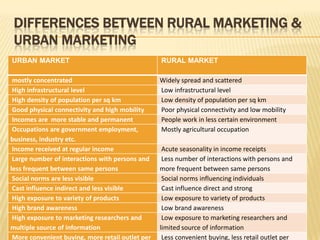
DIFFERENCES BETWEEN RURAL MARKETING &
URBAN MARKETING
URBAN MARKET RURAL MARKET
mostly concentrated Widely spread and scattered
High infrastructural level Low infrastructural level
High density of population per sq km Low density of population per sq km
Good physical connectivity and high mobility Poor physical connectivity and low mobility
Incomes are more stable and permanent People work in less certain environment
Occupations are government employment,
business, industry etc.
Mostly agricultural occupation
Income received at regular income Acute seasonality in income receipts
Large number of interactions with persons and
less frequent between same persons
Less number of interactions with persons and
more frequent between same persons
Social norms are less visible Social norms influencing individuals
Cast influence indirect and less visible Cast influence direct and strong
High exposure to variety of products Low exposure to variety of products
High brand awareness Low brand awareness
High exposure to marketing researchers and
multiple source of information
Low exposure to marketing researchers and
limited source of information
More convenient buying, more retail outlet per Less convenient buying, less retail outlet per

Rural marketing module 2

  • 1.
  • 2.
    RURAL MARKETING  Accordingto National Commission on Agriculture “Rural marketing is a process which starts with a decision to produce a salable farm commodity and it involves all the aspects of market system, and includes pre and post harvest operations i.e. assembling, grading, storage, transportation and distribution”.
  • 3.
    BROADER PERSPECTIVE  “RuralMarketing can be defined as a function that manages all activities involved in assessing, stimulating, and converting the purchasing power of rural consumers into an effective demand for specific products and services and moving these products and services to the people in rural areas to create satisfaction and a better standard of living and thereby achieving organizational goals.”
  • 4.
    NATURE OF RURALMARKET  Large, diverse and scattered market  Major income of rural consumers is from agriculture  Traditional outlook  Standard of living and rising disposable income of the rural customers  Rising literary levels
  • 5.
     Diverse socioeconomic background  Infrastructure facilities
  • 6.
    SCOPE OR ATTRACTIVENESSOF RURAL MARKETING:-  Large population  Rising rural prosperity  Growth in consumption  Change in life style  Market growth rate higher than urban  Life cycle advantage
  • 7.
    ATTRACTIVENESS OF RURALMARKETING ENVIRONMENT  a) Social changes  b) Economic changes  c) Ethical changes  d) Political changes  e) Physical changes  f) Technological changes
  • 8.
    SOCIAL FACTORS  Sociologicalfactor  Anthropological factors  Psychological factors
  • 9.
  • 10.
     c) Ethicalforces:-  d) Political forces:-  e) Physical forces:-  f) Technological force:-
  • 11.
    DIFFERENCES BETWEEN RURALMARKETING & URBAN MARKETING URBAN MARKET RURAL MARKET mostly concentrated Widely spread and scattered High infrastructural level Low infrastructural level High density of population per sq km Low density of population per sq km Good physical connectivity and high mobility Poor physical connectivity and low mobility Incomes are more stable and permanent People work in less certain environment Occupations are government employment, business, industry etc. Mostly agricultural occupation Income received at regular income Acute seasonality in income receipts Large number of interactions with persons and less frequent between same persons Less number of interactions with persons and more frequent between same persons Social norms are less visible Social norms influencing individuals Cast influence indirect and less visible Cast influence direct and strong High exposure to variety of products Low exposure to variety of products High brand awareness Low brand awareness High exposure to marketing researchers and multiple source of information Low exposure to marketing researchers and limited source of information More convenient buying, more retail outlet per Less convenient buying, less retail outlet per