Theory Z
BY WILLIAM OUCHI
Theory Z
Well we can think of Theory Z as an extension of Douglas McGregor’s Theory X and Y only that
Theory Z was created by William Ouchi.
In basic terms Theory Z was born from a mixture of Japanese and American management
practices.
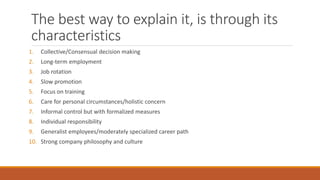
The best way to explain it, is through its
characteristics
1. Collective/Consensual decision making
2. Long-term employment
3. Job rotation
4. Slow promotion
5. Focus on training
6. Care for personal circumstances/holistic concern
7. Informal control but with formalized measures
8. Individual responsibility
9. Generalist employees/moderately specialized career path
10. Strong company philosophy and culture
1. Collective/Consensual decision making
Japan, as capitalist as it is, still holds dear the practice of familial relationship between employee
and employer which we can call paternalistic leadership.
Employees become loyal to the organization when they are listened to and contribute to
decision making.
Here William says corporate America should adopt consensual decision making rather than the
superior domineeringly stating the way forward.
It is a very hard thing for you to listen to your junior when making business decisions, not only
due to fear of wrong decisions made but also ‘fragile egos’.
Employees, because they made the decisions, will strive to implement them. Theory Z assumes
that employees can be very creative leading to better decisions made.
2. Long-term employment
The Japanese management approach deems that employees need to be assured of lifetime
employment because this would give them security.
William Ouchi knew that he was writing mainly to corporate American which was highly
capitalist and individualistic. So he modified lifetime employment to long-term employment.
Americans emphasize on performance and will not tolerate an underperforming employee that
long. Therefore Theory Z makes a compromise.
Long-term employment will almost always be rewarded by motivated employees because of the
security assured to them. For high-performers long-term employment may not create
motivation.
You should note that long-term employment creates a permanent workforce that’s essential for
high and constant productivity.
3. Job rotation
Corporate American believes in specialization at the workplace. But corporate Japan wants
flexible human resource.
William Ouchi therefore recommends that workers need not be specialized to just one single
thing. To do that they have to be rotated through different departments so that they become
generalist employees and not too specialized.
Remember corporate American needed to learn from its Japanese counterpart because Japan’s
economy was doing really well in the 70s and 80s as compared to America’s economy.
Side note: other people argue that Theory Z became not as important when Japan’s economy
was doing badly in the 90s.
A generalist workforce creates a flexible workforce.
4. Slow promotion
Ouchi recommends slow promotion, a characteristic more common in corporate Japan than in
America, where high performers were promoted fast.
The purpose of slow promotion is to ensure employees are rotated across departments for quite
sometime for them to become generalist and flexible. On the other hand we could say that,
rather job rotation across departments automatically causes slow promotion.
Slow promotion will continue in the organization because those promoted, usually after a long
time of working, would in turn do the same for their subordinates.
All this would result in a flexible and permanent workforce.
5. Focus on training
This property is akin to the Japanese mantra: “Gemba kaizen” which is Japanese for: “continuous
improvement”.
The organization needs to keep improving if it is to stay relevant and one way to do that is to
train employees regularly.
That adds to their skillset in favor of the organization.
Training results in a skilled workforce.
6. Care for personal
circumstances/holistic concern.
An organization works for its employees. The organization cannot ignore the personal life of
their employees and it has a moral obligation to foster human dignity.
Again corporate America didn’t seem to agree with this. Japanese organizations were concerned
about employee personal life not just work life.
That means employees have to be given fair remuneration, good working conditions, they
should have time for family life and the organization should support their employees to achieve
their personal goals e.g. mortgages.
This more than anything fulfils moral obligations of an organization. Employees will also become
loyal to the organization.
7. Informal control but with formalized
measures
William recommends that management should not boss around people too much. It should let
them to their work with minimal interference.
As a compensation for the overly profit-oriented America, organization still need formality:
rules, standards of performance. Employees do as they see fit but they will be evaluated by
formal measures.
This results in less MBWA(Management By Wandering Around) and a spirited workforce that is
self-disciplined. This is close to what Elton Mayo found out.
8. Individual responsibility
Corporate America is individualistic and emphasizes performance hence there is a high
preference for individual performance appraisal.
You are always judged as an individual. Conversely, Japan mostly measured performance with a
group perspective. Theory Z wants performance to be measured individually.
This will ensure efficiency, poor performing employees can be sacked or given warnings.
9. Generalist employees/ moderately
specialized career path
Employees need to have a broad skill set. They are rotated from department to department. This
rotation will slow down promotion.
The end result is a flexible workforce. We should note that the Japanese management approach
has this as one of the practices.
10. Strong company philosophy and
culture
Japanese culture values discipline in all sectors. Japanese management practices always create a
strong company philosophy which every employee follows.
Man is a social being, and each person owes their behavior to the society around him or her.
With a strong philosophy and culture employees can quickly understand what the organization
expects of them. The employees will either conform to the culture or will resist it and it will be
easy to spot the black sheep.
Thereby the organization can maintain their culture and remain with like minded employees.
The company culture often contributes to its success.
Google is an example of a company whose culture made it stand out.
References
https://www.toolshero.com/leadership/theory-z/
https://courses.lumenlearning.com/wmopen-introbusiness/chapter/reading-douglas-
mcgregors-theory-x-and-theory-y-2/
https://www.referenceforbusiness.com/management/Str-Ti/Theory-Z.html

Theory z

  • 1.
  • 2.
    Theory Z Well wecan think of Theory Z as an extension of Douglas McGregor’s Theory X and Y only that Theory Z was created by William Ouchi. In basic terms Theory Z was born from a mixture of Japanese and American management practices.
  • 3.
    The best wayto explain it, is through its characteristics 1. Collective/Consensual decision making 2. Long-term employment 3. Job rotation 4. Slow promotion 5. Focus on training 6. Care for personal circumstances/holistic concern 7. Informal control but with formalized measures 8. Individual responsibility 9. Generalist employees/moderately specialized career path 10. Strong company philosophy and culture
  • 4.
    1. Collective/Consensual decisionmaking Japan, as capitalist as it is, still holds dear the practice of familial relationship between employee and employer which we can call paternalistic leadership. Employees become loyal to the organization when they are listened to and contribute to decision making. Here William says corporate America should adopt consensual decision making rather than the superior domineeringly stating the way forward. It is a very hard thing for you to listen to your junior when making business decisions, not only due to fear of wrong decisions made but also ‘fragile egos’. Employees, because they made the decisions, will strive to implement them. Theory Z assumes that employees can be very creative leading to better decisions made.
  • 5.
    2. Long-term employment TheJapanese management approach deems that employees need to be assured of lifetime employment because this would give them security. William Ouchi knew that he was writing mainly to corporate American which was highly capitalist and individualistic. So he modified lifetime employment to long-term employment. Americans emphasize on performance and will not tolerate an underperforming employee that long. Therefore Theory Z makes a compromise. Long-term employment will almost always be rewarded by motivated employees because of the security assured to them. For high-performers long-term employment may not create motivation. You should note that long-term employment creates a permanent workforce that’s essential for high and constant productivity.
  • 6.
    3. Job rotation CorporateAmerican believes in specialization at the workplace. But corporate Japan wants flexible human resource. William Ouchi therefore recommends that workers need not be specialized to just one single thing. To do that they have to be rotated through different departments so that they become generalist employees and not too specialized. Remember corporate American needed to learn from its Japanese counterpart because Japan’s economy was doing really well in the 70s and 80s as compared to America’s economy. Side note: other people argue that Theory Z became not as important when Japan’s economy was doing badly in the 90s. A generalist workforce creates a flexible workforce.
  • 7.
    4. Slow promotion Ouchirecommends slow promotion, a characteristic more common in corporate Japan than in America, where high performers were promoted fast. The purpose of slow promotion is to ensure employees are rotated across departments for quite sometime for them to become generalist and flexible. On the other hand we could say that, rather job rotation across departments automatically causes slow promotion. Slow promotion will continue in the organization because those promoted, usually after a long time of working, would in turn do the same for their subordinates. All this would result in a flexible and permanent workforce.
  • 8.
    5. Focus ontraining This property is akin to the Japanese mantra: “Gemba kaizen” which is Japanese for: “continuous improvement”. The organization needs to keep improving if it is to stay relevant and one way to do that is to train employees regularly. That adds to their skillset in favor of the organization. Training results in a skilled workforce.
  • 9.
    6. Care forpersonal circumstances/holistic concern. An organization works for its employees. The organization cannot ignore the personal life of their employees and it has a moral obligation to foster human dignity. Again corporate America didn’t seem to agree with this. Japanese organizations were concerned about employee personal life not just work life. That means employees have to be given fair remuneration, good working conditions, they should have time for family life and the organization should support their employees to achieve their personal goals e.g. mortgages. This more than anything fulfils moral obligations of an organization. Employees will also become loyal to the organization.
  • 10.
    7. Informal controlbut with formalized measures William recommends that management should not boss around people too much. It should let them to their work with minimal interference. As a compensation for the overly profit-oriented America, organization still need formality: rules, standards of performance. Employees do as they see fit but they will be evaluated by formal measures. This results in less MBWA(Management By Wandering Around) and a spirited workforce that is self-disciplined. This is close to what Elton Mayo found out.
  • 11.
    8. Individual responsibility CorporateAmerica is individualistic and emphasizes performance hence there is a high preference for individual performance appraisal. You are always judged as an individual. Conversely, Japan mostly measured performance with a group perspective. Theory Z wants performance to be measured individually. This will ensure efficiency, poor performing employees can be sacked or given warnings.
  • 12.
    9. Generalist employees/moderately specialized career path Employees need to have a broad skill set. They are rotated from department to department. This rotation will slow down promotion. The end result is a flexible workforce. We should note that the Japanese management approach has this as one of the practices.
  • 13.
    10. Strong companyphilosophy and culture Japanese culture values discipline in all sectors. Japanese management practices always create a strong company philosophy which every employee follows. Man is a social being, and each person owes their behavior to the society around him or her. With a strong philosophy and culture employees can quickly understand what the organization expects of them. The employees will either conform to the culture or will resist it and it will be easy to spot the black sheep. Thereby the organization can maintain their culture and remain with like minded employees. The company culture often contributes to its success. Google is an example of a company whose culture made it stand out.
  • 14.