BY,
BLESSON THOMAS BENCHAMIN
William G. Ouchi
 American professor and author in the field of
business management.
 Ouchi first came to prominence for his studies of
the differences between Japanese and American
companies and management styles.
 Theory Z of Ouchi is Dr. William Ouchi's so-called
"Japanese Management" style popularized during
the Asian economic boom of the 1980s.
 First book in 1981 -“Theory Z: How
American Management Can Meet the
Japanese Challenge.
 Built on Douglas McGregor's Theory X
and Theory Y
What is theory z??????
 Theory Z is an approach to management
based upon a combination of American
and Japanese management philosophies
and characterized by, among other things,
long-term job security, consensual
decision making, slow evaluation and
promotion procedures, and individual
responsibility within a group.
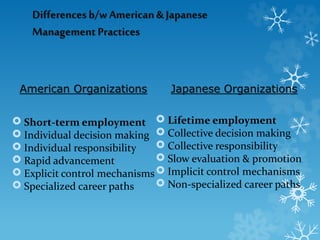
Differencesb/w American& Japanese
Management Practices
American Organizations
 Short-term employment
 Individual decision making
 Individual responsibility
 Rapid advancement
 Explicit control mechanisms
 Specialized career paths
Japanese Organizations
 Lifetime employment
 Collective decision making
 Collective responsibility
 Slow evaluation & promotion
 Implicit control mechanisms
 Non-specialized career paths
FEATURES of theory z
 LONG-TERM EMPLOYMENT
 COLLECTIVE DECISION MAKING
 INDIVIDUAL RESPONSIBILITY
 SLOW EVALUATION AND PROMOTION
 INFORMAL CONTROL WITH FORMALIZED MEASURES
 MODERATELY SPECIALIZED CAREER PATH
 HOLISTIC CONCERN
LONG TERM EMPOLYMENT
Type Z organizations set the conditions to
encourage their employees to make life long
commitments to the organizations. Which promotes
stability in the organization and job security among
employees.
COLLECTIVE DECISION MAKING
 This type of organization helps in effective
communication which helps in effective decision making.
INDIVIDUAL RESPONSIBILITY
 Type Z organizations retain the
emphasises on individual contribution
that are characteristic of most American
firms by recognizing individual
achievements.
SLOW EVALUATION AND
PROMOTION
 The Type A organization has generally
been characterized by short-term
evaluations of performance and rapid
promotion of high achievers. The Type J
organization, conversely, adopts the
Japanese model of slow evaluation and
promotion.
INFORMAL CONTROL WITH FORMALIZED
MEASURES
 The Type Z organization relies on informal
methods of control, but does measure
performance through formal mechanisms.
MODERATELY SPECIALIZED CAREER
PATH
 The Type Z organization adopts a
middle-of-the-road posture, with career
paths that are less specialized than the
traditional U.S. model but more
specialized than the traditional Japanese.
HOLISTIC CONCERN ( like
family)
 The Type Z organization is characterized
by concern for employees that goes
beyond the workplace. This philosophy is
more consistent with the Japanese model
than the U.S. model.
THANK YOU

Btb ppt

  • 1.
  • 2.
    William G. Ouchi American professor and author in the field of business management.  Ouchi first came to prominence for his studies of the differences between Japanese and American companies and management styles.  Theory Z of Ouchi is Dr. William Ouchi's so-called "Japanese Management" style popularized during the Asian economic boom of the 1980s.
  • 3.
     First bookin 1981 -“Theory Z: How American Management Can Meet the Japanese Challenge.  Built on Douglas McGregor's Theory X and Theory Y
  • 4.
    What is theoryz??????  Theory Z is an approach to management based upon a combination of American and Japanese management philosophies and characterized by, among other things, long-term job security, consensual decision making, slow evaluation and promotion procedures, and individual responsibility within a group.
  • 5.
    Differencesb/w American& Japanese ManagementPractices American Organizations  Short-term employment  Individual decision making  Individual responsibility  Rapid advancement  Explicit control mechanisms  Specialized career paths Japanese Organizations  Lifetime employment  Collective decision making  Collective responsibility  Slow evaluation & promotion  Implicit control mechanisms  Non-specialized career paths
  • 6.
    FEATURES of theoryz  LONG-TERM EMPLOYMENT  COLLECTIVE DECISION MAKING  INDIVIDUAL RESPONSIBILITY  SLOW EVALUATION AND PROMOTION  INFORMAL CONTROL WITH FORMALIZED MEASURES  MODERATELY SPECIALIZED CAREER PATH  HOLISTIC CONCERN
  • 7.
    LONG TERM EMPOLYMENT TypeZ organizations set the conditions to encourage their employees to make life long commitments to the organizations. Which promotes stability in the organization and job security among employees.
  • 8.
    COLLECTIVE DECISION MAKING This type of organization helps in effective communication which helps in effective decision making.
  • 9.
    INDIVIDUAL RESPONSIBILITY  TypeZ organizations retain the emphasises on individual contribution that are characteristic of most American firms by recognizing individual achievements.
  • 10.
    SLOW EVALUATION AND PROMOTION The Type A organization has generally been characterized by short-term evaluations of performance and rapid promotion of high achievers. The Type J organization, conversely, adopts the Japanese model of slow evaluation and promotion.
  • 11.
    INFORMAL CONTROL WITHFORMALIZED MEASURES  The Type Z organization relies on informal methods of control, but does measure performance through formal mechanisms.
  • 12.
    MODERATELY SPECIALIZED CAREER PATH The Type Z organization adopts a middle-of-the-road posture, with career paths that are less specialized than the traditional U.S. model but more specialized than the traditional Japanese.
  • 13.
    HOLISTIC CONCERN (like family)  The Type Z organization is characterized by concern for employees that goes beyond the workplace. This philosophy is more consistent with the Japanese model than the U.S. model.
  • 14.