www.oeclib.in
Submitted By:
Odisha Electronics Control Library
Seminar
On
Rover Technology
Content
 INTRODUCTION
 ROVER SERVICES
 ROVER ARCHITECTURE
 ACTION MODEL
 ROVER CLIENTS
 ROVER CONTROLLER
 ROVER DATABASE
 LOCATION SERVER
 MULTI-ROVER SYSTEM
 CONCLUSION & FUTURE WORKS
 REFERENCES
INTRODUCTION
 Location-aware computing involves the automatic tailoring
of information and services based on the cur-rent location
of the user.
 To achieve system scalability to very large client sets,
Rover servers are implemented in an action-based
concurrent soft-ware architecture that enables fine-grained
application-specific scheduling of tasks.
ROVER SERVICES
 BASIC DATA SERVICES
 TRANSACTIONAL SERVICES
 MAP-BASED SERVICES
 FILTER…
 ZOOM….
 TRANSLATE…
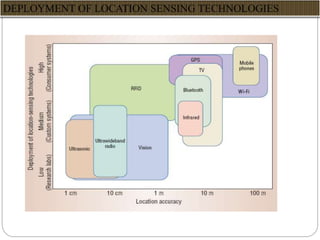
• COARSE GRAINED SYSTEMS
 Accuracies on the order of meters.
 Suitable for outdoor areas.
• FINED GRAINED SYSTEMS
 Accuracies on the order of centimeters.
 Suitable for both (indoor and outdoor areas) with higher
accuracies.
• SENSOR FUSION
LOCATION-SENSING TECHNOLOGIES
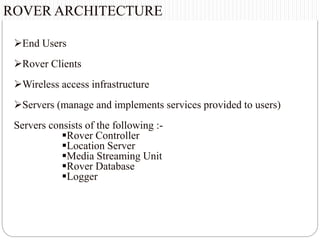
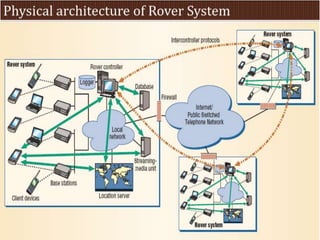
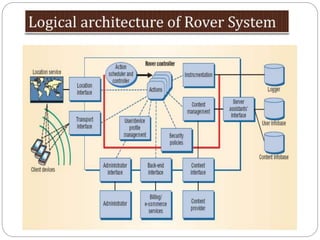
ROVER ARCHITECTURE
End Users
Rover Clients
Wireless access infrastructure
Servers (manage and implements services provided to users)
Servers consists of the following :-
Rover Controller
Location Server
Media Streaming Unit
Rover Database
Logger
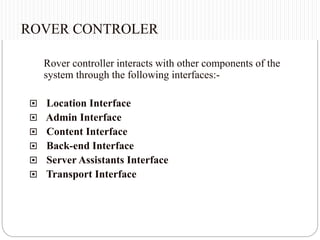
ROVER CONTROLER
Rover controller interacts with other components of the
system through the following interfaces:-
 Location Interface
 Admin Interface
 Content Interface
 Back-end Interface
 Server Assistants Interface
 Transport Interface
ROVER DATABASE
1) User info base:-
Maintains user and device info with
Volatile data and Non-volatile data
2) Content Info base:-
stores content served by the controller.
3) Transactions of rover controller with database from server
operation are done by:-
lock-acquiring and blocking flags
for avoiding deadlock.
LOCATION SERVER
Works in 2 phases:
1) Offline phase.
Signal strength to vectors.
2)A location determination phase.
Vector sample compared with the radio-map.
Signal strength received from each access point is
transform in function of distance.
Allows Rover systems to scale to large user populations by
allowing real-time application specific scheduling of tasks.
 Scheduling is done in atomic units called actions.
 An action is a small piece of code
 All actions are executed in a controlled manner by the Action
Controller.
 The action is executed whenever an I/O response is received.
SERVER OPERATION
 Server operation refer to a transaction that
interacts with the rover controller.
 A SERVER OPERATION IS A SEQUENCE OF
ACTIONS.
 Each server operation has exactly one
“response handling” action for handling
I/O event responses for the operation.
A Server operation is in one of the following three states.
They are:-
 Ready-to-run: At least one action is eligible to be executed
but no action is executing.
 Running: One action is executing
 Blocked: Server operation is waiting for some I/O
response.
ACTION CONTROLLER uses administrator defined policies for
scheduling of actions.
Management and execution of actions :-
• Init(action id, function ptr)
• Run(action id,function parameters, deadline failed handler
ptr)
• Cancel(action id,cancel handler ptr):
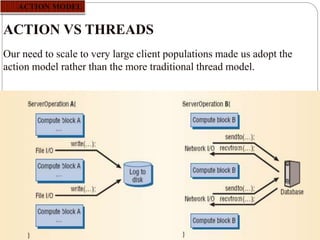
ACTION VS THREADS
Our need to scale to very large client populations made us adopt the
action model rather than the more traditional thread model.
MULTI-ROVER SYSTEM
 The multi-rover system is a collection of independent
rover systems that peer with each other to provide the
seamless connectivity to the users.
 The design of a multi-rover system is similar to the
Mobile IP solution to provide network mobility to
devices.
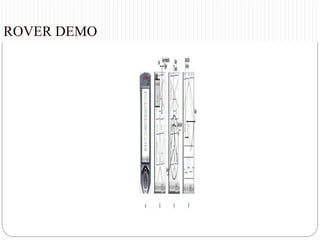
ROVER DEMO
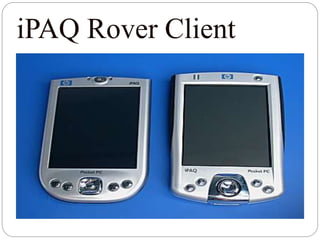
iPAQ Rover Client
Conclusion & Future Works
The short and long term projects of this
paradigm:-
 Experiment with limited capability
devices
 Location aware Streaming Devices
 Interact with cellular providers and
implement this mechanisms on cellular
interface.
 Multi-Rover System
REFERENCES
 www.google.com
 www.wikipedia.com
 www.oeclib.in
THANKS

Rover Technology ppt

  • 1.
    www.oeclib.in Submitted By: Odisha ElectronicsControl Library Seminar On Rover Technology
  • 2.
    Content  INTRODUCTION  ROVERSERVICES  ROVER ARCHITECTURE  ACTION MODEL  ROVER CLIENTS  ROVER CONTROLLER  ROVER DATABASE  LOCATION SERVER  MULTI-ROVER SYSTEM  CONCLUSION & FUTURE WORKS  REFERENCES
  • 3.
    INTRODUCTION  Location-aware computinginvolves the automatic tailoring of information and services based on the cur-rent location of the user.  To achieve system scalability to very large client sets, Rover servers are implemented in an action-based concurrent soft-ware architecture that enables fine-grained application-specific scheduling of tasks.
  • 4.
    ROVER SERVICES  BASICDATA SERVICES  TRANSACTIONAL SERVICES  MAP-BASED SERVICES  FILTER…  ZOOM….  TRANSLATE…
  • 5.
    • COARSE GRAINEDSYSTEMS  Accuracies on the order of meters.  Suitable for outdoor areas. • FINED GRAINED SYSTEMS  Accuracies on the order of centimeters.  Suitable for both (indoor and outdoor areas) with higher accuracies. • SENSOR FUSION LOCATION-SENSING TECHNOLOGIES
  • 7.
    ROVER ARCHITECTURE End Users RoverClients Wireless access infrastructure Servers (manage and implements services provided to users) Servers consists of the following :- Rover Controller Location Server Media Streaming Unit Rover Database Logger
  • 9.
    ROVER CONTROLER Rover controllerinteracts with other components of the system through the following interfaces:-  Location Interface  Admin Interface  Content Interface  Back-end Interface  Server Assistants Interface  Transport Interface
  • 11.
    ROVER DATABASE 1) Userinfo base:- Maintains user and device info with Volatile data and Non-volatile data 2) Content Info base:- stores content served by the controller. 3) Transactions of rover controller with database from server operation are done by:- lock-acquiring and blocking flags for avoiding deadlock.
  • 12.
    LOCATION SERVER Works in2 phases: 1) Offline phase. Signal strength to vectors. 2)A location determination phase. Vector sample compared with the radio-map. Signal strength received from each access point is transform in function of distance.
  • 13.
    Allows Rover systemsto scale to large user populations by allowing real-time application specific scheduling of tasks.  Scheduling is done in atomic units called actions.  An action is a small piece of code  All actions are executed in a controlled manner by the Action Controller.  The action is executed whenever an I/O response is received.
  • 14.
    SERVER OPERATION  Serveroperation refer to a transaction that interacts with the rover controller.  A SERVER OPERATION IS A SEQUENCE OF ACTIONS.  Each server operation has exactly one “response handling” action for handling I/O event responses for the operation.
  • 15.
    A Server operationis in one of the following three states. They are:-  Ready-to-run: At least one action is eligible to be executed but no action is executing.  Running: One action is executing  Blocked: Server operation is waiting for some I/O response.
  • 16.
    ACTION CONTROLLER usesadministrator defined policies for scheduling of actions. Management and execution of actions :- • Init(action id, function ptr) • Run(action id,function parameters, deadline failed handler ptr) • Cancel(action id,cancel handler ptr):
  • 17.
    ACTION VS THREADS Ourneed to scale to very large client populations made us adopt the action model rather than the more traditional thread model.
  • 18.
    MULTI-ROVER SYSTEM  Themulti-rover system is a collection of independent rover systems that peer with each other to provide the seamless connectivity to the users.  The design of a multi-rover system is similar to the Mobile IP solution to provide network mobility to devices.
  • 19.
  • 20.
  • 21.
    Conclusion & FutureWorks The short and long term projects of this paradigm:-  Experiment with limited capability devices  Location aware Streaming Devices  Interact with cellular providers and implement this mechanisms on cellular interface.  Multi-Rover System
  • 22.
  • 23.

Editor's Notes