Arnaud Bouchez | Synopse
From RAD to SOA
with mORMot
20161107T101500 - 20161107T113000
From RAD to SOA
with mORMot
• Notions
– Design
RAD, OOP, SOLID, DDD
– Architecture
2-Tier, 3-Tier, SOA, MicroServices
From RAD to SOA
with mORMot
• Customer-focused Architecture
• Implicit BBM Architecture
• Is it worth it?
• N-Tier
• SOA
• mORMot to the rescue
Customer-focused Architecture
• You can't talk about architecture
in isolation
• Architecture is always driven
by the actual needs
of the application
Customer-focused Architecture
• There is no such "one architecture fits all"
nor "one framework fits all" solution
• Architecture is just a thinking of
how you are building your own software
• Design is architecture applied in code
Customer-focused Architecture
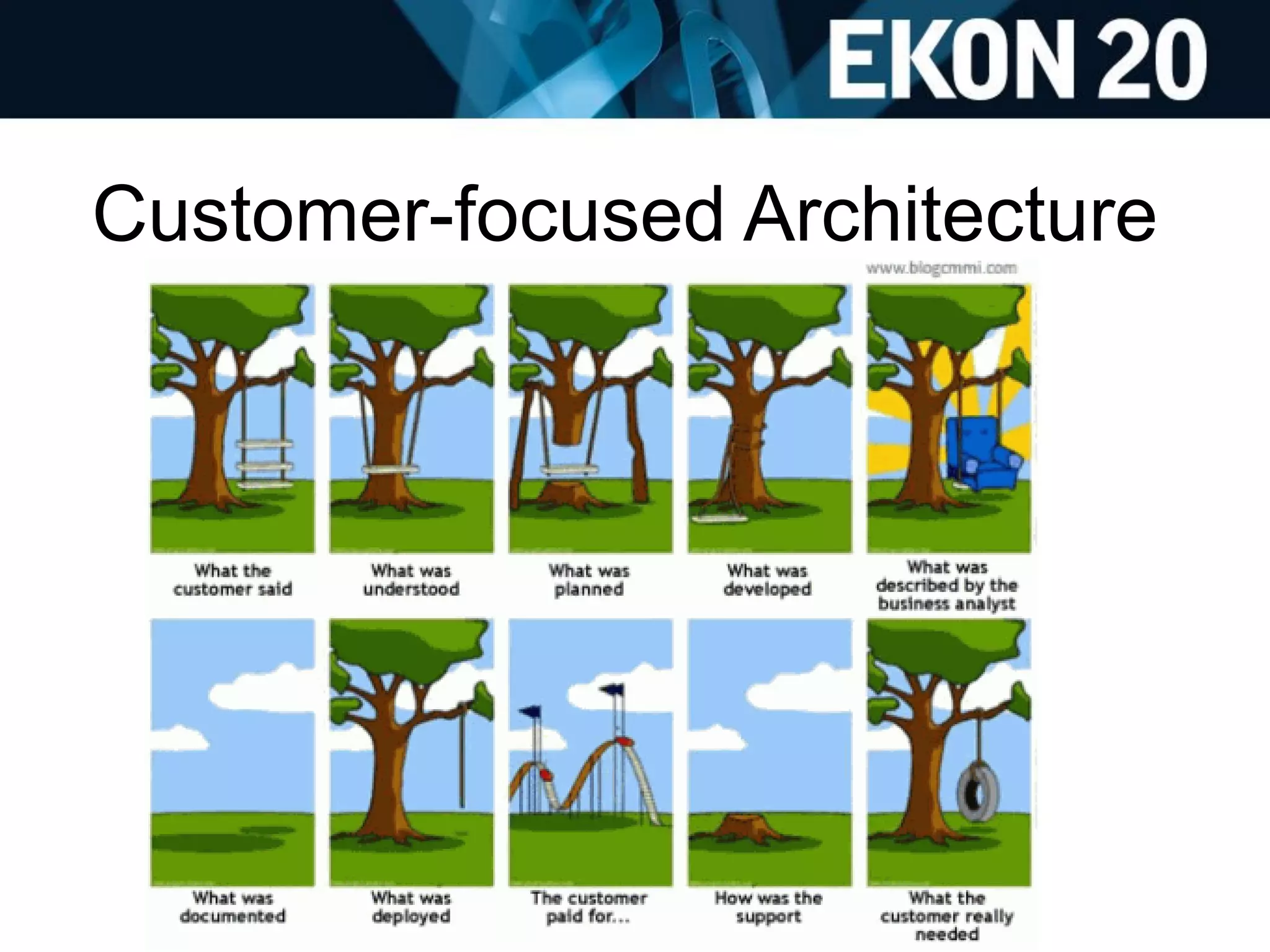
• is not about theory and diagrams
• nor just about best practice
• but an attempt to find
– a way of implementing
– a working solution
– for your customers
Customer-focused Architecture
• Premature architecture
may be the root of all evil (as optimization is)
• But no architecture, nor abstraction,
will close many doors, and let maintainability
be a nightmare, even impossible
Implicit BBM Architecture
• No Architecture?
• Will end with an implicit architecture
• Big Ball of Mud (BBM) design pattern
Implicit BBM Architecture
• Make explicit choices
– At Design / code level
– At Architecture / functional level
Design
• RAD
• OOP
• SOLID
• DDD
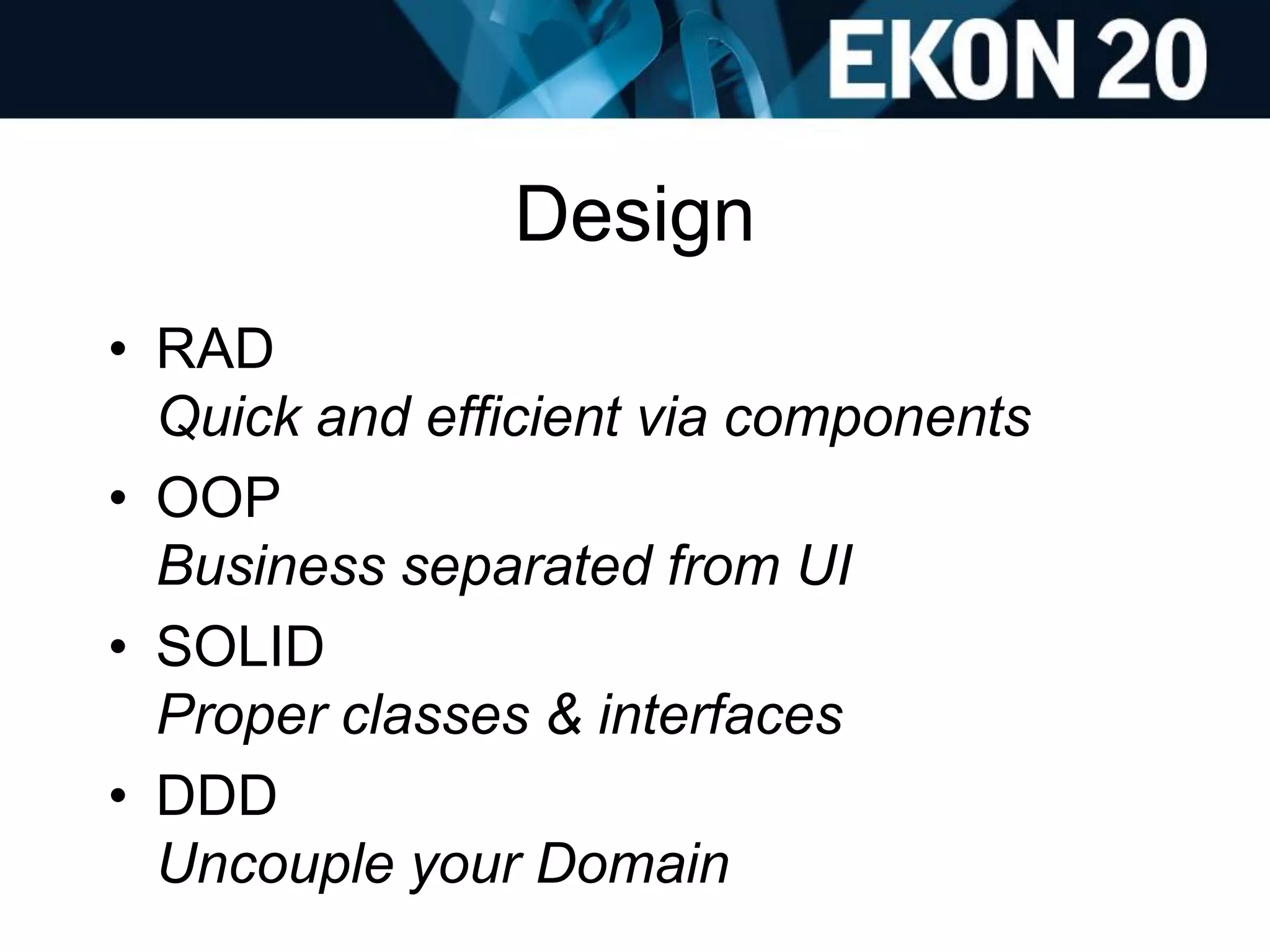
Design
• RAD
Quick and efficient via components
• OOP
Business separated from UI
• SOLID
Proper classes & interfaces
• DDD
Uncouple your Domain
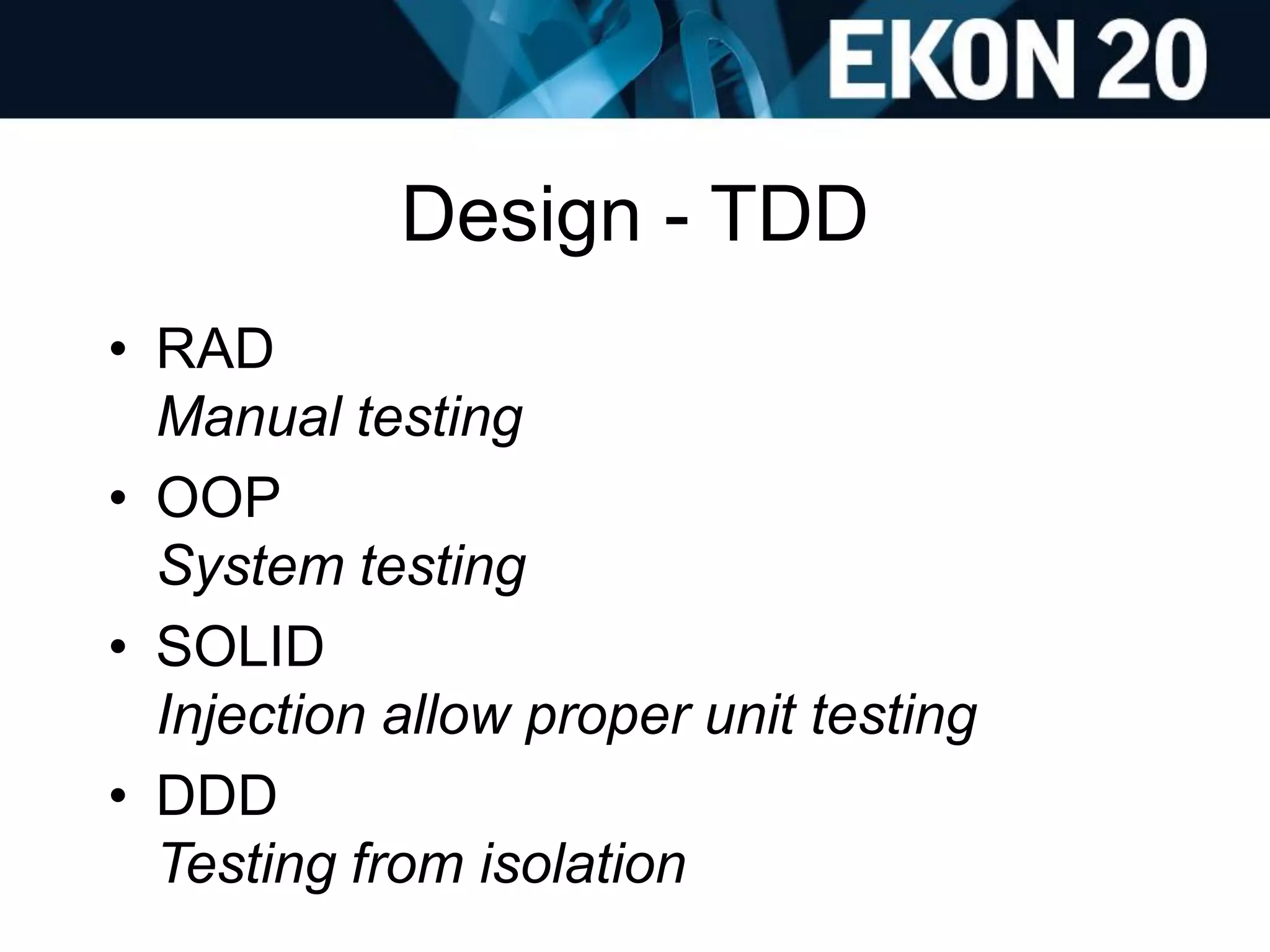
Design - TDD
• RAD
Manual testing
• OOP
System testing
• SOLID
Injection allow proper unit testing
• DDD
Testing from isolation
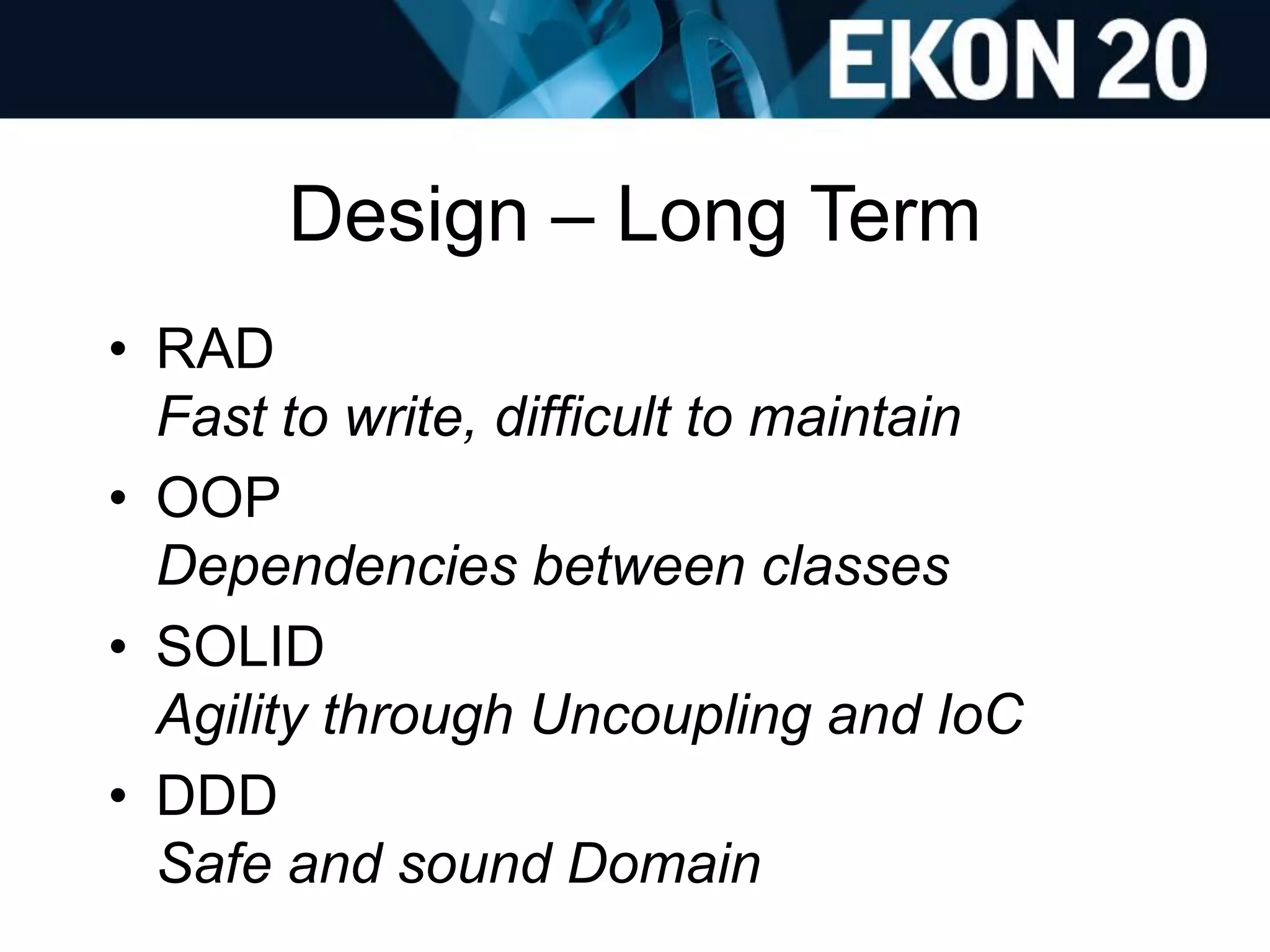
Design – Long Term
• RAD
Fast to write, difficult to maintain
• OOP
Dependencies between classes
• SOLID
Agility through Uncoupling and IoC
• DDD
Safe and sound Domain
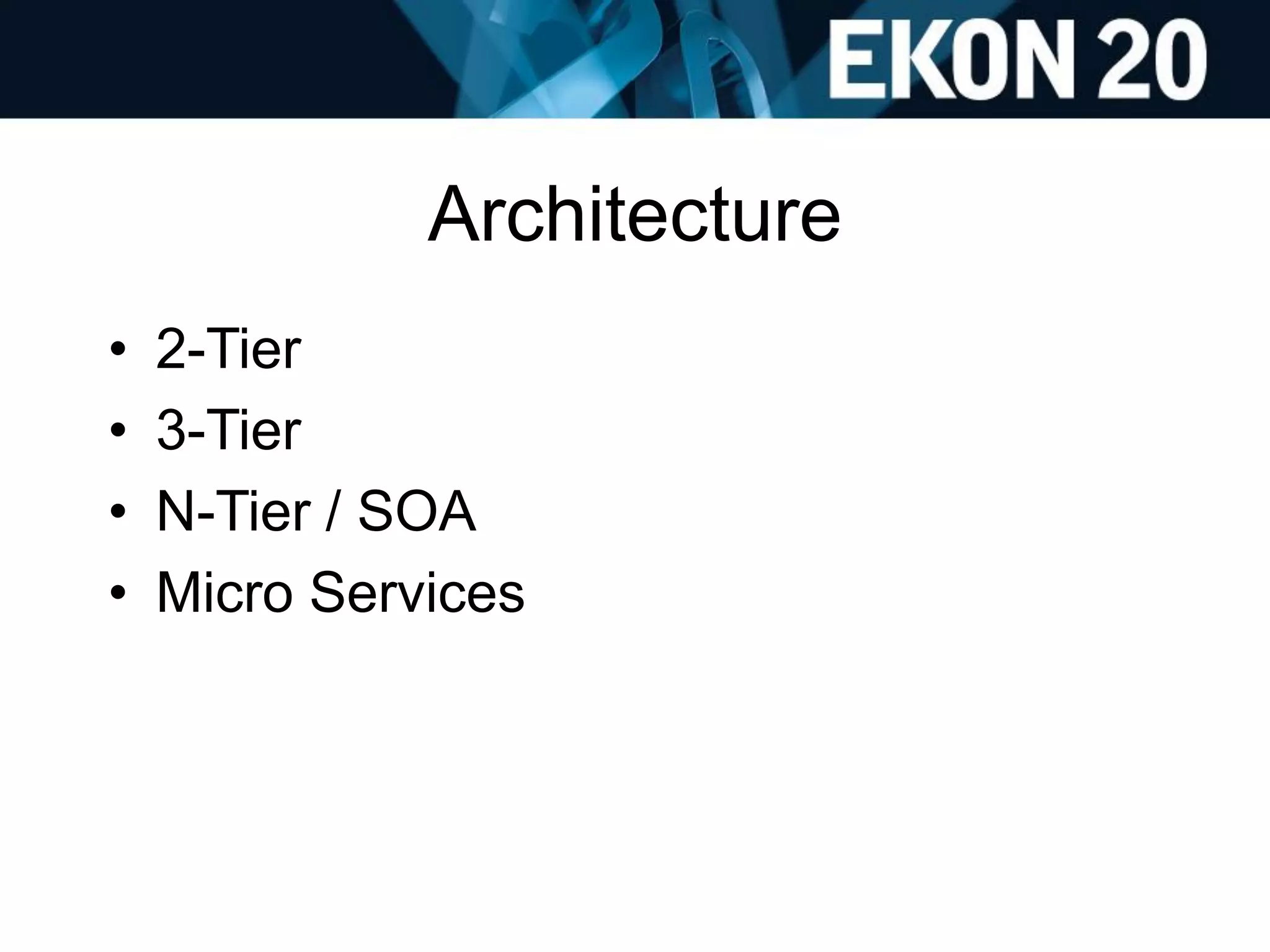
Architecture
• 2-Tier
• 3-Tier
• N-Tier / SOA
• Micro Services
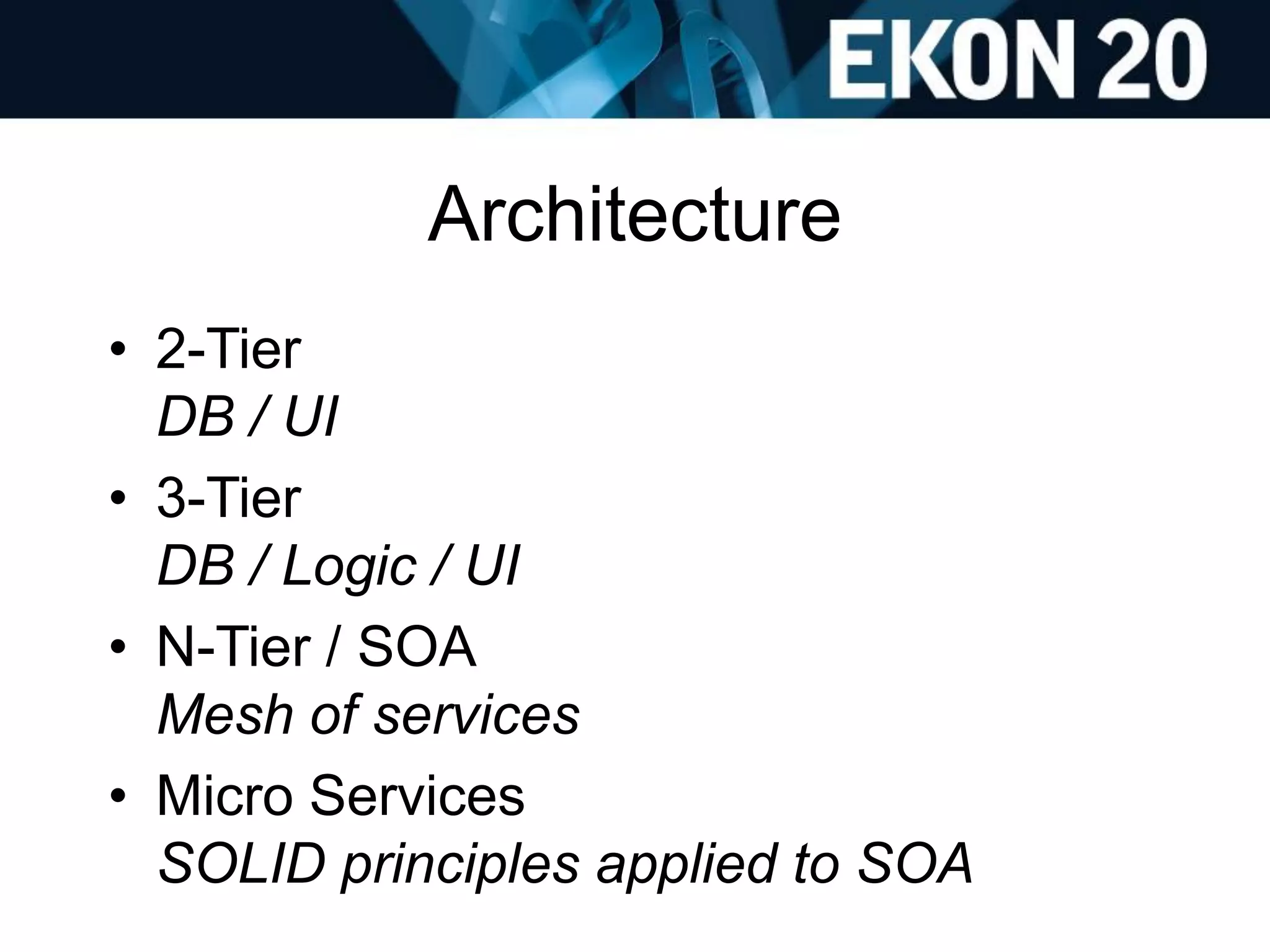
Architecture
• 2-Tier
DB / UI
• 3-Tier
DB / Logic / UI
• N-Tier / SOA
Mesh of services
• Micro Services
SOLID principles applied to SOA
Architecture
• 2-Tier
Single application
• 3-Tier
Client-Server
• N-Tier / SOA
Integration and vertical scaling
• Micro Services
Agility and horizontal scaling
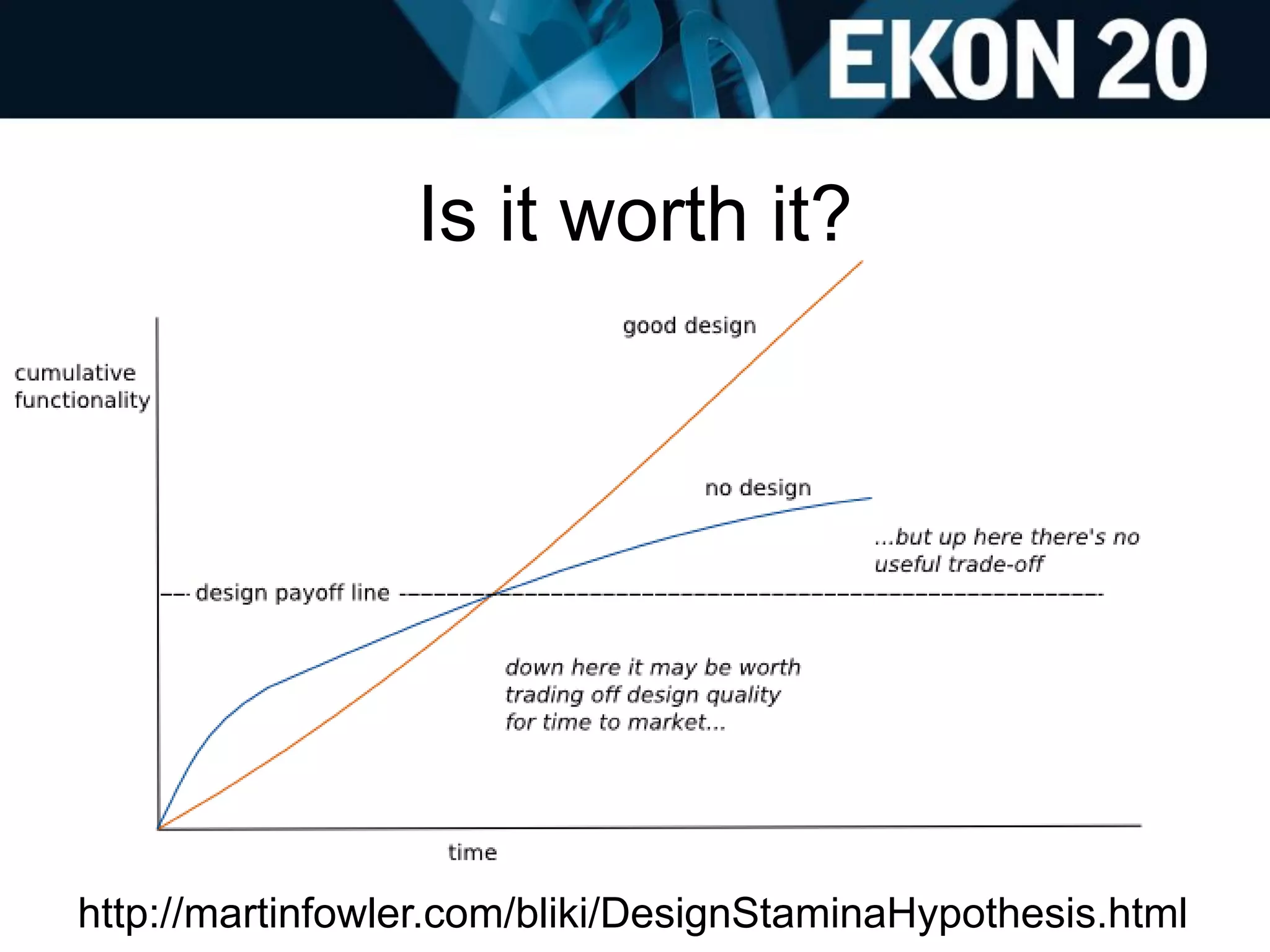
Is it worth it?
http://martinfowler.com/bliki/DesignStaminaHypothesis.html
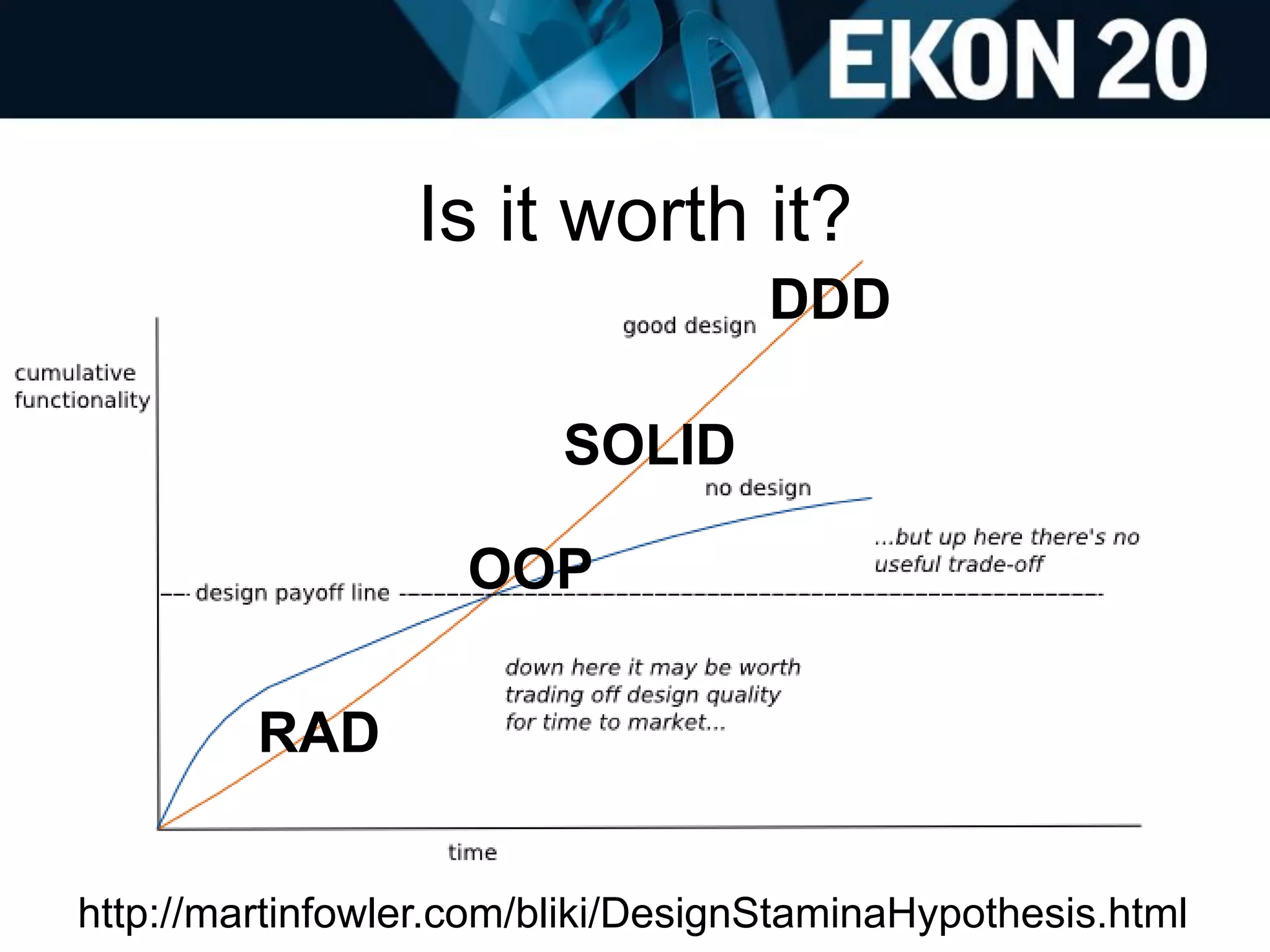
Is it worth it?
http://martinfowler.com/bliki/DesignStaminaHypothesis.html
RAD
OOP
SOLID
DDD
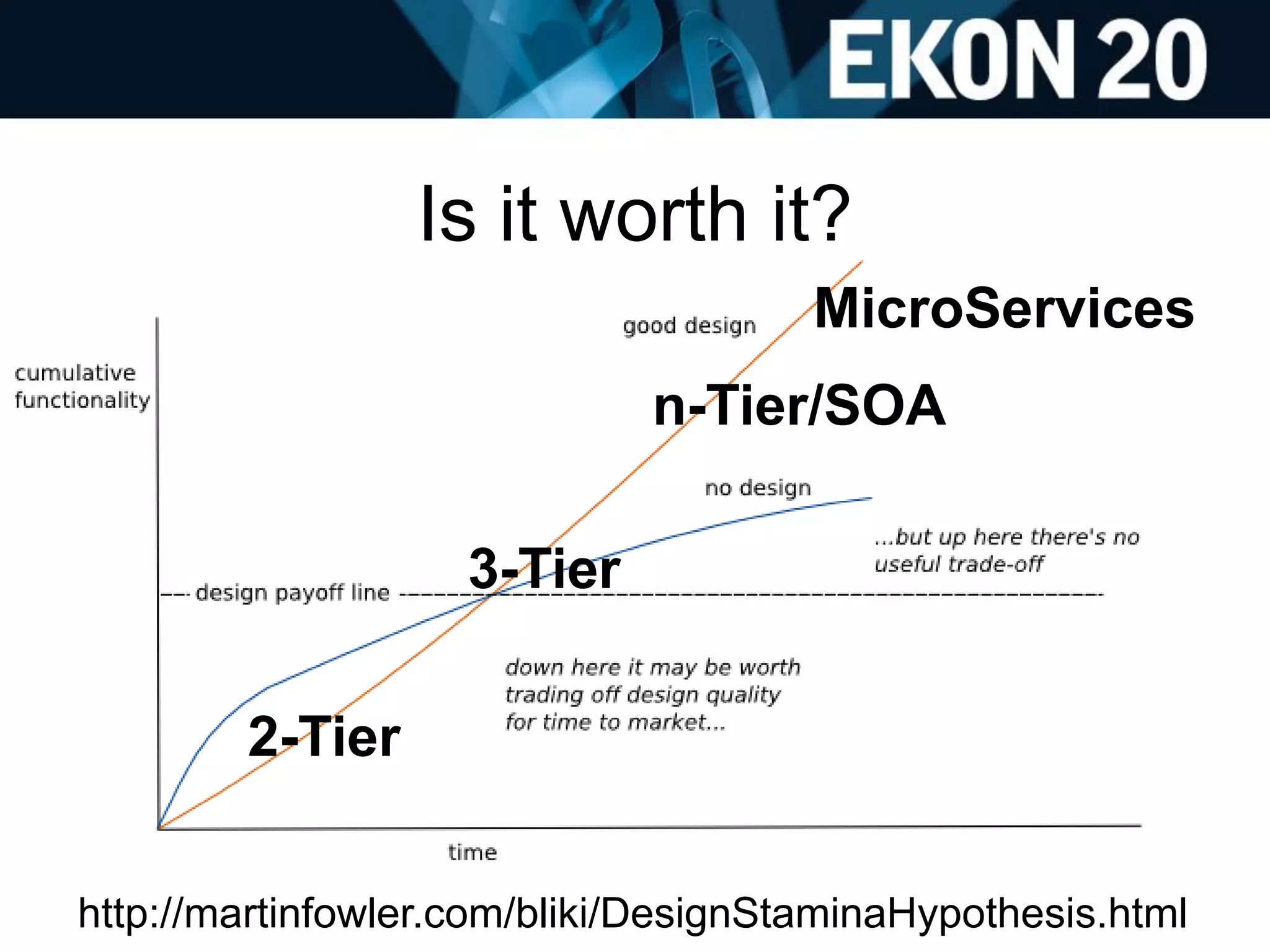
Is it worth it?
http://martinfowler.com/bliki/DesignStaminaHypothesis.html
2-Tier
3-Tier
n-Tier/SOA
MicroServices
N-Tier
… a piece of cake?
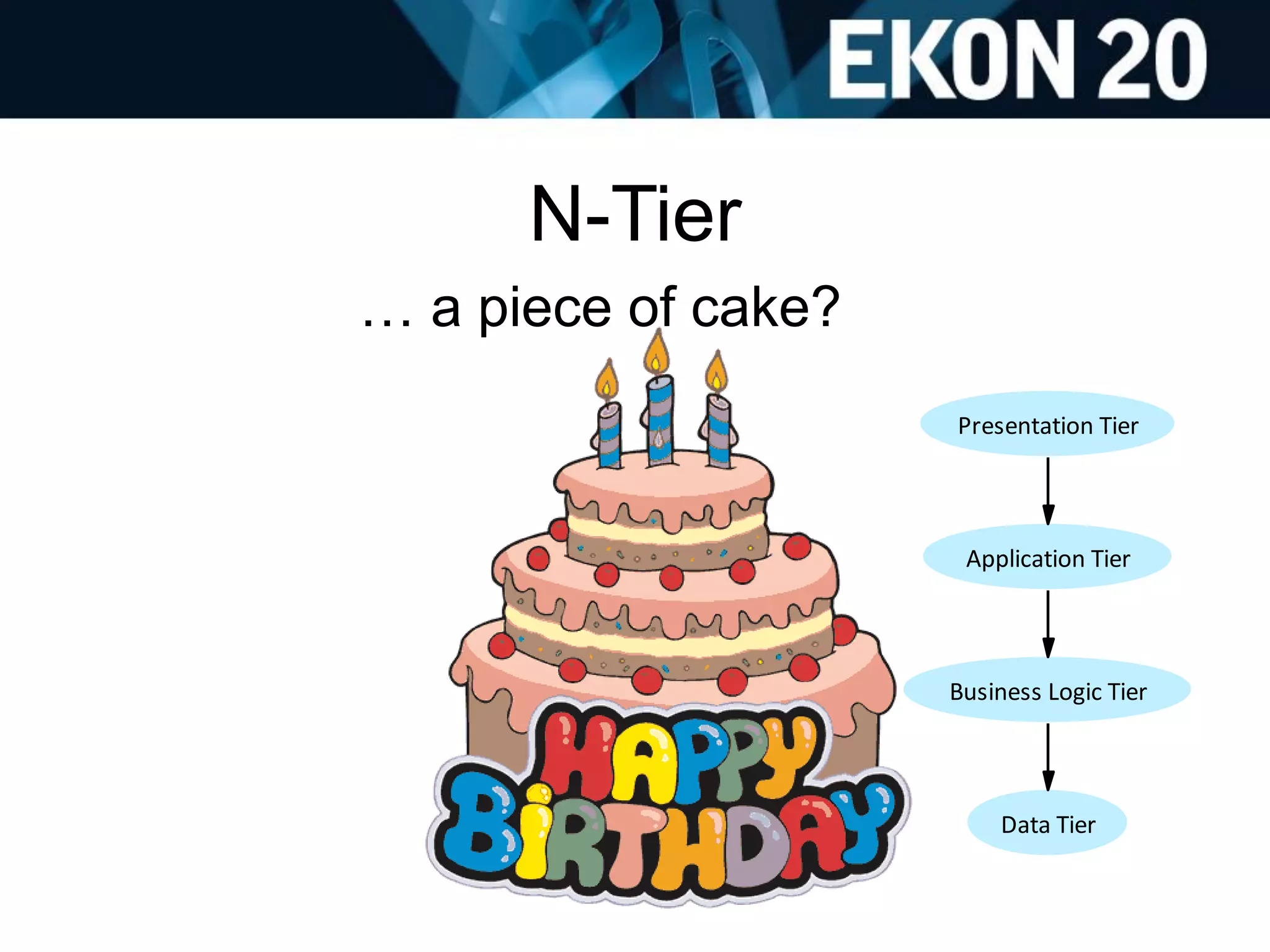
N-Tier
… a piece of cake?
Presentation Tier
Application Tier
Business Logic Tier
Data Tier
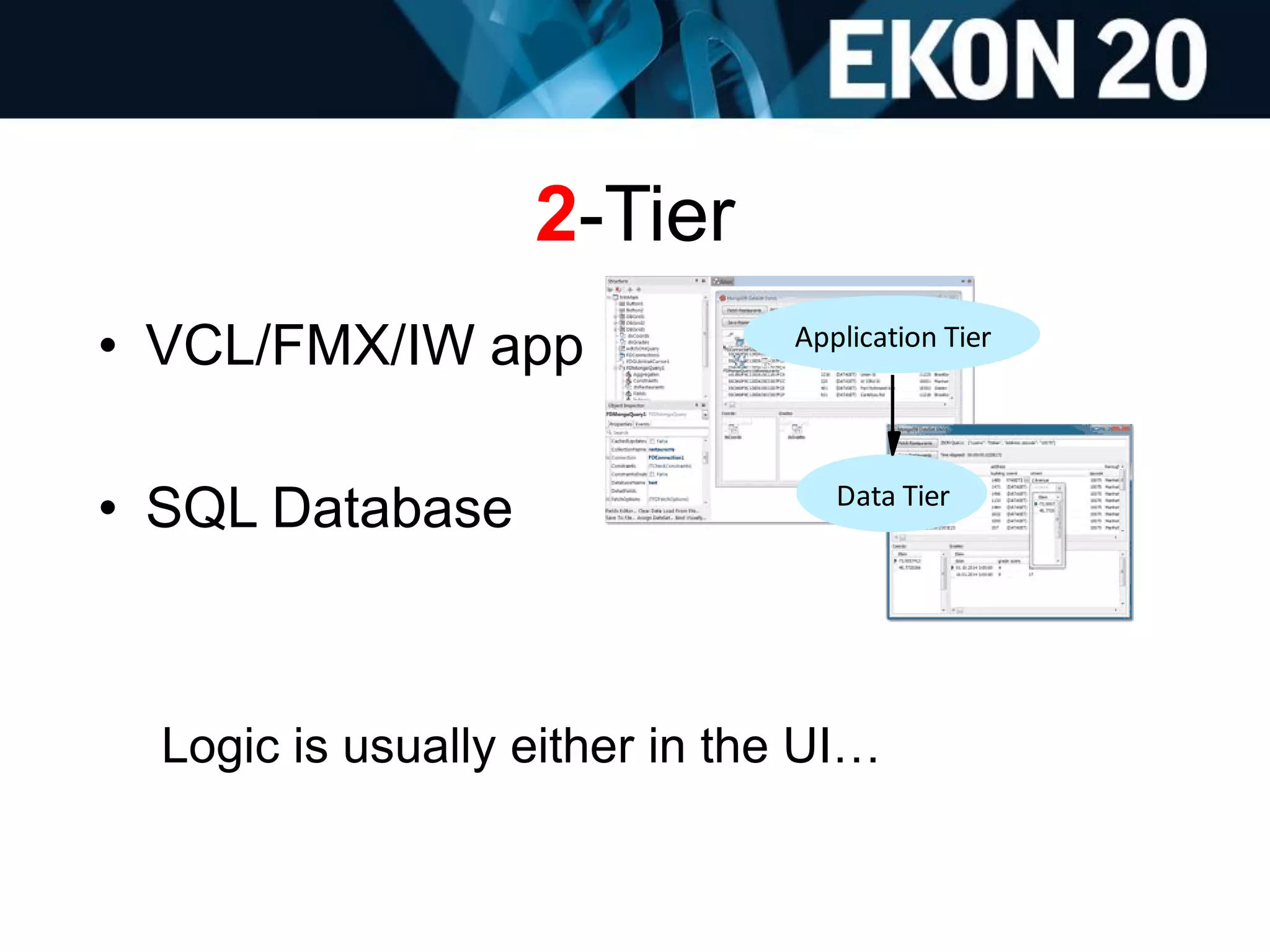
2-Tier
• VCL/FMX/IW app
• SQL Database
2-Tier
• VCL/FMX/IW app
• SQL Database
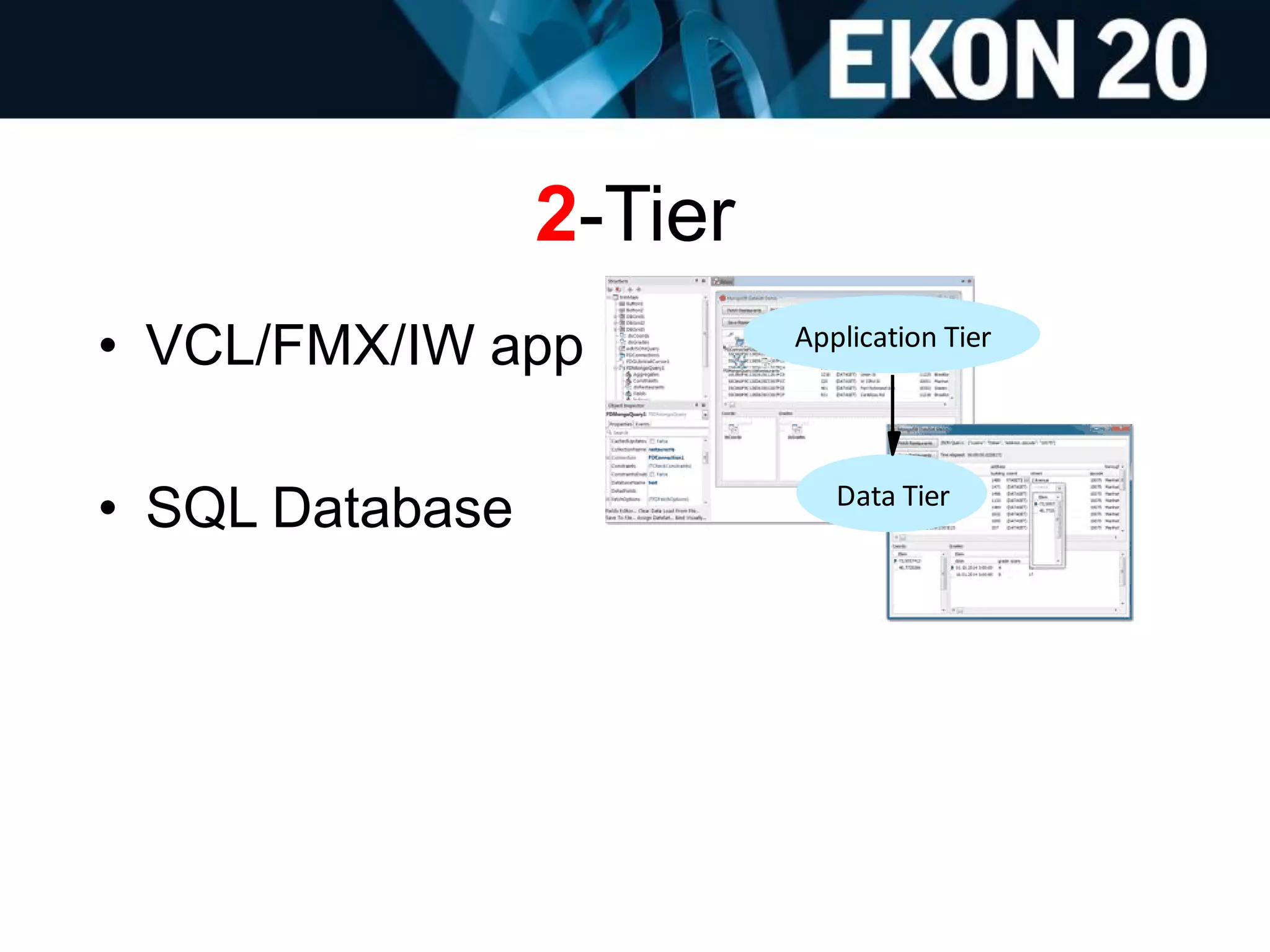
Application Tier
Data Tier
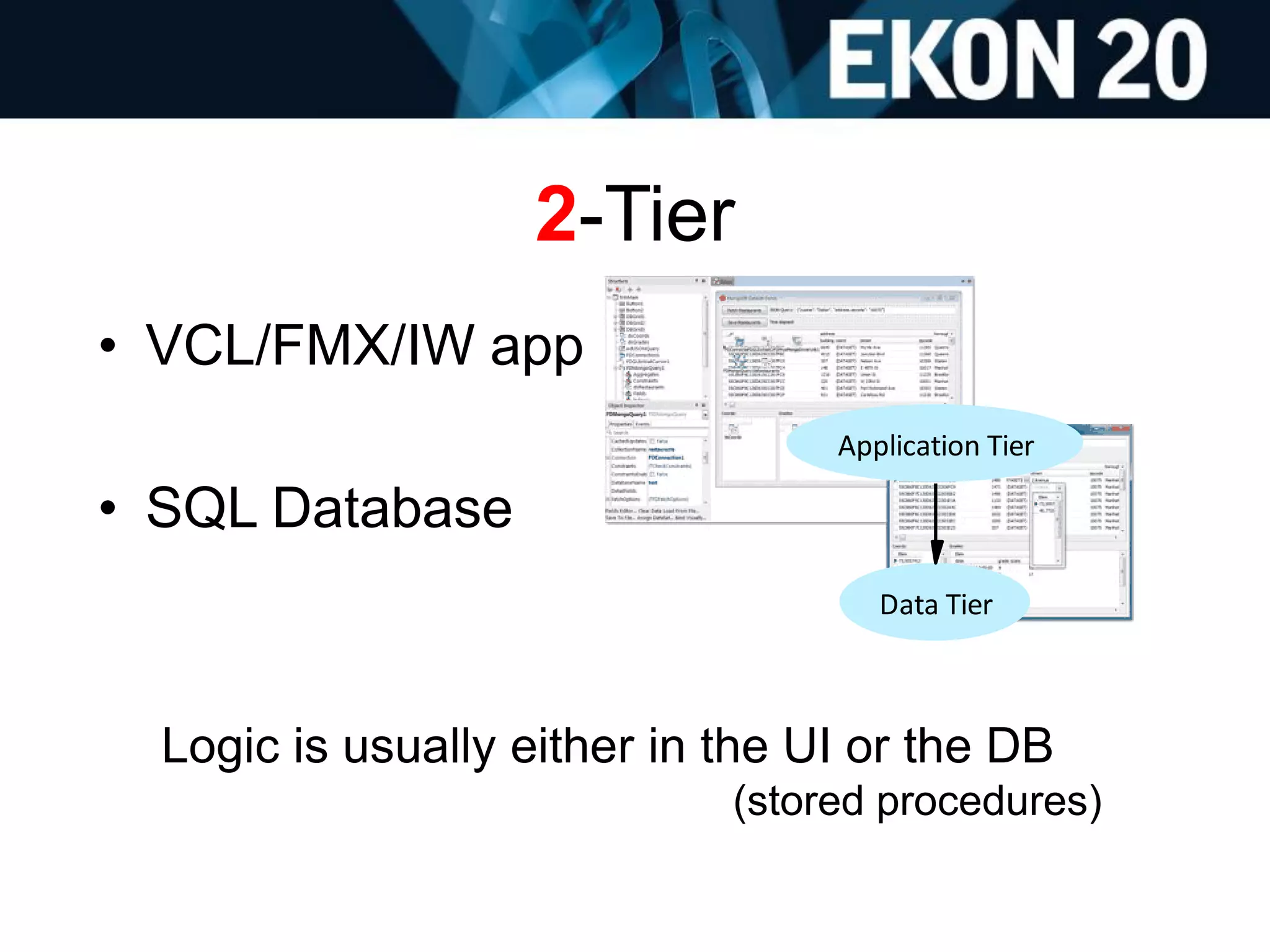
2-Tier
• VCL/FMX/IW app
• SQL Database
Logic is usually either in the UI…
Application Tier
Data Tier
2-Tier
• VCL/FMX/IW app
• SQL Database
Logic is usually either in the UI or the DB
(stored procedures)
Application Tier
Data Tier
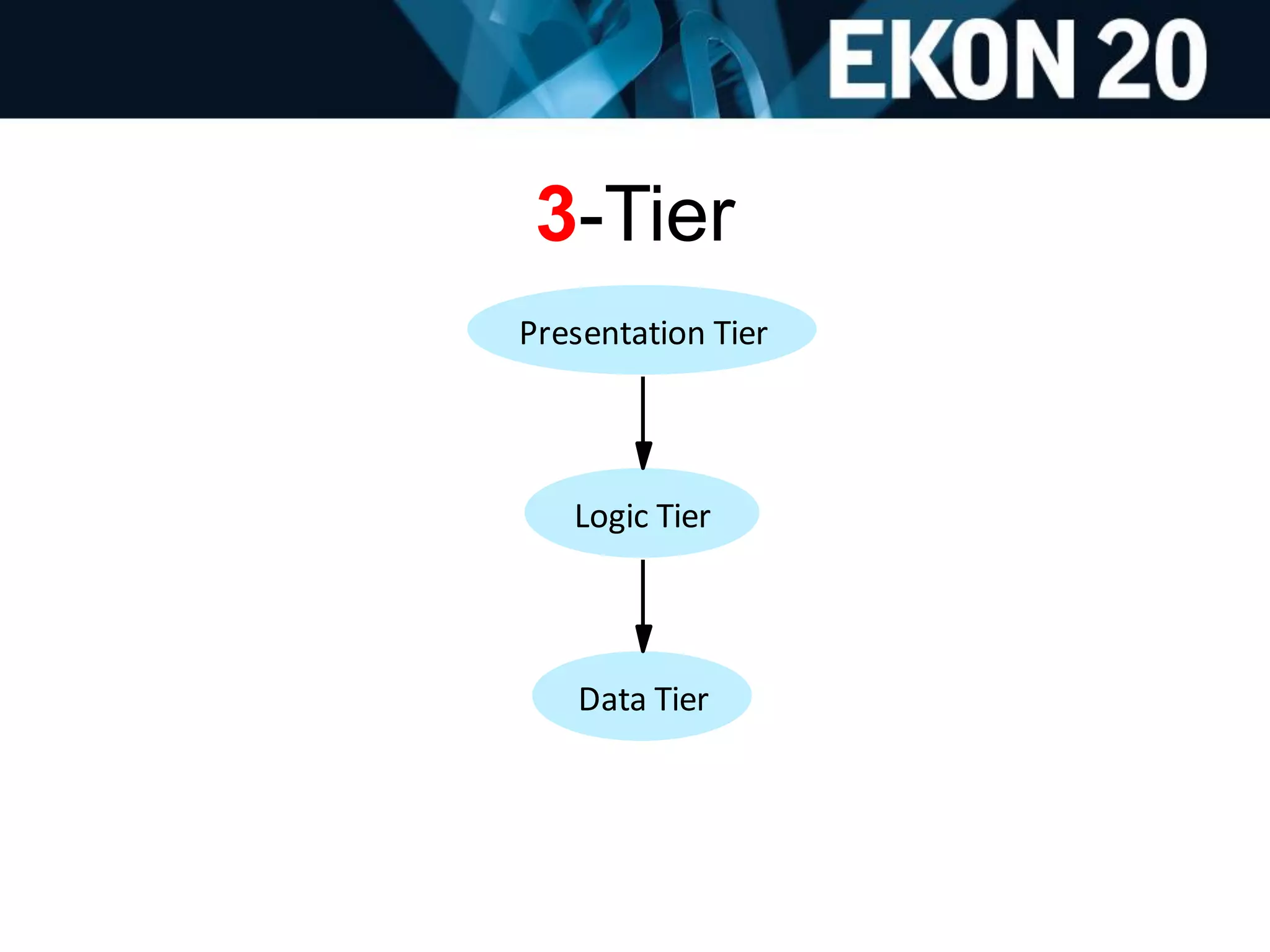
3-Tier
Presentation Tier
Logic Tier
Data Tier
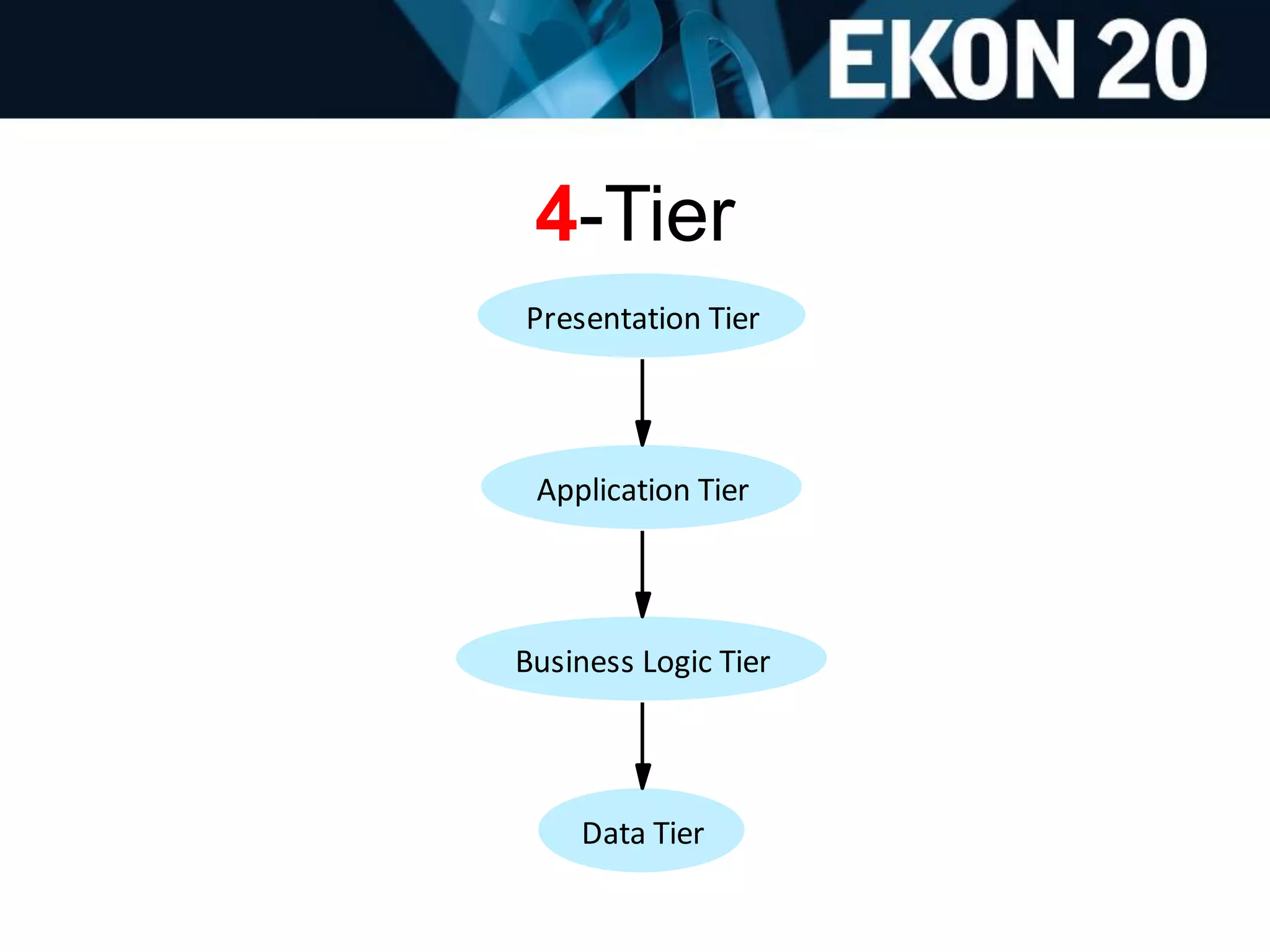
4-Tier
Presentation Tier
Application Tier
Business Logic Tier
Data Tier
N-Tier
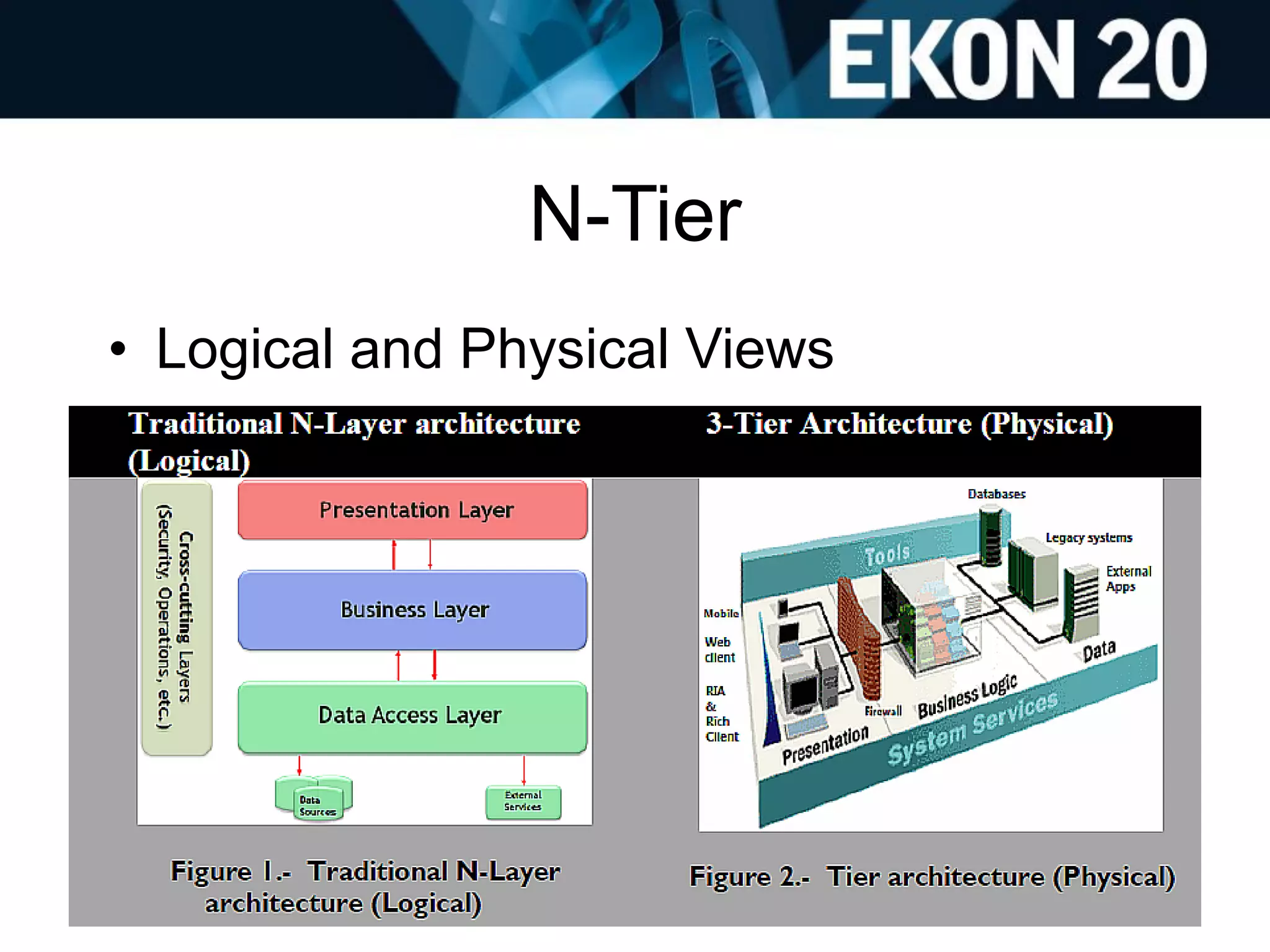
• Logical and Physical Views
Most of the time, n-Tier is intended
to be a physical (hardware) view
– e.g. separation between the database server
and the application server
– placing any tier on a separate machine
to facilitate ease of maintenance
or integrate with IT/SaaS requirements
N-Tier
• Logical and Physical Views
In SOA, we deal with logical layout
– Separation of layers through logic interfaces
– Underlying hardware implementation may,
but will usually not, match the logical layout
N-Tier
• Logical and Physical Views
N-Tier
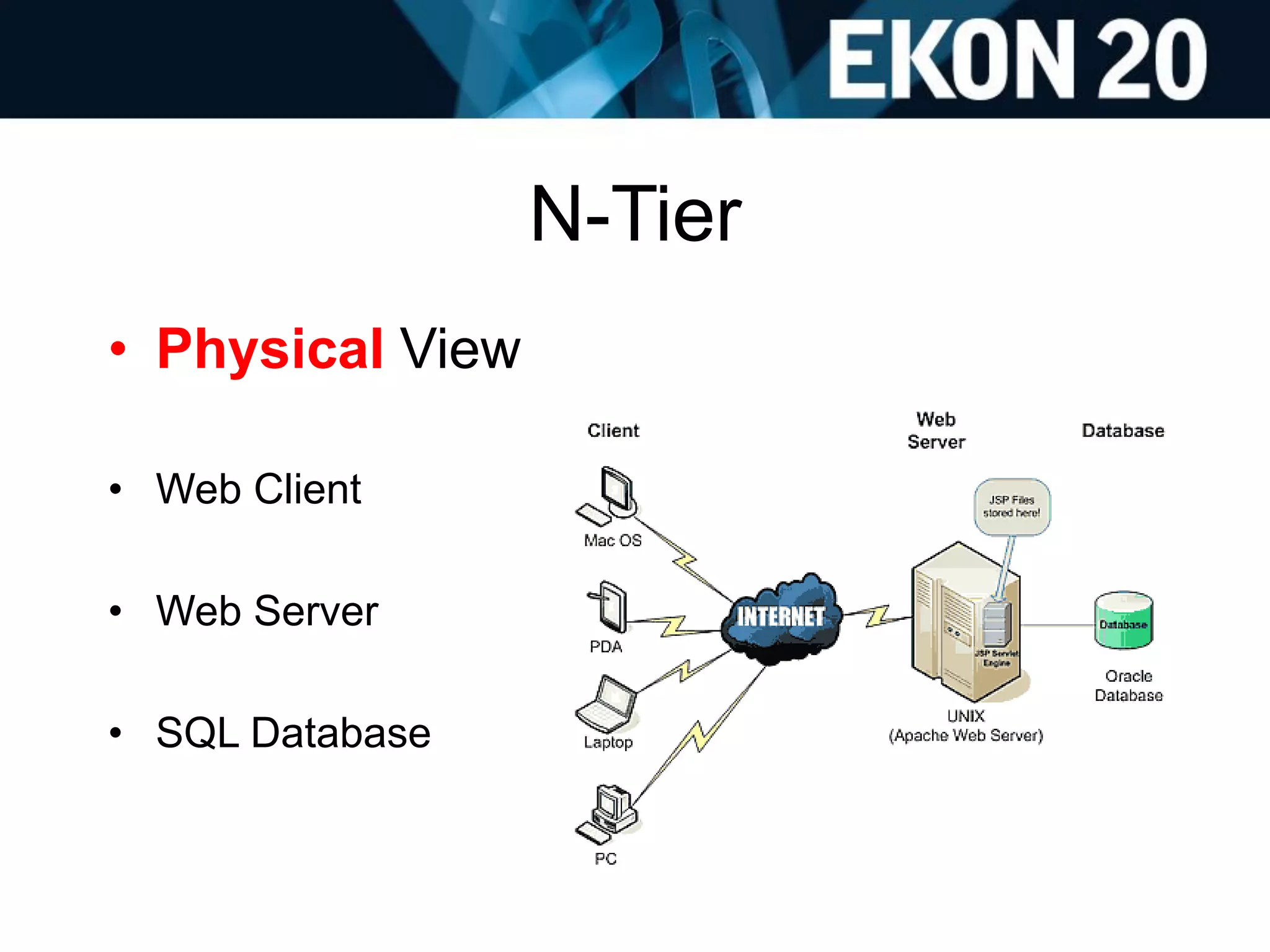
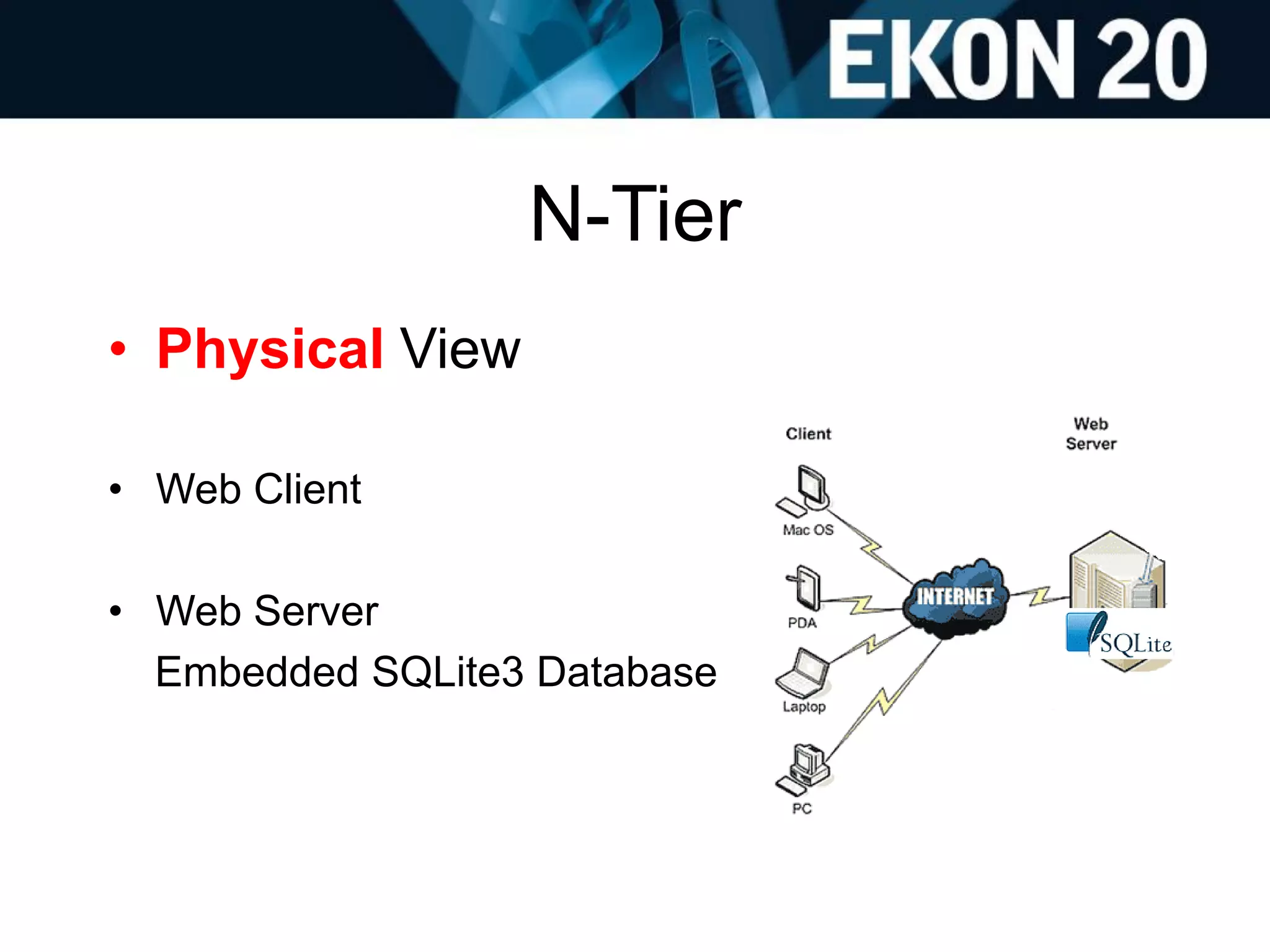
• Physical View
• Web Client
• Web Server
• SQL Database
N-Tier
• Physical View
• Web Client
• Web Server
Embedded SQLite3 Database
N-Tier
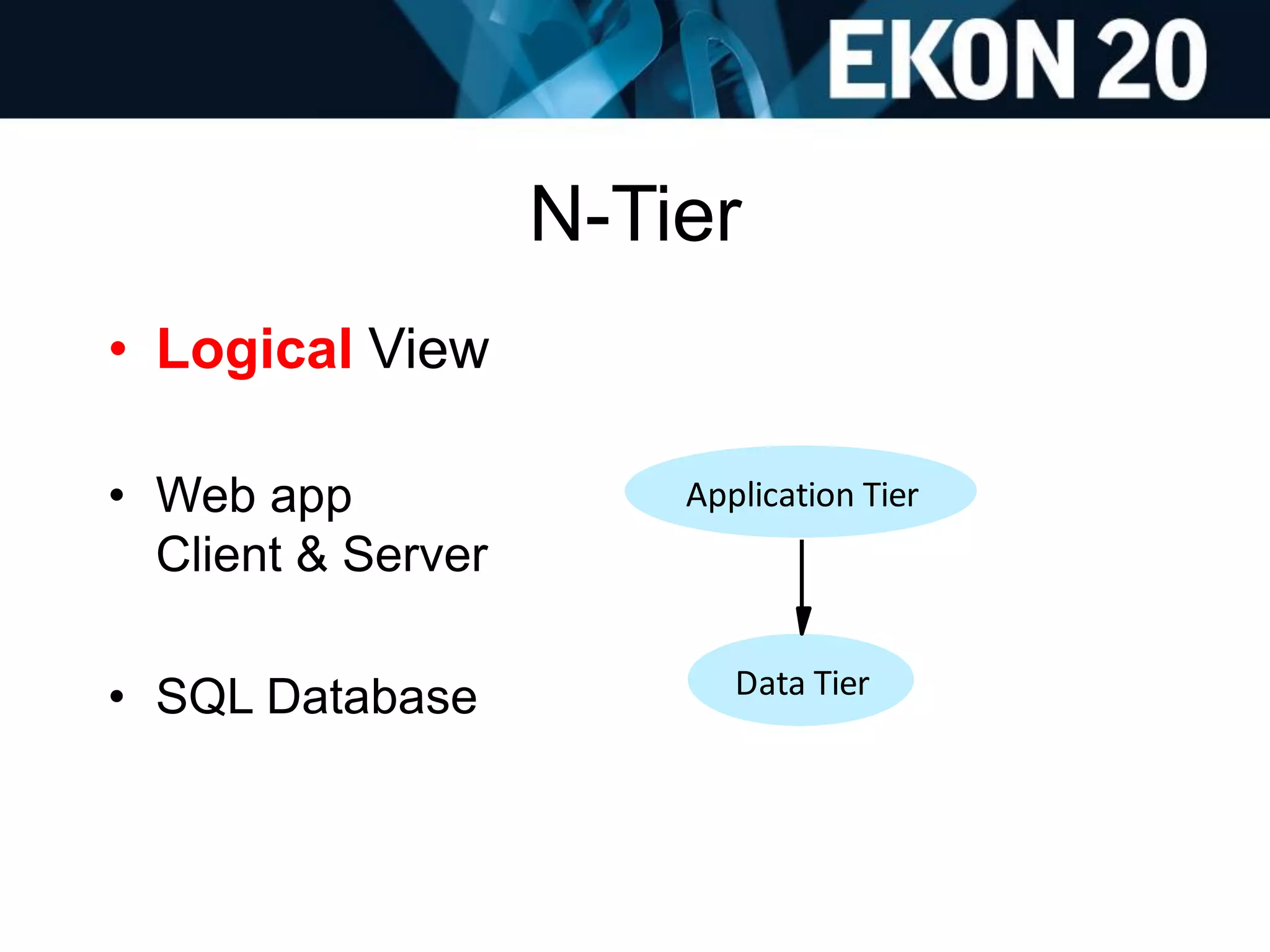
• Logical View
• Web app
Client & Server
• SQL Database
Application Tier
Data Tier
N-Tier
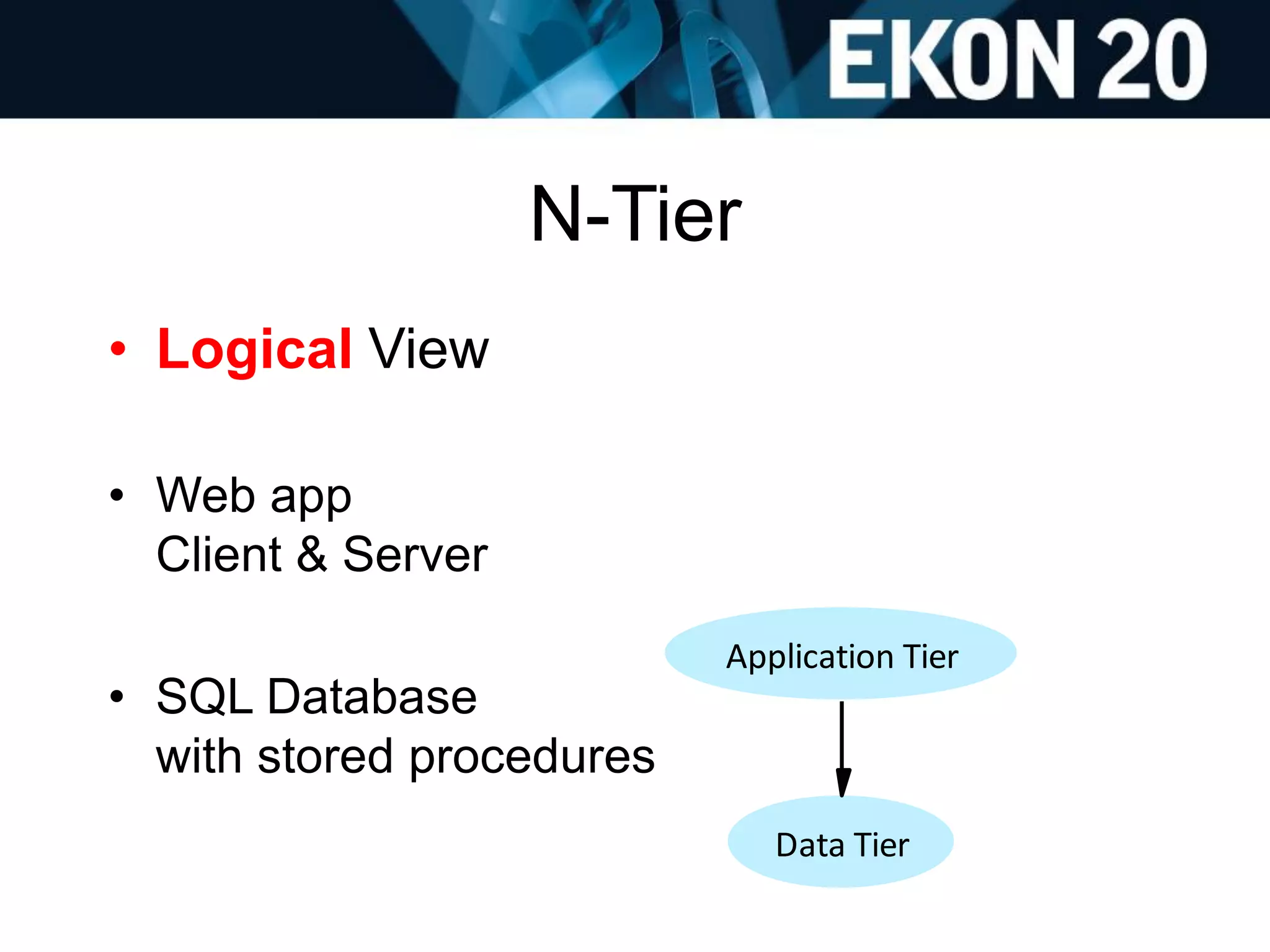
• Logical View
• Web app
Client & Server
• SQL Database
with stored procedures
Application Tier
Data Tier
N-Tier
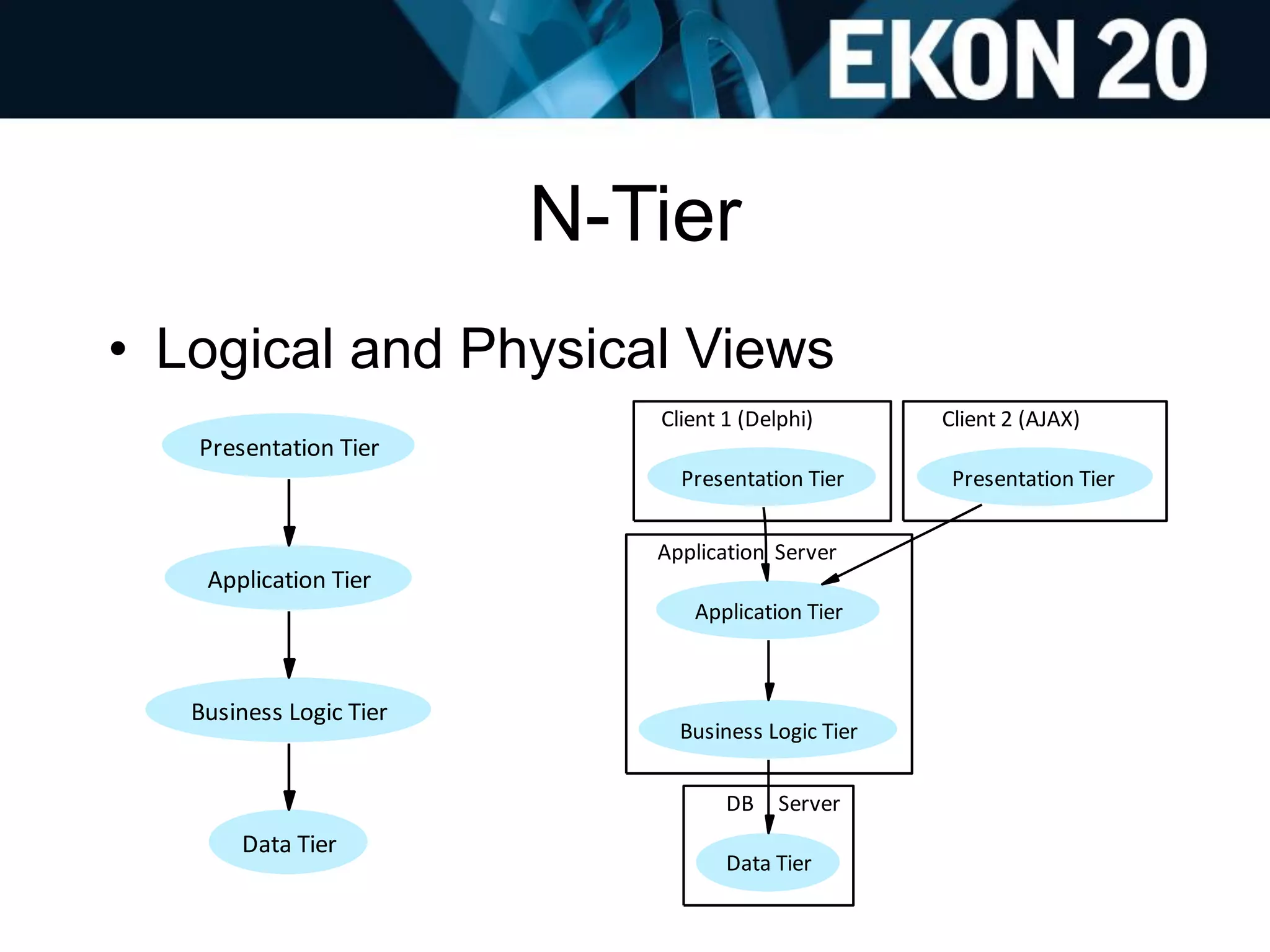
• Logical and Physical Views
Presentation Tier
Application Tier
Business Logic Tier
Data Tier
Client 1 (Delphi) Client 2 (AJAX)
Application Server
DB Server
Presentation Tier
Application Tier
Presentation Tier
Business Logic Tier
Data Tier
SOA
• Service-Oriented Architecture
Definition:
A flexible set of design principles
used during the phases of
systems development and integration
SOA
• Service-Oriented Architecture
Goal:
Package functionality as a suite of
inter-operable services
that can be used within multiple, separate
systems from several business domains
SOA
• Service-Oriented Architecture
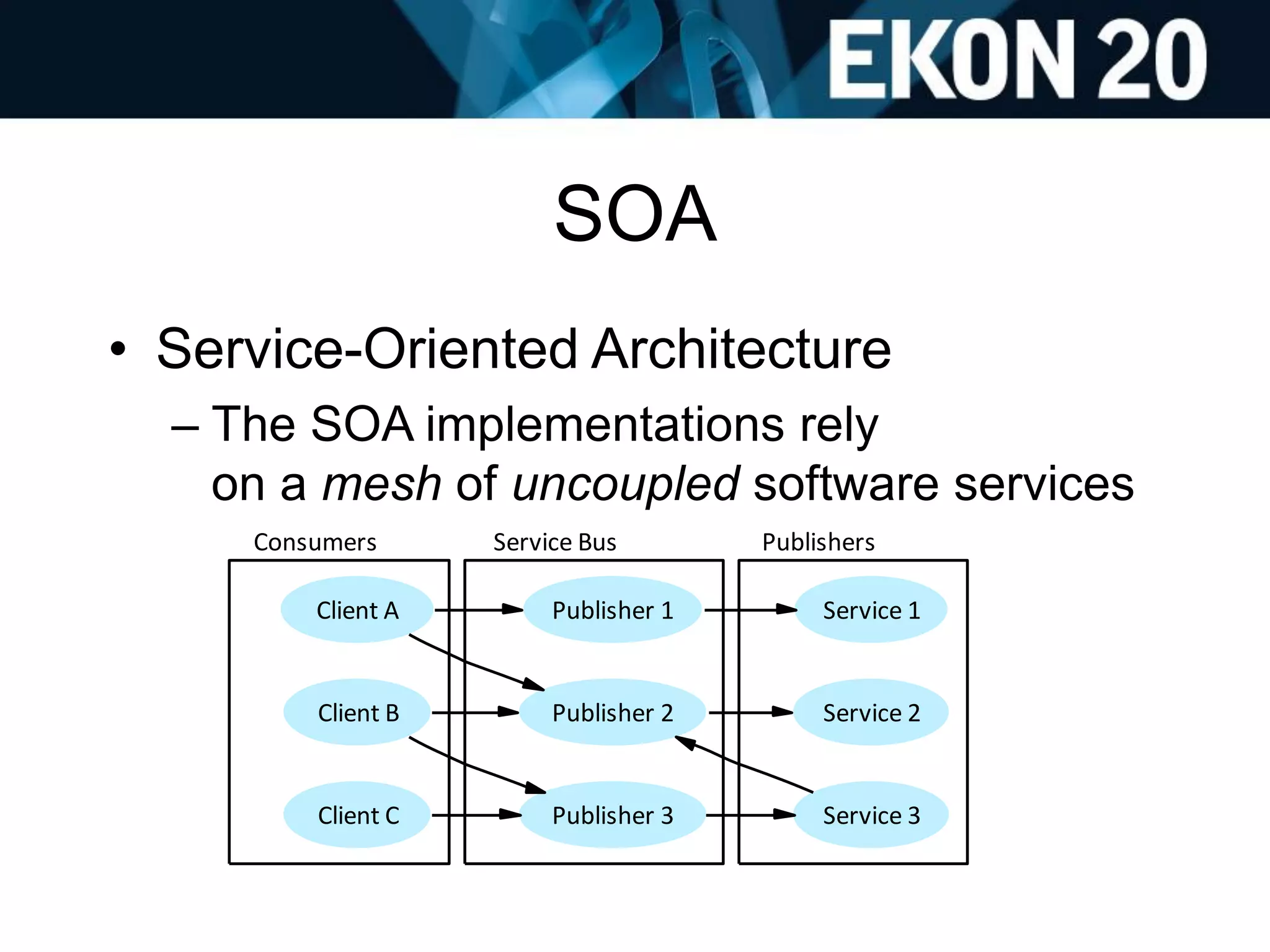
– The SOA implementations rely
on a mesh of uncoupled software services
– Software Service:
• A consumer asks a producer
to act in order to produce a result
• Invocation is (often) free from previous invocation
(stateless), to minimize resource consumption
SOA
• Service-Oriented Architecture
– The SOA implementations rely
on a mesh of uncoupled software services
– Those Services comprise
• unassociated, loosely coupled
units of functionality
(each service implements one action)
• that have no direct call to each other
(via protocols, catalogs over a bus)
SOA
• Service-Oriented Architecture
– The SOA implementations rely
on a mesh of uncoupled software services
Consumers Service Bus Publishers
Client A Publisher 1
Publisher 2Client B
Publisher 3Client C
Service 1
Service 2
Service 3
SOA
• Service-Oriented Architecture
– The SOA implementations rely
on a mesh of uncoupled software services
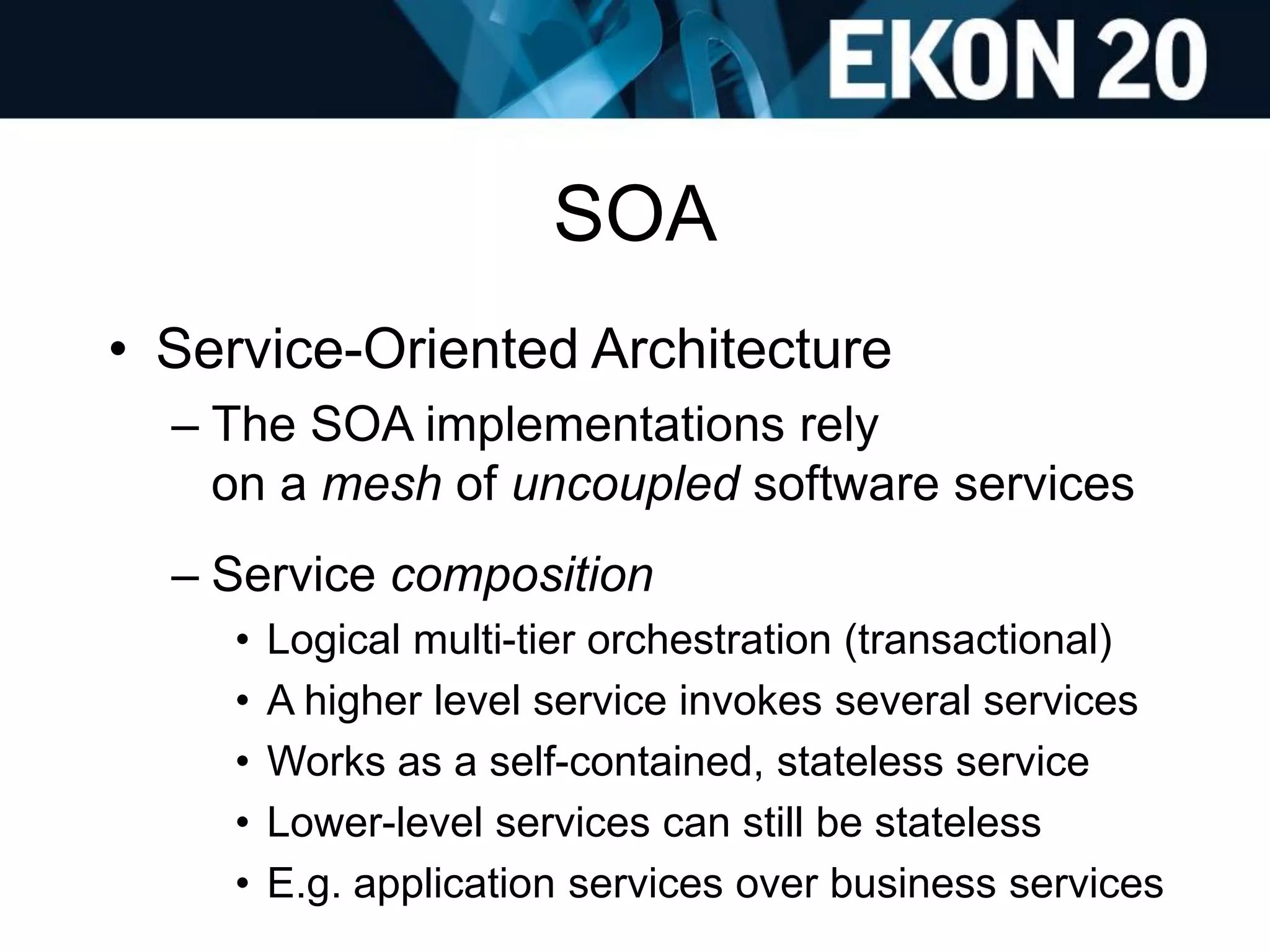
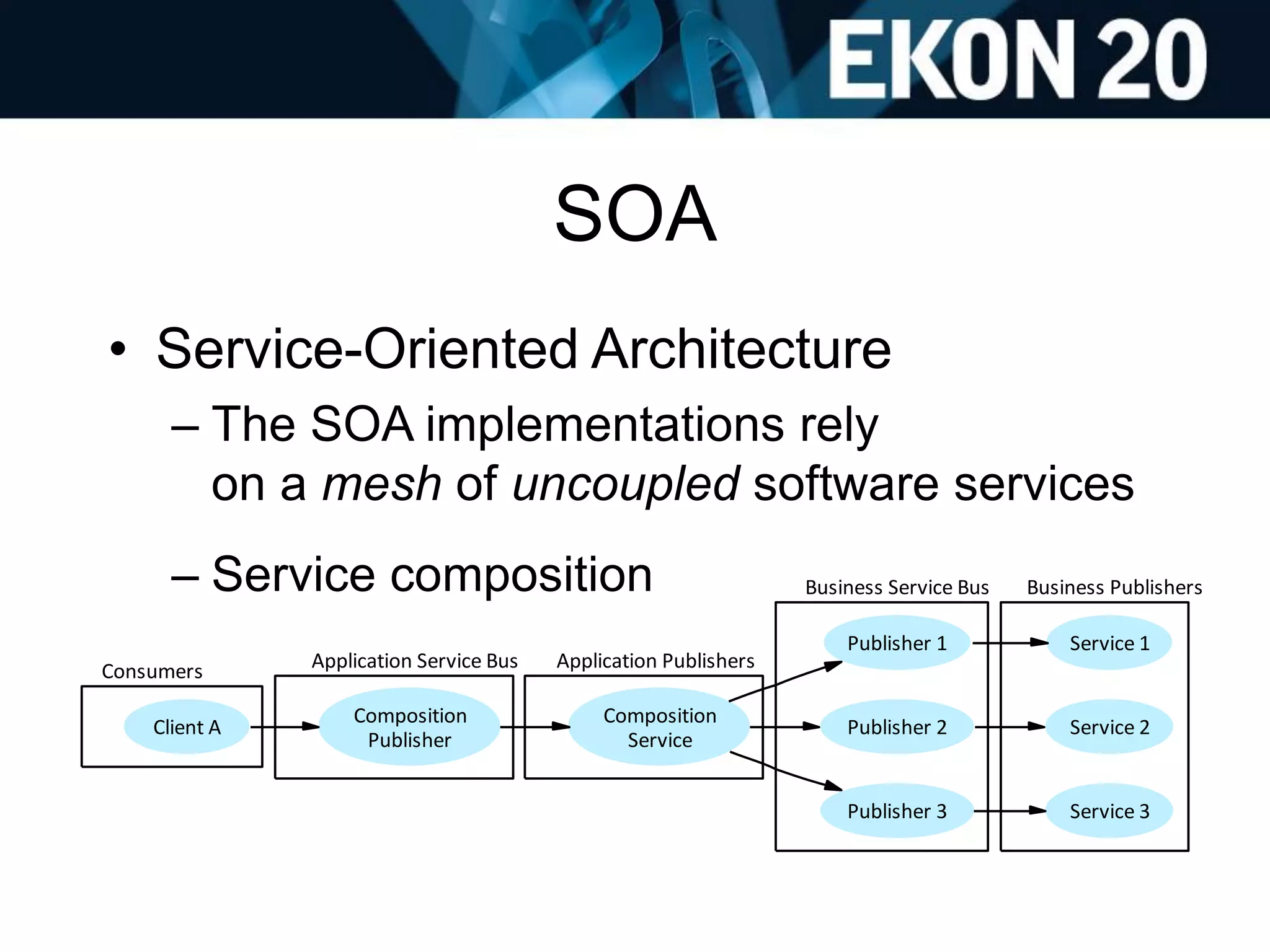
– Service composition
• Logical multi-tier orchestration (transactional)
• A higher level service invokes several services
• Works as a self-contained, stateless service
• Lower-level services can still be stateless
• E.g. application services over business services
SOA
• Service-Oriented Architecture
– The SOA implementations rely
on a mesh of uncoupled software services
– Service composition
Consumers Application Service Bus Application Publishers
Business Service Bus Business Publishers
Client A
Composition
Publisher
Composition
Service
Publisher 1
Publisher 2
Publisher 3
Service 1
Service 2
Service 3
SOA
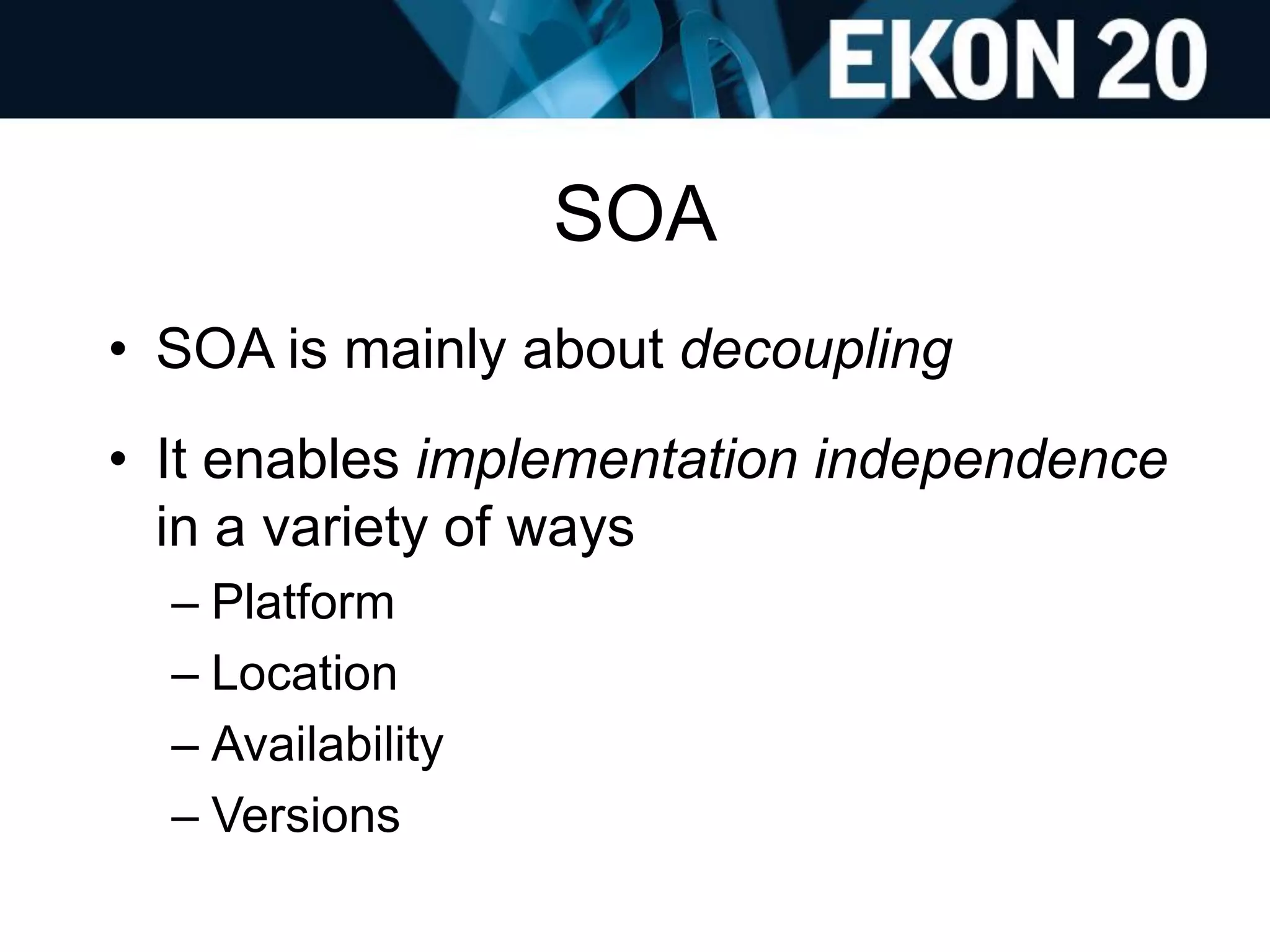
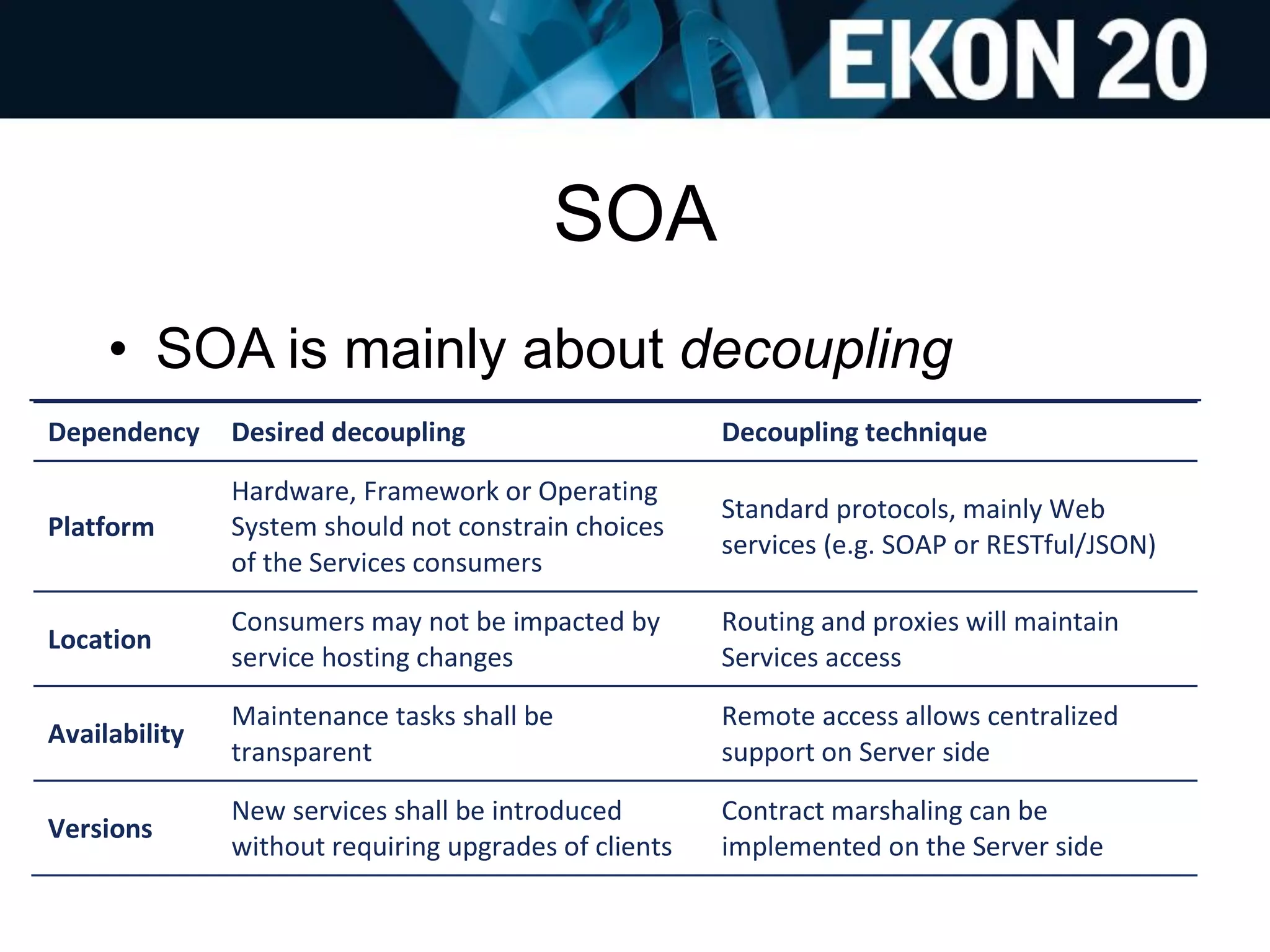
• SOA is mainly about decoupling
• It enables implementation independence
in a variety of ways
– Platform
– Location
– Availability
– Versions
SOA
• SOA is mainly about decoupling
Dependency Desired decoupling Decoupling technique
Platform
Hardware, Framework or Operating
System should not constrain choices
of the Services consumers
Standard protocols, mainly Web
services (e.g. SOAP or RESTful/JSON)
Location
Consumers may not be impacted by
service hosting changes
Routing and proxies will maintain
Services access
Availability
Maintenance tasks shall be
transparent
Remote access allows centralized
support on Server side
Versions
New services shall be introduced
without requiring upgrades of clients
Contract marshaling can be
implemented on the Server side
SOA
• Micro Services
– SOLID principles meet SOA
SOA
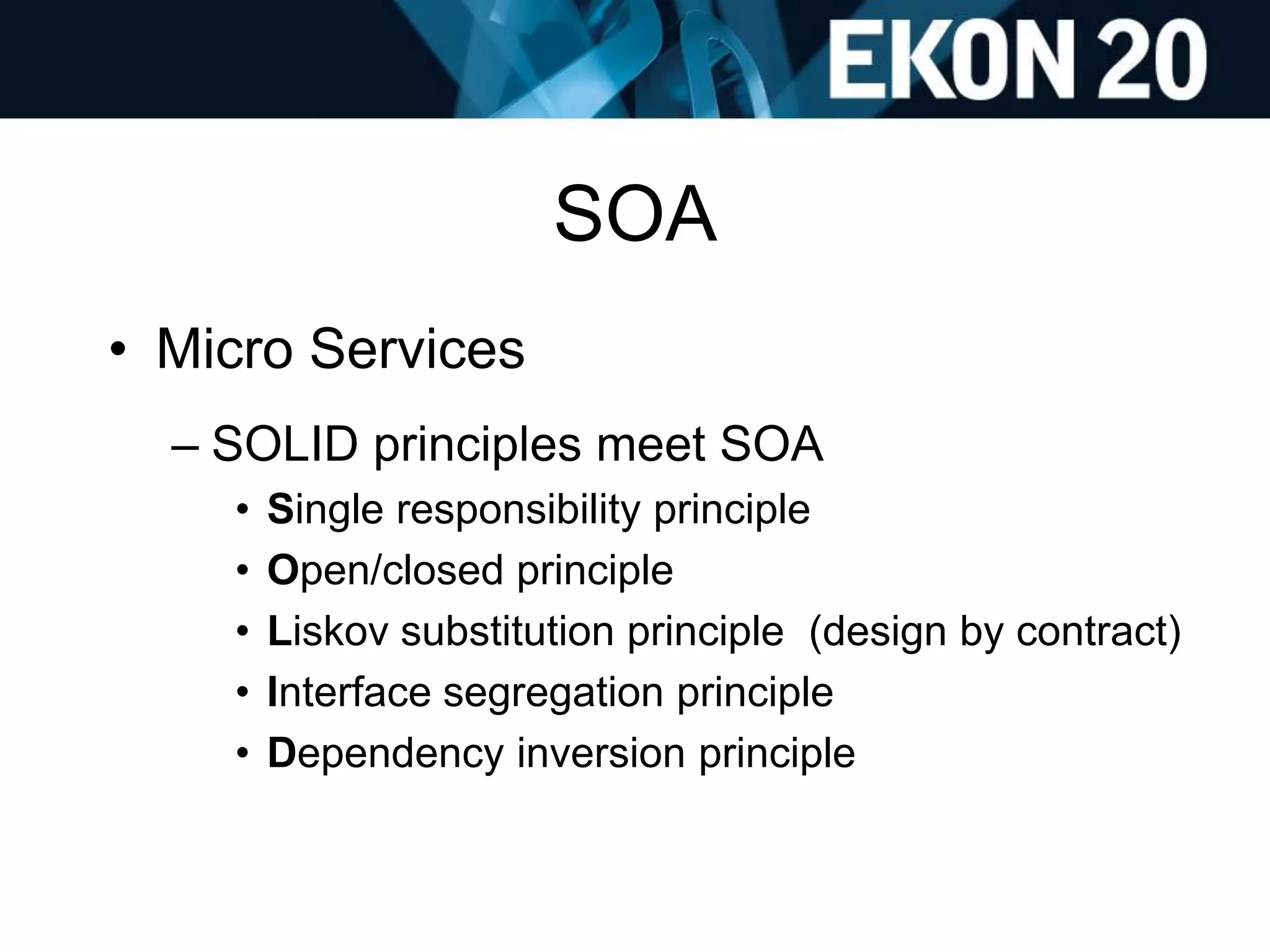
• Micro Services
– SOLID principles meet SOA
• Single responsibility principle
• Open/closed principle
• Liskov substitution principle (design by contract)
• Interface segregation principle
• Dependency inversion principle
SOA
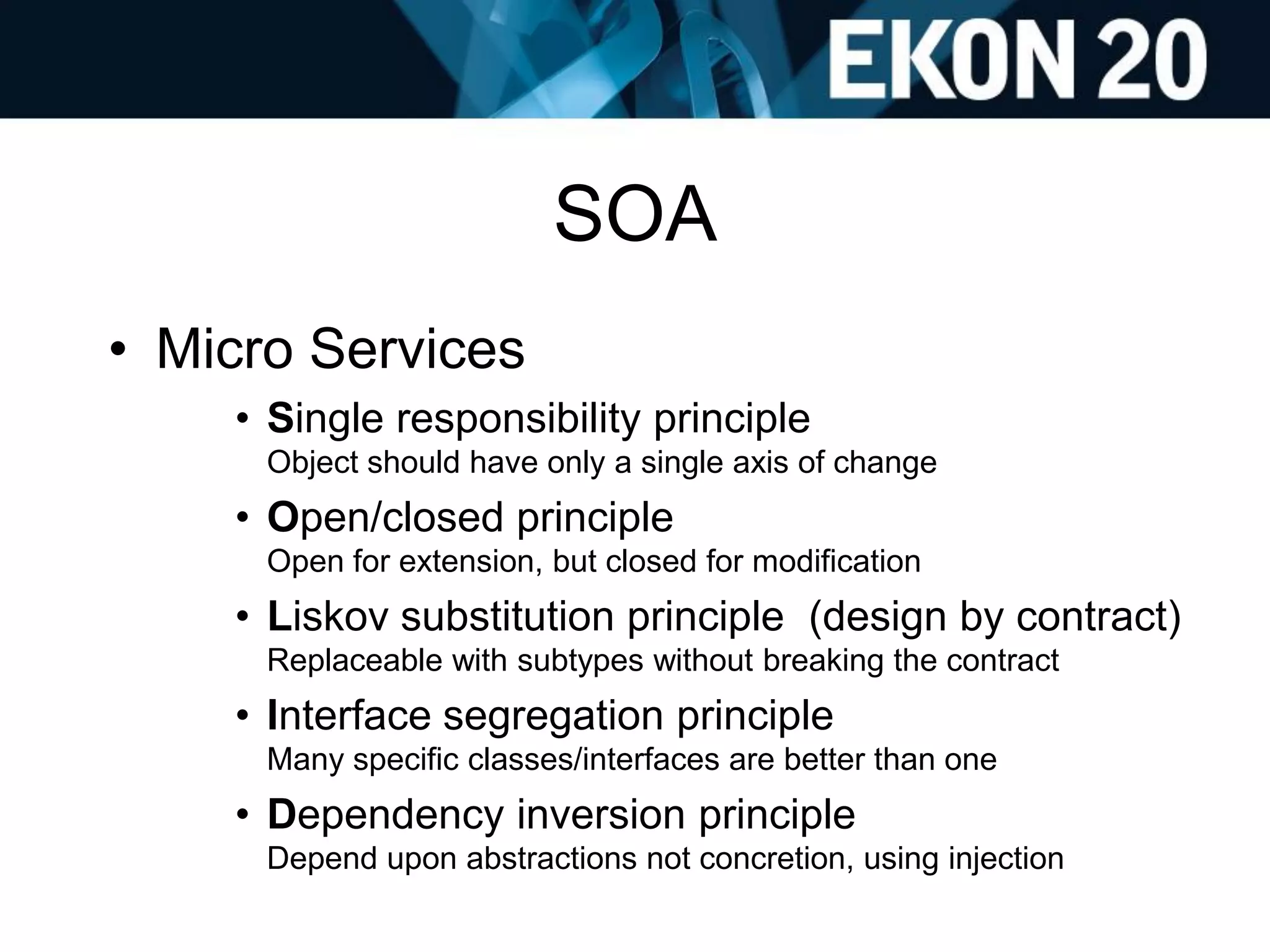
• Micro Services
• Single responsibility principle
Object should have only a single axis of change
• Open/closed principle
Open for extension, but closed for modification
• Liskov substitution principle (design by contract)
Replaceable with subtypes without breaking the contract
• Interface segregation principle
Many specific classes/interfaces are better than one
• Dependency inversion principle
Depend upon abstractions not concretion, using injection
SOA
• Micro Services
– SOLID principles meet SOA
– Favor stateless calls, and/or event-driven
– Implemented as stand-alone nodes
– Enhance scaling abilities
– Expects services discovery
SOA
• Favor logical Multi-tier architecture
• Put business intelligence on the server side
• Use less bandwidth than a fat client
• From fat client to rich clients (new platforms)
• Leverage resources (DB, cache)
• Easier to upgrade
• Cheaper / Safer for the customer (backup, cloud)
SOA
• Expects a top/down implementation
– Don’t start from the DB, but end-user app
• Forget about bottom/up design
• Define services, not data structures
– Ability to uncouple things
• Identify bounded contexts and needed information
SOA
• Expects a top/down implementation
– Modelize your business in reusable services
• Interfaces and explicit types (DTO) everywhere
• Focus on domain to build tools and maximize ROI
– Cross-cutting features may be delegated
• Emailing, CRM, billing, reporting, UI…
• If this is not where money comes from
SOA
• Expects a top/down implementation
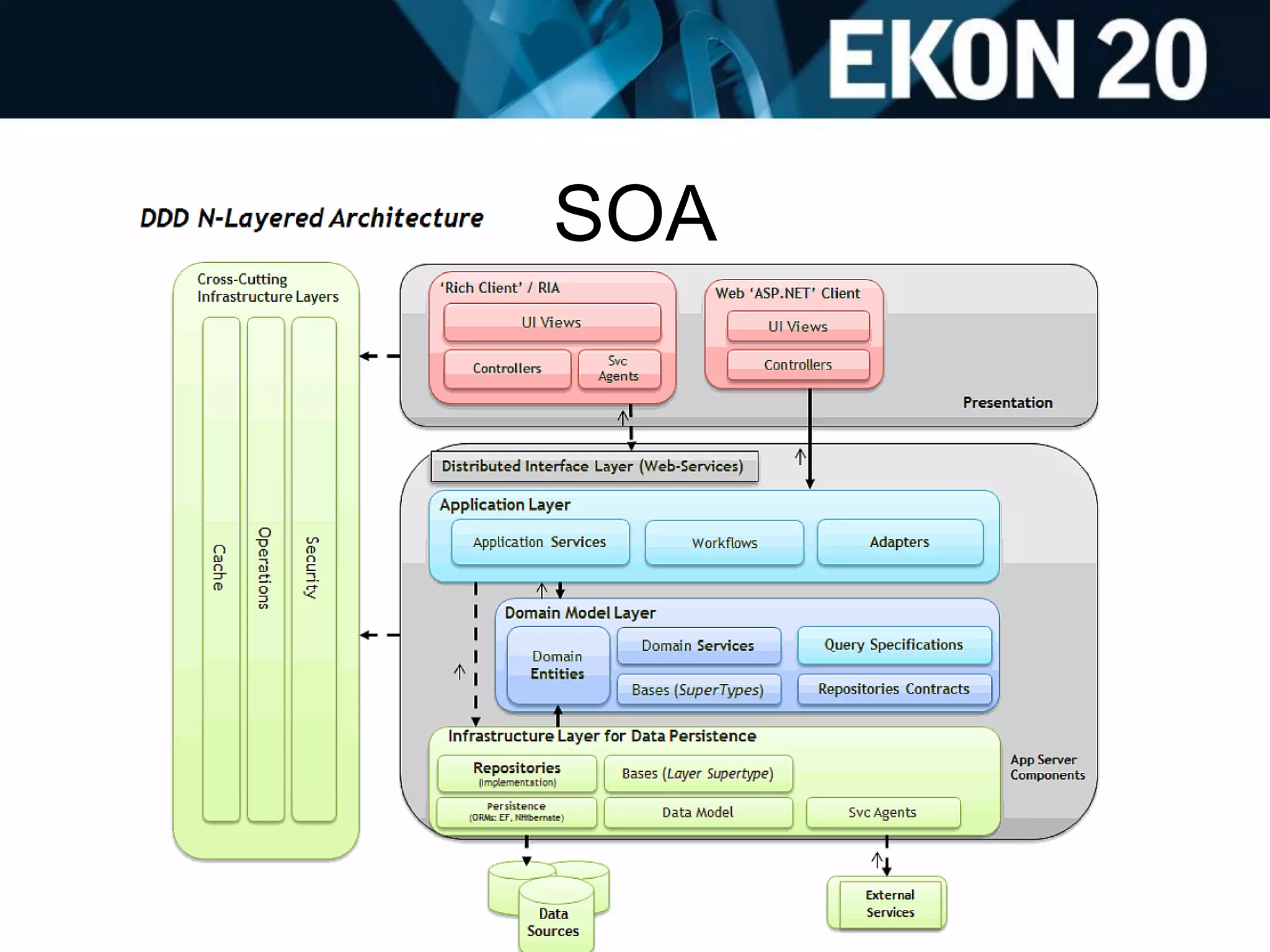
– From n-Tier vertical Architecture
• DB as Root
• Business over DB
– to Clean “onion” Architecture
• Domain as Core
• Persistence as a service
SOA
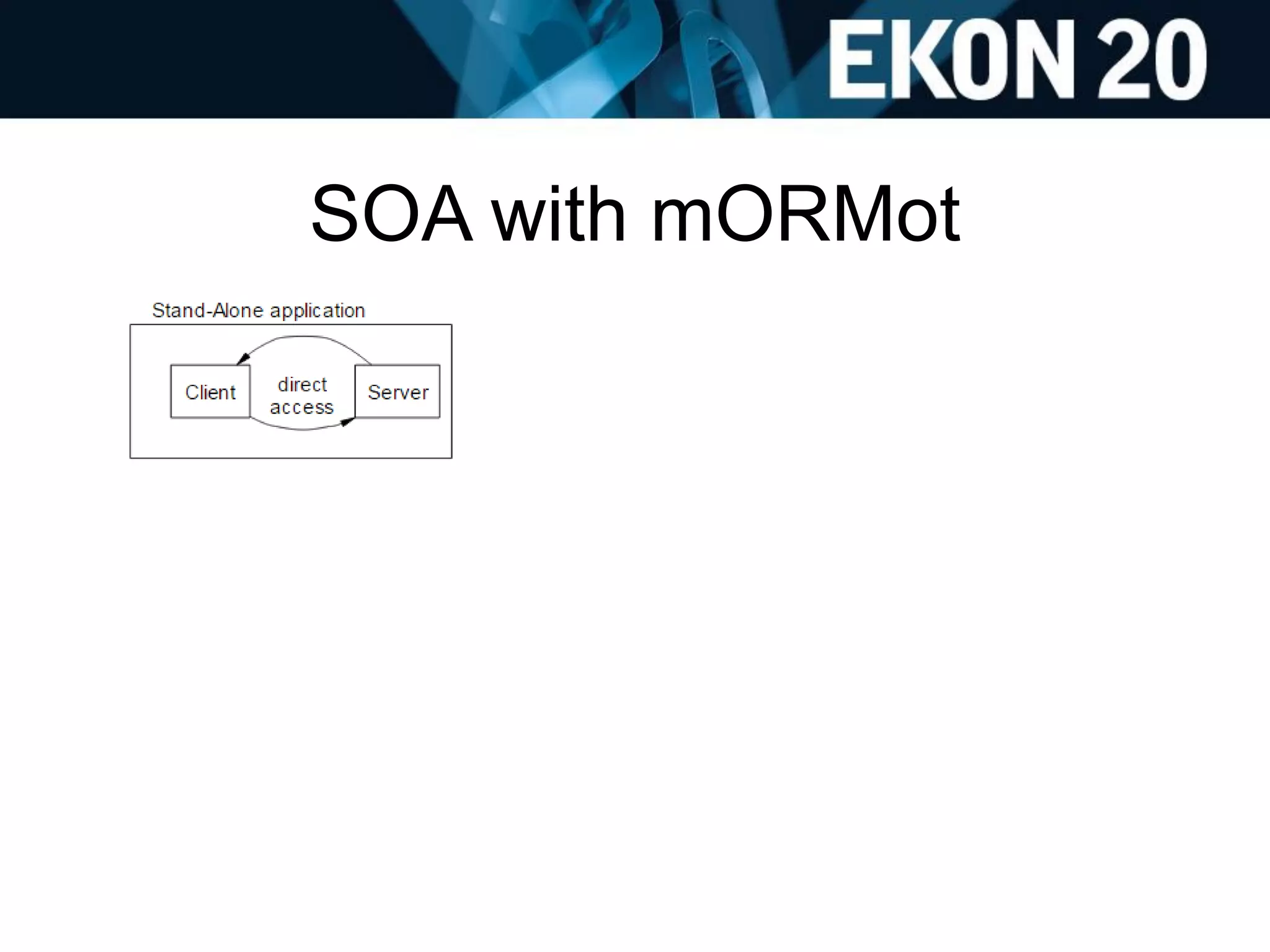
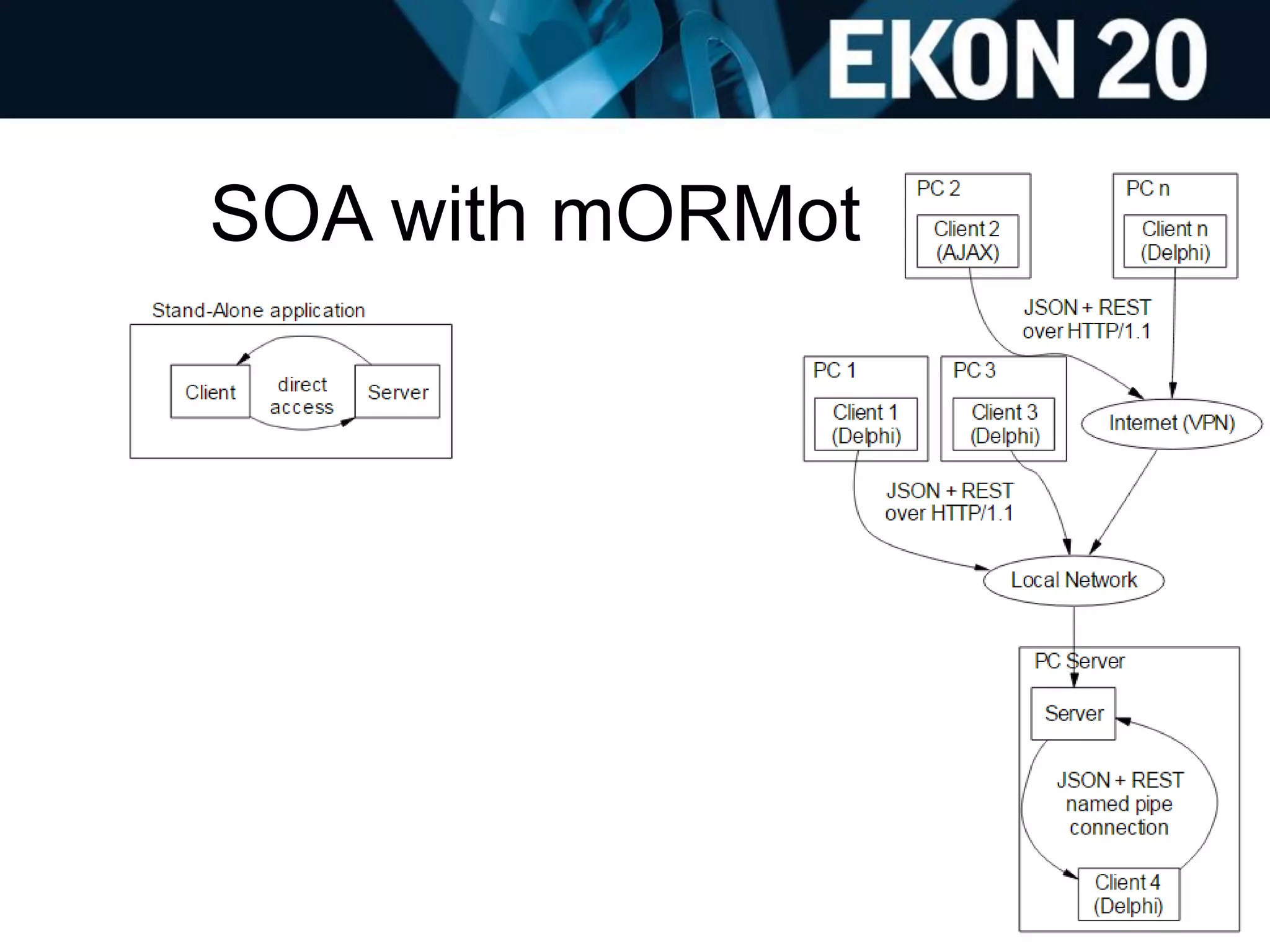
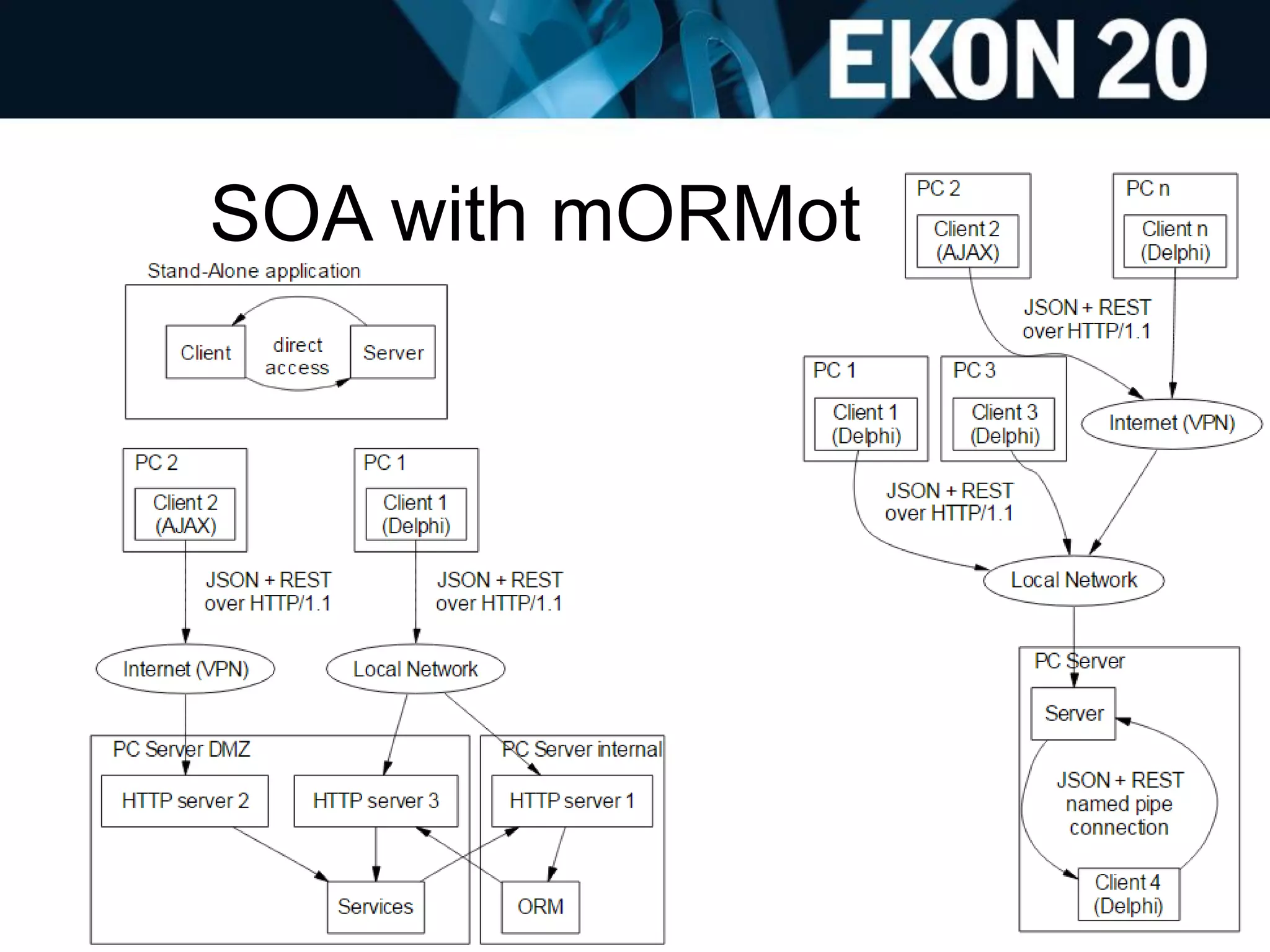
SOA with mORMot
SOA with mORMot
• Services can be implemented as:
– Method-based resource-focused services
– Interface-based services
• RESTful architecture
– Over several protocols, e.g. HTTP/1.1
– JSON and UTF-8 based
• KISS / CoC design
SOA with mORMot
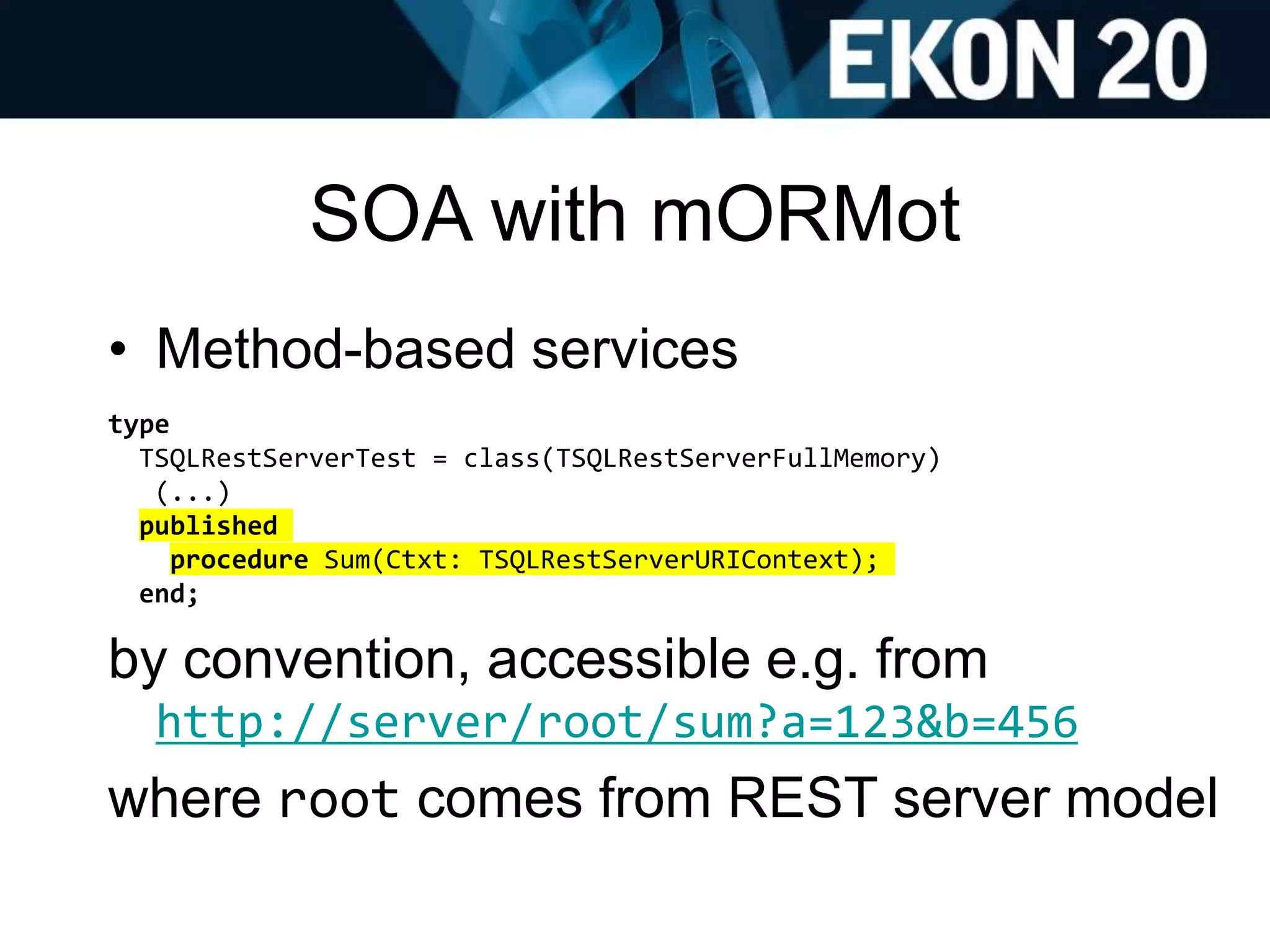
• Method-based services
type
TSQLRestServerTest = class(TSQLRestServerFullMemory)
(...)
published
procedure Sum(Ctxt: TSQLRestServerURIContext);
end;
procedure TSQLRestServerTest.Sum(Ctxt: TSQLRestServerURIContext);
begin
with Ctxt do
Results([Input['a']+Input['b']]);
end;
SOA with mORMot
• Method-based services
type
TSQLRestServerTest = class(TSQLRestServerFullMemory)
(...)
published
procedure Sum(Ctxt: TSQLRestServerURIContext);
end;
procedure TSQLRestServerTest.Sum(Ctxt: TSQLRestServerURIContext);
begin
Ctxt.Results([Ctxt['a']+Ctxt['b']]);
end;
SOA with mORMot
• Method-based services
type
TSQLRestServerTest = class(TSQLRestServerFullMemory)
(...)
published
procedure Sum(Ctxt: TSQLRestServerURIContext);
end;
by convention, accessible e.g. from
http://server/root/sum?a=123&b=456
where root comes from REST server model
SOA with mORMot
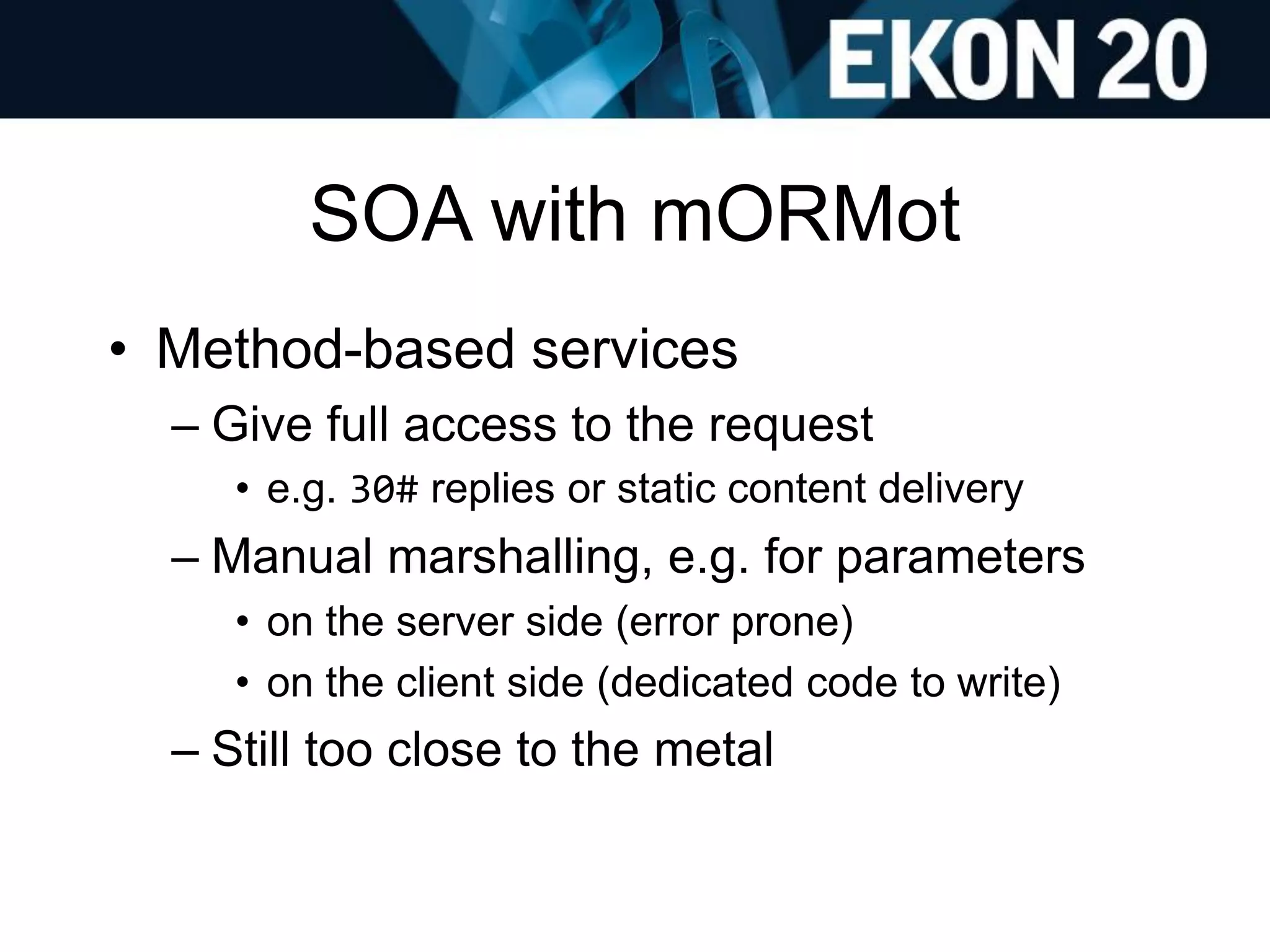
• Method-based services
– Give full access to the request
• e.g. 30# replies or static content delivery
– Manual marshalling, e.g. for parameters
• on the server side (error prone)
• on the client side (dedicated code to write)
– Still too close to the metal
SOA with mORMot
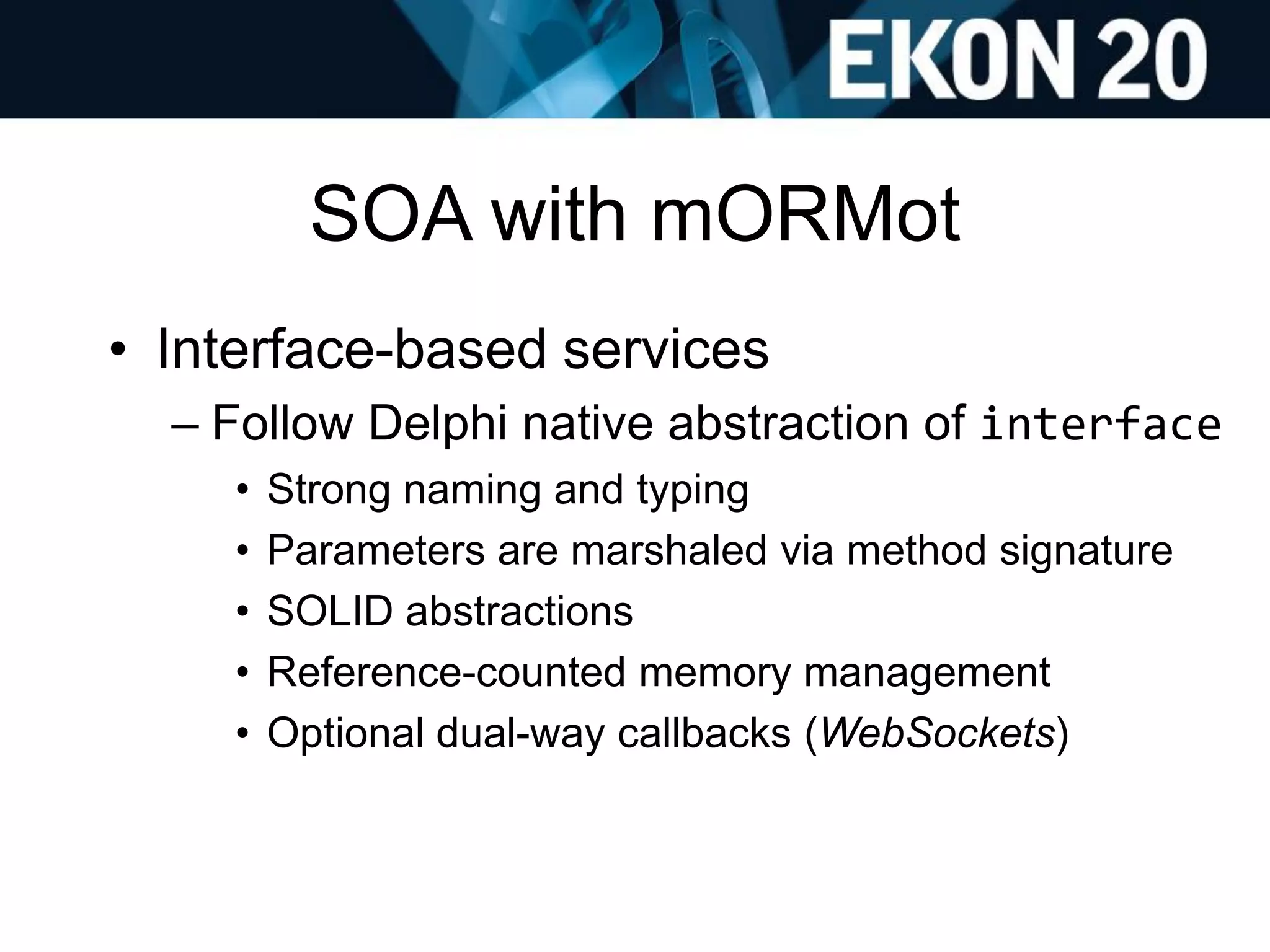
• Interface-based services
– Follow Delphi native abstraction of interface
• Strong naming and typing
• Parameters are marshaled via method signature
• SOLID abstractions
• Reference-counted memory management
• Optional dual-way callbacks (WebSockets)
SOA with mORMot
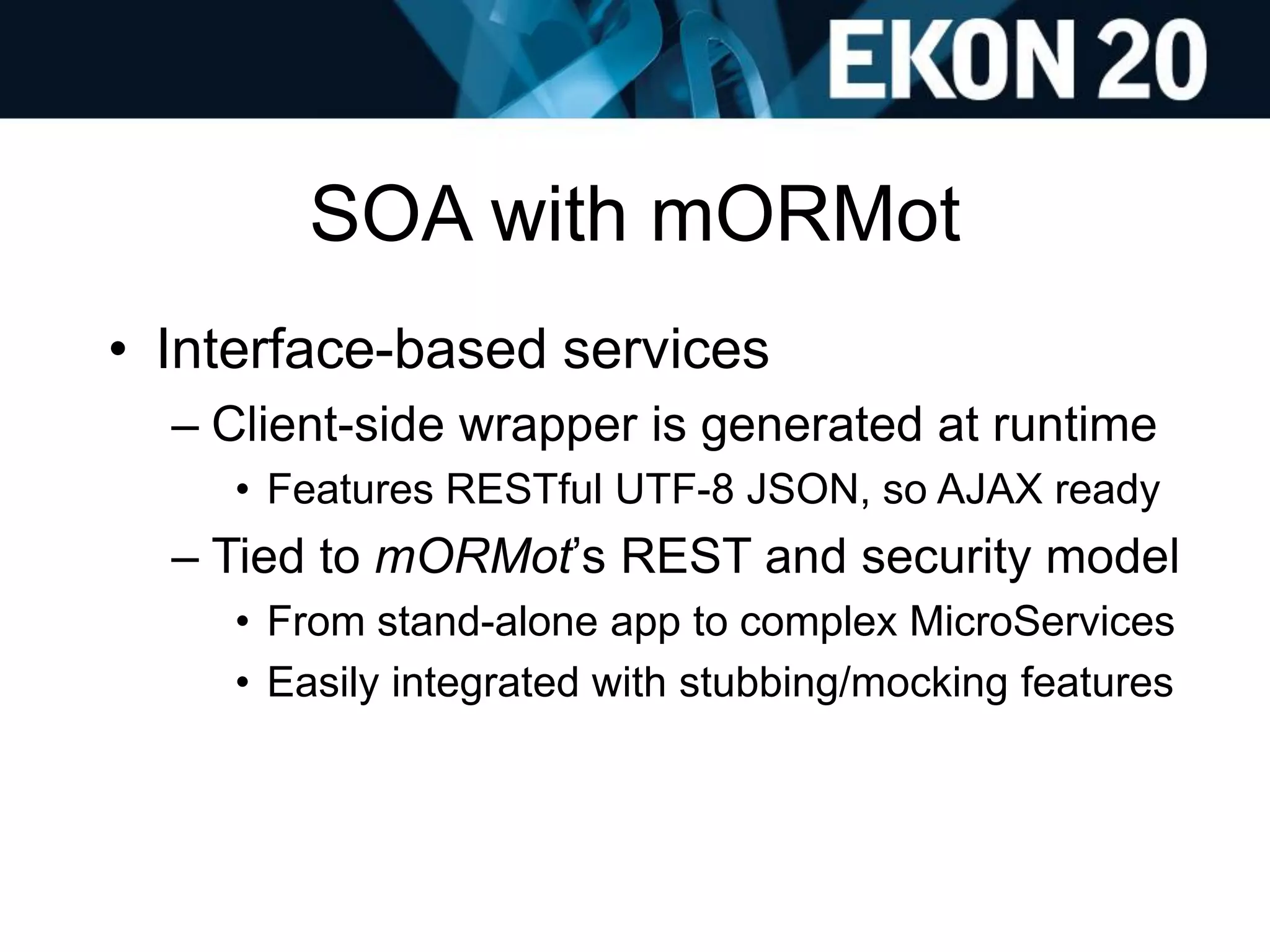
• Interface-based services
– Client-side wrapper is generated at runtime
• Features RESTful UTF-8 JSON, so AJAX ready
– Tied to mORMot’s REST and security model
• From stand-alone app to complex MicroServices
• Easily integrated with stubbing/mocking features
SOA with mORMot
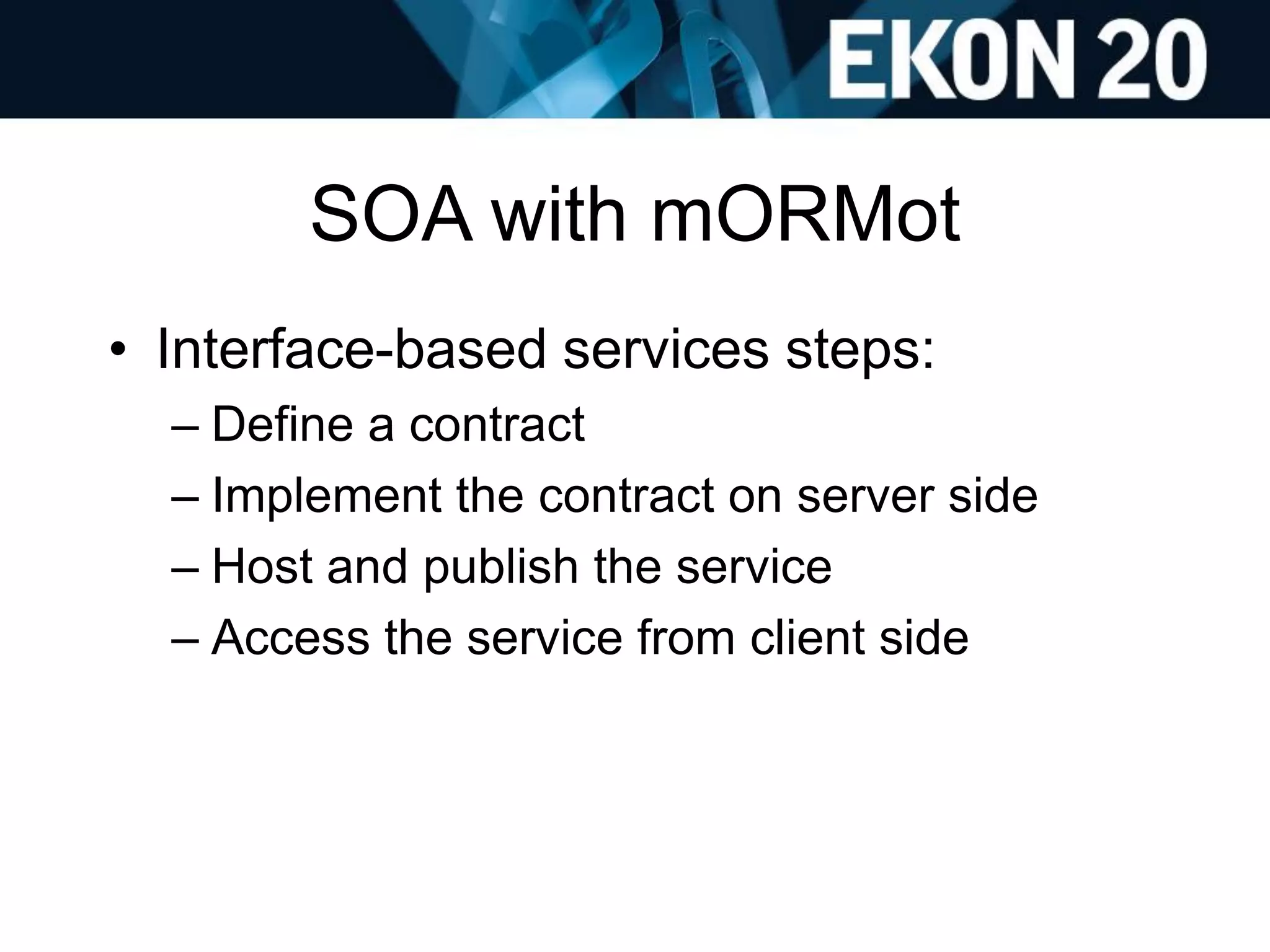
• Interface-based services steps:
– Define a contract
– Implement the contract on server side
– Host and publish the service
– Access the service from client side
SOA with mORMot
• Define a contract
type
ICalculator = interface(IInvokable)
['{9A60C8ED-CEB2-4E09-87D4-4A16F496E5FE}']
/// add two signed 32 bit integers
function Add(n1,n2: integer): integer;
end;
• ICalculator interface defines the contract
• Add() method defines the operation
• Handle any kind of parameters
– Including classes, variants, dynamic arrays or records
SOA with mORMot
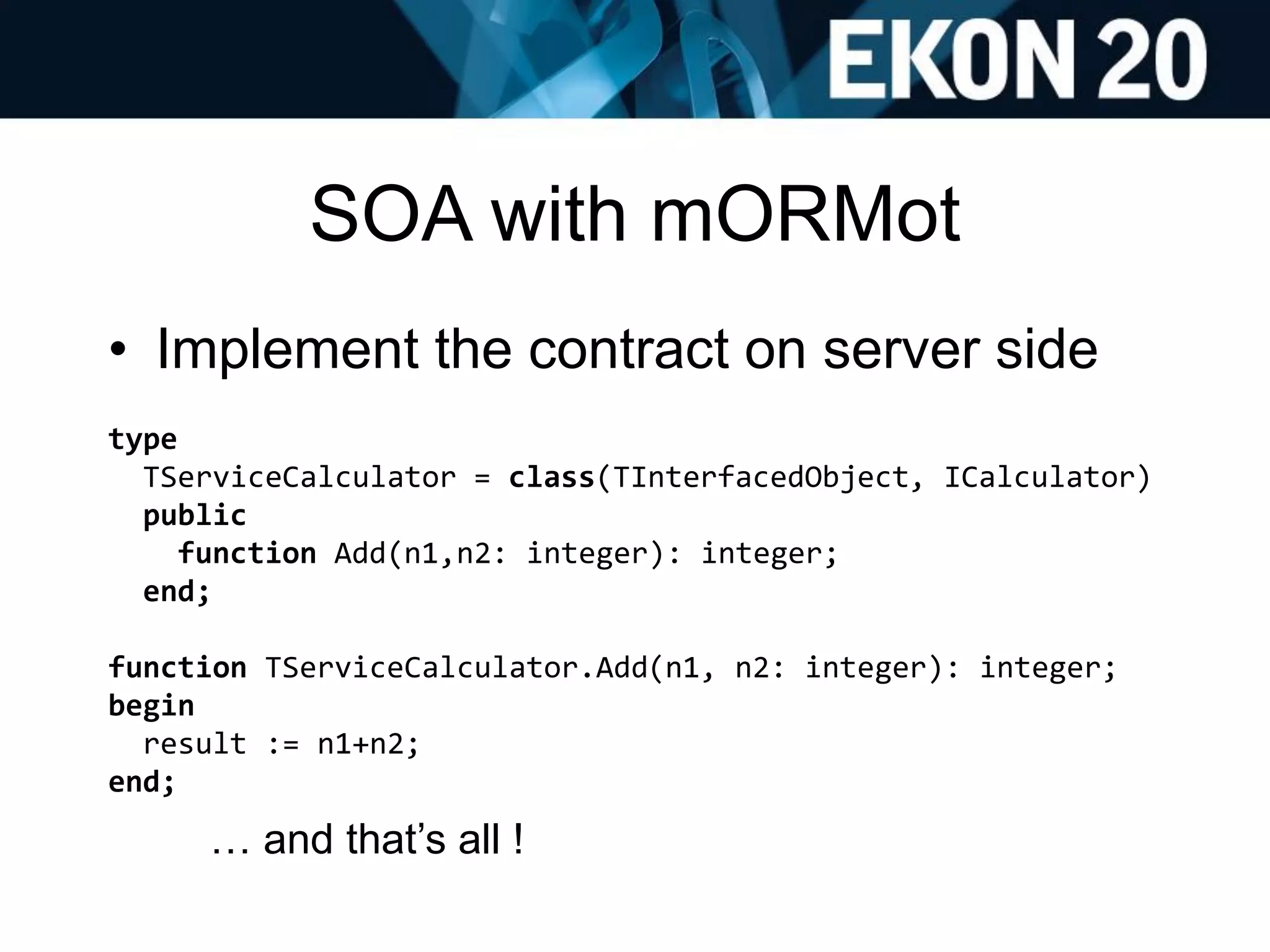
• Implement the contract on server side
type
TServiceCalculator = class(TInterfacedObject, ICalculator)
public
function Add(n1,n2: integer): integer;
end;
function TServiceCalculator.Add(n1, n2: integer): integer;
begin
result := n1+n2;
end;
… and that’s all !
SOA with mORMot
 Host and publish the service
Server.ServiceRegister(
TServiceCalculator,[TypeInfo(ICalculator)],sicShared);
– will register the TServiceCalculator class
– to implement the ICalculator service
– with a single shared instance life time
– to any TSQLRestServer instance
SOA with mORMot
 Host and publish the service
Server.ServiceRegister(
TServiceCalculator,[ICalculator],sicShared);
– will register the TServiceCalculator class
– to implement the ICalculator service
– with a single shared instance life time
– to any TSQLRestServer instance
SOA with mORMot
 Access the service from client side
Client.ServiceDefine([ICalculator],sicShared);
• Register to any kind of TSQLRestClient
via named pipes, messages, HTTP, WebSockets
• Execution will take place on the server side
• ICalculator type defines the contract
SOA with mORMot
 Access the service from client side
var I: ICalculator;
begin
if Client.Services['Calculator'].Get(I) then
result := I.Add(10,20);
end;
• A “fake” class implements ICalculator
• Data is transmitted by representation as JSON / REST
• Any server-side exception will be transmitted back
SOA with mORMot
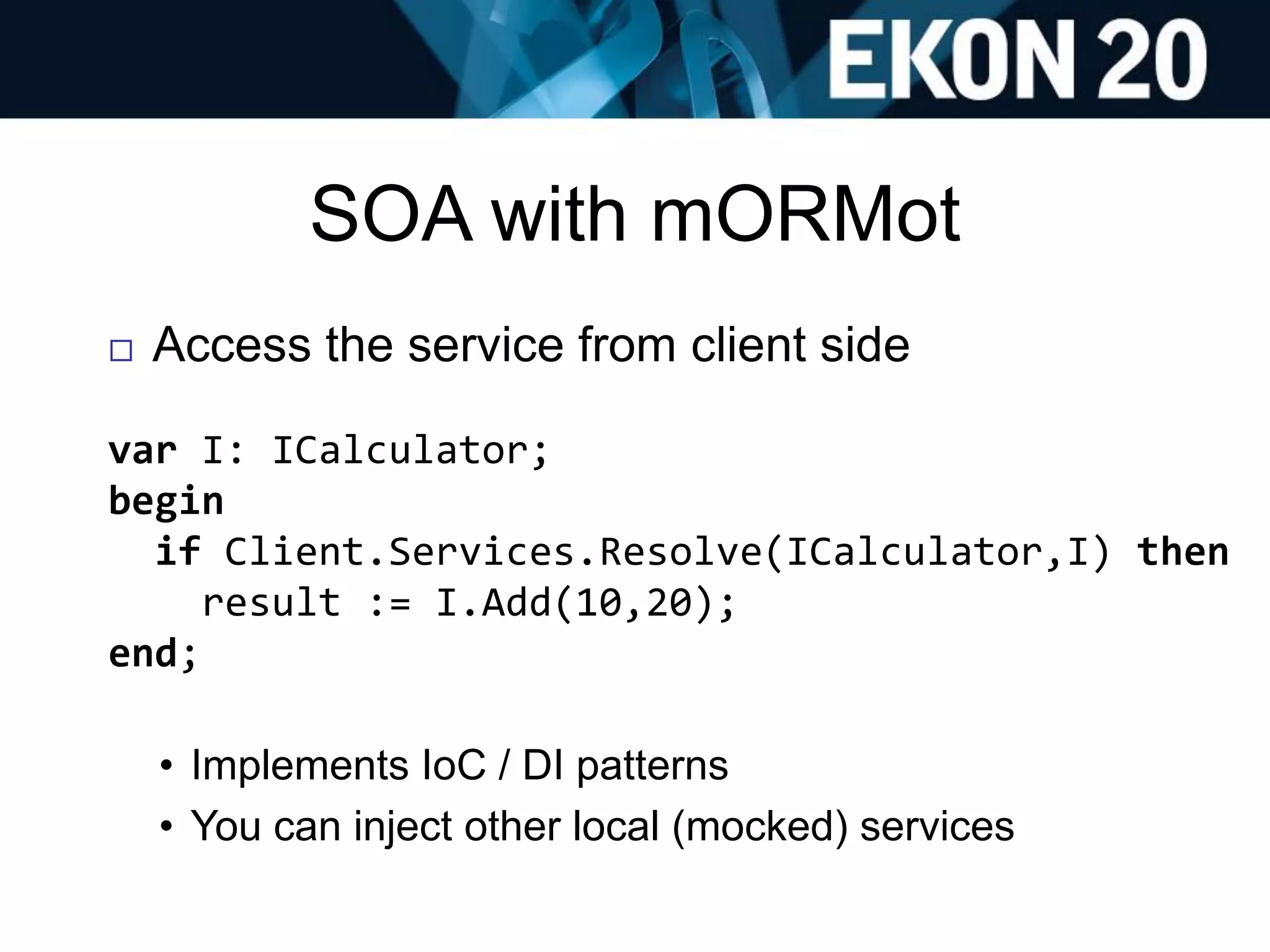
 Access the service from client side
var I: ICalculator;
begin
if Client.Services.Resolve(ICalculator,I) then
result := I.Add(10,20);
end;
• Implements IoC / DI patterns
• You can inject other local (mocked) services
SOA with mORMot
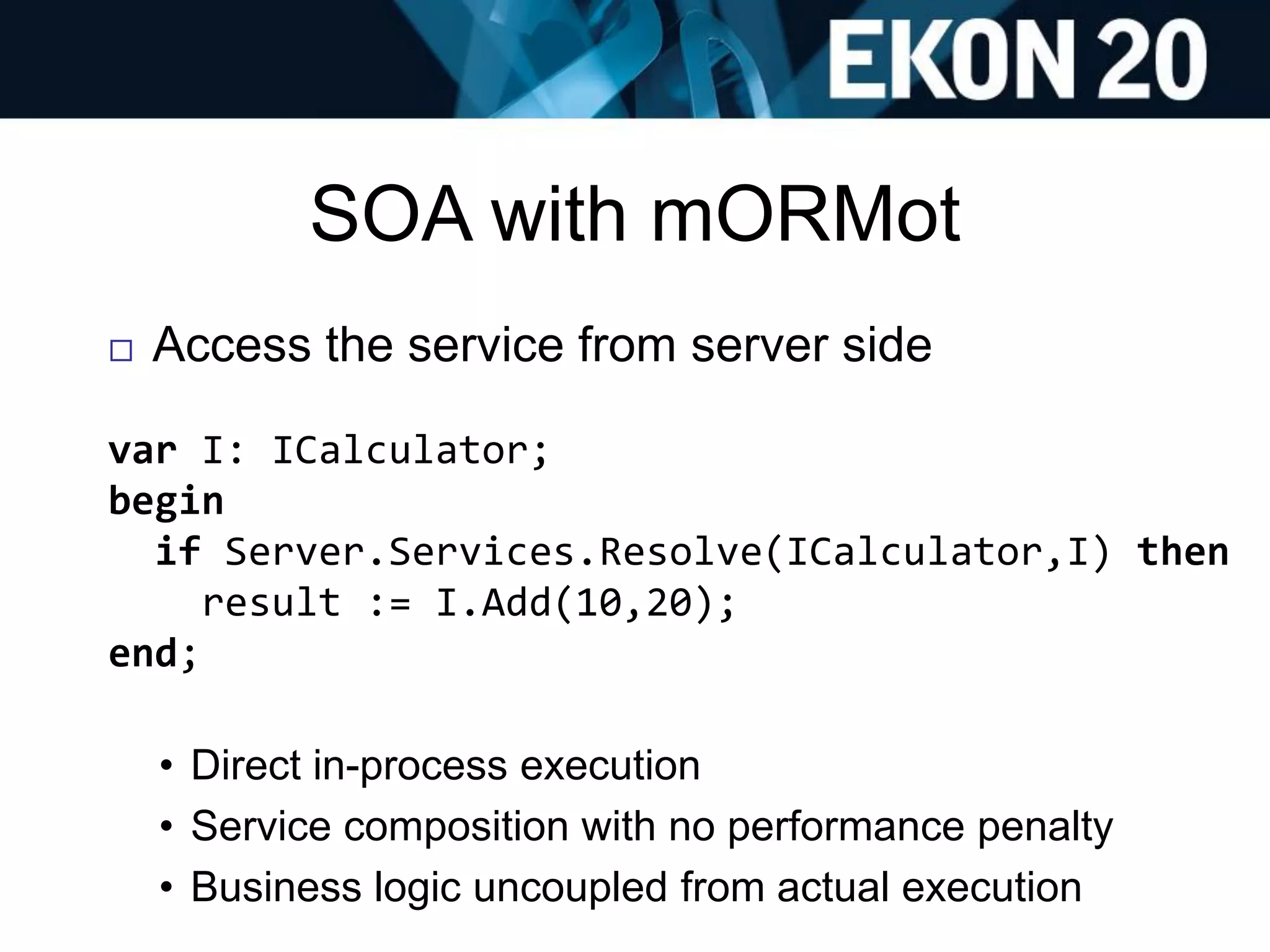
 Access the service from server side
var I: ICalculator;
begin
if Server.Services.Resolve(ICalculator,I) then
result := I.Add(10,20);
end;
• Direct in-process execution
• Service composition with no performance penalty
• Business logic uncoupled from actual execution
SOA with mORMot
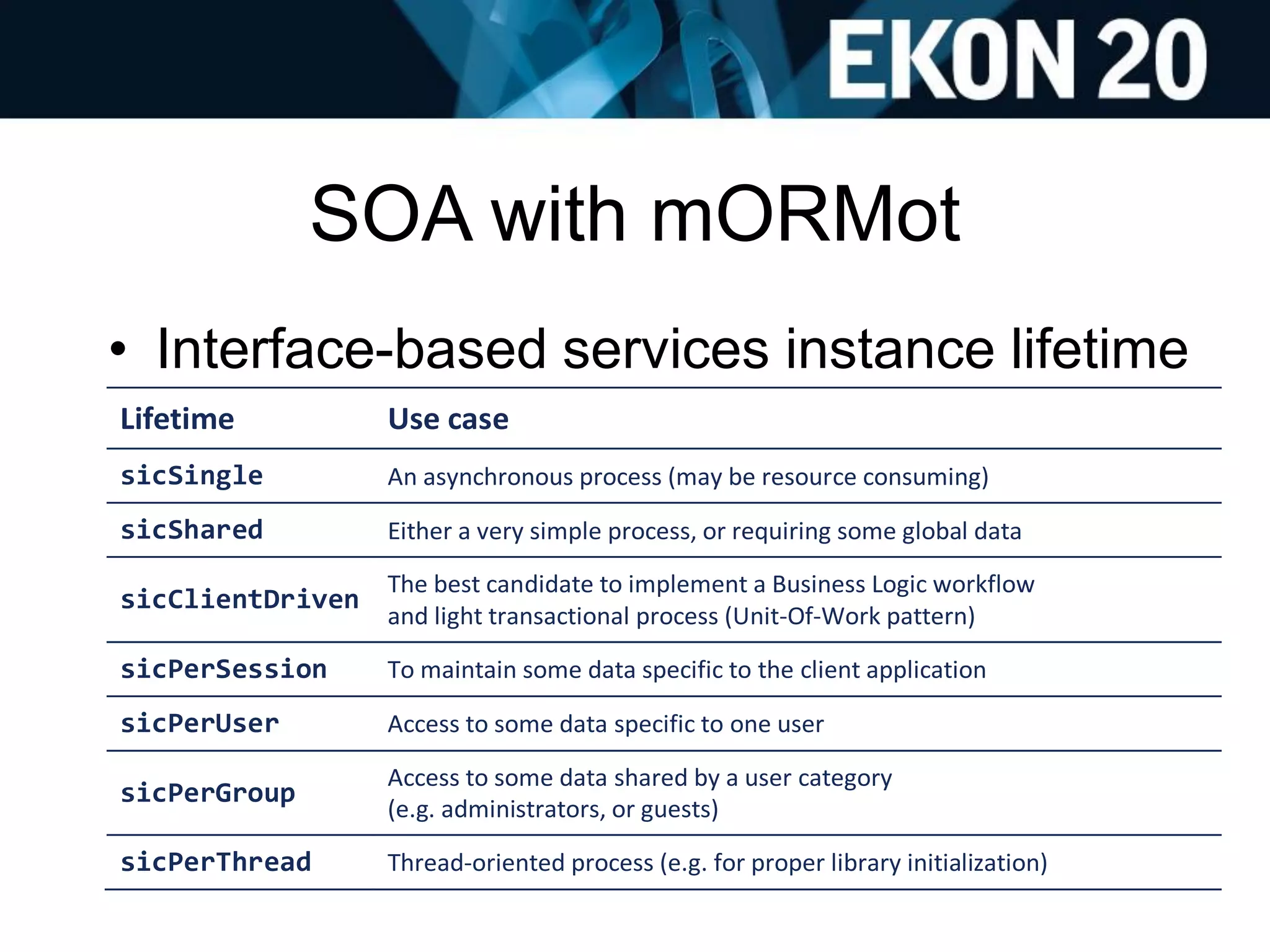
• Interface-based services instance lifetime
Lifetime Use case
sicSingle An asynchronous process (may be resource consuming)
sicShared Either a very simple process, or requiring some global data
sicClientDriven
The best candidate to implement a Business Logic workflow
and light transactional process (Unit-Of-Work pattern)
sicPerSession To maintain some data specific to the client application
sicPerUser Access to some data specific to one user
sicPerGroup
Access to some data shared by a user category
(e.g. administrators, or guests)
sicPerThread Thread-oriented process (e.g. for proper library initialization)
SOA with mORMot
• Interface-based services routing
– Classes available by default:
– you can define your own class
TSQLRestRoutingREST TSQLRestRoutingJSON_RPC
Description RESTful mode JSON-RPC mode
Default Yes No
URI scheme
/Model/Interface.Method[/ClientDrivenID]
or /Model/Interface/Method[/ClientDrivenID]
+ optional URI-encoded params
/Model/Interface
Body content
JSON array (or object) of parameters
or void if parameters were encoded at URI
{"method":"MethodName",
"params":[...]
[,"id":ClientDrivenID]}
Security
RESTful authentication for each method
or for the whole service (interface)
RESTful authentication for the
whole service (interface)
SOA with mORMot
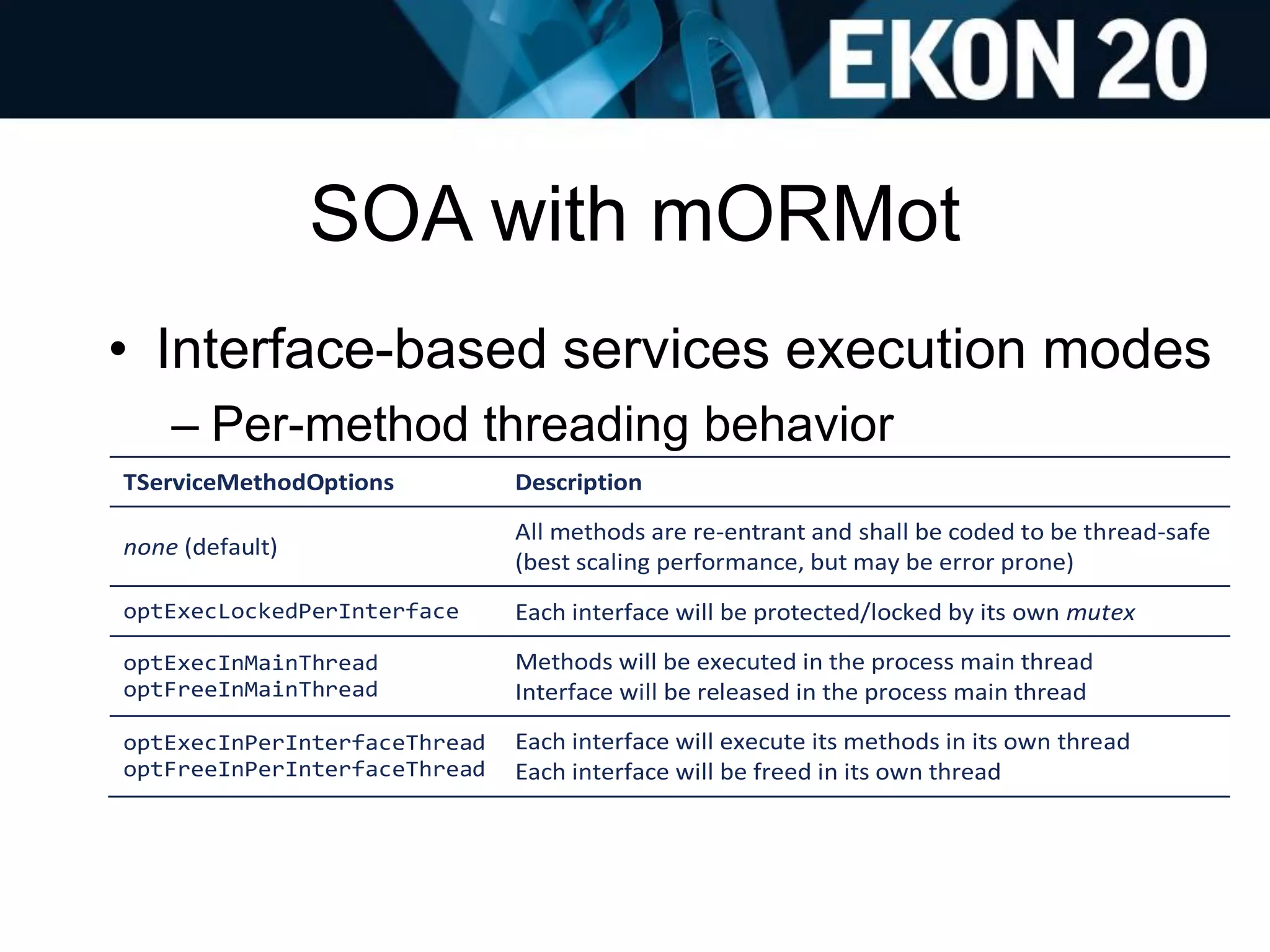
• Interface-based services execution modes
– Per-method threading behavior
TServiceMethodOptions Description
none (default)
All methods are re-entrant and shall be coded to be thread-safe
(best scaling performance, but may be error prone)
optExecLockedPerInterface Each interface will be protected/locked by its own mutex
optExecInMainThread
optFreeInMainThread
Methods will be executed in the process main thread
Interface will be released in the process main thread
optExecInPerInterfaceThread
optFreeInPerInterfaceThread
Each interface will execute its methods in its own thread
Each interface will be freed in its own thread
SOA with mORMot
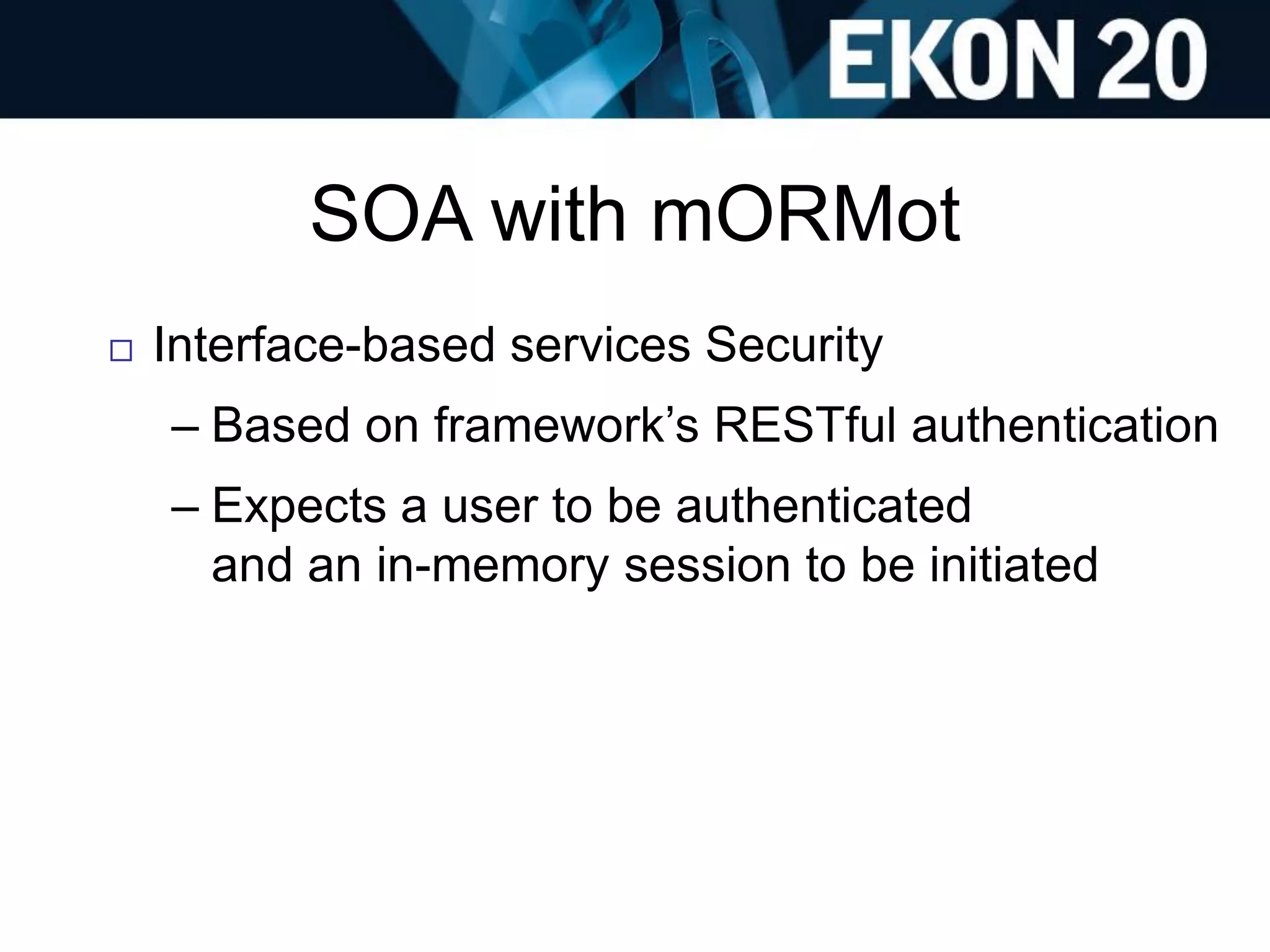
 Interface-based services Security
– Based on framework’s RESTful authentication
– Expects a user to be authenticated
and an in-memory session to be initiated
SOA with mORMot
 Interface-based services Security
– Based on framework’s RESTful authentication
– Restrain execution via fluent interface, e.g.
Server.ServiceDefine(
TServiceCalculator,ICalculator,sicShared).
DenyAll.
AllowAllByName(['Supervisor']);
SOA with mORMot
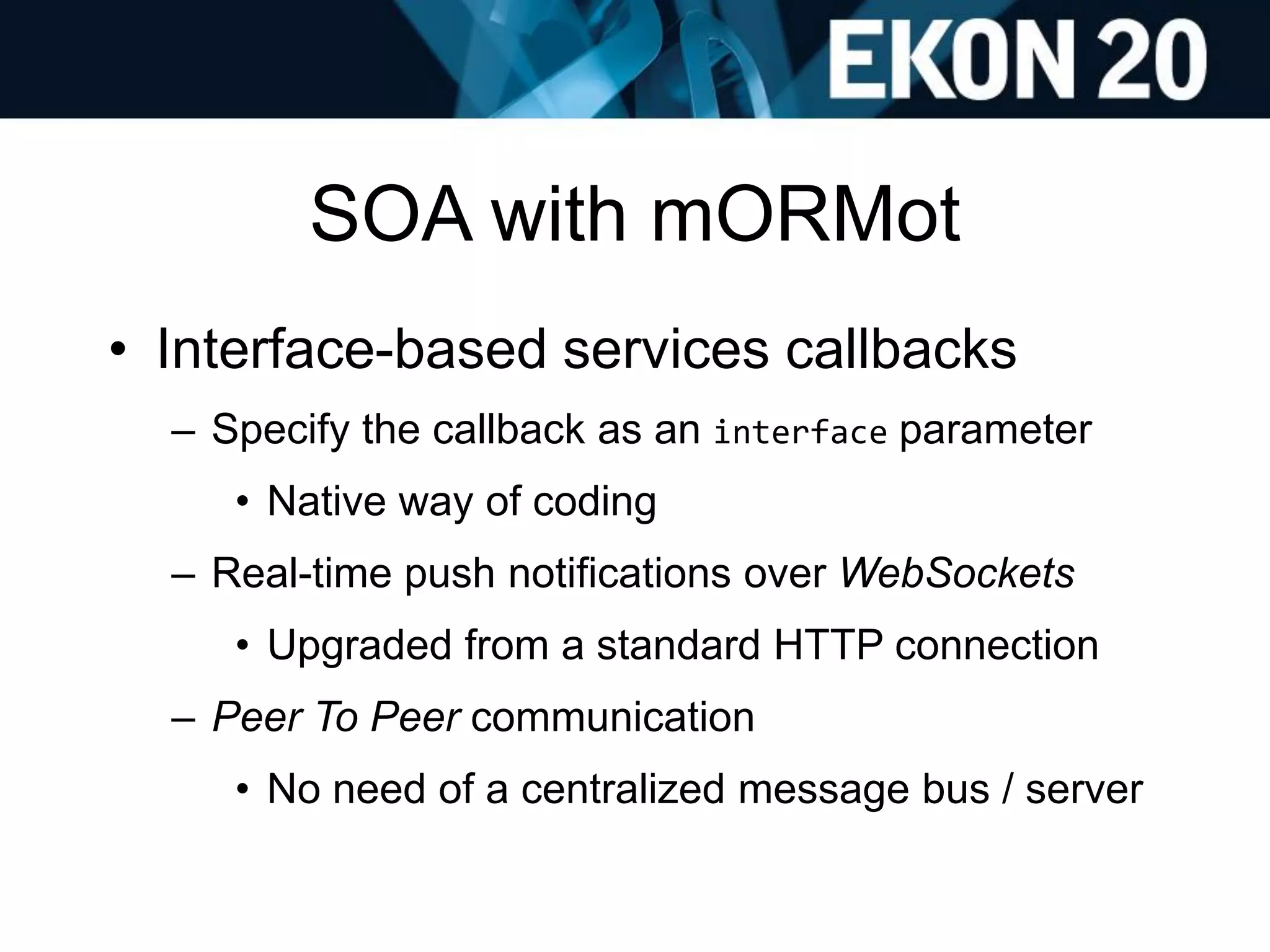
• Interface-based services callbacks
– Specify the callback as an interface parameter
• Native way of coding
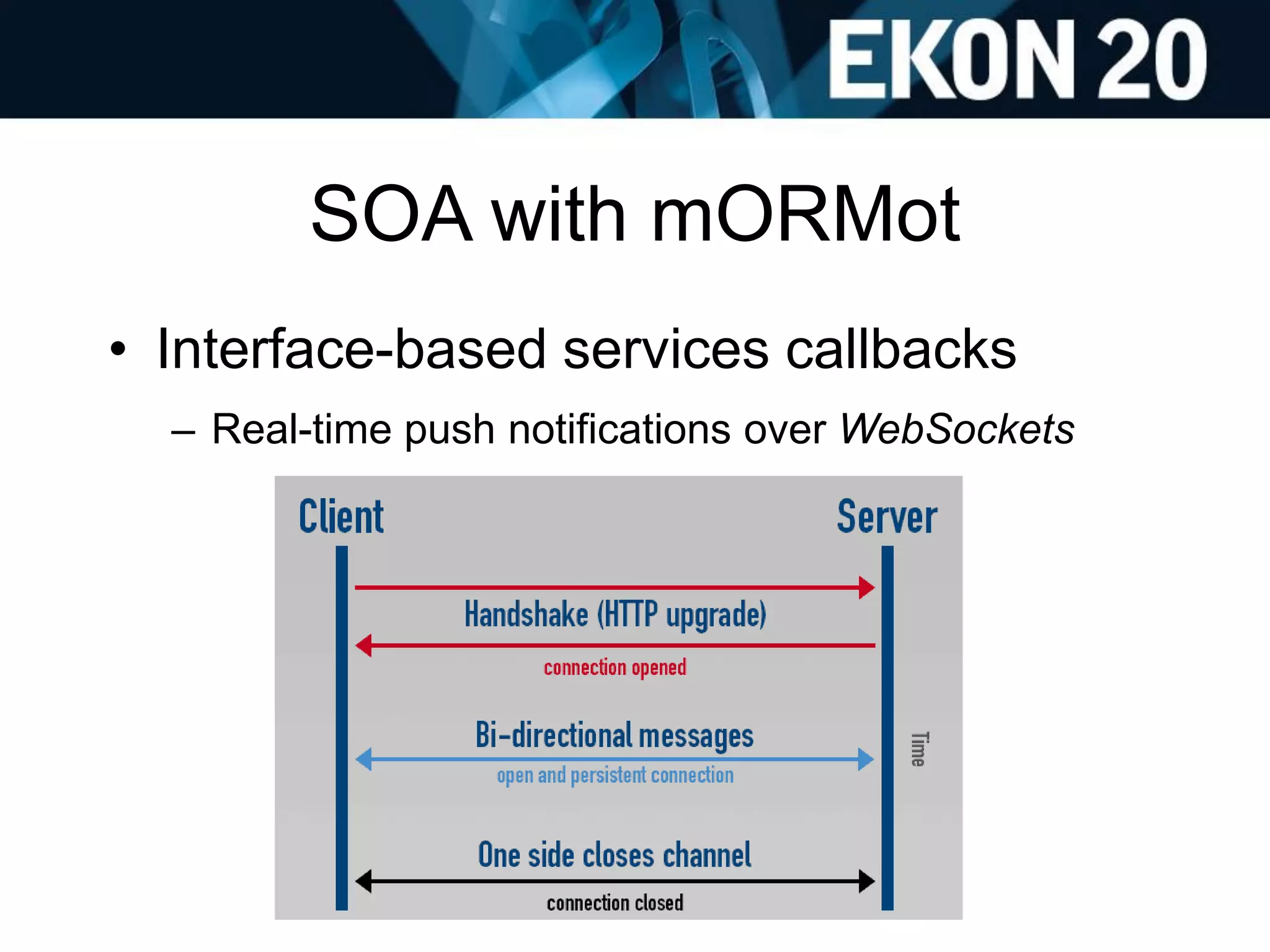
– Real-time push notifications over WebSockets
• Upgraded from a standard HTTP connection
– Peer To Peer communication
• No need of a centralized message bus / server
SOA with mORMot
• Interface-based services callbacks
– Specify the callback as an interface parameter
ILongWorkCallback = interface(IInvokable)
['{425BF199-19C7-4B2B-B1A4-A5BE7A9A4748}']
procedure WorkFinished(const workName: string;
timeTaken: integer);
procedure WorkFailed(const workName, error: string);
end;
SOA with mORMot
• Interface-based services callbacks
– Specify the callback as an interface parameter
ILongWorkCallback = interface(IInvokable)
…
ILongWorkService = interface(IInvokable)
['{09FDFCEF-86E5-4077-80D8-661801A9224A}']
procedure StartWork(const workName: string;
const onFinish: ILongWorkCallback);
function TotalWorkCount: Integer;
end;
SOA with mORMot
• Interface-based services callbacks
– Real-time push notifications over WebSockets
SOA with mORMot
• Interface-based services callbacks
– Real-time push notifications over WebSockets
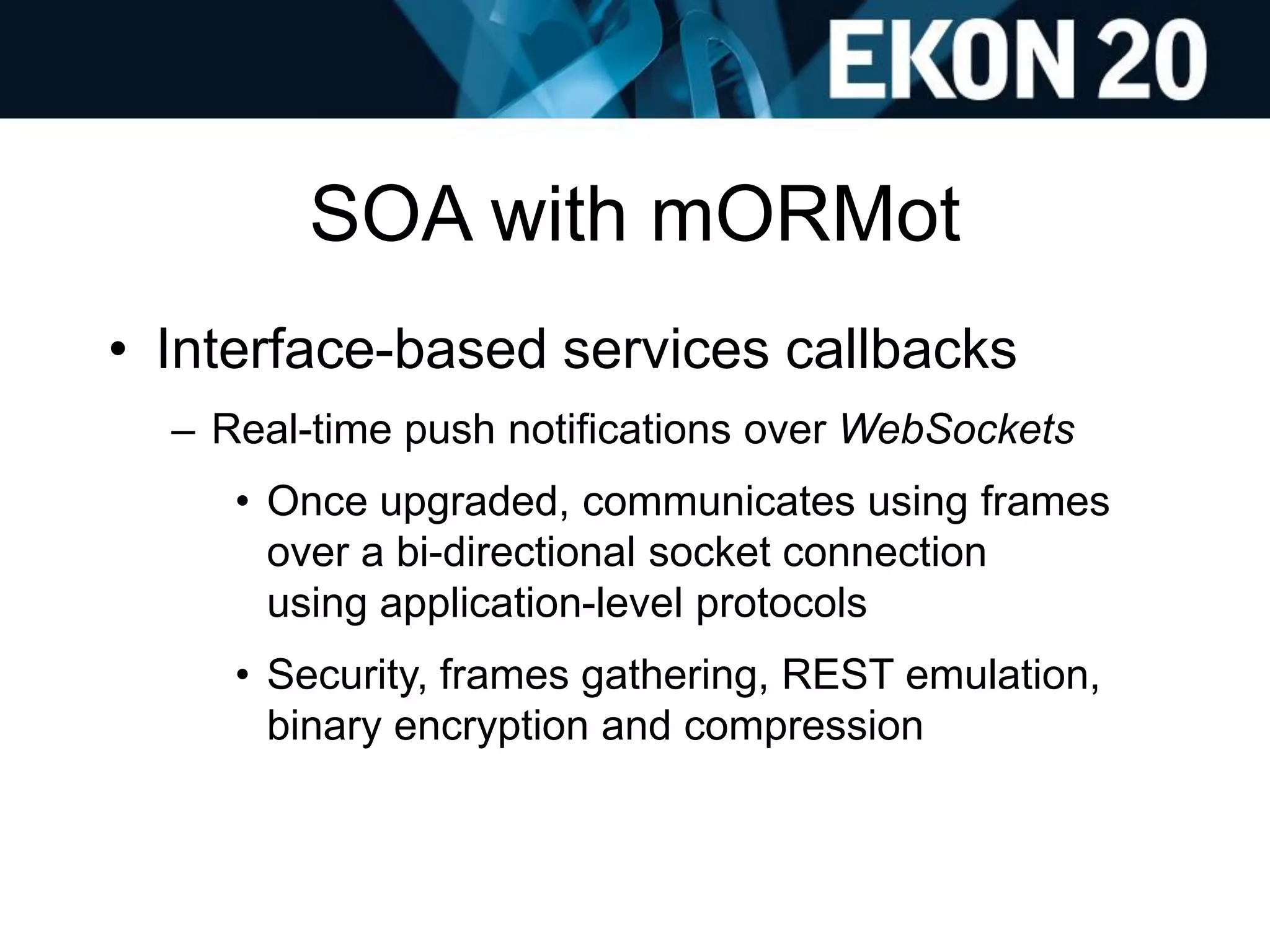
• Once upgraded, communicates using frames
over a bi-directional socket connection
using application-level protocols
• Security, frames gathering, REST emulation,
binary encryption and compression
SOA with mORMot
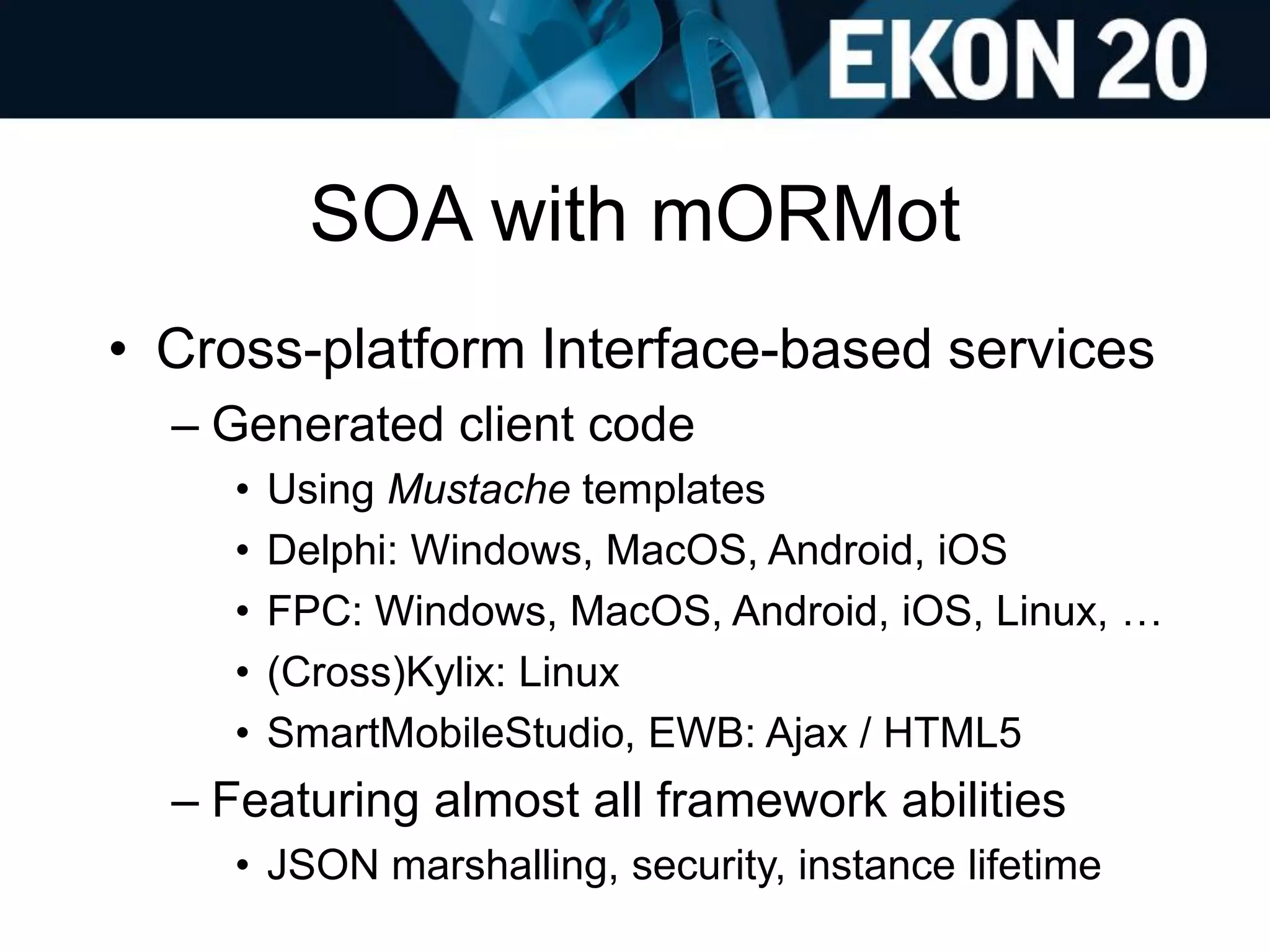
• Cross-platform Interface-based services
– Generated client code
• Using Mustache templates
• Delphi: Windows, MacOS, Android, iOS
• FPC: Windows, MacOS, Android, iOS, Linux, …
• (Cross)Kylix: Linux
• SmartMobileStudio, EWB: Ajax / HTML5
– Featuring almost all framework abilities
• JSON marshalling, security, instance lifetime
SOA with mORMot
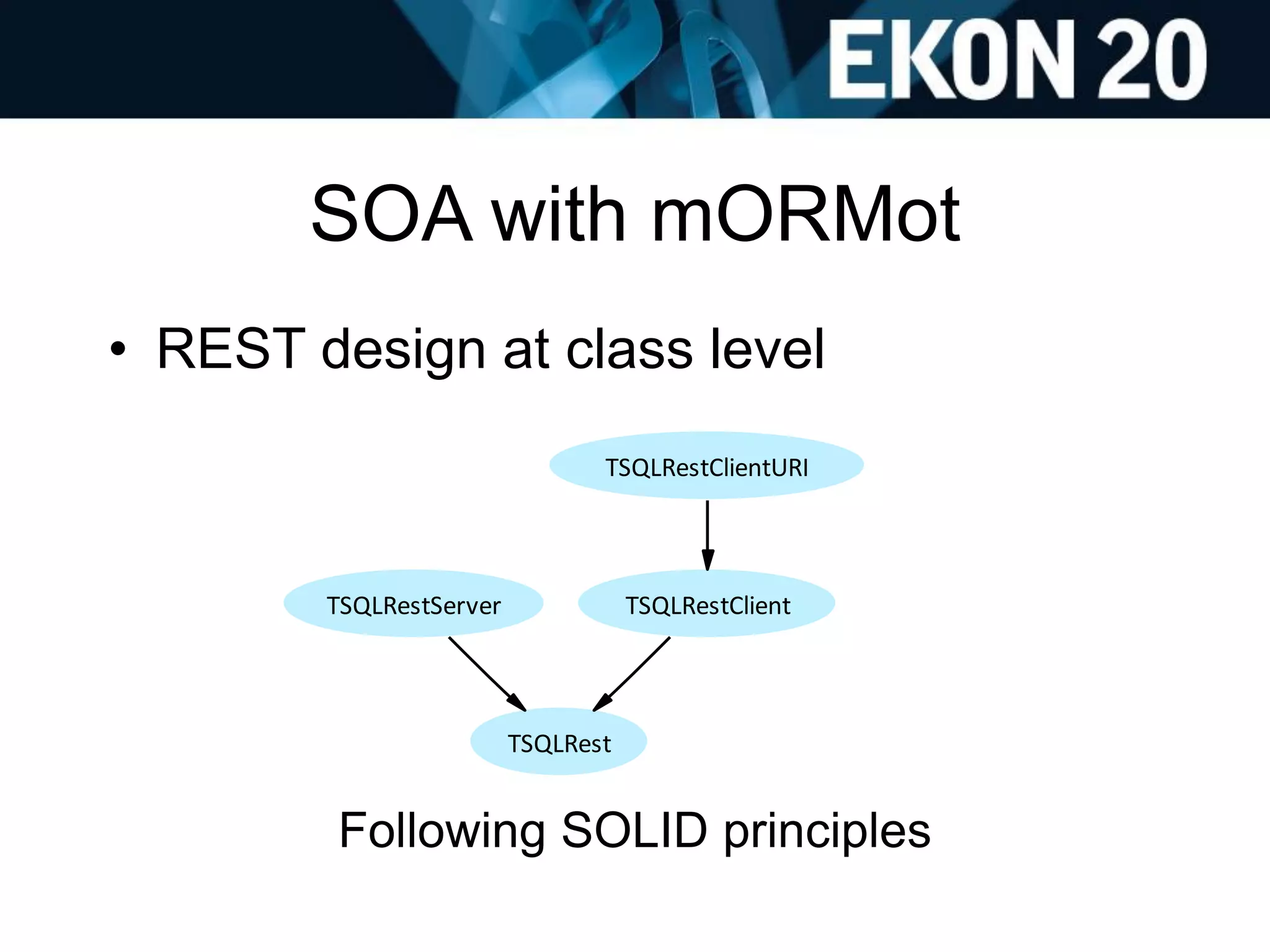
• REST design at class level
Following SOLID principles
TSQLRestServer
TSQLRest
TSQLRestClientURI
TSQLRestClient
SOA with mORMot
SOA with mORMot
SOA with mORMot
SOA with mORMot
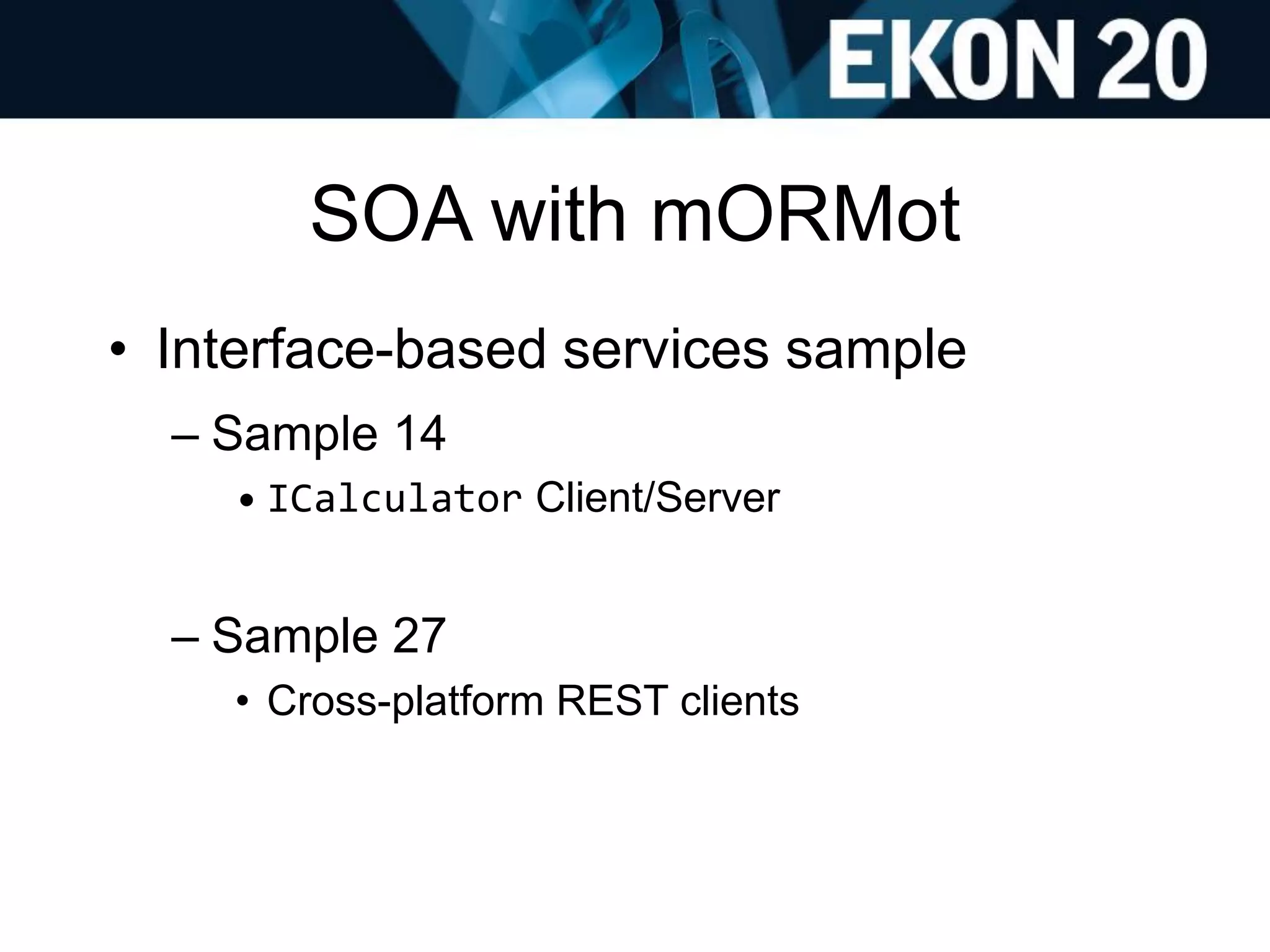
• Interface-based services sample
– Sample 14
• ICalculator Client/Server
– Sample 27
• Cross-platform REST clients
SOA with mORMot
• Interface-based services callbacks
– Sample 31
• Long-Work Push Notification
also known as “Sagas”
• Publish/Subscribe Pattern
also known as “Observer”
SOA with mORMot
• Resources
– http://synopse.info
– http://synopse.info/forum
– http://blog.synopse.info
– http://github.com/synopse/mORMot
Includes exhaustive documentation,
samples and regression tests.
Q & A
©2016 Synopse / A.Bouchez

Ekon20 mORMot SOA Delphi Conference

  • 1.
    Arnaud Bouchez |Synopse From RAD to SOA with mORMot 20161107T101500 - 20161107T113000
  • 2.
    From RAD toSOA with mORMot • Notions – Design RAD, OOP, SOLID, DDD – Architecture 2-Tier, 3-Tier, SOA, MicroServices
  • 3.
    From RAD toSOA with mORMot • Customer-focused Architecture • Implicit BBM Architecture • Is it worth it? • N-Tier • SOA • mORMot to the rescue
  • 4.
    Customer-focused Architecture • Youcan't talk about architecture in isolation • Architecture is always driven by the actual needs of the application
  • 5.
    Customer-focused Architecture • Thereis no such "one architecture fits all" nor "one framework fits all" solution • Architecture is just a thinking of how you are building your own software • Design is architecture applied in code
  • 6.
    Customer-focused Architecture • isnot about theory and diagrams • nor just about best practice • but an attempt to find – a way of implementing – a working solution – for your customers
  • 7.
  • 8.
    Customer-focused Architecture • Prematurearchitecture may be the root of all evil (as optimization is) • But no architecture, nor abstraction, will close many doors, and let maintainability be a nightmare, even impossible
  • 9.
    Implicit BBM Architecture •No Architecture? • Will end with an implicit architecture • Big Ball of Mud (BBM) design pattern
  • 10.
  • 11.
    Implicit BBM Architecture •Make explicit choices – At Design / code level – At Architecture / functional level
  • 12.
  • 13.
    Design • RAD Quick andefficient via components • OOP Business separated from UI • SOLID Proper classes & interfaces • DDD Uncouple your Domain
  • 14.
    Design - TDD •RAD Manual testing • OOP System testing • SOLID Injection allow proper unit testing • DDD Testing from isolation
  • 15.
    Design – LongTerm • RAD Fast to write, difficult to maintain • OOP Dependencies between classes • SOLID Agility through Uncoupling and IoC • DDD Safe and sound Domain
  • 16.
    Architecture • 2-Tier • 3-Tier •N-Tier / SOA • Micro Services
  • 17.
    Architecture • 2-Tier DB /UI • 3-Tier DB / Logic / UI • N-Tier / SOA Mesh of services • Micro Services SOLID principles applied to SOA
  • 18.
    Architecture • 2-Tier Single application •3-Tier Client-Server • N-Tier / SOA Integration and vertical scaling • Micro Services Agility and horizontal scaling
  • 19.
    Is it worthit? http://martinfowler.com/bliki/DesignStaminaHypothesis.html
  • 20.
    Is it worthit? http://martinfowler.com/bliki/DesignStaminaHypothesis.html RAD OOP SOLID DDD
  • 21.
    Is it worthit? http://martinfowler.com/bliki/DesignStaminaHypothesis.html 2-Tier 3-Tier n-Tier/SOA MicroServices
  • 22.
  • 23.
    N-Tier … a pieceof cake? Presentation Tier Application Tier Business Logic Tier Data Tier
  • 24.
  • 25.
    2-Tier • VCL/FMX/IW app •SQL Database Application Tier Data Tier
  • 26.
    2-Tier • VCL/FMX/IW app •SQL Database Logic is usually either in the UI… Application Tier Data Tier
  • 27.
    2-Tier • VCL/FMX/IW app •SQL Database Logic is usually either in the UI or the DB (stored procedures) Application Tier Data Tier
  • 28.
  • 29.
  • 30.
    N-Tier • Logical andPhysical Views Most of the time, n-Tier is intended to be a physical (hardware) view – e.g. separation between the database server and the application server – placing any tier on a separate machine to facilitate ease of maintenance or integrate with IT/SaaS requirements
  • 31.
    N-Tier • Logical andPhysical Views In SOA, we deal with logical layout – Separation of layers through logic interfaces – Underlying hardware implementation may, but will usually not, match the logical layout
  • 32.
    N-Tier • Logical andPhysical Views
  • 33.
    N-Tier • Physical View •Web Client • Web Server • SQL Database
  • 34.
    N-Tier • Physical View •Web Client • Web Server Embedded SQLite3 Database
  • 35.
    N-Tier • Logical View •Web app Client & Server • SQL Database Application Tier Data Tier
  • 36.
    N-Tier • Logical View •Web app Client & Server • SQL Database with stored procedures Application Tier Data Tier
  • 37.
    N-Tier • Logical andPhysical Views Presentation Tier Application Tier Business Logic Tier Data Tier Client 1 (Delphi) Client 2 (AJAX) Application Server DB Server Presentation Tier Application Tier Presentation Tier Business Logic Tier Data Tier
  • 38.
    SOA • Service-Oriented Architecture Definition: Aflexible set of design principles used during the phases of systems development and integration
  • 39.
    SOA • Service-Oriented Architecture Goal: Packagefunctionality as a suite of inter-operable services that can be used within multiple, separate systems from several business domains
  • 40.
    SOA • Service-Oriented Architecture –The SOA implementations rely on a mesh of uncoupled software services – Software Service: • A consumer asks a producer to act in order to produce a result • Invocation is (often) free from previous invocation (stateless), to minimize resource consumption
  • 41.
    SOA • Service-Oriented Architecture –The SOA implementations rely on a mesh of uncoupled software services – Those Services comprise • unassociated, loosely coupled units of functionality (each service implements one action) • that have no direct call to each other (via protocols, catalogs over a bus)
  • 42.
    SOA • Service-Oriented Architecture –The SOA implementations rely on a mesh of uncoupled software services Consumers Service Bus Publishers Client A Publisher 1 Publisher 2Client B Publisher 3Client C Service 1 Service 2 Service 3
  • 43.
    SOA • Service-Oriented Architecture –The SOA implementations rely on a mesh of uncoupled software services – Service composition • Logical multi-tier orchestration (transactional) • A higher level service invokes several services • Works as a self-contained, stateless service • Lower-level services can still be stateless • E.g. application services over business services
  • 44.
    SOA • Service-Oriented Architecture –The SOA implementations rely on a mesh of uncoupled software services – Service composition Consumers Application Service Bus Application Publishers Business Service Bus Business Publishers Client A Composition Publisher Composition Service Publisher 1 Publisher 2 Publisher 3 Service 1 Service 2 Service 3
  • 45.
    SOA • SOA ismainly about decoupling • It enables implementation independence in a variety of ways – Platform – Location – Availability – Versions
  • 46.
    SOA • SOA ismainly about decoupling Dependency Desired decoupling Decoupling technique Platform Hardware, Framework or Operating System should not constrain choices of the Services consumers Standard protocols, mainly Web services (e.g. SOAP or RESTful/JSON) Location Consumers may not be impacted by service hosting changes Routing and proxies will maintain Services access Availability Maintenance tasks shall be transparent Remote access allows centralized support on Server side Versions New services shall be introduced without requiring upgrades of clients Contract marshaling can be implemented on the Server side
  • 47.
    SOA • Micro Services –SOLID principles meet SOA
  • 48.
    SOA • Micro Services –SOLID principles meet SOA • Single responsibility principle • Open/closed principle • Liskov substitution principle (design by contract) • Interface segregation principle • Dependency inversion principle
  • 49.
    SOA • Micro Services •Single responsibility principle Object should have only a single axis of change • Open/closed principle Open for extension, but closed for modification • Liskov substitution principle (design by contract) Replaceable with subtypes without breaking the contract • Interface segregation principle Many specific classes/interfaces are better than one • Dependency inversion principle Depend upon abstractions not concretion, using injection
  • 50.
    SOA • Micro Services –SOLID principles meet SOA – Favor stateless calls, and/or event-driven – Implemented as stand-alone nodes – Enhance scaling abilities – Expects services discovery
  • 51.
    SOA • Favor logicalMulti-tier architecture • Put business intelligence on the server side • Use less bandwidth than a fat client • From fat client to rich clients (new platforms) • Leverage resources (DB, cache) • Easier to upgrade • Cheaper / Safer for the customer (backup, cloud)
  • 52.
    SOA • Expects atop/down implementation – Don’t start from the DB, but end-user app • Forget about bottom/up design • Define services, not data structures – Ability to uncouple things • Identify bounded contexts and needed information
  • 53.
    SOA • Expects atop/down implementation – Modelize your business in reusable services • Interfaces and explicit types (DTO) everywhere • Focus on domain to build tools and maximize ROI – Cross-cutting features may be delegated • Emailing, CRM, billing, reporting, UI… • If this is not where money comes from
  • 54.
    SOA • Expects atop/down implementation – From n-Tier vertical Architecture • DB as Root • Business over DB – to Clean “onion” Architecture • Domain as Core • Persistence as a service
  • 55.
  • 56.
  • 57.
    SOA with mORMot •Services can be implemented as: – Method-based resource-focused services – Interface-based services • RESTful architecture – Over several protocols, e.g. HTTP/1.1 – JSON and UTF-8 based • KISS / CoC design
  • 58.
    SOA with mORMot •Method-based services type TSQLRestServerTest = class(TSQLRestServerFullMemory) (...) published procedure Sum(Ctxt: TSQLRestServerURIContext); end; procedure TSQLRestServerTest.Sum(Ctxt: TSQLRestServerURIContext); begin with Ctxt do Results([Input['a']+Input['b']]); end;
  • 59.
    SOA with mORMot •Method-based services type TSQLRestServerTest = class(TSQLRestServerFullMemory) (...) published procedure Sum(Ctxt: TSQLRestServerURIContext); end; procedure TSQLRestServerTest.Sum(Ctxt: TSQLRestServerURIContext); begin Ctxt.Results([Ctxt['a']+Ctxt['b']]); end;
  • 60.
    SOA with mORMot •Method-based services type TSQLRestServerTest = class(TSQLRestServerFullMemory) (...) published procedure Sum(Ctxt: TSQLRestServerURIContext); end; by convention, accessible e.g. from http://server/root/sum?a=123&b=456 where root comes from REST server model
  • 61.
    SOA with mORMot •Method-based services – Give full access to the request • e.g. 30# replies or static content delivery – Manual marshalling, e.g. for parameters • on the server side (error prone) • on the client side (dedicated code to write) – Still too close to the metal
  • 62.
    SOA with mORMot •Interface-based services – Follow Delphi native abstraction of interface • Strong naming and typing • Parameters are marshaled via method signature • SOLID abstractions • Reference-counted memory management • Optional dual-way callbacks (WebSockets)
  • 63.
    SOA with mORMot •Interface-based services – Client-side wrapper is generated at runtime • Features RESTful UTF-8 JSON, so AJAX ready – Tied to mORMot’s REST and security model • From stand-alone app to complex MicroServices • Easily integrated with stubbing/mocking features
  • 64.
    SOA with mORMot •Interface-based services steps: – Define a contract – Implement the contract on server side – Host and publish the service – Access the service from client side
  • 65.
    SOA with mORMot •Define a contract type ICalculator = interface(IInvokable) ['{9A60C8ED-CEB2-4E09-87D4-4A16F496E5FE}'] /// add two signed 32 bit integers function Add(n1,n2: integer): integer; end; • ICalculator interface defines the contract • Add() method defines the operation • Handle any kind of parameters – Including classes, variants, dynamic arrays or records
  • 66.
    SOA with mORMot •Implement the contract on server side type TServiceCalculator = class(TInterfacedObject, ICalculator) public function Add(n1,n2: integer): integer; end; function TServiceCalculator.Add(n1, n2: integer): integer; begin result := n1+n2; end; … and that’s all !
  • 67.
    SOA with mORMot Host and publish the service Server.ServiceRegister( TServiceCalculator,[TypeInfo(ICalculator)],sicShared); – will register the TServiceCalculator class – to implement the ICalculator service – with a single shared instance life time – to any TSQLRestServer instance
  • 68.
    SOA with mORMot Host and publish the service Server.ServiceRegister( TServiceCalculator,[ICalculator],sicShared); – will register the TServiceCalculator class – to implement the ICalculator service – with a single shared instance life time – to any TSQLRestServer instance
  • 69.
    SOA with mORMot Access the service from client side Client.ServiceDefine([ICalculator],sicShared); • Register to any kind of TSQLRestClient via named pipes, messages, HTTP, WebSockets • Execution will take place on the server side • ICalculator type defines the contract
  • 70.
    SOA with mORMot Access the service from client side var I: ICalculator; begin if Client.Services['Calculator'].Get(I) then result := I.Add(10,20); end; • A “fake” class implements ICalculator • Data is transmitted by representation as JSON / REST • Any server-side exception will be transmitted back
  • 71.
    SOA with mORMot Access the service from client side var I: ICalculator; begin if Client.Services.Resolve(ICalculator,I) then result := I.Add(10,20); end; • Implements IoC / DI patterns • You can inject other local (mocked) services
  • 72.
    SOA with mORMot Access the service from server side var I: ICalculator; begin if Server.Services.Resolve(ICalculator,I) then result := I.Add(10,20); end; • Direct in-process execution • Service composition with no performance penalty • Business logic uncoupled from actual execution
  • 73.
    SOA with mORMot •Interface-based services instance lifetime Lifetime Use case sicSingle An asynchronous process (may be resource consuming) sicShared Either a very simple process, or requiring some global data sicClientDriven The best candidate to implement a Business Logic workflow and light transactional process (Unit-Of-Work pattern) sicPerSession To maintain some data specific to the client application sicPerUser Access to some data specific to one user sicPerGroup Access to some data shared by a user category (e.g. administrators, or guests) sicPerThread Thread-oriented process (e.g. for proper library initialization)
  • 74.
    SOA with mORMot •Interface-based services routing – Classes available by default: – you can define your own class TSQLRestRoutingREST TSQLRestRoutingJSON_RPC Description RESTful mode JSON-RPC mode Default Yes No URI scheme /Model/Interface.Method[/ClientDrivenID] or /Model/Interface/Method[/ClientDrivenID] + optional URI-encoded params /Model/Interface Body content JSON array (or object) of parameters or void if parameters were encoded at URI {"method":"MethodName", "params":[...] [,"id":ClientDrivenID]} Security RESTful authentication for each method or for the whole service (interface) RESTful authentication for the whole service (interface)
  • 75.
    SOA with mORMot •Interface-based services execution modes – Per-method threading behavior TServiceMethodOptions Description none (default) All methods are re-entrant and shall be coded to be thread-safe (best scaling performance, but may be error prone) optExecLockedPerInterface Each interface will be protected/locked by its own mutex optExecInMainThread optFreeInMainThread Methods will be executed in the process main thread Interface will be released in the process main thread optExecInPerInterfaceThread optFreeInPerInterfaceThread Each interface will execute its methods in its own thread Each interface will be freed in its own thread
  • 76.
    SOA with mORMot Interface-based services Security – Based on framework’s RESTful authentication – Expects a user to be authenticated and an in-memory session to be initiated
  • 77.
    SOA with mORMot Interface-based services Security – Based on framework’s RESTful authentication – Restrain execution via fluent interface, e.g. Server.ServiceDefine( TServiceCalculator,ICalculator,sicShared). DenyAll. AllowAllByName(['Supervisor']);
  • 78.
    SOA with mORMot •Interface-based services callbacks – Specify the callback as an interface parameter • Native way of coding – Real-time push notifications over WebSockets • Upgraded from a standard HTTP connection – Peer To Peer communication • No need of a centralized message bus / server
  • 79.
    SOA with mORMot •Interface-based services callbacks – Specify the callback as an interface parameter ILongWorkCallback = interface(IInvokable) ['{425BF199-19C7-4B2B-B1A4-A5BE7A9A4748}'] procedure WorkFinished(const workName: string; timeTaken: integer); procedure WorkFailed(const workName, error: string); end;
  • 80.
    SOA with mORMot •Interface-based services callbacks – Specify the callback as an interface parameter ILongWorkCallback = interface(IInvokable) … ILongWorkService = interface(IInvokable) ['{09FDFCEF-86E5-4077-80D8-661801A9224A}'] procedure StartWork(const workName: string; const onFinish: ILongWorkCallback); function TotalWorkCount: Integer; end;
  • 81.
    SOA with mORMot •Interface-based services callbacks – Real-time push notifications over WebSockets
  • 82.
    SOA with mORMot •Interface-based services callbacks – Real-time push notifications over WebSockets • Once upgraded, communicates using frames over a bi-directional socket connection using application-level protocols • Security, frames gathering, REST emulation, binary encryption and compression
  • 83.
    SOA with mORMot •Cross-platform Interface-based services – Generated client code • Using Mustache templates • Delphi: Windows, MacOS, Android, iOS • FPC: Windows, MacOS, Android, iOS, Linux, … • (Cross)Kylix: Linux • SmartMobileStudio, EWB: Ajax / HTML5 – Featuring almost all framework abilities • JSON marshalling, security, instance lifetime
  • 84.
    SOA with mORMot •REST design at class level Following SOLID principles TSQLRestServer TSQLRest TSQLRestClientURI TSQLRestClient
  • 85.
  • 86.
  • 87.
  • 88.
    SOA with mORMot •Interface-based services sample – Sample 14 • ICalculator Client/Server – Sample 27 • Cross-platform REST clients
  • 89.
    SOA with mORMot •Interface-based services callbacks – Sample 31 • Long-Work Push Notification also known as “Sagas” • Publish/Subscribe Pattern also known as “Observer”
  • 90.
    SOA with mORMot •Resources – http://synopse.info – http://synopse.info/forum – http://blog.synopse.info – http://github.com/synopse/mORMot Includes exhaustive documentation, samples and regression tests.
  • 91.
    Q & A ©2016Synopse / A.Bouchez