FREE RADICALS AND
VITAMIN E
BY: DR. MAYUR MAKADIA
RESIDENT,
BIOCHEMISTRY DEPARTMENT
PRAMUKHSWAMI MEDICAL COLLEGE
KARAMSAD
Definition
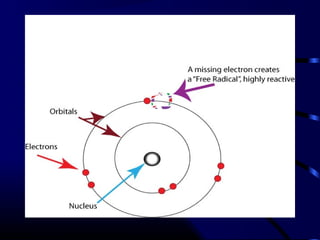
• A free radical is a molcule or molecular
fragment that contains one or more
unpaired electrons in its outer orbital.
• Represented by a superscript dot, (R˙)
ROS
• Normally, 4e- are transferred to
complete reduction of O2 to form H2O.
• O2 + 4H⁺ + 4e- ―› 2 H2O
• The products of partial reduction of O2
are highly reactive and called Reactive
Oxygen Species(ROS), Reactive Oxygen
Intermediates, Oxygen free
radicals(OFR).
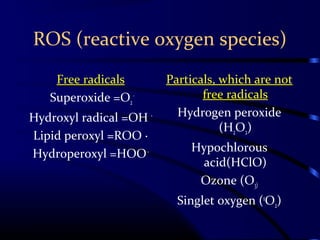
ROS (reactive oxygen species)
Free radicals
Superoxide =O2
·
Hydroxyl radical =OH ·
Lipid peroxyl =ROO ·
Hydroperoxyl =HOO·
Particals, which are not
free radicals
Hydrogen peroxide
(H2O2)
Hypochlorous
acid(HClO)
Ozone (O3)
Singlet oxygen (1
O2)
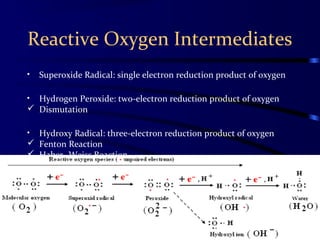
Reactive Oxygen Intermediates
• Superoxide Radical: single electron reduction product of oxygen
• Hydrogen Peroxide: two-electron reduction product of oxygen
 Dismutation
• Hydroxy Radical: three-electron reduction product of oxygen
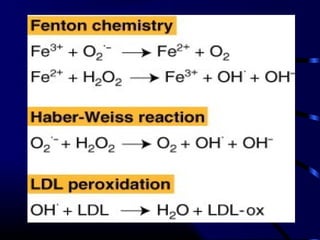
 Fenton Reaction
 Haber- Weiss Reaction
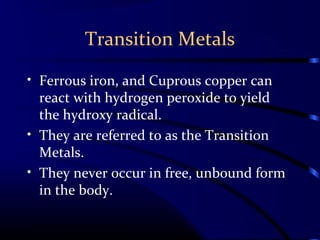
Transition Metals
• Ferrous iron, and Cuprous copper can
react with hydrogen peroxide to yield
the hydroxy radical.
• They are referred to as the Transition
Metals.
• They never occur in free, unbound form
in the body.
Generation of Oxygen Free
Radicals
• 1) Electron Leakage: major source
Constantly produced due to leaks in ETC.
There is production of superoxide radicals
from interaction between CoQ and O2
in ETC.
Generation of Oxygen Free
Radicals
• 2) Normal Oxidation- Reduction
Reaction
• Auto-oxidation of certain compound:
Adrenaline, thiols, ascorbic acid
• Falvin coenzymes present in
peroxisomes are specially active in
generating H2O2.
• Enzymes: xanthine oxidase, aldehyde
oxidase.
Generation of Oxygen Free
Radicals
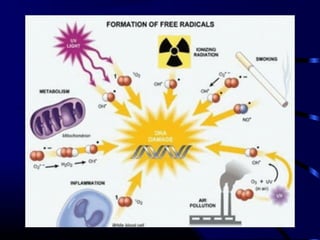
• 3) Exogenous Agents:
• Toxic compound, such as CCl4
• Ionizing Radiation
• Light of appropriate wavelengths
• Cigarette smoke
• Inhalation of air pollutants
Generation of Oxygen Free
Radicals
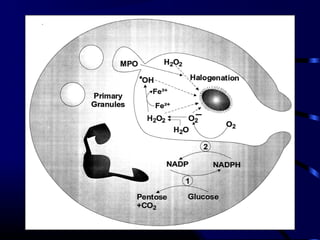
• 4) Respiratory Burst:
• Free radical production is sometimes
required in biological systems.
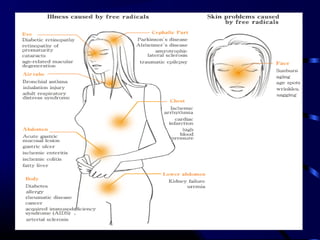
Damage Produced by Free
Radicals
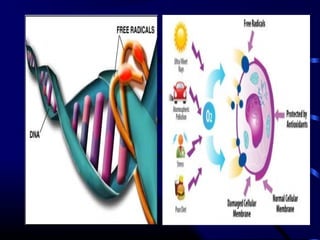
• Extremely reactive
• Half life is only a few milliseconds
• Almost all biological macromolecule are
damaged
• Protein: fragmentation of proteins.
• Oxidation of sulfhydryl group containing
enzymes, loss of function.
• DNA: damaged by strand breaks, directly cause
inhibition of protein and enzyme synthesis and
indirectly cell death, mutation & carcinogenesis.
Lipid Peroxidation
• Lipids are most susceptible
• PUFA present in cell membrane
especially prone to damage.
• Initiation phase:
• Primary event is production of R˙ by
interaction of a PUFA with free radicals
generated by other means.
• RH + OH˙ ―› R˙ + H2O
Lipid Peroxidation
• Propagation phase:
• R˙ rapidly react with molecular O2 forming a Peroxyl
radical (ROO˙) which can attack another PUFA.
• R˙ + O2 ―› ROO˙
• ROO˙ + RH ―› ROOH + R˙
• Net result is the conversion of R˙ to ROOH
(Hydroperoxide).
• But simultaneous conversion of R˙ to ROO˙ which
lead to continuous production of Hydroperoxide.
• Chain reaction
• “Death kiss” by free radicals.
Lipid Peroxidation
• Termination phase:
• The chain reaction continue untill a
peroxyl radical react with another
peroxyl radical to form inactive
products.
• ROO˙ + ROO˙ ―› RO-OR + O2
• R˙ + R˙ ―› R-R
• ROO˙ + R˙ ―› RO-OR
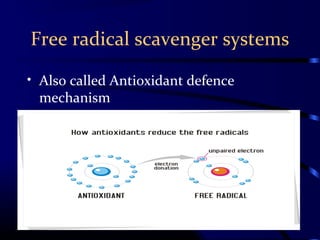
Free radical scavenger systems
• Also called Antioxidant defence
mechanism
Free radical scavenger systems
• A) Preventive mechanism:
Prevent the generation of free radicals
• B) Interceptive mechanism:
Destroy the free radicals that are
generated
Preventive mechanism
• The efficacy of ETC
• Sequestration of transition metals
• Peroxide decomposing enzymes
– Glutathion peroxidase
– Catalase
Interceptive mechanism
• A)Enzyme : Superoxide dismutase
(SOD)
• Only enzyme that take a free radical as
its substrate.
• Different isoenzymes
• 1) mitochondrial SOD: Mg++ dependant
• 2)cytosoplasmic SOD: copper-zinc
dependant
Interceptive mechanism
• B) Non- enzyme substance:
• Vitamin E
• Retinoids
• Ascorbate
• Ceruloplasmin
• Uric acid
Vitamin E as antioxidant
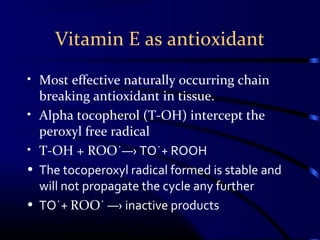
• Most effective naturally occurring chain
breaking antioxidant in tissue.
• Alpha tocopherol (T-OH) intercept the
peroxyl free radical
• T-OH + ROO˙―› TO˙+ ROOH
• The tocoperoxyl radical formed is stable and
will not propagate the cycle any further
• TO˙+ ROO˙ ―› inactive products
Vitamin E
• Only traces of tocopherol are required to
protect considerable amounts of PUFA.
• 1 tocopherol per 1000 lipid molecule
• But as antioxidant, alpha tocopherol is
consumed, so it has to be replenished by
dietary supply
Vitamin E
• Isolated from wheat germ oil
• Earlier known as Anti-Sterility Vitamin
• Other name “tocopherol” derived from
greek word tokos (childbirth), pheros (to
bear) and ol(alcohol)
• Eight naturallly occurring tocophrols
• Most Important: Alpha tocopherol
Vitamin E
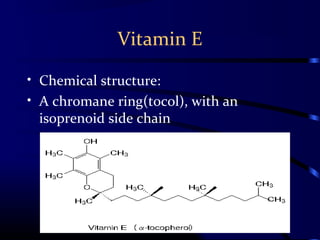
• Chemical structure:
• A chromane ring(tocol), with an
isoprenoid side chain
Vitamin E
• Absorption : along with other fats and need
bile salts
• Transport : as chylomicrons
• Store : adipose tissue
• Plasma concentration : 0.5-1 mg/dL
• Excretion : in feces via hepato-biliary route,
after chromane ring oxidation followed by
conjugation with glucuronic acid
Function of Vitamin E
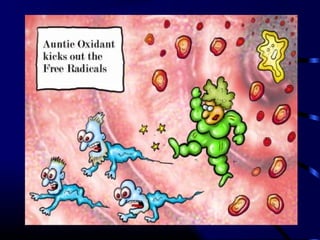
• Most powerful natural antioxidant
Function of Vitamin E
• Reduce risk of Atherosclerosis by reducing
oxidation of LDL
• Boost immune response
• Protect RBC from haemolysis
• Keeps structural and functional integrity of all
cells
• Slows ageing process
• Protection against Alzheimer’s disease
• Act synergistically with Selenium to minimise
lipid peroxidation
Deficiency of Vitamin E
• Uncommon, due to adequate level in
average diet.
• Deficiency seen in :
– Cannot absorb dietary fat
– In premature infants
– In abetalipoproteinemia
– Mutation in the gene for tocopherol trasfer
protein
RDA
• Male : 10 mg/day
• Females : 8 mg/day
• Pregnancy : 10 mg/day
• Lactation: 12 mg/day
• 15 mg Vit. E = 33 IU
• Requirement increase with higher intake of PUFA
• Pharmacological dose= 200-400 IU/day
• Hypervitaminosis E: rarely occur
• Cause tendency to hemorrhage, bcz it is mild anti-
coagulant
Thank You

Free Radicals and Vitamin E

  • 1.
    FREE RADICALS AND VITAMINE BY: DR. MAYUR MAKADIA RESIDENT, BIOCHEMISTRY DEPARTMENT PRAMUKHSWAMI MEDICAL COLLEGE KARAMSAD
  • 2.
    Definition • A freeradical is a molcule or molecular fragment that contains one or more unpaired electrons in its outer orbital. • Represented by a superscript dot, (R˙)
  • 4.
    ROS • Normally, 4e-are transferred to complete reduction of O2 to form H2O. • O2 + 4H⁺ + 4e- ―› 2 H2O • The products of partial reduction of O2 are highly reactive and called Reactive Oxygen Species(ROS), Reactive Oxygen Intermediates, Oxygen free radicals(OFR).
  • 5.
    ROS (reactive oxygenspecies) Free radicals Superoxide =O2 · Hydroxyl radical =OH · Lipid peroxyl =ROO · Hydroperoxyl =HOO· Particals, which are not free radicals Hydrogen peroxide (H2O2) Hypochlorous acid(HClO) Ozone (O3) Singlet oxygen (1 O2)
  • 6.
    Reactive Oxygen Intermediates •Superoxide Radical: single electron reduction product of oxygen • Hydrogen Peroxide: two-electron reduction product of oxygen  Dismutation • Hydroxy Radical: three-electron reduction product of oxygen  Fenton Reaction  Haber- Weiss Reaction
  • 8.
    Transition Metals • Ferrousiron, and Cuprous copper can react with hydrogen peroxide to yield the hydroxy radical. • They are referred to as the Transition Metals. • They never occur in free, unbound form in the body.
  • 9.
    Generation of OxygenFree Radicals • 1) Electron Leakage: major source Constantly produced due to leaks in ETC. There is production of superoxide radicals from interaction between CoQ and O2 in ETC.
  • 10.
    Generation of OxygenFree Radicals • 2) Normal Oxidation- Reduction Reaction • Auto-oxidation of certain compound: Adrenaline, thiols, ascorbic acid • Falvin coenzymes present in peroxisomes are specially active in generating H2O2. • Enzymes: xanthine oxidase, aldehyde oxidase.
  • 11.
    Generation of OxygenFree Radicals • 3) Exogenous Agents: • Toxic compound, such as CCl4 • Ionizing Radiation • Light of appropriate wavelengths • Cigarette smoke • Inhalation of air pollutants
  • 13.
    Generation of OxygenFree Radicals • 4) Respiratory Burst: • Free radical production is sometimes required in biological systems.
  • 15.
    Damage Produced byFree Radicals • Extremely reactive • Half life is only a few milliseconds • Almost all biological macromolecule are damaged • Protein: fragmentation of proteins. • Oxidation of sulfhydryl group containing enzymes, loss of function. • DNA: damaged by strand breaks, directly cause inhibition of protein and enzyme synthesis and indirectly cell death, mutation & carcinogenesis.
  • 17.
    Lipid Peroxidation • Lipidsare most susceptible • PUFA present in cell membrane especially prone to damage. • Initiation phase: • Primary event is production of R˙ by interaction of a PUFA with free radicals generated by other means. • RH + OH˙ ―› R˙ + H2O
  • 18.
    Lipid Peroxidation • Propagationphase: • R˙ rapidly react with molecular O2 forming a Peroxyl radical (ROO˙) which can attack another PUFA. • R˙ + O2 ―› ROO˙ • ROO˙ + RH ―› ROOH + R˙ • Net result is the conversion of R˙ to ROOH (Hydroperoxide). • But simultaneous conversion of R˙ to ROO˙ which lead to continuous production of Hydroperoxide. • Chain reaction • “Death kiss” by free radicals.
  • 19.
    Lipid Peroxidation • Terminationphase: • The chain reaction continue untill a peroxyl radical react with another peroxyl radical to form inactive products. • ROO˙ + ROO˙ ―› RO-OR + O2 • R˙ + R˙ ―› R-R • ROO˙ + R˙ ―› RO-OR
  • 21.
    Free radical scavengersystems • Also called Antioxidant defence mechanism
  • 22.
    Free radical scavengersystems • A) Preventive mechanism: Prevent the generation of free radicals • B) Interceptive mechanism: Destroy the free radicals that are generated
  • 23.
    Preventive mechanism • Theefficacy of ETC • Sequestration of transition metals • Peroxide decomposing enzymes – Glutathion peroxidase – Catalase
  • 24.
    Interceptive mechanism • A)Enzyme: Superoxide dismutase (SOD) • Only enzyme that take a free radical as its substrate. • Different isoenzymes • 1) mitochondrial SOD: Mg++ dependant • 2)cytosoplasmic SOD: copper-zinc dependant
  • 26.
    Interceptive mechanism • B)Non- enzyme substance: • Vitamin E • Retinoids • Ascorbate • Ceruloplasmin • Uric acid
  • 27.
    Vitamin E asantioxidant • Most effective naturally occurring chain breaking antioxidant in tissue. • Alpha tocopherol (T-OH) intercept the peroxyl free radical • T-OH + ROO˙―› TO˙+ ROOH • The tocoperoxyl radical formed is stable and will not propagate the cycle any further • TO˙+ ROO˙ ―› inactive products
  • 28.
    Vitamin E • Onlytraces of tocopherol are required to protect considerable amounts of PUFA. • 1 tocopherol per 1000 lipid molecule • But as antioxidant, alpha tocopherol is consumed, so it has to be replenished by dietary supply
  • 29.
    Vitamin E • Isolatedfrom wheat germ oil • Earlier known as Anti-Sterility Vitamin • Other name “tocopherol” derived from greek word tokos (childbirth), pheros (to bear) and ol(alcohol) • Eight naturallly occurring tocophrols • Most Important: Alpha tocopherol
  • 30.
    Vitamin E • Chemicalstructure: • A chromane ring(tocol), with an isoprenoid side chain
  • 31.
    Vitamin E • Absorption: along with other fats and need bile salts • Transport : as chylomicrons • Store : adipose tissue • Plasma concentration : 0.5-1 mg/dL • Excretion : in feces via hepato-biliary route, after chromane ring oxidation followed by conjugation with glucuronic acid
  • 32.
    Function of VitaminE • Most powerful natural antioxidant
  • 34.
    Function of VitaminE • Reduce risk of Atherosclerosis by reducing oxidation of LDL • Boost immune response • Protect RBC from haemolysis • Keeps structural and functional integrity of all cells • Slows ageing process • Protection against Alzheimer’s disease • Act synergistically with Selenium to minimise lipid peroxidation
  • 35.
    Deficiency of VitaminE • Uncommon, due to adequate level in average diet. • Deficiency seen in : – Cannot absorb dietary fat – In premature infants – In abetalipoproteinemia – Mutation in the gene for tocopherol trasfer protein
  • 36.
    RDA • Male :10 mg/day • Females : 8 mg/day • Pregnancy : 10 mg/day • Lactation: 12 mg/day • 15 mg Vit. E = 33 IU • Requirement increase with higher intake of PUFA • Pharmacological dose= 200-400 IU/day • Hypervitaminosis E: rarely occur • Cause tendency to hemorrhage, bcz it is mild anti- coagulant
  • 38.