Shovels for Surface
Mining
Shovels are a game-changer in the mining industry, allowing for
efficient and careful excavation of earth. In this presentation, we'll
dive into the advantages and inner workings of these machines.
by Dr. Anupam Kher
Shovels for Surface Mining
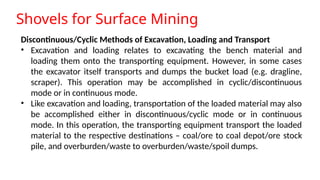
Discontinuous/Cyclic Methods of Excavation, Loading and Transport
• Excavation and loading relates to excavating the bench material and
loading them onto the transporting equipment. However, in some cases
the excavator itself transports and dumps the bucket load (e.g. dragline,
scraper). This operation may be accomplished in cyclic/discontinuous
mode or in continuous mode.
• Like excavation and loading, transportation of the loaded material may also
be accomplished either in discontinuous/cyclic mode or in continuous
mode. In this operation, the transporting equipment transport the loaded
material to the respective destinations – coal/ore to coal depot/ore stock
pile, and overburden/waste to overburden/waste/spoil dumps.
Shovels for Surface Mining
Development of Shovels
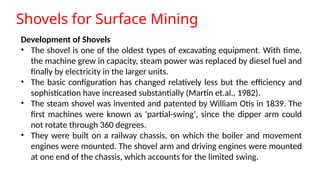
• The shovel is one of the oldest types of excavating equipment. With time,
the machine grew in capacity, steam power was replaced by diesel fuel and
finally by electricity in the larger units.
• The basic configuration has changed relatively less but the efficiency and
sophistication have increased substantially (Martin et.al., 1982).
• The steam shovel was invented and patented by William Otis in 1839. The
first machines were known as 'partial-swing', since the dipper arm could
not rotate through 360 degrees.
• They were built on a railway chassis, on which the boiler and movement
engines were mounted. The shovel arm and driving engines were mounted
at one end of the chassis, which accounts for the limited swing.
Shovels for Surface Mining
Development of
Shovels
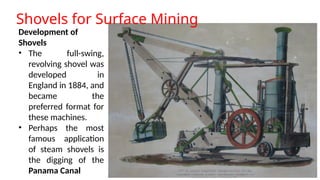
• The full-swing,
revolving shovel was
developed in
England in 1884, and
became the
preferred format for
these machines.
• Perhaps the most
famous application
of steam shovels is
the digging of the
Panama Canal
Shovels for Surface Mining
Development of
Shovels
• The full-swing,
revolving shovel was
developed in
England in 1884, and
became the
preferred format for
these machines.
• Perhaps the most
famous application
of steam shovels is
the digging of the
Panama Canal
Shovels for Surface Mining
Development of Shovels
• Shovels were also used for construction, road and quarry work. Steam shovels
became more and more popular in the 1920s with the publicly funded road
building programs around North America.
• Thousands of miles of State Highways were built in this time period, together
with new factories, docks, ports, buildings, and grain elevators.
• During the 1930s steam shovels lost out to the simpler, cheaper diesel-
powered excavating shovels.
• Open-pit mines were electrified at this time that helped the development of
electric rope shovels.
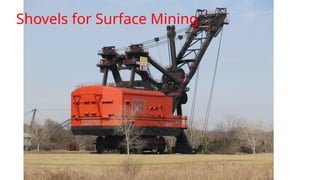
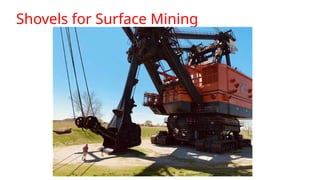
• Bucyrus constructed one of the most famous monsters - the Big Brutus, the
largest power shovel ever built and the largest still in existence.
Shovels for Surface Mining
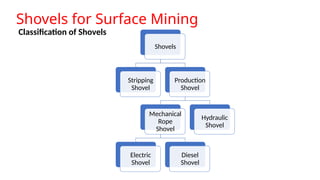
Classification of Shovels
Shovels
Stripping
Shovel
Production
Shovel
Mechanical
Rope
Shovel
Electric
Shovel
Diesel
Shovel
Hydraulic
Shovel
Shovels for Surface Mining
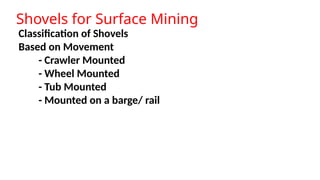
Classification of Shovels
Based on Movement
- Crawler Mounted
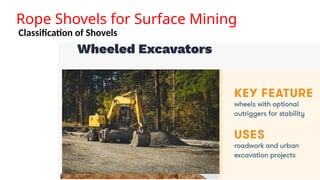
- Wheel Mounted
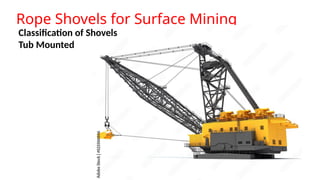
- Tub Mounted
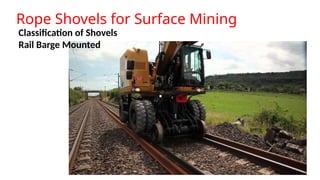
- Mounted on a barge/ rail
Rope Shovels for Surface Mining
Classification of Shovels
Rope Shovels for Surface Mining
Classification of Shovels
Rope Shovels for Surface Mining
Classification of Shovels
Tub Mounted
Rope Shovels for Surface Mining
Classification of Shovels
Rail Barge Mounted
Rope Shovels for Surface Mining
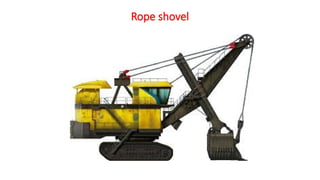
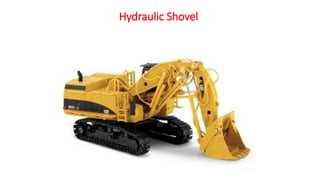
Power Shovel
• A power shovel is a single bucket equipped machine, electrically or diesel
operated for digging and loading earth, fragmented rock or coal/mineral.
They may be classifies as:
–Rope shovel
–Hydraulic shovel
Rope shovel
Hydraulic Shovel
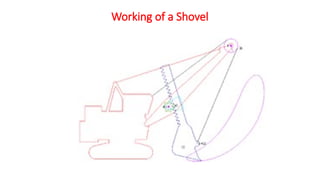
Working of a Shovel
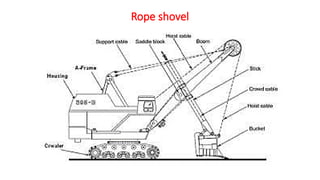
Rope shovel
Rope shovel
Shovels for Surface Mining
Rope Shovels
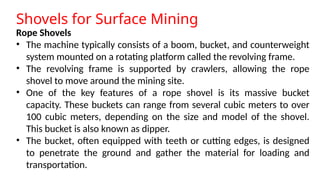
• The machine typically consists of a boom, bucket, and counterweight
system mounted on a rotating platform called the revolving frame.
• The revolving frame is supported by crawlers, allowing the rope
shovel to move around the mining site.
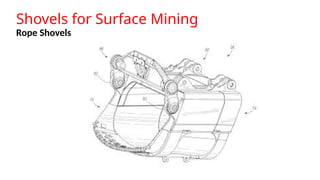
• One of the key features of a rope shovel is its massive bucket
capacity. These buckets can range from several cubic meters to over
100 cubic meters, depending on the size and model of the shovel.
This bucket is also known as dipper.
• The bucket, often equipped with teeth or cutting edges, is designed
to penetrate the ground and gather the material for loading and
transportation.
Shovels for Surface Mining
Rope Shovels
• The operation of a rope shovel involves several essential components. The
boom is the long, rigid arm that supports the bucket and enables it to reach
and dig into the material.
• It can be raised, lowered, and swung to different positions, allowing the shovel
to excavate at various angles. Generally inclination of the boom is 450 to the
horizontal, but it can be varied if required.
• By manipulating the ropes, the shovel can dig into the ground, fill the bucket,
and lift the material for loading onto haul trucks or other transport vehicles.
• Their flexibility and maneuverability allow them to work in various mining
environments, including open-pit mines and surface coal mines.
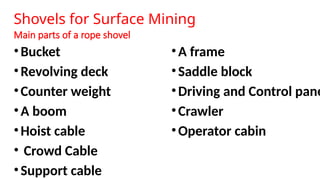
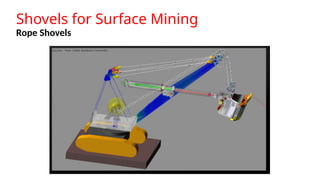
Main parts of a rope shovel
•Bucket
•Revolving deck
•Counter weight
•A boom
•Hoist cable
• Crowd Cable
•Support cable
•A frame
•Saddle block
•Driving and Control pane
•Crawler
•Operator cabin
Shovels for Surface Mining
Rope Shovels
Shovels for Surface Mining
Rope Shovels
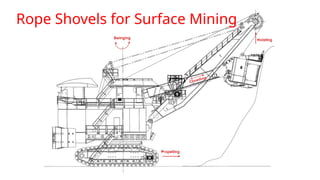
Main motions of a shovel
• Hoist - pulling the bucket up through the bank (i.e. the bank
of material being dug)
• Crowd - moving the dipper handle (arm) out or in to control
the depth of cut and when positioning to dump
• Swing - rotating the shovel between digging and dumping
• Propel - moving the shovel unit to different locations or dig
positions
Shovels for Surface Mining
Factors affecting performance of power shovel
• Height of cut
• Angle of swing
• Material preparation
• Capacity of hauling unit
• Efficiency of operator
• Working environment
• Condition of shovel
Shovels for Surface Mining
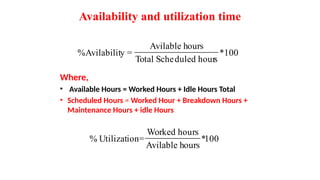
Availability and utilization time
Where,
• Available Hours = Worked Hours + Idle Hours Total
• Scheduled Hours = Worked Hour + Breakdown Hours +
Maintenance Hours + idle Hours
100
*
s
duled hour
Total Sche
ours
Avilable h
=
y
Avilabilit
%
100
*
ours
Avilable h
rs
Worked hou
ion=
% Utilizat
Advantages of Rope Shovels in
Surface Mining
1 Productivity 📈
Rope shovels have a high
production capacity, making
them ideal for large-scale mining
operations.
2 Precision 🔬
These shovels are capable of
precise, controlled excavation,
reducing waste and increasing
accuracy.
3 Durability 💪
Designed for heavy-duty use,
rope shovels can withstand tough
mining conditions for extended
periods of time.
4 Lower Costs 💰
Rope shovels are cost-effective
due to their high productivity and
low operating and maintenance
costs.
Components of Rope Shovels
Boom
The long arm that
carries the dipper
and provides the
shovel's reach.
Cab
The operator's
station, which
contains the
controls for
operating the
shovel.
Dipper
The large bucket
that scoops up
earth and carries it
away.
Crawler
Treads
The treads on
which the shovel
moves within the
mine.
Operating a Rope Shovel
1
Pre-Operation
Inspection
Check the oil,
fuel, and
hydraulic levels
and make sure all
components are
functioning
properly.
2
Starting the
Engine
After inspecting
the machine,
turn on the
engine and wait
for it to warm up.
3
Excavation
Use the controls
in the cab to
maneuver the
shovel and scoop
up earth with the
dipper.
4
Transporting
Material
Swing the shovel
to dump the
material into a
truck or other
transport vehicle.
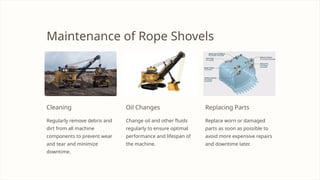
Maintenance of Rope Shovels
Cleaning
Regularly remove debris and
dirt from all machine
components to prevent wear
and tear and minimize
downtime.
Oil Changes
Change oil and other fluids
regularly to ensure optimal
performance and lifespan of
the machine.
Replacing Parts
Replace worn or damaged
parts as soon as possible to
avoid more expensive repairs
and downtime later.
Innovations in Rope Shovel Technology
Automation 💻
Advancements in
automation technology
have made it possible to
operate rope shovels
remotely, reducing the
risk of human error and
increasing safety.
Electric-Powered 🌿
Electric-powered rope
shovels use renewable
energy sources and
produce lower emissions,
making them more
environmentally friendly.
Improved Hydraulics
🚛
New hydraulic systems
allow for better control
and faster operation,
increasing productivity
and efficiency.
Future of Rope Shovels in Mining
Industry
1 Decreased Human Input
The use of automation technology
will continue to rise, leading to more
remote-operated rope shovels.
2
Increased Sustainability
Environmental concerns will drive
the industry towards more electric-
powered and low-emissions rope
shovels.
3 Improved Efficiency
Advancements in hydraulics and
other technologies will lead to faster,
more efficient rope shovels that can
handle larger quantities of earth.
Latest Mining Electric
Shovels
Electric shovels are transforming the mining industry. Discover their
features, benefits, and challenges, and explore the latest
developments in this innovative technology.
by anupam kher
Introduction
The Basics
Electric shovels are
used for removing
large amounts of rock
and soil in mines.
They're powered by
massive electric
motors and are
connected to an
external power
source.
The Advantages
Electric shovels offer
better energy
efficiency, lower
maintenance costs,
and greater control
and precision. They
also generate less
noise and air
pollution than diesel
shovels.
The Uses
Electric shovels are
used for a wide range
of mining activities,
from surface mining
to underground
mining. They're ideal
for mining large-scale
deposits in open-pit
mines.
Components and Technology
1
Drive System
The drive system consists of electric
motors, a motor controller, and a
transformer. It's responsible for
powering the shovel and controlling
its speed and torque.
2
Bucket and Dipper
The bucket and dipper are the main
working tools of the shovel. They're
made of high-strength steel and are
designed to withstand the stress and
wear of continuous use.
3
Control System
The control system manages the
shovel's various functions, including
hoisting, swinging, and dumping. It's
operated by an operator who sits in a
cab and uses joysticks to control the
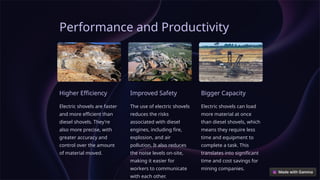
Performance and Productivity
Higher Efficiency
Electric shovels are faster
and more efficient than
diesel shovels. They're
also more precise, with
greater accuracy and
control over the amount
of material moved.
Improved Safety
The use of electric shovels
reduces the risks
associated with diesel
engines, including fire,
explosion, and air
pollution. It also reduces
the noise levels on-site,
making it easier for
workers to communicate
with each other.
Bigger Capacity
Electric shovels can load
more material at once
than diesel shovels, which
means they require less
time and equipment to
complete a task. This
translates into significant
time and cost savings for
mining companies.
Case Studies
1 Primary Gold Mine
A gold mine in Australia
replaced its diesel shovel
fleet with electric shovels,
resulting in a 50% increase
in productivity and a 30%
reduction in fuel
consumption.
2 Bingham Canyon
Copper Mine
The Bingham Canyon
Copper Mine in Utah, USA,
uses one of the largest
electric shovels in the world,
capable of moving 180,000
tons of material a day. It has
helped the mine become
one of the most profitable in
the world.
3 Hibbing Taconite Mine
The Hibbing Taconite Mine in Minnesota, USA, has been using
electric shovels for over 25 years, making it one of the early
adopters of this technology. It has reported significant
improvements in productivity and efficiency.
Challenges and Limitations
Power Infrastructure
Electric shovels require a
reliable, high-voltage
power source. This can
be a challenge in remote
or underdeveloped
mining areas.
Costs
Electric shovels are
generally more
expensive than diesel
shovels. However, they
offer significant long-
term cost savings, which
can offset the initial
investment.
Maintenance
Electric shovels require
specialized maintenance
and repair services,
which may not be
readily available in all
regions. Regular
maintenance is essential
for keeping the shovel
running at optimal
performance.
Future Trends and Developments
1 Automation
Some mining companies are exploring the use of self-driving electric
shovels, which can operate without human intervention. This could
improve safety and efficiency.
2 Battery-powered Shovels
New developments in battery technology could eventually make it
possible to power electric shovels with batteries, instead of reliance on
external power sources. This could allow for greater flexibility and
mobility.
3 Advanced Analytics
Advanced analytics and machine learning algorithms can help improve
the performance and efficiency of electric shovels by predicting their
maintenance needs and optimizing their operating parameters.

Rope Shovels and Electric for Surface Mining

  • 1.
    Shovels for Surface Mining Shovelsare a game-changer in the mining industry, allowing for efficient and careful excavation of earth. In this presentation, we'll dive into the advantages and inner workings of these machines. by Dr. Anupam Kher
  • 2.
  • 3.
    Shovels for SurfaceMining Discontinuous/Cyclic Methods of Excavation, Loading and Transport • Excavation and loading relates to excavating the bench material and loading them onto the transporting equipment. However, in some cases the excavator itself transports and dumps the bucket load (e.g. dragline, scraper). This operation may be accomplished in cyclic/discontinuous mode or in continuous mode. • Like excavation and loading, transportation of the loaded material may also be accomplished either in discontinuous/cyclic mode or in continuous mode. In this operation, the transporting equipment transport the loaded material to the respective destinations – coal/ore to coal depot/ore stock pile, and overburden/waste to overburden/waste/spoil dumps.
  • 4.
    Shovels for SurfaceMining Development of Shovels • The shovel is one of the oldest types of excavating equipment. With time, the machine grew in capacity, steam power was replaced by diesel fuel and finally by electricity in the larger units. • The basic configuration has changed relatively less but the efficiency and sophistication have increased substantially (Martin et.al., 1982). • The steam shovel was invented and patented by William Otis in 1839. The first machines were known as 'partial-swing', since the dipper arm could not rotate through 360 degrees. • They were built on a railway chassis, on which the boiler and movement engines were mounted. The shovel arm and driving engines were mounted at one end of the chassis, which accounts for the limited swing.
  • 5.
    Shovels for SurfaceMining Development of Shovels • The full-swing, revolving shovel was developed in England in 1884, and became the preferred format for these machines. • Perhaps the most famous application of steam shovels is the digging of the Panama Canal
  • 6.
    Shovels for SurfaceMining Development of Shovels • The full-swing, revolving shovel was developed in England in 1884, and became the preferred format for these machines. • Perhaps the most famous application of steam shovels is the digging of the Panama Canal
  • 7.
    Shovels for SurfaceMining Development of Shovels • Shovels were also used for construction, road and quarry work. Steam shovels became more and more popular in the 1920s with the publicly funded road building programs around North America. • Thousands of miles of State Highways were built in this time period, together with new factories, docks, ports, buildings, and grain elevators. • During the 1930s steam shovels lost out to the simpler, cheaper diesel- powered excavating shovels. • Open-pit mines were electrified at this time that helped the development of electric rope shovels. • Bucyrus constructed one of the most famous monsters - the Big Brutus, the largest power shovel ever built and the largest still in existence.
  • 8.
  • 9.
  • 10.
    Shovels for SurfaceMining Classification of Shovels Shovels Stripping Shovel Production Shovel Mechanical Rope Shovel Electric Shovel Diesel Shovel Hydraulic Shovel
  • 11.
    Shovels for SurfaceMining Classification of Shovels Based on Movement - Crawler Mounted - Wheel Mounted - Tub Mounted - Mounted on a barge/ rail
  • 12.
    Rope Shovels forSurface Mining Classification of Shovels
  • 13.
    Rope Shovels forSurface Mining Classification of Shovels
  • 14.
    Rope Shovels forSurface Mining Classification of Shovels Tub Mounted
  • 15.
    Rope Shovels forSurface Mining Classification of Shovels Rail Barge Mounted
  • 16.
    Rope Shovels forSurface Mining
  • 17.
    Power Shovel • Apower shovel is a single bucket equipped machine, electrically or diesel operated for digging and loading earth, fragmented rock or coal/mineral. They may be classifies as: –Rope shovel –Hydraulic shovel
  • 18.
  • 19.
  • 20.
  • 21.
  • 22.
  • 23.
    Shovels for SurfaceMining Rope Shovels • The machine typically consists of a boom, bucket, and counterweight system mounted on a rotating platform called the revolving frame. • The revolving frame is supported by crawlers, allowing the rope shovel to move around the mining site. • One of the key features of a rope shovel is its massive bucket capacity. These buckets can range from several cubic meters to over 100 cubic meters, depending on the size and model of the shovel. This bucket is also known as dipper. • The bucket, often equipped with teeth or cutting edges, is designed to penetrate the ground and gather the material for loading and transportation.
  • 24.
    Shovels for SurfaceMining Rope Shovels • The operation of a rope shovel involves several essential components. The boom is the long, rigid arm that supports the bucket and enables it to reach and dig into the material. • It can be raised, lowered, and swung to different positions, allowing the shovel to excavate at various angles. Generally inclination of the boom is 450 to the horizontal, but it can be varied if required. • By manipulating the ropes, the shovel can dig into the ground, fill the bucket, and lift the material for loading onto haul trucks or other transport vehicles. • Their flexibility and maneuverability allow them to work in various mining environments, including open-pit mines and surface coal mines.
  • 25.
    Main parts ofa rope shovel •Bucket •Revolving deck •Counter weight •A boom •Hoist cable • Crowd Cable •Support cable •A frame •Saddle block •Driving and Control pane •Crawler •Operator cabin Shovels for Surface Mining
  • 26.
    Shovels for SurfaceMining Rope Shovels
  • 27.
    Shovels for SurfaceMining Rope Shovels
  • 28.
    Main motions ofa shovel • Hoist - pulling the bucket up through the bank (i.e. the bank of material being dug) • Crowd - moving the dipper handle (arm) out or in to control the depth of cut and when positioning to dump • Swing - rotating the shovel between digging and dumping • Propel - moving the shovel unit to different locations or dig positions Shovels for Surface Mining
  • 29.
    Factors affecting performanceof power shovel • Height of cut • Angle of swing • Material preparation • Capacity of hauling unit • Efficiency of operator • Working environment • Condition of shovel Shovels for Surface Mining
  • 30.
    Availability and utilizationtime Where, • Available Hours = Worked Hours + Idle Hours Total • Scheduled Hours = Worked Hour + Breakdown Hours + Maintenance Hours + idle Hours 100 * s duled hour Total Sche ours Avilable h = y Avilabilit % 100 * ours Avilable h rs Worked hou ion= % Utilizat
  • 31.
    Advantages of RopeShovels in Surface Mining 1 Productivity 📈 Rope shovels have a high production capacity, making them ideal for large-scale mining operations. 2 Precision 🔬 These shovels are capable of precise, controlled excavation, reducing waste and increasing accuracy. 3 Durability 💪 Designed for heavy-duty use, rope shovels can withstand tough mining conditions for extended periods of time. 4 Lower Costs 💰 Rope shovels are cost-effective due to their high productivity and low operating and maintenance costs.
  • 32.
    Components of RopeShovels Boom The long arm that carries the dipper and provides the shovel's reach. Cab The operator's station, which contains the controls for operating the shovel. Dipper The large bucket that scoops up earth and carries it away. Crawler Treads The treads on which the shovel moves within the mine.
  • 33.
    Operating a RopeShovel 1 Pre-Operation Inspection Check the oil, fuel, and hydraulic levels and make sure all components are functioning properly. 2 Starting the Engine After inspecting the machine, turn on the engine and wait for it to warm up. 3 Excavation Use the controls in the cab to maneuver the shovel and scoop up earth with the dipper. 4 Transporting Material Swing the shovel to dump the material into a truck or other transport vehicle.
  • 34.
    Maintenance of RopeShovels Cleaning Regularly remove debris and dirt from all machine components to prevent wear and tear and minimize downtime. Oil Changes Change oil and other fluids regularly to ensure optimal performance and lifespan of the machine. Replacing Parts Replace worn or damaged parts as soon as possible to avoid more expensive repairs and downtime later.
  • 35.
    Innovations in RopeShovel Technology Automation 💻 Advancements in automation technology have made it possible to operate rope shovels remotely, reducing the risk of human error and increasing safety. Electric-Powered 🌿 Electric-powered rope shovels use renewable energy sources and produce lower emissions, making them more environmentally friendly. Improved Hydraulics 🚛 New hydraulic systems allow for better control and faster operation, increasing productivity and efficiency.
  • 36.
    Future of RopeShovels in Mining Industry 1 Decreased Human Input The use of automation technology will continue to rise, leading to more remote-operated rope shovels. 2 Increased Sustainability Environmental concerns will drive the industry towards more electric- powered and low-emissions rope shovels. 3 Improved Efficiency Advancements in hydraulics and other technologies will lead to faster, more efficient rope shovels that can handle larger quantities of earth.
  • 37.
    Latest Mining Electric Shovels Electricshovels are transforming the mining industry. Discover their features, benefits, and challenges, and explore the latest developments in this innovative technology. by anupam kher
  • 38.
    Introduction The Basics Electric shovelsare used for removing large amounts of rock and soil in mines. They're powered by massive electric motors and are connected to an external power source. The Advantages Electric shovels offer better energy efficiency, lower maintenance costs, and greater control and precision. They also generate less noise and air pollution than diesel shovels. The Uses Electric shovels are used for a wide range of mining activities, from surface mining to underground mining. They're ideal for mining large-scale deposits in open-pit mines.
  • 39.
    Components and Technology 1 DriveSystem The drive system consists of electric motors, a motor controller, and a transformer. It's responsible for powering the shovel and controlling its speed and torque. 2 Bucket and Dipper The bucket and dipper are the main working tools of the shovel. They're made of high-strength steel and are designed to withstand the stress and wear of continuous use. 3 Control System The control system manages the shovel's various functions, including hoisting, swinging, and dumping. It's operated by an operator who sits in a cab and uses joysticks to control the

  • 40.
    Performance and Productivity HigherEfficiency Electric shovels are faster and more efficient than diesel shovels. They're also more precise, with greater accuracy and control over the amount of material moved. Improved Safety The use of electric shovels reduces the risks associated with diesel engines, including fire, explosion, and air pollution. It also reduces the noise levels on-site, making it easier for workers to communicate with each other. Bigger Capacity Electric shovels can load more material at once than diesel shovels, which means they require less time and equipment to complete a task. This translates into significant time and cost savings for mining companies.
  • 41.
    Case Studies 1 PrimaryGold Mine A gold mine in Australia replaced its diesel shovel fleet with electric shovels, resulting in a 50% increase in productivity and a 30% reduction in fuel consumption. 2 Bingham Canyon Copper Mine The Bingham Canyon Copper Mine in Utah, USA, uses one of the largest electric shovels in the world, capable of moving 180,000 tons of material a day. It has helped the mine become one of the most profitable in the world. 3 Hibbing Taconite Mine The Hibbing Taconite Mine in Minnesota, USA, has been using electric shovels for over 25 years, making it one of the early adopters of this technology. It has reported significant improvements in productivity and efficiency.
  • 42.
    Challenges and Limitations PowerInfrastructure Electric shovels require a reliable, high-voltage power source. This can be a challenge in remote or underdeveloped mining areas. Costs Electric shovels are generally more expensive than diesel shovels. However, they offer significant long- term cost savings, which can offset the initial investment. Maintenance Electric shovels require specialized maintenance and repair services, which may not be readily available in all regions. Regular maintenance is essential for keeping the shovel running at optimal performance.
  • 43.
    Future Trends andDevelopments 1 Automation Some mining companies are exploring the use of self-driving electric shovels, which can operate without human intervention. This could improve safety and efficiency. 2 Battery-powered Shovels New developments in battery technology could eventually make it possible to power electric shovels with batteries, instead of reliance on external power sources. This could allow for greater flexibility and mobility. 3 Advanced Analytics Advanced analytics and machine learning algorithms can help improve the performance and efficiency of electric shovels by predicting their maintenance needs and optimizing their operating parameters.