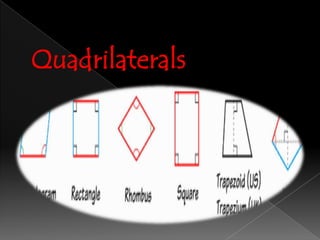
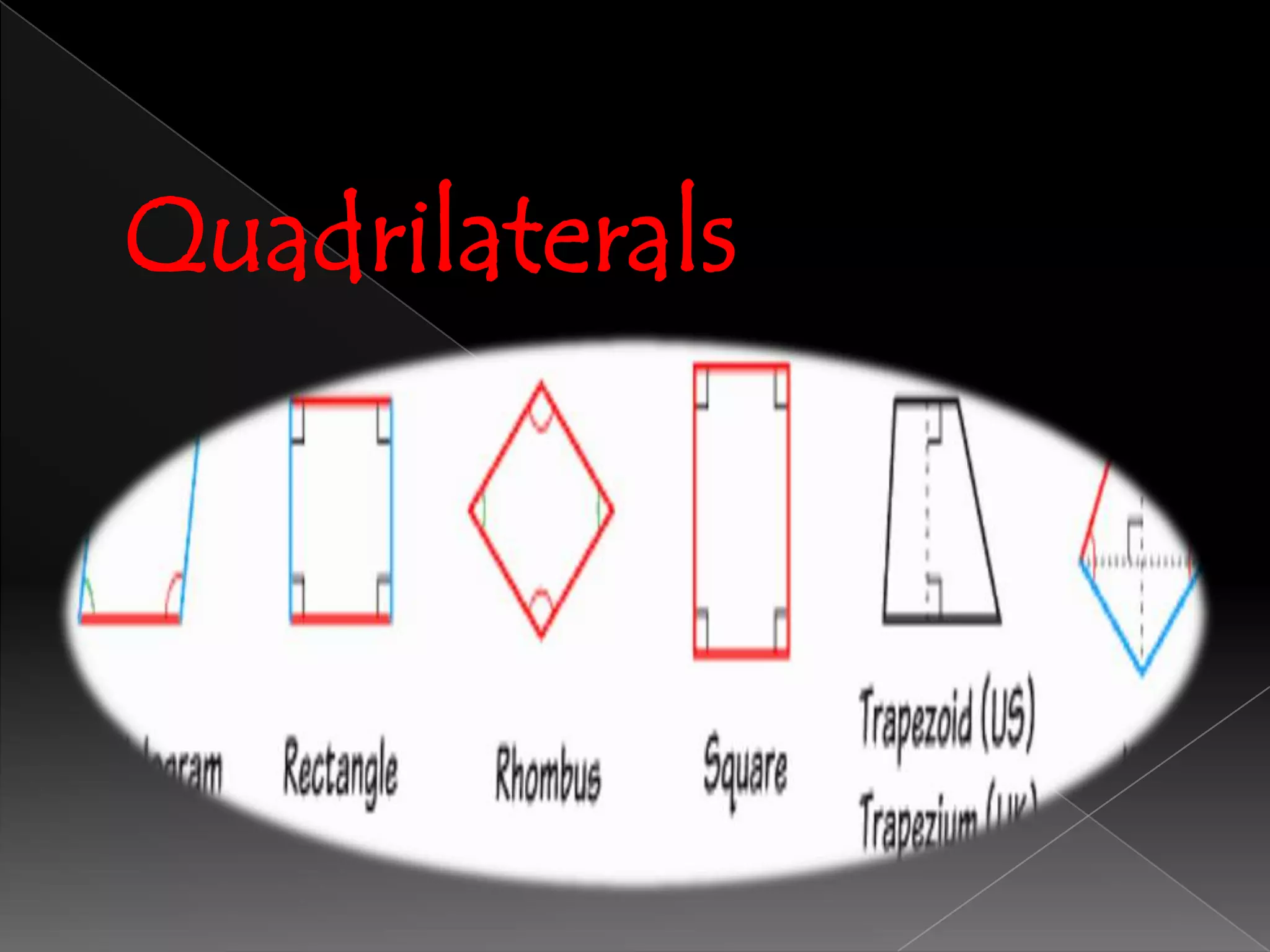
Quadrilaterals
Quadrilaterals
Warm Up
Problem of the Day
Lesson Presentation
Warm Up
Identify the triangle based on the given
measurements.
1. 3 ft, 4 ft, 6 ft
2. 46°, 90°, 44°
3. 7 in., 7 in., 10 in.
scalene
right
isosceles
Problem of the Day
One angle of a parallelogram measures
90°. What are the measures of the other
angles?
all 90°
Learn to name and identify
types of quadrilaterals.
Some quadrilaterals have
properties that classify them as special
quadrilaterals.
Quadrilateral just means "four sides"
(quad means four, lateral means side).
Any four-sided shape is a Quadrilateral.
But the sides have to be straight, and it has to
be 2-dimensional.
1.Parallelogram Properties
Quadrilateral classification:
Quadrilaterals are classified according to the
number of pairs of each parallel sides.
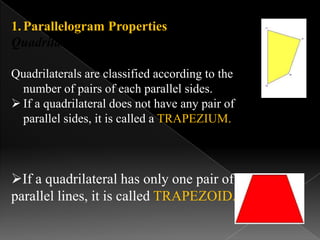
 If a quadrilateral does not have any pair of
parallel sides, it is called a TRAPEZIUM.
If a quadrilateral has only one pair of
parallel lines, it is called TRAPEZOID.
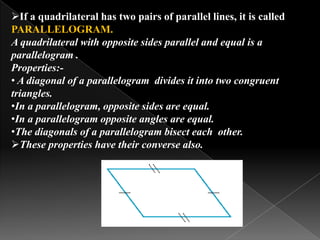
If a quadrilateral has two pairs of parallel lines, it is called
PARALLELOGRAM.
A quadrilateral with opposite sides parallel and equal is a
parallelogram .
Properties:-
• A diagonal of a parallelogram divides it into two congruent
triangles.
•In a parallelogram, opposite sides are equal.
•In a parallelogram opposite angles are equal.
•The diagonals of a parallelogram bisect each other.
These properties have their converse also.
Special Parallelograms
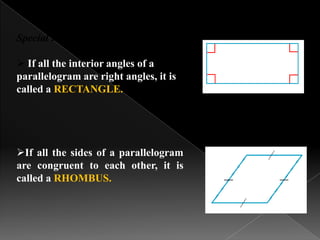
 If all the interior angles of a
parallelogram are right angles, it is
called a RECTANGLE.
If all the sides of a parallelogram
are congruent to each other, it is
called a RHOMBUS.
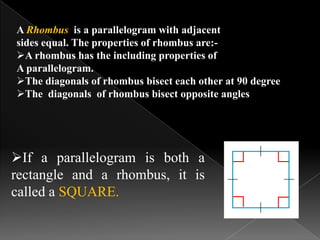
If a parallelogram is both a
rectangle and a rhombus, it is
called a SQUARE.
A Rhombus is a parallelogram with adjacent
sides equal. The properties of rhombus are:-
A rhombus has the including properties of
A parallelogram.
The diagonals of rhombus bisect each other at 90 degree
The diagonals of rhombus bisect opposite angles
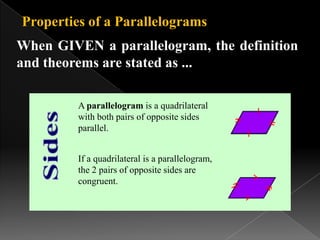
Properties of a Parallelograms
When GIVEN a parallelogram, the definition
and theorems are stated as ...
A parallelogram is a quadrilateral
with both pairs of opposite sides
parallel.
If a quadrilateral is a parallelogram,
the 2 pairs of opposite sides are
congruent.
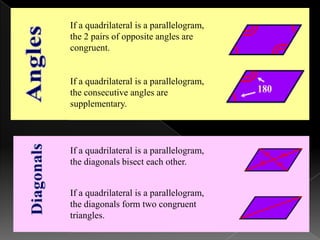
If a quadrilateral is a parallelogram,
the 2 pairs of opposite angles are
congruent.
If a quadrilateral is a parallelogram,
the consecutive angles are
supplementary.
If a quadrilateral is a parallelogram,
the diagonals bisect each other.
If a quadrilateral is a parallelogram,
the diagonals form two congruent
triangles.
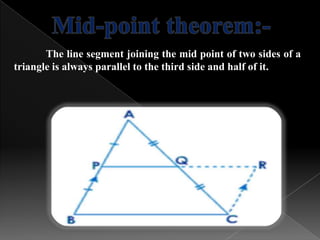
The line segment joining the mid point of two sides of a
triangle is always parallel to the third side and half of it.
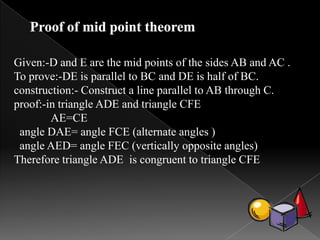
Given:-D and E are the mid points of the sides AB and AC .
To prove:-DE is parallel to BC and DE is half of BC.
construction:- Construct a line parallel to AB through C.
proof:-in triangle ADE and triangle CFE
AE=CE
angle DAE= angle FCE (alternate angles )
angle AED= angle FEC (vertically opposite angles)
Therefore triangle ADE is congruent to triangle CFE
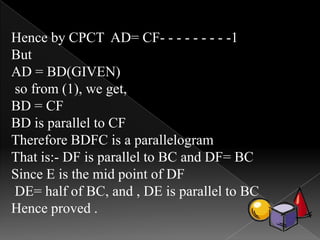
Hence by CPCT AD= CF- - - - - - - - -1
But
AD = BD(GIVEN)
so from (1), we get,
BD = CF
BD is parallel to CF
Therefore BDFC is a parallelogram
That is:- DF is parallel to BC and DF= BC
Since E is the mid point of DF
DE= half of BC, and , DE is parallel to BC
Hence proved .
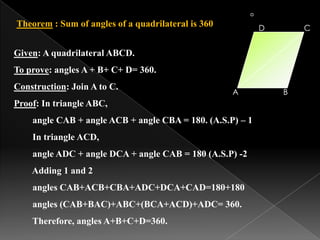
Theorem : Sum of angles of a quadrilateral is 360
Given: A quadrilateral ABCD.
To prove: angles A + B+ C+ D= 360.
Construction: Join A to C.
Proof: In triangle ABC,
angle CAB + angle ACB + angle CBA = 180. (A.S.P) – 1
In triangle ACD,
angle ADC + angle DCA + angle CAB = 180 (A.S.P) -2
Adding 1 and 2
angles CAB+ACB+CBA+ADC+DCA+CAD=180+180
angles (CAB+BAC)+ABC+(BCA+ACD)+ADC= 360.
Therefore, angles A+B+C+D=360.
A B
CD
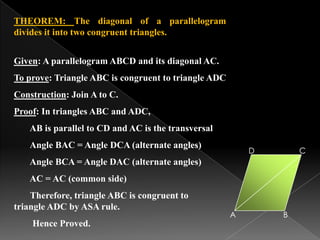
THEOREM: The diagonal of a parallelogram
divides it into two congruent triangles.
Given: A parallelogram ABCD and its diagonal AC.
To prove: Triangle ABC is congruent to triangle ADC
Construction: Join A to C.
Proof: In triangles ABC and ADC,
AB is parallel to CD and AC is the transversal
Angle BAC = Angle DCA (alternate angles)
Angle BCA = Angle DAC (alternate angles)
AC = AC (common side)
Therefore, triangle ABC is congruent to
triangle ADC by ASA rule.
Hence Proved.
A B
CD
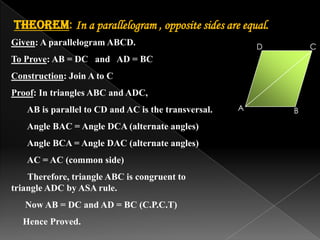
THEOREM: In a parallelogram , opposite sides are equal.
D
A B
C
Given: A parallelogram ABCD.
To Prove: AB = DC and AD = BC
Construction: Join A to C
Proof: In triangles ABC and ADC,
AB is parallel to CD and AC is the transversal.
Angle BAC = Angle DCA (alternate angles)
Angle BCA = Angle DAC (alternate angles)
AC = AC (common side)
Therefore, triangle ABC is congruent to
triangle ADC by ASA rule.
Now AB = DC and AD = BC (C.P.C.T)
Hence Proved.
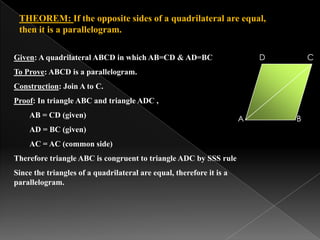
THEOREM: If the opposite sides of a quadrilateral are equal,
then it is a parallelogram.
A B
CDGiven: A quadrilateral ABCD in which AB=CD & AD=BC
To Prove: ABCD is a parallelogram.
Construction: Join A to C.
Proof: In triangle ABC and triangle ADC ,
AB = CD (given)
AD = BC (given)
AC = AC (common side)
Therefore triangle ABC is congruent to triangle ADC by SSS rule
Since the triangles of a quadrilateral are equal, therefore it is a
parallelogram.
B
C
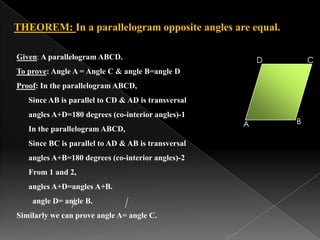
THEOREM: In a parallelogram opposite angles are equal.
A
DGiven: A parallelogram ABCD.
To prove: Angle A = Angle C & angle B=angle D
Proof: In the parallelogram ABCD,
Since AB is parallel to CD & AD is transversal
angles A+D=180 degrees (co-interior angles)-1
In the parallelogram ABCD,
Since BC is parallel to AD & AB is transversal
angles A+B=180 degrees (co-interior angles)-2
From 1 and 2,
angles A+D=angles A+B.
angle D= angle B.
Similarly we can prove angle A= angle C.
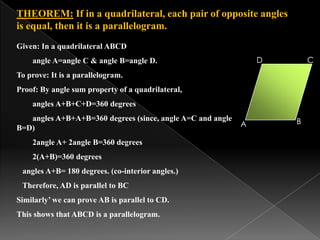
THEOREM: If in a quadrilateral, each pair of opposite angles
is equal, then it is a parallelogram.
B
CD
A
Given: In a quadrilateral ABCD
angle A=angle C & angle B=angle D.
To prove: It is a parallelogram.
Proof: By angle sum property of a quadrilateral,
angles A+B+C+D=360 degrees
angles A+B+A+B=360 degrees (since, angle A=C and angle
B=D)
2angle A+ 2angle B=360 degrees
2(A+B)=360 degrees
angles A+B= 180 degrees. (co-interior angles.)
Therefore, AD is parallel to BC
Similarly’ we can prove AB is parallel to CD.
This shows that ABCD is a parallelogram.
THEOREM: The diagonals of a parallelogram bisect each
other.
B
CD
A
O
Given: A parallelogram ABCD
To prove: AO= OC & BO= OD.
Proof: AD is parallel to BC & BD is transversal.
angles CBD= ADB (alternate angles)
AB is parallel to CD & AC is transversal.
angles DAC= ACB (alternate angles)
Now, in triangles BOC and AOD,
CBD=ADB
DAC=ACB
BC=AD (opposite sides of a parallelogram)
Therefore, triangle BOC is congruent to triangle AOD by ASA rule.
Therefore, AO=OC & BO=OD [C.P.C.T]
This implies that diagonals of a parallelogram bisect each other.
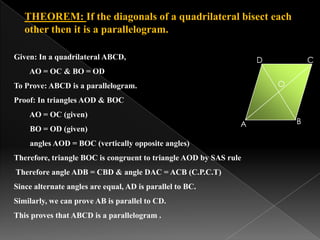
THEOREM: If the diagonals of a quadrilateral bisect each
other then it is a parallelogram.
B
CD
A
O
Given: In a quadrilateral ABCD,
AO = OC & BO = OD
To Prove: ABCD is a parallelogram.
Proof: In triangles AOD & BOC
AO = OC (given)
BO = OD (given)
angles AOD = BOC (vertically opposite angles)
Therefore, triangle BOC is congruent to triangle AOD by SAS rule
Therefore angle ADB = CBD & angle DAC = ACB (C.P.C.T)
Since alternate angles are equal, AD is parallel to BC.
Similarly, we can prove AB is parallel to CD.
This proves that ABCD is a parallelogram .
THEOREM: A quadrilateral is a parallelogram if a pair of
opposite sides is equal and parallel.
B
CD
A
Given: In a quadrilateral ABCD,
AB is parallel to CD AB = CD
To prove: ABCD is a parallelogram.
Construction: Join A to C.
Proof: In triangles ABC & ADC,
AB = CD ( given)
angle BAC = angle DCA (alternate angles.)
AC= AC ( common)
Therefore, triangle ABC is congruent to triangle ADC by SAS rule.
Therefore, angle ACB=DAC and AD=BC [C.P.C.T]
Since, AD is parallel to BC and AD=BC,ABCD is a parallelogram.
THEOREM: The line segment joining the mid-points of two
sides of a triangle is parallel to the third side.
Given: A triangle ABC in which D and E are the mid- points
of AB and Ac respectively.
To prove: DE is parallel to BC & DE=1/2BC
Proof: In triangles AED and CEF
AE = CE (given)
ED = EF (construction)
angle AED = angle CEF (vertically opposite angles)
Therefore, triangle AED is congruent to triangle CEF
by SAS rule.
Thus, AD=CF [ C.P.C.T]
angle ADE = angle CFE [C.P.C.T]
C
A
B
D
E
F
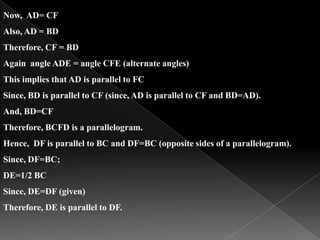
Now, AD= CF
Also, AD = BD
Therefore, CF = BD
Again angle ADE = angle CFE (alternate angles)
This implies that AD is parallel to FC
Since, BD is parallel to CF (since, AD is parallel to CF and BD=AD).
And, BD=CF
Therefore, BCFD is a parallelogram.
Hence, DF is parallel to BC and DF=BC (opposite sides of a parallelogram).
Since, DF=BC;
DE=1/2 BC
Since, DE=DF (given)
Therefore, DE is parallel to DF.
A
B C
D
F
1
2
3
4
l
M
A
E
Given: E is the mid- point of AB, line ‘l’ is passing through
E and is parallel to BC and CM is parallel to BA.
To prove: AF=CF
Proof: Since, Cm is parallel to BA and EFD is parallel to
BC, therefore BEDC is a parallelogram.
BE= CD( opposite sides of a parallelogram)
But, BE = AE, therefore AE=CD.
In triangles AEF & CDF: angle 1=2 (alt.angles)
angle 3=4 (alt.angles)
AE=CD (proved)
Therefore, triangle AEF is congruent to CDF(ASA)
AF=CF [C.P.C.T]. Hence, proved.
THEOREM: The line drawn through the mid-point of one side of a
triangle, parallel to another side bisects the third side.
Submitted by: Alma Buisan
Submitted to: Ms. Charine Masilang

quadrilateral

  • 1.
  • 2.
    Quadrilaterals Warm Up Problem ofthe Day Lesson Presentation
  • 3.
    Warm Up Identify thetriangle based on the given measurements. 1. 3 ft, 4 ft, 6 ft 2. 46°, 90°, 44° 3. 7 in., 7 in., 10 in. scalene right isosceles
  • 4.
    Problem of theDay One angle of a parallelogram measures 90°. What are the measures of the other angles? all 90°
  • 5.
    Learn to nameand identify types of quadrilaterals.
  • 6.
    Some quadrilaterals have propertiesthat classify them as special quadrilaterals. Quadrilateral just means "four sides" (quad means four, lateral means side). Any four-sided shape is a Quadrilateral. But the sides have to be straight, and it has to be 2-dimensional.
  • 7.
    1.Parallelogram Properties Quadrilateral classification: Quadrilateralsare classified according to the number of pairs of each parallel sides.  If a quadrilateral does not have any pair of parallel sides, it is called a TRAPEZIUM. If a quadrilateral has only one pair of parallel lines, it is called TRAPEZOID.
  • 8.
    If a quadrilateralhas two pairs of parallel lines, it is called PARALLELOGRAM. A quadrilateral with opposite sides parallel and equal is a parallelogram . Properties:- • A diagonal of a parallelogram divides it into two congruent triangles. •In a parallelogram, opposite sides are equal. •In a parallelogram opposite angles are equal. •The diagonals of a parallelogram bisect each other. These properties have their converse also.
  • 9.
    Special Parallelograms  Ifall the interior angles of a parallelogram are right angles, it is called a RECTANGLE. If all the sides of a parallelogram are congruent to each other, it is called a RHOMBUS.
  • 10.
    If a parallelogramis both a rectangle and a rhombus, it is called a SQUARE. A Rhombus is a parallelogram with adjacent sides equal. The properties of rhombus are:- A rhombus has the including properties of A parallelogram. The diagonals of rhombus bisect each other at 90 degree The diagonals of rhombus bisect opposite angles
  • 11.
    Properties of aParallelograms When GIVEN a parallelogram, the definition and theorems are stated as ... A parallelogram is a quadrilateral with both pairs of opposite sides parallel. If a quadrilateral is a parallelogram, the 2 pairs of opposite sides are congruent.
  • 12.
    If a quadrilateralis a parallelogram, the 2 pairs of opposite angles are congruent. If a quadrilateral is a parallelogram, the consecutive angles are supplementary. If a quadrilateral is a parallelogram, the diagonals bisect each other. If a quadrilateral is a parallelogram, the diagonals form two congruent triangles.
  • 13.
    The line segmentjoining the mid point of two sides of a triangle is always parallel to the third side and half of it.
  • 14.
    Given:-D and Eare the mid points of the sides AB and AC . To prove:-DE is parallel to BC and DE is half of BC. construction:- Construct a line parallel to AB through C. proof:-in triangle ADE and triangle CFE AE=CE angle DAE= angle FCE (alternate angles ) angle AED= angle FEC (vertically opposite angles) Therefore triangle ADE is congruent to triangle CFE
  • 15.
    Hence by CPCTAD= CF- - - - - - - - -1 But AD = BD(GIVEN) so from (1), we get, BD = CF BD is parallel to CF Therefore BDFC is a parallelogram That is:- DF is parallel to BC and DF= BC Since E is the mid point of DF DE= half of BC, and , DE is parallel to BC Hence proved .
  • 16.
    Theorem : Sumof angles of a quadrilateral is 360 Given: A quadrilateral ABCD. To prove: angles A + B+ C+ D= 360. Construction: Join A to C. Proof: In triangle ABC, angle CAB + angle ACB + angle CBA = 180. (A.S.P) – 1 In triangle ACD, angle ADC + angle DCA + angle CAB = 180 (A.S.P) -2 Adding 1 and 2 angles CAB+ACB+CBA+ADC+DCA+CAD=180+180 angles (CAB+BAC)+ABC+(BCA+ACD)+ADC= 360. Therefore, angles A+B+C+D=360. A B CD
  • 17.
    THEOREM: The diagonalof a parallelogram divides it into two congruent triangles. Given: A parallelogram ABCD and its diagonal AC. To prove: Triangle ABC is congruent to triangle ADC Construction: Join A to C. Proof: In triangles ABC and ADC, AB is parallel to CD and AC is the transversal Angle BAC = Angle DCA (alternate angles) Angle BCA = Angle DAC (alternate angles) AC = AC (common side) Therefore, triangle ABC is congruent to triangle ADC by ASA rule. Hence Proved. A B CD
  • 18.
    THEOREM: In aparallelogram , opposite sides are equal. D A B C Given: A parallelogram ABCD. To Prove: AB = DC and AD = BC Construction: Join A to C Proof: In triangles ABC and ADC, AB is parallel to CD and AC is the transversal. Angle BAC = Angle DCA (alternate angles) Angle BCA = Angle DAC (alternate angles) AC = AC (common side) Therefore, triangle ABC is congruent to triangle ADC by ASA rule. Now AB = DC and AD = BC (C.P.C.T) Hence Proved.
  • 19.
    THEOREM: If theopposite sides of a quadrilateral are equal, then it is a parallelogram. A B CDGiven: A quadrilateral ABCD in which AB=CD & AD=BC To Prove: ABCD is a parallelogram. Construction: Join A to C. Proof: In triangle ABC and triangle ADC , AB = CD (given) AD = BC (given) AC = AC (common side) Therefore triangle ABC is congruent to triangle ADC by SSS rule Since the triangles of a quadrilateral are equal, therefore it is a parallelogram.
  • 20.
    B C THEOREM: In aparallelogram opposite angles are equal. A DGiven: A parallelogram ABCD. To prove: Angle A = Angle C & angle B=angle D Proof: In the parallelogram ABCD, Since AB is parallel to CD & AD is transversal angles A+D=180 degrees (co-interior angles)-1 In the parallelogram ABCD, Since BC is parallel to AD & AB is transversal angles A+B=180 degrees (co-interior angles)-2 From 1 and 2, angles A+D=angles A+B. angle D= angle B. Similarly we can prove angle A= angle C.
  • 21.
    THEOREM: If ina quadrilateral, each pair of opposite angles is equal, then it is a parallelogram. B CD A Given: In a quadrilateral ABCD angle A=angle C & angle B=angle D. To prove: It is a parallelogram. Proof: By angle sum property of a quadrilateral, angles A+B+C+D=360 degrees angles A+B+A+B=360 degrees (since, angle A=C and angle B=D) 2angle A+ 2angle B=360 degrees 2(A+B)=360 degrees angles A+B= 180 degrees. (co-interior angles.) Therefore, AD is parallel to BC Similarly’ we can prove AB is parallel to CD. This shows that ABCD is a parallelogram.
  • 22.
    THEOREM: The diagonalsof a parallelogram bisect each other. B CD A O Given: A parallelogram ABCD To prove: AO= OC & BO= OD. Proof: AD is parallel to BC & BD is transversal. angles CBD= ADB (alternate angles) AB is parallel to CD & AC is transversal. angles DAC= ACB (alternate angles) Now, in triangles BOC and AOD, CBD=ADB DAC=ACB BC=AD (opposite sides of a parallelogram) Therefore, triangle BOC is congruent to triangle AOD by ASA rule. Therefore, AO=OC & BO=OD [C.P.C.T] This implies that diagonals of a parallelogram bisect each other.
  • 23.
    THEOREM: If thediagonals of a quadrilateral bisect each other then it is a parallelogram. B CD A O Given: In a quadrilateral ABCD, AO = OC & BO = OD To Prove: ABCD is a parallelogram. Proof: In triangles AOD & BOC AO = OC (given) BO = OD (given) angles AOD = BOC (vertically opposite angles) Therefore, triangle BOC is congruent to triangle AOD by SAS rule Therefore angle ADB = CBD & angle DAC = ACB (C.P.C.T) Since alternate angles are equal, AD is parallel to BC. Similarly, we can prove AB is parallel to CD. This proves that ABCD is a parallelogram .
  • 24.
    THEOREM: A quadrilateralis a parallelogram if a pair of opposite sides is equal and parallel. B CD A Given: In a quadrilateral ABCD, AB is parallel to CD AB = CD To prove: ABCD is a parallelogram. Construction: Join A to C. Proof: In triangles ABC & ADC, AB = CD ( given) angle BAC = angle DCA (alternate angles.) AC= AC ( common) Therefore, triangle ABC is congruent to triangle ADC by SAS rule. Therefore, angle ACB=DAC and AD=BC [C.P.C.T] Since, AD is parallel to BC and AD=BC,ABCD is a parallelogram.
  • 25.
    THEOREM: The linesegment joining the mid-points of two sides of a triangle is parallel to the third side. Given: A triangle ABC in which D and E are the mid- points of AB and Ac respectively. To prove: DE is parallel to BC & DE=1/2BC Proof: In triangles AED and CEF AE = CE (given) ED = EF (construction) angle AED = angle CEF (vertically opposite angles) Therefore, triangle AED is congruent to triangle CEF by SAS rule. Thus, AD=CF [ C.P.C.T] angle ADE = angle CFE [C.P.C.T] C A B D E F
  • 26.
    Now, AD= CF Also,AD = BD Therefore, CF = BD Again angle ADE = angle CFE (alternate angles) This implies that AD is parallel to FC Since, BD is parallel to CF (since, AD is parallel to CF and BD=AD). And, BD=CF Therefore, BCFD is a parallelogram. Hence, DF is parallel to BC and DF=BC (opposite sides of a parallelogram). Since, DF=BC; DE=1/2 BC Since, DE=DF (given) Therefore, DE is parallel to DF.
  • 27.
    A B C D F 1 2 3 4 l M A E Given: Eis the mid- point of AB, line ‘l’ is passing through E and is parallel to BC and CM is parallel to BA. To prove: AF=CF Proof: Since, Cm is parallel to BA and EFD is parallel to BC, therefore BEDC is a parallelogram. BE= CD( opposite sides of a parallelogram) But, BE = AE, therefore AE=CD. In triangles AEF & CDF: angle 1=2 (alt.angles) angle 3=4 (alt.angles) AE=CD (proved) Therefore, triangle AEF is congruent to CDF(ASA) AF=CF [C.P.C.T]. Hence, proved. THEOREM: The line drawn through the mid-point of one side of a triangle, parallel to another side bisects the third side.
  • 28.
    Submitted by: AlmaBuisan Submitted to: Ms. Charine Masilang