Root Cause Analysis
Overview
Performance & Productivity Improvement
AgendaAgenda
• Root Cause Analysis Definition
• The Root Cause Analysis Method & Tools
• How Do We Perform Root Cause Analysis?
• Other Quality Improvement Process Tools
• When do we perform RCA?
• References
Definition of Root Cause AnalysisDefinition of Root Cause Analysis
• The objective of this process is to determine
the true cause of a problem. It is one of the
most vital functions we can perform to improve
service excellence for our clients because it
helps to prevent problems from occurring
again.
• Everyone in the Organization needs to
understand the purpose of root cause analysis
and should be able to perform the related
procedures.
The Root Cause Analysis Method & Tools
The Method is based on determine
what has happened during an
occurrence/ incident, how it did
happen, and why it did happen. The
method includes:
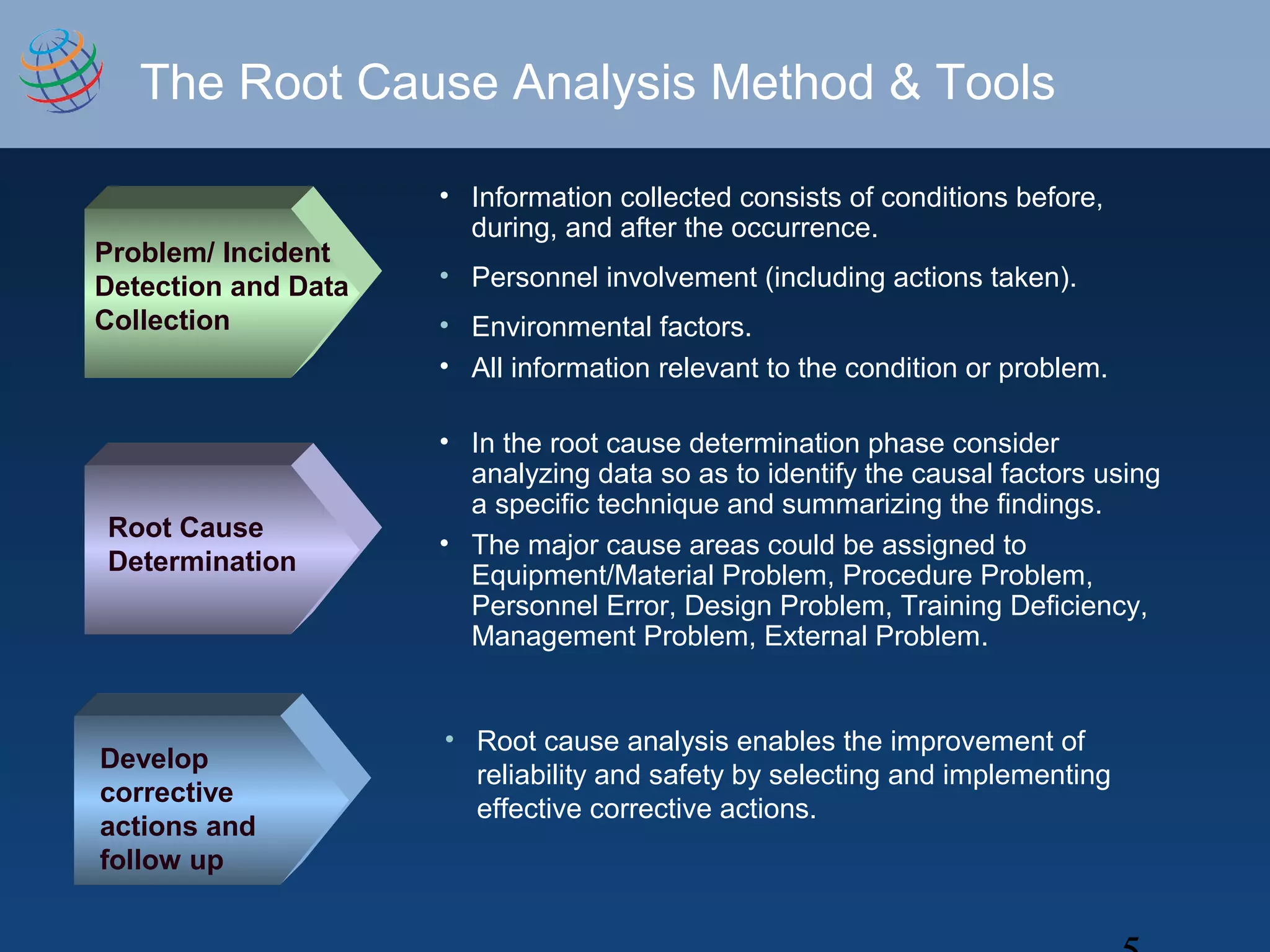
1. Problem/ Incident Detection and Data
Collection.
2. Root Cause Determination.
3. Development of corrective actions
and follow up
• Information collected consists of conditions before,
during, and after the occurrence.
• Personnel involvement (including actions taken).
• Environmental factors.
• All information relevant to the condition or problem.
Problem/ Incident
Detection and Data
Collection
Root Cause
Determination
Develop
corrective
actions and
follow up
The Root Cause Analysis Method & Tools
• In the root cause determination phase consider
analyzing data so as to identify the causal factors using
a specific technique and summarizing the findings.
• The major cause areas could be assigned to
Equipment/Material Problem, Procedure Problem,
Personnel Error, Design Problem, Training Deficiency,
Management Problem, External Problem.
• Root cause analysis enables the improvement of
reliability and safety by selecting and implementing
effective corrective actions.
How Do We Perform Root Cause Analysis?
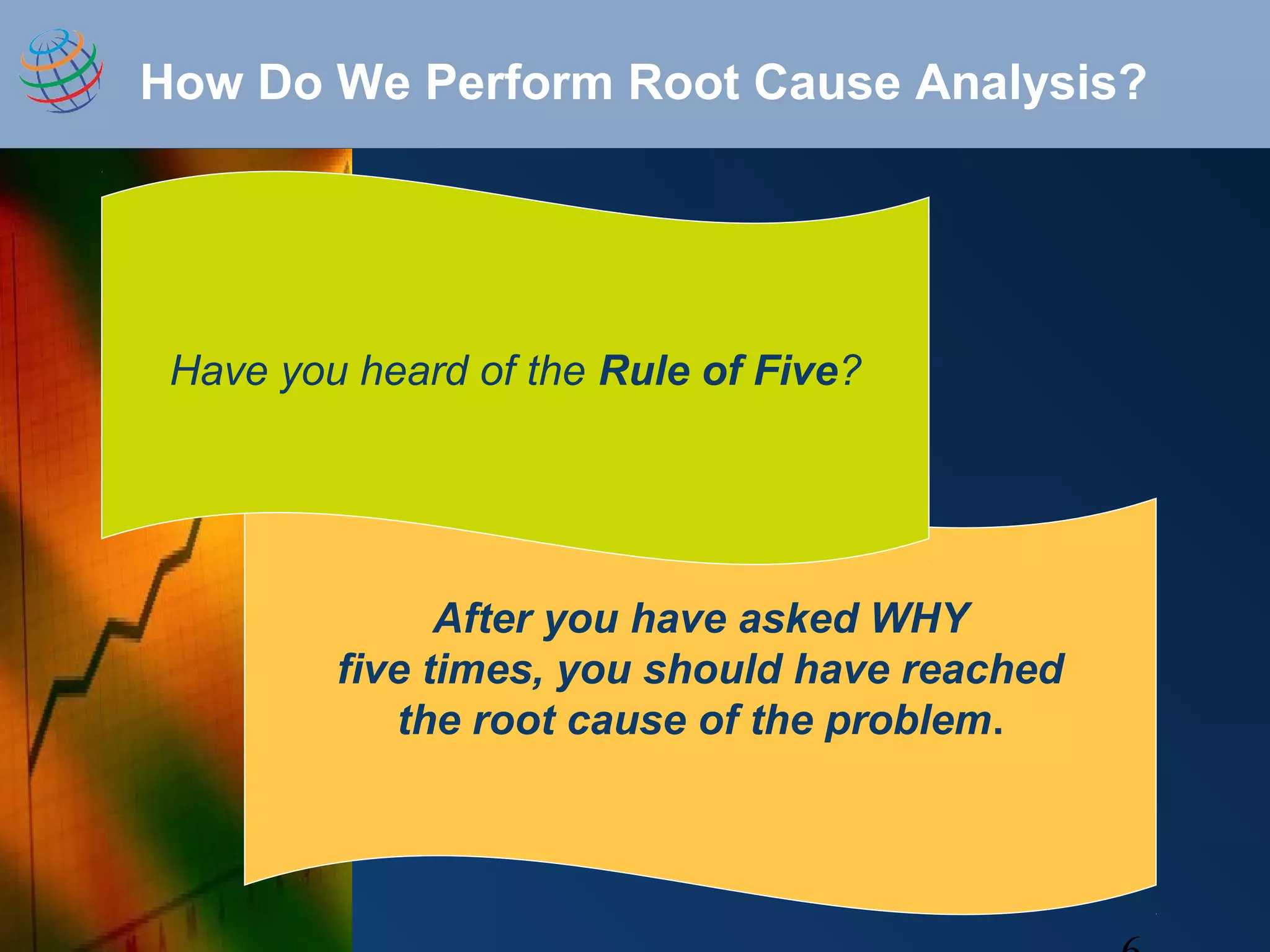
After you have asked WHY
five times, you should have reached
the root cause of the problem.
Have you heard of the Rule of Five?
How Do We Perform Root Cause Analysis?
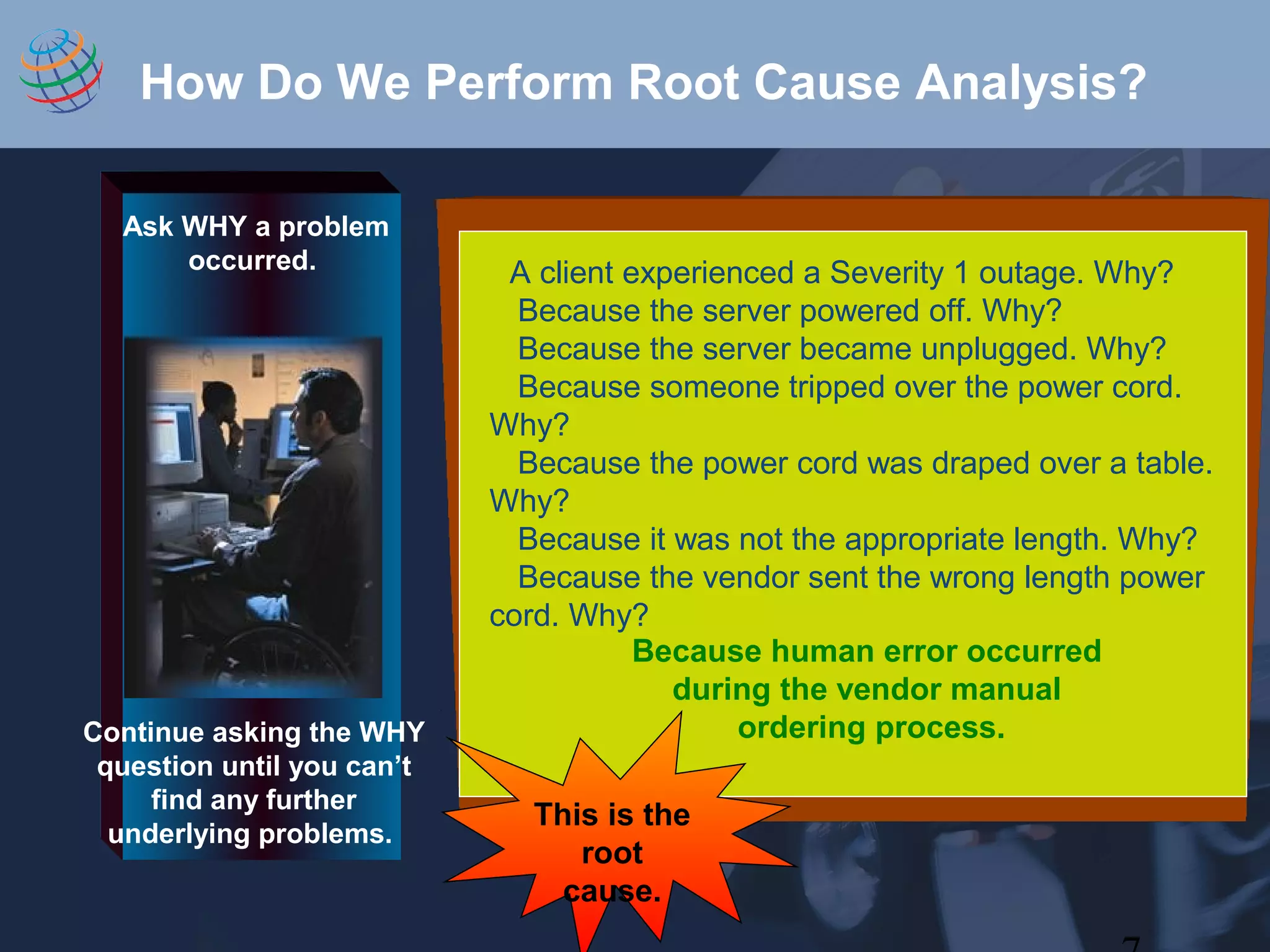
Continue asking the WHY
question until you can’t
find any further
underlying problems.
Ask WHY a problem
occurred. A client experienced a Severity 1 outage. Why?
Because the server powered off. Why?
Because the server became unplugged. Why?
Because someone tripped over the power cord.
Why?
Because the power cord was draped over a table.
Why?
Because it was not the appropriate length. Why?
Because the vendor sent the wrong length power
cord. Why?
Because human error occurred
during the vendor manual
ordering process.
This is the
root
cause.
Other Quality improvement process tools
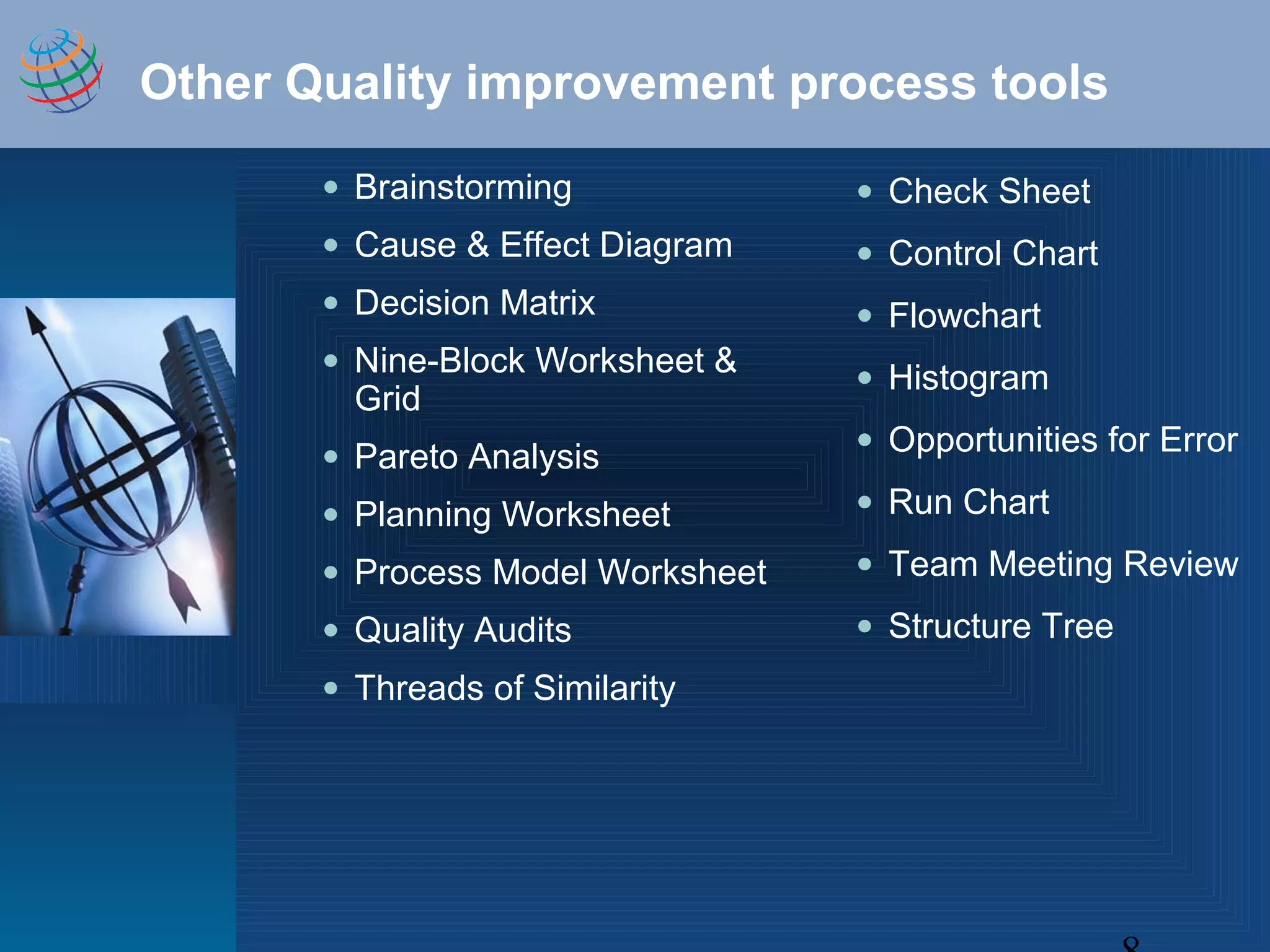
• Brainstorming
• Cause & Effect Diagram
• Decision Matrix
• Nine-Block Worksheet &
Grid
• Pareto Analysis
• Planning Worksheet
• Process Model Worksheet
• Quality Audits
• Threads of Similarity
• Check Sheet
• Control Chart
• Flowchart
• Histogram
• Opportunities for Error
• Run Chart
• Team Meeting Review
• Structure Tree
When Do We Perform Root Cause Analysis?
• Identify Root Cause Analysis will be
performed based on, but not limited to:
• History of common set of symptoms
(threads of similarity.)
• Problem escalated to Senior Management
and/or Customer Management.
• Root causes compared to existing
requests to determine if association is
possible.
• Identification of preventive actions that
could be useful to implement ongoing
preventive maintenance (i.e. equipment
maintenance) or to propagate corrective
action solution to other environments.
When chronic problems occur, the organization will work with all
related parties to identify causes and possible resolutions.
If not resolved in a timely fashion, the project will
escalate the issue until the problem is resolved.
If the chronic problem cannot be resolved, the project
will work with CLIENT to determine appropriate steps.
Root cause analysis is required for severity 1, 2 and 3 problems
and for nonconformance records (CARs), which must be
evaluated every month.
Severity 3 and 4 problems should be considered and evaluated
every 6 months.
When Do We Perform Root Cause Analysis?
References
– http://www.dcmc.hq.dla.mil/teaminfo/aqbd/99plan/METRICS/root.htm
– http://www.philipcrosby.com/qualitystore/cdrom.details/cd.
problemsolving.htm
– http://tis.eh.doe.gov/techstds/standard/nst1004/nst1004.pdf

Root cause analysis arg sc

  • 1.
    Root Cause Analysis Overview Performance& Productivity Improvement
  • 2.
    AgendaAgenda • Root CauseAnalysis Definition • The Root Cause Analysis Method & Tools • How Do We Perform Root Cause Analysis? • Other Quality Improvement Process Tools • When do we perform RCA? • References
  • 3.
    Definition of RootCause AnalysisDefinition of Root Cause Analysis • The objective of this process is to determine the true cause of a problem. It is one of the most vital functions we can perform to improve service excellence for our clients because it helps to prevent problems from occurring again. • Everyone in the Organization needs to understand the purpose of root cause analysis and should be able to perform the related procedures.
  • 4.
    The Root CauseAnalysis Method & Tools The Method is based on determine what has happened during an occurrence/ incident, how it did happen, and why it did happen. The method includes: 1. Problem/ Incident Detection and Data Collection. 2. Root Cause Determination. 3. Development of corrective actions and follow up
  • 5.
    • Information collectedconsists of conditions before, during, and after the occurrence. • Personnel involvement (including actions taken). • Environmental factors. • All information relevant to the condition or problem. Problem/ Incident Detection and Data Collection Root Cause Determination Develop corrective actions and follow up The Root Cause Analysis Method & Tools • In the root cause determination phase consider analyzing data so as to identify the causal factors using a specific technique and summarizing the findings. • The major cause areas could be assigned to Equipment/Material Problem, Procedure Problem, Personnel Error, Design Problem, Training Deficiency, Management Problem, External Problem. • Root cause analysis enables the improvement of reliability and safety by selecting and implementing effective corrective actions.
  • 6.
    How Do WePerform Root Cause Analysis? After you have asked WHY five times, you should have reached the root cause of the problem. Have you heard of the Rule of Five?
  • 7.
    How Do WePerform Root Cause Analysis? Continue asking the WHY question until you can’t find any further underlying problems. Ask WHY a problem occurred. A client experienced a Severity 1 outage. Why? Because the server powered off. Why? Because the server became unplugged. Why? Because someone tripped over the power cord. Why? Because the power cord was draped over a table. Why? Because it was not the appropriate length. Why? Because the vendor sent the wrong length power cord. Why? Because human error occurred during the vendor manual ordering process. This is the root cause.
  • 8.
    Other Quality improvementprocess tools • Brainstorming • Cause & Effect Diagram • Decision Matrix • Nine-Block Worksheet & Grid • Pareto Analysis • Planning Worksheet • Process Model Worksheet • Quality Audits • Threads of Similarity • Check Sheet • Control Chart • Flowchart • Histogram • Opportunities for Error • Run Chart • Team Meeting Review • Structure Tree
  • 9.
    When Do WePerform Root Cause Analysis? • Identify Root Cause Analysis will be performed based on, but not limited to: • History of common set of symptoms (threads of similarity.) • Problem escalated to Senior Management and/or Customer Management. • Root causes compared to existing requests to determine if association is possible. • Identification of preventive actions that could be useful to implement ongoing preventive maintenance (i.e. equipment maintenance) or to propagate corrective action solution to other environments.
  • 10.
    When chronic problemsoccur, the organization will work with all related parties to identify causes and possible resolutions. If not resolved in a timely fashion, the project will escalate the issue until the problem is resolved. If the chronic problem cannot be resolved, the project will work with CLIENT to determine appropriate steps. Root cause analysis is required for severity 1, 2 and 3 problems and for nonconformance records (CARs), which must be evaluated every month. Severity 3 and 4 problems should be considered and evaluated every 6 months. When Do We Perform Root Cause Analysis?
  • 11.

Editor's Notes

  • #6 My team is focused on three main areas in 2002. On the technology side, we are setting up a DBA center of excellence by consolidating support to various accounts to leverage skills.This group can be leveraged to support GM. Due to higher cost differentials, the migration of this activity will bring maximum benefit to GPD. Industry Knowledge - Approx 25% FTPs support Financial services and 50%++ support manufacturing applications. We were assessed at CMM Level 3 last year. The gap analysis for Level 4 is complete and team is working on closing these gaps. We oFTPn feel the need for professional testing competency to add value to current projects to improve our efficiencies. We now have a group setup for CBA which is providing Testing Services from remote location. Similar initiatives for UK. There is thrust on metrics collections and analysis as we move to CMM Level 4. We are providing independent SQA for CBA account who reports to CBA
  • #8 <number>
  • #11 CGSCCurrent FTP Additional Count Capacity Cairo SC45105 Chennai SC 541559 Dublin SC222278 Durham SC105 50 eBx SC25 25 London SC34 66 Mexico City SC180120 Northern MX SC227173 Ottawa SC150 50 Prague SC90 40 Quebec SC92 58 Rio de Janeiro SC308142 Sao Paulo SC465235 Sydney SC1039 11 Wellington SC551199 Total40742111