Root
Cause
Analysis
DIGGING DEEPER
Does it happen in your
organization?
❖ You have a problem which gets repeated day after day, and month after
month.
❖ Whatever actions you take, it does not go away.
❖ You have tried training employees, changing the work instructions, but it
does not seem to make a big difference.
❖ There could be two reasons:
▪ You are not taking a Corrective Action
▪ You take it, but it is not effective
Root Cause Analysis
❖ Root Cause Analysis is used to analyze the root cause of a positive or
negative event. The purpose is to take corrective actions to prevent
recurrence of a negative outcome, or to facilitate the recurrence of a
positive outcome.
▪ In reality, it is mainly used for negative events.
❖ It is typically used to analyze:
▪ A quality problem
▪ A failure (product or service)
▪ A safety incidence
Root Cause Analysis
❖ Most common approaches for the Root Cause Analysis are:
▪ Five Whys
▪ Fishbone Diagram
▪ A3 Problem Solving
▪ 8D (Eight Disciplines)
❖ Root Cause Analysis is a part of the bigger theme: “Problem Solving”
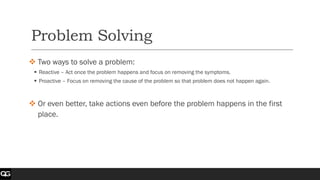
Problem Solving
❖ Two ways to solve a problem:
▪ Reactive – Act once the problem happens and focus on removing the symptoms.
▪ Proactive – Focus on removing the cause of the problem so that problem does not happen again.
❖ Or even better, take actions even before the problem happens in the first
place.
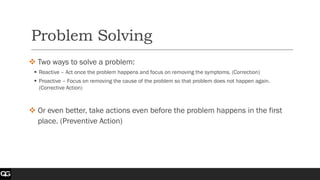
Problem Solving
❖ Two ways to solve a problem:
▪ Reactive – Act once the problem happens and focus on removing the symptoms. (Correction)
▪ Proactive – Focus on removing the cause of the problem so that problem does not happen again.
(Corrective Action)
❖ Or even better, take actions even before the problem happens in the first
place. (Preventive Action)
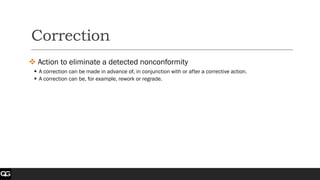
Correction
❖ Action to eliminate a detected nonconformity
▪ A correction can be made in advance of, in conjunction with or after a corrective action.
▪ A correction can be, for example, rework or regrade.
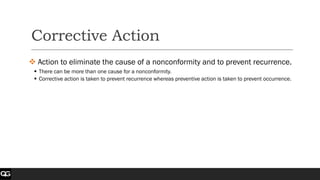
Corrective Action
❖ Action to eliminate the cause of a nonconformity and to prevent recurrence.
▪ There can be more than one cause for a nonconformity.
▪ Corrective action is taken to prevent recurrence whereas preventive action is taken to prevent occurrence.
Preventive Action
❖ Action to eliminate the cause of a potential nonconformity or other potential
undesirable situation
▪ There can be more than one cause for a potential nonconformity.
▪ Preventive action is taken to prevent occurrence whereas corrective action is taken to prevent recurrence.
Root Cause
❖ Cause and Effect relationship
❖ What is a root cause?
▪ A cause if corrected with prevent the recurrence of a problem.
▪ It will also prevent the occurrence of similar problems.
▪ It is the most basic reason of the problem that can be logically identified and corrected
▪ There could be multiple root causes of a problem
❖ A causal factor is one that affects an event's outcome but is not the root
cause.
▪ It might remove or reduce the problem but will not help in avoiding the problem from happening again.
▪ Causal factors are also called contributors or influencers.

root causes analysis

  • 1.
  • 2.
    Does it happenin your organization? ❖ You have a problem which gets repeated day after day, and month after month. ❖ Whatever actions you take, it does not go away. ❖ You have tried training employees, changing the work instructions, but it does not seem to make a big difference. ❖ There could be two reasons: ▪ You are not taking a Corrective Action ▪ You take it, but it is not effective
  • 3.
    Root Cause Analysis ❖Root Cause Analysis is used to analyze the root cause of a positive or negative event. The purpose is to take corrective actions to prevent recurrence of a negative outcome, or to facilitate the recurrence of a positive outcome. ▪ In reality, it is mainly used for negative events. ❖ It is typically used to analyze: ▪ A quality problem ▪ A failure (product or service) ▪ A safety incidence
  • 4.
    Root Cause Analysis ❖Most common approaches for the Root Cause Analysis are: ▪ Five Whys ▪ Fishbone Diagram ▪ A3 Problem Solving ▪ 8D (Eight Disciplines) ❖ Root Cause Analysis is a part of the bigger theme: “Problem Solving”
  • 5.
    Problem Solving ❖ Twoways to solve a problem: ▪ Reactive – Act once the problem happens and focus on removing the symptoms. ▪ Proactive – Focus on removing the cause of the problem so that problem does not happen again. ❖ Or even better, take actions even before the problem happens in the first place.
  • 6.
    Problem Solving ❖ Twoways to solve a problem: ▪ Reactive – Act once the problem happens and focus on removing the symptoms. (Correction) ▪ Proactive – Focus on removing the cause of the problem so that problem does not happen again. (Corrective Action) ❖ Or even better, take actions even before the problem happens in the first place. (Preventive Action)
  • 7.
    Correction ❖ Action toeliminate a detected nonconformity ▪ A correction can be made in advance of, in conjunction with or after a corrective action. ▪ A correction can be, for example, rework or regrade.
  • 8.
    Corrective Action ❖ Actionto eliminate the cause of a nonconformity and to prevent recurrence. ▪ There can be more than one cause for a nonconformity. ▪ Corrective action is taken to prevent recurrence whereas preventive action is taken to prevent occurrence.
  • 9.
    Preventive Action ❖ Actionto eliminate the cause of a potential nonconformity or other potential undesirable situation ▪ There can be more than one cause for a potential nonconformity. ▪ Preventive action is taken to prevent occurrence whereas corrective action is taken to prevent recurrence.
  • 10.
    Root Cause ❖ Causeand Effect relationship ❖ What is a root cause? ▪ A cause if corrected with prevent the recurrence of a problem. ▪ It will also prevent the occurrence of similar problems. ▪ It is the most basic reason of the problem that can be logically identified and corrected ▪ There could be multiple root causes of a problem ❖ A causal factor is one that affects an event's outcome but is not the root cause. ▪ It might remove or reduce the problem but will not help in avoiding the problem from happening again. ▪ Causal factors are also called contributors or influencers.