
innovating for skills……skills for
          innovation

   a New Zealand Paradox?

             Ron Clink
Resilience

 sheds light on capacity to indentify new solutions in every
challenge, but also on the ability to live in situations of rapid
                     or constant change


the human capacity to take a fresh start, no matter the
  conditions, seems to be at the heart of the notion of
                       resilience


             In my work, I used to call it “fail forward”
“success is the ability to go from one failure
   to another with no loss of enthusiasm”

                             Sir Winston Churchill


Let’s consider this in context of Skills and Innovation
the two consistently significant contributors to
     economic growth and living standards in OECD
      countries during the whole period 1870-2006
                                          Jakob B Madsen 2010
                                          Australia/OECD


  educational attainment (...human capital)
                               &
                      innovation intensity
And because we’re NZ….we must do it in scale and with scalability…….to the world
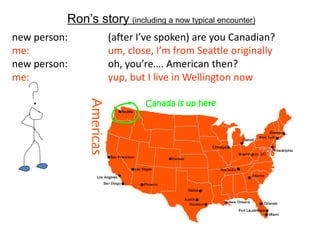
Ron‟s story (including a now typical encounter)
new person:         (after I’ve spoken) are you Canadian?
me:                 um, close, I’m from Seattle originally
new person:         oh, you’re…. American then?
me:                 yup, but I live in Wellington now

                             Canada is up here
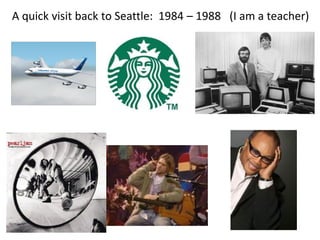
A quick visit back to Seattle: 1984 – 1988 (I am a teacher)
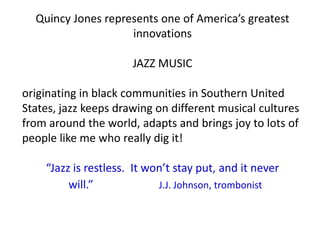
Quincy Jones represents one of America’s greatest
                    innovations

                      JAZZ MUSIC

originating in black communities in Southern United
States, jazz keeps drawing on different musical cultures
from around the world, adapts and brings joy to lots of
people like me who really dig it!

    “Jazz is restless. It won’t stay put, and it never
         will.”             J.J. Johnson, trombonist
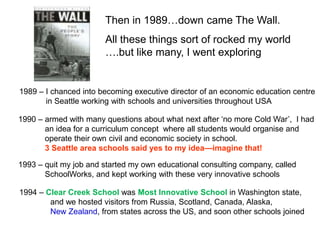
Then in 1989…down came The Wall.
                       All these things sort of rocked my world
                       ….but like many, I went exploring


1989 – I chanced into becoming executive director of an economic education centre
       in Seattle working with schools and universities throughout USA

1990 – armed with many questions about what next after „no more Cold War‟, I had
       an idea for a curriculum concept where all students would organise and
       operate their own civil and economic society in school.
       3 Seattle area schools said yes to my idea—imagine that!

1993 – quit my job and started my own educational consulting company, called
       SchoolWorks, and kept working with these very innovative schools

1994 – Clear Creek School was Most Innovative School in Washington state,
        and we hosted visitors from Russia, Scotland, Canada, Alaska,
        New Zealand, from states across the US, and soon other schools joined
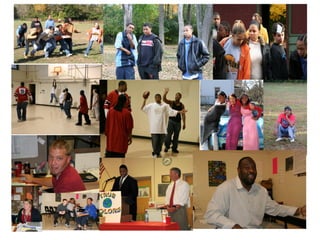
Seattle Students……..1994……
1996 – For that work, I received a 1996 USA national entrepreneurship educator
       of the year award and one day later moved my family to Wellington, NZ.
       Here on a two year contract, I shared the model with 35 NZ eschools and
       rebranded the model as the Primary Enterprise Programme (PrEP)

1998 – recruited to be professor at the University of Cincinnati where I directed the
       education activities of its economics center (rated #1 out of 250 affiliated
       university centers in USA)


  good times really did seem to be rolling for
  me, my family, and my associates…..
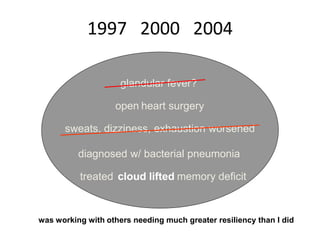
1997 2000 2004

                     glandular fever?

                   open heart surgery

      sweats, dizziness, exhaustion worsened

          diagnosed w/ bacterial pneumonia

          treated cloud lifted memory deficit


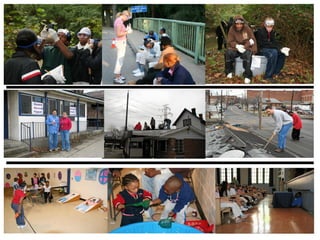
was working with others needing much greater resiliency than I did
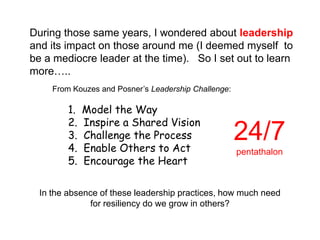
During those same years, I wondered about leadership
and its impact on those around me (I deemed myself to
be a mediocre leader at the time). So I set out to learn
more…..
     From Kouzes and Posner‟s Leadership Challenge:

         1.   Model the Way
         2.   Inspire a Shared Vision
         3.
         4.
              Challenge the Process
              Enable Others to Act
                                                      24/7
                                                      pentathalon
         5.   Encourage the Heart

  In the absence of these leadership practices, how much need
              for resiliency do we grow in others?
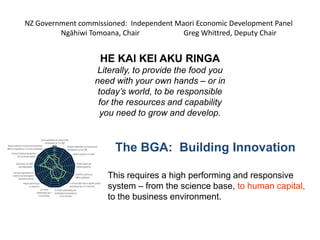
NZ Government commissioned: Independent Maori Economic Development Panel
         Ngāhiwi Tomoana, Chair           Greg Whittred, Deputy Chair


                    HE KAI KEI AKU RINGA
                   Literally, to provide the food you
                  need with your own hands – or in
                   today’s world, to be responsible
                   for the resources and capability
                    you need to grow and develop.


                        The BGA: Building Innovation

                      This requires a high performing and responsive
                      system – from the science base, to human capital,
                      to the business environment.
From the OECD…..the Oslo Manual defines
            innovation as:

“the implementation of a new or significantly
improved product (good or service), or
process, or a new marketing method, or a
new organisational method in business
practices, workplace organisation or external
relations”
Also from the OECD (Innovation Strategy for Education and Training, April 2012)


The critical skills for the most innovative jobs (any type of
innovation) are:
                  - come up with new ideas and solutions
                  -   willingness to question ideas
                  -   present ideas in audience
                  -   alertness to opportunities
                  -   coordinate activities
from three innovative Kiwis (KEA World Class New Zealanders)

    Ideas for innovation come from diversity and differences; customer
    interests drive innovation; we’re (NZ) good at product and process, but
    not so focused on quality of people and how to grow through diversity
                                                                   Bridget Liddell
                                       General Partner, Fahrenheit Wellness Fund
                                                                       New York


     Capabilities Kiwis needed for success in “doing business” in China, in
     India, or in other key emerging markets are: opportunity recognition,
     dynamism to change and adapt, and resiliency
                                                          Dr The Hon. Peter Watson
                                                    President & CEO, Dwight Group
                                                                   Washington D.C.


     “Bugger the boxing…….pour the concrete anyway!!”
                                                   Ian Taylor, founding owner
                                                   Animation Research Limited
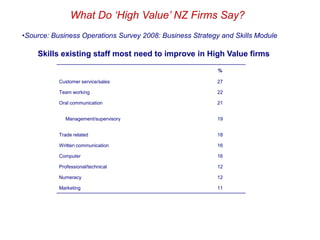
What Do ‘High Value’ NZ Firms Say?
•Source: Business Operations Survey 2008: Business Strategy and Skills Module

    Skills existing staff most need to improve in High Value firms
                                                           %

           Customer service/sales                         27

           Team working                                   22

           Oral communication                             21


             Management/supervisory                       19


           Trade related                                  18

           Written communication                          16

           Computer                                       16

           Professional/technical                         12

           Numeracy                                       12

           Marketing                                      11
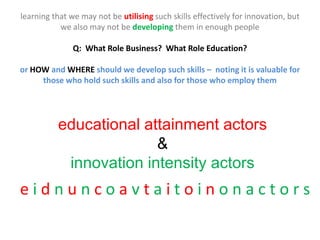
learning that we may not be utilising such skills effectively for innovation, but
           we also may not be developing them in enough people

               Q: What Role Business? What Role Education?

or HOW and WHERE should we develop such skills – noting it is valuable for
     those who hold such skills and also for those who employ them


          educational attainment actors
                        &
           innovation intensity actors
eidnuncoavtaitoinonactors
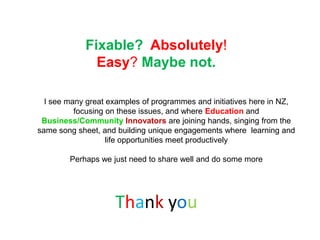
Fixable? Absolutely!
              Easy? Maybe not.

  I see many great examples of programmes and initiatives here in NZ,
          focusing on these issues, and where Education and
 Business/Community Innovators are joining hands, singing from the
same song sheet, and building unique engagements where learning and
                   life opportunities meet productively

        Perhaps we just need to share well and do some more


                    Thank you
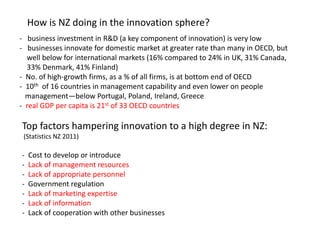
How is NZ doing in the innovation sphere?
- business investment in R&D (a key component of innovation) is very low
- businesses innovate for domestic market at greater rate than many in OECD, but
  well below for international markets (16% compared to 24% in UK, 31% Canada,
  33% Denmark, 41% Finland)
- No. of high-growth firms, as a % of all firms, is at bottom end of OECD
- 10th of 16 countries in management capability and even lower on people
  management—below Portugal, Poland, Ireland, Greece
- real GDP per capita is 21st of 33 OECD countries

Top factors hampering innovation to a high degree in NZ:
 (Statistics NZ 2011)

-   Cost to develop or introduce
-   Lack of management resources
-   Lack of appropriate personnel
-   Government regulation
-   Lack of marketing expertise
-   Lack of information
-   Lack of cooperation with other businesses

Ron Clink - Chief Policy Analyst, Education System Strategy, Ministry of Education - Key Note Presentation at ELF12 - Wellington

  • 1.
    innovating for skills……skillsfor innovation a New Zealand Paradox? Ron Clink
  • 2.
    Resilience sheds lighton capacity to indentify new solutions in every challenge, but also on the ability to live in situations of rapid or constant change the human capacity to take a fresh start, no matter the conditions, seems to be at the heart of the notion of resilience In my work, I used to call it “fail forward”
  • 3.
    “success is theability to go from one failure to another with no loss of enthusiasm” Sir Winston Churchill Let’s consider this in context of Skills and Innovation
  • 4.
    the two consistentlysignificant contributors to economic growth and living standards in OECD countries during the whole period 1870-2006 Jakob B Madsen 2010 Australia/OECD educational attainment (...human capital) & innovation intensity And because we’re NZ….we must do it in scale and with scalability…….to the world
  • 5.
    Ron‟s story (includinga now typical encounter) new person: (after I’ve spoken) are you Canadian? me: um, close, I’m from Seattle originally new person: oh, you’re…. American then? me: yup, but I live in Wellington now Canada is up here
  • 6.
    A quick visitback to Seattle: 1984 – 1988 (I am a teacher)
  • 7.
    Quincy Jones representsone of America’s greatest innovations JAZZ MUSIC originating in black communities in Southern United States, jazz keeps drawing on different musical cultures from around the world, adapts and brings joy to lots of people like me who really dig it! “Jazz is restless. It won’t stay put, and it never will.” J.J. Johnson, trombonist
  • 8.
    Then in 1989…downcame The Wall. All these things sort of rocked my world ….but like many, I went exploring 1989 – I chanced into becoming executive director of an economic education centre in Seattle working with schools and universities throughout USA 1990 – armed with many questions about what next after „no more Cold War‟, I had an idea for a curriculum concept where all students would organise and operate their own civil and economic society in school. 3 Seattle area schools said yes to my idea—imagine that! 1993 – quit my job and started my own educational consulting company, called SchoolWorks, and kept working with these very innovative schools 1994 – Clear Creek School was Most Innovative School in Washington state, and we hosted visitors from Russia, Scotland, Canada, Alaska, New Zealand, from states across the US, and soon other schools joined
  • 9.
  • 10.
    1996 – Forthat work, I received a 1996 USA national entrepreneurship educator of the year award and one day later moved my family to Wellington, NZ. Here on a two year contract, I shared the model with 35 NZ eschools and rebranded the model as the Primary Enterprise Programme (PrEP) 1998 – recruited to be professor at the University of Cincinnati where I directed the education activities of its economics center (rated #1 out of 250 affiliated university centers in USA) good times really did seem to be rolling for me, my family, and my associates…..
  • 11.
    1997 2000 2004 glandular fever? open heart surgery sweats, dizziness, exhaustion worsened diagnosed w/ bacterial pneumonia treated cloud lifted memory deficit was working with others needing much greater resiliency than I did
  • 15.
    During those sameyears, I wondered about leadership and its impact on those around me (I deemed myself to be a mediocre leader at the time). So I set out to learn more….. From Kouzes and Posner‟s Leadership Challenge: 1. Model the Way 2. Inspire a Shared Vision 3. 4. Challenge the Process Enable Others to Act 24/7 pentathalon 5. Encourage the Heart In the absence of these leadership practices, how much need for resiliency do we grow in others?
  • 16.
    NZ Government commissioned:Independent Maori Economic Development Panel Ngāhiwi Tomoana, Chair Greg Whittred, Deputy Chair HE KAI KEI AKU RINGA Literally, to provide the food you need with your own hands – or in today’s world, to be responsible for the resources and capability you need to grow and develop. The BGA: Building Innovation This requires a high performing and responsive system – from the science base, to human capital, to the business environment.
  • 17.
    From the OECD…..theOslo Manual defines innovation as: “the implementation of a new or significantly improved product (good or service), or process, or a new marketing method, or a new organisational method in business practices, workplace organisation or external relations”
  • 18.
    Also from theOECD (Innovation Strategy for Education and Training, April 2012) The critical skills for the most innovative jobs (any type of innovation) are: - come up with new ideas and solutions - willingness to question ideas - present ideas in audience - alertness to opportunities - coordinate activities
  • 19.
    from three innovativeKiwis (KEA World Class New Zealanders) Ideas for innovation come from diversity and differences; customer interests drive innovation; we’re (NZ) good at product and process, but not so focused on quality of people and how to grow through diversity Bridget Liddell General Partner, Fahrenheit Wellness Fund New York Capabilities Kiwis needed for success in “doing business” in China, in India, or in other key emerging markets are: opportunity recognition, dynamism to change and adapt, and resiliency Dr The Hon. Peter Watson President & CEO, Dwight Group Washington D.C. “Bugger the boxing…….pour the concrete anyway!!” Ian Taylor, founding owner Animation Research Limited
  • 20.
    What Do ‘HighValue’ NZ Firms Say? •Source: Business Operations Survey 2008: Business Strategy and Skills Module Skills existing staff most need to improve in High Value firms % Customer service/sales 27 Team working 22 Oral communication 21 Management/supervisory 19 Trade related 18 Written communication 16 Computer 16 Professional/technical 12 Numeracy 12 Marketing 11
  • 21.
    learning that wemay not be utilising such skills effectively for innovation, but we also may not be developing them in enough people Q: What Role Business? What Role Education? or HOW and WHERE should we develop such skills – noting it is valuable for those who hold such skills and also for those who employ them educational attainment actors & innovation intensity actors eidnuncoavtaitoinonactors
  • 22.
    Fixable? Absolutely! Easy? Maybe not. I see many great examples of programmes and initiatives here in NZ, focusing on these issues, and where Education and Business/Community Innovators are joining hands, singing from the same song sheet, and building unique engagements where learning and life opportunities meet productively Perhaps we just need to share well and do some more Thank you
  • 23.
    How is NZdoing in the innovation sphere? - business investment in R&D (a key component of innovation) is very low - businesses innovate for domestic market at greater rate than many in OECD, but well below for international markets (16% compared to 24% in UK, 31% Canada, 33% Denmark, 41% Finland) - No. of high-growth firms, as a % of all firms, is at bottom end of OECD - 10th of 16 countries in management capability and even lower on people management—below Portugal, Poland, Ireland, Greece - real GDP per capita is 21st of 33 OECD countries Top factors hampering innovation to a high degree in NZ: (Statistics NZ 2011) - Cost to develop or introduce - Lack of management resources - Lack of appropriate personnel - Government regulation - Lack of marketing expertise - Lack of information - Lack of cooperation with other businesses