
ROMANESQUE ART &
ARCHITECTURE
Art Appreciation – ART1204
Professor Will Adams
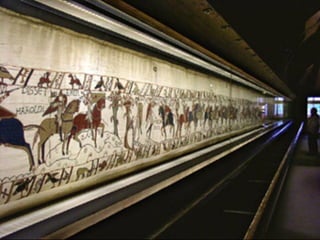
The Bayeux Tapestry
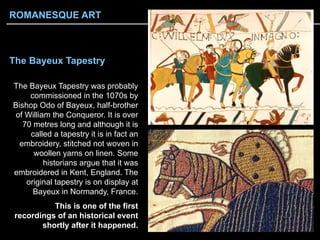
The Bayeux Tapestry was probably
commissioned in the 1070s by
Bishop Odo of Bayeux, half-brother
of William the Conqueror. It is over
70 metres long and although it is
called a tapestry it is in fact an
embroidery, stitched not woven in
woollen yarns on linen. Some
historians argue that it was
embroidered in Kent, England. The
original tapestry is on display at
Bayeux in Normandy, France.
This is one of the first
recordings of an historical event
shortly after it happened.
ROMANESQUE ART
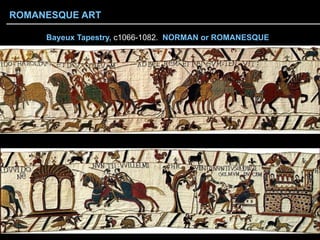
Bayeux Tapestry, c1066-1082. NORMAN or ROMANESQUE
ROMANESQUE ART
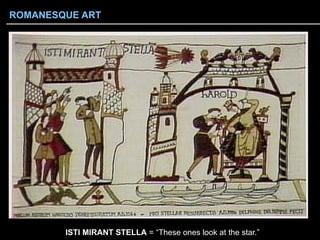
ISTI MIRANT STELLA = “These ones look at the star.”
ROMANESQUE ART
ROMANESQUE
ARCHITECTURE IN FRANCE
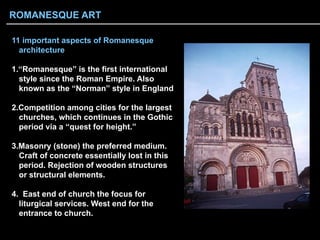
11 important aspects of Romanesque
architecture
1. “Romanesque” is the first international
style since the Roman Empire. Also
known as the “Norman” style in England
2. Competition among cities for the largest
churches, which continues in the Gothic
period via a “quest for height.”
3. Masonry (stone) the preferred medium.
Craft of concrete essentially lost in this
period. Rejection of wooden structures
or structural elements.
4. East end of church the focus for
liturgical services. West end for the
entrance to church.
ROMANESQUE ART
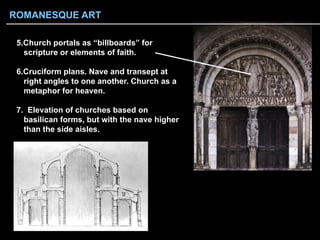
5. Church portals as “billboards” for
scripture or elements of faith.
6. Cruciform plans. Nave and transept at
right angles to one another. Church as a
metaphor for heaven.
7. Elevation of churches based on
basilican forms, but with the nave higher
than the side aisles.
ROMANESQUE ART
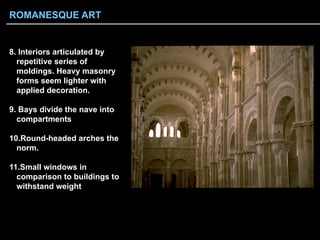
8.  Interiors articulated by
repetitive series of
moldings. Heavy masonry
forms seem lighter with
applied decoration.
9.  Bays divide the nave into
compartments
10. Round-headed arches the
norm.
11. Small windows in
comparison to buildings to
withstand weight
ROMANESQUE ART
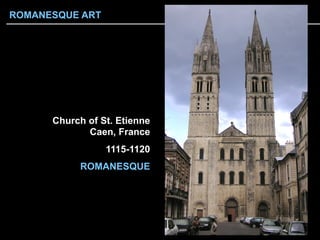
Church of St. Etienne
Caen, France
1115-1120
ROMANESQUE
ROMANESQUE ART
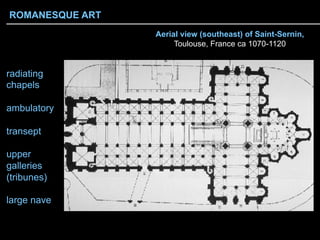
radiating
chapels
ambulatory
transept
upper
galleries
(tribunes)
large nave
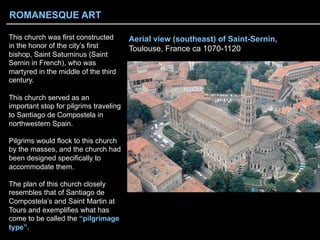
Aerial view (southeast) of Saint-Sernin,
Toulouse, France ca 1070-1120
ROMANESQUE ART
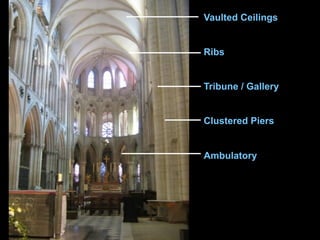
Vaulted Ceilings
Ribs
Tribune / Gallery
Clustered Piers
Ambulatory
Aerial view (southeast) of Saint-Sernin,
Toulouse, France ca 1070-1120
This church was first constructed
in the honor of the city’s first
bishop, Saint Saturninus (Saint
Sernin in French), who was
martyred in the middle of the third
century.
This church served as an
important stop for pilgrims traveling
to Santiago de Compostela in
northwestern Spain.
Pilgrims would flock to this church
by the masses, and the church had
been designed specifically to
accommodate them.
The plan of this church closely
resembles that of Santiago de
Compostela’s and Saint Martin at
Tours and exemplifies what has
come to be called the “pilgrimage
type”.
ROMANESQUE ART
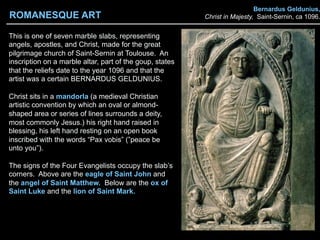
Bernardus Geldunius,
Christ in Majesty, Saint-Sernin, ca 1096.
This is one of seven marble slabs, representing
angels, apostles, and Christ, made for the great
pilgrimage church of Saint-Sernin at Toulouse. An
inscription on a marble altar, part of the goup, states
that the reliefs date to the year 1096 and that the
artist was a certain BERNARDUS GELDUNIUS.
Christ sits in a mandorla (a medieval Christian
artistic convention by which an oval or almond-
shaped area or series of lines surrounds a deity,
most commonly Jesus.) his right hand raised in
blessing, his left hand resting on an open book
inscribed with the words “Pax vobis” (”peace be
unto you”).
The signs of the Four Evangelists occupy the slab’s
corners. Above are the eagle of Saint John and
the angel of Saint Matthew. Below are the ox of
Saint Luke and the lion of Saint Mark.
ROMANESQUE ART
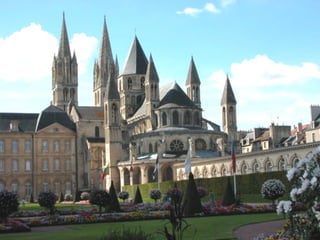
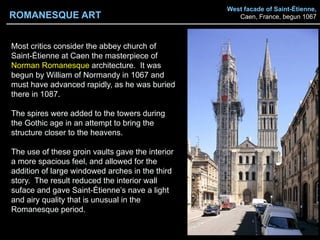
West facade of Saint-Étienne,
Caen, France, begun 1067
Most critics consider the abbey church of
Saint-Étienne at Caen the masterpiece of
Norman Romanesque architecture. It was
begun by William of Normandy in 1067 and
must have advanced rapidly, as he was buried
there in 1087.
The spires were added to the towers during
the Gothic age in an attempt to bring the
structure closer to the heavens.
The use of these groin vaults gave the interior
a more spacious feel, and allowed for the
addition of large windowed arches in the third
story. The result reduced the interior wall
suface and gave Saint-Étienne’s nave a light
and airy quality that is unusual in the
Romanesque period.
ROMANESQUE ART
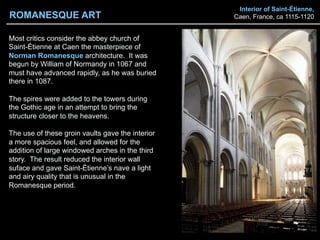
Interior of Saint-Étienne,
Caen, France, ca 1115-1120
Most critics consider the abbey church of
Saint-Étienne at Caen the masterpiece of
Norman Romanesque architecture. It was
begun by William of Normandy in 1067 and
must have advanced rapidly, as he was buried
there in 1087.
The spires were added to the towers during
the Gothic age in an attempt to bring the
structure closer to the heavens.
The use of these groin vaults gave the interior
a more spacious feel, and allowed for the
addition of large windowed arches in the third
story. The result reduced the interior wall
suface and gave Saint-Étienne’s nave a light
and airy quality that is unusual in the
Romanesque period.
ROMANESQUE ART
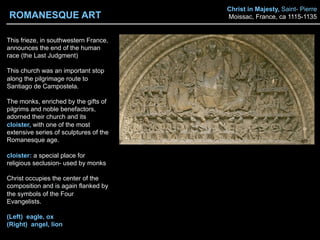
Christ in Majesty, Saint- Pierre
Moissac, France, ca 1115-1135
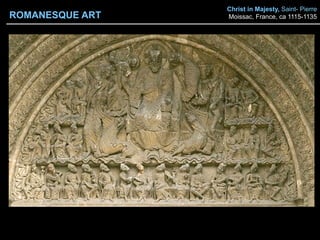
This frieze, in southwestern France,
announces the end of the human
race (the Last Judgment)
This church was an important stop
along the pilgrimage route to
Santiago de Campostela.
The monks, enriched by the gifts of
pilgrims and noble benefactors,
adorned their church and its
cloister, with one of the most
extensive series of sculptures of the
Romanesque age.
cloister: a special place for
religious seclusion- used by monks
Christ occupies the center of the
composition and is again flanked by
the symbols of the Four
Evangelists.
(Left) eagle, ox
(Right) angel, lion
ROMANESQUE ART
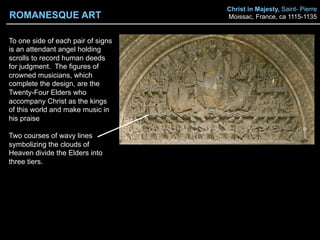
Christ in Majesty, Saint- Pierre
Moissac, France, ca 1115-1135
To one side of each pair of signs
is an attendant angel holding
scrolls to record human deeds
for judgment. The figures of
crowned musicians, which
complete the design, are the
Twenty-Four Elders who
accompany Christ as the kings
of this world and make music in
his praise
Two courses of wavy lines
symbolizing the clouds of
Heaven divide the Elders into
three tiers.
ROMANESQUE ART
Christ in Majesty, Saint- Pierre
Moissac, France, ca 1115-1135ROMANESQUE ART
Lions and Old Testament Prophet (Jeremiah, Isaiah?)
Moissac, France ca 1115-1130
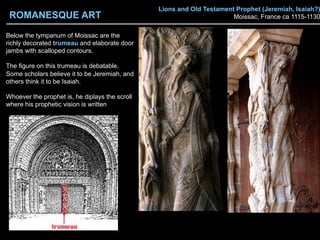
Below the tympanum of Moissac are the
richly decorated trumeau and elaborate door
jambs with scalloped contours.
The figure on this trumeau is debatable.
Some scholars believe it to be Jeremiah, and
others think it to be Isaiah.
Whoever the prophet is, he diplays the scroll
where his prophetic vision is written
ROMANESQUE ART
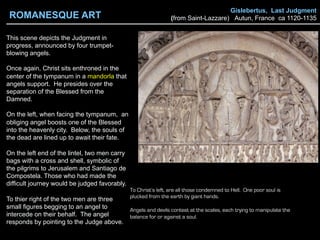
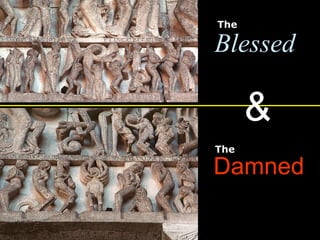
Gislebertus, Last Judgment
(from Saint-Lazzare) Autun, France ca 1120-1135
This scene depicts the Judgment in
progress, announced by four trumpet-
blowing angels.
Once again, Christ sits enthroned in the
center of the tympanum in a mandorla that
angels support. He presides over the
separation of the Blessed from the
Damned.
On the left, when facing the tympanum, an
obliging angel boosts one of the Blessed
into the heavenly city. Below, the souls of
the dead are lined up to await their fate.
On the left end of the lintel, two men carry
bags with a cross and shell, symbolic of
the pilgrims to Jerusalem and Santiago de
Compostela. Those who had made the
difficult journey would be judged favorably.
To thier right of the two men are three
small figures begging to an angel to
intercede on their behalf. The angel
responds by pointing to the Judge above.
To Christ’s left, are all those condemned to Hell. One poor soul is
plucked from the earth by giant hands.
Angels and devils contest at the scales, each trying to manipulate the
balance for or against a soul.
ROMANESQUE ART
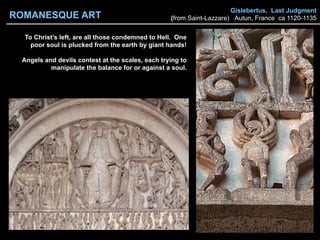
Gislebertus, Last Judgment
(from Saint-Lazzare) Autun, France ca 1120-1135
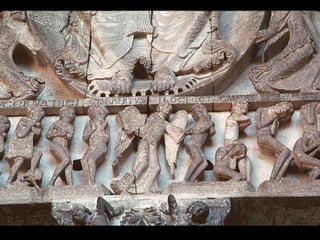
To Christ’s left, are all those condemned to Hell. One
poor soul is plucked from the earth by giant hands!
Angels and devils contest at the scales, each trying to
manipulate the balance for or against a soul.
ROMANESQUE ART
The
The
Blessed
Damned
&
ROMANESQUE
ARCHITECTURE IN ITALY
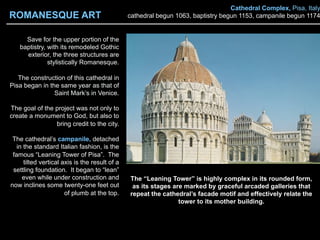
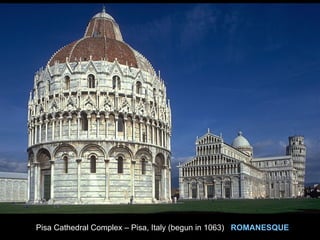
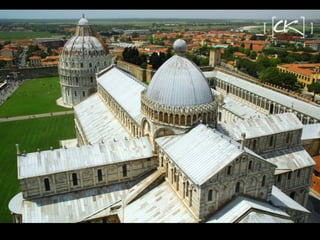
Cathedral Complex, Pisa, Italy
cathedral begun 1063, baptistry begun 1153, campanile begun 1174
Save for the upper portion of the
baptistry, with its remodeled Gothic
exterior, the three structures are
stylistically Romanesque.
The construction of this cathedral in
Pisa began in the same year as that of
Saint Mark’s in Venice.
The goal of the project was not only to
create a monument to God, but also to
bring credit to the city.
The cathedral’s campanile, detached
in the standard Italian fashion, is the
famous “Leaning Tower of Pisa”. The
tilted vertical axis is the result of a
settling foundation. It began to “lean”
even while under construction and
now inclines some twenty-one feet out
of plumb at the top.
The “Leaning Tower” is highly complex in its rounded form,
as its stages are marked by graceful arcaded galleries that
repeat the cathedral’s facade motif and effectively relate the
tower to its mother building.
ROMANESQUE ART
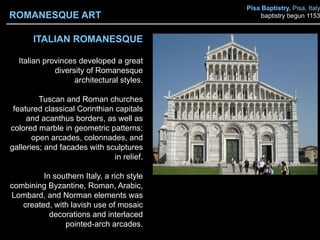
ITALIAN ROMANESQUE
Italian provinces developed a great
diversity of Romanesque
architectural styles.
Tuscan and Roman churches
featured classical Corinthian capitals
and acanthus borders, as well as
colored marble in geometric patterns;
open arcades, colonnades, and
galleries; and facades with sculptures
in relief.
In southern Italy, a rich style
combining Byzantine, Roman, Arabic,
Lombard, and Norman elements was
created, with lavish use of mosaic
decorations and interlaced
pointed-arch arcades.
ROMANESQUE ART
Pisa Baptistry, Pisa, Italy
baptistry begun 1153
Pisa Cathedral Complex – Pisa, Italy (begun in 1063) ROMANESQUE
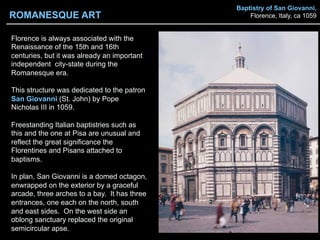
Baptistry of San Giovanni,
Florence, Italy, ca 1059
Florence is always associated with the
Renaissance of the 15th and 16th
centuries, but it was already an important
independent city-state during the
Romanesque era.
This structure was dedicated to the patron
San Giovanni (St. John) by Pope
Nicholas III in 1059.
Freestanding Italian baptistries such as
this and the one at Pisa are unusual and
reflect the great significance the
Florentines and Pisans attached to
baptisms.
In plan, San Giovanni is a domed octagon,
enwrapped on the exterior by a graceful
arcade, three arches to a bay. It has three
entrances, one each on the north, south
and east sides. On the west side an
oblong sanctuary replaced the original
semicircular apse.
ROMANESQUE ART
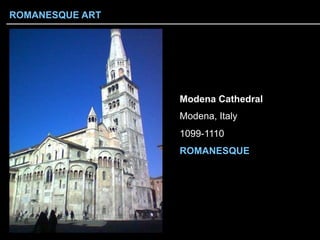
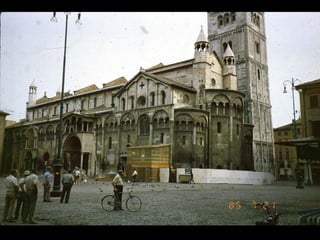
Modena Cathedral
Modena, Italy
1099-1110
ROMANESQUE
ROMANESQUE ART
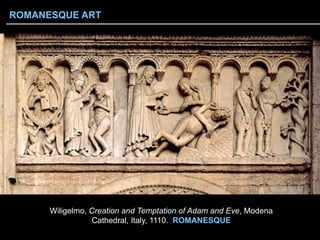
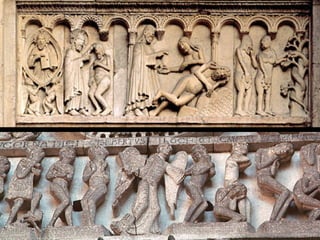
Wiligelmo, Creation and Temptation of Adam and Eve, Modena
Cathedral, Italy, 1110. ROMANESQUE
ROMANESQUE ART
ROMANESQUE
ARCHITECTURE IN ENGLAND
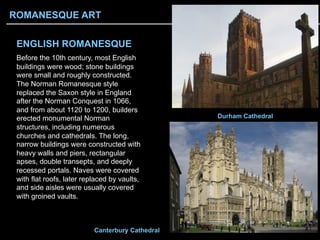
ENGLISH ROMANESQUE
Before the 10th century, most English
buildings were wood; stone buildings
were small and roughly constructed.
The Norman Romanesque style
replaced the Saxon style in England
after the Norman Conquest in 1066,
and from about 1120 to 1200, builders
erected monumental Norman
structures, including numerous
churches and cathedrals. The long,
narrow buildings were constructed with
heavy walls and piers, rectangular
apses, double transepts, and deeply
recessed portals. Naves were covered
with flat roofs, later replaced by vaults,
and side aisles were usually covered
with groined vaults.
Durham Cathedral
Canterbury Cathedral
ROMANESQUE ART
Blues’ Guide to Understanding
Romanesque Art
Spans across many countries & styles
Small Windows, thick stone walls
Many Churches had Gothic spires added later
Long Ribbed Vaults in the Nave
Small piers used as buttresses
Decorative Tympanums & Portals
More side aisles and ambulatories to meet needs
of pilgrimages (i.e. outside galleries)
Addition of the separate Baptistry
ROMANESQUE ART
THE END

Art1204 romanesque art & architecture

  • 1.
    ROMANESQUE ART & ARCHITECTURE ArtAppreciation – ART1204 Professor Will Adams
  • 2.
    The Bayeux Tapestry TheBayeux Tapestry was probably commissioned in the 1070s by Bishop Odo of Bayeux, half-brother of William the Conqueror. It is over 70 metres long and although it is called a tapestry it is in fact an embroidery, stitched not woven in woollen yarns on linen. Some historians argue that it was embroidered in Kent, England. The original tapestry is on display at Bayeux in Normandy, France. This is one of the first recordings of an historical event shortly after it happened. ROMANESQUE ART
  • 3.
    Bayeux Tapestry, c1066-1082.NORMAN or ROMANESQUE ROMANESQUE ART
  • 4.
    ISTI MIRANT STELLA= “These ones look at the star.” ROMANESQUE ART
  • 6.
  • 7.
    11 important aspectsof Romanesque architecture 1. “Romanesque” is the first international style since the Roman Empire. Also known as the “Norman” style in England 2. Competition among cities for the largest churches, which continues in the Gothic period via a “quest for height.” 3. Masonry (stone) the preferred medium. Craft of concrete essentially lost in this period. Rejection of wooden structures or structural elements. 4. East end of church the focus for liturgical services. West end for the entrance to church. ROMANESQUE ART
  • 8.
    5. Church portals as“billboards” for scripture or elements of faith. 6. Cruciform plans. Nave and transept at right angles to one another. Church as a metaphor for heaven. 7. Elevation of churches based on basilican forms, but with the nave higher than the side aisles. ROMANESQUE ART
  • 9.
    8.  Interiors articulatedby repetitive series of moldings. Heavy masonry forms seem lighter with applied decoration. 9.  Bays divide the nave into compartments 10. Round-headed arches the norm. 11. Small windows in comparison to buildings to withstand weight ROMANESQUE ART
  • 10.
    Church of St.Etienne Caen, France 1115-1120 ROMANESQUE ROMANESQUE ART
  • 12.
    radiating chapels ambulatory transept upper galleries (tribunes) large nave Aerial view(southeast) of Saint-Sernin, Toulouse, France ca 1070-1120 ROMANESQUE ART
  • 13.
    Vaulted Ceilings Ribs Tribune /Gallery Clustered Piers Ambulatory
  • 14.
    Aerial view (southeast)of Saint-Sernin, Toulouse, France ca 1070-1120 This church was first constructed in the honor of the city’s first bishop, Saint Saturninus (Saint Sernin in French), who was martyred in the middle of the third century. This church served as an important stop for pilgrims traveling to Santiago de Compostela in northwestern Spain. Pilgrims would flock to this church by the masses, and the church had been designed specifically to accommodate them. The plan of this church closely resembles that of Santiago de Compostela’s and Saint Martin at Tours and exemplifies what has come to be called the “pilgrimage type”. ROMANESQUE ART
  • 15.
    Bernardus Geldunius, Christ inMajesty, Saint-Sernin, ca 1096. This is one of seven marble slabs, representing angels, apostles, and Christ, made for the great pilgrimage church of Saint-Sernin at Toulouse. An inscription on a marble altar, part of the goup, states that the reliefs date to the year 1096 and that the artist was a certain BERNARDUS GELDUNIUS. Christ sits in a mandorla (a medieval Christian artistic convention by which an oval or almond- shaped area or series of lines surrounds a deity, most commonly Jesus.) his right hand raised in blessing, his left hand resting on an open book inscribed with the words “Pax vobis” (”peace be unto you”). The signs of the Four Evangelists occupy the slab’s corners. Above are the eagle of Saint John and the angel of Saint Matthew. Below are the ox of Saint Luke and the lion of Saint Mark. ROMANESQUE ART
  • 16.
    West facade ofSaint-Étienne, Caen, France, begun 1067 Most critics consider the abbey church of Saint-Étienne at Caen the masterpiece of Norman Romanesque architecture. It was begun by William of Normandy in 1067 and must have advanced rapidly, as he was buried there in 1087. The spires were added to the towers during the Gothic age in an attempt to bring the structure closer to the heavens. The use of these groin vaults gave the interior a more spacious feel, and allowed for the addition of large windowed arches in the third story. The result reduced the interior wall suface and gave Saint-Étienne’s nave a light and airy quality that is unusual in the Romanesque period. ROMANESQUE ART
  • 17.
    Interior of Saint-Étienne, Caen,France, ca 1115-1120 Most critics consider the abbey church of Saint-Étienne at Caen the masterpiece of Norman Romanesque architecture. It was begun by William of Normandy in 1067 and must have advanced rapidly, as he was buried there in 1087. The spires were added to the towers during the Gothic age in an attempt to bring the structure closer to the heavens. The use of these groin vaults gave the interior a more spacious feel, and allowed for the addition of large windowed arches in the third story. The result reduced the interior wall suface and gave Saint-Étienne’s nave a light and airy quality that is unusual in the Romanesque period. ROMANESQUE ART
  • 18.
    Christ in Majesty,Saint- Pierre Moissac, France, ca 1115-1135 This frieze, in southwestern France, announces the end of the human race (the Last Judgment) This church was an important stop along the pilgrimage route to Santiago de Campostela. The monks, enriched by the gifts of pilgrims and noble benefactors, adorned their church and its cloister, with one of the most extensive series of sculptures of the Romanesque age. cloister: a special place for religious seclusion- used by monks Christ occupies the center of the composition and is again flanked by the symbols of the Four Evangelists. (Left) eagle, ox (Right) angel, lion ROMANESQUE ART
  • 19.
    Christ in Majesty,Saint- Pierre Moissac, France, ca 1115-1135 To one side of each pair of signs is an attendant angel holding scrolls to record human deeds for judgment. The figures of crowned musicians, which complete the design, are the Twenty-Four Elders who accompany Christ as the kings of this world and make music in his praise Two courses of wavy lines symbolizing the clouds of Heaven divide the Elders into three tiers. ROMANESQUE ART
  • 20.
    Christ in Majesty,Saint- Pierre Moissac, France, ca 1115-1135ROMANESQUE ART
  • 21.
    Lions and OldTestament Prophet (Jeremiah, Isaiah?) Moissac, France ca 1115-1130 Below the tympanum of Moissac are the richly decorated trumeau and elaborate door jambs with scalloped contours. The figure on this trumeau is debatable. Some scholars believe it to be Jeremiah, and others think it to be Isaiah. Whoever the prophet is, he diplays the scroll where his prophetic vision is written ROMANESQUE ART
  • 22.
    Gislebertus, Last Judgment (fromSaint-Lazzare) Autun, France ca 1120-1135 This scene depicts the Judgment in progress, announced by four trumpet- blowing angels. Once again, Christ sits enthroned in the center of the tympanum in a mandorla that angels support. He presides over the separation of the Blessed from the Damned. On the left, when facing the tympanum, an obliging angel boosts one of the Blessed into the heavenly city. Below, the souls of the dead are lined up to await their fate. On the left end of the lintel, two men carry bags with a cross and shell, symbolic of the pilgrims to Jerusalem and Santiago de Compostela. Those who had made the difficult journey would be judged favorably. To thier right of the two men are three small figures begging to an angel to intercede on their behalf. The angel responds by pointing to the Judge above. To Christ’s left, are all those condemned to Hell. One poor soul is plucked from the earth by giant hands. Angels and devils contest at the scales, each trying to manipulate the balance for or against a soul. ROMANESQUE ART
  • 23.
    Gislebertus, Last Judgment (fromSaint-Lazzare) Autun, France ca 1120-1135 To Christ’s left, are all those condemned to Hell. One poor soul is plucked from the earth by giant hands! Angels and devils contest at the scales, each trying to manipulate the balance for or against a soul. ROMANESQUE ART
  • 25.
  • 26.
  • 27.
    Cathedral Complex, Pisa,Italy cathedral begun 1063, baptistry begun 1153, campanile begun 1174 Save for the upper portion of the baptistry, with its remodeled Gothic exterior, the three structures are stylistically Romanesque. The construction of this cathedral in Pisa began in the same year as that of Saint Mark’s in Venice. The goal of the project was not only to create a monument to God, but also to bring credit to the city. The cathedral’s campanile, detached in the standard Italian fashion, is the famous “Leaning Tower of Pisa”. The tilted vertical axis is the result of a settling foundation. It began to “lean” even while under construction and now inclines some twenty-one feet out of plumb at the top. The “Leaning Tower” is highly complex in its rounded form, as its stages are marked by graceful arcaded galleries that repeat the cathedral’s facade motif and effectively relate the tower to its mother building. ROMANESQUE ART
  • 28.
    ITALIAN ROMANESQUE Italian provincesdeveloped a great diversity of Romanesque architectural styles. Tuscan and Roman churches featured classical Corinthian capitals and acanthus borders, as well as colored marble in geometric patterns; open arcades, colonnades, and galleries; and facades with sculptures in relief. In southern Italy, a rich style combining Byzantine, Roman, Arabic, Lombard, and Norman elements was created, with lavish use of mosaic decorations and interlaced pointed-arch arcades. ROMANESQUE ART Pisa Baptistry, Pisa, Italy baptistry begun 1153
  • 29.
    Pisa Cathedral Complex– Pisa, Italy (begun in 1063) ROMANESQUE
  • 31.
    Baptistry of SanGiovanni, Florence, Italy, ca 1059 Florence is always associated with the Renaissance of the 15th and 16th centuries, but it was already an important independent city-state during the Romanesque era. This structure was dedicated to the patron San Giovanni (St. John) by Pope Nicholas III in 1059. Freestanding Italian baptistries such as this and the one at Pisa are unusual and reflect the great significance the Florentines and Pisans attached to baptisms. In plan, San Giovanni is a domed octagon, enwrapped on the exterior by a graceful arcade, three arches to a bay. It has three entrances, one each on the north, south and east sides. On the west side an oblong sanctuary replaced the original semicircular apse. ROMANESQUE ART
  • 32.
  • 34.
    Wiligelmo, Creation andTemptation of Adam and Eve, Modena Cathedral, Italy, 1110. ROMANESQUE ROMANESQUE ART
  • 36.
  • 37.
    ENGLISH ROMANESQUE Before the10th century, most English buildings were wood; stone buildings were small and roughly constructed. The Norman Romanesque style replaced the Saxon style in England after the Norman Conquest in 1066, and from about 1120 to 1200, builders erected monumental Norman structures, including numerous churches and cathedrals. The long, narrow buildings were constructed with heavy walls and piers, rectangular apses, double transepts, and deeply recessed portals. Naves were covered with flat roofs, later replaced by vaults, and side aisles were usually covered with groined vaults. Durham Cathedral Canterbury Cathedral ROMANESQUE ART
  • 38.
    Blues’ Guide toUnderstanding Romanesque Art Spans across many countries & styles Small Windows, thick stone walls Many Churches had Gothic spires added later Long Ribbed Vaults in the Nave Small piers used as buttresses Decorative Tympanums & Portals More side aisles and ambulatories to meet needs of pilgrimages (i.e. outside galleries) Addition of the separate Baptistry ROMANESQUE ART
  • 39.