COLD ROLLED SHEETS
Ayushi Kanakia
1405022040
Appearance
β€’ Smoother
appearance
β€’ Sharper
accuracy and
finish
Mechanical
Properties
β€’ Yield strength :
Higher than
Hot Rolled
β€’ Tensile
Strength:
Higher than
Hot Rolled
Product
Condition
β€’ Annealed and
skin passed
β€’ Full hard
β€’ Sheets, discs
and slit wide
coil
Cold Rolled Steel:
Rolled at room temp
Smooth, Shiny finish
Sharper corners, more precise
dimensions
Better Mechanical Properties:
- consistent and reliable end product
quality
- lighter and stronger products
- repeatable, trouble-freprocessing
- maximised yield
- reduced waste and rework
Hot Rolled Steel:
Rolled at high temp
Gray scaly finish
After the Rolls/Coils are procured, it further undergoes a more detailed process [ SMALL SCALE]
ROLL BENDING
ROLL FORMING
FLAT ROLLING RING ROLLING
STRUCTURAL SHAPE ROLLING
CONTROLLED ROLLING
FORGE ROLLING
Roll forming, roll bending or plate rolling is a continuous bending operation:
strip of metal (typically coiled steel) is passed through consecutive sets of
rolls,or stands until the desired cross-section profile is obtained. Roll forming
is ideal for producing parts with long lengths or in large quantities.
Roll Forming
Flat Rolling
Flat rolling is the most basic form of rolling with the starting and ending
material having a rectangular cross-section. The material is fed in between
two rollers, called working rolls, that rotate in opposite directions.The friction at
the interface between the material and the rolls causes the material to be
pushed through.
Forge rolling
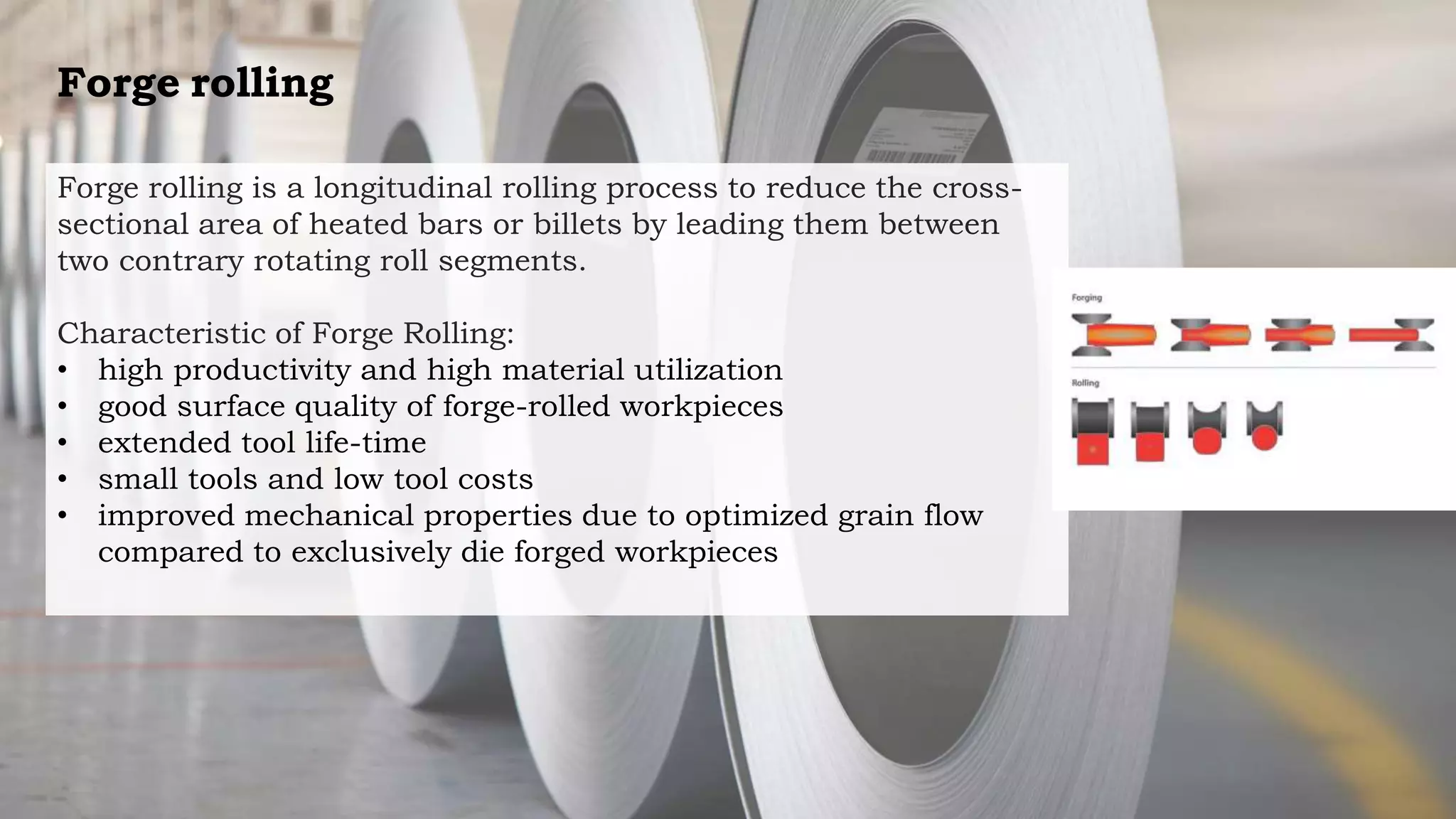
Forge rolling is a longitudinal rolling process to reduce the cross-
sectional area of heated bars or billets by leading them between
two contrary rotating roll segments.
Characteristic of Forge Rolling:
β€’ high productivity and high material utilization
β€’ good surface quality of forge-rolled workpieces
β€’ extended tool life-time
β€’ small tools and low tool costs
β€’ improved mechanical properties due to optimized grain flow
compared to exclusively die forged workpieces
Ring rolling
Ring rolling is a specialized type of hot rolling
that increases the diameter of a ring. The starting material is
a thick-walled ring. As the rolling occurs the wall thickness
decreases as the diameter increases.
Controlled rolling
Controlled rolling is a type of thermomechanical
processing which integrates controlled deformation and heat
treating.
Automotive Parts Bathtubs Construction
and Building
components
Drums and
vessels
Domestic
Appliance
Furniture Radiators Electrical
goods
APPLICATIONS
Thankyou

Cold Rolled Sheets

  • 1.
    COLD ROLLED SHEETS AyushiKanakia 1405022040
  • 2.
    Appearance β€’ Smoother appearance β€’ Sharper accuracyand finish Mechanical Properties β€’ Yield strength : Higher than Hot Rolled β€’ Tensile Strength: Higher than Hot Rolled Product Condition β€’ Annealed and skin passed β€’ Full hard β€’ Sheets, discs and slit wide coil
  • 3.
    Cold Rolled Steel: Rolledat room temp Smooth, Shiny finish Sharper corners, more precise dimensions Better Mechanical Properties: - consistent and reliable end product quality - lighter and stronger products - repeatable, trouble-freprocessing - maximised yield - reduced waste and rework Hot Rolled Steel: Rolled at high temp Gray scaly finish
  • 5.
    After the Rolls/Coilsare procured, it further undergoes a more detailed process [ SMALL SCALE] ROLL BENDING ROLL FORMING FLAT ROLLING RING ROLLING STRUCTURAL SHAPE ROLLING CONTROLLED ROLLING FORGE ROLLING
  • 6.
    Roll forming, rollbending or plate rolling is a continuous bending operation: strip of metal (typically coiled steel) is passed through consecutive sets of rolls,or stands until the desired cross-section profile is obtained. Roll forming is ideal for producing parts with long lengths or in large quantities. Roll Forming Flat Rolling Flat rolling is the most basic form of rolling with the starting and ending material having a rectangular cross-section. The material is fed in between two rollers, called working rolls, that rotate in opposite directions.The friction at the interface between the material and the rolls causes the material to be pushed through.
  • 7.
    Forge rolling Forge rollingis a longitudinal rolling process to reduce the cross- sectional area of heated bars or billets by leading them between two contrary rotating roll segments. Characteristic of Forge Rolling: β€’ high productivity and high material utilization β€’ good surface quality of forge-rolled workpieces β€’ extended tool life-time β€’ small tools and low tool costs β€’ improved mechanical properties due to optimized grain flow compared to exclusively die forged workpieces
  • 8.
    Ring rolling Ring rollingis a specialized type of hot rolling that increases the diameter of a ring. The starting material is a thick-walled ring. As the rolling occurs the wall thickness decreases as the diameter increases. Controlled rolling Controlled rolling is a type of thermomechanical processing which integrates controlled deformation and heat treating.
  • 9.
    Automotive Parts BathtubsConstruction and Building components Drums and vessels Domestic Appliance Furniture Radiators Electrical goods APPLICATIONS
  • 10.