LAYOUT STRATEGY
    OPERATIONS MANAGEMENT


                  Aim
 To develop an economic layout that will
meet the firm’s competitive requirements
TYPES
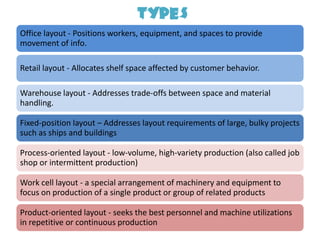
Office layout - Positions workers, equipment, and spaces to provide
movement of info.

Retail layout - Allocates shelf space affected by customer behavior.

Warehouse layout - Addresses trade-offs between space and material
handling.

Fixed-position layout – Addresses layout requirements of large, bulky projects
such as ships and buildings

Process-oriented layout - low-volume, high-variety production (also called job
shop or intermittent production)

Work cell layout - a special arrangement of machinery and equipment to
focus on production of a single product or group of related products

Product-oriented layout - seeks the best personnel and machine utilizations
in repetitive or continuous production
REASON BEHIND LAYOUT DECISIONS

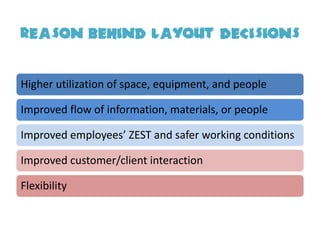
Higher utilization of space, equipment, and people

Improved flow of information, materials, or people

Improved employees’ ZEST and safer working conditions

Improved customer/client interaction

Flexibility
A CLASSIC ex. McDonald’s
INNOVATION TIMELINE + LAYOUT DECISIONS

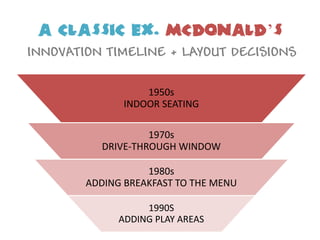
                   1950s
               INDOOR SEATING

                   1970s
          DRIVE-THROUGH WINDOW

                   1980s
        ADDING BREAKFAST TO THE MENU

                   1990S
              ADDING PLAY AREAS
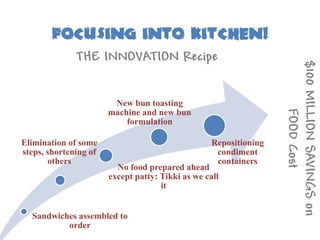
FOCUSING INTO KITCHEN!
              THE INNOVATION Recipe


                                                                   $100 MILLION SAVINGS on
                        New bun toasting


                                                                           FOOD Cost
                       machine and new bun
                           formulation

Elimination of some                                Repositioning
steps, shortening of                                condiment
       others                                       containers
                         No food prepared ahead
                       except patty: Tikki as we call
                                     it


  Sandwiches assembled to
          order
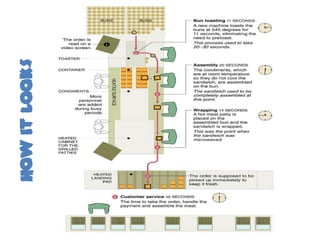
HOW IT LOOKS
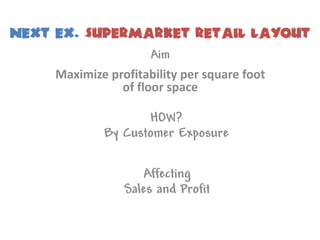
NEXT EX. SUPERMARKET RETAIL LAYOUT
                      Aim
     Maximize profitability per square foot
                of floor space

                    HOW?
             By Customer Exposure

                    Affecting
                 Sales and Profit
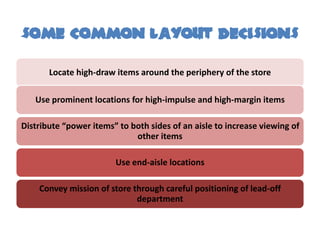
SOME COMMON LAYOUT DECISIONS
       Locate high-draw items around the periphery of the store

   Use prominent locations for high-impulse and high-margin items

Distribute “power items” to both sides of an aisle to increase viewing of
                             other items

                        Use end-aisle locations

    Convey mission of store through careful positioning of lead-off
                             department
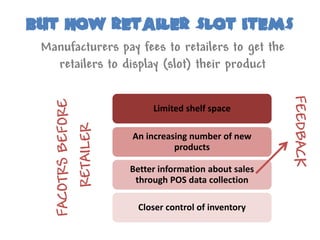
BUT HOW RETAILER SLOT ITEMs
 Manufacturers pay fees to retailers to get the
   retailers to display (slot) their product


                                                     FEEDBACK
   FACOTRS BEFORE

                         Limited shelf space
       RETAILER


                    An increasing number of new
                              products

                    Better information about sales
                     through POS data collection

                     Closer control of inventory
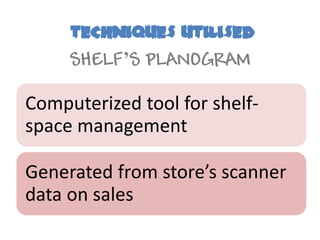
TECHNIQUES UTILISED
     SHELF’S PLANOGRAM

Computerized tool for shelf-
space management

Generated from store’s scanner
data on sales
III RD ex. Warehouse layout
                     Aim

Optimize trade-offs between handling costs and
     costs associated with warehouse space
Maximize the total “cube” of the warehouse –
 utilize its full volume while maintaining low
             material handling costs
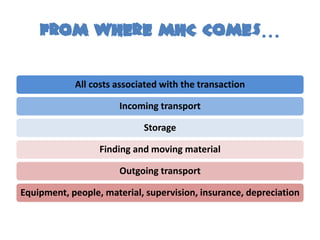
From where mhc comes…

            All costs associated with the transaction

                       Incoming transport

                            Storage

                  Finding and moving material

                       Outgoing transport

Equipment, people, material, supervision, insurance, depreciation
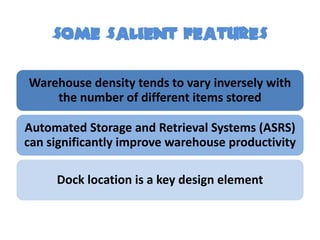
Some SALIENT FEATURES

Warehouse density tends to vary inversely with
    the number of different items stored

Automated Storage and Retrieval Systems (ASRS)
can significantly improve warehouse productivity

     Dock location is a key design element
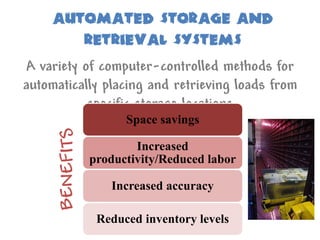
Automated Storage and
       Retrieval Systems
A variety of computer-controlled methods for
automatically placing and retrieving loads from
           specific storage locations
                      Space savings
     BENEFITS


                        Increased
                productivity/Reduced labor

                   Increased accuracy

                 Reduced inventory levels
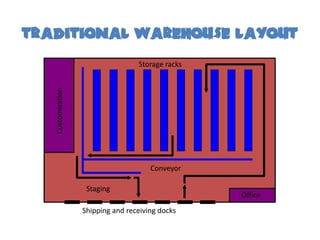
TRADITIONAL WAREHOUSE LAYOUT
                                   Storage racks
   Customization


                                       Conveyor

                    Staging
                                                   Office
                   Shipping and receiving docks
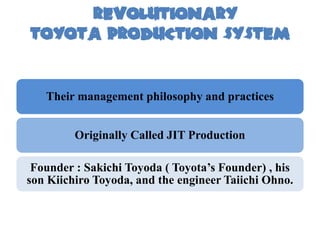
Revolutionary
TOYOTA PRODUCTION SYSTEM


   Their management philosophy and practices


         Originally Called JIT Production

 Founder : Sakichi Toyoda ( Toyota’s Founder) , his
son Kiichiro Toyoda, and the engineer Taiichi Ohno.
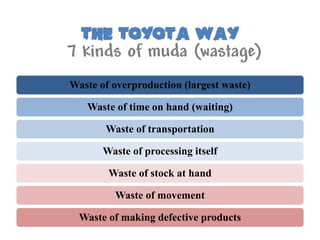
THE Toyota way
7 kinds of muda (wastage)
Waste of overproduction (largest waste)

   Waste of time on hand (waiting)

       Waste of transportation

       Waste of processing itself

        Waste of stock at hand

         Waste of movement

  Waste of making defective products
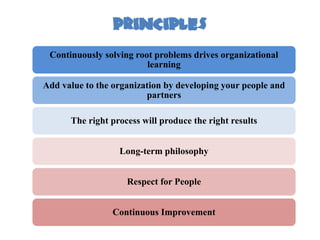
PRINCIPLES
 Continuously solving root problems drives organizational
                         learning

Add value to the organization by developing your people and
                         partners

      The right process will produce the right results


                  Long-term philosophy


                    Respect for People


                Continuous Improvement
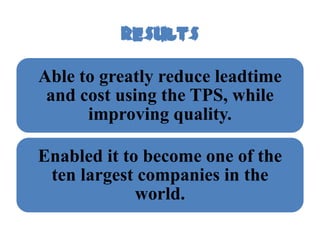
RESULTS
Able to greatly reduce leadtime
 and cost using the TPS, while
      improving quality.

Enabled it to become one of the
 ten largest companies in the
             world.
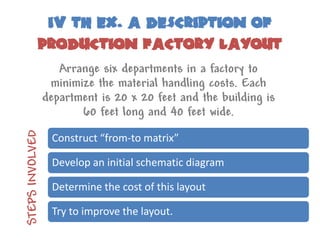
Iv th ex. A description of
           Production factory layout
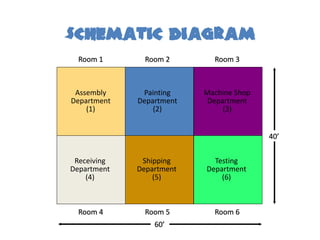
                    Arrange six departments in a factory to
                  minimize the material handling costs. Each
                 department is 20 x 20 feet and the building is
                        60 feet long and 40 feet wide.
STEPS INVOLVED


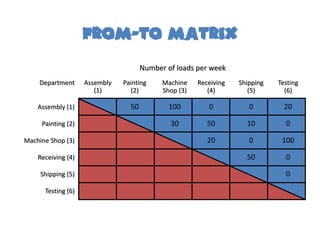
                  Construct “from-to matrix”

                  Develop an initial schematic diagram

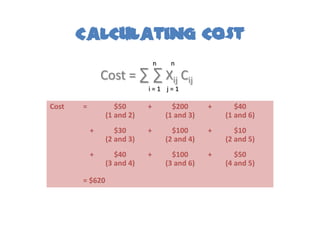
                  Determine the cost of this layout

                  Try to improve the layout.
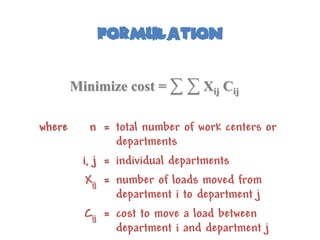
formulation

        Minimize cost = ∑   ∑ Xij Cij

where      n = total number of work centers or
                departments
         i, j = individual departments
          Xij = number of loads moved from
                department i to department j
          Cij = cost to move a load between
                department i and department j
From-to matrix
                                      Number of loads per week
    Department      Assembly   Painting     Machine    Receiving   Shipping   Testing
                       (1)       (2)        Shop (3)      (4)         (5)       (6)

    Assembly (1)                 50           100         0           0         20

     Painting (2)                             30          50         10         0

Machine Shop (3)                                          20          0        100

    Receiving (4)                                                    50         0

     Shipping (5)                                                               0

      Testing (6)
Schematic diagram
  Room 1       Room 2       Room 3


 Assembly     Painting    Machine Shop
Department   Department    Department
    (1)          (2)           (3)


                                         40’


 Receiving    Shipping      Testing
Department   Department   Department
    (4)          (5)          (6)


  Room 4       Room 5       Room 6
                 60’
CALCULATING COST
                                n    n
               Cost = ∑ ∑ Xij Cij
                            i=1 j=1

Cost   =           $50      +         $200      +      $40
                (1 and 2)           (1 and 3)       (1 and 6)
           +       $30      +         $100      +      $10
                (2 and 3)           (2 and 4)       (2 and 5)
           +       $40      +         $100      +      $50
                (3 and 4)           (3 and 6)       (4 and 5)

       = $620
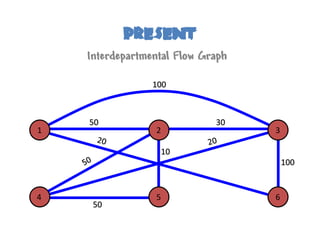
PRESENt
    Interdepartmental Flow Graph

                 100


    50                       30
1                2                 3

                  10
                                       100


4                5                 6
     50
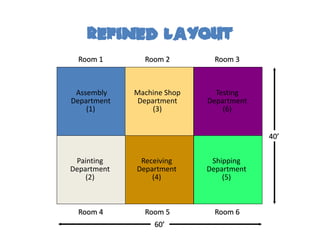
Refined layout
  Room 1       Room 2         Room 3


 Assembly    Machine Shop     Testing
Department    Department    Department
    (1)           (3)           (6)


                                         40’


 Painting     Receiving      Shipping
Department   Department     Department
    (2)          (4)            (5)


  Room 4       Room 5         Room 6
                  60’
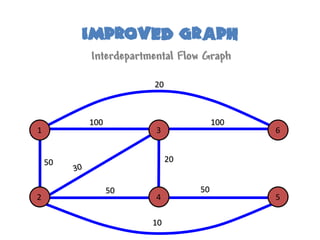
IMPROVED GRAPH
         Interdepartmental Flow Graph

                     20


         100                        100
1                     3                   6


    50                    20


               50              50
2                     4                   5

                     10
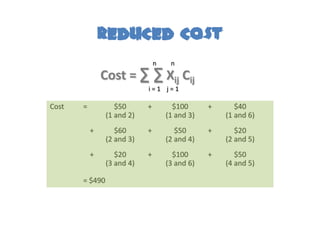
REDUCED COST
                                n    n
               Cost = ∑ ∑ Xij Cij
                            i=1 j=1

Cost   =           $50      +         $100      +      $40
                (1 and 2)           (1 and 3)       (1 and 6)
           +       $60      +          $50      +      $20
                (2 and 3)           (2 and 4)       (2 and 5)
           +       $20      +         $100      +      $50
                (3 and 4)           (3 and 6)       (4 and 5)

       = $490
CONCLUSION
  HERE we DISCUSSED 4 examples giving
   a glimpse of how layout decisions are
    carried out at various stages from
         Production  Retailing.
    HOPE IT WAS WORTH SPENDING
                  TIME!
                                         DEEPAK SHARMA
Copyright 2012 Deepak Sharma IIT Mandi      IIT MANDI

Layout Strategy

  • 1.
    LAYOUT STRATEGY OPERATIONS MANAGEMENT Aim To develop an economic layout that will meet the firm’s competitive requirements
  • 2.
    TYPES Office layout -Positions workers, equipment, and spaces to provide movement of info. Retail layout - Allocates shelf space affected by customer behavior. Warehouse layout - Addresses trade-offs between space and material handling. Fixed-position layout – Addresses layout requirements of large, bulky projects such as ships and buildings Process-oriented layout - low-volume, high-variety production (also called job shop or intermittent production) Work cell layout - a special arrangement of machinery and equipment to focus on production of a single product or group of related products Product-oriented layout - seeks the best personnel and machine utilizations in repetitive or continuous production
  • 3.
    REASON BEHIND LAYOUTDECISIONS Higher utilization of space, equipment, and people Improved flow of information, materials, or people Improved employees’ ZEST and safer working conditions Improved customer/client interaction Flexibility
  • 4.
    A CLASSIC ex.McDonald’s INNOVATION TIMELINE + LAYOUT DECISIONS 1950s INDOOR SEATING 1970s DRIVE-THROUGH WINDOW 1980s ADDING BREAKFAST TO THE MENU 1990S ADDING PLAY AREAS
  • 5.
    FOCUSING INTO KITCHEN! THE INNOVATION Recipe $100 MILLION SAVINGS on New bun toasting FOOD Cost machine and new bun formulation Elimination of some Repositioning steps, shortening of condiment others containers No food prepared ahead except patty: Tikki as we call it Sandwiches assembled to order
  • 6.
  • 7.
    NEXT EX. SUPERMARKETRETAIL LAYOUT Aim Maximize profitability per square foot of floor space HOW? By Customer Exposure Affecting Sales and Profit
  • 8.
    SOME COMMON LAYOUTDECISIONS Locate high-draw items around the periphery of the store Use prominent locations for high-impulse and high-margin items Distribute “power items” to both sides of an aisle to increase viewing of other items Use end-aisle locations Convey mission of store through careful positioning of lead-off department
  • 9.
    BUT HOW RETAILERSLOT ITEMs Manufacturers pay fees to retailers to get the retailers to display (slot) their product FEEDBACK FACOTRS BEFORE Limited shelf space RETAILER An increasing number of new products Better information about sales through POS data collection Closer control of inventory
  • 10.
    TECHNIQUES UTILISED SHELF’S PLANOGRAM Computerized tool for shelf- space management Generated from store’s scanner data on sales
  • 11.
    III RD ex.Warehouse layout Aim Optimize trade-offs between handling costs and costs associated with warehouse space Maximize the total “cube” of the warehouse – utilize its full volume while maintaining low material handling costs
  • 12.
    From where mhccomes… All costs associated with the transaction Incoming transport Storage Finding and moving material Outgoing transport Equipment, people, material, supervision, insurance, depreciation
  • 13.
    Some SALIENT FEATURES Warehousedensity tends to vary inversely with the number of different items stored Automated Storage and Retrieval Systems (ASRS) can significantly improve warehouse productivity Dock location is a key design element
  • 14.
    Automated Storage and Retrieval Systems A variety of computer-controlled methods for automatically placing and retrieving loads from specific storage locations Space savings BENEFITS Increased productivity/Reduced labor Increased accuracy Reduced inventory levels
  • 15.
    TRADITIONAL WAREHOUSE LAYOUT Storage racks Customization Conveyor Staging Office Shipping and receiving docks
  • 16.
    Revolutionary TOYOTA PRODUCTION SYSTEM Their management philosophy and practices Originally Called JIT Production Founder : Sakichi Toyoda ( Toyota’s Founder) , his son Kiichiro Toyoda, and the engineer Taiichi Ohno.
  • 17.
    THE Toyota way 7kinds of muda (wastage) Waste of overproduction (largest waste) Waste of time on hand (waiting) Waste of transportation Waste of processing itself Waste of stock at hand Waste of movement Waste of making defective products
  • 18.
    PRINCIPLES Continuously solvingroot problems drives organizational learning Add value to the organization by developing your people and partners The right process will produce the right results Long-term philosophy Respect for People Continuous Improvement
  • 19.
    RESULTS Able to greatlyreduce leadtime and cost using the TPS, while improving quality. Enabled it to become one of the ten largest companies in the world.
  • 20.
    Iv th ex.A description of Production factory layout Arrange six departments in a factory to minimize the material handling costs. Each department is 20 x 20 feet and the building is 60 feet long and 40 feet wide. STEPS INVOLVED Construct “from-to matrix” Develop an initial schematic diagram Determine the cost of this layout Try to improve the layout.
  • 21.
    formulation Minimize cost = ∑ ∑ Xij Cij where n = total number of work centers or departments i, j = individual departments Xij = number of loads moved from department i to department j Cij = cost to move a load between department i and department j
  • 22.
    From-to matrix Number of loads per week Department Assembly Painting Machine Receiving Shipping Testing (1) (2) Shop (3) (4) (5) (6) Assembly (1) 50 100 0 0 20 Painting (2) 30 50 10 0 Machine Shop (3) 20 0 100 Receiving (4) 50 0 Shipping (5) 0 Testing (6)
  • 23.
    Schematic diagram Room 1 Room 2 Room 3 Assembly Painting Machine Shop Department Department Department (1) (2) (3) 40’ Receiving Shipping Testing Department Department Department (4) (5) (6) Room 4 Room 5 Room 6 60’
  • 24.
    CALCULATING COST n n Cost = ∑ ∑ Xij Cij i=1 j=1 Cost = $50 + $200 + $40 (1 and 2) (1 and 3) (1 and 6) + $30 + $100 + $10 (2 and 3) (2 and 4) (2 and 5) + $40 + $100 + $50 (3 and 4) (3 and 6) (4 and 5) = $620
  • 25.
    PRESENt Interdepartmental Flow Graph 100 50 30 1 2 3 10 100 4 5 6 50
  • 26.
    Refined layout Room 1 Room 2 Room 3 Assembly Machine Shop Testing Department Department Department (1) (3) (6) 40’ Painting Receiving Shipping Department Department Department (2) (4) (5) Room 4 Room 5 Room 6 60’
  • 27.
    IMPROVED GRAPH Interdepartmental Flow Graph 20 100 100 1 3 6 50 20 50 50 2 4 5 10
  • 28.
    REDUCED COST n n Cost = ∑ ∑ Xij Cij i=1 j=1 Cost = $50 + $100 + $40 (1 and 2) (1 and 3) (1 and 6) + $60 + $50 + $20 (2 and 3) (2 and 4) (2 and 5) + $20 + $100 + $50 (3 and 4) (3 and 6) (4 and 5) = $490
  • 29.
    CONCLUSION HEREwe DISCUSSED 4 examples giving a glimpse of how layout decisions are carried out at various stages from Production  Retailing. HOPE IT WAS WORTH SPENDING TIME! DEEPAK SHARMA Copyright 2012 Deepak Sharma IIT Mandi IIT MANDI