ROLLING PROCESS
2.Metal Rolling
Principle:
● In Rolling operation, the material(metal strip) is compressed in between the two
rotating rollers such that the stress responsible for changing of the shapes is only
by compressive stress. This process reduces the actual thickness to the desired
thickness.
● Presence of friction between rollers and the strip is making it pull the strip into the
rollers without applying any pulling and pushing.
Rolling is classified according to the temperature of the metal being rolled. If the
temperature of the metal is above the recrystallization temperature, then the
process is known as hot rolling.
If the temperature of the metal is below the recrystallization temperature during
rolling, then the process is known as cold rolling.
2.2 How to avoid bending during
rolling?
To avoid the bending of the strip during rolling, the surface velocity of both the rollers must
be equal.
I.e. Vtop roller = Vbottom roller
-->(πDN)top roller = (πDN)bottom roller
-->(DN)top roller = (DN)bottom roller
● If Dt = Db =>Nt = Nb
{Here Dt=Dia of Top Roller & Db = Dia of bottom Roller}
● To ensure that the contact area between the rollers and the strip at both the sides, the dia
of both the sides must be same. hence RPM of both the rollers also will become the
same.
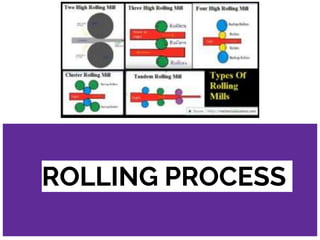
2.3 Types of Rolling:
● Metal Rolling is classified into 5 Types and they are as follows.
● Two High Rolling mill
● Three High Rolling mill
● Four High Rolling mill
● Cluster Rolling mill
● Tandem Rolling mill
1.Two High Rolling mill:
● It consists of two rolling mills which are rotated in opposite directions to each other.
● The material is to be passed in between these two rolling mills such that the
compressive forces can changes its thickness from the original.
2.Three High Rolling mill:
● Three Rolling mills are arranged one on the other in the vertical direction such that two
metal strips can pass in between the rollers at a time and shape change(reduce their
thickness) takes place.
3.Four High Rolling mill:
● Four Rolling mills are arranged one on the other in the vertical
direction such that only one metal strip can pass in between the
rollers and shape change(reduce their thickness) takes place.
● The Upper and lower rollers are just for support(Backup
Rollers) whose diameter is bigger than the other two rollers are
held in Vertical direction, one on the other and the material is
to be passed in between the two small rollers and shape change
takes place.
● This type of rolling is applicable to the high thickness
materials where high compressive forces are needed to reduce
the thickness of the material.
4.Cluster Rolling Mill:
● The material is to be passed through the two small rollers which
are in support by Four backup rollers.
● This type of rolling is applicable to the high thickness materials
where high compressive forces are needed.
5.Tandem Rolling Mill:
● In this type of rolling mill, the material is to be continuously
passed through the pair of rollers so that we can obtain the
desired shape and thickness.
● Applicable to High thickness materials.
Rolling Applications/Products:
● Rolling is used for making rods, hollow seamless tubes, etc.
● By rolling process, Large length cross sections are produced
● Bearings, Rings of turbines and other machines are the
products of rolling
● It is used for mass production of threaded parts like bolts,
screw, etc.
● Steel sheets and plates are made by the rolling process.
● Cement Kilns are produced from the rolling process only.
● It is used in automotive industries for manufacturing various
parts.
For Detailed explanation, you can visit
Rolling Process

Rolling Process-Metal Forming Process-Mechanicalstudents.com

  • 1.
  • 2.
    2.Metal Rolling Principle: ● InRolling operation, the material(metal strip) is compressed in between the two rotating rollers such that the stress responsible for changing of the shapes is only by compressive stress. This process reduces the actual thickness to the desired thickness. ● Presence of friction between rollers and the strip is making it pull the strip into the rollers without applying any pulling and pushing.
  • 3.
    Rolling is classifiedaccording to the temperature of the metal being rolled. If the temperature of the metal is above the recrystallization temperature, then the process is known as hot rolling. If the temperature of the metal is below the recrystallization temperature during rolling, then the process is known as cold rolling.
  • 4.
    2.2 How toavoid bending during rolling? To avoid the bending of the strip during rolling, the surface velocity of both the rollers must be equal. I.e. Vtop roller = Vbottom roller -->(πDN)top roller = (πDN)bottom roller -->(DN)top roller = (DN)bottom roller ● If Dt = Db =>Nt = Nb {Here Dt=Dia of Top Roller & Db = Dia of bottom Roller} ● To ensure that the contact area between the rollers and the strip at both the sides, the dia of both the sides must be same. hence RPM of both the rollers also will become the same.
  • 5.
    2.3 Types ofRolling: ● Metal Rolling is classified into 5 Types and they are as follows. ● Two High Rolling mill ● Three High Rolling mill ● Four High Rolling mill ● Cluster Rolling mill ● Tandem Rolling mill
  • 6.
    1.Two High Rollingmill: ● It consists of two rolling mills which are rotated in opposite directions to each other. ● The material is to be passed in between these two rolling mills such that the compressive forces can changes its thickness from the original. 2.Three High Rolling mill: ● Three Rolling mills are arranged one on the other in the vertical direction such that two metal strips can pass in between the rollers at a time and shape change(reduce their thickness) takes place.
  • 7.
    3.Four High Rollingmill: ● Four Rolling mills are arranged one on the other in the vertical direction such that only one metal strip can pass in between the rollers and shape change(reduce their thickness) takes place. ● The Upper and lower rollers are just for support(Backup Rollers) whose diameter is bigger than the other two rollers are held in Vertical direction, one on the other and the material is to be passed in between the two small rollers and shape change takes place. ● This type of rolling is applicable to the high thickness materials where high compressive forces are needed to reduce the thickness of the material.
  • 8.
    4.Cluster Rolling Mill: ●The material is to be passed through the two small rollers which are in support by Four backup rollers. ● This type of rolling is applicable to the high thickness materials where high compressive forces are needed. 5.Tandem Rolling Mill: ● In this type of rolling mill, the material is to be continuously passed through the pair of rollers so that we can obtain the desired shape and thickness. ● Applicable to High thickness materials.
  • 9.
    Rolling Applications/Products: ● Rollingis used for making rods, hollow seamless tubes, etc. ● By rolling process, Large length cross sections are produced ● Bearings, Rings of turbines and other machines are the products of rolling ● It is used for mass production of threaded parts like bolts, screw, etc. ● Steel sheets and plates are made by the rolling process. ● Cement Kilns are produced from the rolling process only. ● It is used in automotive industries for manufacturing various parts.
  • 10.
    For Detailed explanation,you can visit Rolling Process